 Скачать презентацию The global consequences of our nutritional habits The
4d5e3fb45956c07b3fd75f26523a6a36.ppt
- Количество слайдов: 72



The global consequences of our nutritional habits The consequences of the worldwide production of 65 billion farm animals per year on the environment and climate, global nutrition, animal welfare and human health – and possible alternatives! Global consequences of our nutritional habits & livestock Kurt Schmidinger – www. futurefood. org Geophysicist & Food Scientist
Livestock / Consumption of animal products Global consequences – the major 4: Environment (incl. climate) Human health Animal rights and animal welfare World nutrition / world hunger Global consequences of our nutritional habits & livestock Kurt Schmidinger – www. futurefood. org Geophysicist & Food Scientist
Environment / Climate Film: Mechanisms of the greenhouse effect – described in simple form: http: //www. youtube. com/watch? v=Hxhe. REfg. UGY Film: Veggie-Day as a first political measure: Already existing in Gent (BE), Bremen (DE), Sao Paolo (BR), San Francisco (US), Washington DC (US), Kapstadt (ZA), Zagreb (HR) http: //www. youtube. com/watch? v=xj 80 Lfoh 2_c Global consequences of our nutritional habits & livestock Kurt Schmidinger – www. futurefood. org Geophysicist & Food Scientist
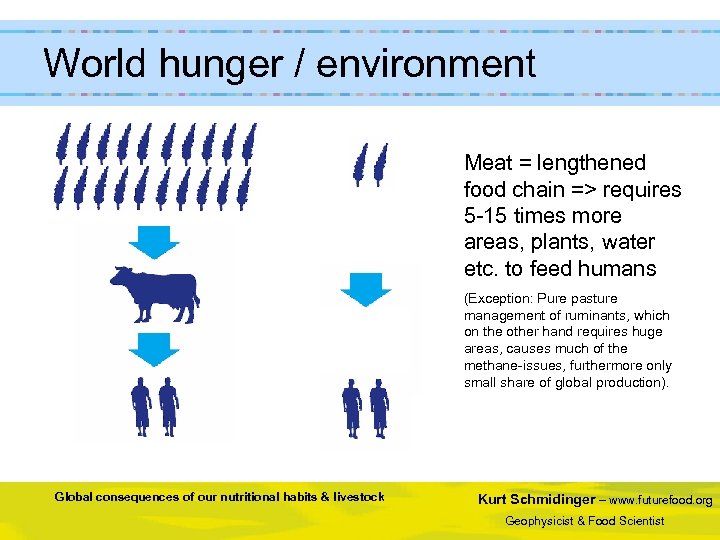
World hunger / environment Meat = lengthened food chain => requires 5 -15 times more areas, plants, water etc. to feed humans (Exception: Pure pasture management of ruminants, which on the other hand requires huge areas, causes much of the methane-issues, furthermore only small share of global production). Global consequences of our nutritional habits & livestock Kurt Schmidinger – www. futurefood. org Geophysicist & Food Scientist
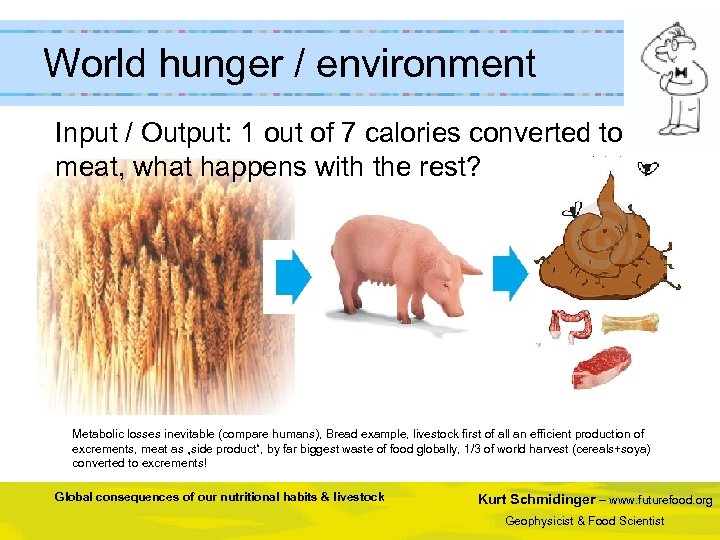
World hunger / environment Input / Output: 1 out of 7 calories converted to meat, what happens with the rest? Metabolic losses inevitable (compare humans), Bread example, livestock first of all an efficient production of excrements, meat as „side product“, by far biggest waste of food globally, 1/3 of world harvest (cereals+soya) converted to excrements! Global consequences of our nutritional habits & livestock Kurt Schmidinger – www. futurefood. org Geophysicist & Food Scientist
Environment: Climate, water, erosion, land consumption, . . . « The livestock sector emerges as one of the top two or three most significant contributors to the most serious environmental problems, at every scale from local to global. The findings of this report suggest that it should be a major policy focus when dealing with problems of land degradation, climate change and air pollution, water shortage and water pollution and loss of biodiversity. Livestock’s contribution to environmental problems is on a massive scale and its potential contribution to their solution is equally large. The impact is so significant that it needs to be addressed with urgency. Major redutions in impact could be achieved at reasonable cost » Livestock’s Long Shadow, FAO 2006 Land consumption, water pollution, rainforest destruction Climate, loss of biodiversity, soil erosion, air pollution Global consequences of our nutritional habits & livestock Kurt Schmidinger – www. futurefood. org Geophysicist & Food Scientist
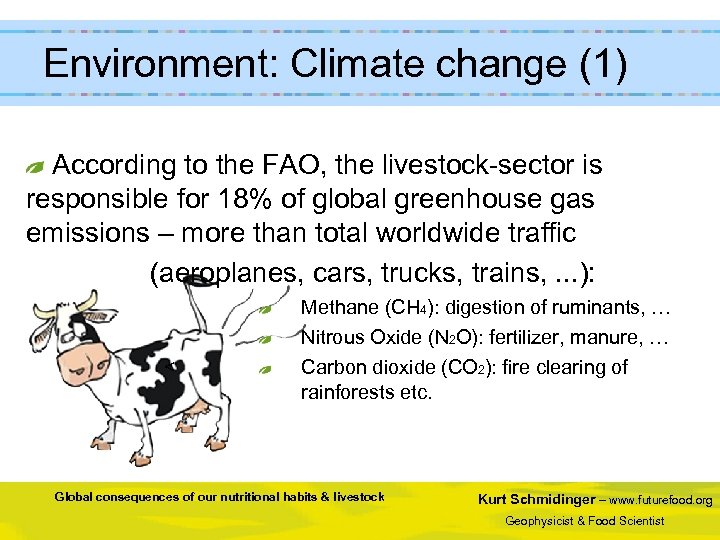
Environment: Climate change (1) According to the FAO, the livestock-sector is responsible for 18% of global greenhouse gas emissions – more than total worldwide traffic (aeroplanes, cars, trucks, trains, . . . ): < Methane (CH 4): digestion of ruminants, … Nitrous Oxide (N 2 O): fertilizer, manure, … Carbon dioxide (CO 2): fire clearing of rainforests etc. Global consequences of our nutritional habits & livestock Kurt Schmidinger – www. futurefood. org Geophysicist & Food Scientist
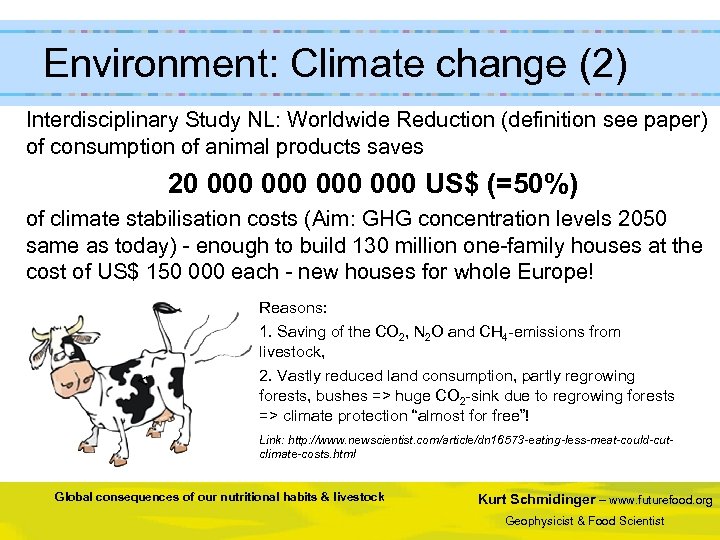
Environment: Climate change (2) Interdisciplinary Study NL: Worldwide Reduction (definition see paper) of consumption of animal products saves 20 000 000 US$ (=50%) of climate stabilisation costs (Aim: GHG concentration levels 2050 same as today) - enough to build 130 million one-family houses at the cost of US$ 150 000 each - new houses for whole Europe! < Reasons: 1. Saving of the CO 2, N 2 O and CH 4 -emissions from livestock, 2. Vastly reduced land consumption, partly regrowing forests, bushes => huge CO 2 -sink due to regrowing forests => climate protection “almost for free”! Link: http: //www. newscientist. com/article/dn 16573 -eating-less-meat-could-cutclimate-costs. html Global consequences of our nutritional habits & livestock Kurt Schmidinger – www. futurefood. org Geophysicist & Food Scientist
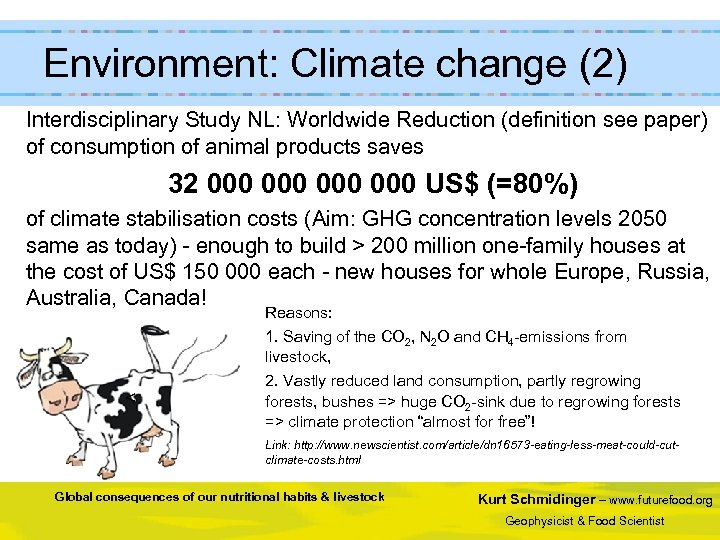
Environment: Climate change (2) Interdisciplinary Study NL: Worldwide Reduction (definition see paper) of consumption of animal products saves 32 000 000 US$ (=80%) of climate stabilisation costs (Aim: GHG concentration levels 2050 same as today) - enough to build > 200 million one-family houses at the cost of US$ 150 000 each - new houses for whole Europe, Russia, Australia, Canada! < Reasons: 1. Saving of the CO 2, N 2 O and CH 4 -emissions from livestock, 2. Vastly reduced land consumption, partly regrowing forests, bushes => huge CO 2 -sink due to regrowing forests => climate protection “almost for free”! Link: http: //www. newscientist. com/article/dn 16573 -eating-less-meat-could-cutclimate-costs. html Global consequences of our nutritional habits & livestock Kurt Schmidinger – www. futurefood. org Geophysicist & Food Scientist
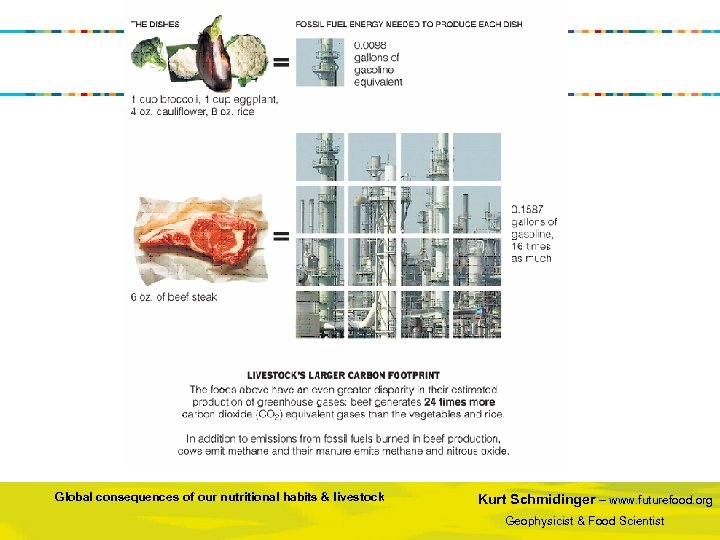
Global consequences of our nutritional habits & livestock Kurt Schmidinger – www. futurefood. org Geophysicist & Food Scientist
Environment: Rainforest destruction Fire clearance of rainforests Pastures for cattle Feed monocultures (85% of global soy harvest as animal feed) CO 2 -emissions due to fire clearances or later: agricultural areas prevent that woods can function as CO 2 -sink (CO 2 -“sponge”) Global consequences of our nutritional habits & livestock Kurt Schmidinger – www. futurefood. org Geophysicist & Food Scientist
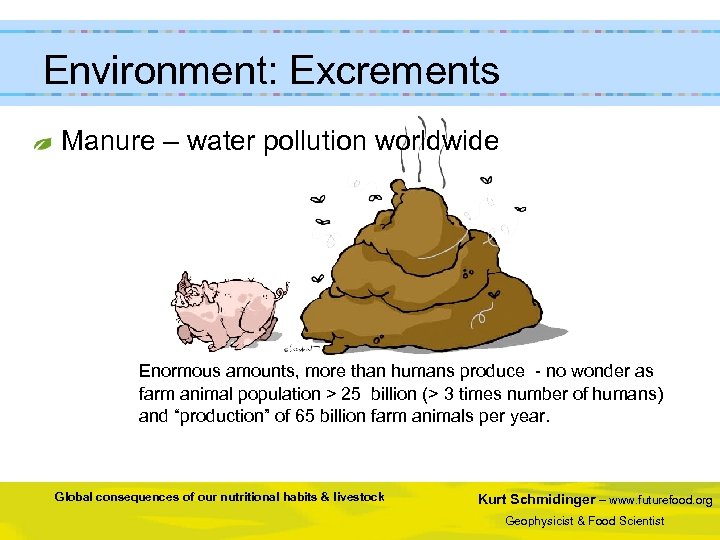
Environment: Excrements Manure – water pollution worldwide Enormous amounts, more than humans produce - no wonder as farm animal population > 25 billion (> 3 times number of humans) and “production” of 65 billion farm animals per year. Global consequences of our nutritional habits & livestock Kurt Schmidinger – www. futurefood. org Geophysicist & Food Scientist
# Tierhaltung: 51%, 18%, <5% - was stimmt ? ? Warum kommen Studien zur Auswirkung von Tierhaltung / Fleischkonsum aufs Weltklima auf so dramatisch unterschiedliche Ergebnisse? Worldwatch 51%, FAO 18%, einige behaupten < 5%, z. B. für die USA die U. S. Environmental Protection Agency (2008) (U. S. EPA. 2008. Inventory of U. S. Greenhouse Gas Emissions and Sinks: 1990 -2006. U. S. EPA, Washington, DC. ) Global consequences of our nutritional habits & livestock Kurt Schmidinger – www. futurefood. org Geophysicist & Food Scientist
# Tierhaltung: 51%, 18%, <5% - was stimmt ? ? 1. Die Methoden (LCA, ökolog. Fußabdruck, . . . ) – LCA “blind” für Flächenverbrauch, misst nur THGEmissionen – Footprint misst alles in Flächen (gha): Flächen die wir direkt brauchen, und auch Flächen (Wald), die nötig wären/sind, um z. B. unsere THG-Emissionen wieder zu binden und aus der Atmosphäre zu bringen. Tierhaltung hier also durch zwei Faktoren: THG-Emissionen und direkte Flächen (Tierhaltung 80% der landwirtsch. Flächen weltweit) – “missed carbon sink” durch Flächenverbrauch im Footprint de facto drinnen, in LCAs (noch? ) gar nicht Global consequences of our nutritional habits & livestock Kurt Schmidinger – www. futurefood. org Geophysicist & Food Scientist
# Tierhaltung: 51%, 18%, <5% - was stimmt ? ? Interdisziplinäre Studie NL: Weltweiter Verzicht auf Tierhaltung spart 32. 000 US$ (=80%) an Klimastabilisierungskosten (Ziel: Treibhausgaskonzentration 2050 in etwa so wie heute). Das entspricht > 200 Millionen Einfamilienhäusern zu je 150. 000 US$!! Neue Häuser für ganz Europa, Russland, Australien, Kanada! < Gründe: 1. Wegfall der CO 2, N 2 O und CH 4 -Emissionen aus Tierhaltung, 2. weitaus geringerer Flächenbedarf, z. T. Wiederbewaldung => riesige CO 2 -Senke durch nachwachsende Wälder => Klimaschutz fast zum Nulltarif! Link: http: //www. newscientist. com/article/dn 16573 -eating-less-meat-could-cutclimate-costs. html Global consequences of our nutritional habits & livestock Kurt Schmidinger – www. futurefood. org Geophysicist & Food Scientist
# Tierhaltung: 51%, 18%, <5% - was stimmt ? ? 2. Überzählige oder fehlende Faktoren in der Bilanz – Z. B. Worldwatch rechnet Atmung der Tiere mit (CO 2 entsteht), aber nicht CO 2 -Aufnahme durch die Futtermittel-Pflanzen: Beides bildet aber einen kurzlebigen Kreislauf, ein Nullsummenspiel, entweder ich zähl beides, oder lass es (als Nullsumme) gleich weg aus der Bilanz. Nur eines in die Bilanz aufzunehmen ist falsch. – Österreichs Landwirtschaft lässt gern die importierten Futtermittel aus der Bilanz raus. Global consequences of our nutritional habits & livestock Kurt Schmidinger – www. futurefood. org Geophysicist & Food Scientist
# Tierhaltung: 51%, 18%, <5% - was stimmt ? ? 3. Landänderungen (v. a. Regenwaldbrandrodung/ -abholzung) – tendenziöse Zuordnung zu Ursachen – Ziel: Fleisch kein Klimakiller: „Ursache Landspekulationen o. ä. , spätere Nutzung für Futtermittel oder Rinderweiden hat mit Emissionen aus Zerstörung nichts mehr zu tun“ – Ziel: Fleisch ist Klimakiller: „Ursache natürlich Futtermittel und Weideland, auch Landspekulation wäre ohne spätere Nutzung für diese Zwecke nicht möglich“. – Spielen kann man auch mit weiteren Schräubchen wie dem Zeitraum, über den man diese Emissionen den Produkten anlastet. Global consequences of our nutritional habits & livestock Kurt Schmidinger – www. futurefood. org Geophysicist & Food Scientist
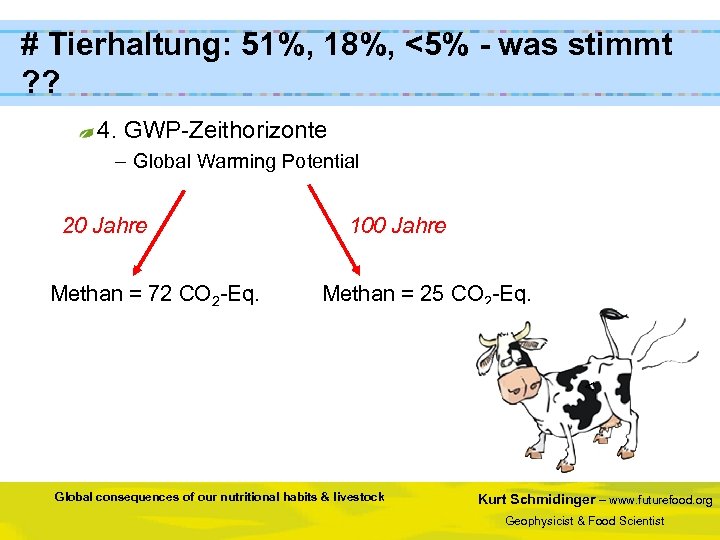
# Tierhaltung: 51%, 18%, <5% - was stimmt ? ? 4. GWP-Zeithorizonte – Global Warming Potential 20 Jahre Methan = 72 CO 2 -Eq. 100 Jahre Methan = 25 CO 2 -Eq. < Global consequences of our nutritional habits & livestock Kurt Schmidinger – www. futurefood. org Geophysicist & Food Scientist
# Tierhaltung: 51%, 18%, <5% - was stimmt ? ? 5. “Tierhaltungssysteme der Zukunft effizienter!“ ? ? – Oft wird argumentiert, je produktiver/hochgezüchteter ein Tier, umso weniger THG-Emissionen pro Kilogramm Fleisch/Milch/Eier. – Achtung, viele andere Faktoren: Welternährung („effiziente Nutztiere“ sind Nahrungskonkurrenten, keine Weidetiere), Verknappung der Ackerflächen, Biodiversität, Bodenerosion, Wasserverschmutzung, Tierschutz. . . kein gangbarer Weg Global consequences of our nutritional habits & livestock Kurt Schmidinger – www. futurefood. org Geophysicist & Food Scientist
# Tierhaltung: 51%, 18%, <5% - was stimmt ? ? Hauptschraube (deckt 1. -5. ab): Politische Absicht! Wie groß ist der Klimaeffekt der Tierhaltung weltweit wirklich? – Diskussion anhand der FAO- und Worldwatch-Zahlen und der 5 Punkte und grobe Einschätzung. – 1. FAO lässt methodisch „missed carbon sink“ aus: sehr relevant. – 2. Bilanzfaktoren bei FAO weitgehend korrekt, Worldwatch-Fehler – 3. Zuordnung Landänderung: FAO bemüht um Objektivität – 4. Evtl. GWP 50 Jahre, FAO dann moderat zu niedrig (Methan) – 5. Theoret. FAO zu hoch, aber industrielle Tierhaltung Sackgasse Global consequences of our nutritional habits & livestock Kurt Schmidinger – www. futurefood. org Geophysicist & Food Scientist
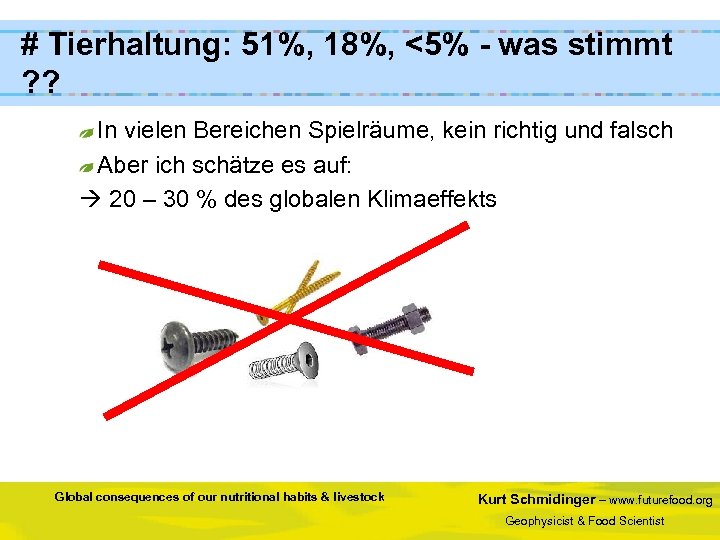
# Tierhaltung: 51%, 18%, <5% - was stimmt ? ? In vielen Bereichen Spielräume, kein richtig und falsch Aber ich schätze es auf: 20 – 30 % des globalen Klimaeffekts Global consequences of our nutritional habits & livestock Kurt Schmidinger – www. futurefood. org Geophysicist & Food Scientist
Planet Earth 2013 Global consequences of our nutritional habits & livestock Kurt Schmidinger – www. futurefood. org Geophysicist & Food Scientist
World hunger Of 7 billion humans 800 000 suffer from hunger, among these are 200 000 children. 25 000 people die from malnutrition each day. FAO-Report “Crop Prospects and Food Situation” 2008: 754 million tons of cereals are fed to farm animals each year (with a yield of 1: 7 for calorie-conversion this is a loss of calculated 650 million tons of cereals for human nutrition) – soy, etc. not yet included Compare: Due to biofuel production (2 nd biggest problem for loss of calories at croplands) we lose “only” 100 million tons of cereals for human nutrition Global consequences of our nutritional habits & livestock Kurt Schmidinger – www. futurefood. org Geophysicist & Food Scientist
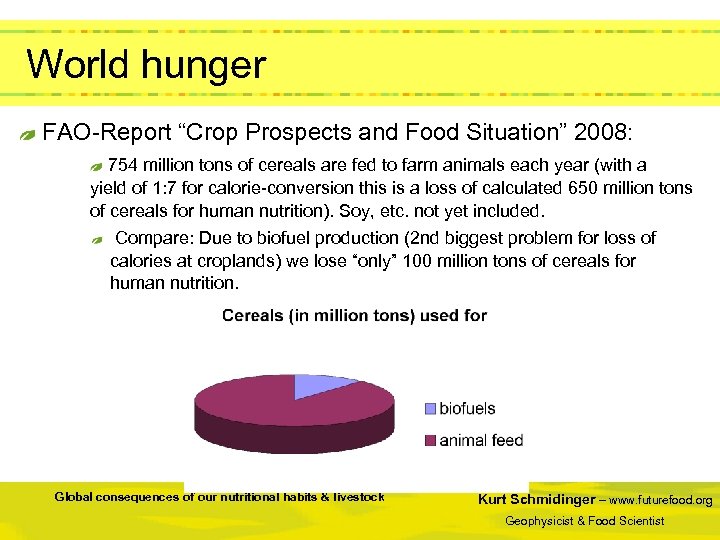
World hunger FAO-Report “Crop Prospects and Food Situation” 2008: 754 million tons of cereals are fed to farm animals each year (with a yield of 1: 7 for calorie-conversion this is a loss of calculated 650 million tons of cereals for human nutrition). Soy, etc. not yet included. Compare: Due to biofuel production (2 nd biggest problem for loss of calories at croplands) we lose “only” 100 million tons of cereals for human nutrition. Global consequences of our nutritional habits & livestock Kurt Schmidinger – www. futurefood. org Geophysicist & Food Scientist
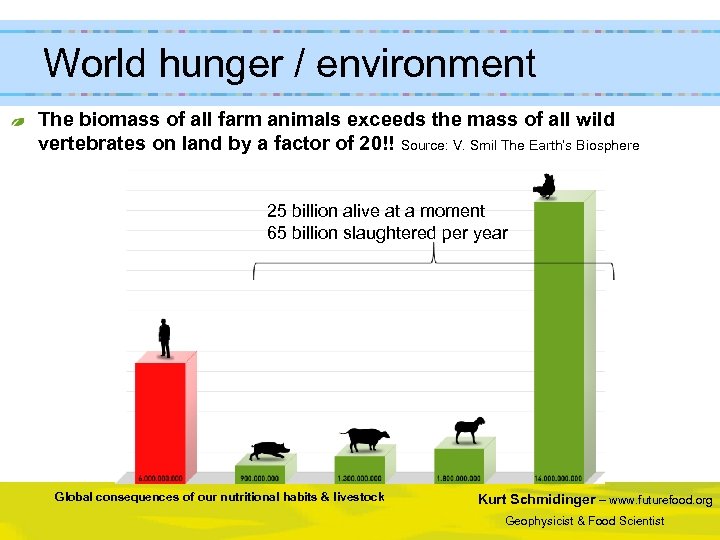
World hunger / environment The biomass of all farm animals exceeds the mass of all wild vertebrates on land by a factor of 20!! Source: V. Smil The Earth‘s Biosphere 25 billion alive at a moment 65 billion slaughtered per year Global consequences of our nutritional habits & livestock Kurt Schmidinger – www. futurefood. org Geophysicist & Food Scientist
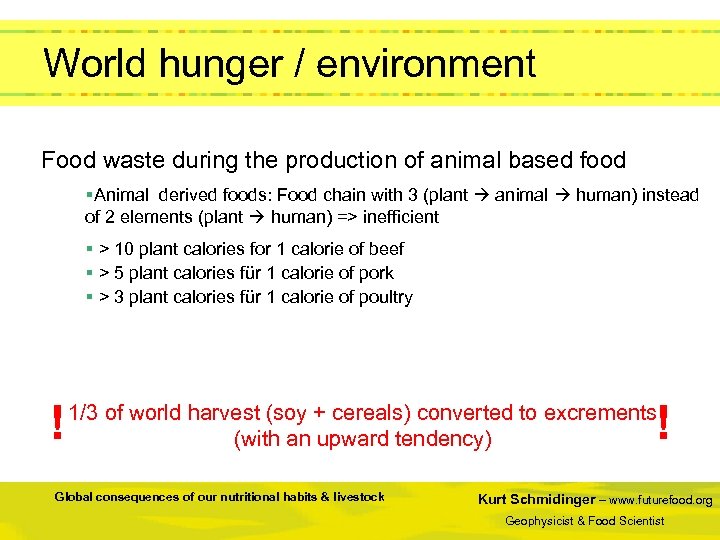
World hunger / environment Food waste during the production of animal based food §Animal derived foods: Food chain with 3 (plant animal human) instead of 2 elements (plant human) => inefficient § > 10 plant calories for 1 calorie of beef § > 5 plant calories für 1 calorie of pork § > 3 plant calories für 1 calorie of poultry ! ! 1/3 of world harvest (soy + cereals) converted to excrements (with an upward tendency) Global consequences of our nutritional habits & livestock Kurt Schmidinger – www. futurefood. org Geophysicist & Food Scientist
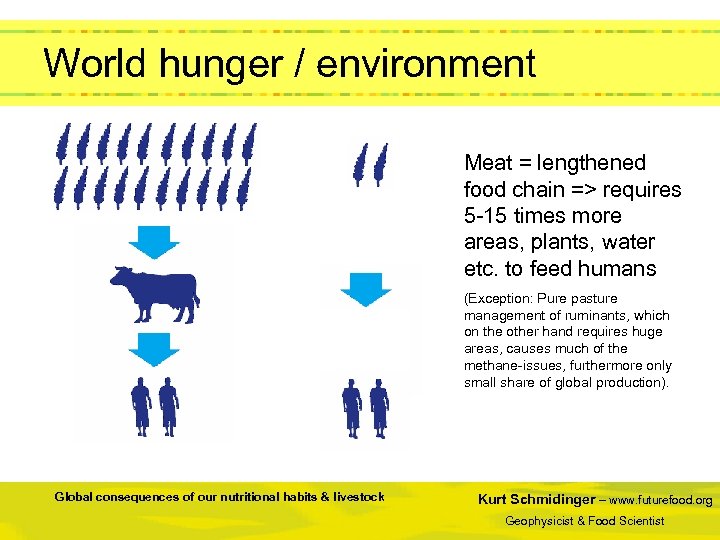
World hunger / environment Meat = lengthened food chain => requires 5 -15 times more areas, plants, water etc. to feed humans (Exception: Pure pasture management of ruminants, which on the other hand requires huge areas, causes much of the methane-issues, furthermore only small share of global production). Global consequences of our nutritional habits & livestock Kurt Schmidinger – www. futurefood. org Geophysicist & Food Scientist
World hunger / environment Short food chain plant human could release enormous areas globally: Possibilities to use these: §Regrowing vegetation could absorb huge amounts of CO 2 from the atmosphere (see slides earlier, interdisciplinary study NL): Massive contribution to climate stabilisation §Growing of maize for renewable plastic alternatives without causing a global food crisis §Photovoltaics for energy production, maybe even biofuels would make sense again §. . . Global consequences of our nutritional habits & livestock Kurt Schmidinger – www. futurefood. org Geophysicist & Food Scientist
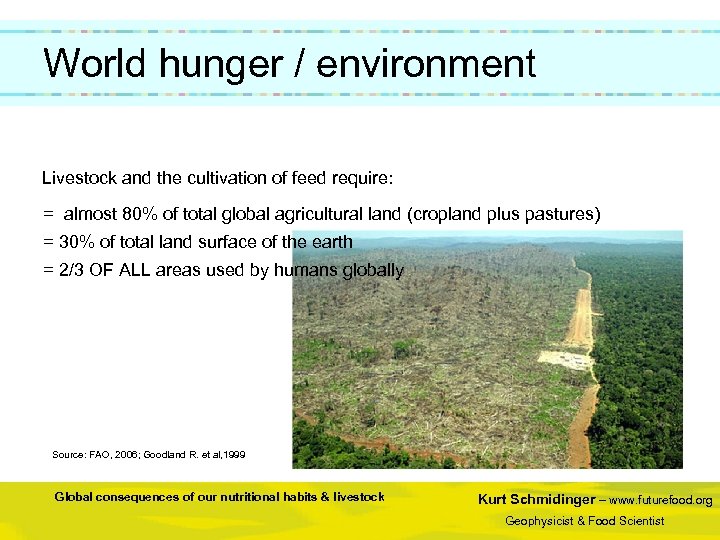
World hunger / environment Livestock and the cultivation of feed require: = almost 80% of total global agricultural land (cropland plus pastures) = 30% of total land surface of the earth = 2/3 OF ALL areas used by humans globally Source: FAO, 2006; Goodland R. et al, 1999 Global consequences of our nutritional habits & livestock Kurt Schmidinger – www. futurefood. org Geophysicist & Food Scientist
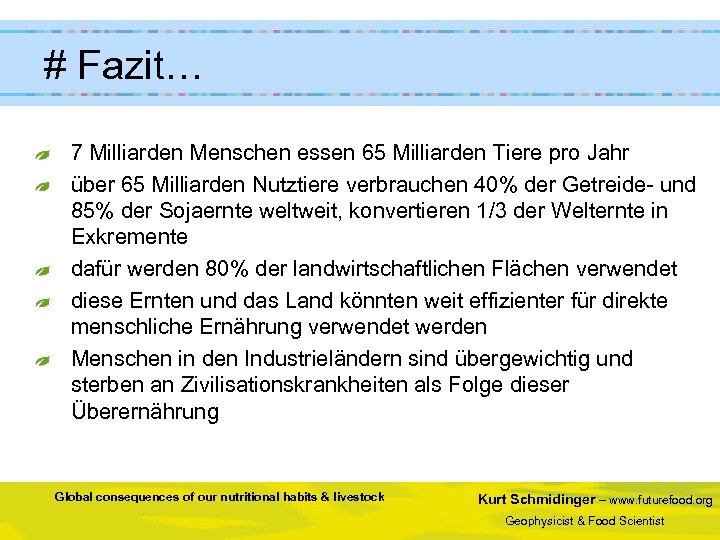
# Fazit… 7 Milliarden Menschen essen 65 Milliarden Tiere pro Jahr über 65 Milliarden Nutztiere verbrauchen 40% der Getreide- und 85% der Sojaernte weltweit, konvertieren 1/3 der Welternte in Exkremente dafür werden 80% der landwirtschaftlichen Flächen verwendet diese Ernten und das Land könnten weit effizienter für direkte menschliche Ernährung verwendet werden Menschen in den Industrieländern sind übergewichtig und sterben an Zivilisationskrankheiten als Folge dieser Überernährung Global consequences of our nutritional habits & livestock Kurt Schmidinger – www. futurefood. org Geophysicist & Food Scientist
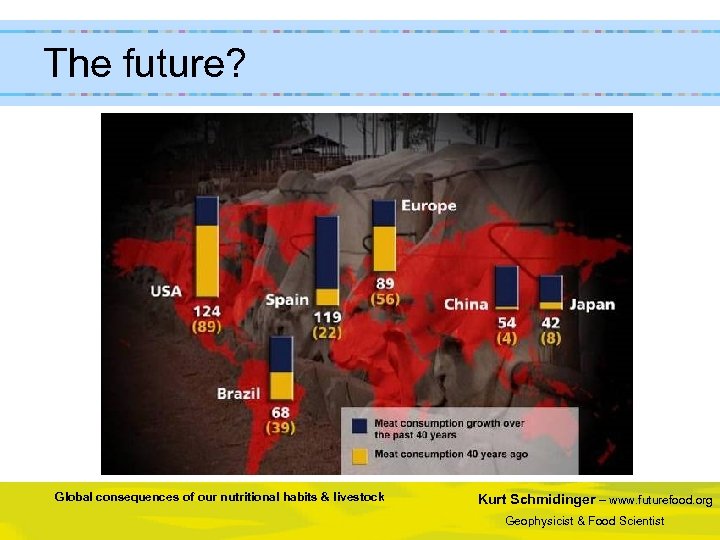
The future? Global consequences of our nutritional habits & livestock Kurt Schmidinger – www. futurefood. org Geophysicist & Food Scientist
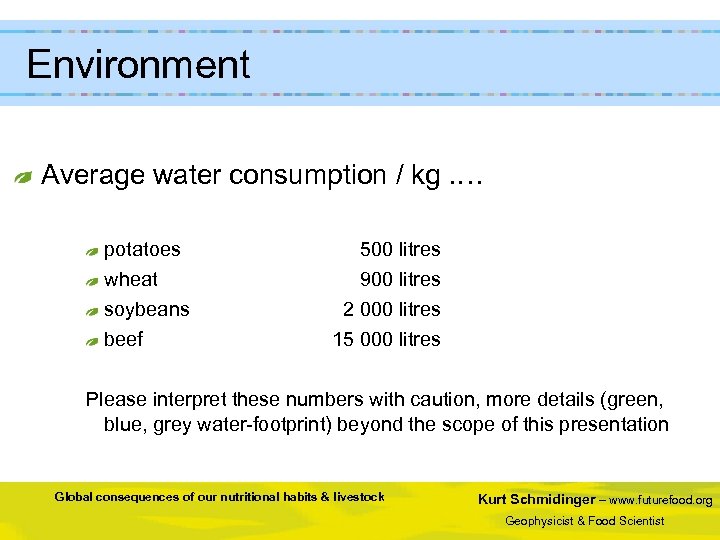
Environment Average water consumption / kg. … potatoes wheat soybeans beef 500 litres 900 litres 2 000 litres 15 000 litres Please interpret these numbers with caution, more details (green, blue, grey water-footprint) beyond the scope of this presentation Global consequences of our nutritional habits & livestock Kurt Schmidinger – www. futurefood. org Geophysicist & Food Scientist
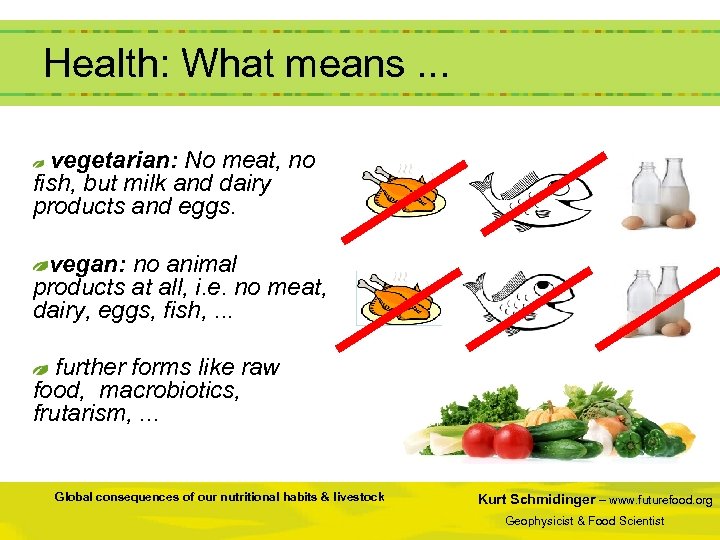
Health: What means. . . vegetarian: No meat, no fish, but milk and dairy products and eggs. vegan: no animal products at all, i. e. no meat, dairy, eggs, fish, . . . further forms like raw food, macrobiotics, frutarism, . . . Global consequences of our nutritional habits & livestock Kurt Schmidinger – www. futurefood. org Geophysicist & Food Scientist
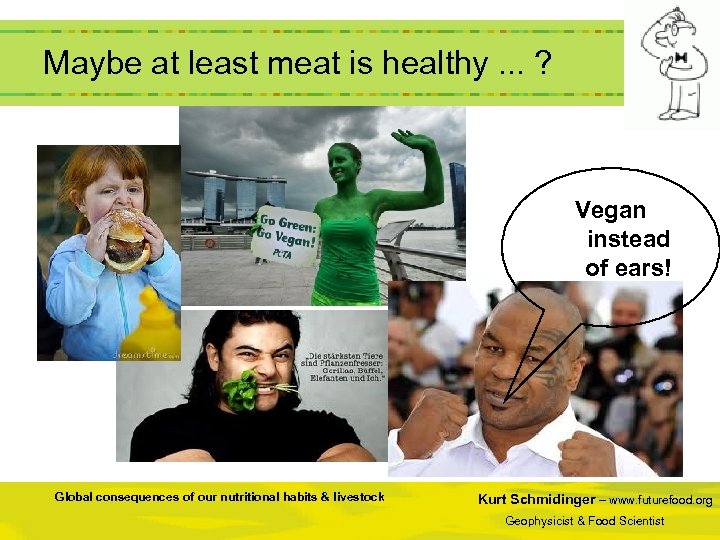
Maybe at least meat is healthy. . . ? Vegan instead of ears! Global consequences of our nutritional habits & livestock Kurt Schmidinger – www. futurefood. org Geophysicist & Food Scientist
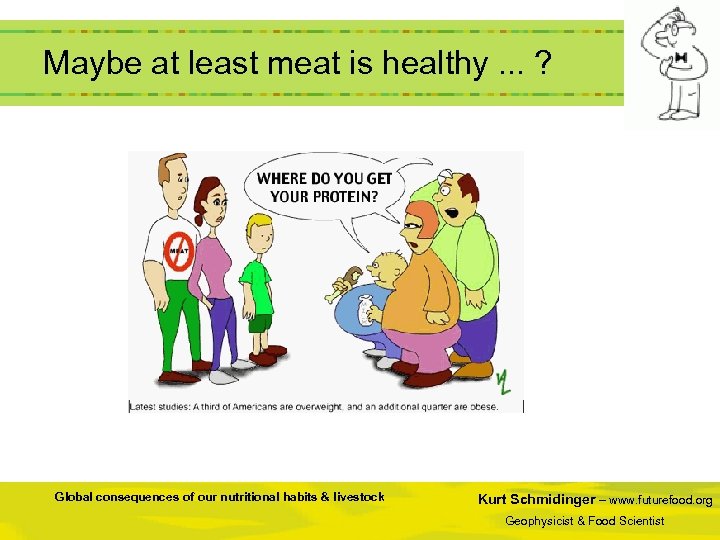
Maybe at least meat is healthy. . . ? Global consequences of our nutritional habits & livestock Kurt Schmidinger – www. futurefood. org Geophysicist & Food Scientist
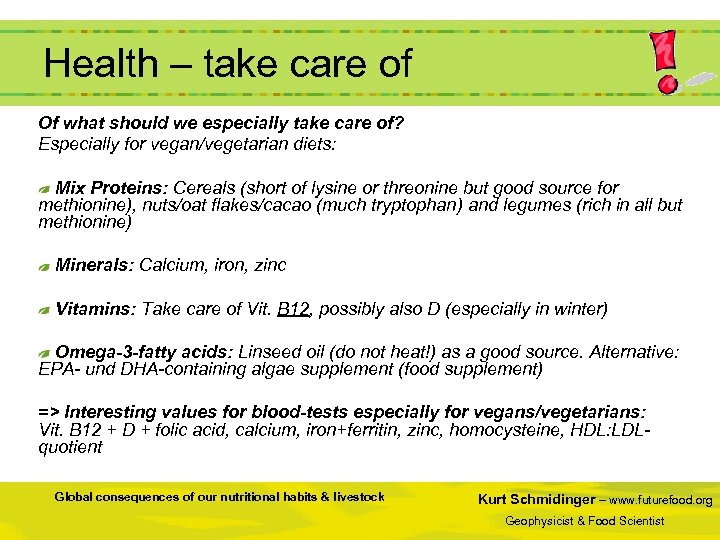
Health – take care of Of what should we especially take care of? Especially for vegan/vegetarian diets: Mix Proteins: Cereals (short of lysine or threonine but good source for methionine), nuts/oat flakes/cacao (much tryptophan) and legumes (rich in all but methionine) Minerals: Calcium, iron, zinc Vitamins: Take care of Vit. B 12, possibly also D (especially in winter) Omega-3 -fatty acids: Linseed oil (do not heat!) as a good source. Alternative: EPA- und DHA-containing algae supplement (food supplement) => Interesting values for blood-tests especially for vegans/vegetarians: Vit. B 12 + D + folic acid, calcium, iron+ferritin, zinc, homocysteine, HDL: LDLquotient Global consequences of our nutritional habits & livestock Kurt Schmidinger – www. futurefood. org Geophysicist & Food Scientist
Health – veggies celebrate! And these are especially important advantages again especially for vegan diets: De facto all worldwide pandemics of the last decades (bird flu, swine flu, EHEC, BSE, . . . ) and of the future (. . . , . . . ) from intensive livestock farms: Billions of animals packed together, bad housing, bad immune system, . . . => without livestock avoidable! Antibiotic resistance from intensive livestock farms (“factory farming”) would be avoidable Bacterial food poisoning (salmonellosis, E Coli, etc. ) mostly a problem with animal products => avoidable You get far less of these “evils”: Cholesterol, arachidonic acid, purines, saturated fatty acids, also free radicals/ox. stress, . . . You get more of these “good things”: Vitamin C+E, fibres (whole meal) and phytochemiclas (fruits!, vegetables!, antioxidative effects etc. ) Global consequences of our nutritional habits & livestock Kurt Schmidinger – www. futurefood. org Geophysicist & Food Scientist
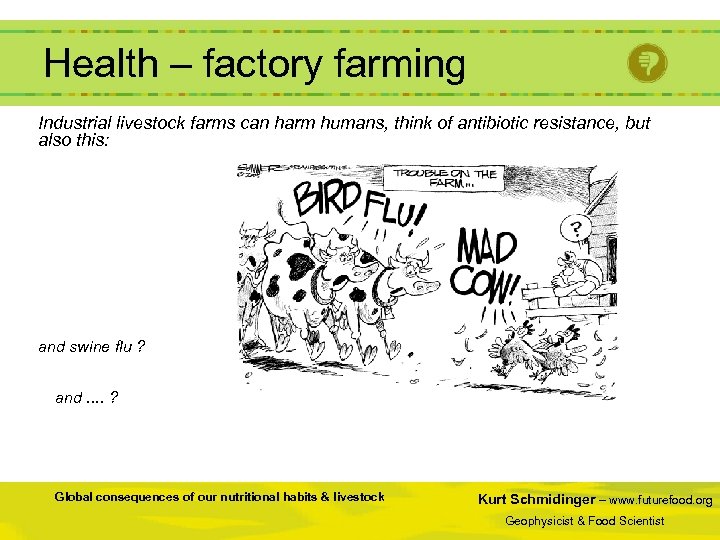
Health – factory farming Industrial livestock farms can harm humans, think of antibiotic resistance, but also this: and swine flu ? and. . ? Global consequences of our nutritional habits & livestock Kurt Schmidinger – www. futurefood. org Geophysicist & Food Scientist
Health – “meat sicknesses” (1) The (high) consumption of animal products is linked to the following sicknesses: Cardiovascular diseases (Oxford Studies, 7 th Day Adventists study, studies of the ADA, Uni Gießen, Bundesgesundheitsamt Berlin, u. v. m. ) Colon Cancer (American Cancer Society, Univ. Oxford, Univ. San Diego, Krebsforschungszentrum Heidelberg), breast cancer (Harvard Medical School), prostate cancer (PCRM, Washington DC), gastric cancers (EPIC) Global consequences of our nutritional habits & livestock Kurt Schmidinger – www. futurefood. org Geophysicist & Food Scientist
Health – “meat sicknesses” (2) Osteoporosis (!) (UC San Francisco, USDA-ARS) Multiple sclerosis (CHRU Grenoble) Gallstones Type 2 diabetes Obesity Allergies Rheumatoid Arthritis (UUH Oslo) Links to the papers www. futurefood. org For the world Health Global consequences of our nutritional habits & livestock Kurt Schmidinger – www. futurefood. org Geophysicist & Food Scientist

# Gesundheit: in Belgien Ergebnisse der Nationalen Ernährungsumfrage: Zu wenig Gemüse Zu wenig Obst Zu wenig Ballaststoffe Zu wenig Flüssigkeit Zu viel Süßes / Alkohol Zu viel Fleisch Global consequences of our nutritional habits & livestock Aktueller Entwurf Gesundheitsvorsorge. Plan Mehr Gemüse! Mehr Obst! Mehr Ballaststoffe! Mehr trinken! Weniger Süßes / Alkohol ? ? Kurt Schmidinger – www. futurefood. org Geophysicist & Food Scientist
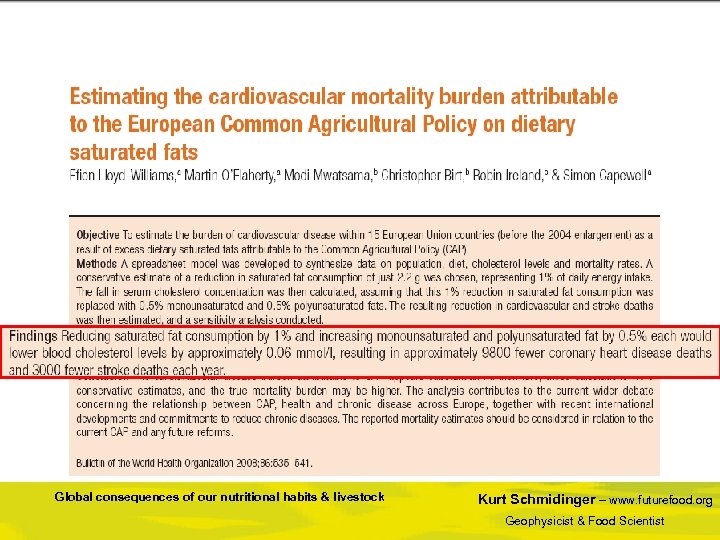
Global consequences of our nutritional habits & livestock Kurt Schmidinger – www. futurefood. org Geophysicist & Food Scientist
Health – Veggie also Kids, . . ? ! for Vegetarian diets with milk (and eggs) are widely accepted: They reduce many – but do not avoid all – problems caused by animal products. A deliberate vegan diet avoids all disadvantages of animal products and avoids the disadvantages of a non-deliberate vegan diet optimum For infants: ADA (the world biggest dietetic association) and others recommend a vegan diet for all stages of the life cycle, others are more sceptical. Vegan mothers have to be well nourished and should breast feed the child For small and big children: Pay attention to slide => Health – take care of !. . . and then make use of the benefits! Global consequences of our nutritional habits & livestock Kurt Schmidinger – www. futurefood. org Geophysicist & Food Scientist
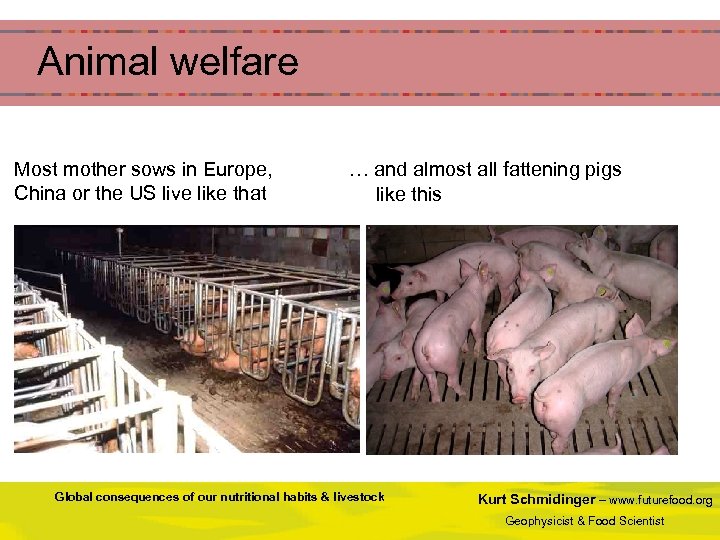
Animal welfare Most mother sows in Europe, China or the US live like that … and almost all fattening pigs like this Global consequences of our nutritional habits & livestock Kurt Schmidinger – www. futurefood. org Geophysicist & Food Scientist
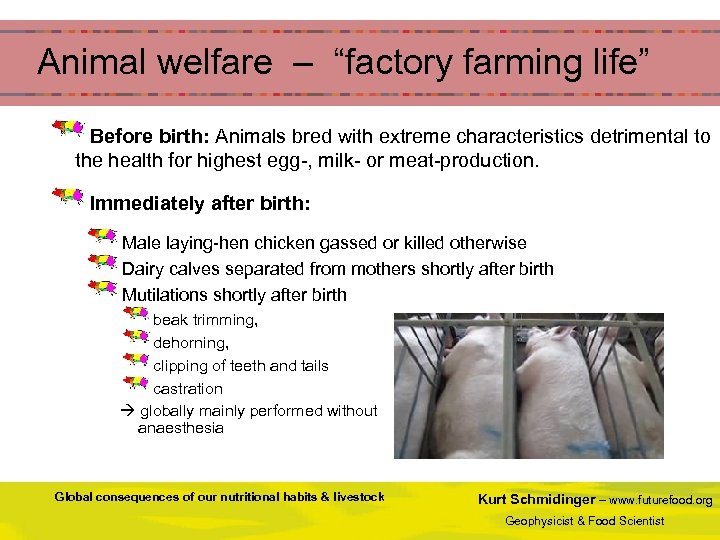
Animal welfare – “factory farming life” Before birth: Animals bred with extreme characteristics detrimental to the health for highest egg-, milk- or meat-production. Immediately after birth: Male laying-hen chicken gassed or killed otherwise Dairy calves separated from mothers shortly after birth Mutilations shortly after birth beak trimming, dehorning, clipping of teeth and tails castration globally mainly performed without anaesthesia Global consequences of our nutritional habits & livestock Kurt Schmidinger – www. futurefood. org Geophysicist & Food Scientist
Animal welfare – “factory farming life” Life Tiny cages (laying hens, rabbits, quails, mother sows, …) Tethered: Many dairy cows Kept densely packed: Fattening pigs, broiler chickens, turkeys, rabbits, ducks, … Often strong stench (smell) Individual : Force feeding (e. g. goose- or duck fatty liver) with 1/5 of the live weight of th ducks and geese per day. Injured animals left to die from injuries or thirst in cages or outside boxes … Broiler chicken “runts” die of thirst Technical failures / fire lead to mass deaths, usually no evacuation possible Global consequences of our nutritional habits & livestock Kurt Schmidinger – www. futurefood. org Geophysicist & Food Scientist
Animal welfare – “factory farming life” And the end? Transport to slaughterhouses, sometimes half way around the world, (e. g. sheep or cattle from Australia to Egypt) Slaughterhouse: Often stunning does not work, and billions are also butchered kosher/halal withou intended stunning Individuals (pigs, poultry) live until they reach the tanks where they are scalded Some species are boiled alive (such as lobsters) Undercover investigations also show abuse and sadism carried out on animals Compare with golden rule of ethics: „One should not treat others in ways that one would not like to be treated“. Global consequences of our nutritional habits & livestock Kurt Schmidinger – www. futurefood. org Geophysicist & Food Scientist
Animal welfare – “factory farming life” Films / Documentaries 10 -25 minutes: Meet your Meat (USA, but in many aspects similar conditions in Europe, too): http: //www. meat. org/ Intensive pig farming, focus on Austria (German): http: //www. tierrechtsfilme. at/langfilme/schweinehaltung_lucie/luci e. htm Force feeding of ducks and geese (forbidden in many countries, but imported almost everywhere): http: //www. vierpfoten. org/website/output. php? id=1177&idcontent= 1909&language=2 Global consequences of our nutritional habits & livestock Kurt Schmidinger – www. futurefood. org Geophysicist & Food Scientist
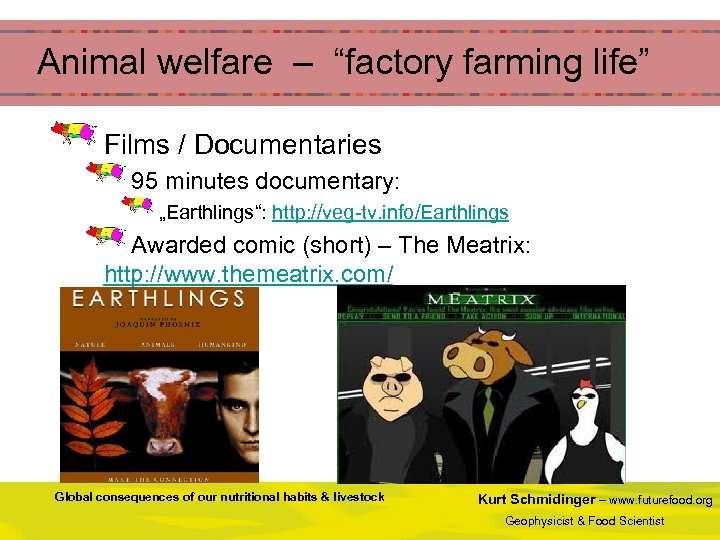
Animal welfare – “factory farming life” Films / Documentaries 95 minutes documentary: „Earthlings“: http: //veg-tv. info/Earthlings Awarded comic (short) – The Meatrix: http: //www. themeatrix. com/ Global consequences of our nutritional habits & livestock Kurt Schmidinger – www. futurefood. org Geophysicist & Food Scientist
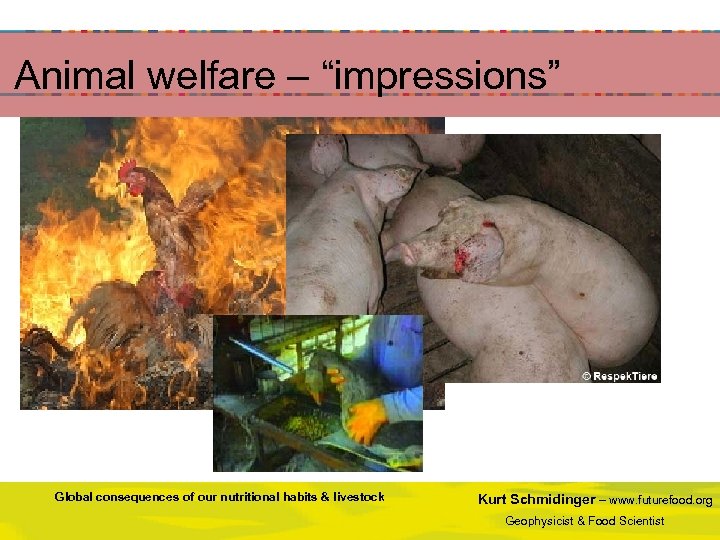
Animal welfare – “impressions” Global consequences of our nutritional habits & livestock Kurt Schmidinger – www. futurefood. org Geophysicist & Food Scientist
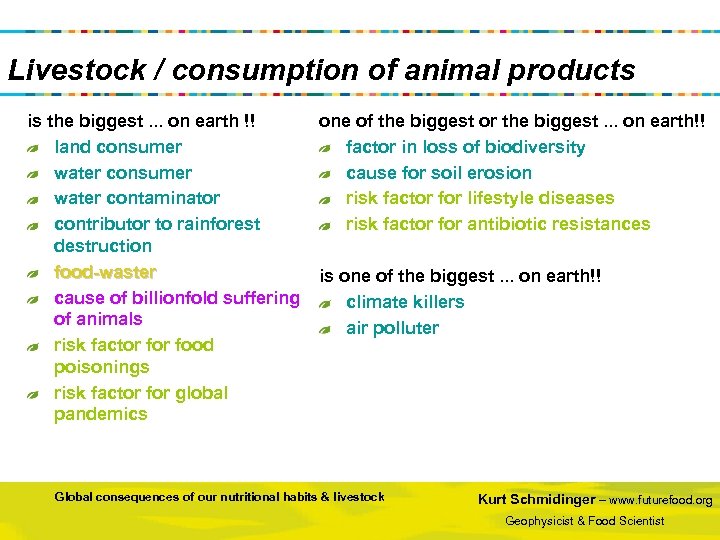
Livestock / consumption of animal products is the biggest. . . on earth !! land consumer water contaminator contributor to rainforest destruction food-waster cause of billionfold suffering of animals risk factor food poisonings risk factor for global pandemics one of the biggest or the biggest. . . on earth!! factor in loss of biodiversity cause for soil erosion risk factor for lifestyle diseases risk factor for antibiotic resistances is one of the biggest. . . on earth!! climate killers air polluter Global consequences of our nutritional habits & livestock Kurt Schmidinger – www. futurefood. org Geophysicist & Food Scientist
„With each meal the earth is at stake“ If too much meat is a big part of the problems, we should modernise our nutrition as part of the solutions Global consequences of our nutritional habits & livestock Kurt Schmidinger – www. futurefood. org Geophysicist & Food Scientist
Global consequences of our nutritional habits & livestock Kurt Schmidinger – www. futurefood. org Geophysicist & Food Scientist
www. futurefood. org - alternatives to animals products The reasons Environment (climate) Health Animal welfare World nutrition / hunger Global consequences of our nutritional habits & livestock Kurt Schmidinger – www. futurefood. org Geophysicist & Food Scientist
What could lead to a collapse of the „factory farming“ practices? Human reason / ethics ? ? Top-products as alternatives to animal products ? ? Food shortages (climate? ) / concurrency of non-food croplands (plastic alternatives made of maize, biofuels) ? ? Antibiotic-resistances from intensive livestock facilities ? ? ? Serious new pandemics from intensive livestock facilities ? Global consequences of our nutritional habits & livestock Kurt Schmidinger – www. futurefood. org Geophysicist & Food Scientist
Success criteria? Flavour: Taste, aroma, smell, texture, satiety feeling, . . . Price Marketing, target groups, advertising Health Shelf life / hygiene / logistic advantages Global consequences of our nutritional habits & livestock Kurt Schmidinger – www. futurefood. org Geophysicist & Food Scientist
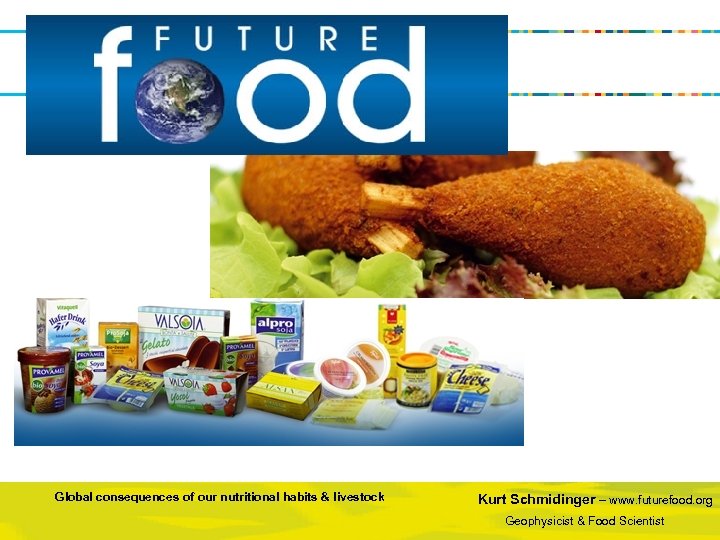
www. futurefood. org Alternatives to animal products “Vegetarian meat”: All raw materials to replace meat “Non dairy milk products”: All raw materials to replace dairy milk, cheese, joghurt etc. “Replace egg products”: All raw materials to replace egg products Global consequences of our nutritional habits & livestock Kurt Schmidinger – www. futurefood. org Geophysicist & Food Scientist
Global consequences of our nutritional habits & livestock Kurt Schmidinger – www. futurefood. org Geophysicist & Food Scientist
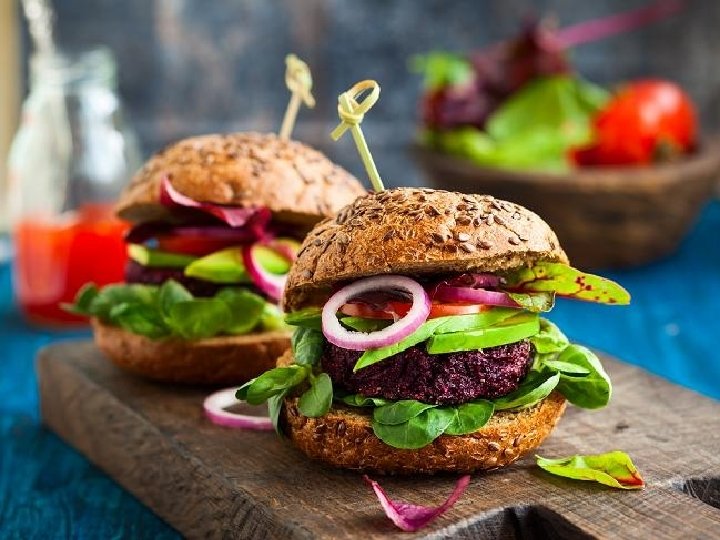
Vegetarian meat Wheat: Wheat gluten (seitan) Soy: Soya meat (TVP), tofu, tempeh, sprouted soybeans Sweet lupines Fresh mushrooms Fermented fungi, e. g. Quorn Algae Rice, peas Global consequences of our nutritional habits & livestock Kurt Schmidinger – www. futurefood. org Geophysicist & Food Scientist
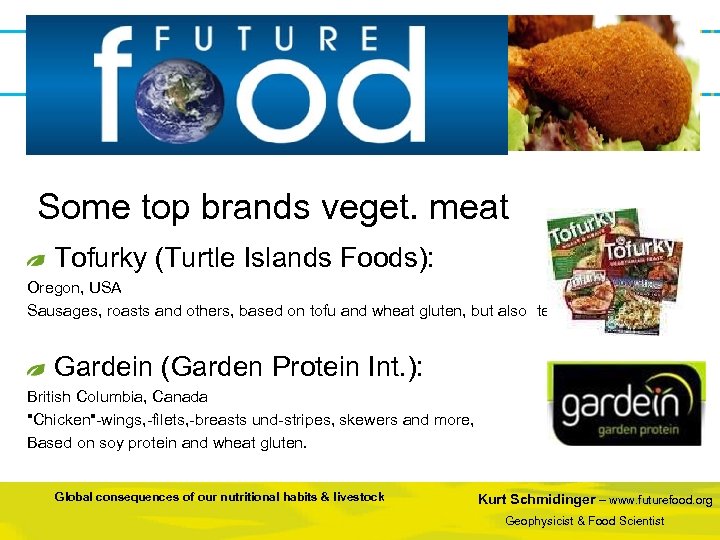
Some top brands veget. meat Tofurky (Turtle Islands Foods): Oregon, USA Sausages, roasts and others, based on tofu and wheat gluten, but also tempeh. Gardein (Garden Protein Int. ): British Columbia, Canada "Chicken"-wings, -filets, -breasts und-stripes, skewers and more, Based on soy protein and wheat gluten. Global consequences of our nutritional habits & livestock Kurt Schmidinger – www. futurefood. org Geophysicist & Food Scientist
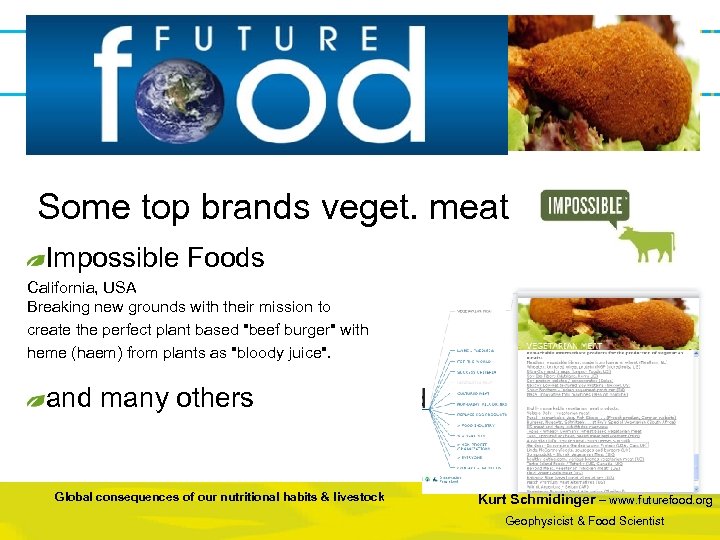
Some top brands veget. meat Impossible Foods California, USA Breaking new grounds with their mission to create the perfect plant based "beef burger" with heme (haem) from plants as "bloody juice". and many others Global consequences of our nutritional habits & livestock Kurt Schmidinger – www. futurefood. org Geophysicist & Food Scientist
Plant based alternatives to dairy products Drinks (“milk”), yoghurts, cream, sour cream made from soy, oat, almond, rice, coco, quinoa, millet, spelt, barley, kamut. Often fortified with B 2, B 12, D 2, calcium, A, B 6, folic acid, E Ice cream from soy, rice, etc. “Cheese” from soy protein, pea protein, tofu, potato starch, rice starch, soy oil, other plant based fats and oils, nut butter, thickening agents, yeast, but also: tapioca- u. arrowroot flour, rapeseed oil, safflower oil, coconut oil, etc. Desserts, confectionaries, margarine. . . Global consequences of our nutritional habits & livestock Kurt Schmidinger – www. futurefood. org Geophysicist & Food Scientist
Some top brands for dairy alternatives Alpro / Provamel Belgium, but also Germany, UK European market leader, huge variety, mostly based on soy, to a lesser extent on rice, almond or oat, Provamel is the brand for the organic product range Turtle Mountain Oregon, USA „So Delicious” and “Purely Decadent”, ice cream, frozen desserts, based on soy Global consequences of our nutritional habits & livestock Kurt Schmidinger – www. futurefood. org Geophysicist & Food Scientist
Some top brands for dairy alternatives Valsoia Italiy Drinks, Desserts, ice cream, confectionary based on soy, partly also rice, also vegetarian meat products (burgers, sausages cutlets, …) Daiya Canada Cheese alternatives, also cooperation with other veggie-foodproducers (e. g. as pizza cheese), unique composition: tapioca- and arrowroot flour, rapeseed oil, safflower oil, coconut oil, pea protein Global consequences of our nutritional habits & livestock Kurt Schmidinger – www. futurefood. org Geophysicist & Food Scientist
Plant based alternatives to egg products Alternatives to egg products for the industry: About 10 companies in the US, NL, UK and others. Made of gelling and thickening agents (alginate, carrageen, guar flour, locust bean gum, xanthan gum), soy lecithin, potato protein, potato starch, full soy beans, wheat gluten, corn syrup, sometimes also dairy(!) or egg(!!) ingredients see http: //www. futurefood. org/eggproducts/index_en. php Interesting startups like “Beyond Eggs – Hampton Creek” – supported by Bill Gates, “mayo wars” with Unilever, brought huge popularity Global consequences of our nutritional habits & livestock Kurt Schmidinger – www. futurefood. org Geophysicist & Food Scientist
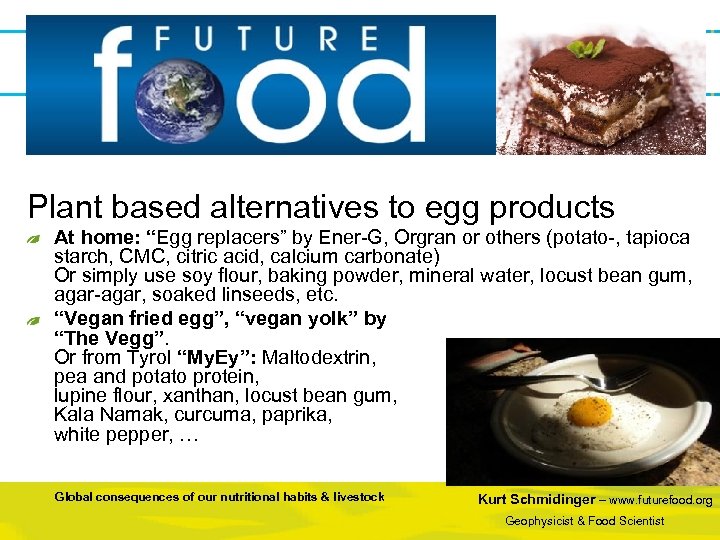
Plant based alternatives to egg products At home: “Egg replacers” by Ener-G, Orgran or others (potato-, tapioca starch, CMC, citric acid, calcium carbonate) Or simply use soy flour, baking powder, mineral water, locust bean gum, agar-agar, soaked linseeds, etc. “Vegan fried egg”, “vegan yolk” by “The Vegg”. Or from Tyrol “My. Ey”: Maltodextrin, pea and potato protein, lupine flour, xanthan, locust bean gum, Kala Namak, curcuma, paprika, white pepper, … Global consequences of our nutritional habits & livestock Kurt Schmidinger – www. futurefood. org Geophysicist & Food Scientist
Other options to optimize a possible vegan future nutrition Breeding enhancements for crops Fertilization of crops well-directed fortification of foods Special fermentation processes Global consequences of our nutritional habits & livestock Kurt Schmidinger – www. futurefood. org Geophysicist & Food Scientist
Futuristic approaches Biofermenter: Peter Arras / AKT, Germany, take ruminants as model/guide food out of straw, harvest waste, etc. (all this would suddenly also be basis for human nutrition) In Vitro Meat: ”Real” meat without animals, produced out of cells in labs. Technological basic facts: Initial cells, culture medium incl. growth factors, bioreactors, etc. see http: //www. futurefood. org/Dissertation. Schmidinger. pdf, chapt. 12 Global consequences of our nutritional habits & livestock Kurt Schmidinger – www. futurefood. org Geophysicist & Food Scientist
Futuristic approaches – in vitro meat Some protagonists: Henk Haagsman and Bernard Roelen (NL): Worked on basic understanding Mark Post (NL): Supported by Sergey Brin, presented the first in-vitro-meat burger of the world for 250. 000 € in August 2013. NGOs new-harvest. org or thegoodfoodinstitute. org and (in earlier times more active) Stig Omholt (Norway, with 1. in-vitro-meat symposium): Networking Gabor a. Andras Forgacs (USA): “Modern Meadow”, 3 D-printer, Thiel-Foundation Vladimir Mironov and Nick Genovese (USA): Pe. TA, 3 -D-printer, networking, mastermind Oron Catts & Ionat Zurr (AUS): Artists from Australia Willem van Eelen (NL): Pioneer, cultured meat patent Memphis Meats, first in-vitro-meatball in 2016 Global consequences of our nutritional habits & livestock Kurt Schmidinger – www. futurefood. org Geophysicist & Food Scientist
Tips: Handouts: e. g. Tofushopping, Link auf die Präsentation, ## This Präsentation: http: //www. futurefood. org/basic_english. ppt Tips for canteen kitchens: Canteen kitchen project: www. gv-nachhaltig. de/ Regional veggie-gastronomy: ## z. b. Graz Ginko, Mangolds, Rest. Arche ## Global consequences of our nutritional habits & livestock Kurt Schmidinger – www. futurefood. org Geophysicist & Food Scientist
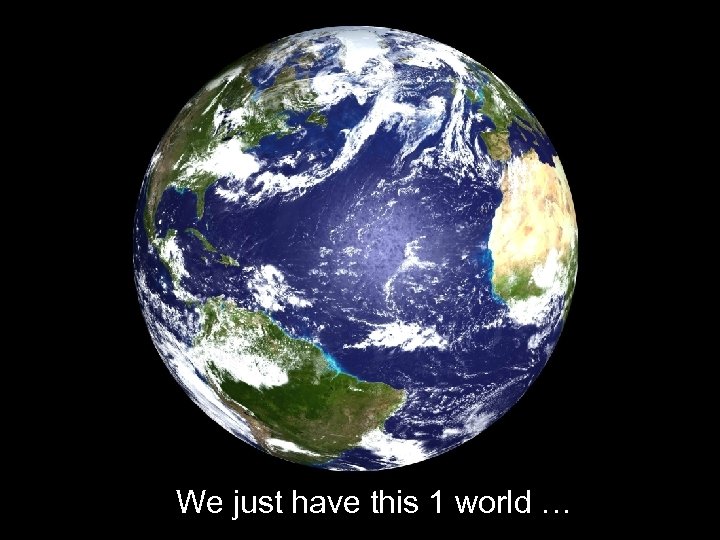
Kurt Schmidinger We just have this 1 world … Global consequences of our nutritional habits & livestock – www. futurefood. org Geophysicist & Food Scientist
Dr. Kurt Schmidinger Graduate in Geophysics & Doctor in Food Science Project Leader www. futurefood. org Tel. +43 / 676 / 33 22 107 Kurt. schmidinger@futurefood. org Global consequences of our nutritional habits & livestock Kurt Schmidinger – www. futurefood. org Geophysicist & Food Scientist
Скачать презентацию The global consequences of our nutritional habits The
4d5e3fb45956c07b3fd75f26523a6a36.ppt