


 Скачать презентацию The GLAST Large Area Telescope Design construction test
7ca4256c2d7c456561d0a19adb3bd657.ppt
- Количество слайдов: 1
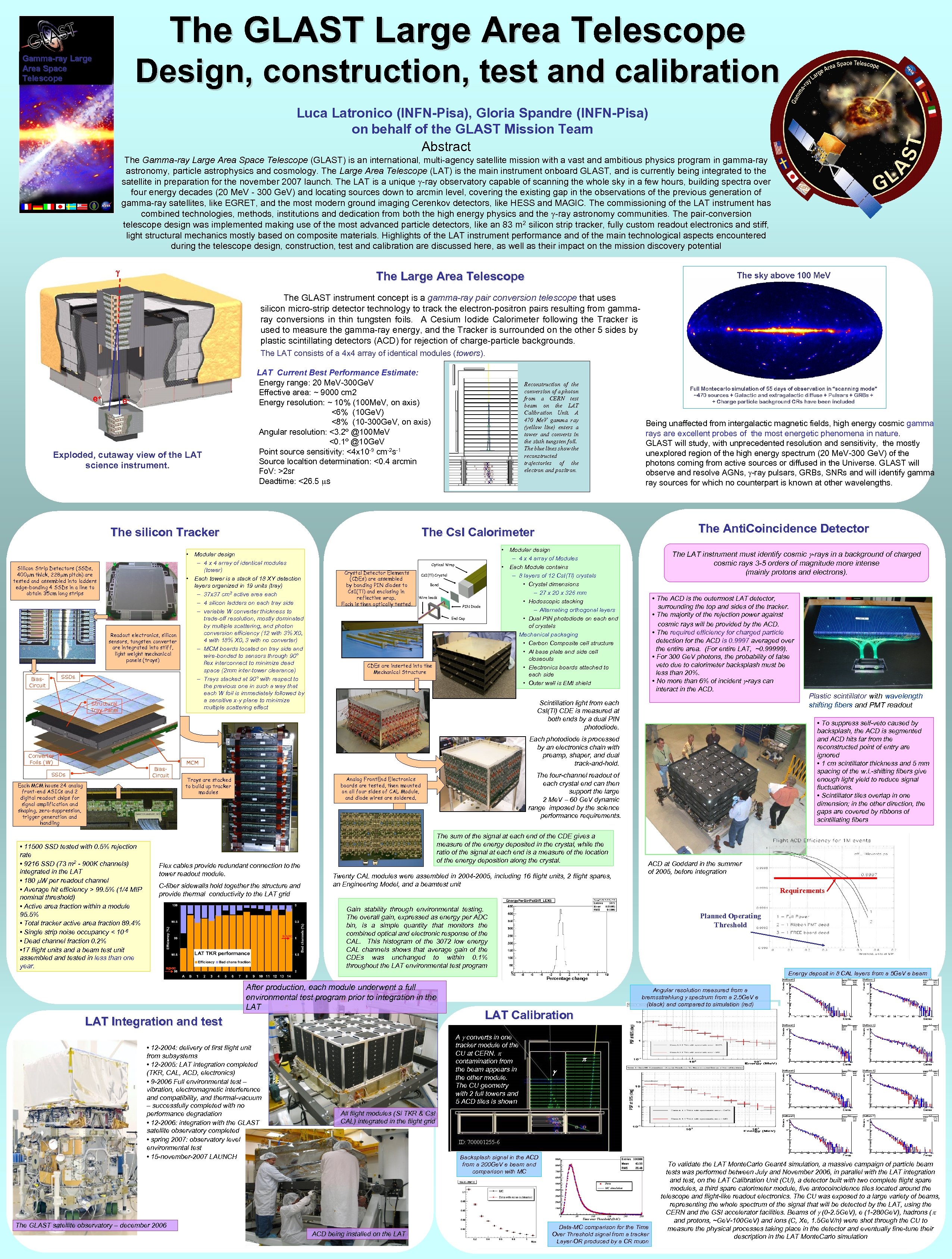 The GLAST Large Area Telescope Design, construction, test and calibration Gamma-ray Large Area Space Telescope Luca Latronico (INFN-Pisa), Gloria Spandre (INFN-Pisa) on behalf of the GLAST Mission Team Abstract The Gamma-ray Large Area Space Telescope (GLAST) is an international, multi-agency satellite mission with a vast and ambitious physics program in gamma-ray astronomy, particle astrophysics and cosmology. The Large Area Telescope (LAT) is the main instrument onboard GLAST, and is currently being integrated to the satellite in preparation for the november 2007 launch. The LAT is a unique g-ray observatory capable of scanning the whole sky in a few hours, building spectra over four energy decades (20 Me. V - 300 Ge. V) and locating sources down to arcmin level, covering the existing gap in the observations of the previous generation of gamma-ray satellites, like EGRET, and the most modern ground imaging Cerenkov detectors, like HESS and MAGIC. The commissioning of the LAT instrument has combined technologies, methods, institutions and dedication from both the high energy physics and the g-ray astronomy communities. The pair-conversion telescope design was implemented making use of the most advanced particle detectors, like an 83 m 2 silicon strip tracker, fully custom readout electronics and stiff, light structural mechanics mostly based on composite materials. Highlights of the LAT instrument performance and of the main technological aspects encountered during the telescope design, construction, test and calibration are discussed here, as well as their impact on the mission discovery potential g The Large Area Telescope The GLAST instrument concept is a gamma-ray pair conversion telescope that uses silicon micro-strip detector technology to track the electron-positron pairs resulting from gammaray conversions in thin tungsten foils. A Cesium Iodide Calorimeter following the Tracker is used to measure the gamma-ray energy, and the Tracker is surrounded on the other 5 sides by plastic scintillating detectors (ACD) for rejection of charge-particle backgrounds. The LAT consists of a 4 x 4 array of identical modules (towers). e+ e- Exploded, cutaway view of the LAT science instrument. LAT Current Best Performance Estimate: Energy range: 20 Me. V-300 Ge. V Effective area: ~ 9000 cm 2 Energy resolution: ~ 10% (100 Me. V, on axis) <6% (10 Ge. V) <8% (10 -300 Ge. V, on axis) Angular resolution: <3. 2º @100 Me. V <0. 1º @10 Ge. V Point source sensitivity: <4 x 10 -9 cm-2 s-1 Source localtion determination: <0. 4 arcmin Fo. V: >2 sr Deadtime: <26. 5 ms Readout electronics, silicon sensors, tungsten converter are integrated into stiff, light weight mechanical panels (trays) SSDs Bias. Circuit Structural Tray Panel Converter Foils (W) • Modular design – 4 x 4 array of identical modules (tower) • Each tower is a stack of 18 XY detection layers organized in 19 units (tray) – 37 x 37 cm 2 active area each – 4 silicon ladders on each tray side – variable W converter thickness to trade-off resolution, mostly dominated by multiple scattering, and photon conversion efficiency (12 with 3% X 0, 4 with 18% X 0, 3 with no converter) – MCM boards located on tray side and wire-bonded to sensors through 90° flex interconnect to minimize dead space (2 mm inter-tower clearance) – Trays stacked at 90° with respect to the previous one in such a way that each W foil is immediately followed by a sensitive x-y plane to minimize multiple scattering effect SSDs Each MCM house 24 analog front-end ASICs and 2 digital readout chips for signal amplification and shaping. zero-suppression, trigger generation and handling • 11500 SSD tested with 0. 5% rejection rate • 9216 SSD (73 m 2 - 900 K channels) integrated in the LAT • 180 m. W per readout channel • Average hit efficiency > 99. 5% (1/4 MIP nominal threshold) • Active area fraction within a module 95. 5% • Total tracker active area fraction 89. 4% • Single strip noise occupancy < 10 -6 • Dead channel fraction 0. 2% • 17 flight units and a beam test unit assembled and tested in less than one year. The Anti. Coincidence Detector • Modular design – 4 x 4 array of Modules • Each Module contains – 8 layers of 12 Cs. I(Tl) crystals • Crystal dimensions – 27 x 20 x 326 mm • Hodoscopic stacking – Alternating orthogonal layers • Dual PIN photodiode on each end of crystals – Mechanical packaging • Carbon Composite cell structure • Al base plate and side cell closeouts • Electronics boards attached to each side • Outer wall is EMI shield Optical Wrap Crystal Detector Elements (CDEs) are assembled by bonding PIN diodes to Cs. I(Tl) and enclosing in reflective wrap. Each is then optically tested. Cs. I(Tl) Crystal Bond Wire leads PIN Diode End Cap CDEs are inserted into the Mechanical Structure The LAT instrument must identify cosmic -rays in a background of charged cosmic rays 3 -5 orders of magnitude more intense (mainly protons and electrons). • The ACD is the outermost LAT detector, surrounding the top and sides of the tracker. • The majority of the rejection power against cosmic rays will be provided by the ACD. • The required efficiency for charged particle detection for the ACD is 0. 9997 averaged over the entire area. (For entire LAT, ~0. 99999). • For 300 Ge. V photons, the probability of false veto due to calorimeter backsplash must be less than 20%. • No more than 6% of incident -rays can interact in the ACD. Scintillation light from each Cs. I(Tl) CDE is measured at both ends by a dual PIN photodiode. The four-channel readout of each crystal end can then support the large 2 Me. V 60 Ge. V dynamic range imposed by the science performance requirements. Analog Front. End Electronics boards are tested, then mounted on all four sides of CAL Module, and diode wires are soldered. Trays are stacked to build up tracker modules Flex cables provide redundant connection to the tower readout module. C-fiber sidewalls hold together the structure and provide thermal conductivity to the LAT grid spec The sum of the signal at each end of the CDE gives a measure of the energy deposited in the crystal, while the ratio of the signal at each end is a measure of the location of the energy deposition along the crystal. Twenty CAL modules were assembled in 2004 -2005, including 16 flight units, 2 flight spares, an Engineering Model, and a beamtest unit ACD at Goddard in the summer of 2005, before integration Requirements Gain stability through environmental testing. The overall gain, expressed as energy per ADC bin, is a simple quantity that monitors the combined optical and electronic response of the CAL. This histogram of the 3072 low energy CAL channels shows that average gain of the CDEs was unchanged to within 0. 1% throughout the LAT environmental test program Planned Operating Threshold Energy deposit in 8 CAL layers from a 5 Ge. V e beam Percentage change After production, each module underwent a full environmental test program prior to integration in the LAT Integration and test • 12 -2004: delivery of first flight unit from subsystems • 12 -2005: LAT integration completed (TKR, CAL, ACD, electronics) • 9 -2006 Full environmental test – vibration, electromagnetic interference and compatibility, and thermal-vacuum – successfully completed with no performance degradation • 12 -2006: integration with the GLAST satellite observatory completed • spring 2007: observatory level environmental test • 15 -november-2007 LAUNCH Plastic scintillator with wavelength shifting fibers and PMT readout • To suppress self-veto caused by backsplash, the ACD is segmented and ACD hits far from the reconstructed point of entry are ignored • 1 cm scintillator thickness and 5 mm spacing of the w. l. -shifting fibers give enough light yield to reduce signal fluctuations. • Scintillator tiles overlap in one dimension; in the other direction, the gaps are covered by ribbons of scintillating fibers Each photodiode is processed by an electronics chain with preamp, shaper, and dual track-and-hold. MCM Bias. Circuit Being unaffected from intergalactic magnetic fields, high energy cosmic gamma rays are excellent probes of the most energetic phenomena in nature. GLAST will study, with unprecedented resolution and sensitivity, the mostly unexplored region of the high energy spectrum (20 Me. V-300 Ge. V) of the photons coming from active sources or diffused in the Universe. GLAST will observe and resolve AGNs, g-ray pulsars, GRBs, SNRs and will identify gamma ray sources for which no counterpart is known at other wavelengths. The Cs. I Calorimeter The silicon Tracker Silicon Strip Detectors (SSDs. 400 mm thick, 228 mm pitch) are tested and assembled into ladders edge-bonding 4 SSDs in a line to obtain 35 cm long strips Reconstruction of the conversion of a photon from a CERN test beam on the LAT Calibration Unit. A 470 Me. V gamma ray (yellow line) enters a tower and converts in the sixth tungsten foil. The blue lines show the reconstructed trajectories of the electron and positron. Angular resolution measured from a bremsstrahlung spectrum from a 2. 5 Ge. V e (black) and compared to simulation (red) LAT Calibration A converts in one tracker module of the CU at CERN. p contamination from the beam appears in the other module. The CU geometry with 2 full towers and 5 ACD tiles is shown p g All flight modules (Si TKR & Cs. I CAL) integrated in the flight grid Backsplash signal in the ACD from a 200 Ge. V e beam and comparison with MC The GLAST satellite observatory – december 2006 ACD being installed on the LAT Data-MC comparison for the Time Over Threshold signal from a tracker Layer-OR produced by a CR muon To validate the LAT Monte. Carlo Geant 4 simulation, a massive campaign of particle beam tests was performed between July and November 2006, in parallel with the LAT integration and test, on the LAT Calibration Unit (CU), a detector built with two complete flight spare modules, a third spare calorimeter module, five antocoincidence tiles located around the telescope and flight-like readout electronics. The CU was exposed to a large variety of beams, representing the whole spectrum of the signal that will be detected by the LAT, using the CERN and the GSI accelerator facilities. Beams of (0 -2. 5 Ge. V), e (1 -280 Ge. V), hadrons (p and protons, ~Ge. V-100 Ge. V) and ions (C, Xe, 1. 5 Ge. V/n) were shot through the CU to measure the physical processes taking place in the detector and eventually fine-tune their description in the LAT Monte. Carlo simulation