 Скачать презентацию THE GHANA STUDY RURAL ELECTRIFICATION BY GRID EXTENSION
b63cfb3ed3d2d6711fc6f4b8853d00ad.ppt
- Количество слайдов: 20



THE GHANA STUDY: RURAL ELECTRIFICATION BY GRID EXTENSION Solomon Kodjo Quansah
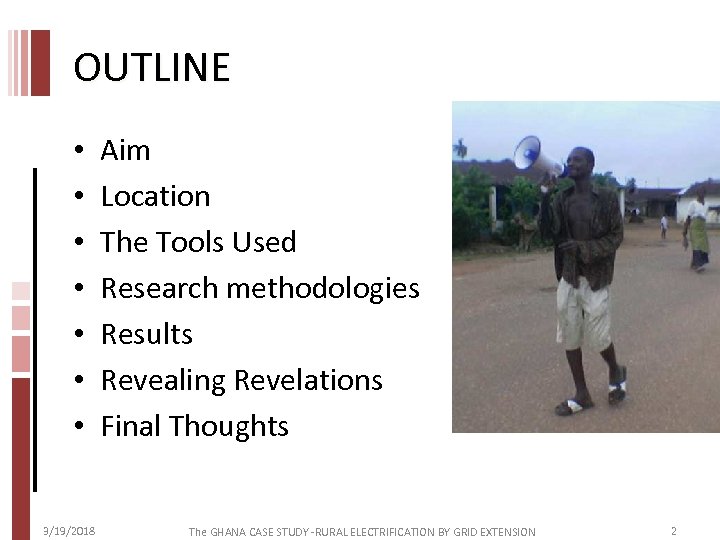
OUTLINE • • 3/19/2018 Aim Location The Tools Used Research methodologies Results Revealing Revelations Final Thoughts The GHANA CASE STUDY -RURAL ELECTRIFICATION BY GRID EXTENSION 2
AIM 1. The aim of the study was to investigate the impacts of rural electrification by grid extension on the social, economic and other aspects of the lives of the people. 2. To assess the adequacy of the Assessment Framework. 3/19/2018 The GHANA CASE STUDY -RURAL ELECTRIFICATION BY GRID EXTENSION 3
Location: 3 Comm. in C. Region 1. EKUMFI–OTABANADZE, – Pop. is abt 1000, 1 Kdg, 1 Primary, 1 JSS – drinks borehole water, no bank, no post office. – Real access in the community is about 75%. 2. EKUMFI–EKRAWFO – Pop. -1000, 1 Kdg, 1 Primary, 1 JSS – drinks borehole water, no bank, no post office. – Real access in this community is about 40%. 3. EKUMFI–ATAKWA – Pop. -1700, 1 Kdg, 1 Primary, 1 JSS – borehole water, no bank, has a post office, private clinic which is about 100 meters away from the community. – Real access in this community is about 75%. 3/19/2018 The GHANA CASE STUDY -RURAL ELECTRIFICATION BY GRID EXTENSION 4
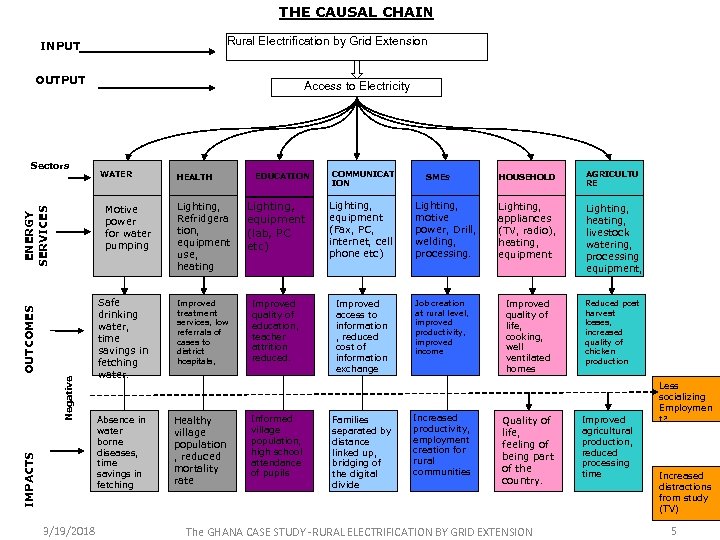
THE CAUSAL CHAIN Rural Electrification by Grid Extension INPUT OUTPUT Sectors Access to Electricity WATER IMPACTS Negative OUTCOMES ENERGY SERVICES Motive power for water pumping 3/19/2018 Safe drinking water, time savings in fetching water. Absence in water borne diseases, time savings in fetching HEALTH EDUCATION COMMUNICAT ION Lighting, Refridgera tion, equipment use, heating Lighting, equipment (lab, PC etc) Lighting, equipment (Fax, PC, internet, cell phone etc) Improved treatment services, low referrals of cases to district hospitals, Improved quality of education, teacher attrition reduced. Improved access to information , reduced cost of information exchange Healthy village population , reduced mortality rate Informed village population, high school attendance of pupils Families separated by distance linked up, bridging of the digital divide SMEs Lighting, motive power, Drill, welding, processing. Job creation at rural level, improved productivity, improved income Increased productivity, employment creation for rural communities HOUSEHOLD AGRICULTU RE Lighting, appliances (TV, radio), heating, equipment Lighting, heating, livestock watering, processing equipment, Improved quality of life, cooking, well ventilated homes Reduced post harvest losses, increased quality of chicken production Quality of life, feeling of being part of the country. The GHANA CASE STUDY -RURAL ELECTRIFICATION BY GRID EXTENSION Improved agricultural production, reduced processing time Less socializing Employmen t? Increased distractions from study (TV) 5
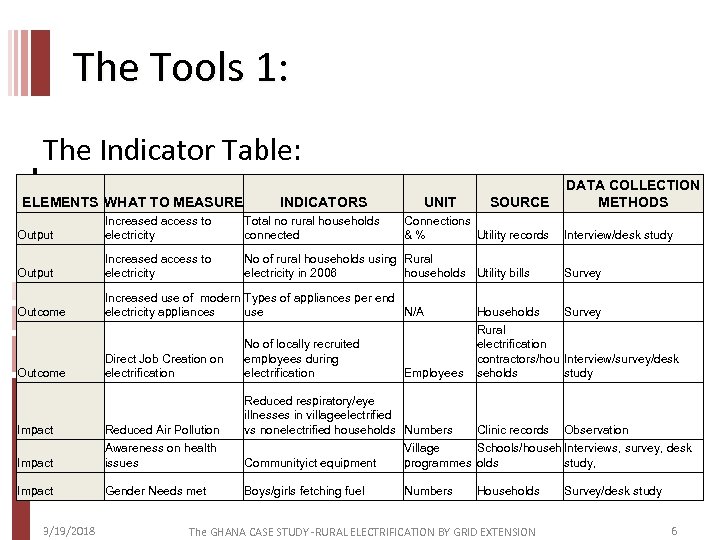
The Tools 1: The Indicator Table: ELEMENTS WHAT TO MEASURE INDICATORS UNIT SOURCE Output Increased access to electricity Total no rural households connected Output Increased access to electricity No of rural households using Rural electricity in 2006 households Utility bills Outcome Increased use of modern Types of appliances per end electricity appliances use N/A Outcome Direct Job Creation on electrification No of locally recruited employees during electrification Impact Reduced Air Pollution Reduced respiratory/eye illnesses in villageelectrified vs nonelectrified households Numbers Impact Awareness on health issues Communityict equipment Village Schools/househ Interviews, survey, desk programmes olds study, Impact Gender Needs met Boys/girls fetching fuel Numbers 3/19/2018 Connections & % Utility records DATA COLLECTION METHODS Employees Interview/desk study Survey Households Survey Rural electrification contractors/hou Interview/survey/desk seholds study Clinic records Households The GHANA CASE STUDY -RURAL ELECTRIFICATION BY GRID EXTENSION Observation Survey/desk study 6
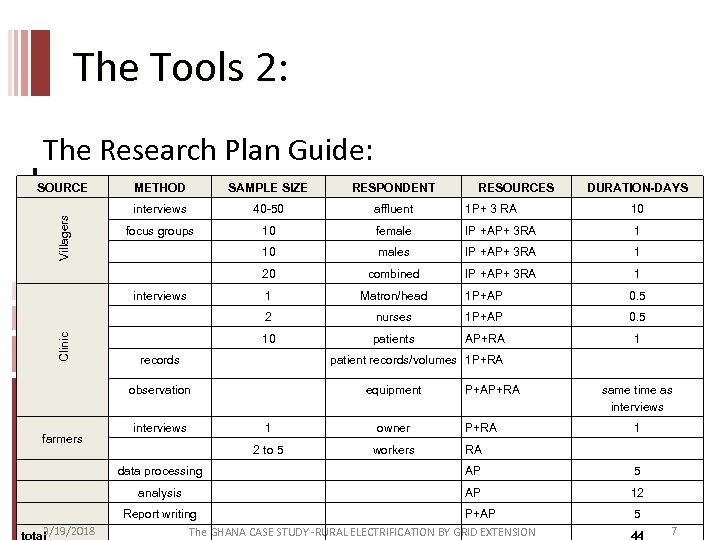
The Tools 2: The Research Plan Guide: METHOD SAMPLE SIZE RESPONDENT interviews 40 -50 affluent 1 P+ 3 RA 10 focus groups 10 female IP +AP+ 3 RA 1 10 males IP +AP+ 3 RA 1 20 combined IP +AP+ 3 RA 1 1 Matron/head 1 P+AP 0. 5 2 Villagers SOURCE nurses 1 P+AP 0. 5 10 patients AP+RA 1 Clinic interviews records interviews DURATION-DAYS patient records/volumes 1 P+RA observation farmers RESOURCES equipment 1 owner 2 to 5 workers P+AP+RA same time as interviews 1 RA data processing AP 5 analysis AP 12 3/19/2018 total Report writing P+AP The GHANA CASE STUDY -RURAL ELECTRIFICATION BY GRID EXTENSION 5 44 7
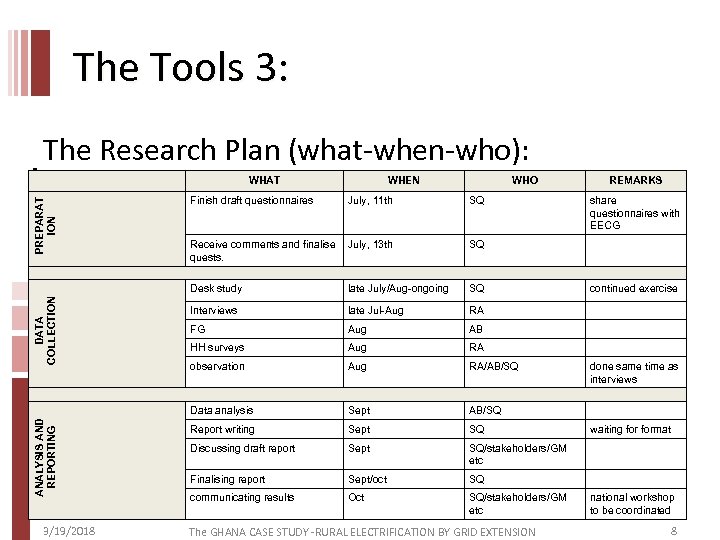
The Tools 3: The Research Plan (what-when-who): WHAT WHO REMARKS PREPARAT ION DATA COLLECTION ANALYSIS AND REPORTING July, 11 th SQ share questionnaires with EECG Receive comments and finalise July, 13 th quests. SQ Desk study 3/19/2018 Finish draft questionnaires WHEN late July/Aug-ongoing SQ continued exercise Interviews late Jul-Aug RA FG Aug AB HH surveys Aug RA observation Aug RA/AB/SQ done same time as interviews Data analysis Sept AB/SQ Report writing Sept SQ waiting format Discussing draft report Sept SQ/stakeholders/GM etc Finalising report Sept/oct SQ communicating results Oct SQ/stakeholders/GM etc national workshop to be coordinated The GHANA CASE STUDY -RURAL ELECTRIFICATION BY GRID EXTENSION 8
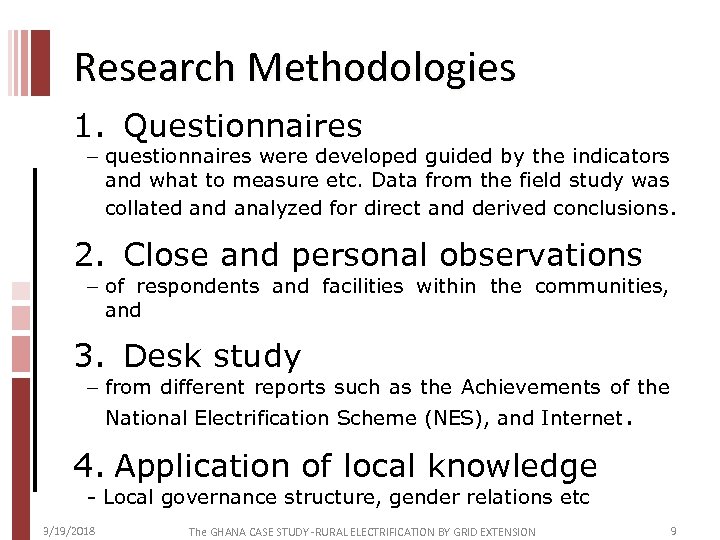
Research Methodologies 1. Questionnaires – questionnaires were developed guided by the indicators and what to measure etc. Data from the field study was collated analyzed for direct and derived conclusions. 2. Close and personal observations – of respondents and facilities within the communities, and 3. Desk study – from different reports such as the Achievements of the National Electrification Scheme (NES), and Internet. 4. Application of local knowledge - Local governance structure, gender relations etc 3/19/2018 The GHANA CASE STUDY -RURAL ELECTRIFICATION BY GRID EXTENSION 9
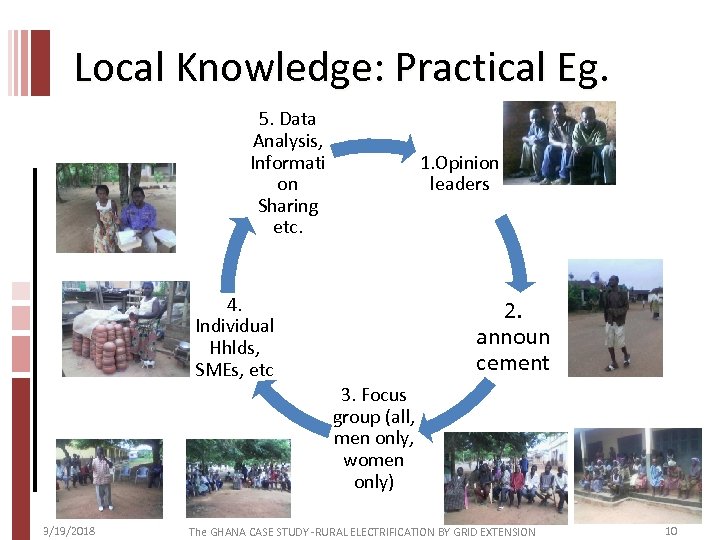
Local Knowledge: Practical Eg. 5. Data Analysis, Informati on Sharing etc. 1. Opinion leaders 4. Individual Hhlds, SMEs, etc 2. announ cement 3. Focus group (all, men only, women only) 3/19/2018 The GHANA CASE STUDY -RURAL ELECTRIFICATION BY GRID EXTENSION 10
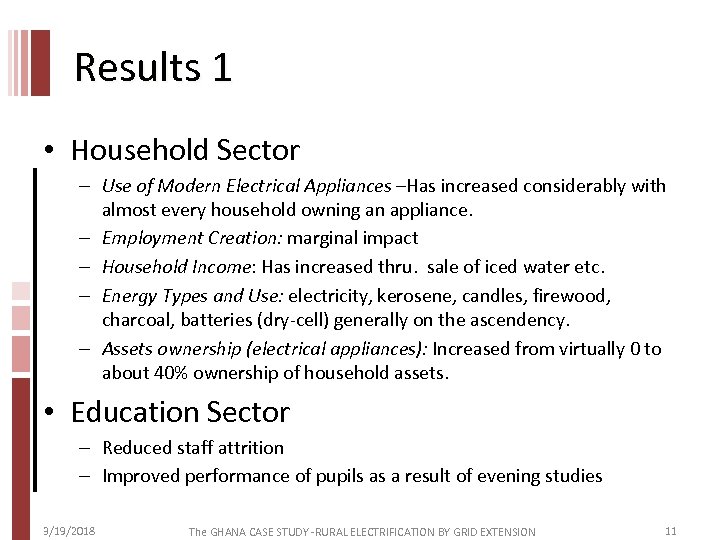
Results 1 • Household Sector – Use of Modern Electrical Appliances –Has increased considerably with almost every household owning an appliance. – Employment Creation: marginal impact – Household Income: Has increased thru. sale of iced water etc. – Energy Types and Use: electricity, kerosene, candles, firewood, charcoal, batteries (dry-cell) generally on the ascendency. – Assets ownership (electrical appliances): Increased from virtually 0 to about 40% ownership of household assets. • Education Sector – Reduced staff attrition – Improved performance of pupils as a result of evening studies 3/19/2018 The GHANA CASE STUDY -RURAL ELECTRIFICATION BY GRID EXTENSION 11
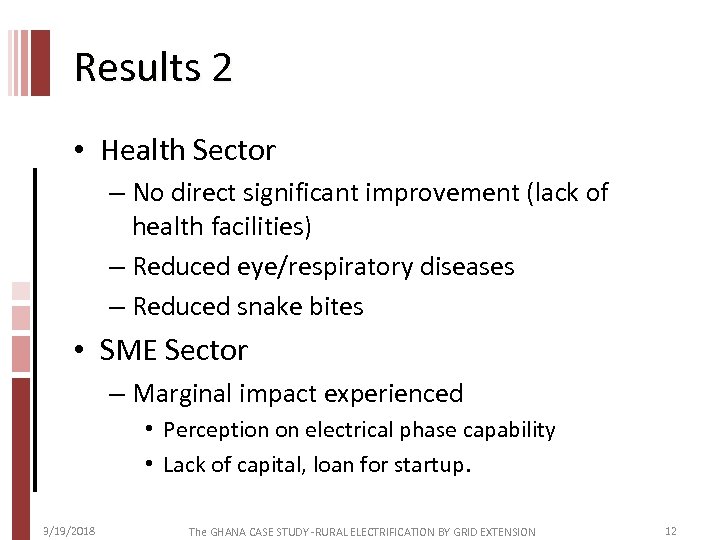
Results 2 • Health Sector – No direct significant improvement (lack of health facilities) – Reduced eye/respiratory diseases – Reduced snake bites • SME Sector – Marginal impact experienced • Perception on electrical phase capability • Lack of capital, loan for startup. 3/19/2018 The GHANA CASE STUDY -RURAL ELECTRIFICATION BY GRID EXTENSION 12
Results 3 • Agriculture Sector – No direct impact recorded. All farming activities here are subsistent. • Communication Sector – Significant impact; ownership of mobiles phones or access to mobiles phones; fax machines • Water Sector – No direct impact – borehole use (non motorised) 3/19/2018 The GHANA CASE STUDY -RURAL ELECTRIFICATION BY GRID EXTENSION 13
Results 4 Other Social Impacts – Social knowledge equity: increased knowledge in communities – radio, television – Increased collective socializing – extended social programmes - funerals, video shows etc – Alternatives to bedtime entertainment : Bedtime has been shifted to later hours – Expansion of communities : other people coming in to settle – Increased gender sensitivity : discussions on media have engendered this sensitivity. 3/19/2018 The GHANA CASE STUDY -RURAL ELECTRIFICATION BY GRID EXTENSION 14
‘Revealing’ Revelations • Transport cost – ECG should collect the bill • Unfair disconnection methods • Unfair cost of extending electricity to houses (same as in the cities) • Plantations of electric poles - no one to buy poles • Worrying Perceptions – Wrong meter reading by meter readers – Single vs Three Phase wiring capabilities • Exploitations – tricksters playing on rural folks • Innovating bill collection methods 3/19/2018 The GHANA CASE STUDY -RURAL ELECTRIFICATION BY GRID EXTENSION 15
Results vis-à-vis the NES 1 A reminder - the National Electrification Scheme goals; 1. 2. 3. 4. 5. 6. Poverty reduction, especially in the rural areas; Increasing the overall socio-economic development of the nation; Increasing people’s standard of living, especially those in the rural areas; Creating small-to-medium-scale industries in rural areas; Enhancing activities in other sectors of the economy, such as agriculture, health, education, tourism, etc; Creating jobs in the rural areas and thus reducing the rate of rural to urban migration. 3/19/2018 The GHANA CASE STUDY -RURAL ELECTRIFICATION BY GRID EXTENSION 16
Results vis-à-vis the NES 2 • Goal 1 -- Poverty reduction, especially in the rural areas – Direct/significant poverty reduction could not firmly be established. – The increasing costs of living (fuel prices, goods, transport, low employment). – To curb this trend, more needs to be done in the areas of employment creation in the rural areas and providing subsidized/special services such as special transport fares etc. • Goal 2 -- Increasing the overall socio-economic development of the nation – – • increase in knowledge, in touch with the outside world. increased gender-sensitivity through education on the radios and television. awareness of rights and responsibilities. increase in assets ownership such as Television sets, refrigerators etc. Goal 3 -- Increasing people’s standard of living, especially those in the rural areas – impacted positively on the living standards in some respect. – increased sense of security and safety in the communities. Respondents said that snake bites for instance had dropped drastically. – There are increased social activities at night due to lighting. 3/19/2018 The GHANA CASE STUDY -RURAL ELECTRIFICATION BY GRID EXTENSION 17
Results vis-à-vis the NES 3 • Goal 4 -- Creating small-to-medium-scale industries (SMEs) in rural areas – – Creation of small-to-medium-scale industries has not occurred (or marginal). due to the inadequacy of the electric energy provided Lack of capital, well developed marketing systems. innovative financing schemes and loans, education on single vrs 3 phase capabilities • Goal 5 -- Enhancing activities in other sectors of the economy, such as agriculture, health, education, tourism, etc; – Some of the sectors had experienced positive impacts as a result of electrification however others had no direct positive impacts • Goal 6 -- Creating jobs in the rural areas and thus reducing the rate of rural to urban migration have been partly achieved – Job creation is minimal. The general lack of SMEs had led to the lack of jobs and the inherent migration of the youth from these communities. 3/19/2018 The GHANA CASE STUDY -RURAL ELECTRIFICATION BY GRID EXTENSION 18
Final Thoughts Adequacy of Assessment Framework • The AF is a very useful tool, however researchers would have to know the ff: – the peculiar needs of the research that is to be carried out and adapt the framework to suit their purposes. – local knowledge on the approach to research methodologies in the targets communities. – traditional governance structure, – gender relations etc in the communities 3/19/2018 The GHANA CASE STUDY -RURAL ELECTRIFICATION BY GRID EXTENSION 19

ASANTA SAANA ANY THOUGHTS? Email : solomon@kiteonline. net
Скачать презентацию THE GHANA STUDY RURAL ELECTRIFICATION BY GRID EXTENSION
b63cfb3ed3d2d6711fc6f4b8853d00ad.ppt