 Скачать презентацию The GFOA of BC and the Ministry of
346000612f156d737b1f60d4f0663524.ppt
- Количество слайдов: 33



The GFOA of BC and the Ministry of Community Services have joined together to assist BC local governments with the New TCA reporting requirements impacting communities throughout Canada. Goal Meet legislated requirements Standardize TCA reporting Meet legislated deadlines
TANGIBLE CAPITAL ASSETS
Overview What are TCA’s? Is there a concern? What can we do? How do we do it? Will it be enough?
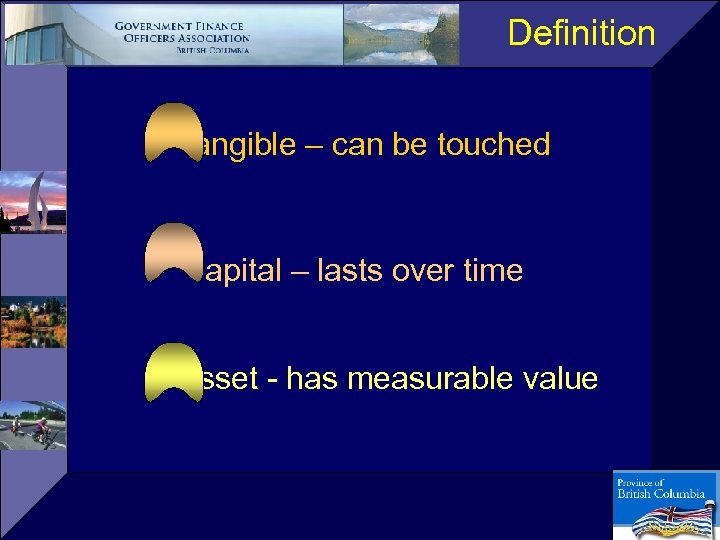
Definition angible – can be touched apital – lasts over time sset - has measurable value
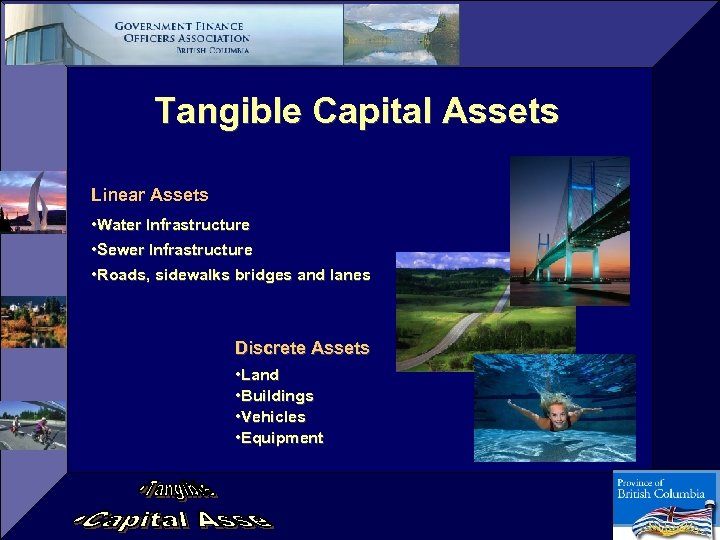
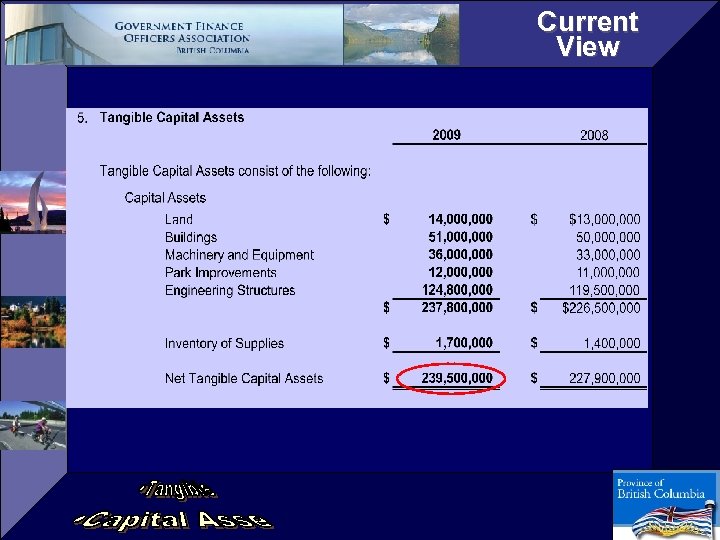
Tangible Capital Assets Linear Assets • Water Infrastructure • Sewer Infrastructure • Roads, sidewalks bridges and lanes Discrete Assets • Land • Buildings • Vehicles • Equipment
Infrastructure Deficit ! Problem 1. Assets deteriorate over time 2. Money is not set aside for replacement
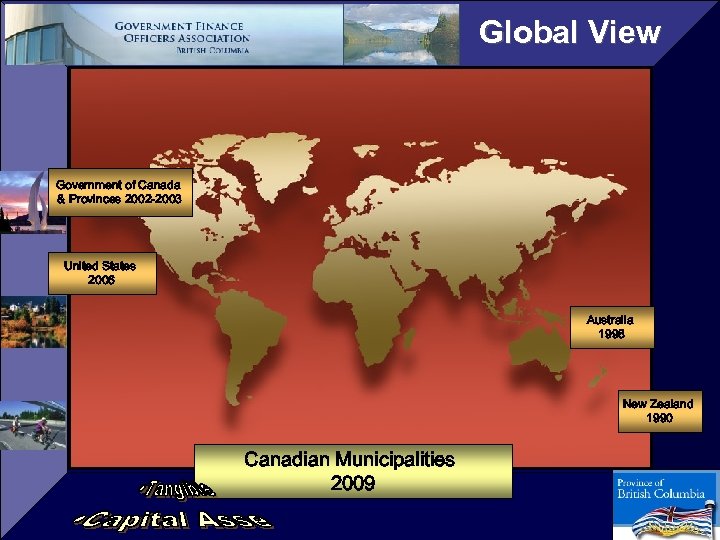
Global View Government of Canada & Provinces 2002 -2003 United States 2006 Australia 1998 New Zealand 1990 Canadian Municipalities 2009
The Issue “Our $60 Billion national municipal infrastructure deficit grows by $2 Billion per year, and the longer we take to erase it, the more it will cost Canadians. ” Michael Coleman, President, Federation of Canadian Municipalities
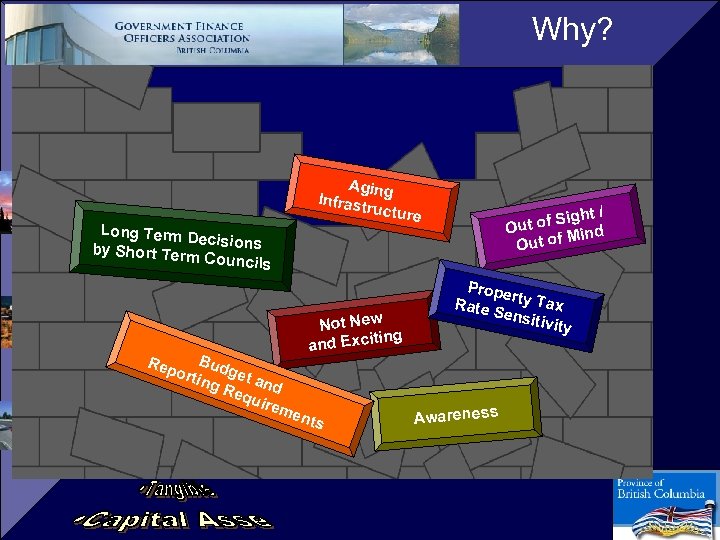
Why? Aging Infrast ructur Long Term D ecisions by Short Ter m Councils Bu orti dget a ng Req nd uire m Rep ight / ut of S nd O Mi Out of e Not New ting and Exci ent s Prope Rate rty Tax Sensi tivity Awareness
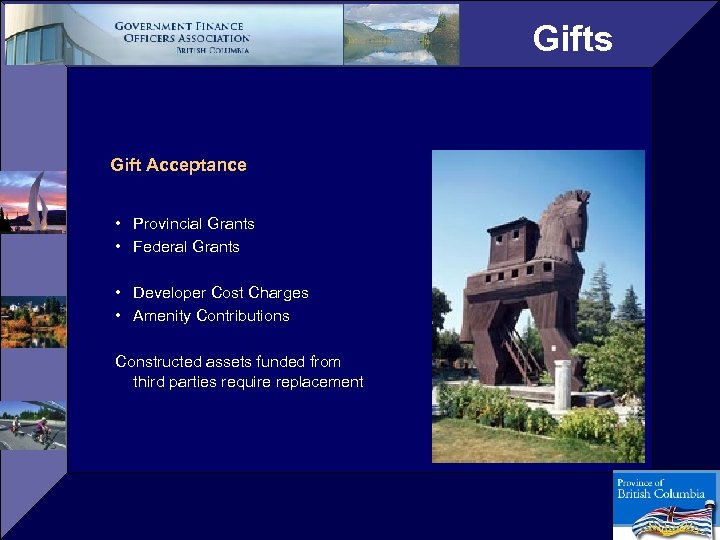
Gifts Gift Acceptance • Provincial Grants • Federal Grants • Developer Cost Charges • Amenity Contributions Constructed assets funded from third parties require replacement
Review Tangible Capital Assets (TCA) defined Global Issue Problem Quantification Why the TCA issue was not addressed earlier? Solution
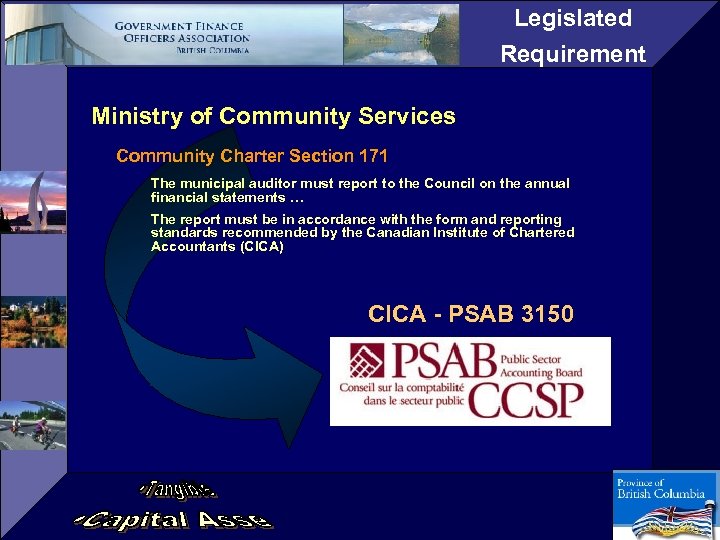
Legislated Requirement Ministry of Community Services Community Charter Section 171 The municipal auditor must report to the Council on the annual financial statements … The report must be in accordance with the form and reporting standards recommended by the Canadian Institute of Chartered Accountants (CICA) CICA - PSAB 3150
Standards CICA - PSAB 3150
Current View
Current View
Current View
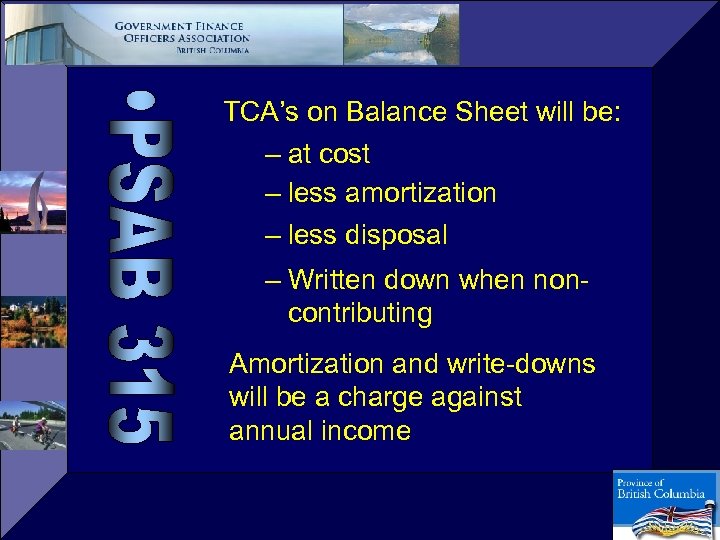
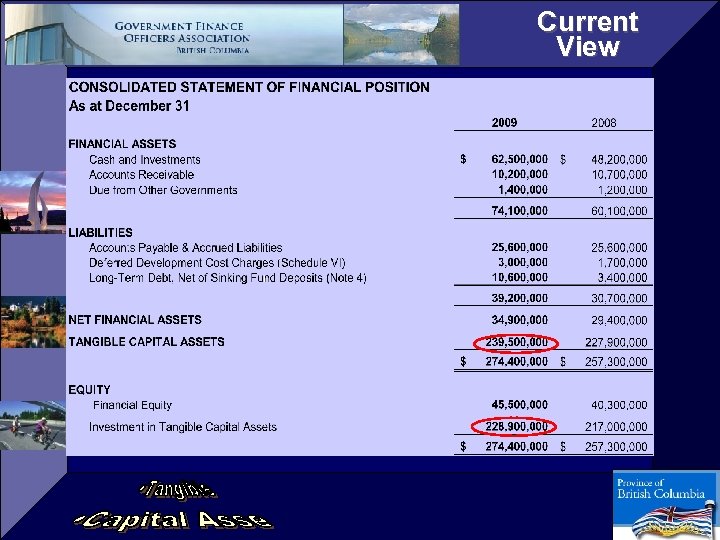
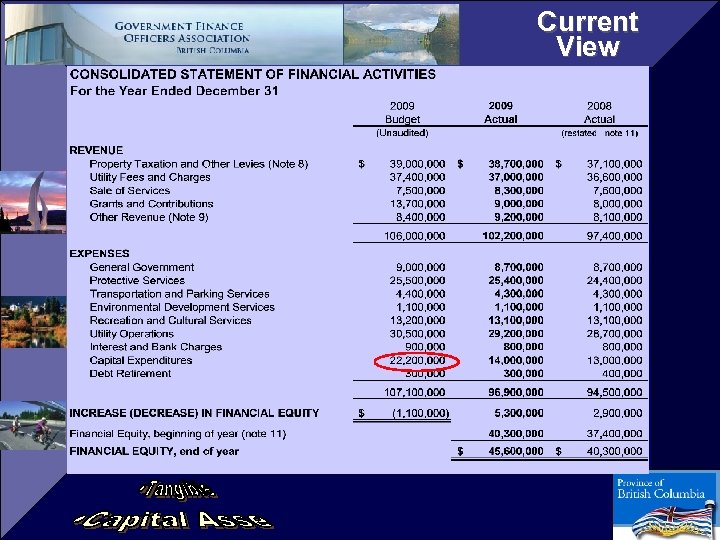
TCA’s on Balance Sheet will be: – at cost – less amortization – less disposal – Written down when noncontributing Amortization and write-downs will be a charge against annual income
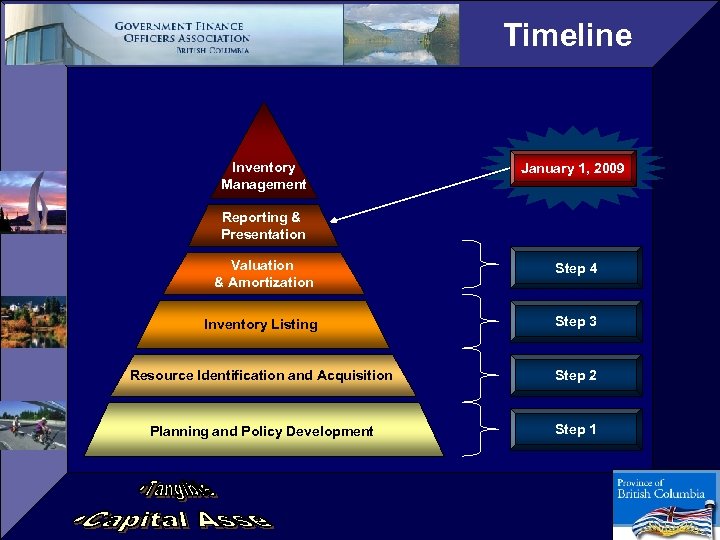
Timeline Inventory Management January 1, 2009 Reporting & Presentation Valuation & Amortization Step 4 Inventory Listing Step 3 Resource Identification and Acquisition Step 2 Planning and Policy Development Step 1
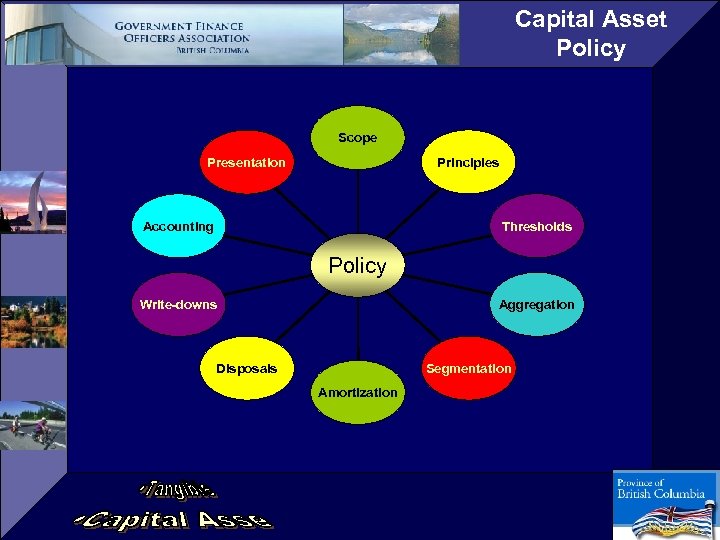
Capital Asset Policy Scope Principles Presentation Thresholds Accounting Policy Aggregation Write-downs Disposals Segmentation Amortization
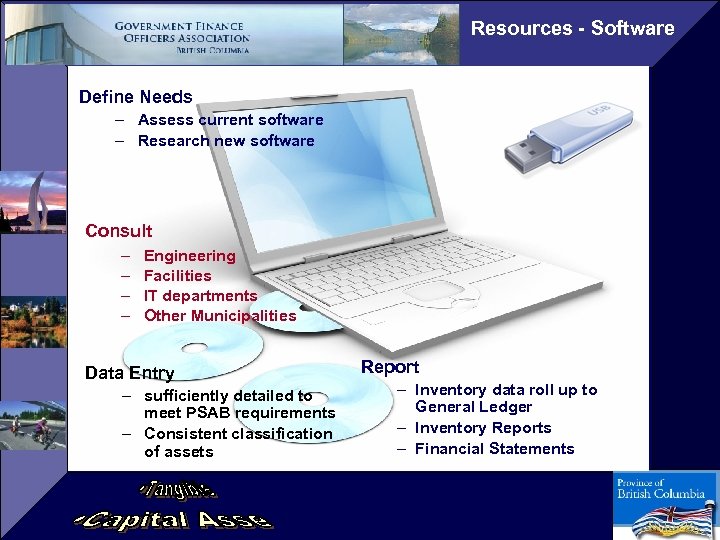
Resources - Software Define Needs – Assess current software – Research new software Consult – – Engineering Facilities IT departments Other Municipalities Data Entry – sufficiently detailed to meet PSAB requirements – Consistent classification of assets Report – Inventory data roll up to General Ledger – Inventory Reports – Financial Statements
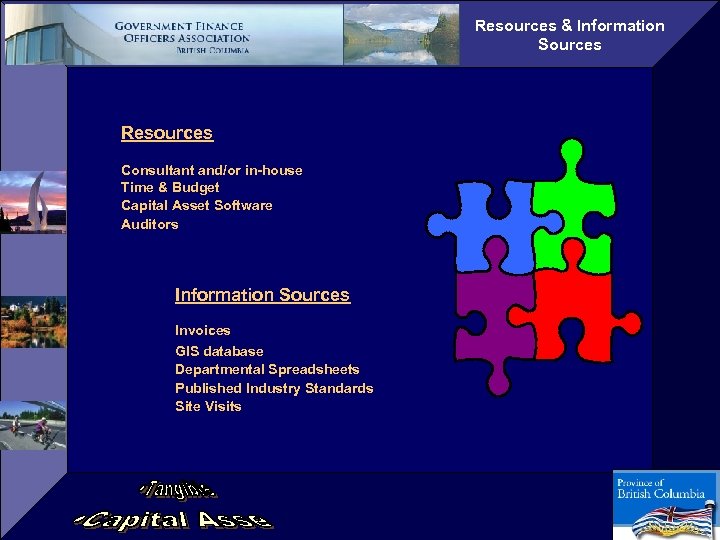
Resources & Information Sources Resources Consultant and/or in-house Time & Budget Capital Asset Software Auditors Information Sources Invoices GIS database Departmental Spreadsheets Published Industry Standards Site Visits
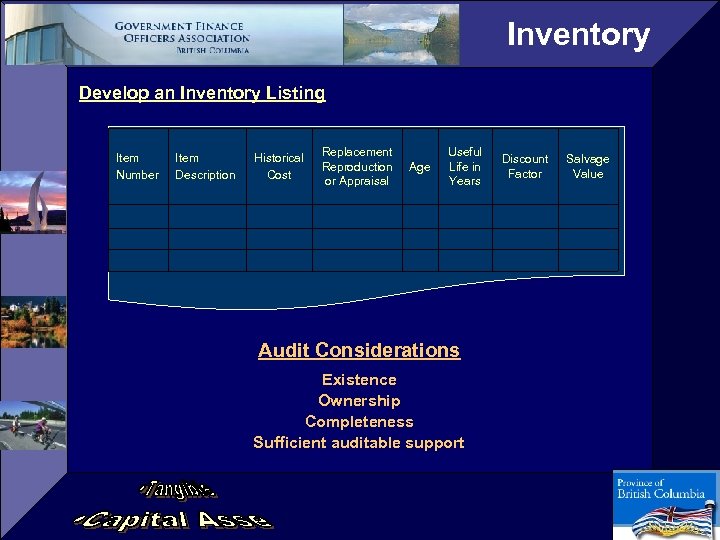
Inventory Develop an Inventory Listing Item Number Item Description Historical Cost Replacement Reproduction or Appraisal Age Useful Life in Years Audit Considerations Existence Ownership Completeness Sufficient auditable support Discount Factor Salvage Value
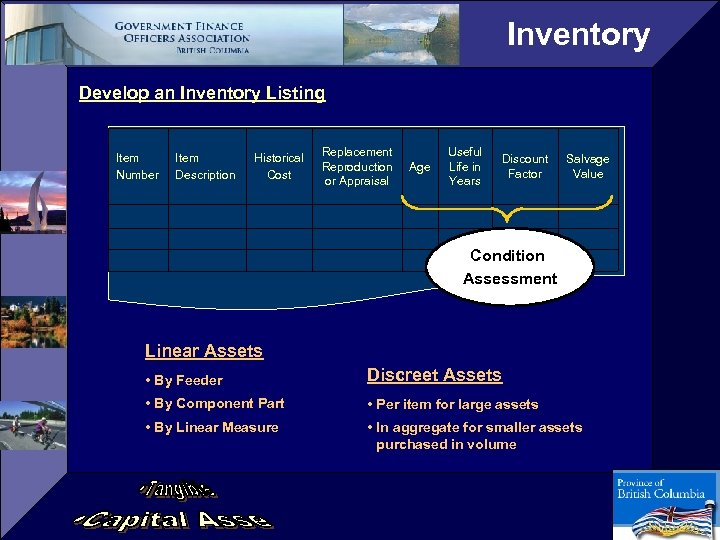
Inventory Develop an Inventory Listing Item Number Item Description Historical Cost Replacement Reproduction or Appraisal Age Useful Life in Years Discount Factor Salvage Value Condition Assessment Linear Assets • By Feeder Discreet Assets • By Component Part • Per item for large assets • By Linear Measure • In aggregate for smaller assets purchased in volume
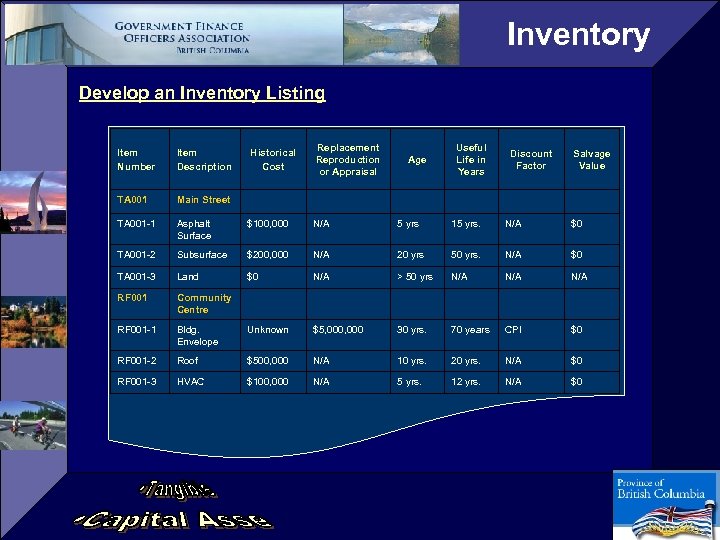
Inventory Develop an Inventory Listing Historical Cost Replacement Reproduction or Appraisal Useful Life in Years Item Number Item Description TA 001 Main Street TA 001 -1 Asphalt Surface $100, 000 N/A 5 yrs 15 yrs. N/A $0 TA 001 -2 Subsurface $200, 000 N/A 20 yrs 50 yrs. N/A $0 TA 001 -3 Land $0 N/A > 50 yrs N/A N/A RF 001 Community Centre RF 001 -1 Bldg. Envelope Unknown $5, 000 30 yrs. 70 years CPI $0 RF 001 -2 Roof $500, 000 N/A 10 yrs. 20 yrs. N/A $0 RF 001 -3 HVAC $100, 000 N/A 5 yrs. 12 yrs. N/A $0 Age Discount Factor Salvage Value
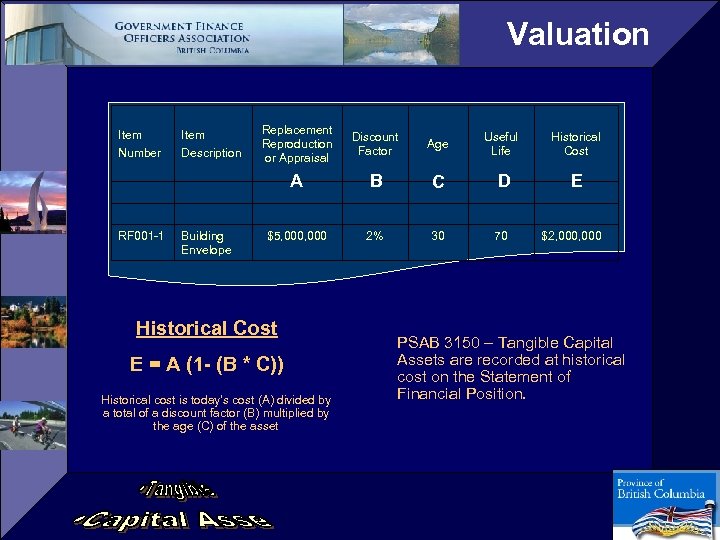
Valuation RF 001 -1 Item Description Building Envelope Replacement Reproduction or Appraisal Discount Factor Age Useful Life Historical Cost A Item Number B C D E $5, 000 2% 30 70 Historical Cost E = A (1 - (B * C)) Historical cost is today’s cost (A) divided by a total of a discount factor (B) multiplied by the age (C) of the asset $2, 000 PSAB 3150 – Tangible Capital Assets are recorded at historical cost on the Statement of Financial Position.
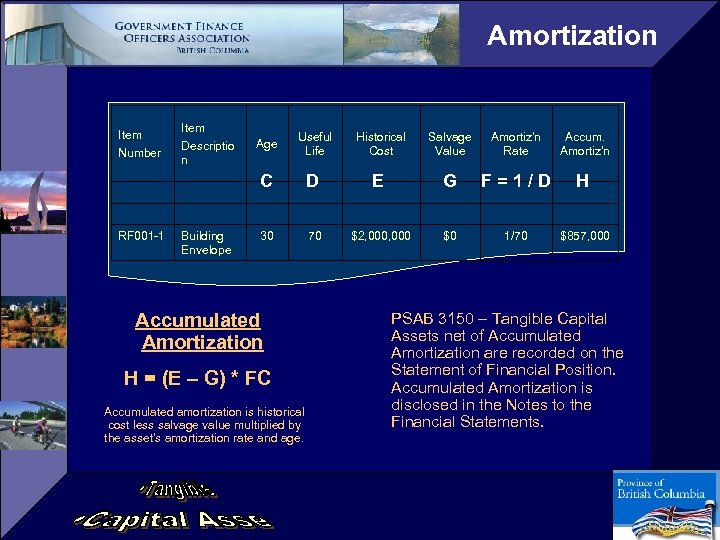
Amortization Item Number Item Descriptio n Building Envelope Useful Life Historical Cost Salvage Value Amortiz’n Rate Accum. Amortiz’n C RF 001 -1 Age D E G F=1/D H 30 70 $2, 000 $0 1/70 $857, 000 Accumulated Amortization H = (E – G) * FC Accumulated amortization is historical cost less salvage value multiplied by the asset’s amortization rate and age. PSAB 3150 – Tangible Capital Assets net of Accumulated Amortization are recorded on the Statement of Financial Position. Accumulated Amortization is disclosed in the Notes to the Financial Statements.
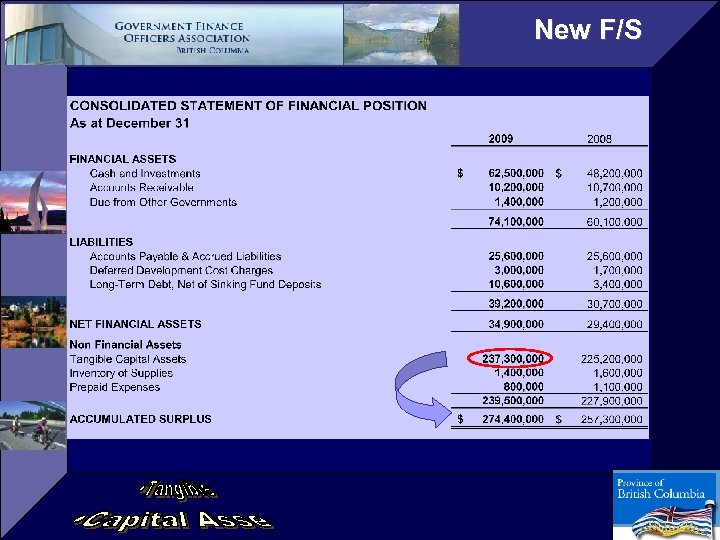
New F/S
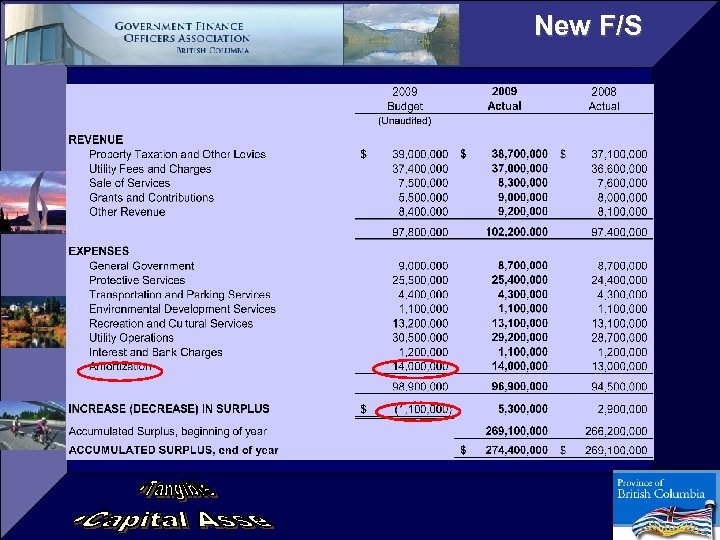
New F/S
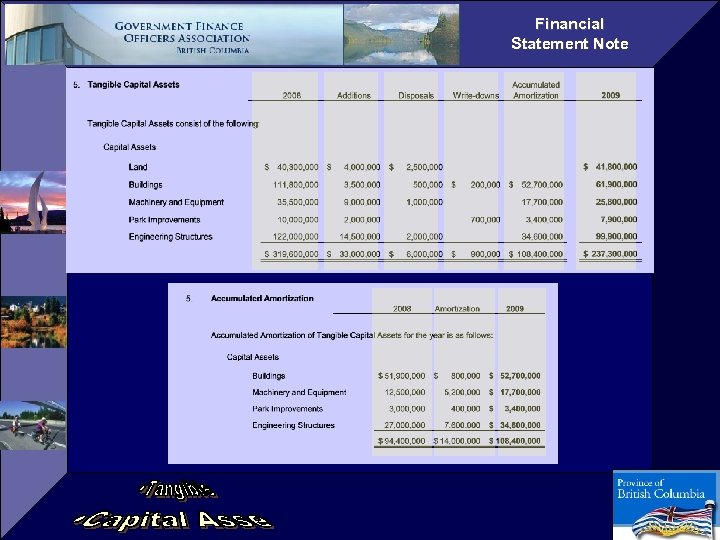
Financial Statement Note
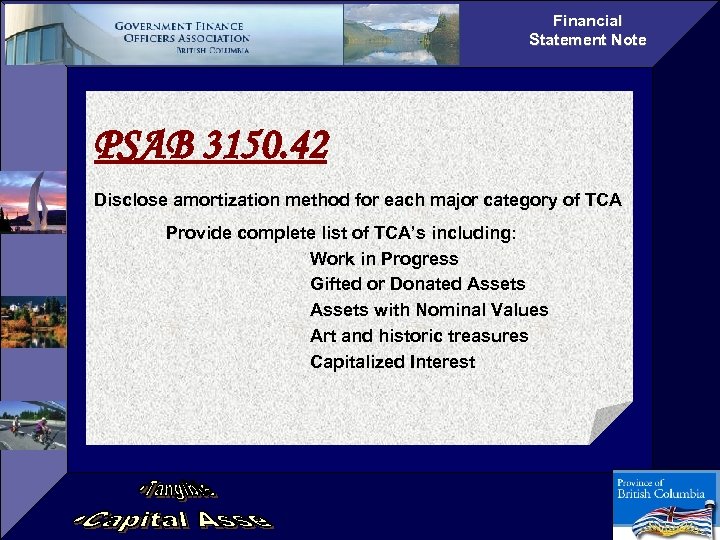
Financial Statement Note PSAB 3150. 42 Disclose amortization method for each major category of TCA Provide complete list of TCA’s including: Work in Progress Gifted or Donated Assets with Nominal Values Art and historic treasures Capitalized Interest
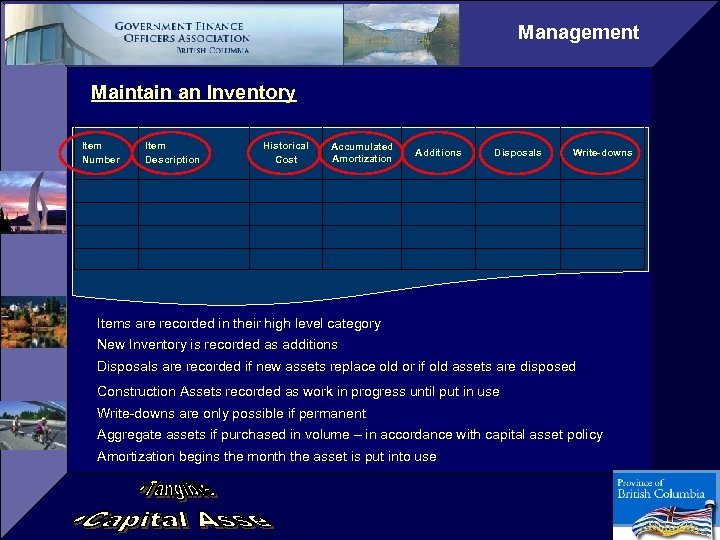
Management Maintain an Inventory Item Number Item Description Historical Cost Accumulated Amortization Additions Disposals Write-downs Items are recorded in their high level category New Inventory is recorded as additions Disposals are recorded if new assets replace old or if old assets are disposed Construction Assets recorded as work in progress until put in use Write-downs are only possible if permanent Aggregate assets if purchased in volume – in accordance with capital asset policy Amortization begins the month the asset is put into use
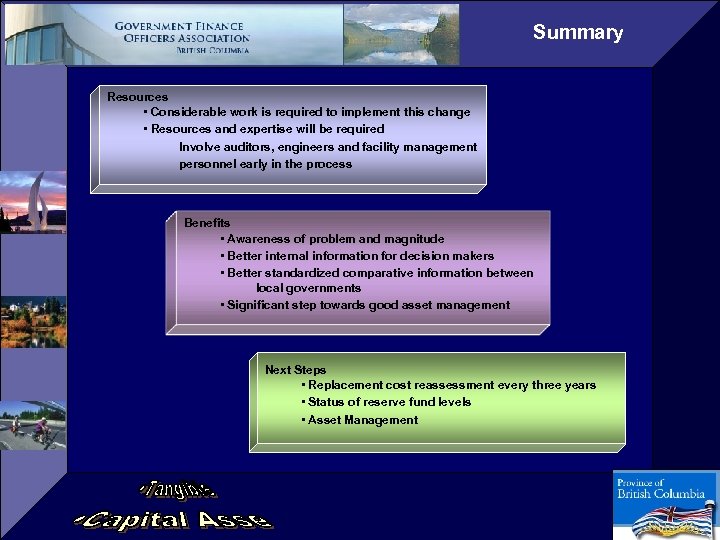
Summary Resources • Considerable work is required to implement this change • Resources and expertise will be required Involve auditors, engineers and facility management personnel early in the process Benefits • Awareness of problem and magnitude • Better internal information for decision makers • Better standardized comparative information between local governments • Significant step towards good asset management Next Steps • Replacement cost reassessment every three years • Status of reserve fund levels • Asset Management
 Скачать презентацию The GFOA of BC and the Ministry of
346000612f156d737b1f60d4f0663524.ppt