


 Скачать презентацию The Geoscience Standard Names Ontology Scott D Peckham
a3267990157b50ad547156ff52510949.ppt
- Количество слайдов: 9
 The Geoscience Standard Names Ontology Scott D. Peckham Senior Research Scientist at INSTAAR Lead PI for Earth System Bridge Former Chief Software Architect for CSDMS University of Colorado, Boulder January 10, 2017 Earth. Cube
 The Big Problem: Our Motivation If you have worked to serve a community of geoscientists, or if you have studied a large number of cross-domain geoscience “use cases”, sooner or later you come to realize that: (1) The big, generic problem facing geoscientists today stems from lack of interoperability across a huge number of heterogeneous resources. (2) While discovery and access could certainly be improved (especially for “dark resources”), the real time sink for geoscientists comes when they try to use, understand connect resources into workflows. Analogy: You shop online, find some pre-fab furniture or vehicle parts and have these shipped to your house. Then the real work begins. Discovery & citation well-served by Dublin Core & Data. Cite. (3) The only practical way to “tame” this heterogeneity is to do 2 things: (a) Collect standardized, “deep-description” metadata for resources, then (b) “Wrap” the resources with standardized APIs that provide callers with access to both the data and the metadata. (Adapter Pattern) Software written to utilize these 2 things will be called a mediator or a broker. The only alternative to this, which is completely impractical when the number of different resources is large, is to write separate software to deal with each individual resource. Standardized metadata => ontologies.
 Object – Attribute –Value This use of Objects, Attributes and Values is an extremely powerful “data model” that underpins object-oriented programming. It is also called the Entity-Attribute-Value or EAV data model: see https: //en. wikipedia. org/wiki/Entity–attribute–value_model Note that: • It is the values of variables that are the “exchange items” that we write to and read from data files, store in computer memory and pass between models and • A variable name associates a symbol to a value. If we want to construct unique variable names for the purpose of semantic mediation that are unambiguous, human & machine readable and standardized, it therefore makes sense to construct these variable names as unique pairings of object names and quantity names. 7
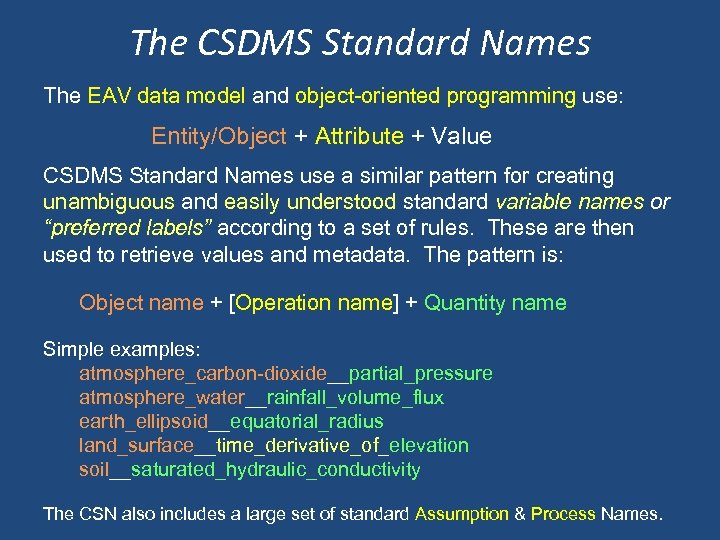 The CSDMS Standard Names The EAV data model and object-oriented programming use: Entity/Object + Attribute + Value CSDMS Standard Names use a similar pattern for creating unambiguous and easily understood standard variable names or “preferred labels” according to a set of rules. These are then used to retrieve values and metadata. The pattern is: Object name + [Operation name] + Quantity name Simple examples: atmosphere_carbon-dioxide__partial_pressure atmosphere_water__rainfall_volume_flux earth_ellipsoid__equatorial_radius land_surface__time_derivative_of_elevation soil__saturated_hydraulic_conductivity The CSN also includes a large set of standard Assumption & Process Names.
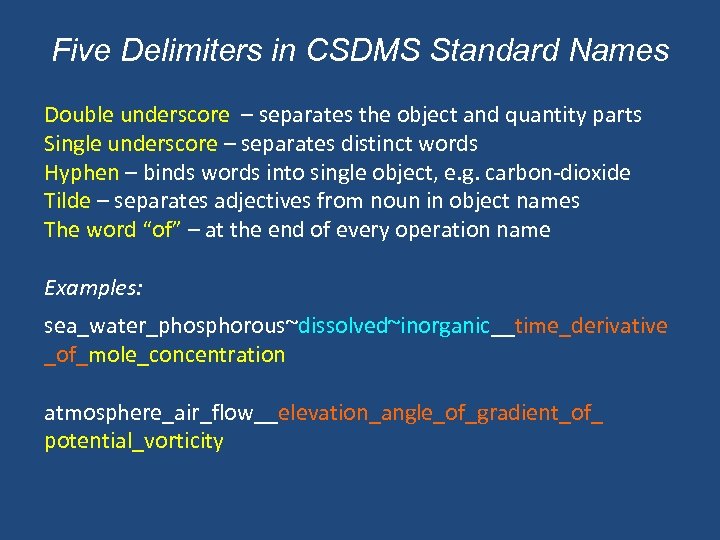 Five Delimiters in CSDMS Standard Names Double underscore – separates the object and quantity parts Single underscore – separates distinct words Hyphen – binds words into single object, e. g. carbon-dioxide Tilde – separates adjectives from noun in object names The word “of” – at the end of every operation name Examples: sea_water_phosphorous~dissolved~inorganic__time_derivative _of_mole_concentration atmosphere_air_flow__elevation_angle_of_gradient_of_ potential_vorticity
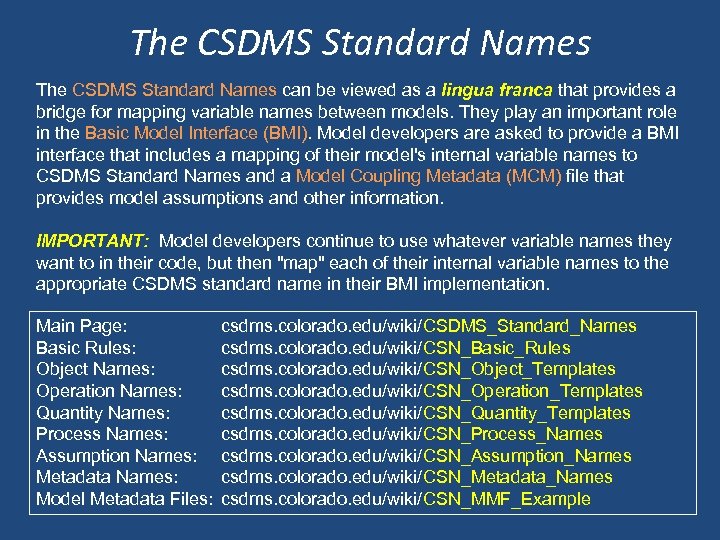 The CSDMS Standard Names can be viewed as a lingua franca that provides a bridge for mapping variable names between models. They play an important role in the Basic Model Interface (BMI). Model developers are asked to provide a BMI interface that includes a mapping of their model's internal variable names to CSDMS Standard Names and a Model Coupling Metadata (MCM) file that provides model assumptions and other information. IMPORTANT: Model developers continue to use whatever variable names they want to in their code, but then "map" each of their internal variable names to the appropriate CSDMS standard name in their BMI implementation. Main Page: Basic Rules: Object Names: Operation Names: Quantity Names: Process Names: Assumption Names: Metadata Names: Model Metadata Files: csdms. colorado. edu/wiki/CSDMS_Standard_Names csdms. colorado. edu/wiki/CSN_Basic_Rules csdms. colorado. edu/wiki/CSN_Object_Templates csdms. colorado. edu/wiki/CSN_Operation_Templates csdms. colorado. edu/wiki/CSN_Quantity_Templates csdms. colorado. edu/wiki/CSN_Process_Names csdms. colorado. edu/wiki/CSN_Assumption_Names csdms. colorado. edu/wiki/CSN_Metadata_Names csdms. colorado. edu/wiki/CSN_MMF_Example
 The Geoscience Standard Names: A Formal Ontology Based on The CSDMS Standard Names Taking CSN to the next level: Extending and repackaging the CSN Using Semantic Web Technologies and Best Practices geostandardnames. org geoscienceontology. org Now available as a SPARQL endpoint via Apache Jena Fuseki
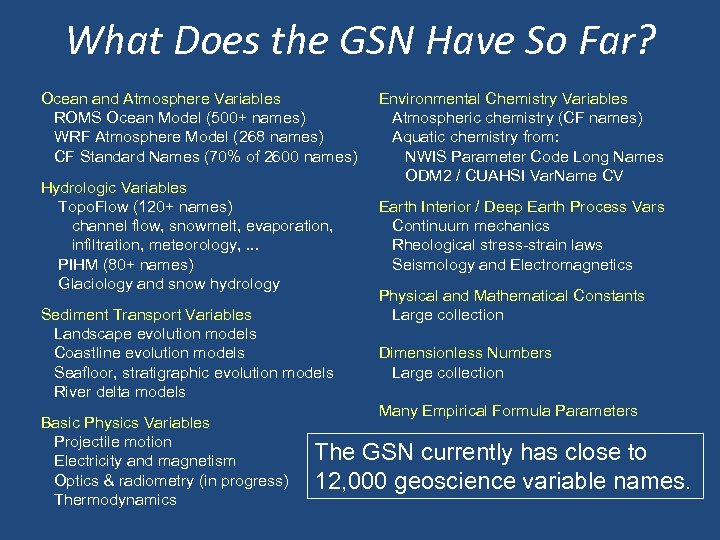 What Does the GSN Have So Far? Ocean and Atmosphere Variables ROMS Ocean Model (500+ names) WRF Atmosphere Model (268 names) CF Standard Names (70% of 2600 names) Hydrologic Variables Topo. Flow (120+ names) channel flow, snowmelt, evaporation, infiltration, meteorology, . . . PIHM (80+ names) Glaciology and snow hydrology Sediment Transport Variables Landscape evolution models Coastline evolution models Seafloor, stratigraphic evolution models River delta models Basic Physics Variables Projectile motion Electricity and magnetism Optics & radiometry (in progress) Thermodynamics Environmental Chemistry Variables Atmospheric chemistry (CF names) Aquatic chemistry from: NWIS Parameter Code Long Names ODM 2 / CUAHSI Var. Name CV Earth Interior / Deep Earth Process Vars Continuum mechanics Rheological stress-strain laws Seismology and Electromagnetics Physical and Mathematical Constants Large collection Dimensionless Numbers Large collection Many Empirical Formula Parameters The GSN currently has close to 12, 000 geoscience variable names.
 Minimal Governance by Design: Rules-based, Assisted Name Construction We learned from the CF Standard Names effort that with only guidelines and no rigorous set of rules for constructing names, the vetting of proposed, new names was a tedious and time-consuming process, requiring a lot of volunteer/committee work and near-endless email discussion. This led to: (1) restricting the scope to only ocean and atmosphere model names (2) long delays between when new names were proposed and adopted. (3) internal inconsistencies or self-contradictions. Our approach is based on a close examination of the variable names that are currently used in the most sophisticated computational models, a study of prior, related projects such as the CF Standard Names and the NWIS Parameter Code Dictionary Long Names. This led to the identification of common patterns that cut across science domains, so that in most cases new names can be constructed from existing templates.