 Скачать презентацию The Geopolitics of Energy Presentation by Strategic Advisors
516d2f35a48642c1b317bf3fc0705854.ppt
- Количество слайдов: 43



The Geopolitics of Energy Presentation by Strategic Advisors in Global Energy Fareed Mohamedi Chief Economist, PFC Energy to Energy and Nanotechnology Conference Houston, Texas May 3, 2003
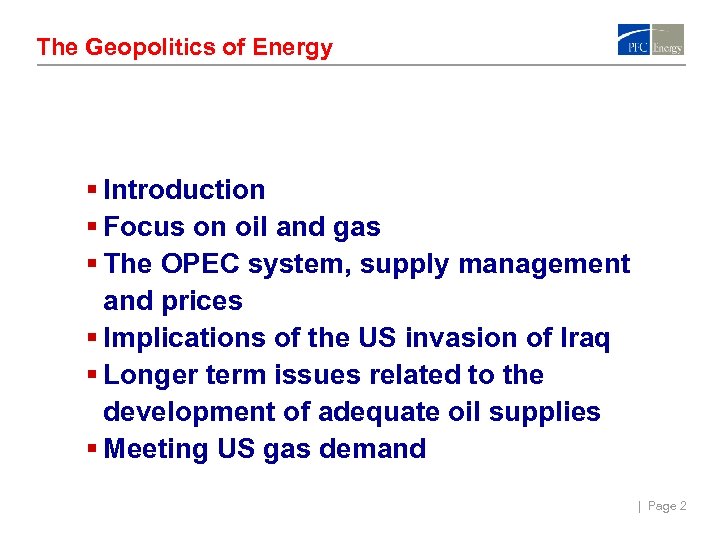
The Geopolitics of Energy § Introduction § Focus on oil and gas § The OPEC system, supply management and prices § Implications of the US invasion of Iraq § Longer term issues related to the development of adequate oil supplies § Meeting US gas demand | Page 2
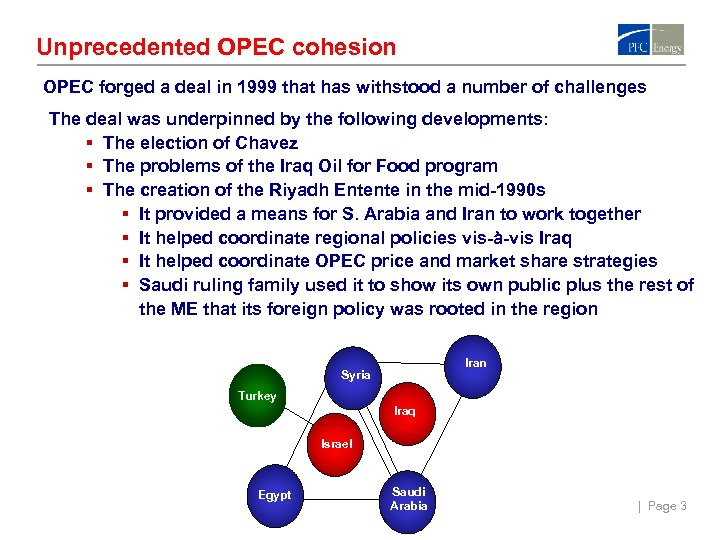
Unprecedented OPEC cohesion OPEC forged a deal in 1999 that has withstood a number of challenges The deal was underpinned by the following developments: § The election of Chavez § The problems of the Iraq Oil for Food program § The creation of the Riyadh Entente in the mid-1990 s § It provided a means for S. Arabia and Iran to work together § It helped coordinate regional policies vis-à-vis Iraq § It helped coordinate OPEC price and market share strategies § Saudi ruling family used it to show its own public plus the rest of the ME that its foreign policy was rooted in the region Iran Syria Turkey Iraq Israel Egypt Saudi Arabia | Page 3
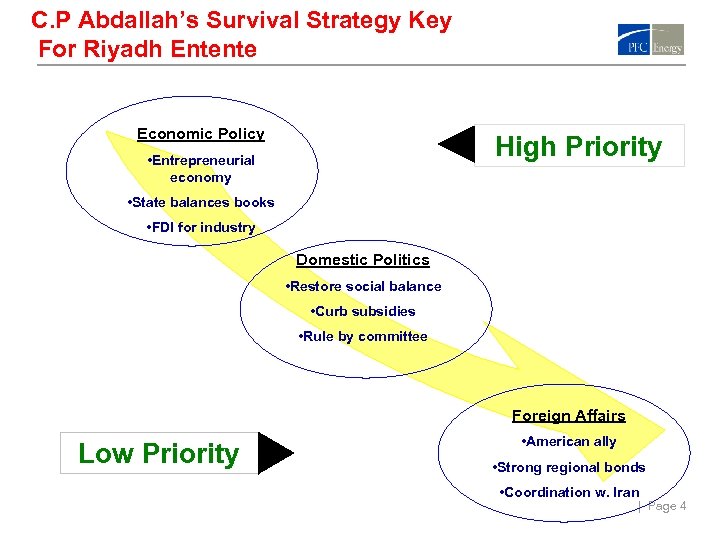
C. P Abdallah’s Survival Strategy Key For Riyadh Entente Economic Policy High Priority • Entrepreneurial economy • State balances books • FDI for industry Domestic Politics • Restore social balance • Curb subsidies • Rule by committee Foreign Affairs Low Priority • American ally • Strong regional bonds • Coordination w. Iran | Page 4
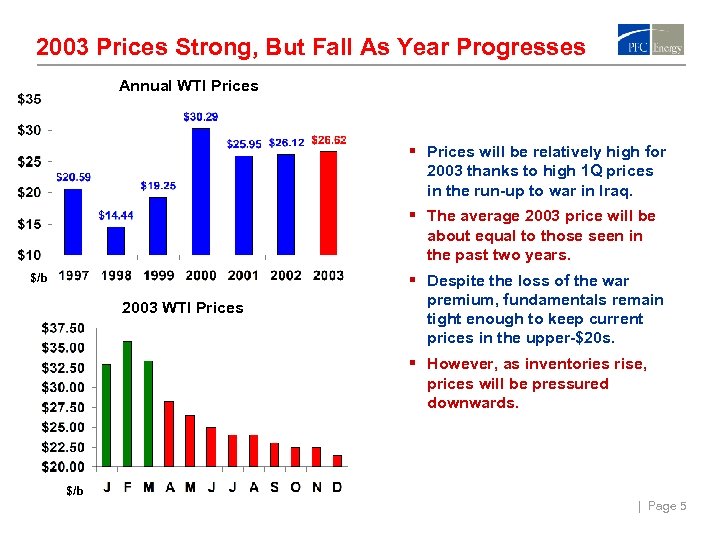
2003 Prices Strong, But Fall As Year Progresses Annual WTI Prices § Prices will be relatively high for 2003 thanks to high 1 Q prices in the run-up to war in Iraq. § The average 2003 price will be about equal to those seen in the past two years. $/b 2003 WTI Prices § Despite the loss of the war premium, fundamentals remain tight enough to keep current prices in the upper-$20 s. § However, as inventories rise, prices will be pressured downwards. $/b | Page 5
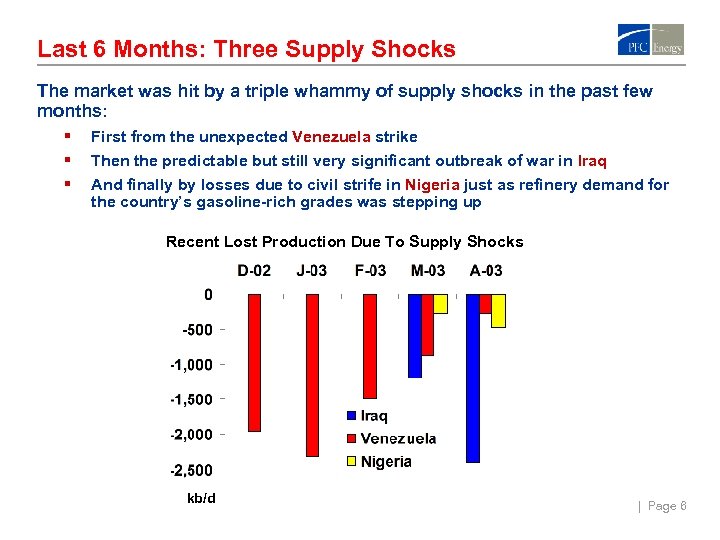
Last 6 Months: Three Supply Shocks The market was hit by a triple whammy of supply shocks in the past few months: § § § First from the unexpected Venezuela strike Then the predictable but still very significant outbreak of war in Iraq And finally by losses due to civil strife in Nigeria just as refinery demand for the country’s gasoline-rich grades was stepping up Recent Lost Production Due To Supply Shocks kb/d | Page 6
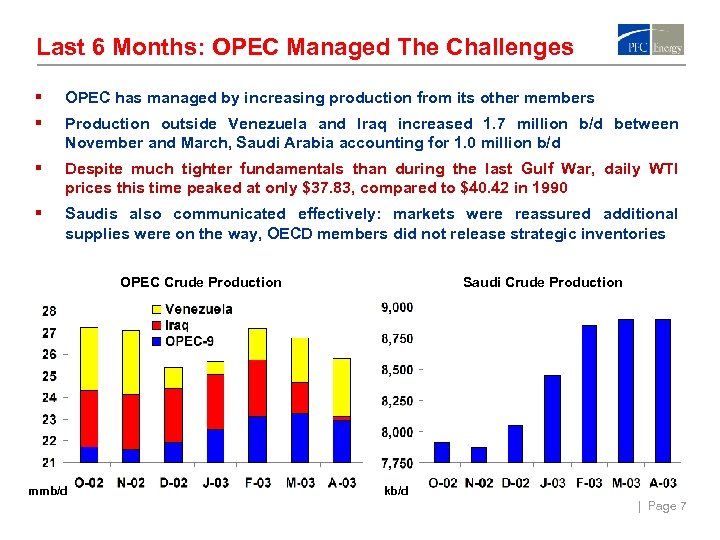
Last 6 Months: OPEC Managed The Challenges § OPEC has managed by increasing production from its other members § Production outside Venezuela and Iraq increased 1. 7 million b/d between November and March, Saudi Arabia accounting for 1. 0 million b/d § Despite much tighter fundamentals than during the last Gulf War, daily WTI prices this time peaked at only $37. 83, compared to $40. 42 in 1990 § Saudis also communicated effectively: markets were reassured additional supplies were on the way, OECD members did not release strategic inventories OPEC Crude Production mmb/d Saudi Crude Production kb/d | Page 7
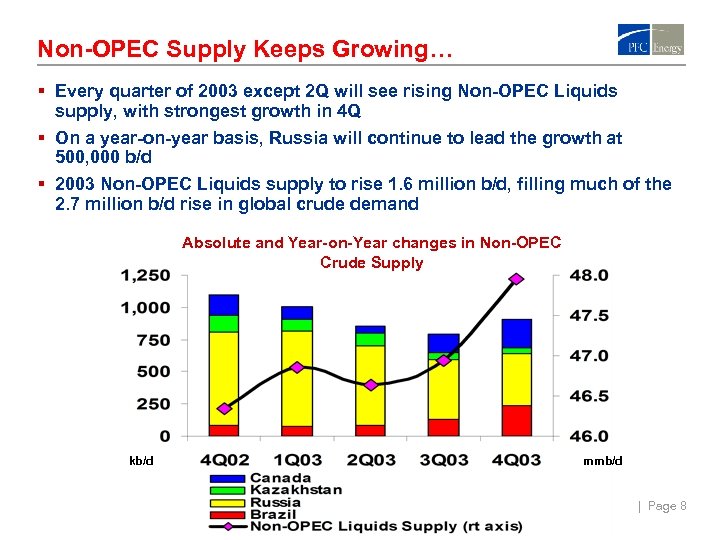
Non-OPEC Supply Keeps Growing… § Every quarter of 2003 except 2 Q will see rising Non-OPEC Liquids supply, with strongest growth in 4 Q § On a year-on-year basis, Russia will continue to lead the growth at 500, 000 b/d § 2003 Non-OPEC Liquids supply to rise 1. 6 million b/d, filling much of the 2. 7 million b/d rise in global crude demand Absolute and Year-on-Year changes in Non-OPEC Crude Supply kb/d mmb/d | Page 8
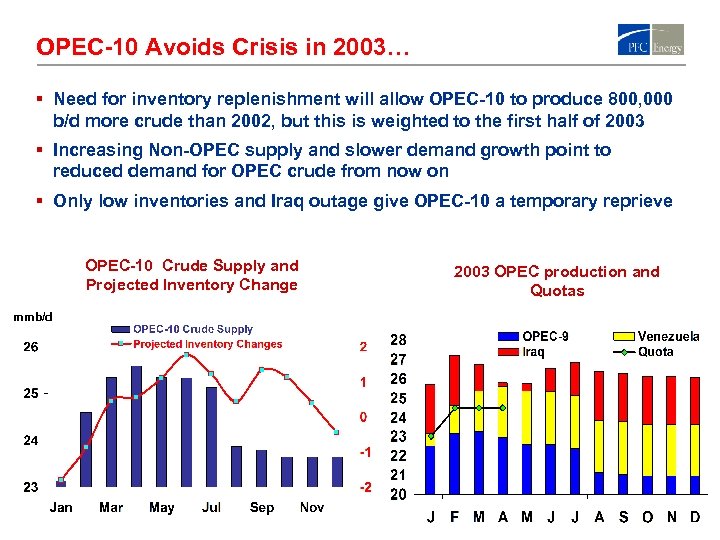
OPEC-10 Avoids Crisis in 2003… § Need for inventory replenishment will allow OPEC-10 to produce 800, 000 b/d more crude than 2002, but this is weighted to the first half of 2003 § Increasing Non-OPEC supply and slower demand growth point to reduced demand for OPEC crude from now on § Only low inventories and Iraq outage give OPEC-10 a temporary reprieve OPEC-10 Crude Supply and Projected Inventory Change 2003 OPEC production and Quotas mmb/d | Page 9
Was The Invasion of Iraq An Oil War? § The oil companies are not behind this war §Who are the oil companies? §What have they become? § The US oil companies would rather have sanctions removed from all major producer countries § The non-US oil companies used the constraints on US companies to make inroads into the Middle East § The current Administration has not fulfilled the few promises it made to the oil patch §Drilling offshore Florida §Removing the subsidies for ethanol §Revoking ILSA §Alaska is not seen as a real oil play | Page 10
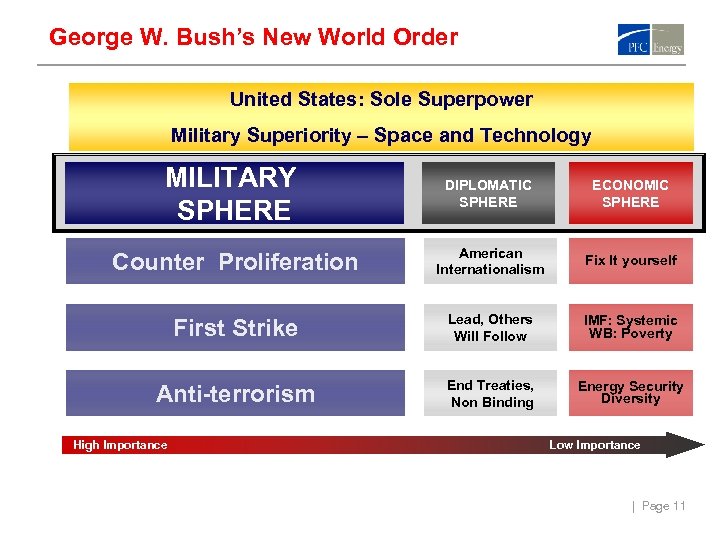
George W. Bush’s New World Order United States: Sole Superpower Military Superiority – Space and Technology MILITARY SPHERE DIPLOMATIC SPHERE ECONOMIC SPHERE Counter Proliferation American Internationalism Fix It yourself First Strike Lead, Others Will Follow IMF: Systemic WB: Poverty Anti-terrorism End Treaties, Non Binding Energy Security Diversity High Importance Low Importance | Page 11
Oil Key to New Iraq § The administration of the Iraqi oil industry will be a challenge, particularly in the first year or two, and the prospects of a shortterm jump in production are effectively nil. § The challenges will be: 1. To minimize short-term production losses while maintaining a reasonably safe operating environment 2. Create an environment (political, administrative, legal) that will allow a very rapid conclusion of negotiations for investment in new capacity Only then is substantial growth in production is possible. In the best case, real growth (from 2001 -2002 peak capacity) will not happen before 2005. | Page 12
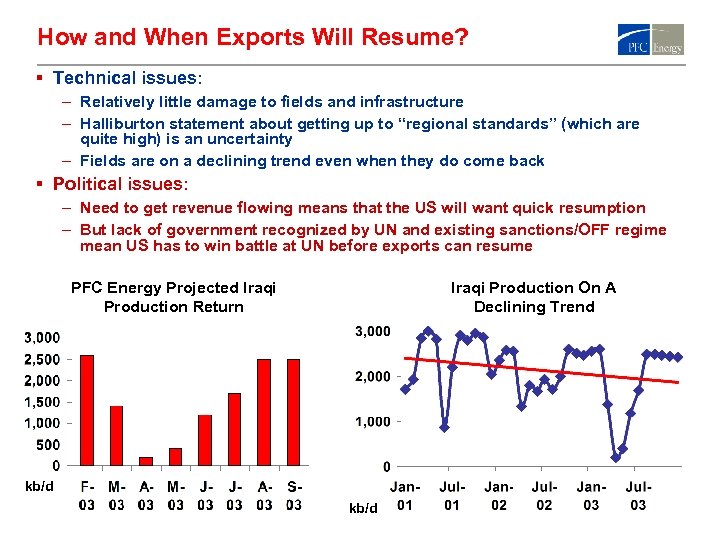
How and When Exports Will Resume? § Technical issues: – Relatively little damage to fields and infrastructure – Halliburton statement about getting up to “regional standards” (which are quite high) is an uncertainty – Fields are on a declining trend even when they do come back § Political issues: – Need to get revenue flowing means that the US will want quick resumption – But lack of government recognized by UN and existing sanctions/OFF regime mean US has to win battle at UN before exports can resume PFC Energy Projected Iraqi Production Return Iraqi Production On A Declining Trend kb/d | Page 13
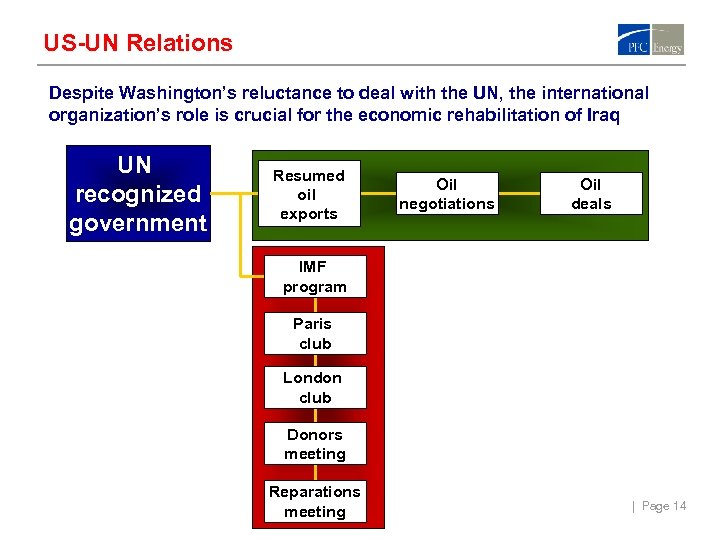
US-UN Relations Despite Washington’s reluctance to deal with the UN, the international organization’s role is crucial for the economic rehabilitation of Iraq UN recognized government Resumed oil exports Oil negotiations Oil deals IMF program Paris club London club Donors meeting Reparations meeting | Page 14
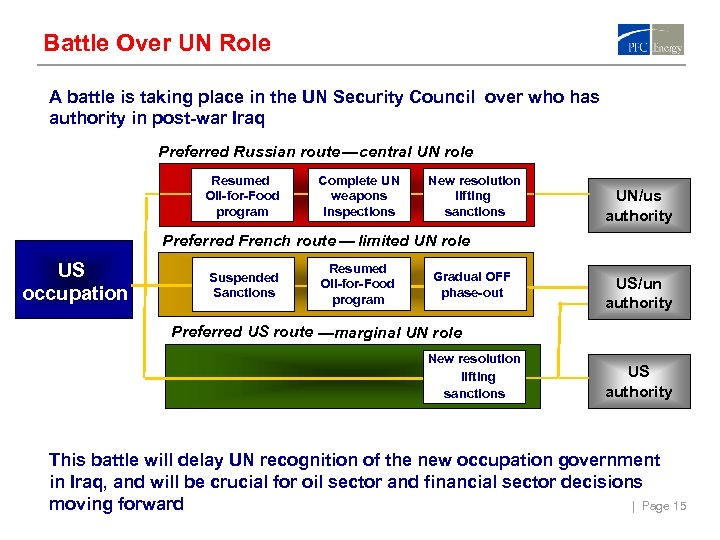
Battle Over UN Role A battle is taking place in the UN Security Council over who has authority in post-war Iraq Preferred Russian route —central UN role Resumed Oil-for-Food program Complete UN weapons inspections New resolution lifting sanctions UN/us authority Preferred French route — limited UN role US occupation Suspended Sanctions Resumed Oil-for-Food program Gradual OFF phase-out US/un authority Preferred US route —marginal UN role New resolution lifting sanctions US authority This battle will delay UN recognition of the new occupation government in Iraq, and will be crucial for oil sector and financial sector decisions moving forward | Page 15
Best Case Scenarios This model assumes that there will be no commercial or logistical constraints on companies. In other words, within 12 to 18 months contracts would be signed and companies would find the necessary equipment to ramp up operations in an aggressive manner | Page 16
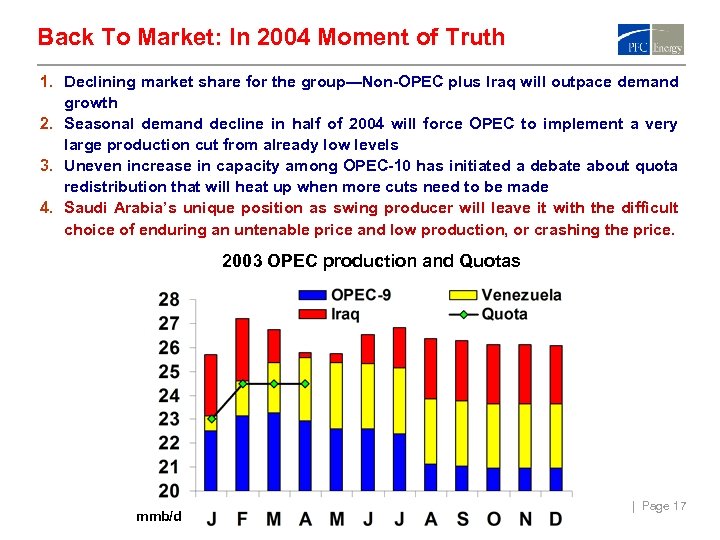
Back To Market: In 2004 Moment of Truth 1. Declining market share for the group—Non-OPEC plus Iraq will outpace demand growth 2. Seasonal demand decline in half of 2004 will force OPEC to implement a very large production cut from already low levels 3. Uneven increase in capacity among OPEC-10 has initiated a debate about quota redistribution that will heat up when more cuts need to be made 4. Saudi Arabia’s unique position as swing producer will leave it with the difficult choice of enduring an untenable price and low production, or crashing the price. 2003 OPEC production and Quotas mmb/d | Page 17
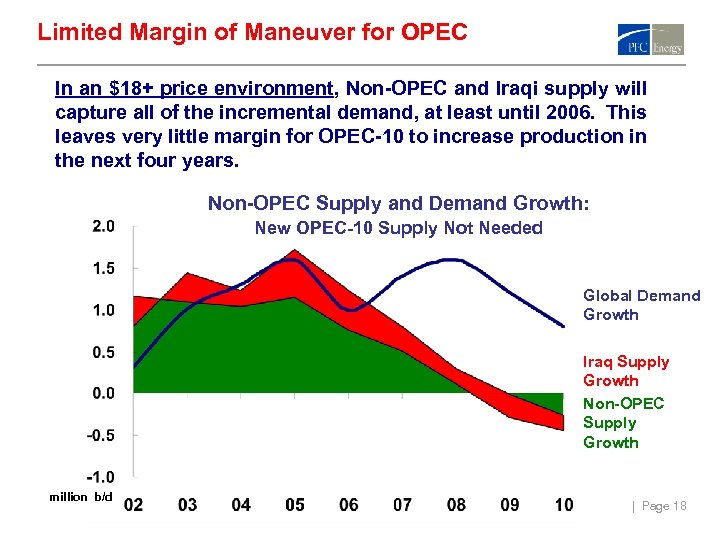
Limited Margin of Maneuver for OPEC In an $18+ price environment, Non-OPEC and Iraqi supply will capture all of the incremental demand, at least until 2006. This leaves very little margin for OPEC-10 to increase production in the next four years. Non-OPEC Supply and Demand Growth: New OPEC-10 Supply Not Needed Global Demand Growth Iraq Supply Growth Non-OPEC Supply Growth million b/d | Page 18
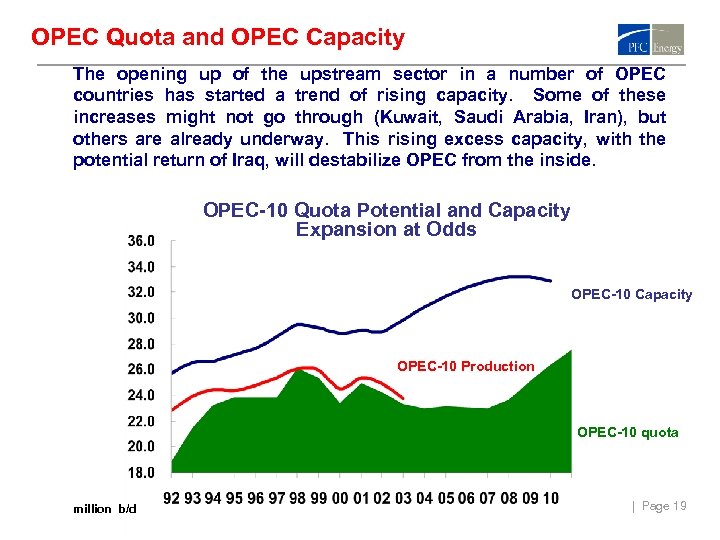
OPEC Quota and OPEC Capacity The opening up of the upstream sector in a number of OPEC countries has started a trend of rising capacity. Some of these increases might not go through (Kuwait, Saudi Arabia, Iran), but others are already underway. This rising excess capacity, with the potential return of Iraq, will destabilize OPEC from the inside. OPEC-10 Quota Potential and Capacity Expansion at Odds OPEC-10 Capacity OPEC-10 Production OPEC-10 quota million b/d | Page 19
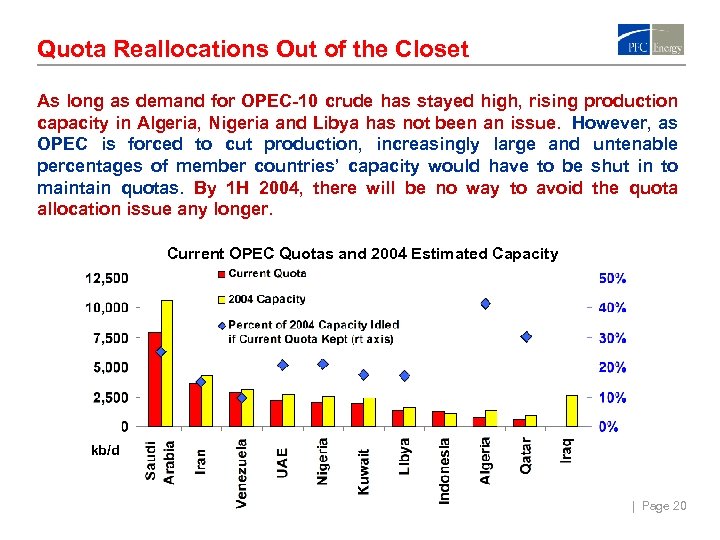
Quota Reallocations Out of the Closet As long as demand for OPEC-10 crude has stayed high, rising production capacity in Algeria, Nigeria and Libya has not been an issue. However, as OPEC is forced to cut production, increasingly large and untenable percentages of member countries’ capacity would have to be shut in to maintain quotas. By 1 H 2004, there will be no way to avoid the quota allocation issue any longer. Current OPEC Quotas and 2004 Estimated Capacity kb/d | Page 20
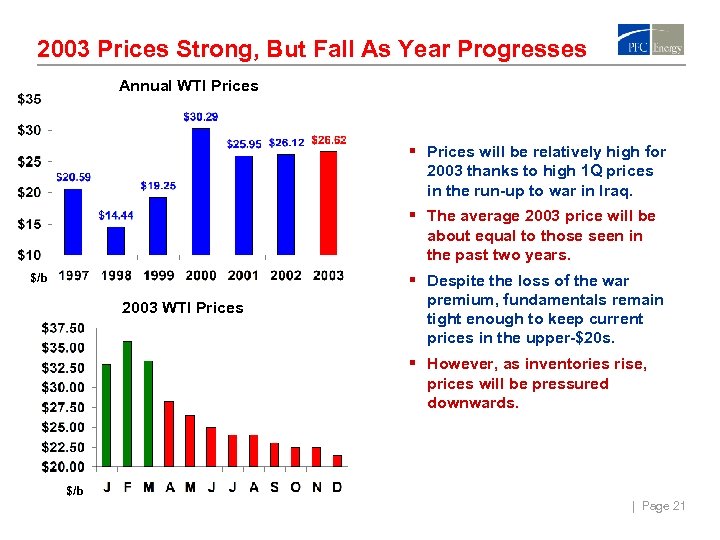
2003 Prices Strong, But Fall As Year Progresses Annual WTI Prices § Prices will be relatively high for 2003 thanks to high 1 Q prices in the run-up to war in Iraq. § The average 2003 price will be about equal to those seen in the past two years. $/b 2003 WTI Prices § Despite the loss of the war premium, fundamentals remain tight enough to keep current prices in the upper-$20 s. § However, as inventories rise, prices will be pressured downwards. $/b | Page 21
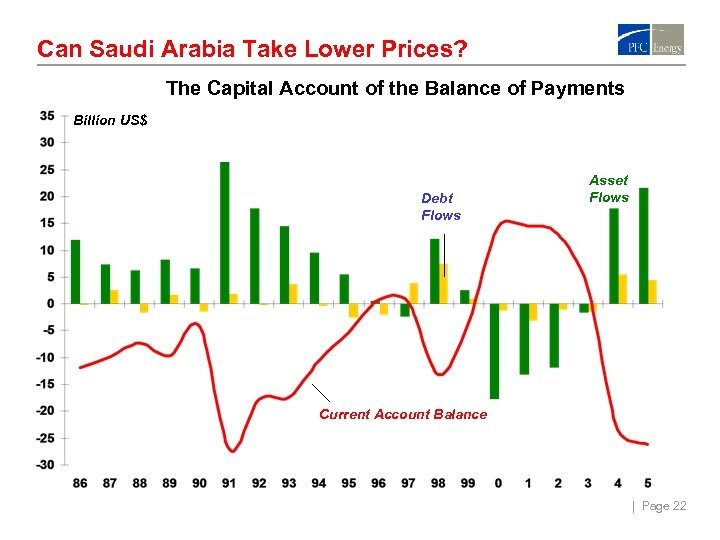
Can Saudi Arabia Take Lower Prices? The Capital Account of the Balance of Payments Billion US$ Debt Flows Asset Flows Current Account Balance | Page 22
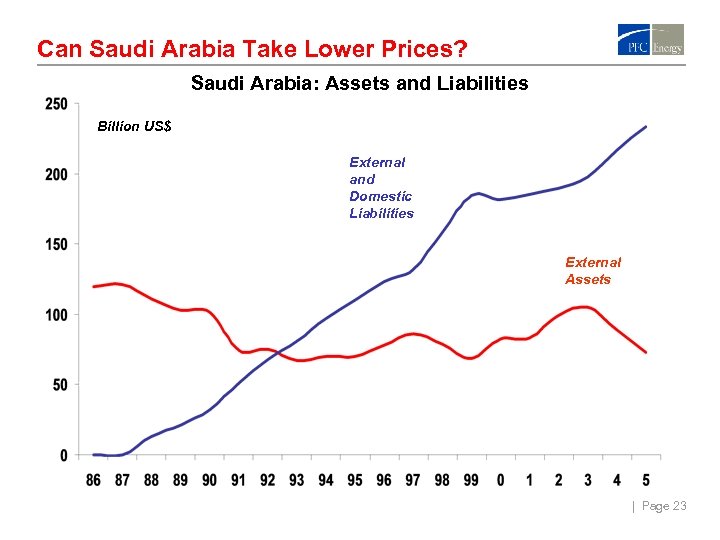
Can Saudi Arabia Take Lower Prices? Saudi Arabia: Assets and Liabilities Billion US$ External and Domestic Liabilities External Assets | Page 23
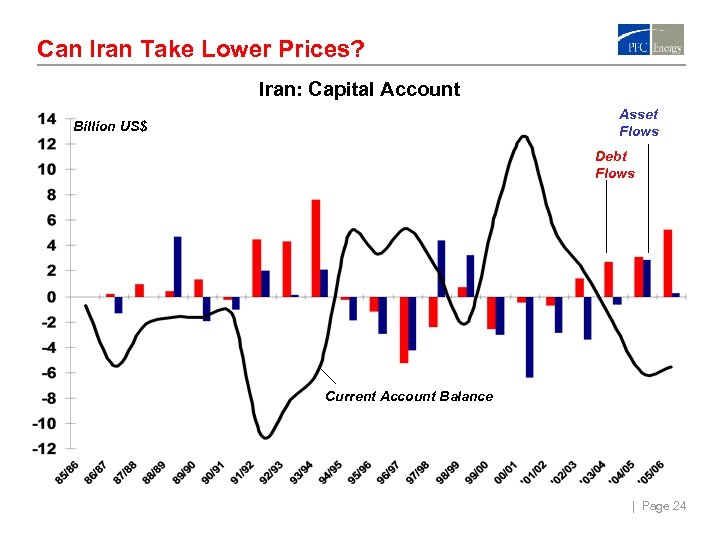
Can Iran Take Lower Prices? Iran: Capital Account Asset Flows Billion US$ Debt Flows Current Account Balance | Page 24
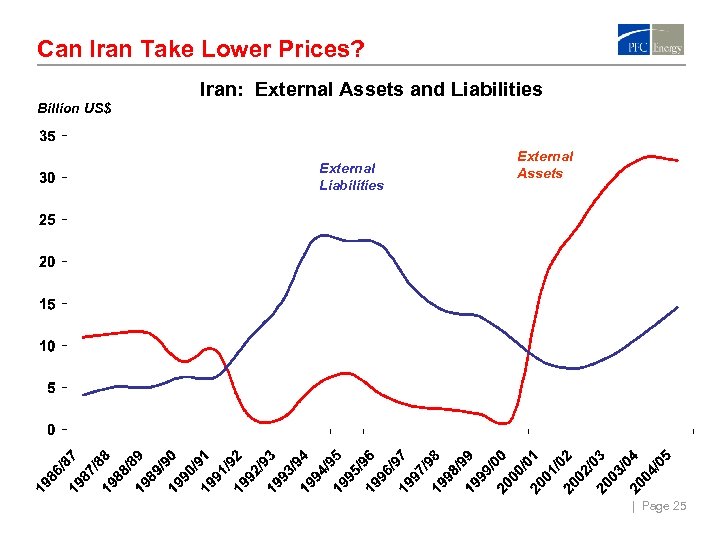
Can Iran Take Lower Prices? Iran: External Assets and Liabilities Billion US$ External Liabilities External Assets | Page 25
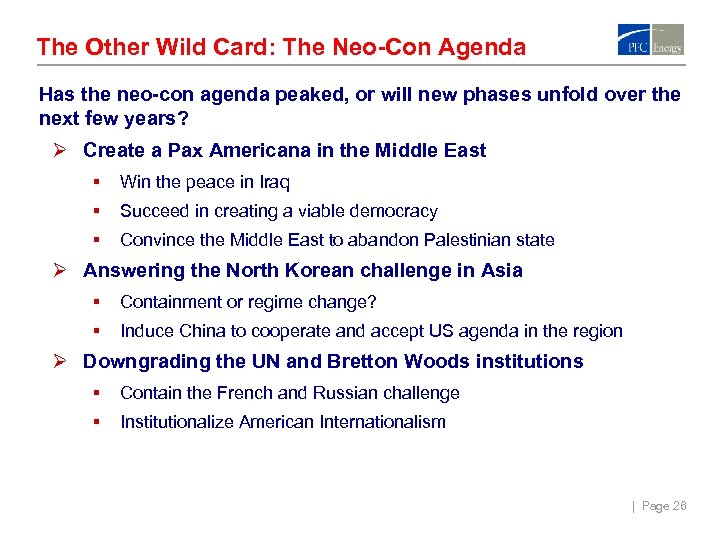
The Other Wild Card: The Neo-Con Agenda Has the neo-con agenda peaked, or will new phases unfold over the next few years? Ø Create a Pax Americana in the Middle East § Win the peace in Iraq § Succeed in creating a viable democracy § Convince the Middle East to abandon Palestinian state Ø Answering the North Korean challenge in Asia § Containment or regime change? § Induce China to cooperate and accept US agenda in the region Ø Downgrading the UN and Bretton Woods institutions § Contain the French and Russian challenge § Institutionalize American Internationalism | Page 26
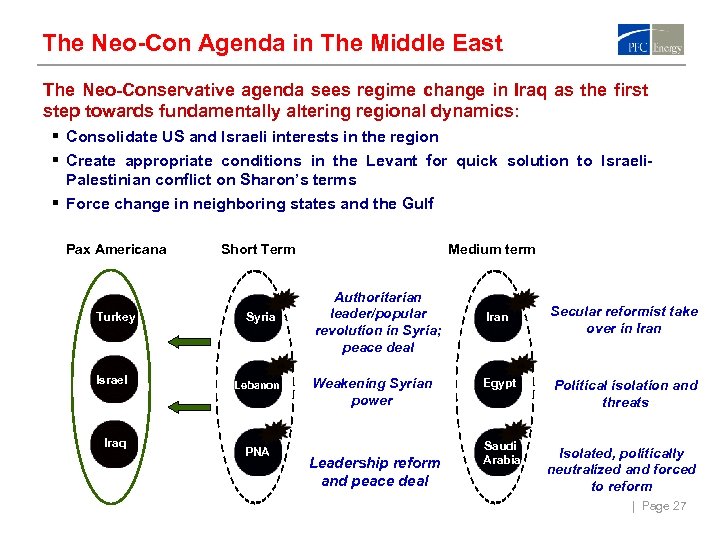
The Neo-Con Agenda in The Middle East The Neo-Conservative agenda sees regime change in Iraq as the first step towards fundamentally altering regional dynamics: § Consolidate US and Israeli interests in the region § Create appropriate conditions in the Levant for quick solution to Israeli. Palestinian conflict on Sharon’s terms § Force change in neighboring states and the Gulf Pax Americana Turkey Israel Short Term Syria Lebanon PNA Iraq Medium term Authoritarian leader/popular revolution in Syria; peace deal Weakening Syrian power Leadership reform and peace deal Iran Egypt PNA Saudi Arabia Secular reformist take over in Iran Political isolation and threats Isolated, politically neutralized and forced to reform | Page 27
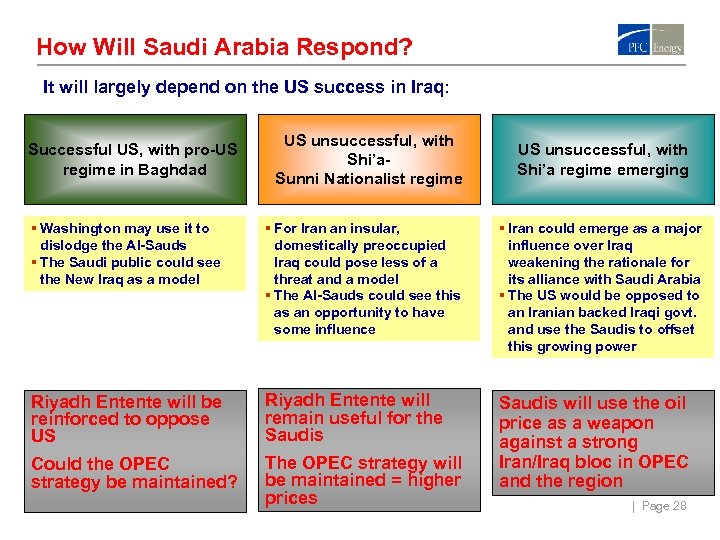
How Will Saudi Arabia Respond? It will largely depend on the US success in Iraq: Successful US, with pro-US regime in Baghdad US unsuccessful, with Shi’a. Sunni Nationalist regime US unsuccessful, with Shi’a regime emerging § Washington may use it to dislodge the Al-Sauds § The Saudi public could see the New Iraq as a model § For Iran an insular, domestically preoccupied Iraq could pose less of a threat and a model § The Al-Sauds could see this as an opportunity to have some influence § Iran could emerge as a major influence over Iraq weakening the rationale for its alliance with Saudi Arabia § The US would be opposed to an Iranian backed Iraqi govt. and use the Saudis to offset this growing power Riyadh Entente will be reinforced to oppose US Riyadh Entente will remain useful for the Saudis Could the OPEC strategy be maintained? The OPEC strategy will be maintained = higher prices Saudis will use the oil price as a weapon against a strong Iran/Iraq bloc in OPEC and the region | Page 28
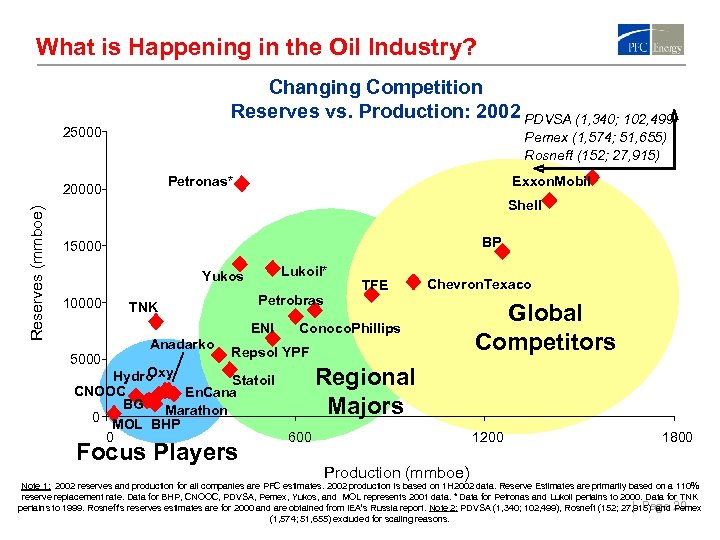
What is Happening in the Oil Industry? Changing Competition Reserves vs. Production: 2002 PDVSA (1, 340; 102, 499) 25000 Pemex (1, 574; 51, 655) Rosneft (152; 27, 915) Petronas* Reserves (mmboe) 20000 Exxon. Mobil Shell BP 15000 Lukoil* Yukos 10000 Petrobras TNK ENI Anadarko 5000 TFE Chevron. Texaco Conoco. Phillips Repsol YPF Oxy Hydro Statoil CNOOC En. Cana BG Marathon 0 MOL BHP 0 600 Focus Players Global Competitors Regional Majors 1200 Production (mmboe) 1800 Note 1: 2002 reserves and production for all companies are PFC estimates. 2002 production is based on 1 H 2002 data. Reserve Estimates are primarily based on a 110% reserve replacement rate. Data for BHP, CNOOC, PDVSA, Pemex, Yukos, and MOL represents 2001 data. * Data for Petronas and Lukoil pertains to 2000. Data for TNK | Page Pemex pertains to 1999. Rosneft’s reserves estimates are for 2000 and are obtained from IEA’s Russia report. Note 2: PDVSA (1, 340; 102, 499), Rosneft (152; 27, 915) and 29 (1, 574; 51, 655) excluded for scaling reasons.
Replacing Core Areas § Many core areas in maturity phase – Business going to Non-OECD basins – Strategy depends on region (e. g. , Petrobras, Repsol YPF, and PDVSA in Latin America and Petronas in Asia-Pacific) § Selected “oil cores” transiting to gas § With the exception of deepwater plays, major companies are not creating new core areas through exploration, but through production deals § Production deals create new challenges -- new risks § Core “transitions” from oil risk to gas risk -- e. g. technical to commercial | Page 30
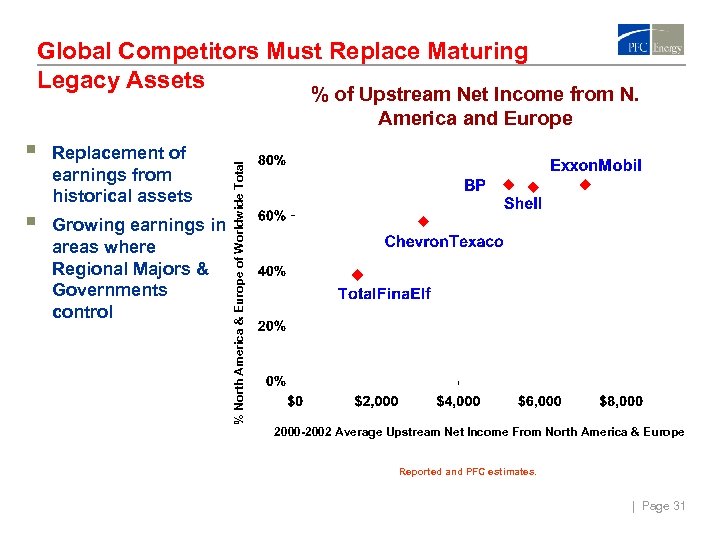
Global Competitors Must Replace Maturing Legacy Assets § Replacement of earnings from historical assets § Growing earnings in areas where Regional Majors & Governments control % North America & Europe of Worldwide Total % of Upstream Net Income from N. America and Europe 2000 -2002 Average Upstream Net Income From North America & Europe Reported and PFC estimates. | Page 31
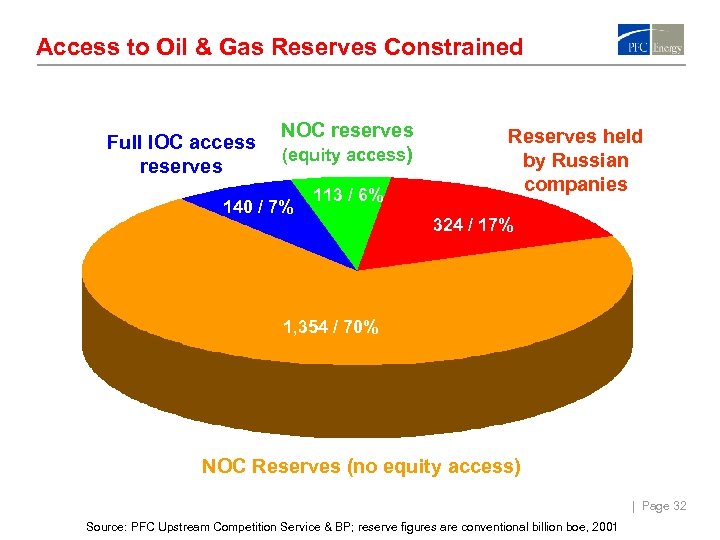
Access to Oil & Gas Reserves Constrained Full IOC access reserves NOC reserves (equity access) 140 / 7% 113 / 6% Reserves held by Russian companies 324 / 17% 1, 354 / 70% NOC Reserves (no equity access) | Page 32 Source: PFC Upstream Competition Service & BP; reserve figures are conventional billion boe, 2001
Industry Shift § Divestiture in mature areas § Majors withdrawing from non-strategic areas § Independents moving in and aggregating positions § New independents likely to be created to capture opportunities unattractive to large independents | Page 33
National Oil Companies § NOCs growing importance in the industry – Generally more commercial and some privatizing § But NOCs can be threat to state especially if political leadership is from different background from NOC managers § Distrust of IOCs falling – even among populist or leftist governments – States looking for production deals to attract capital and technology § What States want is evolving so IOC access issue is a very dynamic and at times confusing one for IOCs | Page 34
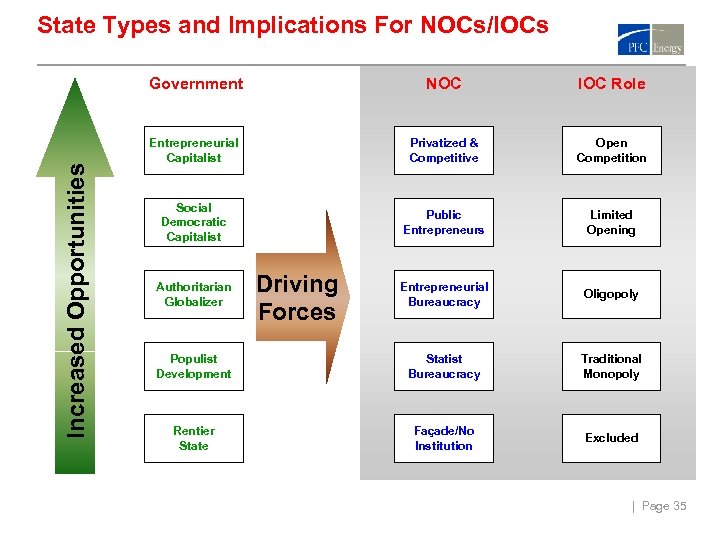
State Types and Implications For NOCs/IOCs Increased Opportunities Government NOC IOC Role Entrepreneurial Capitalist Privatized & Competitive Open Competition Social Democratic Capitalist Public Entrepreneurs Limited Opening Entrepreneurial Bureaucracy Oligopoly Populist Development Statist Bureaucracy Traditional Monopoly Rentier State Façade/No Institution Excluded Authoritarian Globalizer Driving Forces | Page 35
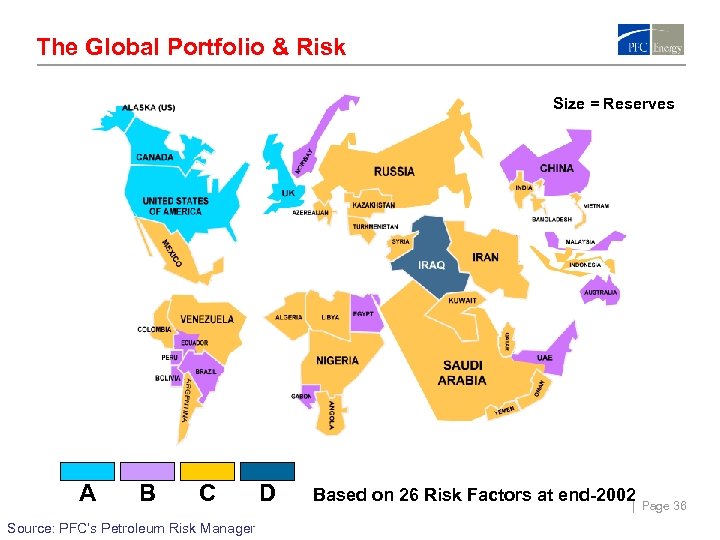
The Global Portfolio & Risk Size = Reserves A B C Source: PFC’s Petroleum Risk Manager D Based on 26 Risk Factors at end-2002 | Page 36
US Nat. Gas Supply: A Pressing Issue § Energy security also means natural gas supply security – Defined as reliable supply at a reasonable cost § Demand encouraged, but supply shrinking – Washington encouraged the growing consumption of gas but has actively discouraged production – In 2002, gas supply has declined by 5. 6% in continental US, forcing the suppression of industrial demand – In the next few months, up to 4 bcf of industrial demand need to be suppressed to allow storage to refill for next winter – Industries and jobs lost in the US | Page 37
US Nat. Gas Supply: A Political Question? § Continental supply is extremely difficult to grow quickly -- no matter how high the price: – Basin exhaustion a fact of life in a mature asset base – Accelerating decline rates creating treadmill effect – Regulatory hurdles for areas now open to exploration – Access to federal land practically closed – Offshore Florida, California and East Coast closed – LNG: siting issues, so little help in the foreseeable future – Alaskan/Mac. Kenzie Delta pipelines: Right Answer, wrong decade | Page 38
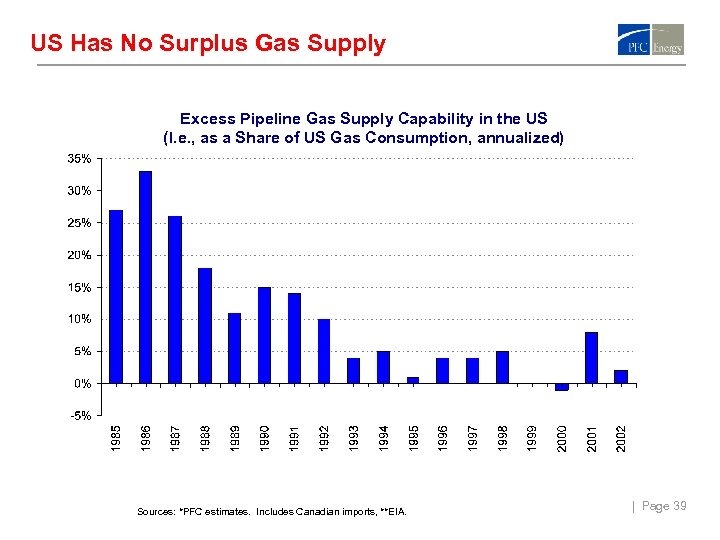
US Has No Surplus Gas Supply Excess Pipeline Gas Supply Capability in the US (I. e. , as a Share of US Gas Consumption, annualized) Sources: *PFC estimates. Includes Canadian imports, **EIA. | Page 39
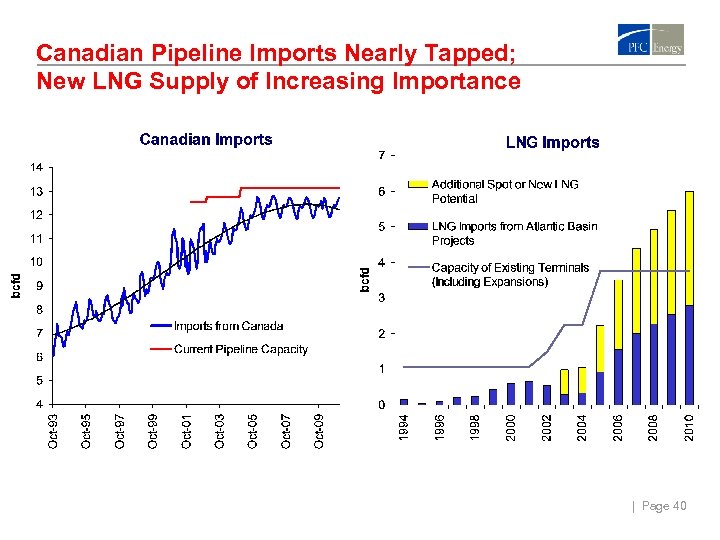
Canadian Pipeline Imports Nearly Tapped; New LNG Supply of Increasing Importance | Page 40
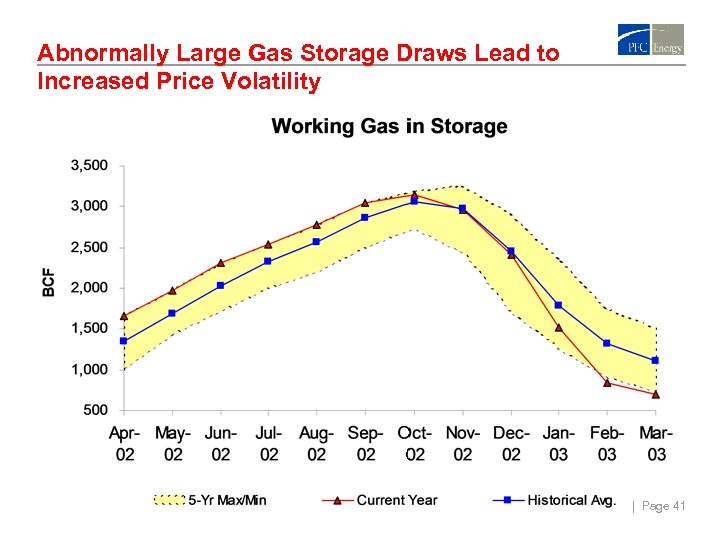
Abnormally Large Gas Storage Draws Lead to Increased Price Volatility | Page 41
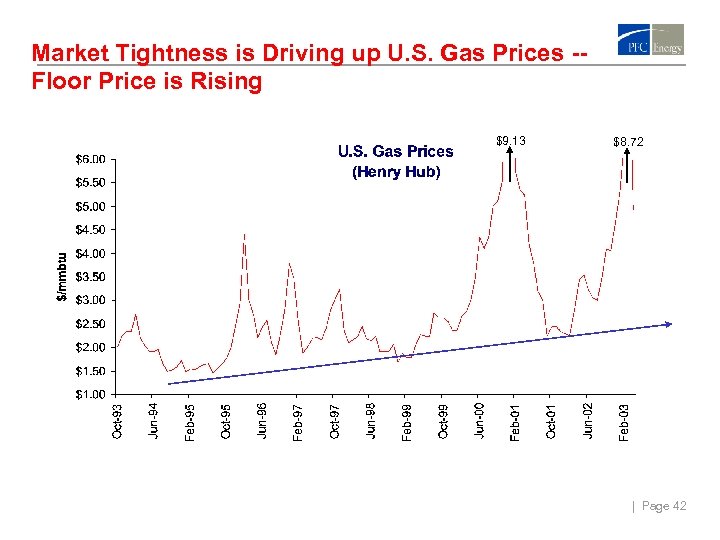
Market Tightness is Driving up U. S. Gas Prices -Floor Price is Rising $9. 13 $8. 72 | Page 42

Corporate Offices 1300 Connecticut Avenue, N. W. Suite 800 Washington, DC 20036 USA Tel: 1 -202 -872 -1199 Fax: 1 -202 -872 -1219 3, Cité Paradis 75010 Paris, France Tel : (33. 1) 4770 -2900 Fax : (33. 1) 4770 -2737 Strategic Advisors in Global Energy Houston, Texas Tel : 1 -281 -599 -7099 Fax: 1 -281 -599 -9891 info@pfcenergy. com www. pfcenergy. com
Скачать презентацию The Geopolitics of Energy Presentation by Strategic Advisors
516d2f35a48642c1b317bf3fc0705854.ppt