 Скачать презентацию The GE Honeywell merger and the issue of bundling
a0815b0fc765d3ddce81cfe29a8a0c1b.ppt
- Количество слайдов: 17



The GE/Honeywell merger and the issue of bundling
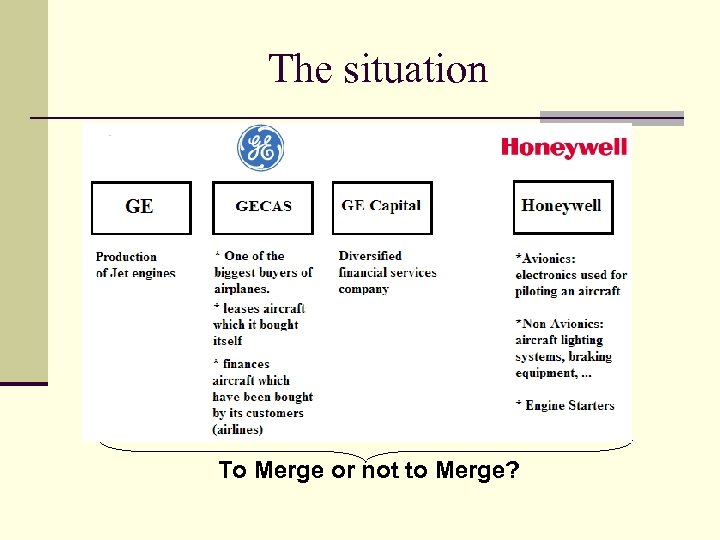
The situation To Merge or not to Merge?
The European Commission prohibited the US-merger n 2 arguments: n Market foreclosure through bundling of GE and Honeywell products n Market foreclosure through the vertical integration of Honeywell with GECAS, GE’s leasing arm
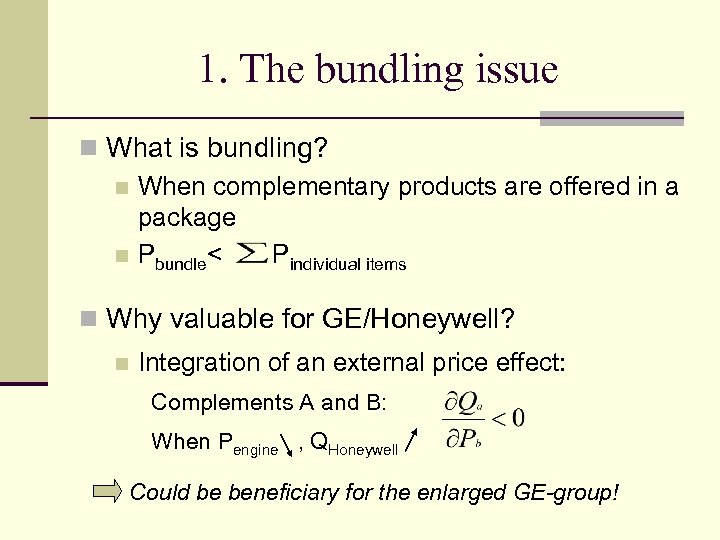
1. The bundling issue n What is bundling? n When complementary products are offered in a package n Pbundle< Pindividual items n Why valuable for GE/Honeywell? n Integration of an external price effect: Complements A and B: When Pengine , QHoneywell Could be beneficiary for the enlarged GE-group!
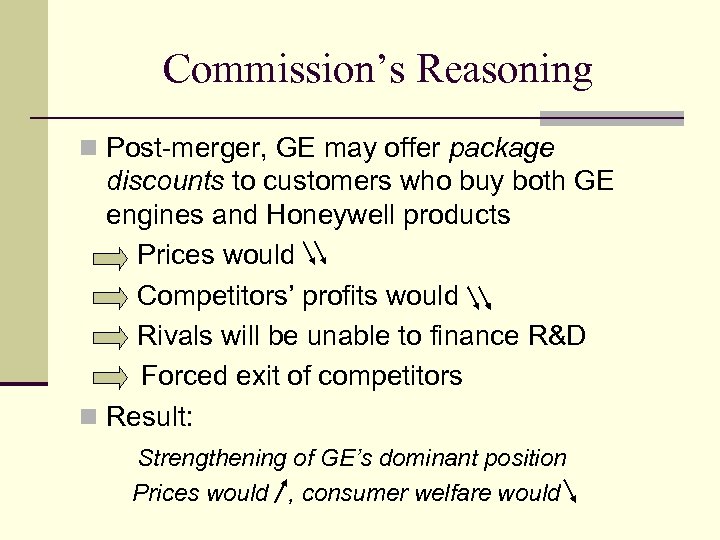
Commission’s Reasoning n Post-merger, GE may offer package discounts to customers who buy both GE engines and Honeywell products Prices would Competitors’ profits would Rivals will be unable to finance R&D Forced exit of competitors n Result: Strengthening of GE’s dominant position Prices would , consumer welfare would
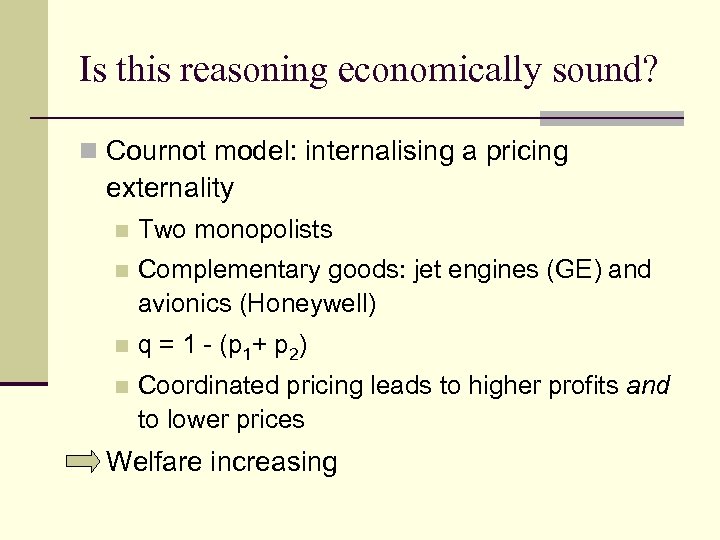
Is this reasoning economically sound? n Cournot model: internalising a pricing externality n Two monopolists n Complementary goods: jet engines (GE) and avionics (Honeywell) n q = 1 - (p 1+ p 2) n Coordinated pricing leads to higher profits and to lower prices Welfare increasing
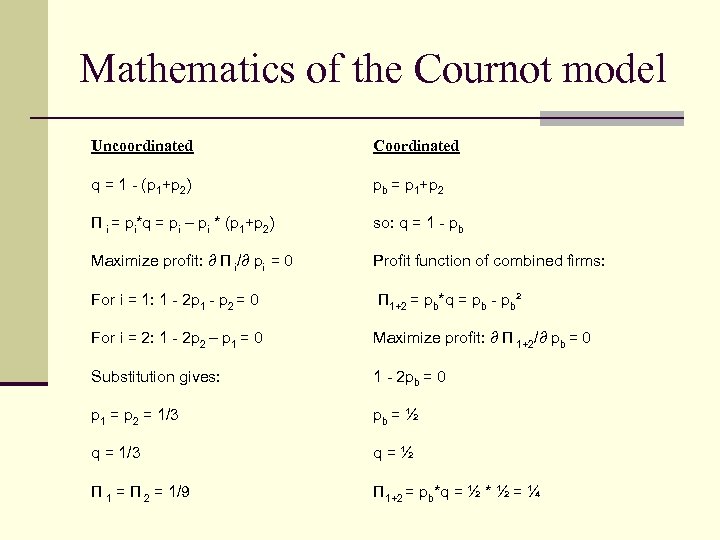
Mathematics of the Cournot model Uncoordinated Coordinated q = 1 - (p 1+p 2) pb = p 1+p 2 П i = pi*q = pi – pi * (p 1+p 2) so: q = 1 - pb Maximize profit: ∂ П i/∂ pi = 0 Profit function of combined firms: For i = 1: 1 - 2 p 1 - p 2 = 0 П 1+2 = pb*q = pb - pb² For i = 2: 1 - 2 p 2 – p 1 = 0 Maximize profit: ∂ П 1+2/∂ pb = 0 Substitution gives: 1 - 2 pb = 0 p 1 = p 2 = 1/3 pb = ½ q = 1/3 q=½ П 1 = П 2 = 1/9 П 1+2 = pb*q = ½ * ½ = ¼
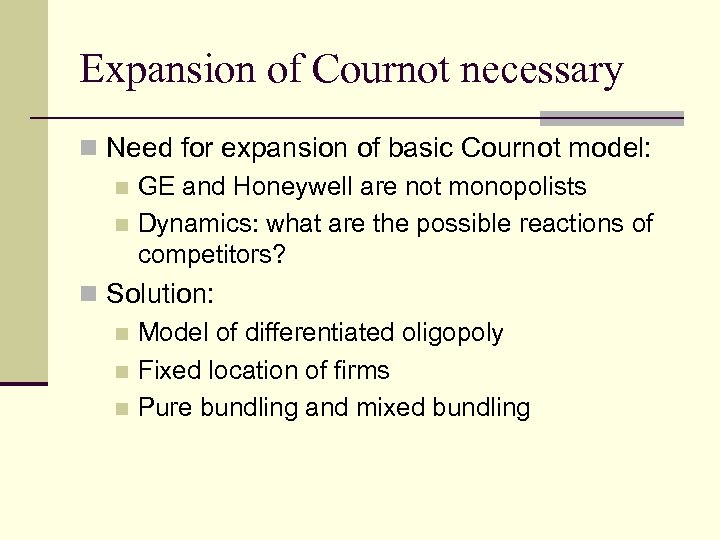
Expansion of Cournot necessary n Need for expansion of basic Cournot model: n GE and Honeywell are not monopolists n Dynamics: what are the possible reactions of competitors? n Solution: n Model of differentiated oligopoly n Fixed location of firms n Pure bundling and mixed bundling
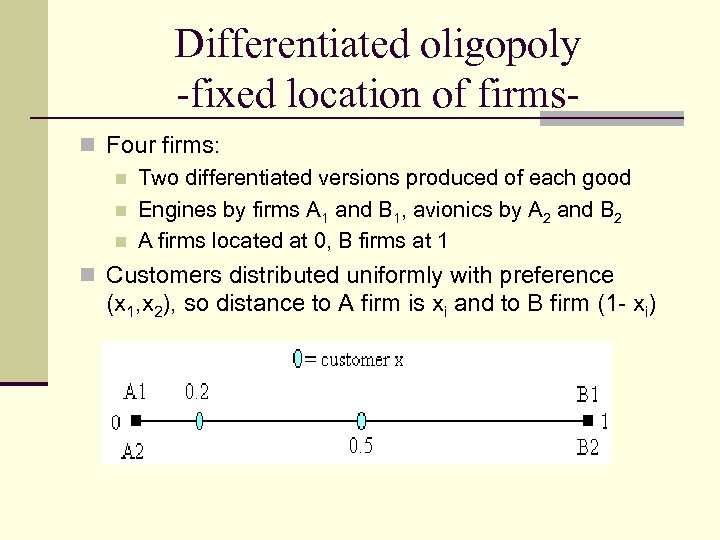
Differentiated oligopoly -fixed location of firmsn Four firms: n Two differentiated versions produced of each good n Engines by firms A 1 and B 1, avionics by A 2 and B 2 n A firms located at 0, B firms at 1 n Customers distributed uniformly with preference (x 1, x 2), so distance to A firm is xi and to B firm (1 - xi)
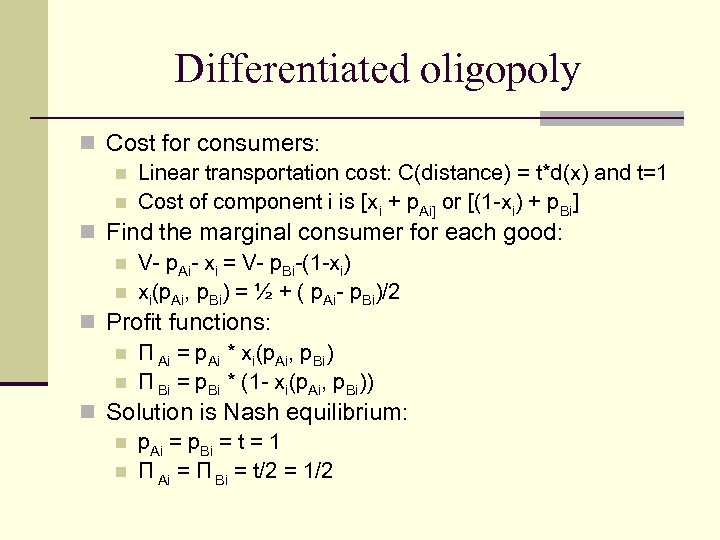
Differentiated oligopoly n Cost for consumers: n Linear transportation cost: C(distance) = t*d(x) and t=1 n Cost of component i is [xi + p. Ai] or [(1 -xi) + p. Bi] n Find the marginal consumer for each good: n V- p. Ai- xi = V- p. Bi-(1 -xi) n xi(p. Ai, p. Bi) = ½ + ( p. Ai- p. Bi)/2 n Profit functions: n П Ai = p. Ai * xi(p. Ai, p. Bi) n П Bi = p. Bi * (1 - xi(p. Ai, p. Bi)) n Solution is Nash equilibrium: n p. Ai = p. Bi = t = 1 n П Ai = П Bi = t/2 = 1/2
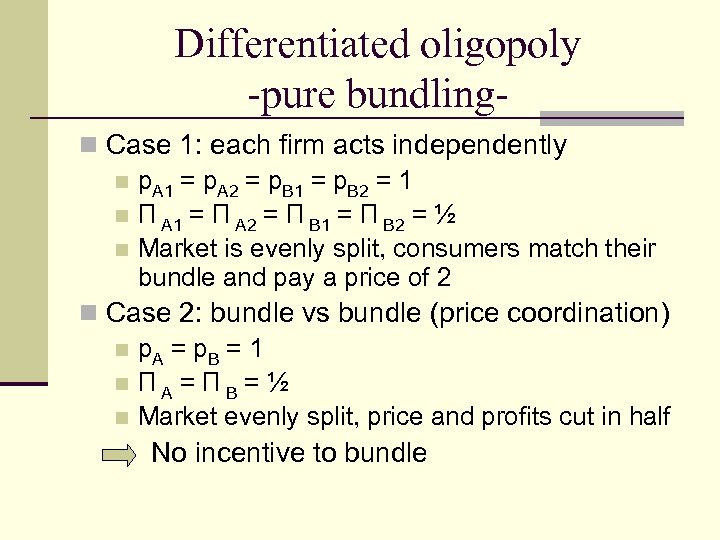
Differentiated oligopoly -pure bundlingn Case 1: each firm acts independently n p. A 1 = p. A 2 = p. B 1 = p. B 2 = 1 n П A 1 = П A 2 = П B 1 = П B 2 = ½ n Market is evenly split, consumers match their bundle and pay a price of 2 n Case 2: bundle vs bundle (price coordination) n p. A = p. B = 1 n ПA = ПB = ½ n Market evenly split, price and profits cut in half No incentive to bundle
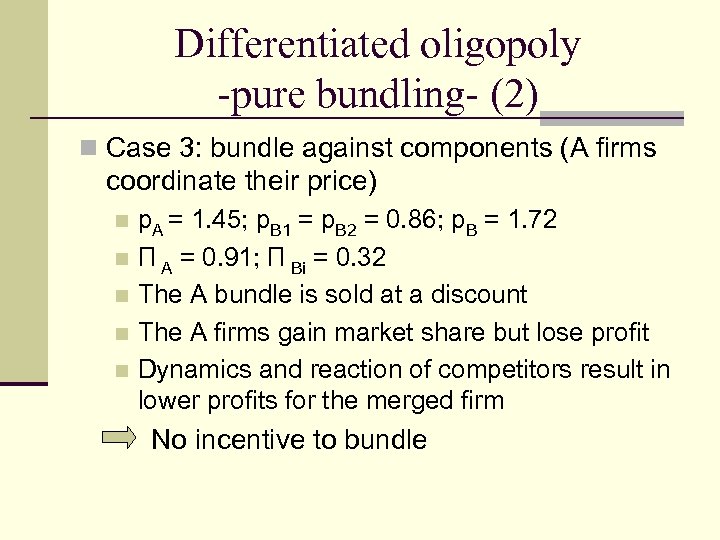
Differentiated oligopoly -pure bundling- (2) n Case 3: bundle against components (A firms coordinate their price) p. A = 1. 45; p. B 1 = p. B 2 = 0. 86; p. B = 1. 72 n П A = 0. 91; П Bi = 0. 32 n The A bundle is sold at a discount n The A firms gain market share but lose profit n Dynamics and reaction of competitors result in lower profits for the merged firm n No incentive to bundle
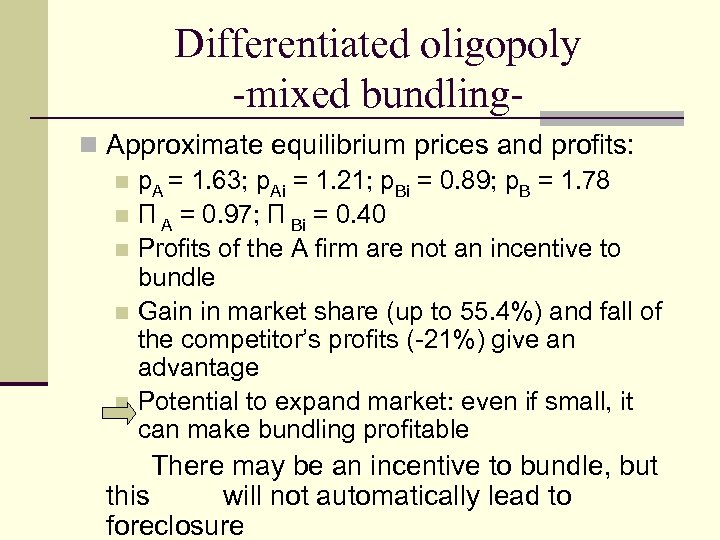
Differentiated oligopoly -mixed bundlingn Approximate equilibrium prices and profits: n p. A = 1. 63; p. Ai = 1. 21; p. Bi = 0. 89; p. B = 1. 78 n П A = 0. 97; П Bi = 0. 40 n Profits of the A firm are not an incentive to bundle n Gain in market share (up to 55. 4%) and fall of the competitor’s profits (-21%) give an advantage n Potential to expand market: even if small, it can make bundling profitable There may be an incentive to bundle, but this will not automatically lead to foreclosure
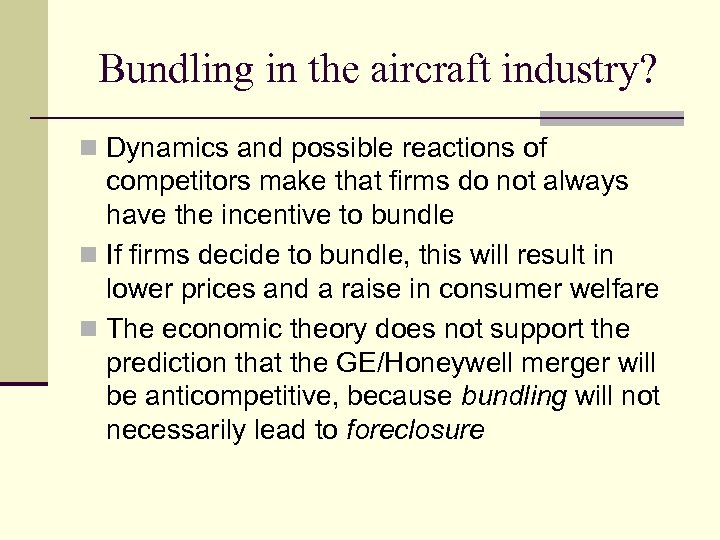
Bundling in the aircraft industry? n Dynamics and possible reactions of competitors make that firms do not always have the incentive to bundle n If firms decide to bundle, this will result in lower prices and a raise in consumer welfare n The economic theory does not support the prediction that the GE/Honeywell merger will be anticompetitive, because bundling will not necessarily lead to foreclosure
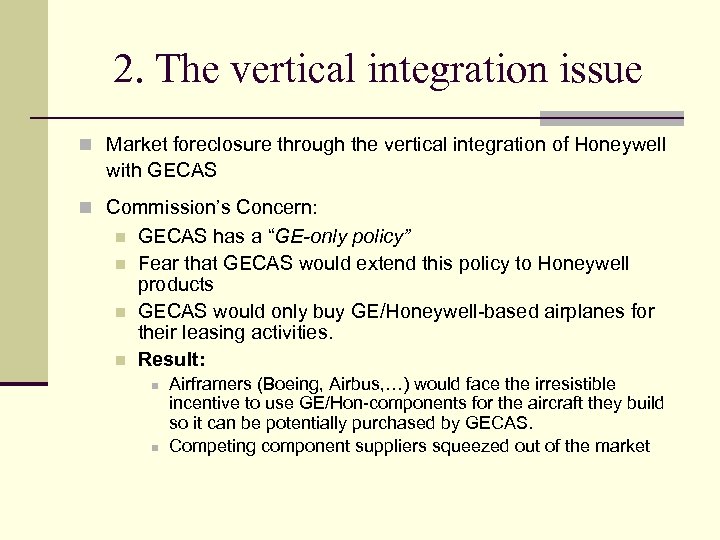
2. The vertical integration issue n Market foreclosure through the vertical integration of Honeywell with GECAS n Commission’s Concern: n n GECAS has a “GE-only policy” Fear that GECAS would extend this policy to Honeywell products GECAS would only buy GE/Honeywell-based airplanes for their leasing activities. Result: n n Airframers (Boeing, Airbus, …) would face the irresistible incentive to use GE/Hon-components for the aircraft they build so it can be potentially purchased by GECAS. Competing component suppliers squeezed out of the market
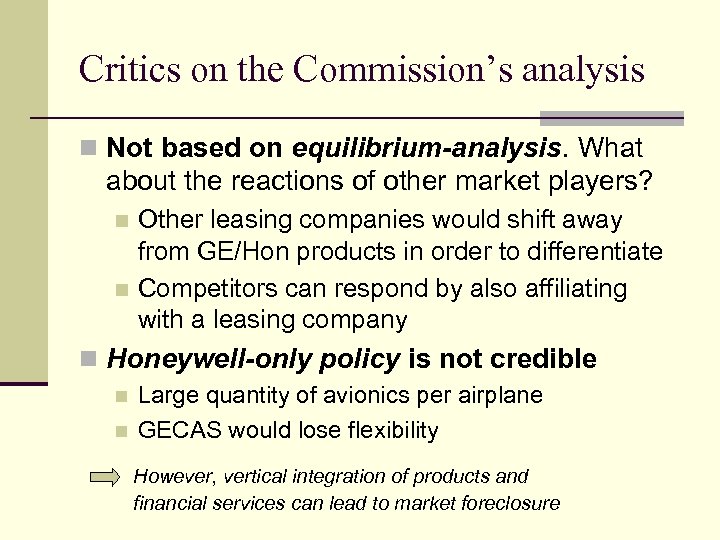
Critics on the Commission’s analysis n Not based on equilibrium-analysis. What about the reactions of other market players? Other leasing companies would shift away from GE/Hon products in order to differentiate n Competitors can respond by also affiliating with a leasing company n n Honeywell-only policy is not credible n n Large quantity of avionics per airplane GECAS would lose flexibility However, vertical integration of products and financial services can lead to market foreclosure
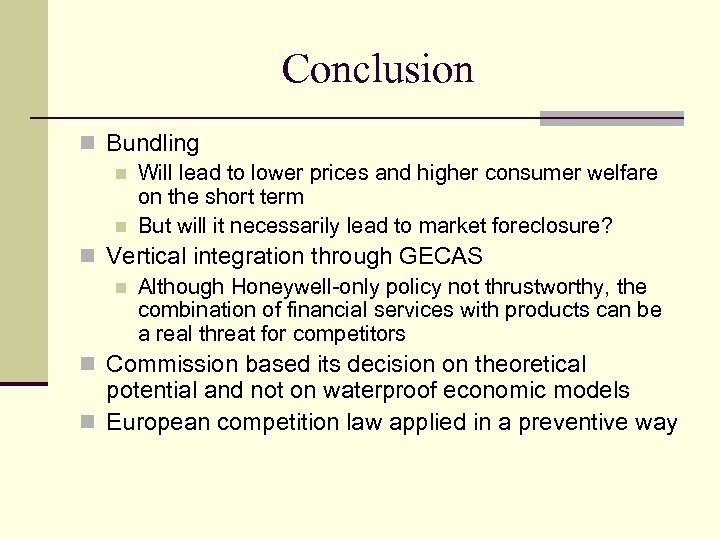
Conclusion n Bundling n Will lead to lower prices and higher consumer welfare on the short term n But will it necessarily lead to market foreclosure? n Vertical integration through GECAS n Although Honeywell-only policy not thrustworthy, the combination of financial services with products can be a real threat for competitors n Commission based its decision on theoretical potential and not on waterproof economic models n European competition law applied in a preventive way
Скачать презентацию The GE Honeywell merger and the issue of bundling
a0815b0fc765d3ddce81cfe29a8a0c1b.ppt