


 Скачать презентацию The Gamma-ray Large Area Space Telescope GLAST and
165773b498617327b6ffbd7f95e9668b.ppt
- Количество слайдов: 1
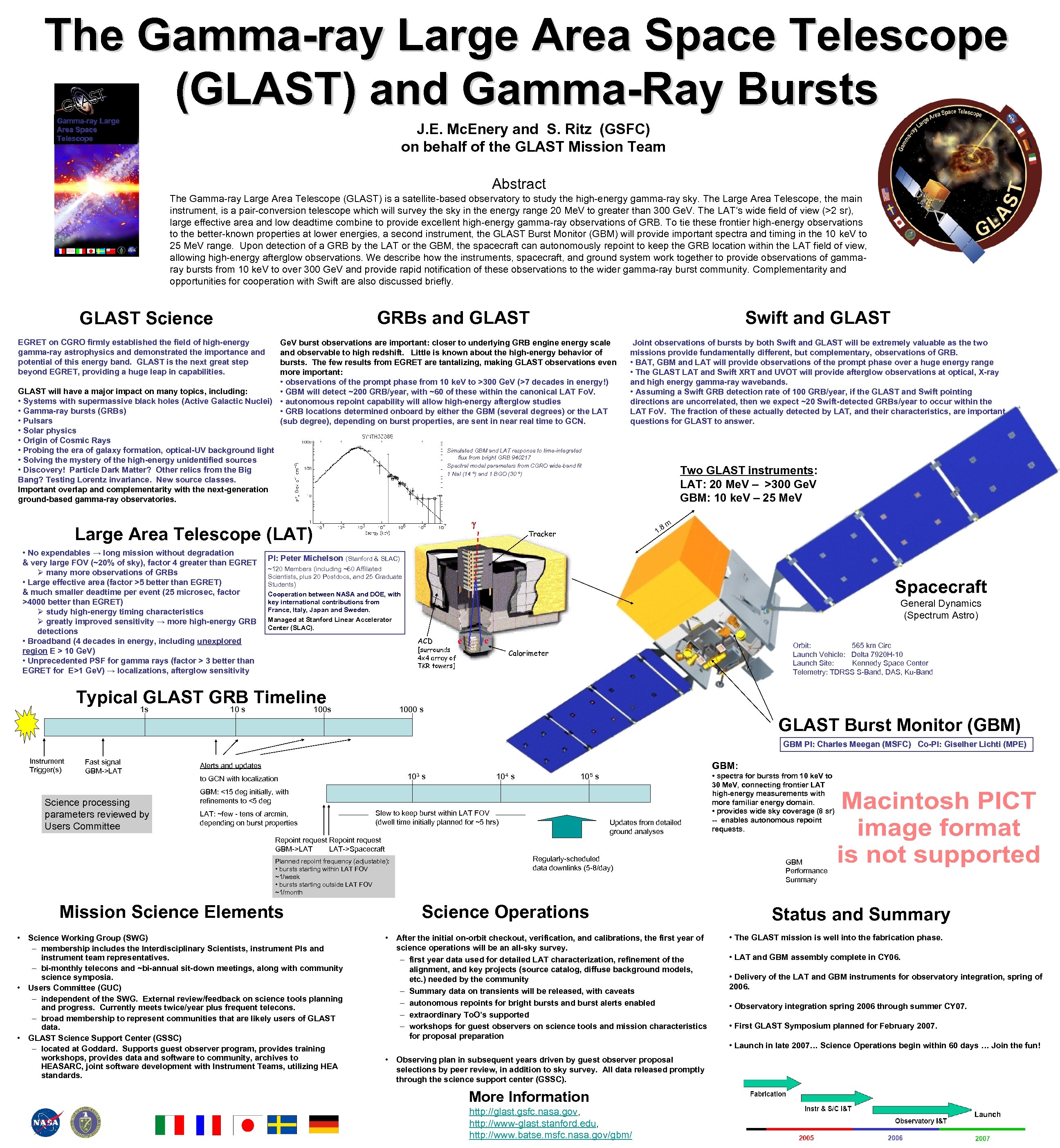 The Gamma-ray Large Area Space Telescope (GLAST) and Gamma-Ray Bursts Gamma-ray Large Area Space Telescope J. E. Mc. Enery and S. Ritz (GSFC) on behalf of the GLAST Mission Team Abstract The Gamma-ray Large Area Telescope (GLAST) is a satellite-based observatory to study the high-energy gamma-ray sky. The Large Area Telescope, the main instrument, is a pair-conversion telescope which will survey the sky in the energy range 20 Me. V to greater than 300 Ge. V. The LAT’s wide field of view (>2 sr), large effective area and low deadtime combine to provide excellent high-energy gamma-ray observations of GRB. To tie these frontier high-energy observations to the better-known properties at lower energies, a second instrument, the GLAST Burst Monitor (GBM) will provide important spectra and timing in the 10 ke. V to 25 Me. V range. Upon detection of a GRB by the LAT or the GBM, the spacecraft can autonomously repoint to keep the GRB location within the LAT field of view, allowing high-energy afterglow observations. We describe how the instruments, spacecraft, and ground system work together to provide observations of gammaray bursts from 10 ke. V to over 300 Ge. V and provide rapid notification of these observations to the wider gamma-ray burst community. Complementarity and opportunities for cooperation with Swift are also discussed briefly. GRBs and GLAST Science Swift and GLAST EGRET on CGRO firmly established the field of high-energy gamma-ray astrophysics and demonstrated the importance and potential of this energy band. GLAST is the next great step beyond EGRET, providing a huge leap in capabilities. Ge. V burst observations are important: closer to underlying GRB engine energy scale and observable to high redshift. Little is known about the high-energy behavior of bursts. The few results from EGRET are tantalizing, making GLAST observations even more important: • observations of the prompt phase from 10 ke. V to >300 Ge. V (>7 decades in energy!) GLAST will have a major impact on many topics, including: • GBM will detect ~200 GRB/year, with ~60 of these within the canonical LAT Fo. V. • Systems with supermassive black holes (Active Galactic Nuclei) • autonomous repoint capability will allow high-energy afterglow studies • Gamma-ray bursts (GRBs) • GRB locations determined onboard by either the GBM (several degrees) or the LAT • Pulsars (sub degree), depending on burst properties, are sent in near real time to GCN. • Solar physics • Origin of Cosmic Rays Simulated GBM and LAT response to time-integrated • Probing the era of galaxy formation, optical-UV background light flux from bright GRB 940217 • Solving the mystery of the high-energy unidentified sources Spectral model parameters from CGRO wide-band fit • Discovery! Particle Dark Matter? Other relics from the Big 1 Na. I (14 º) and 1 BGO (30 º) Bang? Testing Lorentz invariance. New source classes. Important overlap and complementarity with the next-generation ground-based gamma-ray observatories. Large Area Telescope (LAT) • No expendables → long mission without degradation & very large FOV (~20% of sky), factor 4 greater than EGRET Ø many more observations of GRBs • Large effective area (factor >5 better than EGRET) & much smaller deadtime per event (25 microsec, factor >4000 better than EGRET) Ø study high-energy timing characteristics Ø greatly improved sensitivity → more high-energy GRB detections • Broadband (4 decades in energy, including unexplored region E > 10 Ge. V) • Unprecedented PSF for gamma rays (factor > 3 better than EGRET for E>1 Ge. V) → localizations, afterglow sensitivity Two GLAST instruments: LAT: 20 Me. V – >300 Ge. V GBM: 10 ke. V – 25 Me. V 1. 8 Tracker m PI: Peter Michelson (Stanford & SLAC) ~120 Members (including ~60 Affiliated Scientists, plus 20 Postdocs, and 25 Graduate Students) Spacecraft Cooperation between NASA and DOE, with key international contributions from France, Italy, Japan and Sweden. Managed at Stanford Linear Accelerator Center (SLAC). General Dynamics (Spectrum Astro) ACD [surrounds e+ e– 10 s 100 s Orbit: 565 km Circ Launch Vehicle: Delta 7920 H-10 Launch Site: Kennedy Space Center Telemetry: TDRSS S-Band, DAS, Ku-Band Calorimeter 4 x 4 array of TKR towers] Typical GLAST GRB Timeline 1 s Joint observations of bursts by both Swift and GLAST will be extremely valuable as the two missions provide fundamentally different, but complementary, observations of GRB. • BAT, GBM and LAT will provide observations of the prompt phase over a huge energy range • The GLAST LAT and Swift XRT and UVOT will provide afterglow observations at optical, X-ray and high energy gamma-ray wavebands. • Assuming a Swift GRB detection rate of 100 GRB/year, if the GLAST and Swift pointing directions are uncorrelated, then we expect ~20 Swift-detected GRBs/year to occur within the LAT Fo. V. The fraction of these actually detected by LAT, and their characteristics, are important questions for GLAST to answer. 1000 s GLAST Burst Monitor (GBM) GBM PI: Charles Meegan (MSFC) Co-PI: Giselher Lichti (MPE) Instrument Trigger(s) Fast signal GBM->LAT Science processing parameters reviewed by Users Committee GBM: Alerts and updates 103 s to GCN with localization 104 s 105 s GBM: <15 deg initially, with refinements to <5 deg LAT: ~few - tens of arcmin, depending on burst properties Slew to keep burst within LAT FOV (dwell time initially planned for ~5 hrs) Updates from detailed ground analyses • spectra for bursts from 10 ke. V to 30 Me. V, connecting frontier LAT high-energy measurements with more familiar energy domain. • provides wide sky coverage (8 sr) -- enables autonomous repoint requests. Repoint request GBM->LAT LAT->Spacecraft Planned repoint frequency (adjustable): • bursts starting within LAT FOV ~1/week • bursts starting outside LAT FOV ~1/month Mission Science Elements • Science Working Group (SWG) – membership includes the Interdisciplinary Scientists, instrument PIs and instrument team representatives. – bi-monthly telecons and ~bi-annual sit-down meetings, along with community science symposia. • Users Committee (GUC) – independent of the SWG. External review/feedback on science tools planning and progress. Currently meets twice/year plus frequent telecons. – broad membership to represent communities that are likely users of GLAST data. • GLAST Science Support Center (GSSC) – located at Goddard. Supports guest observer program, provides training workshops, provides data and software to community, archives to HEASARC, joint software development with Instrument Teams, utilizing HEA standards. Regularly-scheduled data downlinks (5 -8/day) Science Operations • After the initial on-orbit checkout, verification, and calibrations, the first year of science operations will be an all-sky survey. – first year data used for detailed LAT characterization, refinement of the alignment, and key projects (source catalog, diffuse background models, etc. ) needed by the community – Summary data on transients will be released, with caveats – autonomous repoints for bright bursts and burst alerts enabled – extraordinary To. O’s supported – workshops for guest observers on science tools and mission characteristics for proposal preparation GBM Performance Summary Status and Summary • The GLAST mission is well into the fabrication phase. • LAT and GBM assembly complete in CY 06. • Delivery of the LAT and GBM instruments for observatory integration, spring of 2006. • Observatory integration spring 2006 through summer CY 07. • First GLAST Symposium planned for February 2007. • Launch in late 2007… Science Operations begin within 60 days … Join the fun! • Observing plan in subsequent years driven by guest observer proposal selections by peer review, in addition to sky survey. All data released promptly through the science support center (GSSC). More Information http: //glast. gsfc. nasa. gov, http: //www-glast. stanford. edu, http: //www. batse. msfc. nasa. gov/gbm/ Launch