 Скачать презентацию THE FUTURE OF THE PUBLIC S HEALTH in the
26fa25b2e8177828d201c59d25a74d66.ppt
- Количество слайдов: 52



THE FUTURE OF THE PUBLIC’S HEALTH in the 21 st Century INSTITUTE OF MEDICINE OF THE NATIONAL ACADEMIES 3/18/2018 Committee on Assuring the Health of the Public in the 21 st Century
Approach and rationale · · Health = public good = social goal of many sectors and communities Government has fundamental, statutory duty to assure the health of the public, but Government cannot do it alone Need for intersectoral engagement in partnership with government. 3/18/2018
Approach and rationale • In 1988 report, public health refers to the organized efforts of society, both government and others, to assure the population’s health. • The 2002 report elaborates on the efforts of the other potential public health system actors. 3/18/2018
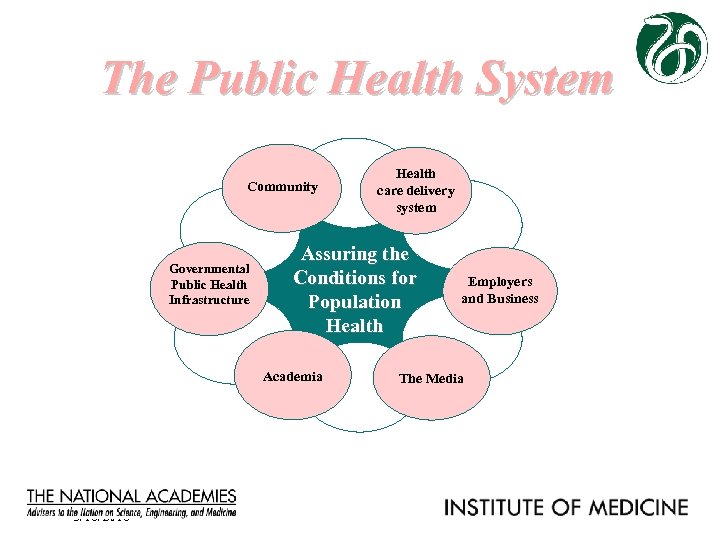
The Public Health System Community Governmental Public Health Infrastructure Assuring the Conditions for Population Health Academia 3/18/2018 Health care delivery system Employers and Business The Media
Areas of action and change • Adopt a population-level approach, including multiple determinants of health • Strengthen the governmental public health infrastructure • Build partnerships • Develop systems of accountability • Base policy and practice on evidence • Enhance communication 3/18/2018
Infrastructure Recommendations to Congress Recommendation 2. All government public health agencies should develop strategies to ensure that public health workers who are involved in the provision of essential public health services demonstrate mastery of the core public health competencies appropriate to their jobs. 3/18/2018
Infrastructure Recommendations to Congress Recommendation 3. Designate funds to CDC and HRSA to support periodic assessment of workforce preparedness, and the provision of needed training. 3/18/2018
Infrastructure Recommendations to the Secretary of HHS and DHHS agencies Recommendation 4. Leadership training, support, and development should be a high priority for government public health agencies and other organization in the public health system and for schools of public health that supply the public health infrastructure with its professionals and leaders. 3/18/2018
Academia Recommendations to Congress Recommendation 29. Increase funding for HRSA programs that support public health students, the Public Health Training Center, and the National and Regional Leadership Institutes that train public health and community leaders. 3/18/2018
Infrastructure Recommendations to the Secretary of HHS and DHHS agencies Recommendation 5. Initiate a broad-based national dialogue, led by a national commission convened by the Secretary of HHS, to explore perspectives on workforce credentialing, and to outline next steps based on decisions reached. 3/18/2018
Infrastructure Recommendations to the Secretary of HHS and DHHS agencies Recommendation 13. Develop a research agenda and estimate the funding needed to build the evidence base that will guide policy making for public health practice. 3/18/2018
Health Care Delivery System Recommendations to government and others Recommendation 20. Federal government and other major investors in health care should support bold, large-scale demonstrations to test radical new approaches to increase the efficiency and effectiveness of health care finance and delivery systems. 3/18/2018
Business and Employers Recommendations to government and business Recommendation 22. The corporate community and public health agencies should engage in joint efforts to strengthen health promotion, and disease and injury prevention programs for employees and their communities, including developing communication and information linkages, enhancing the research base, and recognizing business leadership in employee and community health. 3/18/2018
The Media Recommendations to government agencies and others Recommendation 27. “Public health and communication researchers should develop an evidence base on media influences on health knowledge and behavior, as well as on the promotion of healthy public policy. ” 3/18/2018
Academia Recommendations to Academia and Funders Recommendation 30. “Federal funders of research and academic institutions should recognize and reward faculty scholarship related to public health practice research. ” 3/18/2018
Academia (cont) Recommendations to Congress Recommendation 31. Increase funding to support CDC in enhancing its investigatorinitiated program for prevention research in addition to maintaining a strong program of Centers, Institutes, and Offices (CIO)generated research. 3/18/2018
Academia (cont) Recommendations to CDC should take steps to: • expand the external peer review mechanism for review of investigator-initiated research, • allow more generous time lines, often required by prevention research, • establishing a central mechanism for coordination of investigator-initiated proposal submissions. 3/18/2018
Academia (cont) Recommendations to Congress Recommendation 33. NIH should increase the portion of its budget allocated to population- and community-based prevention research that: • addresses population-level health problems, • involves a definable population and operates at the level of the whole person, 3/18/2018
Academia (cont) Recommendations to Congress Recommendation 33 (cont). NIH should increase the portion of its budget allocated to population- and community-based prevention research that: • evaluates the application and impact of new discoveries on the health of the population • focuses on behavioral and/or environmental factors associated with primary and secondary prevention of disease and disability in populations. 3/18/2018
Academia (cont) Recommendations to Academia Recommendation 34. “Academic institutions should develop criteria for recognizing and rewarding faculty scholarship related to service activities that strengthen public health practice. ” 3/18/2018
Who Will Keep the Public Healthy? Educating Public Health Professionals for the 21 st Century 3/18/2018
Study Charge • To develop a framework for how education, training, and research can be strengthened to meet the needs of future public health professionals to improve population health. 3/18/2018
Who is a public health professional? • A public health professional is a person educated in public health or a related discipline who is employed to improve health through a population focus. 3/18/2018
An Ecological Model of Health • An Ecological Model: – multiple determinants of health – linkages and relationships among determinants are emphasized 3/18/2018
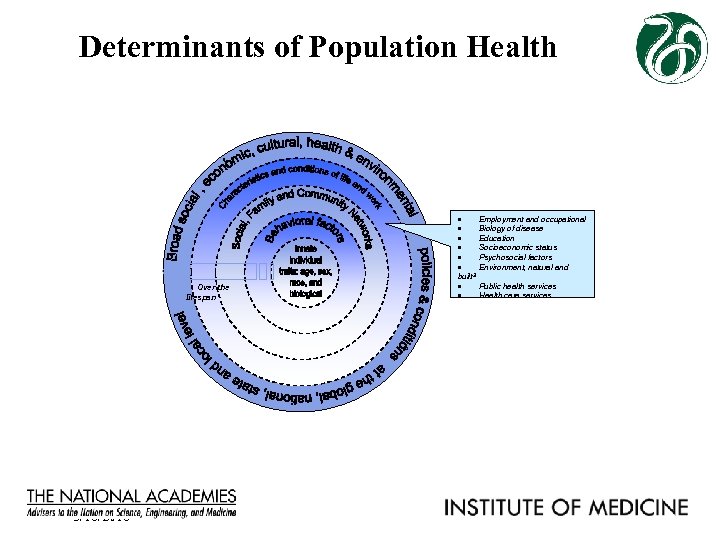
Determinants of Population Health Over the lifespan 3/18/2018 · Employment and occupational · Biology of disease · Education · Socioeconomic status · Psychosocial factors · Environment, natural and built 3 · Public health services · Health care services
Recommendation • Schools of public health should emphasize the importance and centrality of the ecological approach and have a primary role in influencing the incorporation of this ecological view, as well as a population focus, into all health professional education and practice. 3/18/2018
Education in Schools of Public Health • Eight new content areas needed – Informatics Genomics – Communication Cultural competency – Community-based participatory research (CBPR) – Global health Policy and law – Ethics 3/18/2018
Recommendation • For each of the eight emerging content areas, the committee recommends that: – competencies be identified – each area be included in graduate level public health education – continuing development and creation of new knowledge be pursued – opportunity for specialization be offered. 3/18/2018
Schools of Public Health Six Major Responsibilities • Educate the educators, practitioners, and researchers as well as to prepare public health leaders and managers • Serve as a focal point for multi-school transdisciplinary research as well as traditional public health research to improve the health of the public • Contribute to policy that advances the health of the public 3/18/2018
Responsibilities (cont. ) • Work collaboratively with other professional schools to assure quality public health content in their programs • Assure access to life-long learning for the public health workforce • Engage actively with various communities to improve the public’s health. 3/18/2018
Schools of Public Health Recommendation for Education • Schools should embrace as a primary educational mission the preparation of individuals for positions of senior responsibility in public health practice, research and training. 3/18/2018
Schools of Public Health Recommendation for Education • There should be a significant expansion of supervised practice opportunities and sites (e. g. , community-based public health programs, delivery systems, and health agencies). Such field work must be organized and supervised by faculty who have appropriate practical experience. 3/18/2018
Schools of Public Health Recommendation for Access to Life-Long Learning • Schools of public health should fulfill their responsibility for assuring access to life long learning opportunities for several disparate groups including: – public health professionals – other members of the public health workforce – other health professionals who participate in public health activities. 3/18/2018
Research in Schools of Public Health • Should move from research dominated by a single discipline or a small number of disciplines to transdisciplinary research • Transdisciplinary research involves broadly constituted teams of researchers that work across disciplines in the development of the research questions to be addressed. 3/18/2018
Research in Schools of Public Health • Transdisciplinary research implies the conception of research questions that transcend the individual disciplines or specialized knowledge bases because they are intended to solve applied public health research questions that are, by definition, beyond the purview of any single discipline. 3/18/2018
Research in Schools of Public Health • In transdisciplinary research the different specialties combine their expertise (and that of community members) to collectively define the health problem and solutions to be taken. • One qualitative difference in using the transdisciplinary process is that the blending of expert and community input happens holistically, thus producing more integration across disciplines. 3/18/2018
Schools of Public Health Recommendation for Research • Schools of public health should reevaluate their research portfolios as plans are developed for curricular and faculty reform. To foster the envisioned transdisciplinary research, schools may need to establish new relationships with other health science schools, community organizations, health agencies, and groups within their region. 3/18/2018
Schools of Public Health Recommendation for Academic Collaboration • Schools should actively seek opportunities for collaboration in education, research, and faculty development with other academic schools and departments, to increase the number of graduates in health and related disciplines who have had an introduction to public health content and interdisciplinary practice, and to foster research across disciplines. 3/18/2018
Schools of Public Health Recommendation for Community Collaboration • Schools of public health should – position themselves as active participants in community -based research, learning, and service – collaborate with other academic units to provide transdisciplinary approaches to active community involvement to improve population health – provide students with didactic and practical training in community-based public health activities, including policy development and implementation 3/18/2018
Schools of Public Health Recommendation for Community Collaboration • Community-based organizations should have enhanced presence in schools’ advisory, planning, and teaching activities 3/18/2018
Schools of Public Health Recommendation for Faculty • There should be major changes in criteria used to hire and promote school of public health faculty. Criteria should reward experiential excellence in the classroom and the practical training of practitioners. 3/18/2018
Local, State, and Federal Public Health Agencies (cont) • Should – Develop plans, in partnership with schools of public health and accredited public health programs for assuring that public health education and training needs are addressed – develop incentives to encourage continuing education and degree program learning 3/18/2018
Local, State, and Federal Public Health Agencies (cont) • Should – engage in faculty and staff exchanges and collaborations with schools of public health and accredited public health education programs 3/18/2018
Local, State, and Federal Public Health Agencies (cont) • Should – assure that those in public health leadership and management positions within federal, state, and local public health agencies are public health professionals with MPH level education or experience in the ecological approach to public health. 3/18/2018
Federal Public Health Agencies Recommendation • Should provide increased funding to – develop competencies and curriculum in emerging areas of practice – fund degree-oriented public health fellowship programs – provide incentives for developing academic/practice partnerships 3/18/2018
Federal Public Health Agencies Recommendation – support increased participation of public health professionals in the education and training activities of schools and programs of public health; especially, but not solely, practitioners from local and state public health agencies – improve practice experiences for public health students through support for increased numbers and types of agencies and organizations that would serve as sites for practice rotations 3/18/2018
Funding Recommendations • There should be a significant increase in public health research support (i. e. , population health, primary prevention, community-based and public health systems research) with emphasis on transdisciplinary efforts. 3/18/2018
Funding Recommendations (cont) • AHRQ should spearhead a new effort in public health systems research • NIH should launch a new series of faculty development awards (“K” awards) for population health and related areas 3/18/2018
Funding Recommendations (cont) • CDC should redirect current extramural research to increase peer reviewed investigator-initiated awards in population health, prevention, community-based and public policy research. • CDC should reallocate a significant portion of current categorical public health research funding to competitive extramural grants in population health, prevention, community-based, and public health policy research. 3/18/2018
IOM Committee Comments on Public Health Research • Education of public health professionals is built on very slender research base. • Little or no research to support advancing the MPH degree as the hallmark of readiness to practice public health, or on the differential contributions to public health of persons educated in various combinations of professional and on-the-job programs. 3/18/2018
IOM Committee Comments on Public Health Research (cont) • No research on the relationship of staff preparation to outcomes of public health programs. • Only discussion so far of building a public health systems research base. • CDC and HRSA should make funds available for this important research either as specifically funded studies or as components of other research portfolios. 3/18/2018
Community-Based Participatory Research • Community-based participatory research is “a partnership approach to research that equitably involves community members, organizational representatives, and researchers in all aspects of the research process” (Israel, et al. 2001) 3/18/2018
Скачать презентацию THE FUTURE OF THE PUBLIC S HEALTH in the
26fa25b2e8177828d201c59d25a74d66.ppt