


 Скачать презентацию The Future of the New Zealand Economy
edccfce1c994164cdfb64d3eaa61d795.ppt
- Количество слайдов: 23
 The Future of the New Zealand Economy – Where are we heading? Brent Layton EMA’s CEO Network Breakfast 9 May 2006 1
 Short-term • Real Gross Domestic Product (GDP) has not grown over the 9 months to March 2006. • Real GDP is currently forecast by NZIER to grow by 0. 7% in the year to March 2007 and by about 2. 0% in the year to March 2008. • On a per capita basis the picture is even worse. • Business profits have tumbled and according to NZIER’s QSBO they are expected to tumble further 2
 Short-term (2) • Investment is slowing and QSBO’s investment intentions measure indicates it will slow further. The investment in the residential sector will decline sharply. • QSBO’s difficulty of finding labour measure has eased very quickly and firms on balance expect to make further staff reductions. • QSBO’s capacity utilization measure has been falling for eighteen months. • The Reserve Bank (RB) still thinks NZ has an inflation problem. 3
 Short-term (3) • In its March MPS, the RB threatened to hold interest rates at current levels until next year. • It repeated the threat when making its April OCR announcement. • What is spooking the RB into its inflation fears are: – Oil prices. Judging by futures they will go a fair bit higher. – Depreciation of the NZ$. – Current inflation at 3. 3% being outside the 1 -3% band in the short-term could go higher. – Low unemployment, wage settlements and gravity defying house prices and resilient consumption activity. 4
 Medium-term • Scenario 1: RB accepts NZIER (and Westpac’s) view of the economy’s state and prospects and adopts a more medium term forward looking focus. • RB will cut rates now: – – NZ$ will weaken again Exports will continue to lift Inflation will go slightly higher Economy will start export led recovery in 2007 calendar year 5
 Medium-term (2) • Scenario 2: RB sticks with its current perspective and stated intentions: • RB will cut rates sometime next year: – – The NZ$ will hold up longer Export increase will be subdued and even slower Economic activity will continue to slow in 2006 and 2007 The shallow and short recession will turn into something deeper and longer – The economy will not start to recover until 2008 or later 6
 Longer-term • If current policies in NZ are maintained Australia will grow strongly relative to NZ in terms of real GDP and particularly in terms of real GDP per capita : – – Energy and minerals demand from China and India Fewer infrastructure problems – roads, rail, ports, energy Closer to new locus of world economy Economies of scale – 5 x the population and 7 x the economy – Lower cost of capital due to lower sovereign risk in PTMRP – FTA with the United States 7
 Longer-term (2) • This is despite some obvious relative drawbacks for Australia when compared with NZ in terms of: – Labour relations rules (although Australia is changing) – Over-regulation of a number of sectors including the important finance and banking and energy sectors – Excessive governance costs due to the Federal nature of the state and bi-cameral parliaments – Higher security and defense risks and costs because of its location and foreign policy stances 8
 Longer-term (3) • The consequences of Australia’s relative performance will be: – The income differentials between NZ and Australia will widen further – ‘Top skimming’ of talent and skills from NZ will accelerate – Relocation of business decisions and higher income jobs to Australia will continue • New Zealand won’t just be vulnerable to these from Australia, but Australia is the closest and most significant competitor 9
 Are there options for NZ? • We can’t create mineral and energy resources we do not have, but we can allow those we have to be exploited • We can solve our infrastructure problems which are largely confined to roads and energy very easily: – – Implement Jim Mc. Lay’s 1997 RAG Report for roading Privatise the SOE generators Remove the self-imposed impediments on the use of coal Reform the RMA so the right balance between infrastructural needs, the environment and NIMBY is found quicker 10
 Are there options for NZ? (2) • We can’t change New Zealand’s geographic location and relative size, although we can adopt approaches that minimise the handicaps: – A further round of port reform requiring the removal of local government involvement which has been an inhibitor to rationalisation and, in some cases, to further labour reform – Retain a competitive transport system • Whenuapai, a lost opportunity? • Encourage competition in air transport • Encourage competition in sea transport (repeal Commerce Act exemption) 11
 Are there options for NZ? (3) • We can adopt policies that will over time lower our cost of capital: – Encourage domestic savings in an efficient manner and investment in businesses and assets other than housing (Kiwi. Saver and Govt super fund are not efficient) – Avoid policies that expropriate shareholder wealth e. g. Telecom and local loop unbundling – Merge the NZ and Australian capital markets? • We can improve our chances of better trade deals with the United States and continue to promote access to other markets. On the US front we are very likely to have to deal with the ‘sacred cow’ of nuclear propulsion. 12
 Are there options for NZ? (4) • We can also avoid falling into Australia’s weaknesses of over-regulation and excessive governance and adopting foreign policies that exacerbate security risks. • These options at best will just slow the pace at which NZ loses ground relative to Australia ( and elsewhere). 13
 Is there a winning game plan? • Is there a game plan that will allow NZ to hold its own or better still one that will allow it to catch up? • Possibilities are to focus on: – Design of high-end quality products – Tourism – improve yield – Education – improve yield and develop more secure reputation – Health – develop the export sector? • But picking winners is not smart. Removing barriers to businesses creating wealth should be the focus of policy. 14
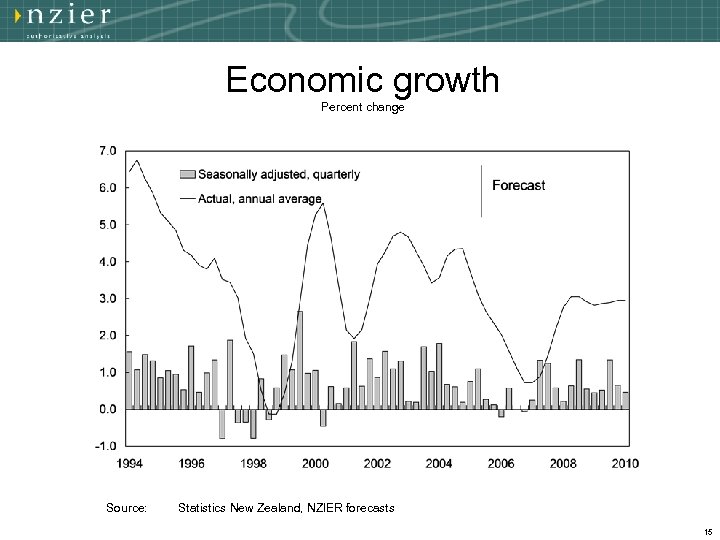 Economic growth Percent change Source: Statistics New Zealand, NZIER forecasts 15
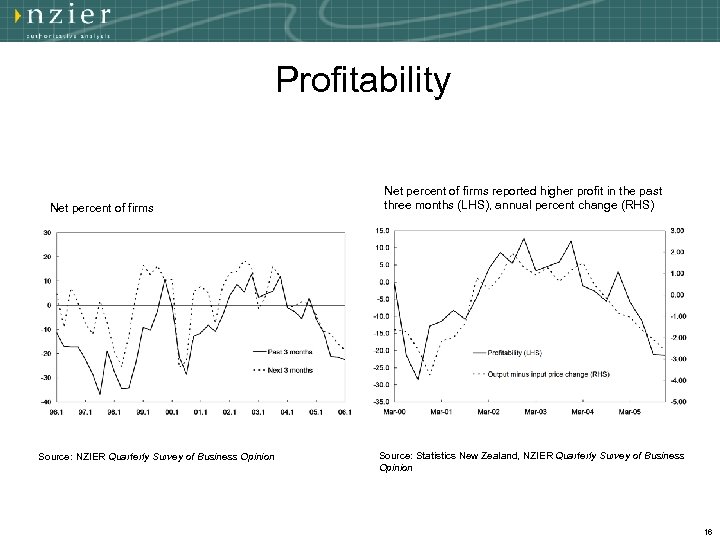 Profitability Net percent of firms Source: NZIER Quarterly Survey of Business Opinion Net percent of firms reported higher profit in the past three months (LHS), annual percent change (RHS) Source: Statistics New Zealand, NZIER Quarterly Survey of Business Opinion 16
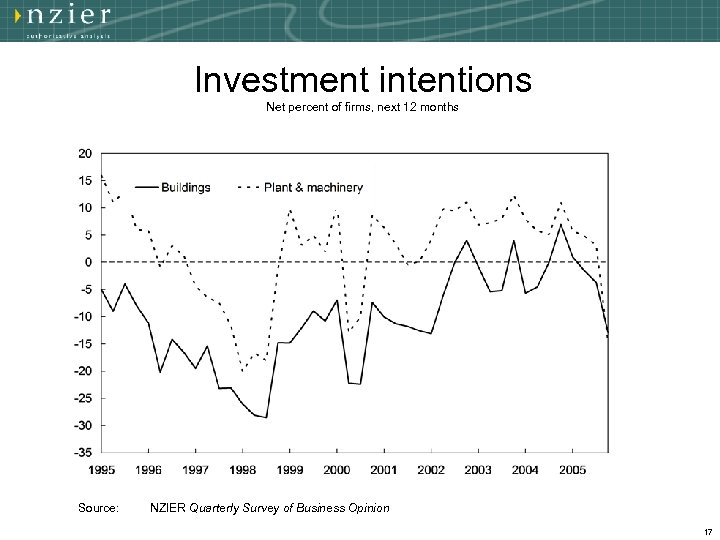 Investment intentions Net percent of firms, next 12 months Source: NZIER Quarterly Survey of Business Opinion 17
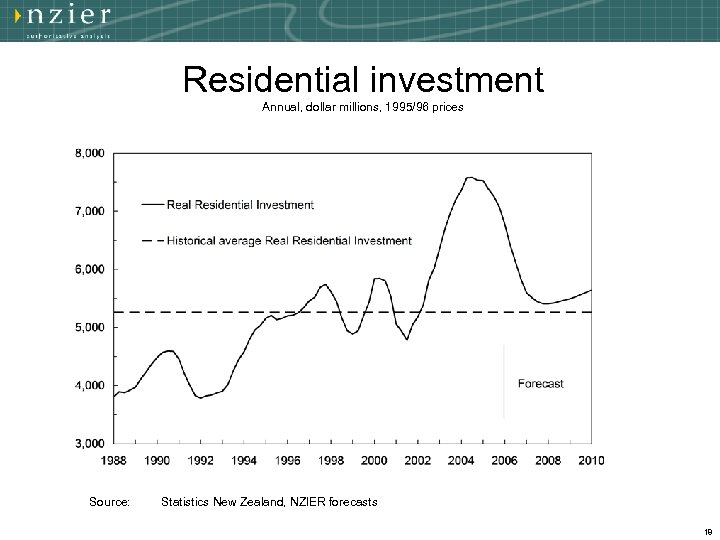 Residential investment Annual, dollar millions, 1995/96 prices Source: Statistics New Zealand, NZIER forecasts 18
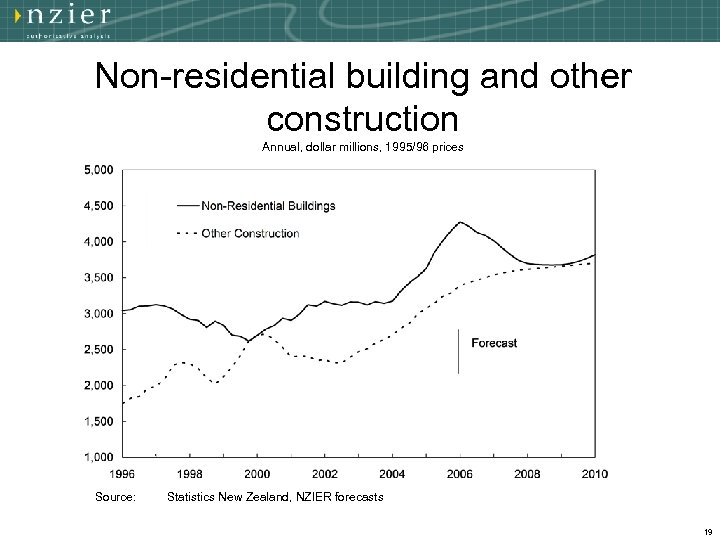 Non-residential building and other construction Annual, dollar millions, 1995/96 prices Source: Statistics New Zealand, NZIER forecasts 19
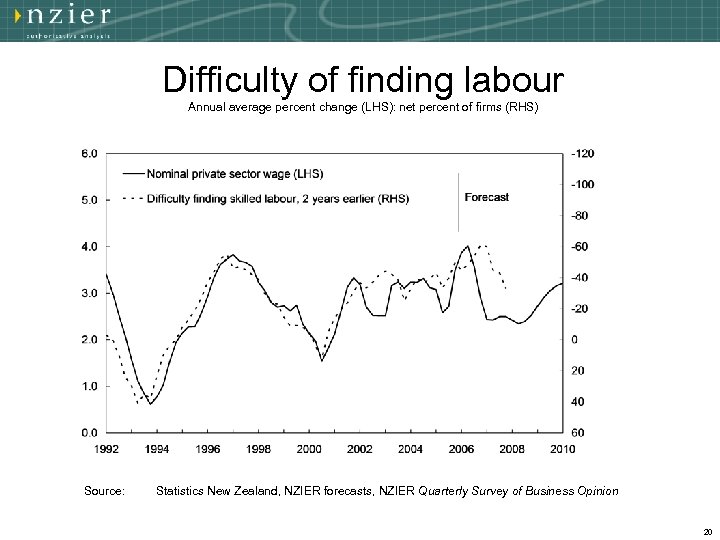 Difficulty of finding labour Annual average percent change (LHS): net percent of firms (RHS) Source: Statistics New Zealand, NZIER forecasts, NZIER Quarterly Survey of Business Opinion 20
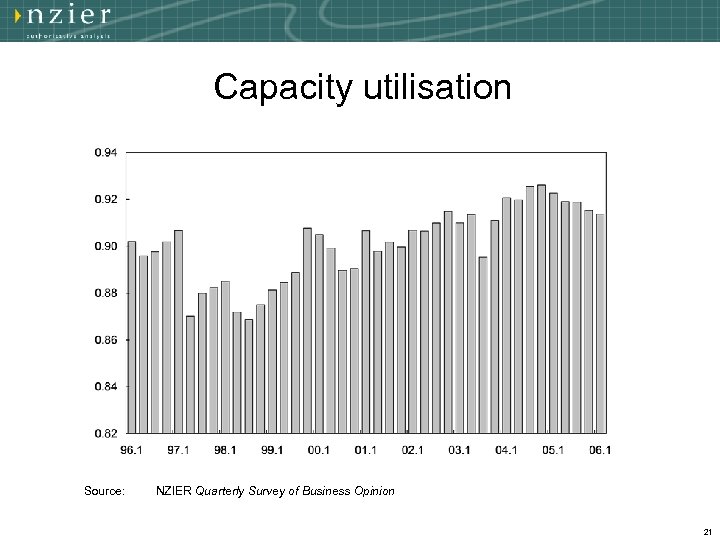 Capacity utilisation Source: NZIER Quarterly Survey of Business Opinion 21
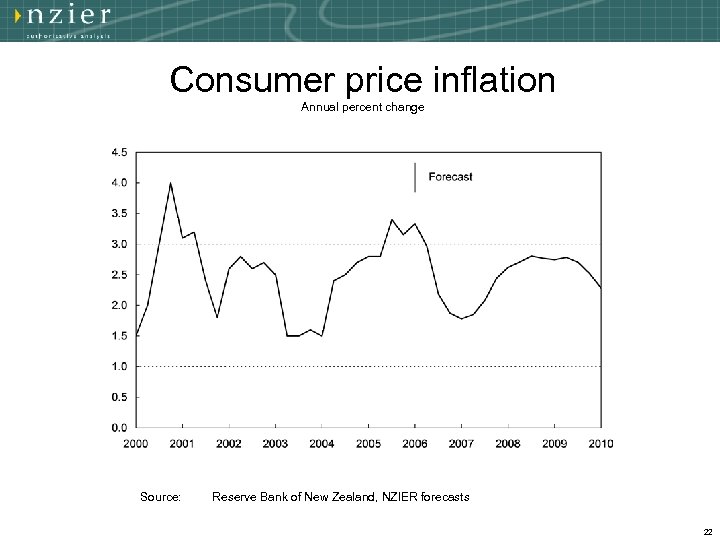 Consumer price inflation Annual percent change Source: Reserve Bank of New Zealand, NZIER forecasts 22
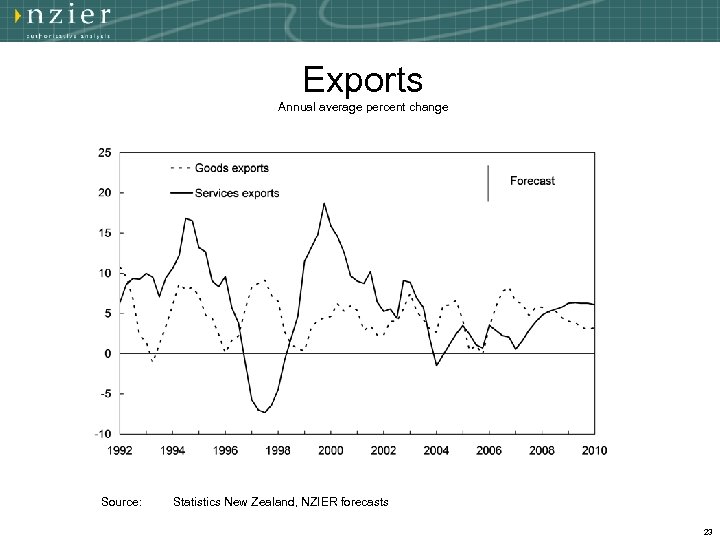 Exports Annual average percent change Source: Statistics New Zealand, NZIER forecasts 23