 Скачать презентацию The Future of Scholarly Publication and Communication Martin
a633cfeb25acfebe7576d338ffba573e.ppt
- Количество слайдов: 77



The Future of Scholarly Publication and Communication Martin Grötschel Konrad-Zuse-Zentrum für Informationstechnik and Technische Universität Berlin, Germany May 7, 1999 Universidade de São Paulo, Brazil
Contents À Technological Developments, their Impact on Communication, Visions Á Searching for Contents, Fears, Transition Crisis Observations: Where is the Publication Crisis? Ã The Players: Intentions and Obstacles Ä The Challenges: How do the Sciences Act?
Contents - 1 À Technological Developments, their Impact on Communication, Visions
Current Technological Developments Computer speed m Storage growth m Network bandwidth m Internet growth m Cost reduction m Exponential growth Bright future
Visions from the PITAC - Report to the President Information Technology Research: Investing in Our Future President's Information Technology Advisory Committee Report to the President, February 24, 1999 www. ccic. gov
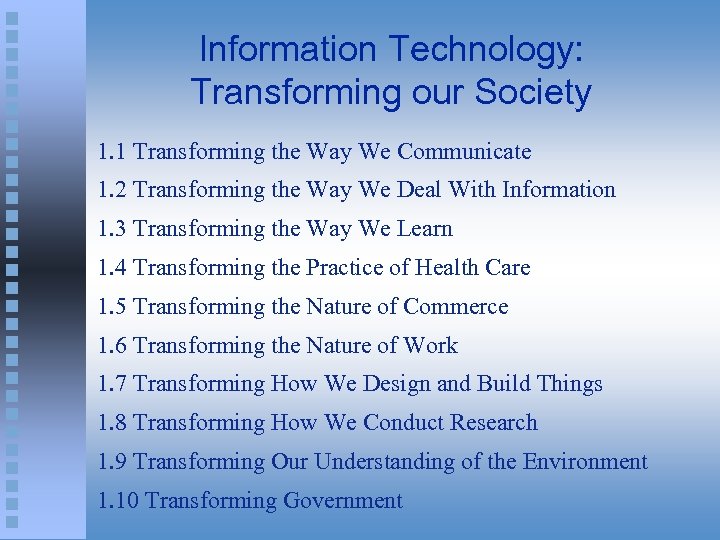
Information Technology: Transforming our Society 1. 1 Transforming the Way We Communicate 1. 2 Transforming the Way We Deal With Information 1. 3 Transforming the Way We Learn 1. 4 Transforming the Practice of Health Care 1. 5 Transforming the Nature of Commerce 1. 6 Transforming the Nature of Work 1. 7 Transforming How We Design and Build Things 1. 8 Transforming How We Conduct Research 1. 9 Transforming Our Understanding of the Environment 1. 10 Transforming Government
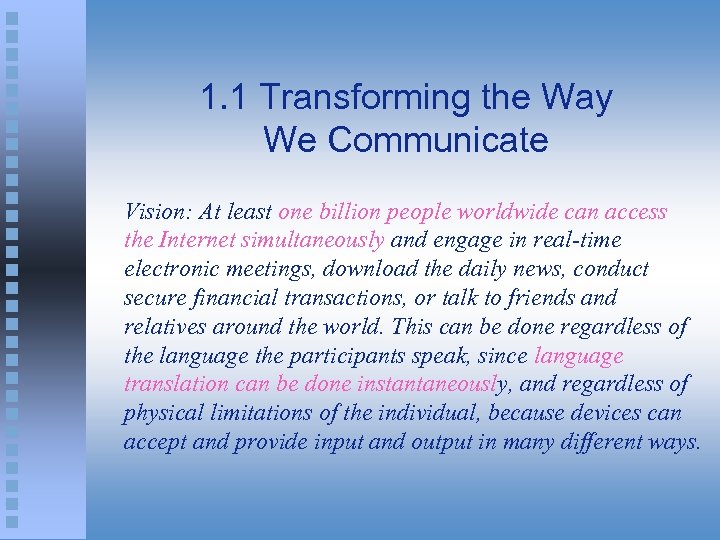
1. 1 Transforming the Way We Communicate Vision: At least one billion people worldwide can access the Internet simultaneously and engage in real-time electronic meetings, download the daily news, conduct secure financial transactions, or talk to friends and relatives around the world. This can be done regardless of the language the participants speak, since language translation can be done instantaneously, and regardless of physical limitations of the individual, because devices can accept and provide input and output in many different ways.
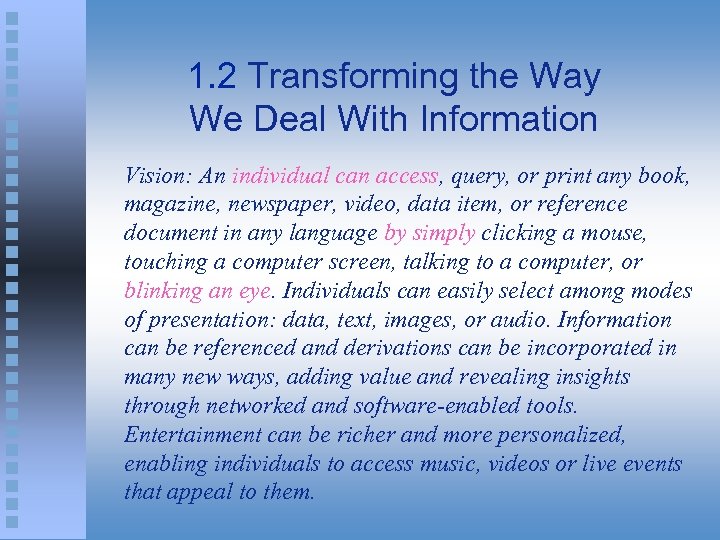
1. 2 Transforming the Way We Deal With Information Vision: An individual can access, query, or print any book, magazine, newspaper, video, data item, or reference document in any language by simply clicking a mouse, touching a computer screen, talking to a computer, or blinking an eye. Individuals can easily select among modes of presentation: data, text, images, or audio. Information can be referenced and derivations can be incorporated in many new ways, adding value and revealing insights through networked and software-enabled tools. Entertainment can be richer and more personalized, enabling individuals to access music, videos or live events that appeal to them.
1. 3 Transforming the Way We Learn Vision: Any individual can participate in on-line education programs regardless of geographic location, age, physical limitation, or personal schedule. Everyone can access repositories of educational materials, easily recalling past lessons, updating skills, or selecting from among different teaching methods in order to discover the most effective ways of learning. Educational programs can be customized to each individual's needs, so that the information revolution reaches everyone and personal digital libraries provide a mechanism for managing ones accumulated knowledge resources. Learning involves all our senses, to help focus each student's attention and better communicate educational material.
1. 4 Transforming the Practice of Health Care Vision: Telemedicine applications are commonplace. Specialists use videoconferencing and telesensing methods to interview and even to examine patients who may be hundreds of miles away. Computer-aided surgery with Internet-based video is used to demonstrate surgical procedures to others. Powerful high-end systems provide expert advice based on sophisticated analysis of huge amounts of medical information. Patients are empowered in making decisions about their own care through new models of interaction with their physicians and everincreasing access to biomedical information via digital medical libraries and the Internet. New communications and monitoring technologies support treatment of patients comfortably from their own homes.
1. 5 Transforming the Nature of Commerce Vision: Any company can be easily reached by its customers, regardless of location. It can receive immediate customer feedback, and rapidly adjust marketing strategies, prices, or product inventories based on that feedback. Consumers can shop for the best products, services, and prices from the convenience of their hotel room, home, or office. Electronic purchases can be made securely and with total privacy, providing suppliers and retailers with immediate access to cash generated by sales and consumers with automated statements detailing spending and purchases that allow for improved personal financial management.
1. 6 Transforming the Nature of Work Vision: The workplace is no longer confined to a specific geographic location, as workers can easily access their tasks and colleagues from alternate locations or while en route. Workers can do their jobs without regard to physical proximity to major metropolitan areas. They can choose where they live based on nearness to family or lifestyle preference rather than job market opportunities. A highly flexible workplace is able to accommodate each individual's needs, from working parents to workers with disabilities.
1. 7 Transforming How We Design and Build Things Vision: Products and structures, from the highly complex, such as automobiles and buildings, to those used in everyday life, such as consumer appliances and fashion, can be designed with computer simulations that accurately represent the physical properties of the systems being built. Designers, manufacturers/builders, suppliers, and endusers participate in the design process, providing one another immediate feedback. Multiple designs and manufacturing processes can be rapidly explored yielding safer products, higher quality, and lower costs.
1. 8 Transforming How We Conduct Research Vision: Research is conducted in virtual laboratories in which scientists and engineers can routinely perform their work without regard to physical location -- interacting with colleagues, accessing instrumentation, sharing data and computational resources, and accessing information in digital libraries. All scientific and technical journals are available on-line, allowing readers to download equations and databases and manipulate variables to interactively explore the published research.
1. 9 Transforming Our Understanding of the Environment Vision: Information technology can help us to improve a variety of problems from water and air quality to controlling the effects of toxic material. For example, reliable climate models permit us to determine the rate and regional distribution of climate change to support accurate projections by sector and region. Sophisticated models accurately predict the response of ecosystems to changes in temperature, water availability, and atmospheric composition. Fully integrated models allow scientists and policy makers to consider information on climate trends, population trends, resource utilization, and the value of natural and economic resources when making decisions regarding technically feasible and cost-effective options to reduce environmental impacts or adapt to climate change.
1. 10 Transforming Government Vision: Government services and information are easily accessible to citizens, regardless of their physical location, level of computer literacy, or physical capacity. Intelligent systems guide citizens by providing a one-stop shopping experience for locating requested information. Documents and forms can be accessed, completed, and submitted electronically. Automated business processes allow nearly instantaneous response to citizens' requests. In times of natural emergencies, emergency crews have instant access to three-dimensional building models, risk analysis and assessment, high-resolution local weather predictions, stress analyses of damaged structures, rapid evacuation planning tools, and emergency agency coordination.
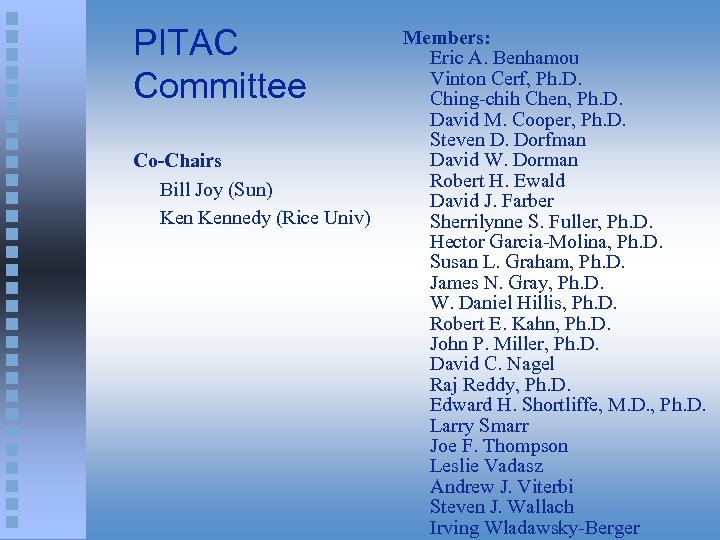
PITAC Committee Co-Chairs Bill Joy (Sun) Kennedy (Rice Univ) Members: Eric A. Benhamou Vinton Cerf, Ph. D. Ching-chih Chen, Ph. D. David M. Cooper, Ph. D. Steven D. Dorfman David W. Dorman Robert H. Ewald David J. Farber Sherrilynne S. Fuller, Ph. D. Hector Garcia-Molina, Ph. D. Susan L. Graham, Ph. D. James N. Gray, Ph. D. W. Daniel Hillis, Ph. D. Robert E. Kahn, Ph. D. John P. Miller, Ph. D. David C. Nagel Raj Reddy, Ph. D. Edward H. Shortliffe, M. D. , Ph. D. Larry Smarr Joe F. Thompson Leslie Vadasz Andrew J. Viterbi Steven J. Wallach Irving Wladawsky-Berger
Impact on Communication Personal E-mail ê Newsgroups and mailing lists ê Internet archives ê Software exchange ê Data transport ê Encourages speed-up, growth, quality increase, etc. in (group) communication. Phantastic!
Newspapers and Journals: Hypertexts allow new quality of reading ê Multimedia revolutionizes teaching ê Best courses/lectures available in the Internet ê Search engines help find everything ê Latest scientific news at your fingertips ê Everything accessible from everywhere at any time by everybody! TRUE?
Contents - 2 À Technological Developments, their Impact on Communication, Visions Á Searching for Contents, Fears, Transition Crisis
Searching Alta. Vista, Excite, Info. Seek, Hot. Bot, etc. Extensive search results: ê Covering gigantic amounts of digital material ê But essentially only based on "words" within texts ê Often resulting in huge lists of unstructured search results without "quality aspects"
Searching What does science need? ê Subject specific results ê ê (say, references to material in mathematics only) Very problem specific results ê (say, references to graph theory or coloring theory only) Immediate access to abstracts and full texts ê (Quality Guarantee) ê
Solution Put all literature (and everything else) into the Internet! ê Is it there? ê Is it accessible? Why Not?
êA new market develops ê The rules of the new market have not emerged yet ê Every player is afraid of losing its power and market share
We are in a "Transition Crisis" The players of the old publication market have not found their new rules: authors m readers m publishers m libraries m database providers m distributors m financial funding institutions m
Some Fears m m m Authors distribute directly to readers, eliminating everybody else (LANL server in physics) Publishers offer books and journals electronically, from their own archives, making libraries obsolete (E -Journals from Elsevier Science Direct, Springer Link) Scientific libraries publish literature produced in their institutions, making publishers obsolete (High. Wire Press) One virtual book shop eliminates all other book shops (Amazon. com) The Web and its search engines make databases superfluous (Alta Vista)
Contents - 3 À Technological Developments, their Impact on Communication, Visions Á Searching for Contents, Fears, Transition Crisis Observations: Where is the Publication Crisis?
Some Observations Despite electronic hype, paper prevails ê The number of books and journals increases ê Publishers go bankrupt and/or merge ê Purchasing power of library budgets shrinks ê Electronic journals are not catching on ê At the same time, Information Flood & Information Shortage
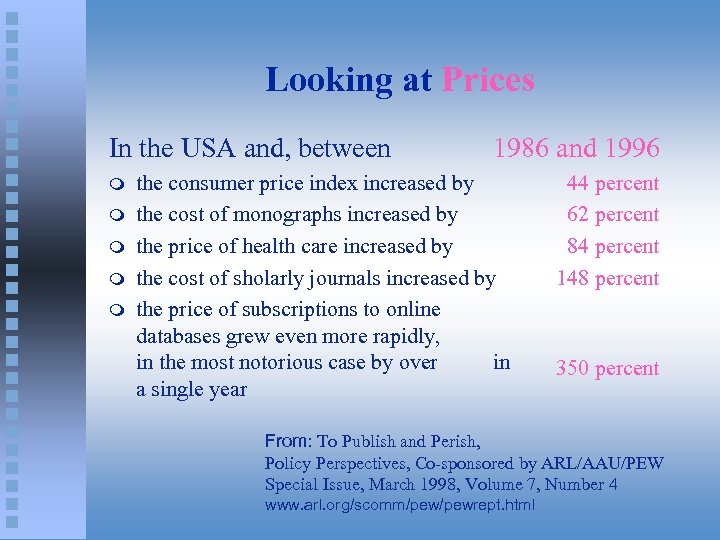
Looking at Prices In the USA and, between m m m 1986 and 1996 the consumer price index increased by the cost of monographs increased by the price of health care increased by the cost of sholarly journals increased by the price of subscriptions to online databases grew even more rapidly, in the most notorious case by over in a single year 44 percent 62 percent 84 percent 148 percent 350 percent From: To Publish and Perish, Policy Perspectives, Co-sponsored by ARL/AAU/PEW Special Issue, March 1998, Volume 7, Number 4 www. arl. org/scomm/pewrept. html
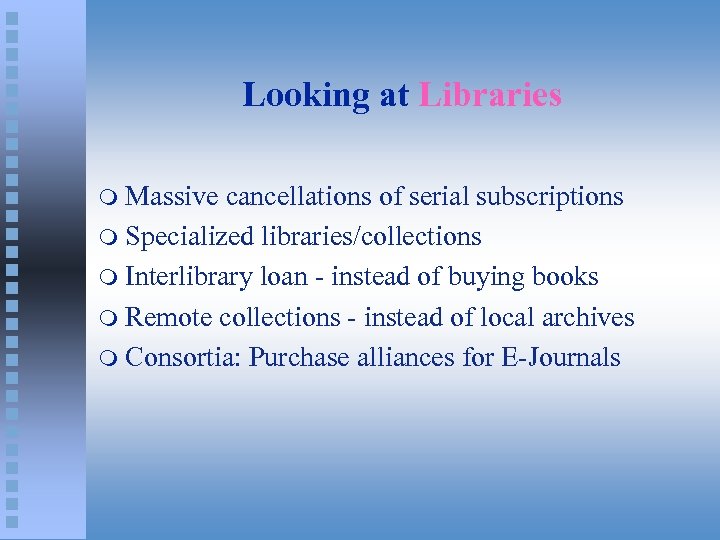
Looking at Libraries Massive cancellations of serial subscriptions m Specialized libraries/collections m Interlibrary loan - instead of buying books m Remote collections - instead of local archives m Consortia: Purchase alliances for E-Journals m
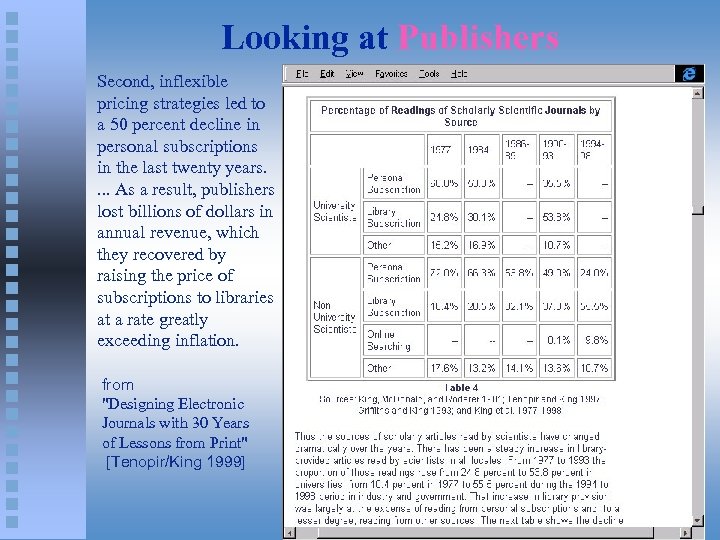
Looking at Publishers Second, inflexible pricing strategies led to a 50 percent decline in personal subscriptions in the last twenty years. . As a result, publishers lost billions of dollars in annual revenue, which they recovered by raising the price of subscriptions to libraries at a rate greatly exceeding inflation. from "Designing Electronic Journals with 30 Years of Lessons from Print" [Tenopir/King 1999]
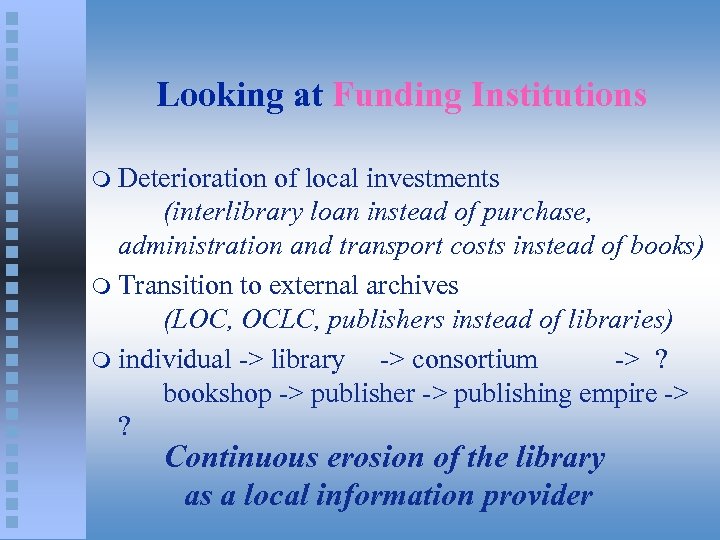
Looking at Funding Institutions Deterioration of local investments (interlibrary loan instead of purchase, administration and transport costs instead of books) m Transition to external archives (LOC, OCLC, publishers instead of libraries) m individual -> library -> consortium -> ? bookshop -> publisher -> publishing empire -> ? m Continuous erosion of the library as a local information provider
Looking at the Reader The scientific reader (in the paper world) must expect m to buy more and more literature on his own m to spend more time on searching m to wait longer for articles and books m to miss the access to an increasing number of older/sold-out documents and books
A Summarizing View (of the Paper World) The price spiral has resulted in ê publishers losing circulation ê scientists spending more time on obtaining articles ê libraries paying more fees for fewer journals ê funding sources becoming uncertain over their allocation of funds That lose-lose-lose pricing situation happened gradually and the parties do not seem to know how to reverse it. [ARL/AAU/PEW 1999]
So, why don't we go electronic?
Contents - 4 À Technological Developments, their Impact on Communication, Visions Á Searching for Contents, Fears, Transition Crisis Observations: Where is the Publication Crisis? Ã The Players: Intentions and Obstacles
ê Motives and Intentions for participating in the scientific publication market ê Obstacles against the move into the electronic world
Intentions/Obstacles: The Readers are the group of persons for which the publication systems are designed (Really? ) ê does not want to read from screen, readers require paper ê pleasant interface ê looks for high quality, new and original ideas, filtered and certified information (to save time) ê wants information immediately at the desk What does the reader provide? p payment (sometimes) p acknowledgement (that's what the author longs for)
Intentions/Obstacles: The Author ê ê ê p p p wants to distribute his ideas wants to communicate with his peers and colleagues looks for acknowledgement (from his competitors) intends to establish priority looks for an item on his curriculum vitae for promotion seeks for prestige and reputation is afraid that his ideas are stolen/copied in the Internet fears to loose his advantage wants to earn some money (? )
Intentions/Obstacles: The Publisher ê ê p p make profit being attractive for good authors paper publication system has a long history copy right
Intentions/Obstacles: The Librarian ê provide the scientist/student an excellent service help find items classification, archiving, indexing, retrieval keep his job administer a big budget have a beautiful building p electronic media can be accessed without the librarians help ê ê ê
Intentions/Obstacles: The Editor ê wishes to define what quality is wants to serve the community and execute power hopes to obtain reputation/prestige wishes to earn some money (? ) p electronic media may do without him ê ê ê
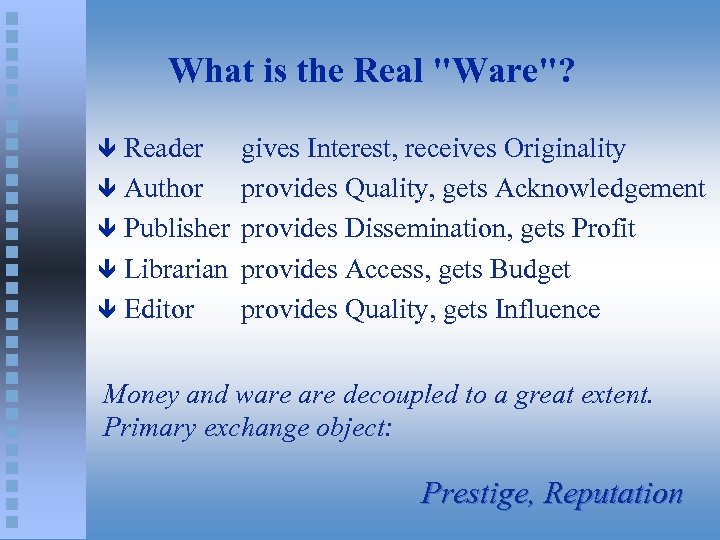
What is the Real "Ware"? Reader ê Author ê Publisher ê Librarian ê Editor ê gives Interest, receives Originality provides Quality, gets Acknowledgement provides Dissemination, gets Profit provides Access, gets Budget provides Quality, gets Influence Money and ware decoupled to a great extent. Primary exchange object: Prestige, Reputation
Summarizing View Money and commercial value is by far not the only driving force m prestige are of at least m vanity equal importance m influence m quality aspects
Summarizing View For a successful move into the electronic world we have to introduce the same êtrusted structure êreward system and provide êsuperior services
Contents - 5 À Technological Developments, their Impact on Communication, Visions Á Searching for Contents, Fears, Transition Crisis Observations: Where is the Publication Crisis? Ã The Players: Intentions and Obstacle Ä The Challenges: How do the Sciences Act?
What is being done? m Iu. K-Initiative m Math. Net m IMU CEIC of Learned Societies

Die Iu. K Initiative Information und Kommunikation der wissenschaftlichen Fachgesellschaften in Deutschland elfikom. physik. uni-oldenburg. de/Iu. K/
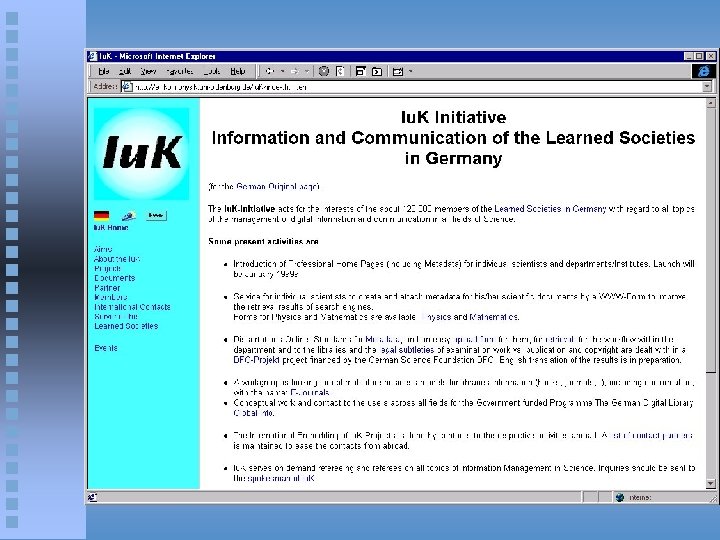
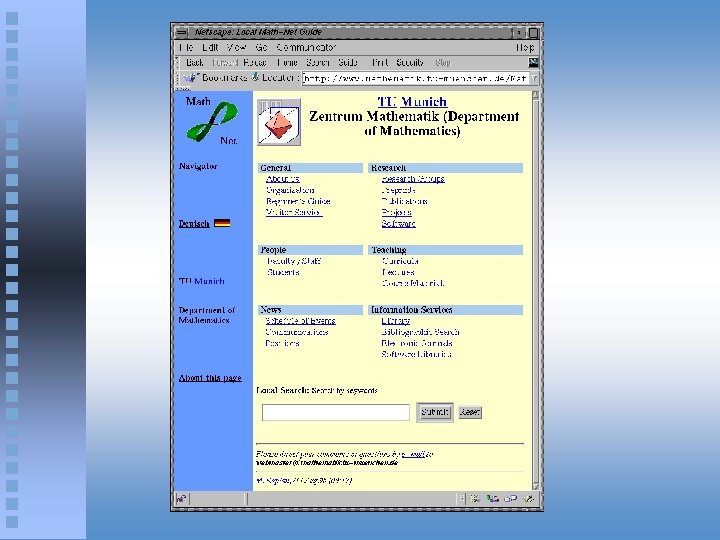
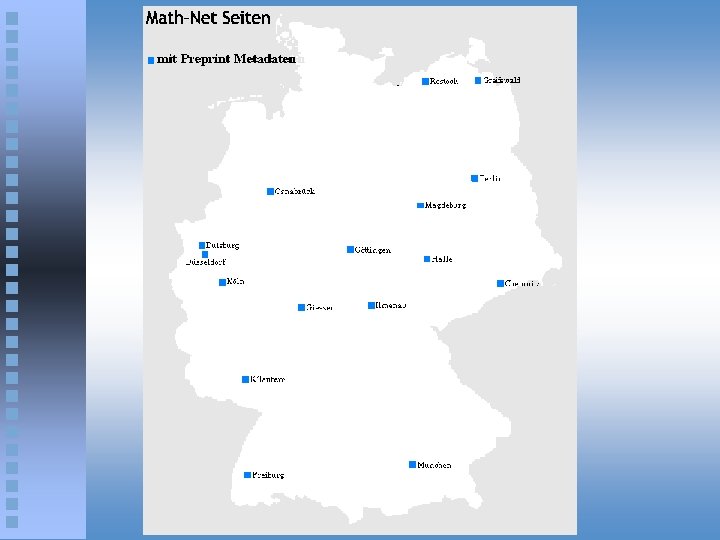
Math. Net: A Network for Mathematics Prototype developed in Germany at Konrad-Zuse-Zentrum für Informationstechnik (ZIB) and several participating mathematical departments www. math-net. de Now to be extended to a worldwide system supported by the International Mathematical Union (IMU)
Vision ê Mathematical information at your fingertips ê World wide electronic information and communication system (for mathematics to support research and teaching)
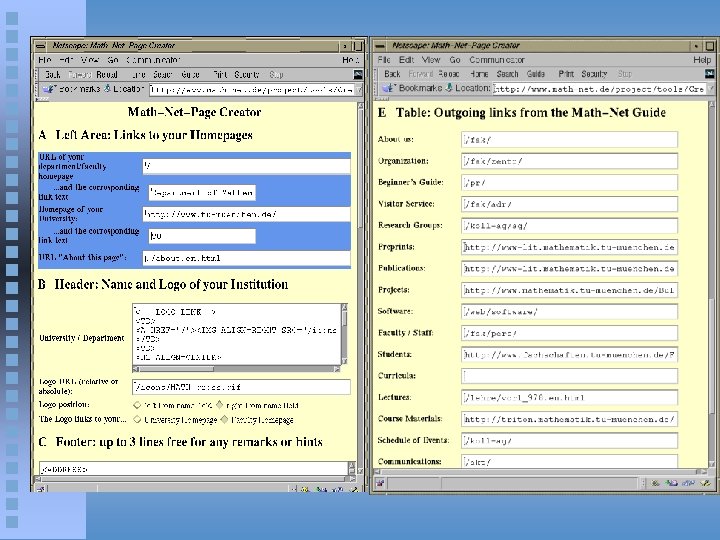
Aims of the Math. Net Project ê Distributed, electronic information and communication system for mathematics: m user-driven and user-friendly m high quality Basis: local electronic information offers provided by the mathematical departments ê Central navigation and retrieval system for a more precise browsing and search ê
Technical Standards m Openness (technical and organizational) m Use of international standards (Internet, WWW)
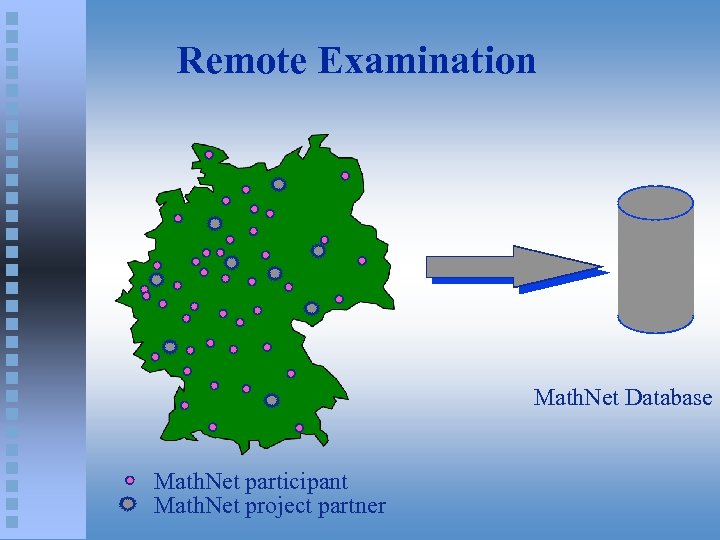
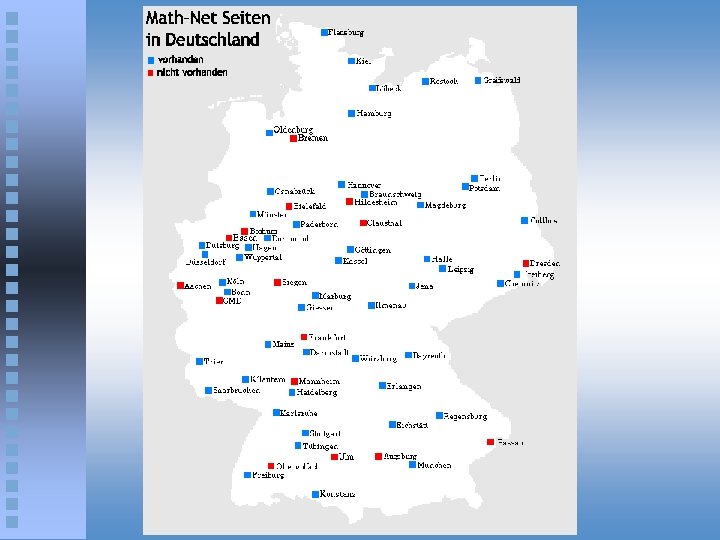
Remote Examination Math. Net Database Math. Net participant Math. Net project partner
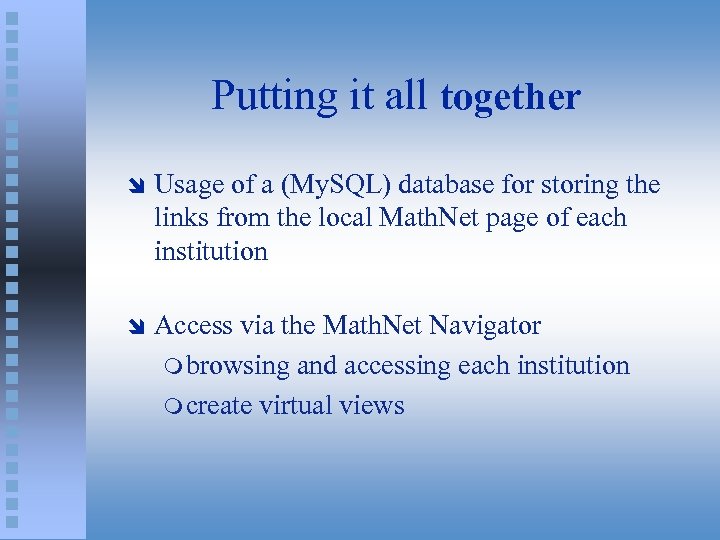
Putting it all together î Usage of a (My. SQL) database for storing the links from the local Math. Net page of each institution î Access via the Math. Net Navigator m browsing and accessing each institution m create virtual views
Structuring Local Information ê Short-term solution: Local Math. Net Guide ê Long-term solution: Use of Metadata m Principle: the authors add some data to their information (Metadata), e. g. , author, title, MSC-classification.
Who encodes Metadata in digital Documents ? ê The author of the document is willing to spend a little bit more time to write good and correct metadata (e. g. MSC-Class) ê Implementation of suitable tools that help the author prepare the required metadata
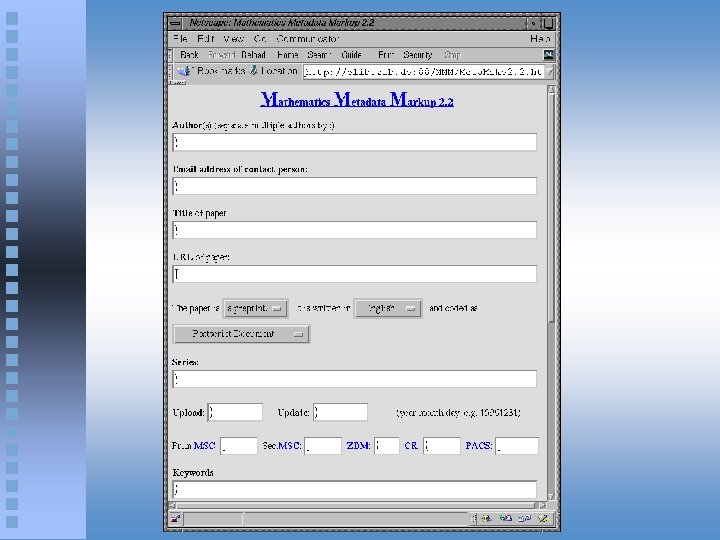
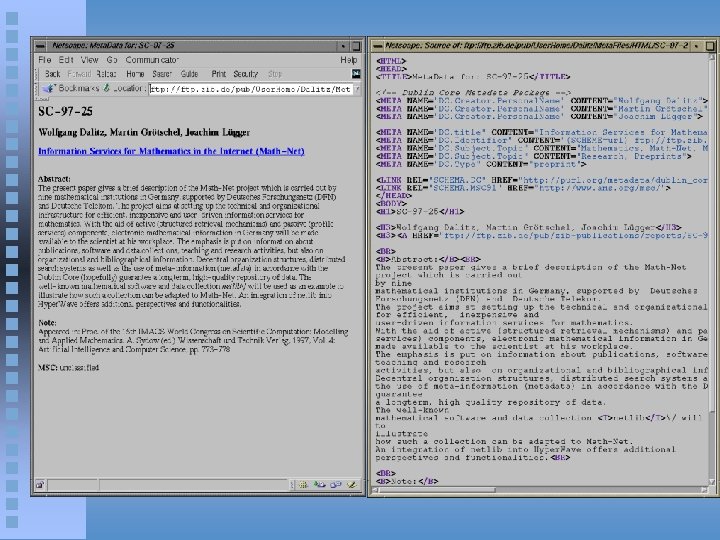
Bringing it together Harvest is a distributed search system ê Harvest evaluates DC-metadata ê Harvest allows a fulltext search ê ê Harvest consists mainly of m gatherer m broker
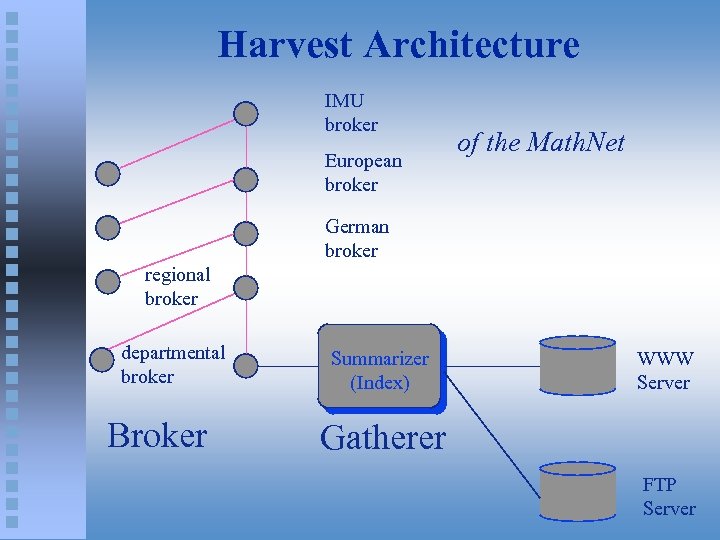
Harvest Architecture IMU broker European broker of the Math. Net German broker regional broker departmental broker Broker Summarizer (Index) WWW Server Gatherer FTP Server
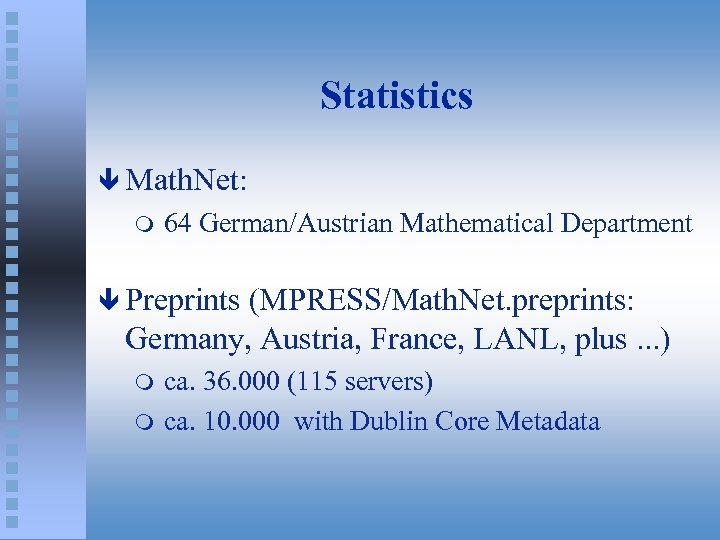
Statistics ê Math. Net: m 64 German/Austrian Mathematical Department ê Preprints (MPRESS/Math. Net. preprints: Germany, Austria, France, LANL, plus. . . ) m m ca. 36. 000 (115 servers) ca. 10. 000 with Dublin Core Metadata
Challenges ê Technical m Network connectivity and bandwidth ê Organizational m Local personal infrastructure and stability
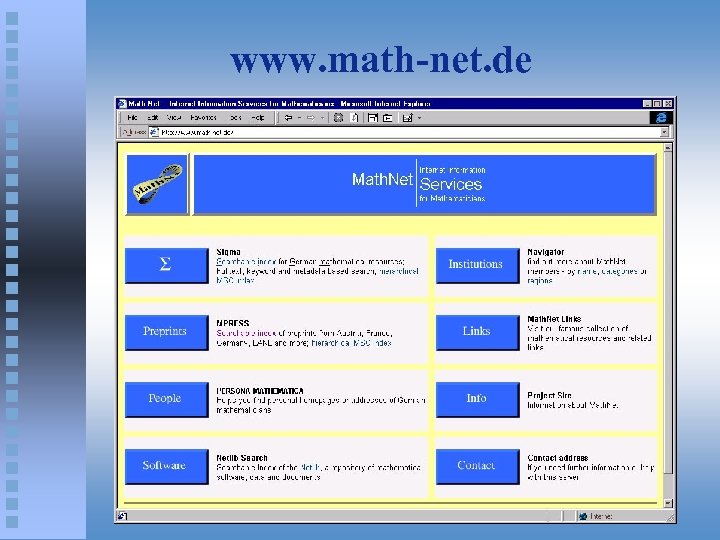
www. math-net. de
Building on the enabling resolution passed by the General Assembly in Dresden on August 16, 1998, the Executive Committee of the International Mathematical Union etablishes a Committee on Electronic Information and Communication (CEIC) of the International Mathematical Union (IMU)
Terms of Reference (a) The CEIC shall be a o standing committee of the Executive Committee (EC) of the IMU, o to be reviewed every four years by the EC at its meeting preceding that of the GA. o Members will be appointed for four year terms by procedures identical to those for its Commissions. o The Executive Committee will appoint one of its members to serve on the CEIC.
Terms of Reference (b) The CEIC may o meet as necessary in each four year period, o review the development of Electronic Information and Communication as it impacts the international mathematical community and o submit a report to EC.
Terms of Reference (c) The CEIC may o organize or sponsor international meetings or forums to bring together representatives of all interested parties, including ; ; o societies, publishers, libraries, and researchers. publish and otherwise disseminate ; ; ; proceedings, reviews of recent developments, and technical surveys for the use of the mathematical community.
Terms of Reference (d) The CEIC may p recommend international standards on issues related to electronic communication. p Such recommendations should be reviewed by the EC and, if approved, may be published and promoted in the name of the IMU.
Terms of Reference (e) During its first 4 year term, the CEIC is specifically asked to address o the coordination of world-wide efforts to establish web-based servers for ; ; o This includes issues of uniformizing ; ; ; o mirroring and the development of search engines for mathematical material and coordination of existing servers. It should publish its findings with the goal of making ; ; o metadata, document identifiers and supported formats, promoting ; ; ; o mathematical papers, preprints, journals and books. the use of these servers universally understood and usable by the whole mathematical community. It is also asked to consider tranferring the World Directory of Mathematicians to an electronic freely accessible form.
Terms of Reference (f) Membership: * Peter Michor, chair, University of Vienna, Austria; Peter. Michor@esi. ac. at * Jonathan Borwein, Simon Fraser University, Burnaby, Canada; jborwein@cecm. sfu. ca * John Ewing, American Mathematical Society, Providence, USA; jhe@ams. org * Jonas Gomes, IMPA, Rio de Janeiro, Brazil; jonas@impa. br * Wilfrid Hodges, Queen Mary & Westfield College, London, UK; w. hodges@qmw. ac. uk * Martin Groetschel, EC member, Konrad-Zuse-Zentrum, Berlin, Germany; groetschel@zib. de * David Morrison, Duke University, Durham, USA; drm@math. duke. edu * Zhou Qin, East China Normal University, Shanghai, China; * Alf van der Poorten, Macquarie University, Sydney, Australia; alf@mpce. mq. edu. au * Alexei Zhizhchenco, Russian Academy of Sciences, Moscow, Russia;
Final Summary m The great perspectives are not so bright m many roadblocks But m joint worldwide efforts of individuals/learned societies/libraries (+publishers) can establish a very useful electronic information and communication system for the sciences
m To include hypertexts, images, pictures, sound, music, multimedia documents, and similar technologically advanced documents, a big leap is still necessary. Prototyping is current game m The sciences are moving more slowly than one should expect. The Humanities creep. m We are transcending boaders. Nobody knows the new territory! Personally, I am optimistic!
Скачать презентацию The Future of Scholarly Publication and Communication Martin
a633cfeb25acfebe7576d338ffba573e.ppt