


 Скачать презентацию The Future of NWP Stephen J Lord NCEP
2c7819ef9bfdac621479da89455c1211.ppt
- Количество слайдов: 40
 The Future of NWP Stephen J. Lord NCEP Environmental Modeling Center EMC Senior Staff Fred Toepfer John Derber Hua-Lu Pan Ken Mitchell Geoff Di. Mego Naomi Surgi D. B. Rao 1
 Overview • Why have we been so successful? • What can we do for an encore? • Shortfalls (or what do we need to do better)? Caveat • Mostly a personal perspective, colored by experience at EMC, NCEP…NOAA 2
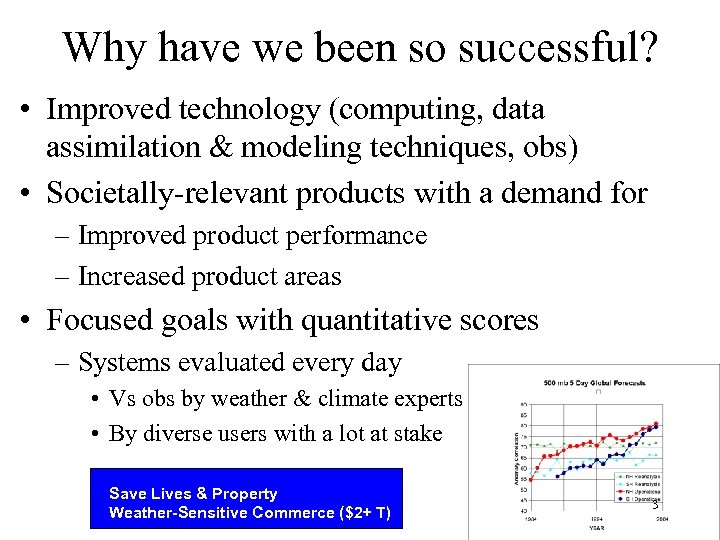 Why have we been so successful? • Improved technology (computing, data assimilation & modeling techniques, obs) • Societally-relevant products with a demand for – Improved product performance – Increased product areas • Focused goals with quantitative scores – Systems evaluated every day • Vs obs by weather & climate experts • By diverse users with a lot at stake Save Lives & Property Weather-Sensitive Commerce ($2+ T) 3
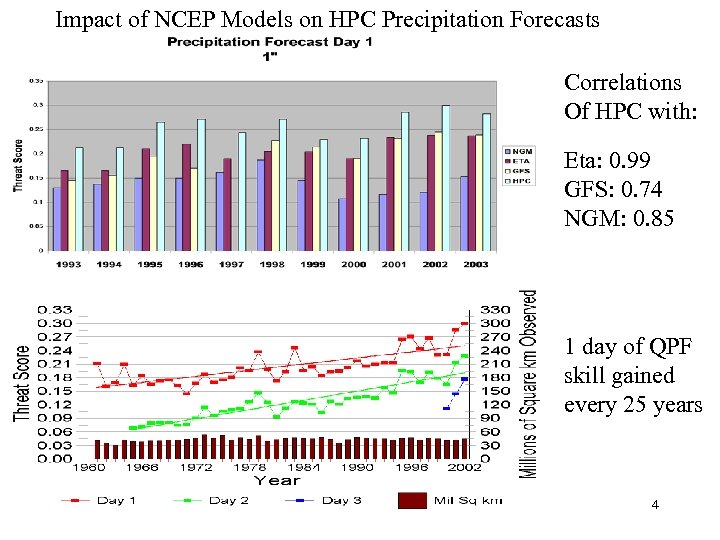 Impact of NCEP Models on HPC Precipitation Forecasts Correlations Of HPC with: Eta: 0. 99 GFS: 0. 74 NGM: 0. 85 1 day of QPF skill gained every 25 years 4
 Why have we been so successful? (cont) • Competition – With ourselves – Across international, operational and research, weather & climate forecast centers • Diverse approaches – Highly accurate NWP analysis & forecast systems with different approaches – No single solution (normalized for available resources) – Very few “breakthroughs” (although 4 D-VAR, “physics”, “vertical coordinate” are some individual reasons for success) 5
 What can we do for an encore? 1. Continue to exploit the systems we have built* 2. Increase the rate of development for possible operational implementation* *To be discussed further 6
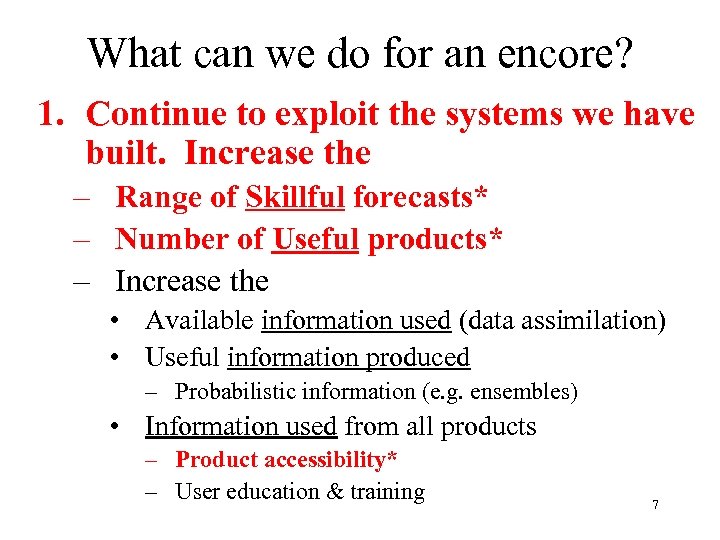 What can we do for an encore? 1. Continue to exploit the systems we have built. Increase the – Range of Skillful forecasts* – Number of Useful products* – Increase the • Available information used (data assimilation) • Useful information produced – Probabilistic information (e. g. ensembles) • Information used from all products – Product accessibility* – User education & training 7
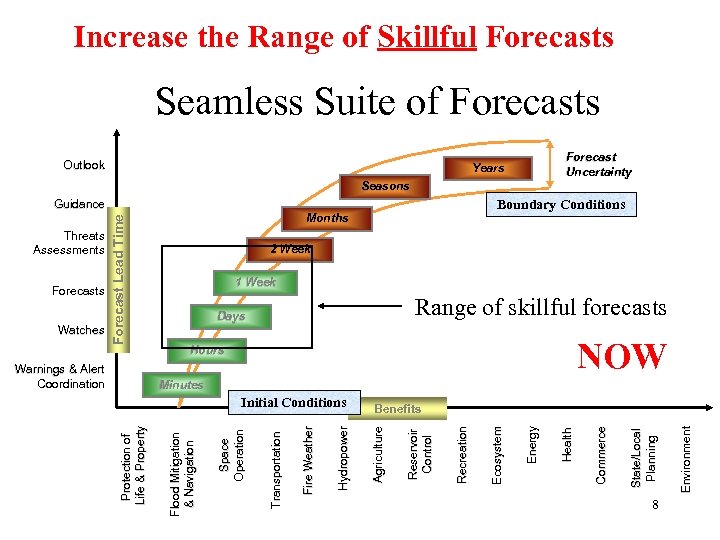 Increase the Range of Skillful Forecasts Seamless Suite of Forecasts Outlook Forecast Uncertainty Years Seasons Boundary Conditions Warnings & Alert Coordination 1 Week Range of skillful forecasts Days NOW Hours Minutes 8 Environment State/Local Planning Commerce Health Energy Ecosystem Recreation Reservoir Control Benefits Agriculture Hydropower Fire Weather Protection of Life & Property Initial Conditions Transportation Watches 2 Week Space Operation Forecasts Months Flood Mitigation & Navigation Threats Assessments Forecast Lead Time Guidance
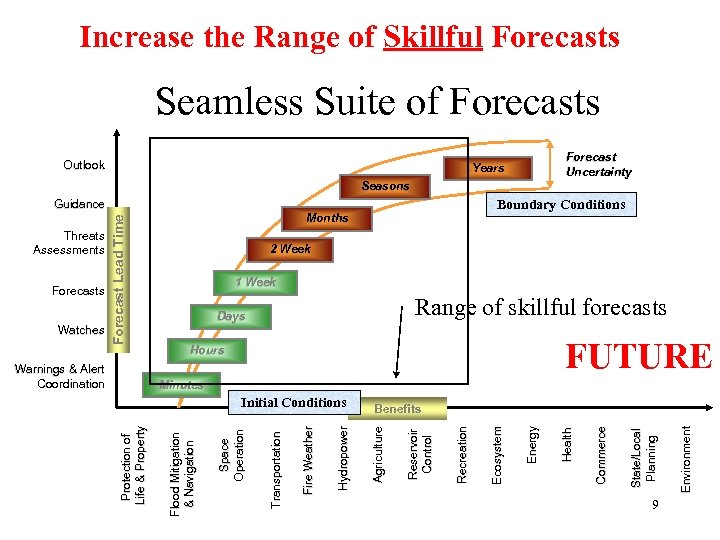 Increase the Range of Skillful Forecasts Seamless Suite of Forecasts Outlook Forecast Uncertainty Years Seasons Boundary Conditions Warnings & Alert Coordination 1 Week Range of skillful forecasts Days FUTURE Hours Minutes 9 Environment State/Local Planning Commerce Health Energy Ecosystem Recreation Reservoir Control Benefits Agriculture Hydropower Fire Weather Protection of Life & Property Initial Conditions Transportation Watches 2 Week Space Operation Forecasts Months Flood Mitigation & Navigation Threats Assessments Forecast Lead Time Guidance
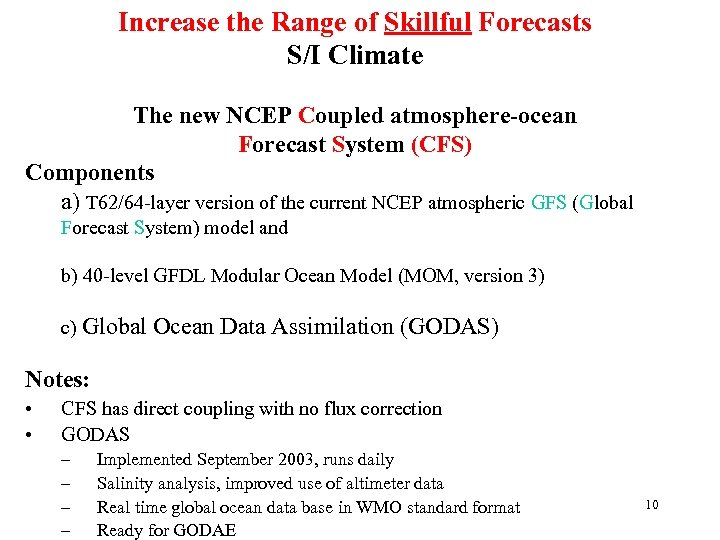 Increase the Range of Skillful Forecasts S/I Climate The new NCEP Coupled atmosphere-ocean Forecast System (CFS) Components a) T 62/64 -layer version of the current NCEP atmospheric GFS (Global Forecast System) model and b) 40 -level GFDL Modular Ocean Model (MOM, version 3) c) Global Ocean Data Assimilation (GODAS) Notes: • • CFS has direct coupling with no flux correction GODAS – – Implemented September 2003, runs daily Salinity analysis, improved use of altimeter data Real time global ocean data base in WMO standard format Ready for GODAE 10
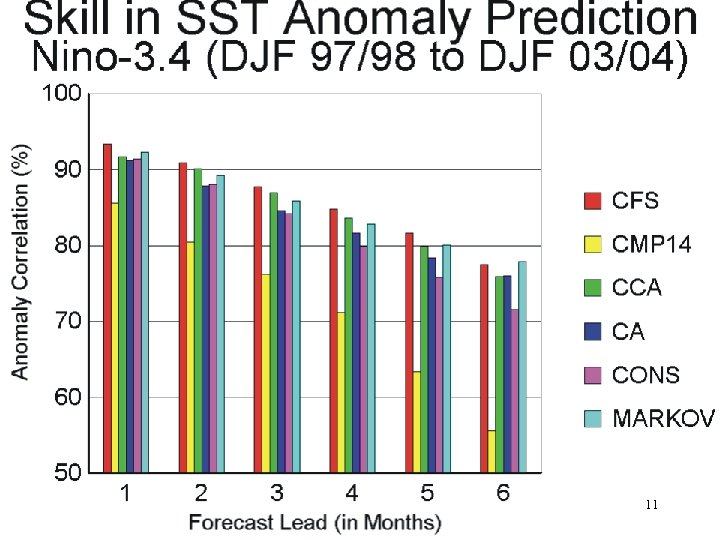 11
11
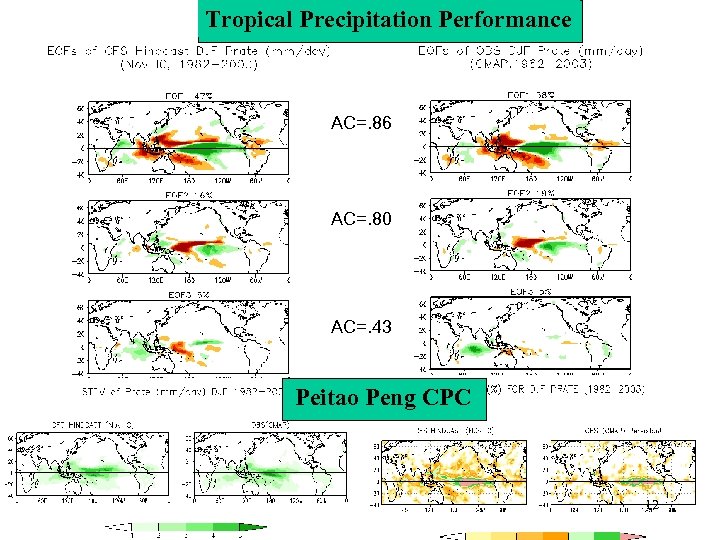 Tropical Precipitation Performance AC=. 86 AC=. 80 AC=. 43 Peitao Peng CPC 12
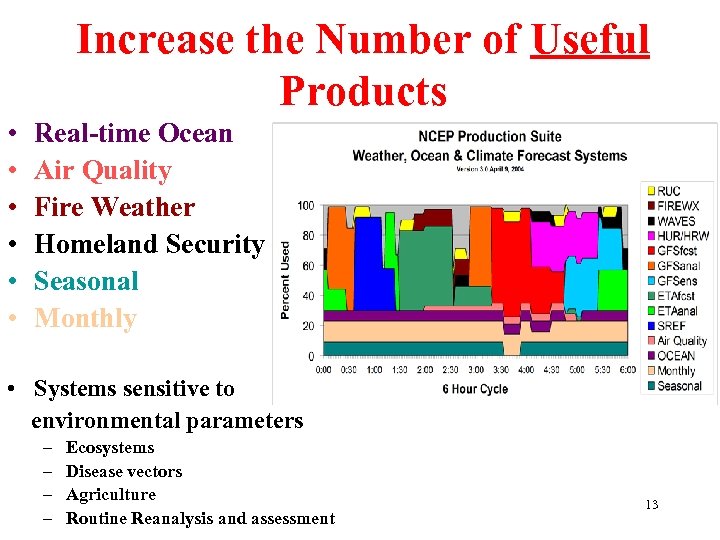 Increase the Number of Useful Products • • • Real-time Ocean Air Quality Fire Weather Homeland Security Seasonal Monthly • Systems sensitive to environmental parameters – – Ecosystems Disease vectors Agriculture Routine Reanalysis and assessment 13
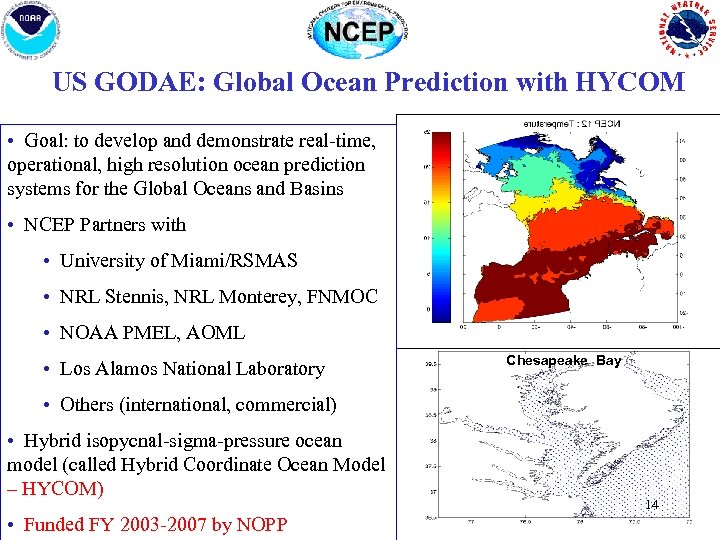 US GODAE: Global Ocean Prediction with HYCOM • Goal: to develop and demonstrate real-time, operational, high resolution ocean prediction systems for the Global Oceans and Basins • NCEP Partners with • University of Miami/RSMAS • NRL Stennis, NRL Monterey, FNMOC • NOAA PMEL, AOML • Los Alamos National Laboratory Chesapeake Bay • Others (international, commercial) • Hybrid isopycnal-sigma-pressure ocean model (called Hybrid Coordinate Ocean Model – HYCOM) • Funded FY 2003 -2007 by NOPP 14
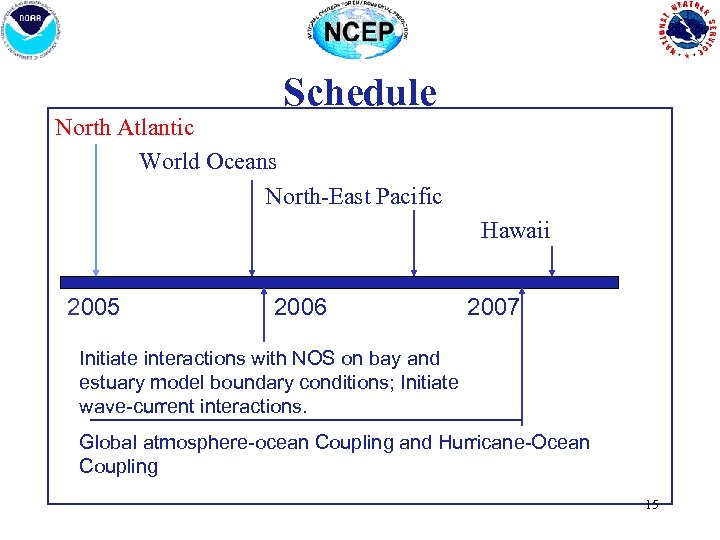 Schedule North Atlantic World Oceans North-East Pacific Hawaii 2005 2006 2007 Initiate interactions with NOS on bay and estuary model boundary conditions; Initiate wave-current interactions. Global atmosphere-ocean Coupling and Hurricane-Ocean Coupling 15
 Future Enabling Architectures • Adding Model Components (to increase useful products) – ESMF • Complexity vs computational efficiency • Product accessibility* – NOMADS 16
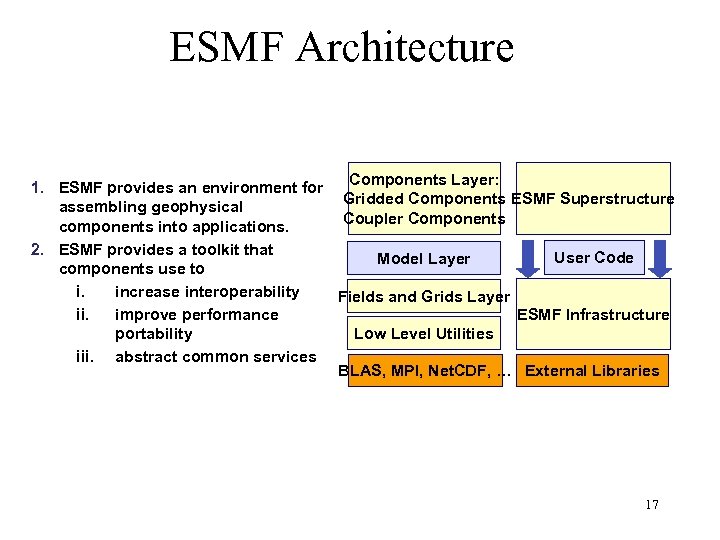 ESMF Architecture Components Layer: 1. ESMF provides an environment for Gridded Components ESMF Superstructure assembling geophysical Coupler Components components into applications. 2. ESMF provides a toolkit that User Code Model Layer components use to i. increase interoperability Fields and Grids Layer ii. improve performance ESMF Infrastructure Low Level Utilities portability iii. abstract common services BLAS, MPI, Net. CDF, … External Libraries 17
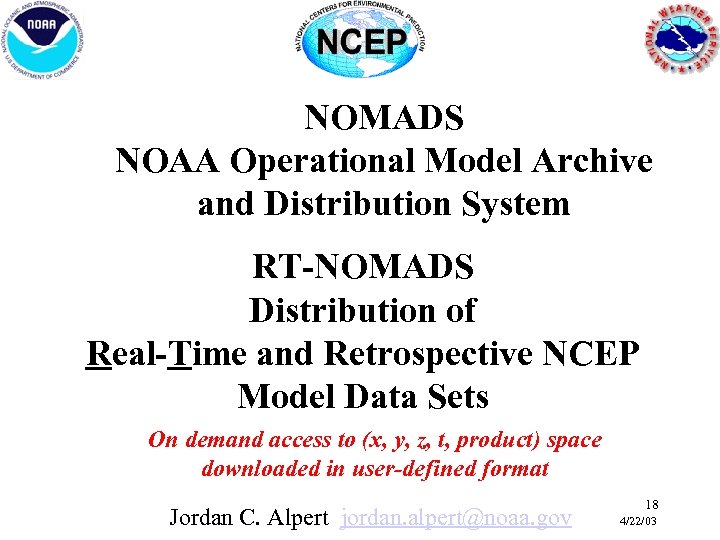 NOMADS NOAA Operational Model Archive and Distribution System RT-NOMADS Distribution of Real-Time and Retrospective NCEP Model Data Sets On demand access to (x, y, z, t, product) space downloaded in user-defined format Jordan C. Alpert jordan. alpert@noaa. gov 18 4/22/03
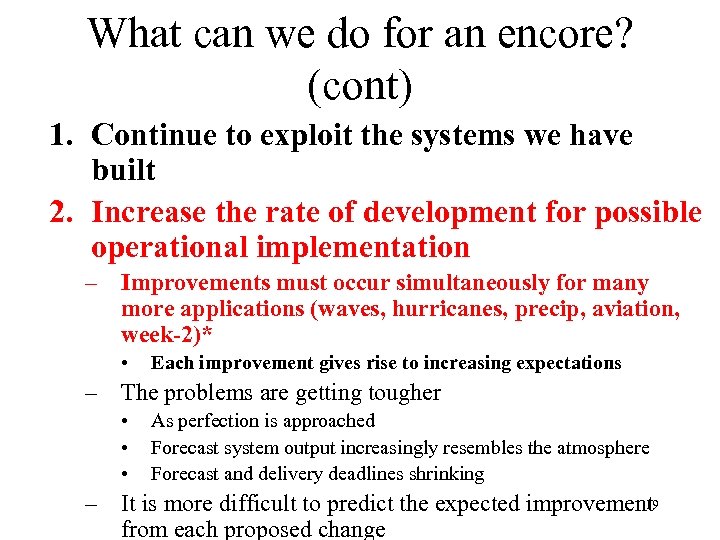 What can we do for an encore? (cont) 1. Continue to exploit the systems we have built 2. Increase the rate of development for possible operational implementation – Improvements must occur simultaneously for many more applications (waves, hurricanes, precip, aviation, week-2)* • Each improvement gives rise to increasing expectations – The problems are getting tougher • • • As perfection is approached Forecast system output increasingly resembles the atmosphere Forecast and delivery deadlines shrinking 19 – It is more difficult to predict the expected improvement from each proposed change
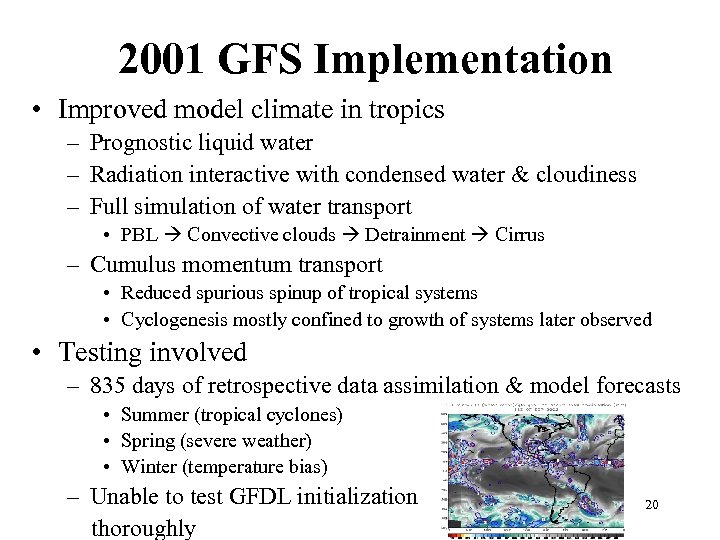 2001 GFS Implementation • Improved model climate in tropics – Prognostic liquid water – Radiation interactive with condensed water & cloudiness – Full simulation of water transport • PBL Convective clouds Detrainment Cirrus – Cumulus momentum transport • Reduced spurious spinup of tropical systems • Cyclogenesis mostly confined to growth of systems later observed • Testing involved – 835 days of retrospective data assimilation & model forecasts • Summer (tropical cyclones) • Spring (severe weather) • Winter (temperature bias) – Unable to test GFDL initialization thoroughly 20
 What can we do for an encore? (cont) 2. Increase the rate of development for possible operational implementation HOW? 21
 What can we do for an encore? (cont) HOW? Focus efforts on improving operational systems – Improved project management • • • – – Increase computing resources beyond Moore’s Law (constant $) Consolidate software & forecast systems • – Operations needs to have increased influence on scientific direction of applied research Mutual discussion and execution of highest priority development projects More rapid transition of development to operations GSI (global and regional analysis system) Continue to exploit Test Bed concept • • Enhanced Visiting Scientist exchange program Increase the (potential) workforce capabilities – • – Student education and training Support for non-operational users of operational systems Examples follow 22
 NASA-NOAA-DOD Joint Center for Satellite Data Assimilation (JCSDA) – NOAA, NASA, DOD partnership – Mission • Accelerate and improve the quantitative use of research and operational satellite data in weather and climate prediction models – Current generation data – Prepare for next-generation (NPOESS, METOP, research) instruments – Supports applied research • Partners • University, Government and Commercial Labs 23
 JCSDA Prioritized Applied Research Areas • Advanced radiative transfer • Clouds and precipitation • Assess impacts of current instruments • Improve sea surface temperature data and use of altimeter data • Enhance land surface data sets (surface emissivity model) • AIRS data implementation 24
![Improve Sea Surface Temperature Data [X. Li & Derber] SST Difference 29 -28 October](https://present5.com/presentation/2c7819ef9bfdac621479da89455c1211/image-25.jpg "Improve Sea Surface Temperature Data [X. Li & Derber] SST Difference 29 -28 October") Improve Sea Surface Temperature Data [X. Li & Derber] SST Difference 29 -28 October 2003 - Control • New physical retrieval from AVHRR data, cast as variational problem • OPTRAN RTM & Linear Tangent Model • Eventual direct use of AVHRR (and other) radiance data RMS and Bias Fits to Independent Buoy SST Data SST Difference 29 -28 October 2003 - Experiment NOAA-16 AVHRR data only Northern Hemisphere Ex. Tropics 25
Improve Sea Surface Temperature Data [X. Li & Derber] SST Difference 29 -28 October 2003 - Control • New physical retrieval from AVHRR data, cast as variational problem • OPTRAN RTM & Linear Tangent Model • Eventual direct use of AVHRR (and other) radiance data RMS and Bias Fits to Independent Buoy SST Data SST Difference 29 -28 October 2003 - Experiment NOAA-16 AVHRR data only Northern Hemisphere Ex. Tropics 25
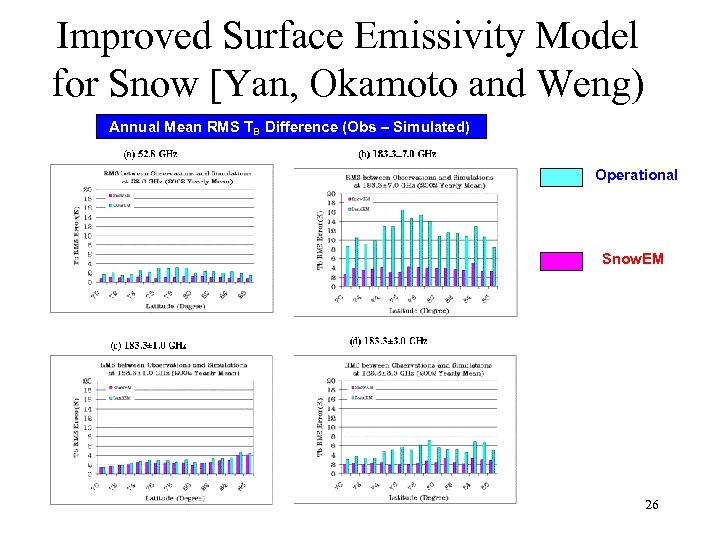 Improved Surface Emissivity Model for Snow [Yan, Okamoto and Weng) Annual Mean RMS TB Difference (Obs – Simulated) Operational Snow. EM 26
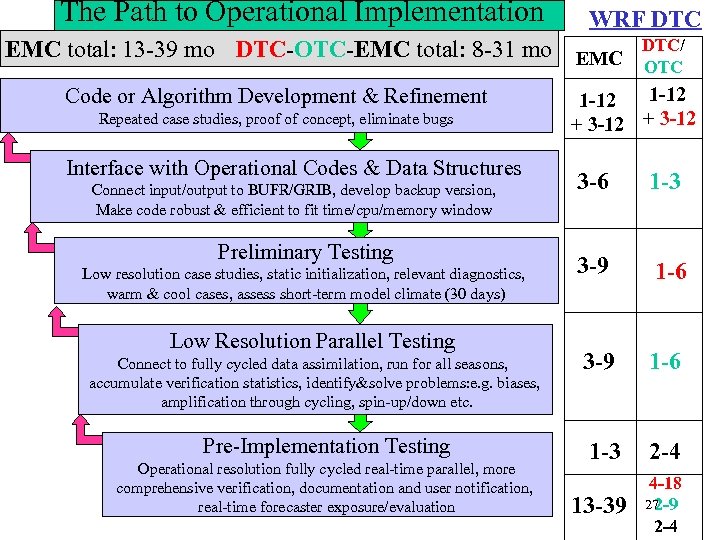 The Path to Operational Implementation WRF DTC EMC total: 13 -39 mo DTC-OTC-EMC total: 8 -31 mo EMC Code or Algorithm Development & Refinement Repeated case studies, proof of concept, eliminate bugs Interface with Operational Codes & Data Structures Connect input/output to BUFR/GRIB, develop backup version, Make code robust & efficient to fit time/cpu/memory window Preliminary Testing Low resolution case studies, static initialization, relevant diagnostics, warm & cool cases, assess short-term model climate (30 days) Low Resolution Parallel Testing Connect to fully cycled data assimilation, run for all seasons, accumulate verification statistics, identify&solve problems: e. g. biases, amplification through cycling, spin-up/down etc. Pre-Implementation Testing Operational resolution fully cycled real-time parallel, more comprehensive verification, documentation and user notification, real-time forecaster exposure/evaluation DTC/ OTC 1 -12 + 3 -12 3 -6 1 -3 3 -9 1 -6 1 -3 2 -4 13 -39 4 -18 27 2 -9 2 -4
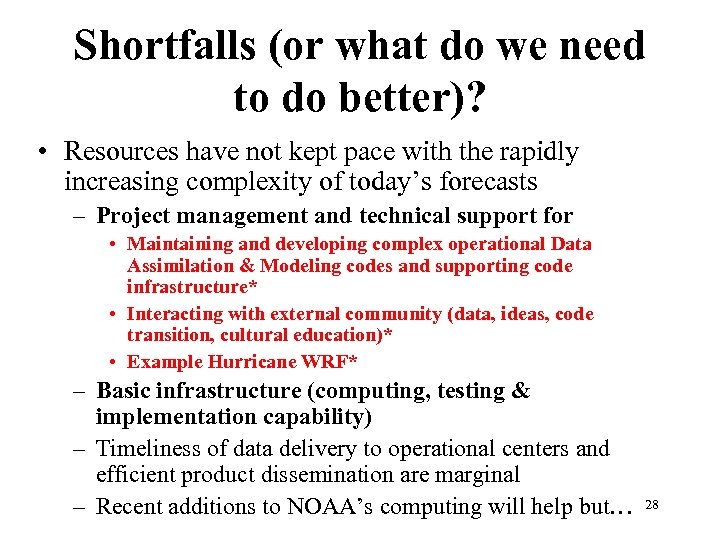 Shortfalls (or what do we need to do better)? • Resources have not kept pace with the rapidly increasing complexity of today’s forecasts – Project management and technical support for • Maintaining and developing complex operational Data Assimilation & Modeling codes and supporting code infrastructure* • Interacting with external community (data, ideas, code transition, cultural education)* • Example Hurricane WRF* – Basic infrastructure (computing, testing & implementation capability) – Timeliness of data delivery to operational centers and efficient product dissemination are marginal – Recent additions to NOAA’s computing will help but… 28
 29
29
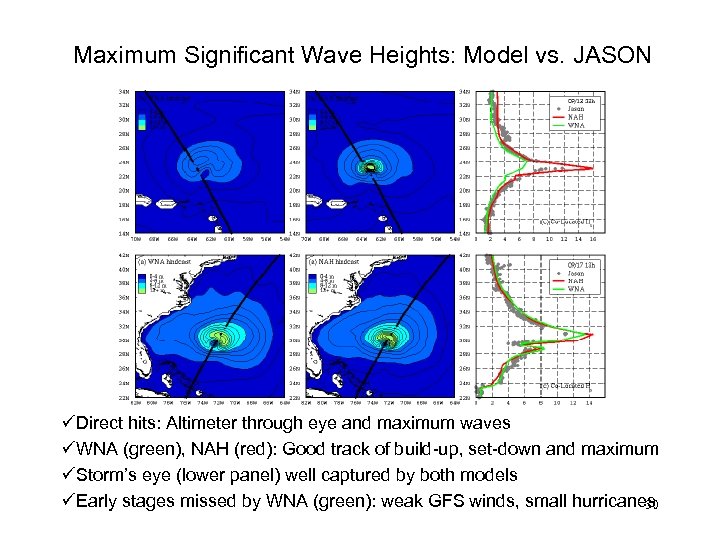 Maximum Significant Wave Heights: Model vs. JASON üDirect hits: Altimeter through eye and maximum waves üWNA (green), NAH (red): Good track of build-up, set-down and maximum üStorm’s eye (lower panel) well captured by both models üEarly stages missed by WNA (green): weak GFS winds, small hurricanes 30
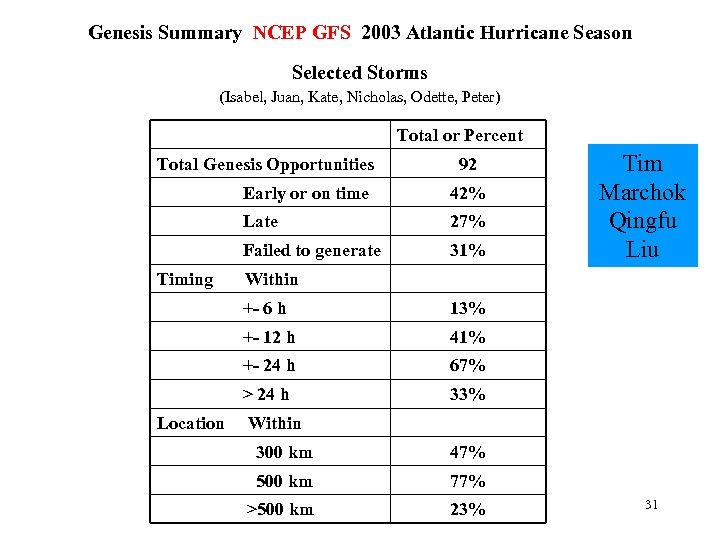 Genesis Summary NCEP GFS 2003 Atlantic Hurricane Season Selected Storms (Isabel, Juan, Kate, Nicholas, Odette, Peter) Total or Percent Total Genesis Opportunities 92 Early or on time Late 27% Failed to generate Timing 42% 31% Within +- 6 h 13% +- 12 h 41% +- 24 h 67% > 24 h Location Tim Marchok Qingfu Liu 33% Within 300 km 47% 500 km 77% >500 km 23% 31
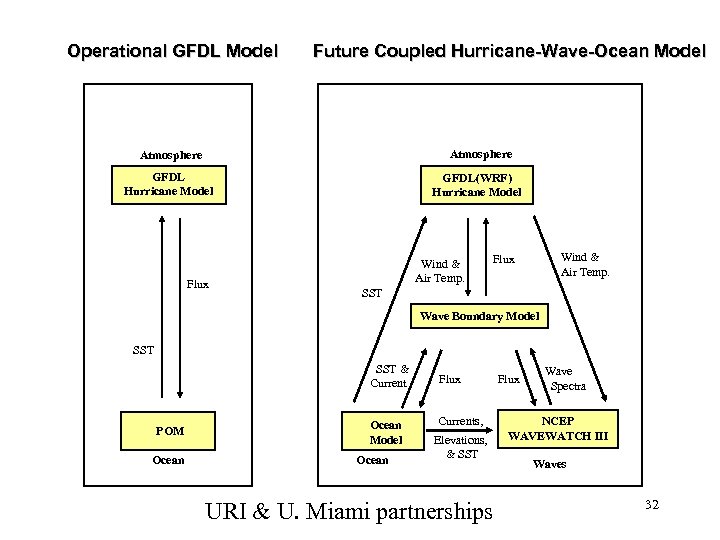 Operational GFDL Model Future Coupled Hurricane-Wave-Ocean Model Atmosphere GFDL Hurricane Model Flux GFDL(WRF) Hurricane Model Wind & Air Temp. Flux SST Wave Boundary Model SST & Current POM Ocean Model Ocean Flux Currents, Elevations, & SST URI & U. Miami partnerships Flux Wave Spectra NCEP WAVEWATCH III Waves 32
 Shortfalls (or what do we need to do better)? (cont) • A solid scientific strategy and policy are needed to guide an expanded and improved observing system – Evaluation of today’s system (e. g. current JCSDA assessment)* – Ways to assess potential impact of new instruments (e. g. OSSEs)* – Examples follow* – Recent activities are encouraging • Ocean observing system for climate is step in right direction • Support for above projects is helping • Still a long way to go 33
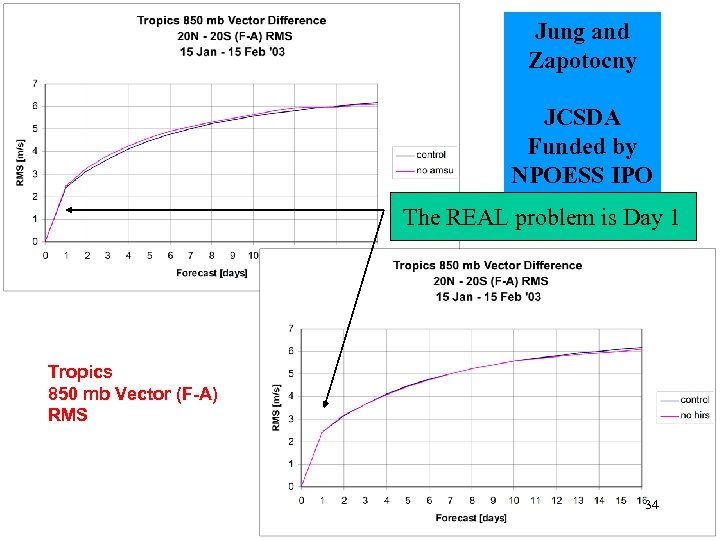 Jung and Zapotocny JCSDA Funded by NPOESS IPO The REAL problem is Day 1 Tropics 850 mb Vector (F-A) RMS 34
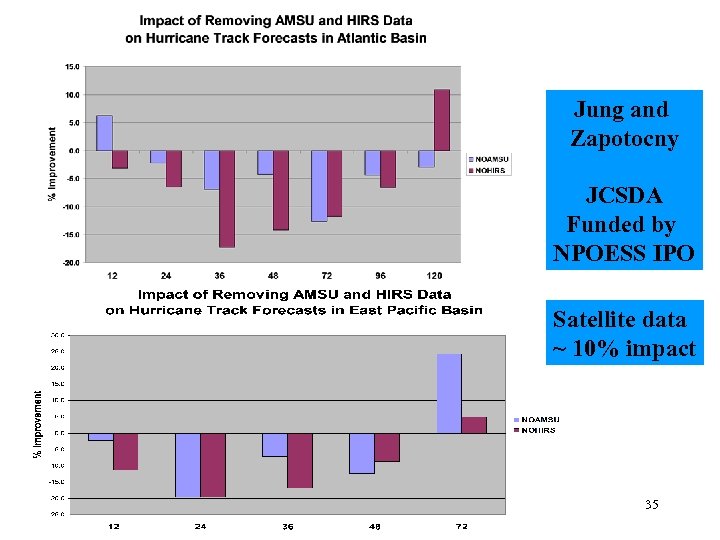 Jung and Zapotocny JCSDA Funded by NPOESS IPO Satellite data ~ 10% impact 35
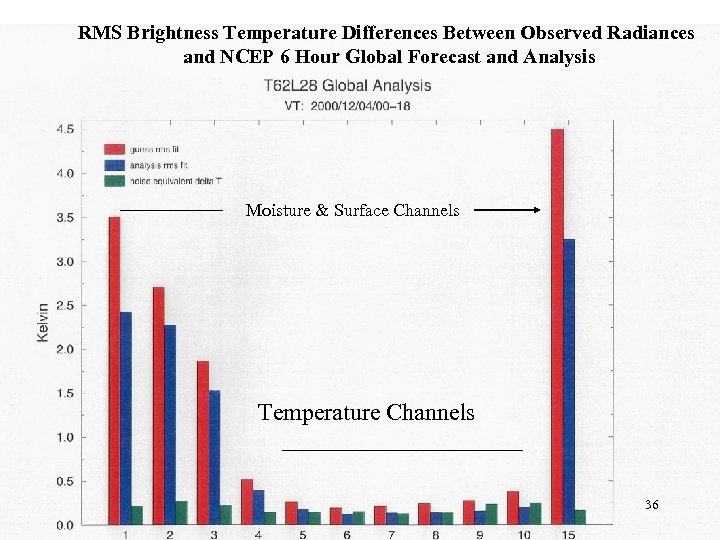 RMS Brightness Temperature Differences Between Observed Radiances and NCEP 6 Hour Global Forecast and Analysis Moisture & Surface Channels Temperature Channels 36
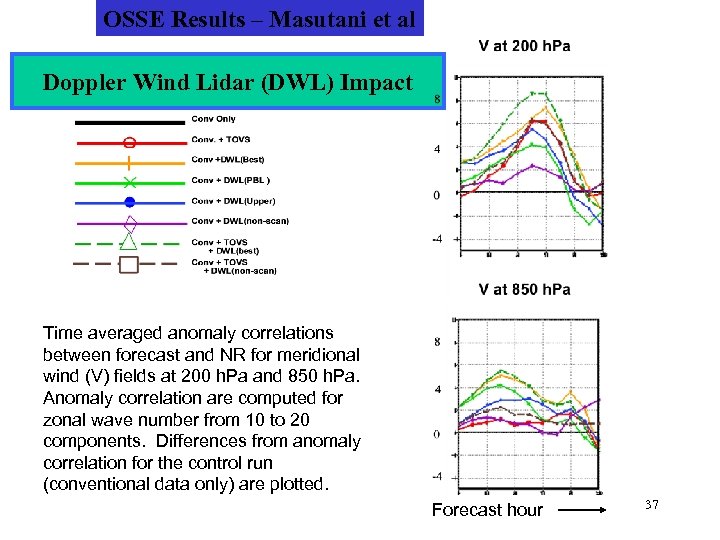 OSSE Results – Masutani et al Doppler Wind Lidar (DWL) Impact Time averaged anomaly correlations between forecast and NR for meridional wind (V) fields at 200 h. Pa and 850 h. Pa. Anomaly correlation are computed for zonal wave number from 10 to 20 components. Differences from anomaly correlation for the control run (conventional data only) are plotted. Forecast hour 37
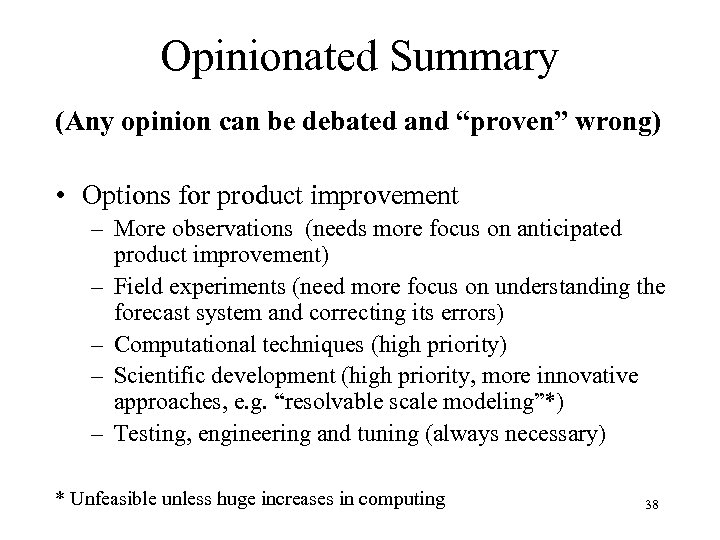 Opinionated Summary (Any opinion can be debated and “proven” wrong) • Options for product improvement – More observations (needs more focus on anticipated product improvement) – Field experiments (need more focus on understanding the forecast system and correcting its errors) – Computational techniques (high priority) – Scientific development (high priority, more innovative approaches, e. g. “resolvable scale modeling”*) – Testing, engineering and tuning (always necessary) * Unfeasible unless huge increases in computing 38
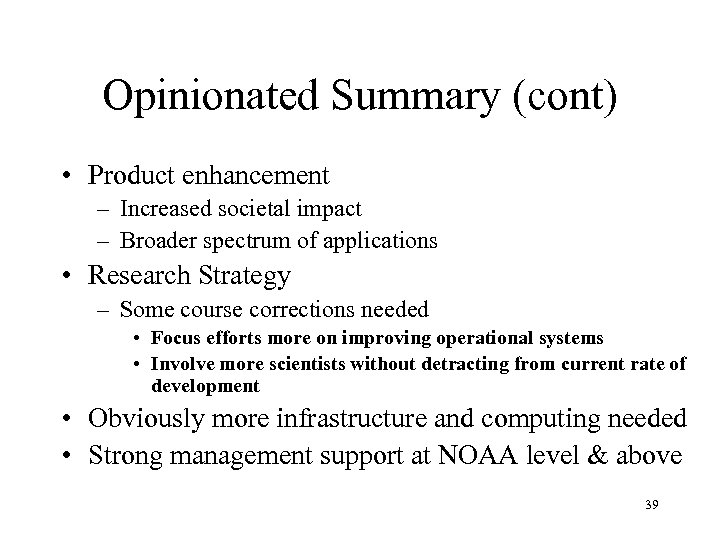 Opinionated Summary (cont) • Product enhancement – Increased societal impact – Broader spectrum of applications • Research Strategy – Some course corrections needed • Focus efforts more on improving operational systems • Involve more scientists without detracting from current rate of development • Obviously more infrastructure and computing needed • Strong management support at NOAA level & above 39
 Opinionated Summary (cont) The last word: • Everyone still has a role to play • Sociology and our past may be greater enemies than the science yet to be conquered* *On runway, Birmingham AL airport, 10: 15 PM, 12% laptop juice “Thunderstorms in Baltimore area have created a traffic jam” 40