


 Скачать презентацию The future of medical journals Richard Smith Editor
400effb8011c655a57c6a414e10b10e5.ppt
- Количество слайдов: 49
 The future of medical journals Richard Smith Editor, BMJ
 What I’m going to talk about • What’s wrong now with our attempts to provide doctors with the information they need? • Why might journals die? • Drivers of change for the future of medical publishing • What might the future look like?
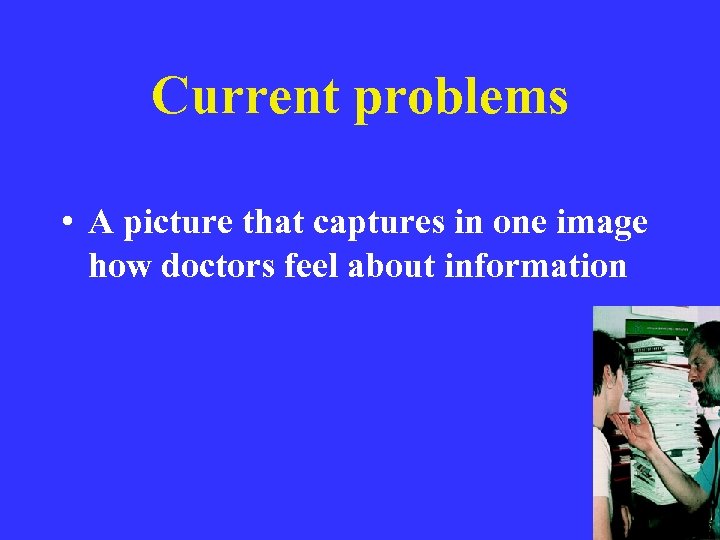 Current problems • A picture that captures in one image how doctors feel about information
 Current problems • One man’s view
 Current problems • Our current information policy resembles the worst aspects of our old agricultural policy, which left grain rotting in thousands of storage files while people were starving. We have warehouses of unused information >rotting= while critical questions are left unanswered and critical problems are left unresolved. Al Gore
 Current problems • On my desk I have accumulated journals and books as information sources, and I assume that I use them. But in some respects they are not as useful as they might be. Many of my textbooks are out of date; I would like to purchase new ones, but they are expensive. My journals are not organised so that I can quickly find answers to questions that arise, and so I don=t have print sources that will answer some questions. On the other hand, there is likely to be a human source who can answer nearly all of the questions that arise, albeit with another set of barriers. An ordinary doctor.
 Current problems • Think of all the information that you might read to help you do your job better. • How much of it do you read?
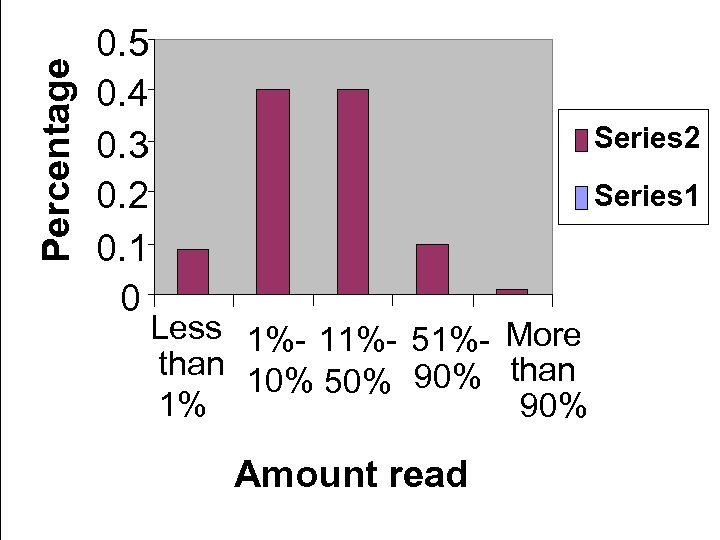 Percentage 0. 5 0. 4 0. 3 0. 2 0. 1 0 Series 2 Series 1 Less 1%- 11%- 51%- More than 10% 50% 90% than 1% 90% Amount read
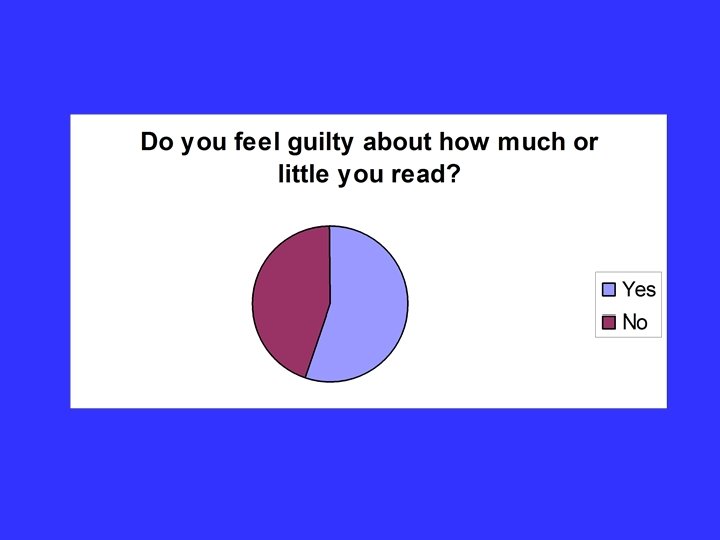
 Current problems • Do you feel guilty about how much or how little you read?
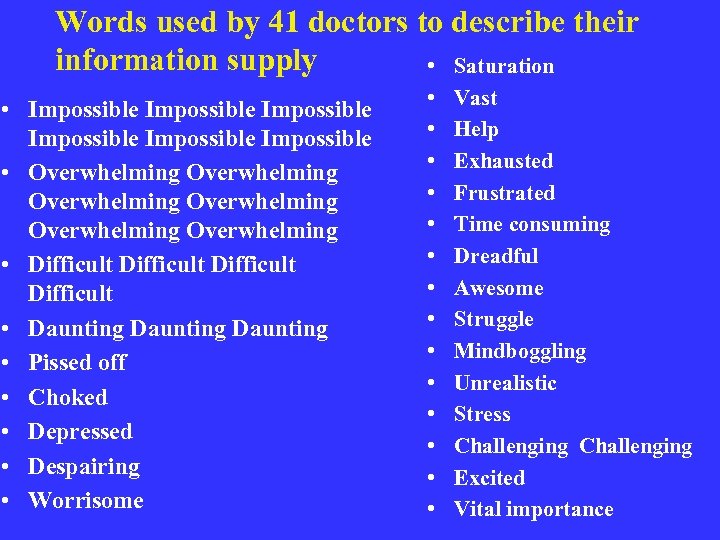 Words used by 41 doctors to describe their information supply • Saturation • Impossible Impossible • Overwhelming Overwhelming • Difficult • Daunting • Pissed off • Choked • Depressed • Despairing • Worrisome • • • • Vast Help Exhausted Frustrated Time consuming Dreadful Awesome Struggle Mindboggling Unrealistic Stress Challenging Excited Vital importance
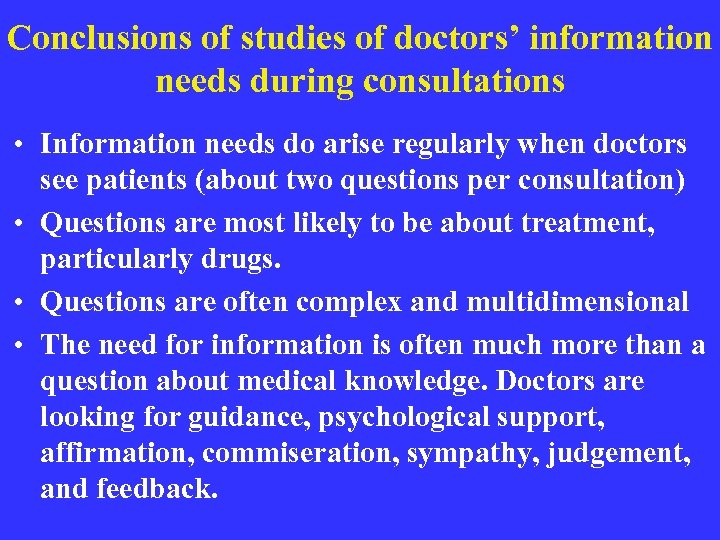 Conclusions of studies of doctors’ information needs during consultations • Information needs do arise regularly when doctors see patients (about two questions per consultation) • Questions are most likely to be about treatment, particularly drugs. • Questions are often complex and multidimensional • The need for information is often much more than a question about medical knowledge. Doctors are looking for guidance, psychological support, affirmation, commiseration, sympathy, judgement, and feedback.
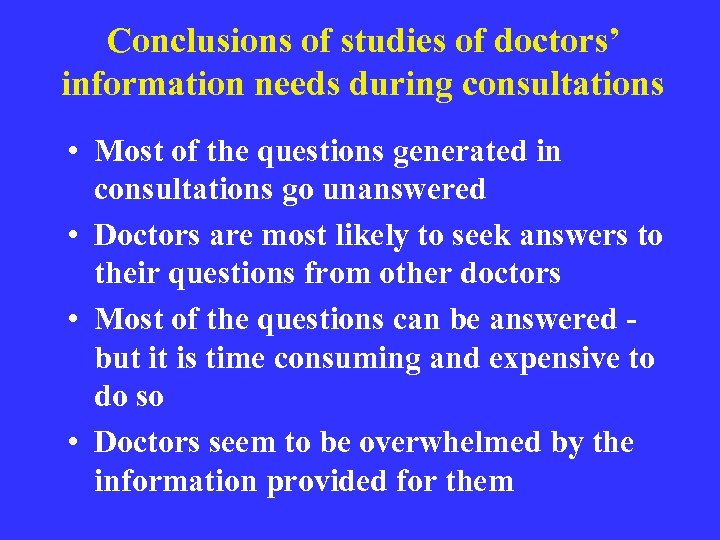 Conclusions of studies of doctors’ information needs during consultations • Most of the questions generated in consultations go unanswered • Doctors are most likely to seek answers to their questions from other doctors • Most of the questions can be answered but it is time consuming and expensive to do so • Doctors seem to be overwhelmed by the information provided for them
 The information paradox: Muir Gray • Doctors are overwhelmed with information yet cannot find the information they need
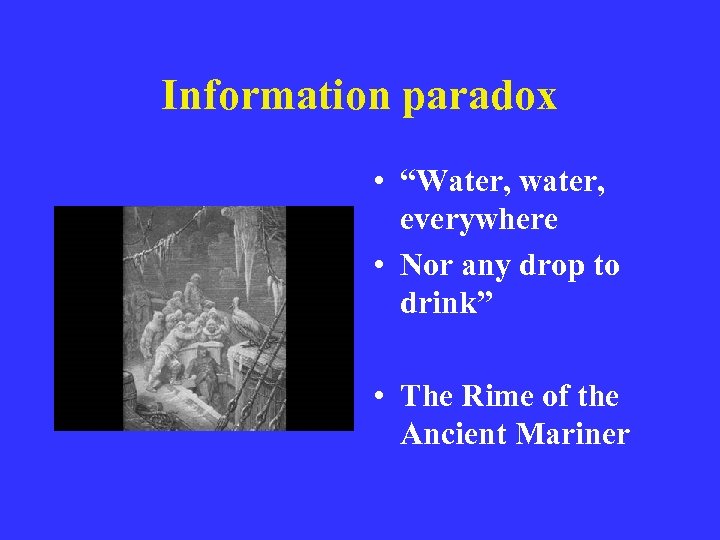 Information paradox • “Water, water, everywhere • Nor any drop to drink” • The Rime of the Ancient Mariner
 What’s wrong with medical journals • • Don=t meet information needs Too many of them Too much rubbish Too hard work Not relevant Too boring Too expensive
 What’s wrong with medical journals • • Don=t add value Slow every thing down Too biased Anti-innovatory Too awful to look at Too pompous Too establishment
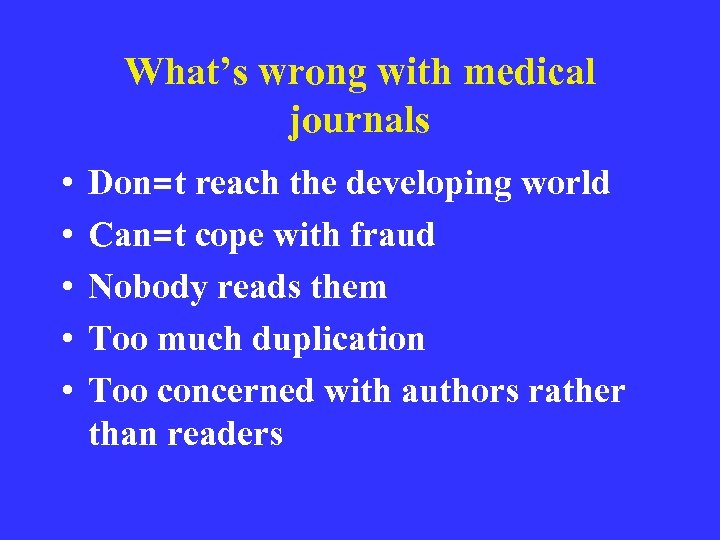 What’s wrong with medical journals • • • Don=t reach the developing world Can=t cope with fraud Nobody reads them Too much duplication Too concerned with authors rather than readers
 The future
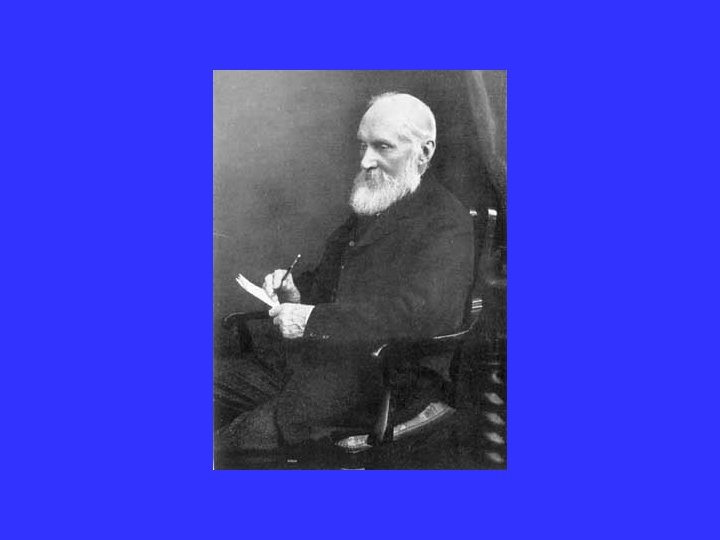
 Predictions of Lord Kelvin, president of the Royal Society, 1890 -95 • Radio has no future • X rays will prove to be a hoax • Heavier than air flying machines are impossible
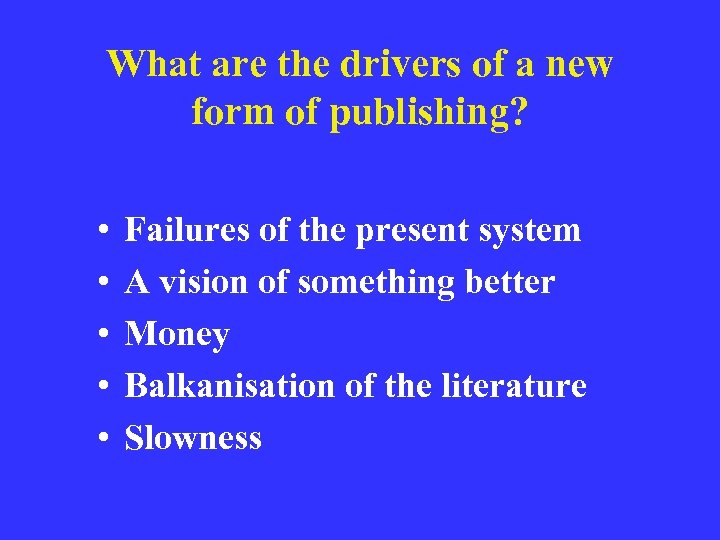 What are the drivers of a new form of publishing? • • • Failures of the present system A vision of something better Money Balkanisation of the literature Slowness
 A vision of something better • "It's easy to say what would be the ideal online resource for scholars and scientists: all papers in all fields, systematically interconnected, effortlessly accessible and rationally navigable, from any researcher's desk, worldwide for free. ” Stevan Harnad
 A vision of something better • If you have an apple and I have an apple and if we exchange these apple then you and I will still each have one apple. But if you have an idea and I have an idea and we exchange these ideas, then each of us will have two ideas. George Bernard Shaw
 Money What does the research community do? • Do the research, often funded by public • • money, often costing millions Hand over the copyright to the journals Do the editing, often unpaid Do the peer review, almost always unpaid Often do the technical editing, often unpaid Buy the journals, often at inflated prices, some cost $10 000 Read the journals Store the journals
 Money • • • What do the publishers do? May own the journals, although often they don=t Manage the process Lend the money to keep the process going Design - usually minimal Typeset, print, and distribute the journal Market the journal - but often to libraries that have to have them • Sell reprints - sometimes for $250 000 a time (nothing to authors or funders of the research); can almost sell themselves • Sell advertising - often none
 Balkanisation • If you are a gastroenterologist the research that might matter to you may be in 30 different journals • The difficulty of doing systematic reviews • Important research articles are all over the place, some in Medline, many not • Even if you can find the stuff, it costs a fortune to gather it all together (systematic review on research misconduct -£ 2000 to get photocopies)
 Slowness • For many journals the time between submission and publication is over a year-unacceptable
 Publiclibraryofscience. org • To encourage the publishers of our journals to support this endeavor [of making research available free to all], we pledge that, beginning in September, 2001, we will publish in, edit or review for, and personally subscribe to, only those scholarly and scientific journals that have agreed to grant unrestricted free distribution rights to any and all original research reports that they have published through Pub. Med Central and similar online public resources, within 6 months of their initial publication date.
 Dangers of predicting the future • I never make predictions, especially about the future. Sam Goldwyn Mayer
 Versions of the future • Pubmed Central • Open archives • A Napster for science • Databases plus
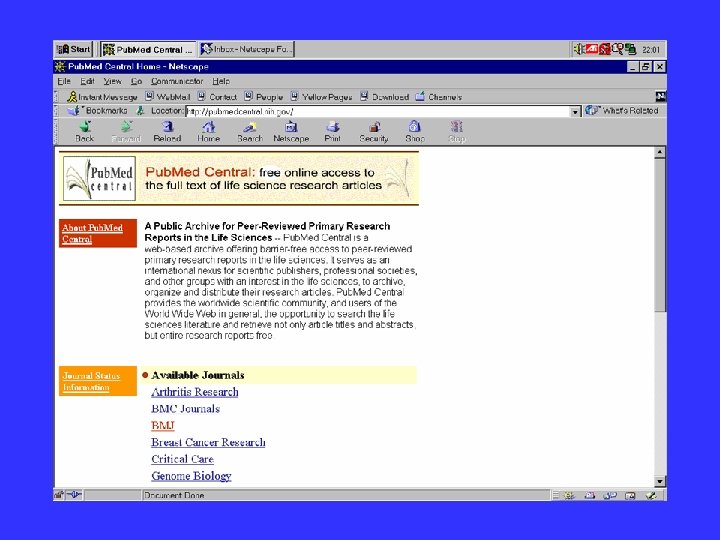
 Pubmed Central • Started by NIH • Database of peer reviewed papers posted there after peer review (now links to other sites rather than a database) • Pubmed Express--Eprint server
 Possible developments I • Add a register of trials/research • Avoid repetition • Avoid publication bias • Public and patients can know what=s going on • Avoid putting resources into useless research
 Possible developments II • Might develop some kind of system-perhaps Ahits@--for categorising into levels: gold, silver, and bronze • Papers might be updated
 Journals currently included in Pubmed Central • • Arthritis Research Biomed Central Journals BMJ Breast Cancer Research Critical Care Genome Biology Molecular Biology of the Cell Proceedings of the National Academy of Sciences
 Journals that will appear on Pubmed Central • • Biomed central Bulletin of the Medical Library Association Canadian Medical Association Journal of American Medical Informatics Journal of Medical Entomology Nucleic Acids Research The Plant Cell Plant Physiology
 Open archives • Everybody keeps their own material-authors, universities, governments, pharmaceutical companies, journals, etc • Common standards ensures that they are linked and searchable • A central register (Pubmed) and/or search engines allow everything to be found
 A Napster for science • Your computer will access a science paper from any other computer • A central server simply tells you where the paper is • With Nutella no central server is necessary (so what could be illegal) • This might include material from the past as well as the future
 Databases plus • Medicine and biology follow astronomy and physics to become mostly studies based on huge datasets • Small, investigator driven studies largely disappear • It could happen in medicine: need for bigger studies; need for databases to answer many questions
 Journals in the new world • Not Abusiness as usual@ but Areinventing ourselves@ • Probably far fewer • Concentrate on meeting the needs of readers/ a community rather than authors • Rather than peer reviewing whatever is sent to them they would select relevant material from Pubmed Central and present it in an attractive way. (What the BMJ has always done). • All the rest - education, debate, reviews, what=s on. Forum for debate Abe the glue that holds a
 Journals in the new world • Use all the possibilities of the electronic and paper world • ELPS (electronic long, paper short) • Online open review • Copyright back to authors - each does what they want, payment to authors for reprints • Benign publishers - low profit professional societies
 ELPS (Electronic long, paper short) • Paper - easier, shorter, brighter, more fun, more readable • Electronic • • • full data, software, video, sound extra material links interactive updating immediate posting
 Problems with peer review • • Slow Expensive A lottery Ineffective Biased Easily abused Can’t detect fraud Works for improving studies not selecting which to publish • Can’t detect fraud
 Towards online peer review • Reviewers identity revealed to authors (RCT) • Reviewers’ comments posted on the web of accepted papers (RCT underway) • Reviewers’ comments posted as available • Training reviewers (RCT started)
 Vision of peer review • “Peer review is changed from being an arbitrary decision made in a closed box to an open scientific discourse. ”
 Conclusions • We do a bad job of meeting the information needs of doctors • Medical journals are full of defects • Various strong drivers mean that research studies will eventually be published on the web • The role of journals will be to select what’s relevant and important and present it in a sexy way
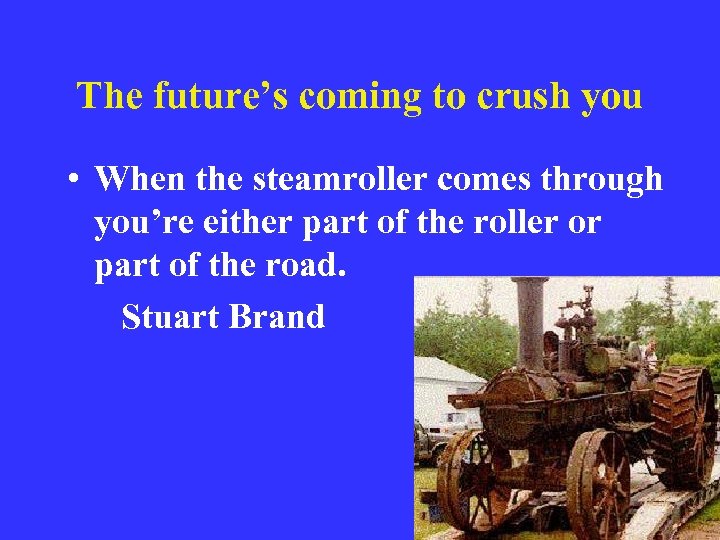 The future’s coming to crush you • When the steamroller comes through you’re either part of the roller or part of the road. Stuart Brand