Скачать презентацию The Future of Identity Management in Higher Education
9b68eb0b9c1c0ef6e63b53d58d7ab3bf.ppt
- Количество слайдов: 34
 The Future of Identity Management in Higher Education JA-SIG June 2007 Jens Haeusser Director, Strategy IT, UBC
 Agenda § Today: Centralized Identity Management – Overview, Best Practices, and Lessons Learned – “Identity 1. 0” § Tomorrow: Federated ID – Shibboleth and eduroam – “Identity 1. 5” § What’s Next: Distributed / User Centric ID – Open ID, Cardspace, and Claims – “Identity 2. 0”
 What is Identity Management? § Lifecycle maintenance of electronic accounts § Provisioning – – Account creation Account updates Role maintenance Account removal § Authentication & Authorization § Access Control
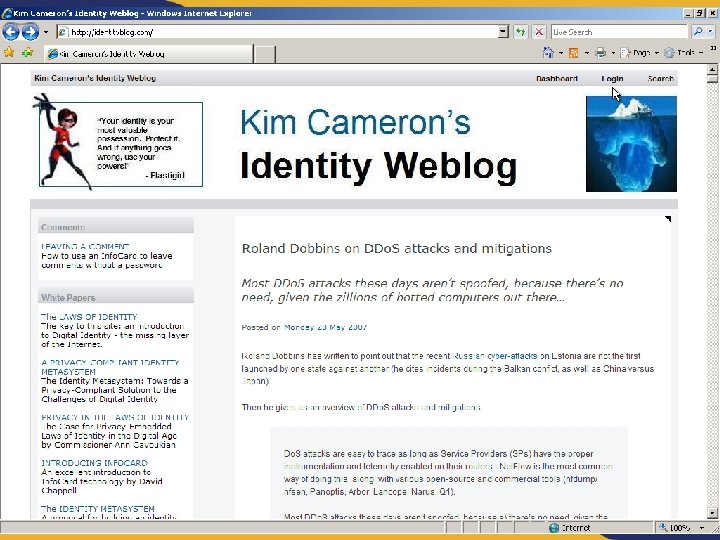
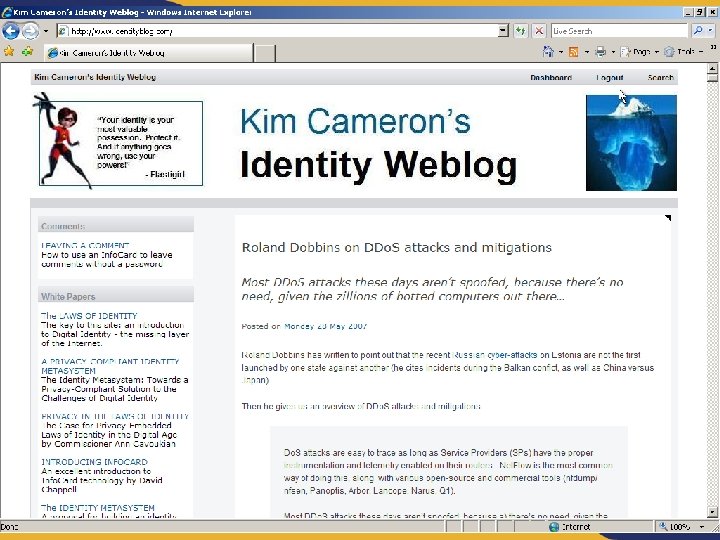
 Why is it Important? “Your identity is your most valuable possession. Protect it. And if anything goes wrong, use your powers!” – Elastigirl Kim Cameron’s Identity Weblog
 Today’s Challenges § Complex and fractured identity landscape – – Many systems of records Many applications Many passwords Many overlapping roles § Make life easier for faculty, staff and students – Enable access to resources – Enforce privacy and security – Create a sense of a unified University
 Today’s Solutions § Consolidated directories § Integrated and automated provisioning § Multiple managed domain controllers § Separation of Authentication and Authorization § Role-based access control § Virtual organizations § Distributed and delegated administration § Initial/reduced/single sign-on
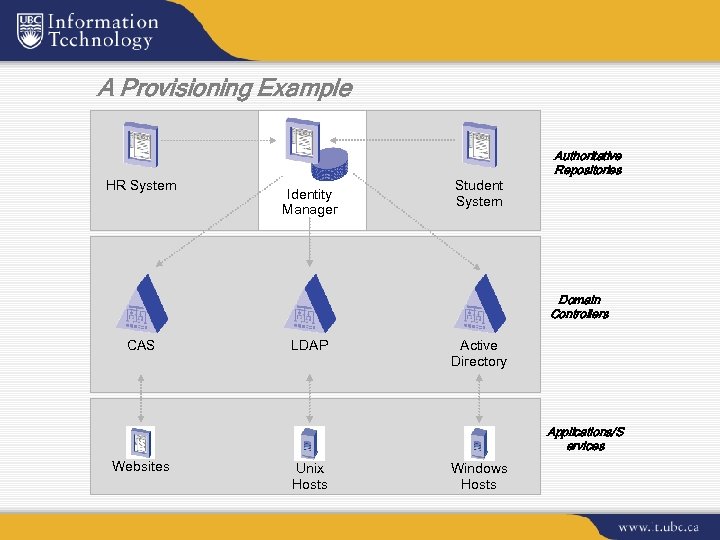 A Provisioning Example HR System Identity Manager Student System Authoritative Repositories Domain Controllers CAS LDAP Active Directory Applications/S ervices Websites Unix Hosts Windows Hosts
 Lessons Learned § It’s all about relationships – Let people engage, cradle to grave – Multiple, overlapping, ever changing § Embrace multiple authoritative sources – Authoritative for attributes, not people § Account names should be ephemeral – Users should be free to select and change – Applications should record account ID, not name § Dynamic rules, not static roles
 Tomorrow: Federation § Today’s solutions are institution centric – Institution as walled garden – Centralized Identity - “Identity 1. 0” § Tomorrow’s solutions move beyond the institution – Broadcast identity from one institution to another – Trust model controlled by institution, not user – Federated Identity - “Identity 1. 5”
 What are Federations? § Group of organizations sharing a set of agreed policies and rules for access to online resources – enable members to establish trust and shared understanding of language or terminology – provide a structure / legal framework that enables authentication and authorization § Enables people to use their home credentials to connect to remote sites – Without revealing their credentials (pseudonimity) – Without releasing unnecessary private information
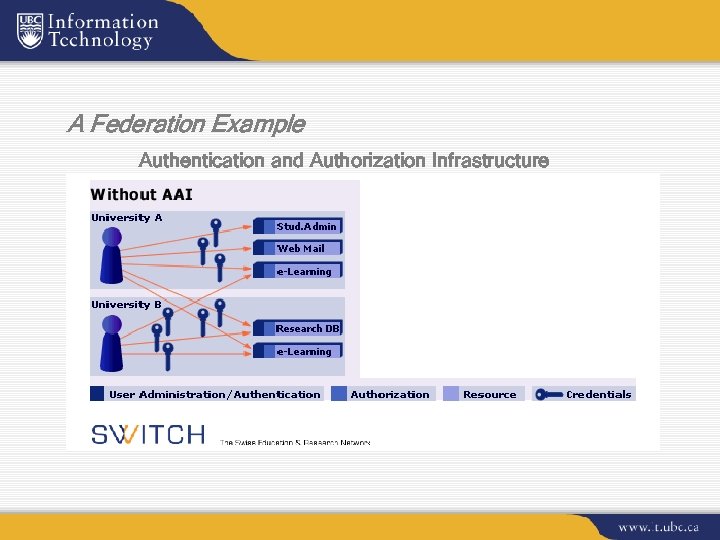 A Federation Example Authentication and Authorization Infrastructure
 What is ? § An open source project supporting inter-institutional sharing of web resources subject to access controls. § Streamlines sharing secured online services § Leverages campus identity and access management infrastructures – sends information about users to resource site – enables resource provider to make authorization decisions § Ideal for lightweight web authentication – digital libraries – learning object repositories
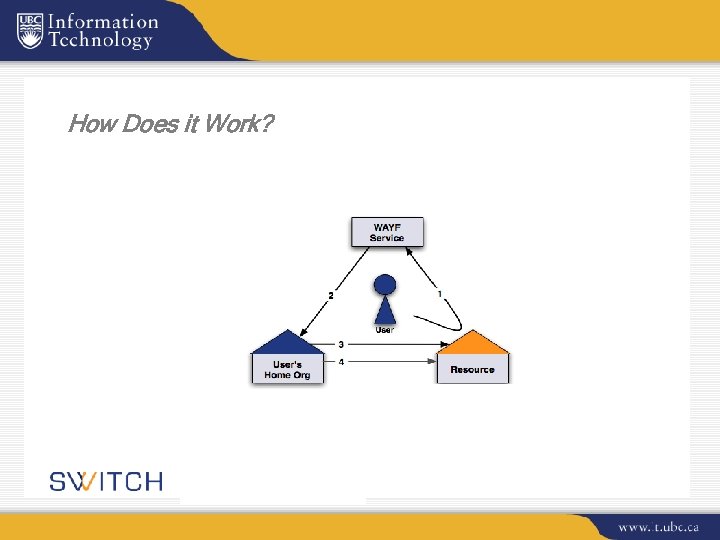 How Does it Work? 3 2 4 1
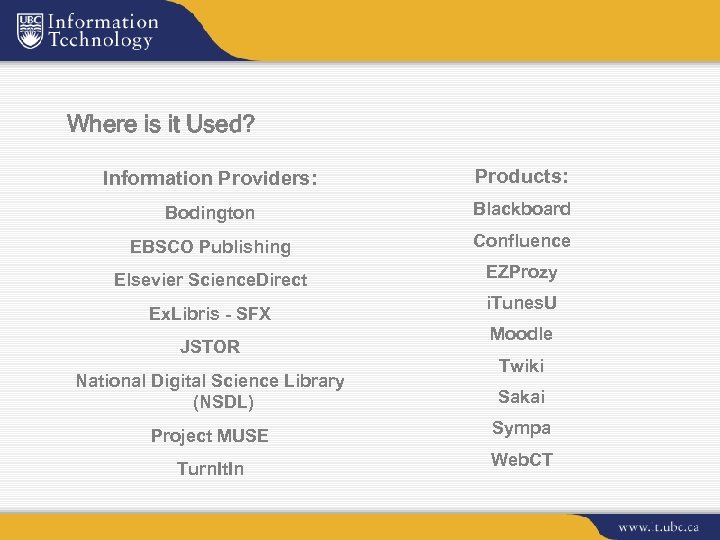 Where is it Used? Information Providers: Products: Bodington Blackboard EBSCO Publishing Confluence Elsevier Science. Direct EZProzy Ex. Libris - SFX JSTOR i. Tunes. U Moodle Twiki National Digital Science Library (NSDL) Sakai Project MUSE Sympa Turn. It. In Web. CT
 What is ? § eduroam stands for Education Roaming § Originally a European initiative § Launched in 2003 to deal with the “Roaming Scholar problem” § RADIUS-based infrastructure § Uses 802. 1 X to allow inter-institutional roaming § Allows users visiting other eduroam institutions to access WLAN using home credentials
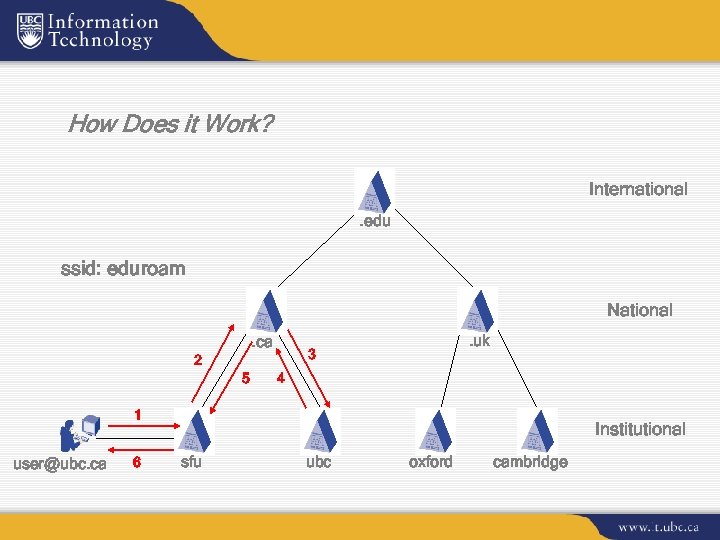 How Does it Work? International. edu ssid: eduroam National. ca 2 5 . uk 3 4 1 user@ubc. ca 6 Institutional sfu ubc oxford cambridge
 Where Does it Work?
 Higher Education Federations § Shibboleth – In. Common (US) – UK Access Management Federation § eduroam – JANET (UK) – TERANA § Policy Based – CIMF (Canada) – SWITCH (Switzerland)
 What Comes Next? § Move control from the institution to the individual § Complex interactions with many institutions § Greater control over identity data – User chooses which attributes (claims) to release, and where to get those claims § User Centric Identity - “Identity 2. 0” “Of course I have a secret identity. I mean, do you see me at the supermarket wearing. . . this? Who wants to go shopping as Elastigirl, know what I'm saying? "
 What are Claims? § An assertion, made by the user, of identity data – Identifier (account name) – Personal information (name, address, birthday) – Group membership (over 21, University student) § Multiple types – Directly validated (password) – User-asserted (self signed) – Third party validated (trusted public key)
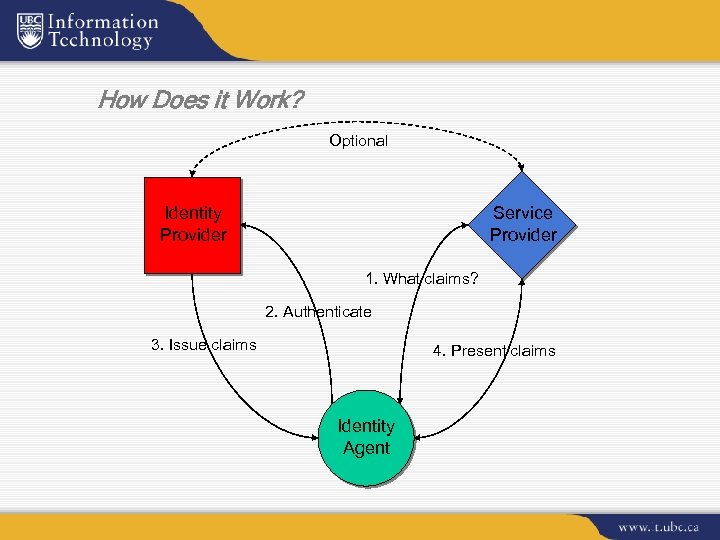 How Does it Work? Optional Identity Provider Service Provider 1. What claims? 2. Authenticate 3. Issue claims 4. Present claims Identity Agent
 What is Open. ID? § Open source, distributed authentication system § Simple and lightweight: identity is a URL § Fully decentralized and open platform § I want to log into example. com: 1. I type my Open. ID URL into the login form on example. com 2. example. com redirects me (via my web-browser) to myopenid. com 3. I tell myopenid. com whether or not I trust example. com with my identity 4. I am redirected back to example. com and am automatically logged in
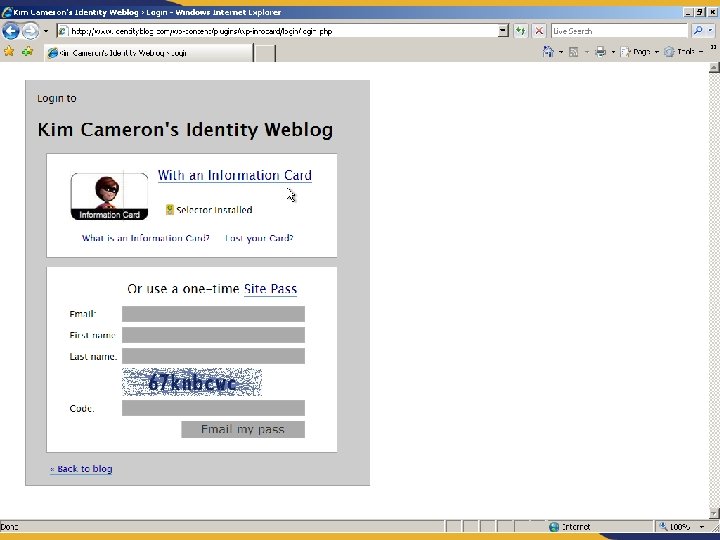
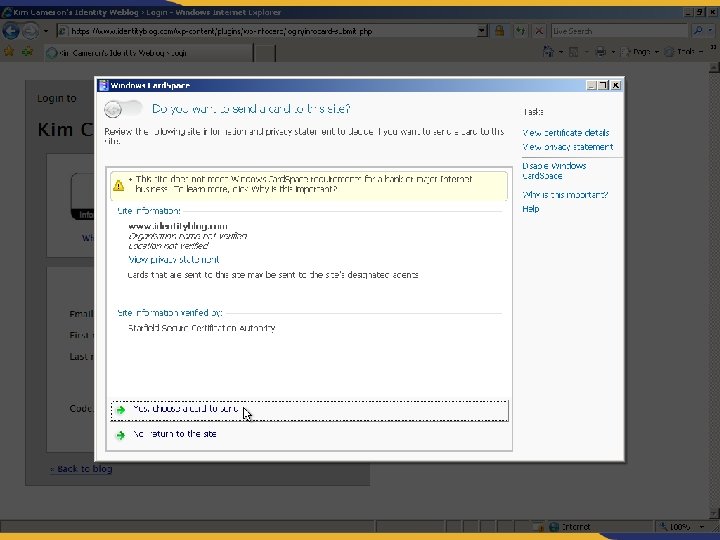
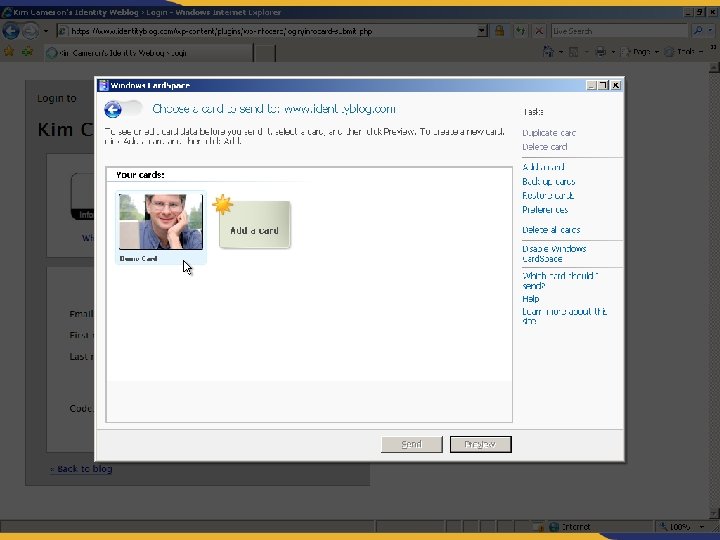
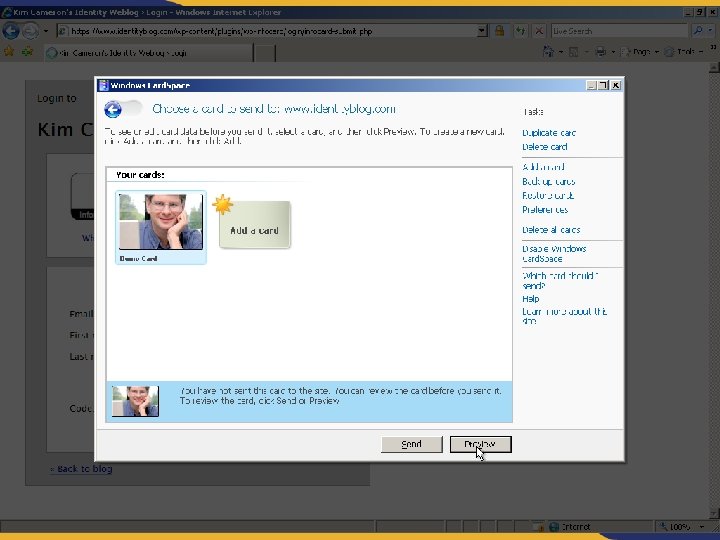
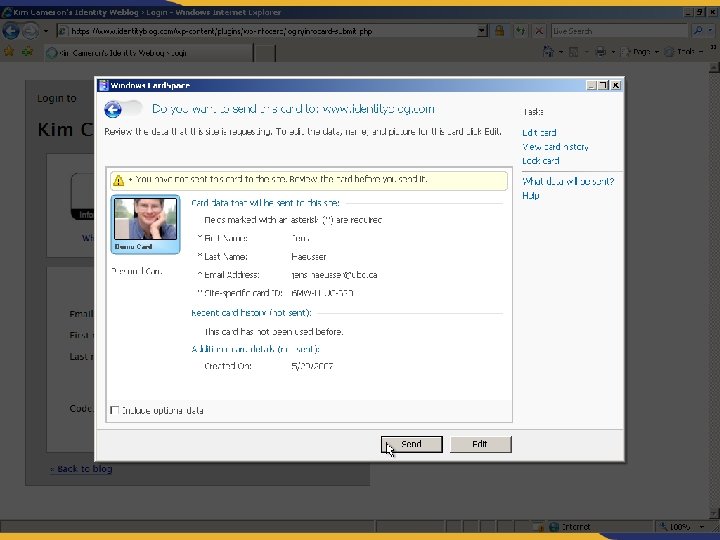
 What is Card. Space? § Windows client software- part of Microsoft’s “Identity Metasystem” § Stores “Identity Cards” – Bundles of claims – Managed or self-issued cards § Presents user with choice of valid cards § Token Agnostic – Can use SAML, Shibboleth, Open. ID, WS-*, …
 The Coming Convergence § Still early days, and rapid development, but… § Active, open conversation between developers, creating the Internet Identity Layer § Open Source Infocard clients and servers emerging § Microsoft sponsored Shibboleth-Cardspace integration § CAS 3. 1 supports Open. ID and SAML
 Conclusion § Identity practice undergoing dramatic changes § Users will expect to engage with us in new ways – Bring identity information when they join – Gradual migration to claim based access § Prepare by continuing to strengthen and consolidate internal Identity Management § Target low hanging fruit for Federation § Keep abreast of user-centric identity management
 Questions? jens. haeusser@ubc. ca
 Additional Resources 1. 2. 3. 4. Open. ID Higgins: Open Source Identity Project Card. Space: Wikipedia Article Burton Document: The Information Card Landscape (Card. Space and Higgins) 5. eduroam 6. Shibboleth 7. CIMF Shibboleth Pilot 8. Phil Windley’s Technometria 9. Phil Windley’s book: Digital Identity [sample chapter] 10. Kim Cameron’s Blog 11. Kim Cameron’s Laws of Identity 12. Dick Hardt’s Blog