 Скачать презентацию The Future of Global Real Estate A syndicated
5bbf628421e383e6cad5b120a673fb3f.ppt
- Количество слайдов: 26




The Future of Global Real Estate A syndicated research programme uncovering the future of global property values Economist Intelligence Unit Country and Economic Research March 2009 1

Our proposed methodology 2
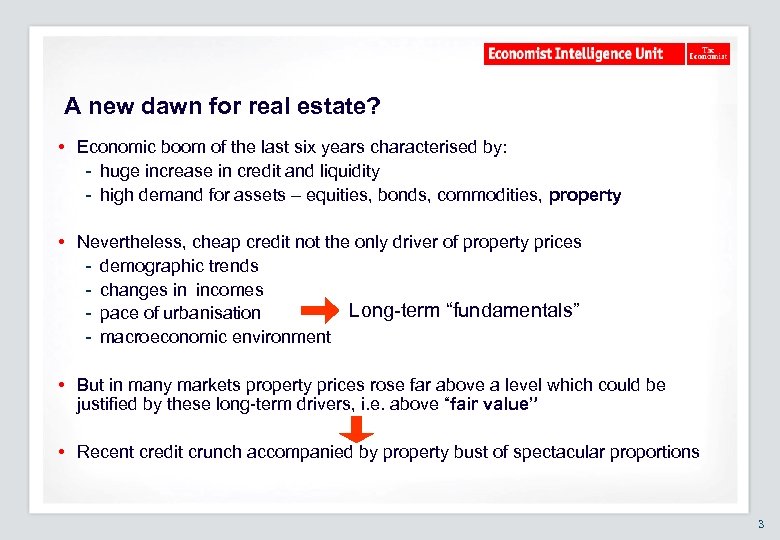
A new dawn for real estate? • Economic boom of the last six years characterised by: - huge increase in credit and liquidity - high demand for assets – equities, bonds, commodities, property • Nevertheless, cheap credit not the only driver of property prices - demographic trends - changes in incomes Long-term “fundamentals” - pace of urbanisation - macroeconomic environment • But in many markets property prices rose far above a level which could be justified by these long-term drivers, i. e. above “fair value” • Recent credit crunch accompanied by property bust of spectacular proportions 3
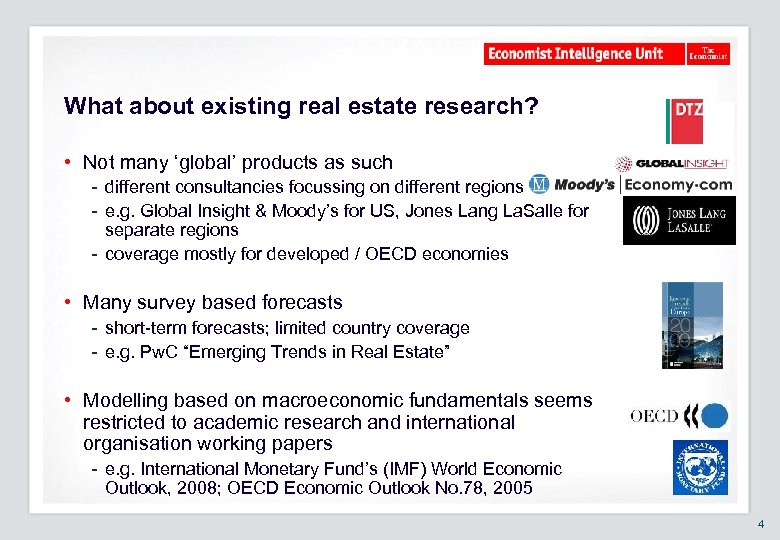
What about existing real estate research? • Not many ‘global’ products as such - different consultancies focussing on different regions - e. g. Global Insight & Moody’s for US, Jones Lang La. Salle for separate regions - coverage mostly for developed / OECD economies • Many survey based forecasts - short-term forecasts; limited country coverage - e. g. Pw. C “Emerging Trends in Real Estate” • Modelling based on macroeconomic fundamentals seems restricted to academic research and international organisation working papers - e. g. International Monetary Fund’s (IMF) World Economic Outlook, 2008; OECD Economic Outlook No. 78, 2005 4
Our methodology • Theoretical background: - IMF, WEO 2004: “House prices in Australia, UK, Ireland Spain exceeded their predicted values by 20 pc” - IMF, WEO 2007: “During 1997 to 2007 […] house prices were [up to] 30 pc higher than justified by the fundamentals” - OECD, Economic Outlook 2005: ”To address [overvaluation] it is necessary to relate these prices to their putative underlying determinants” 5
Our methodology • Econometric analysis to arrive at a real estate 'fair' price equation - based on a regression which best explains past price fluctuations given historical economic data - determine what should have happened to prices given the path of economic fundamentals in the past and determine the 'price gap‘ • Forecasts: apply price equation to our in-house macroeconomic forecasts - determine the future path of 'fair' prices of real estate in light of future macroeconomic conditions - EIU’s forecasting approach will combine long-term economic forecasting with property specific factors and will ensure that price forecasts take appropriate account of the state of the economy and income levels. 6
Why the Economist Intelligence Unit? Independent, long-run perspective required Some property specialists will forecast property prices based on historic trends and industry specific factors (such as availability of planning permits etc). But a truly insightful long run property forecast requires much more than this - it needs to be rooted in a deep understanding of the broader national and international economic context. This is an area in which the EIU has a proven track record. Therefore the EIU’s forecasting approach, which combines long-term economic forecasting with property specific factors, is designed to ensure that our forecasts take appropriate account of the state of the economy and income levels. Many of the mistakes in forecasting property prices in the past have arisen because these factors were not taken sufficiently into account. 7

Why the Economist Intelligence Unit? World leader in country analysis and forecasting. For over 60 years we have provided business intelligence that corporate executives, government officials and academics require to understand developments around the world. We cover more than 200 countries, providing economic forecasts on the world's 150 largest markets. A truly insightful long run property forecast needs to be rooted in a deep understanding of the broader national and international economic context. This is an area in which the EIU has a proven track record. It is our analytical framework and forecasting methodology that gives us our competitive edge. Our approach combines the best in analysis–drawing on the country expertise of our specialists–and the best in forecasting, grounded in tested models, carefully vetted data and a quality–control process that ensures both accuracy and consistency. 8
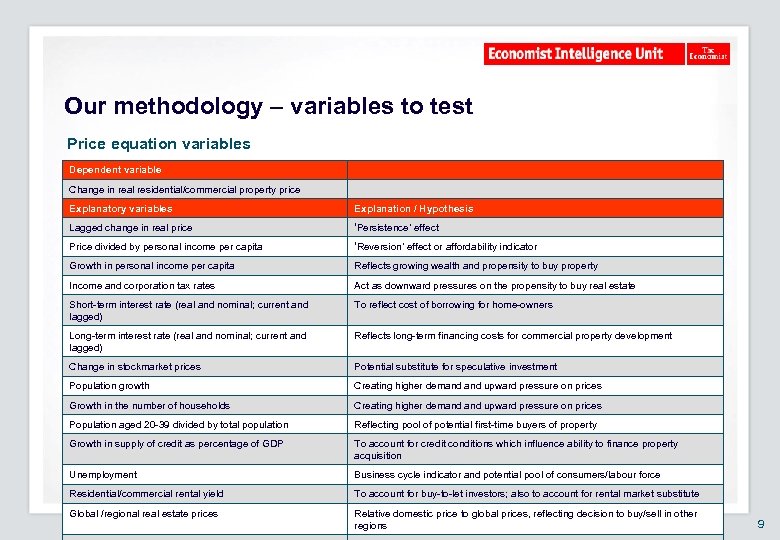
Our methodology – variables to test Price equation variables Dependent variable Change in real residential/commercial property price Explanatory variables Explanation / Hypothesis Lagged change in real price ‘Persistence’ effect Price divided by personal income per capita ‘Reversion’ effect or affordability indicator Growth in personal income per capita Reflects growing wealth and propensity to buy property Income and corporation tax rates Act as downward pressures on the propensity to buy real estate Short-term interest rate (real and nominal; current and lagged) To reflect cost of borrowing for home-owners Long-term interest rate (real and nominal; current and lagged) Reflects long-term financing costs for commercial property development Change in stockmarket prices Potential substitute for speculative investment Population growth Creating higher demand upward pressure on prices Growth in the number of households Creating higher demand upward pressure on prices Population aged 20 -39 divided by total population Reflecting pool of potential first-time buyers of property Growth in supply of credit as percentage of GDP To account for credit conditions which influence ability to finance property acquisition Unemployment Business cycle indicator and potential pool of consumers/labour force Residential/commercial rental yield To account for buy-to-let investors; also to account for rental market substitute Global /regional real estate prices Relative domestic price to global prices, reflecting decision to buy/sell in other regions 9
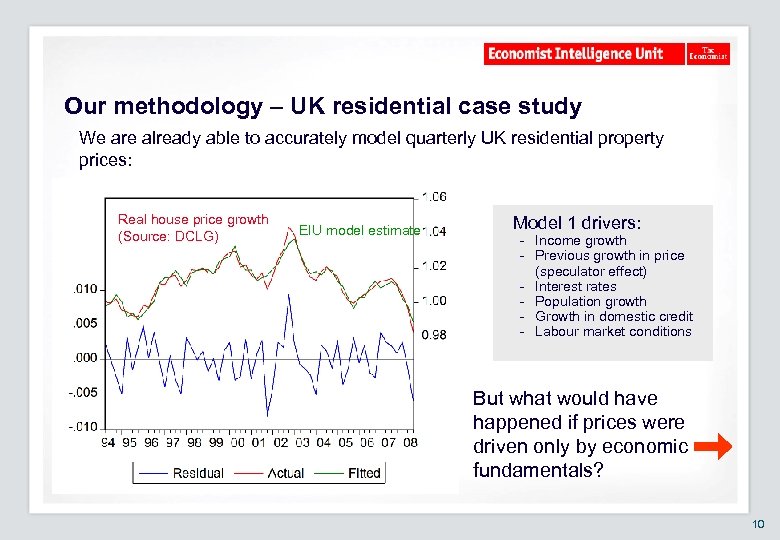
Our methodology – UK residential case study We are already able to accurately model quarterly UK residential property prices: Real house price growth (Source: DCLG) EIU model estimate Model 1 drivers: - Income growth - Previous growth in price (speculator effect) - Interest rates - Population growth - Growth in domestic credit - Labour market conditions But what would have happened if prices were driven only by economic fundamentals? 10
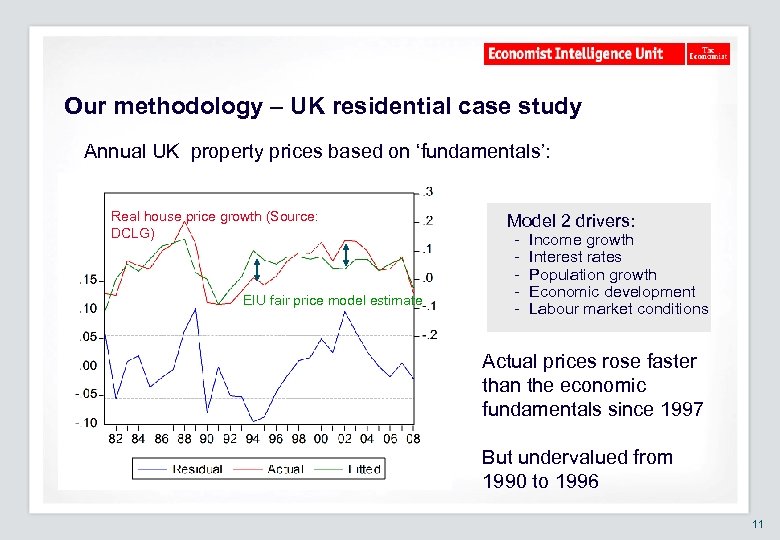
Our methodology – UK residential case study Annual UK property prices based on ‘fundamentals’: Real house price growth (Source: DCLG) EIU fair price model estimate Model 2 drivers: - Income growth Interest rates Population growth Economic development Labour market conditions Actual prices rose faster than the economic fundamentals since 1997 But undervalued from 1990 to 1996 11
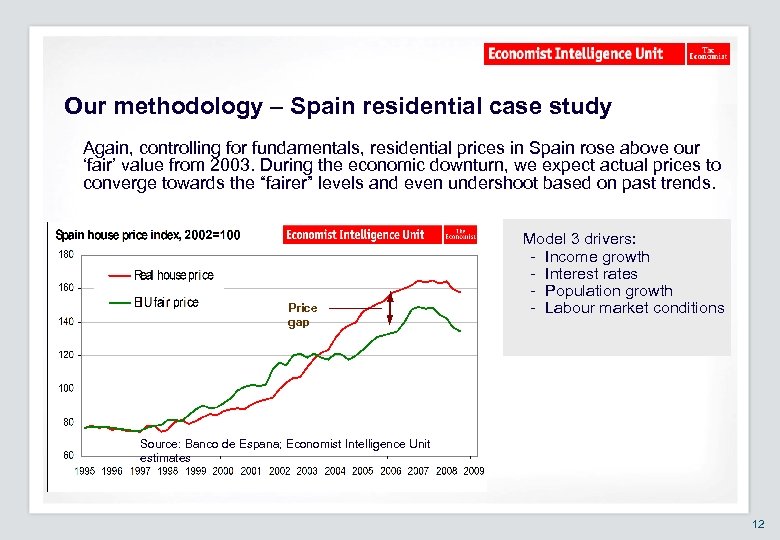
Our methodology – Spain residential case study Again, controlling for fundamentals, residential prices in Spain rose above our ‘fair’ value from 2003. During the economic downturn, we expect actual prices to converge towards the “fairer” levels and even undershoot based on past trends. Price gap Model 3 drivers: - Income growth - Interest rates - Population growth - Labour market conditions Source: Banco de Espana; Economist Intelligence Unit estimates 12
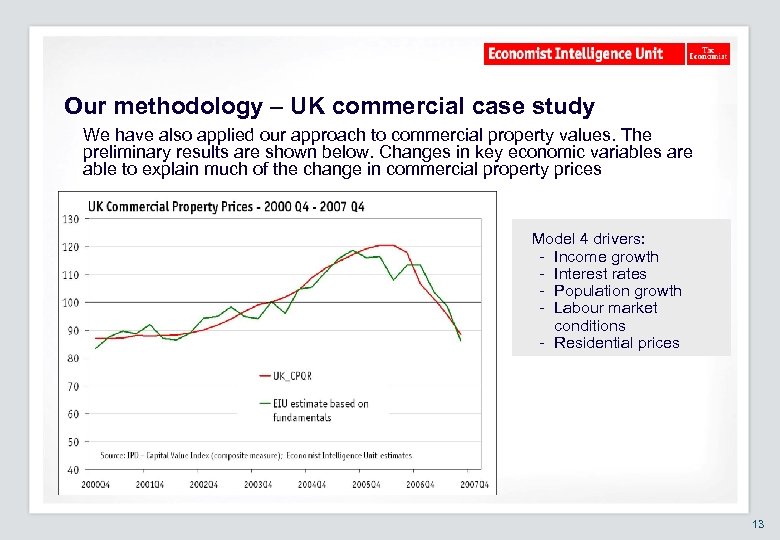
Our methodology – UK commercial case study We have also applied our approach to commercial property values. The preliminary results are shown below. Changes in key economic variables are able to explain much of the change in commercial property prices Model 4 drivers: - Income growth - Interest rates - Population growth - Labour market conditions - Residential prices 13

Our proposed deliverables 14
A new dawn for real estate? A model of residential and commercial property prices in over 50 countries and 70 cities to identify "fair value" for each market based on long-term fundamentals. An exciting research project that will provide members with exclusive insight into the real estate market around the world. • In which countries is real estate overvalued and how low are prices likely to fall? • When can we expect a recovery? • Which markets are undervalued and where will the next investment opportunities occur? 15
What will our research provide? There are numerous benefits arising from participating in this programme: • Access price data for over 50 countries and 70 cities via a secure online platform • Identify which markets are over- or undervalued and target your investments effectively • Download exclusive forecast data for residential and commercial property prices to 2020 • Network with peers online • Understand the key economic fundamentals driving real estate market prices around the world 16
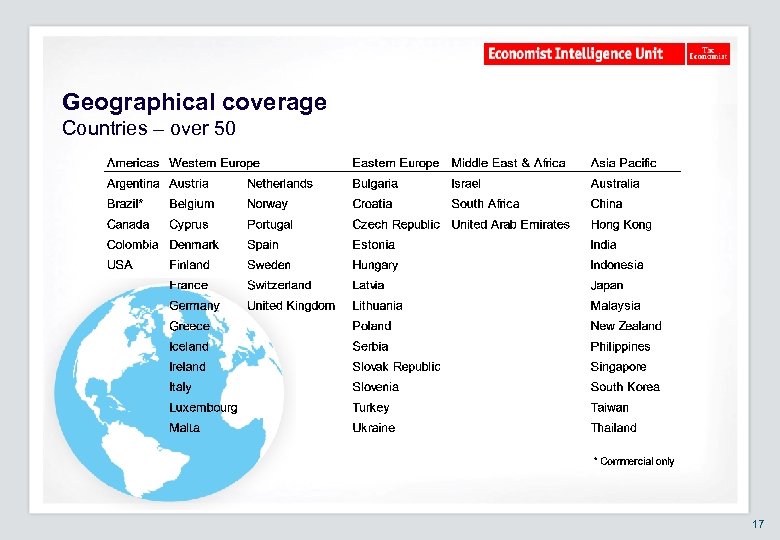
Geographical coverage Countries – over 50 17
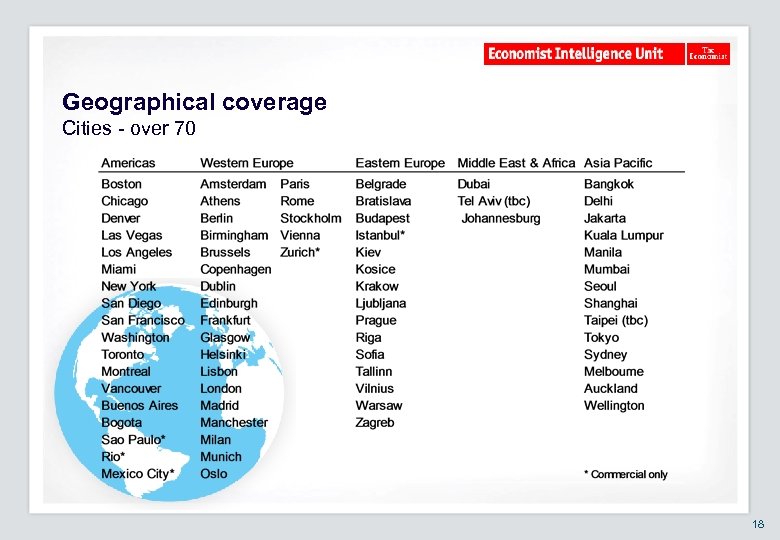
Geographical coverage Cities - over 70 18
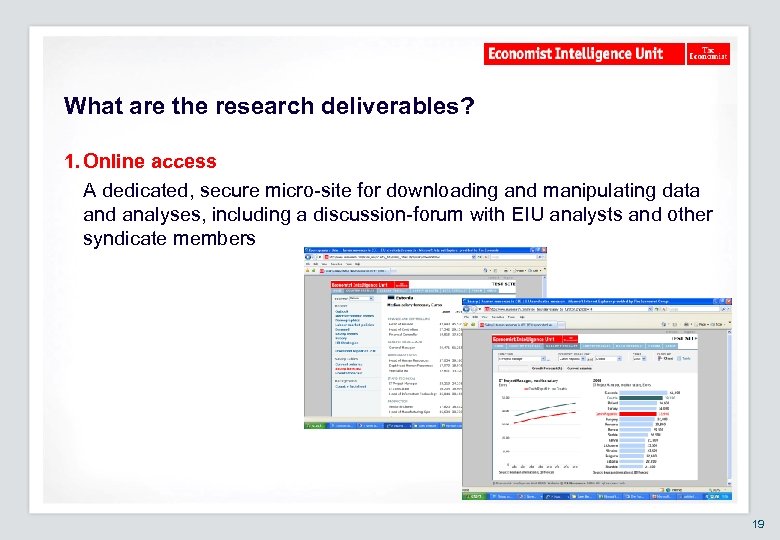
What are the research deliverables? 1. Online access A dedicated, secure micro-site for downloading and manipulating data and analyses, including a discussion-forum with EIU analysts and other syndicate members 19
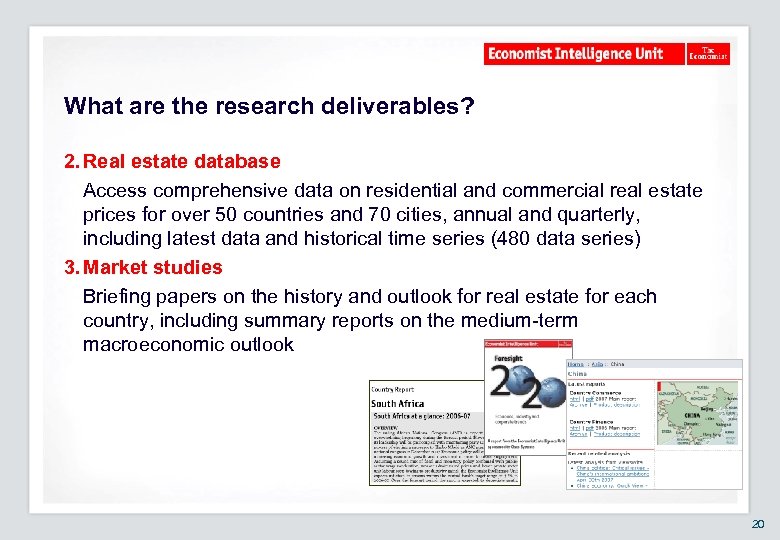
What are the research deliverables? 2. Real estate database Access comprehensive data on residential and commercial real estate prices for over 50 countries and 70 cities, annual and quarterly, including latest data and historical time series (480 data series) 3. Market studies Briefing papers on the history and outlook for real estate for each country, including summary reports on the medium-term macroeconomic outlook 20
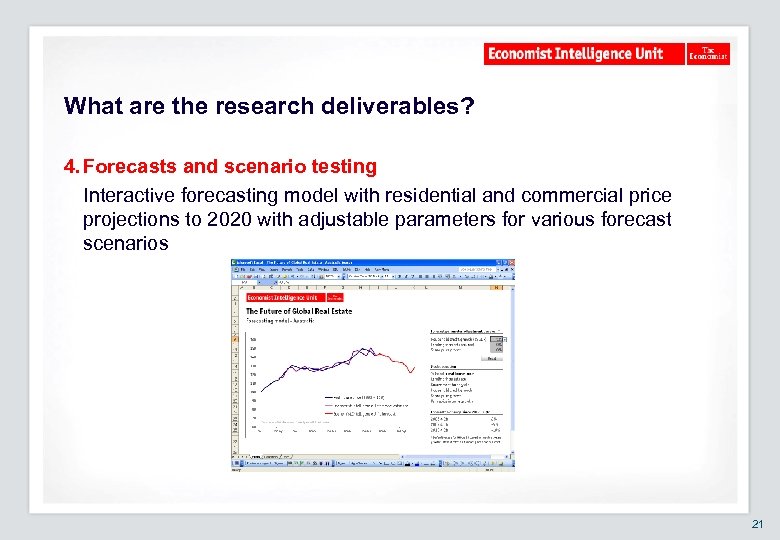
What are the research deliverables? 4. Forecasts and scenario testing Interactive forecasting model with residential and commercial price projections to 2020 with adjustable parameters for various forecast scenarios 21
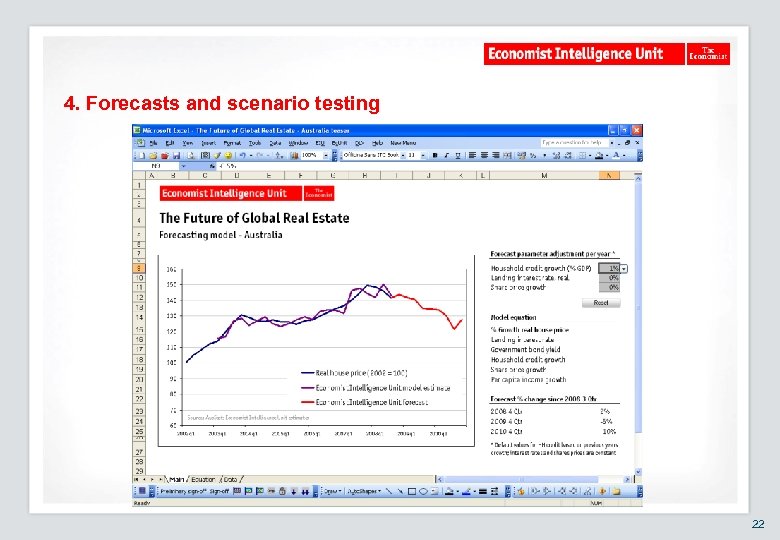
4. Forecasts and scenario testing 22

Timeline, syndicate fees and project team 23
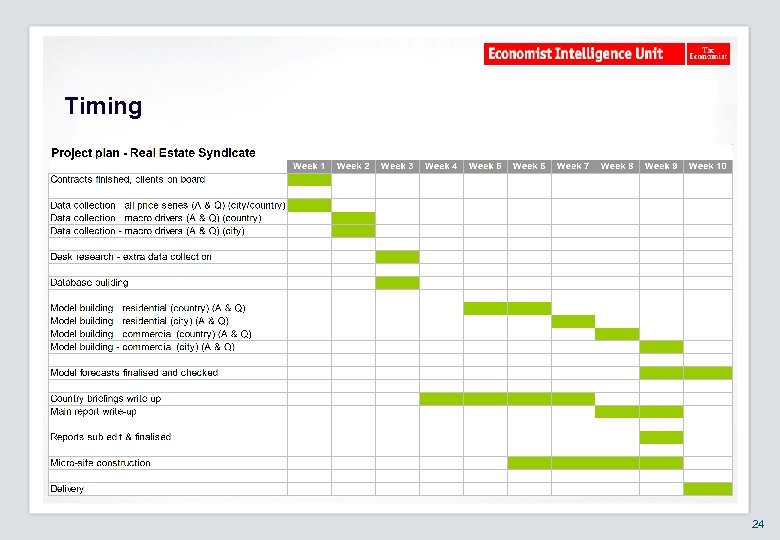
Timing 24

The team Project management team • Andrew Williamson, Global Director Economic Research • Gavin Jaunky, Senior Economist • Robert Metz, Senior Analyst Economics team • Robin Bew, Editorial Director and Chief Economist • Robert Ward, Director, Global Forecasting • Chris Pearce, Director, Economics Unit; Director, Data Services • • • Regional teams Charles Jenkins, Regional Director, Western Europe Pat Thaker, Regional Director, Africa Laza Kekic, Regional Director, Central & Eastern Europe; Director, Country Forecasting Services Justine Thody, Regional Director, Latin America Gerard Walsh, Regional Director, Asia David Butter, Regional Director, MENA 25
Fees • £ 16, 000 / US$24, 000 For more information, please contact us using the customer enquiry form at www. eiu. com/property 26
Скачать презентацию The Future of Global Real Estate A syndicated
5bbf628421e383e6cad5b120a673fb3f.ppt