


 Скачать презентацию The Future of GEWEX and its new imperatives
28b032e414ee4c4e21242989a4b723ca.ppt
- Количество слайдов: 21
 The Future of GEWEX and its new imperatives Peter van Oevelen
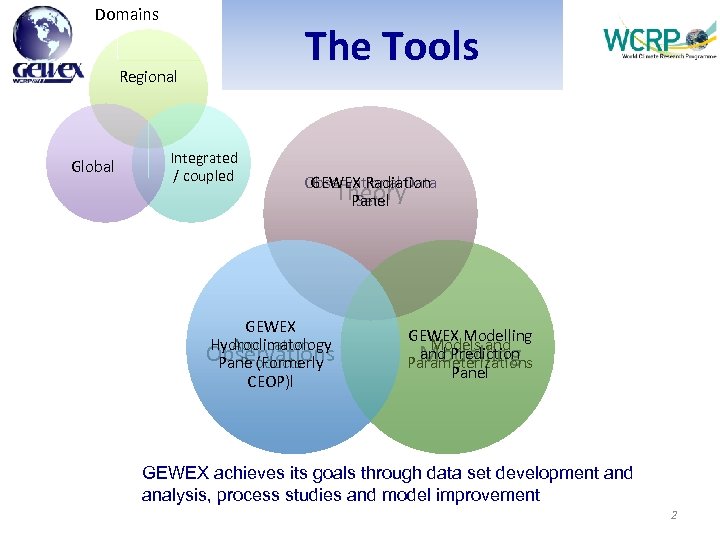 Domains The Tools Regional Global Integrated / coupled Observational Data GEWEX Radiation Theory Sets Panel GEWEX Application Hydroclimatology Observations Products Pane (Formerly CEOP)l GEWEX Modelling Models and Prediction Modelling Parameterizations Panel GEWEX achieves its goals through data set development and analysis, process studies and model improvement 2
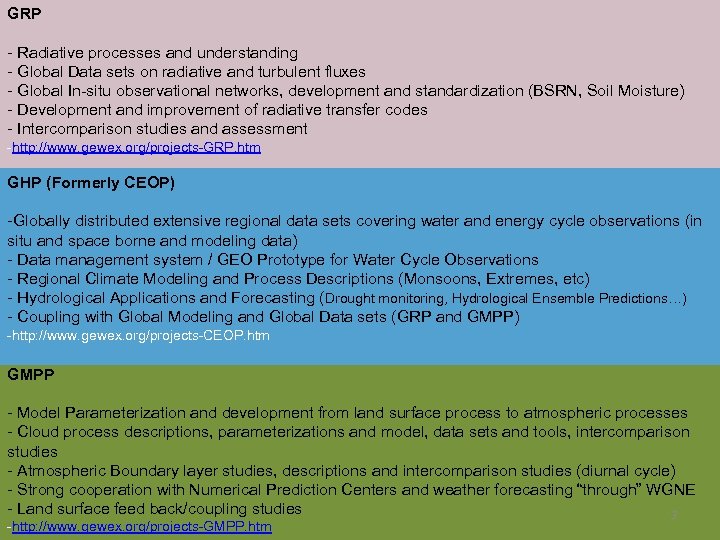 GRP - Radiative processes and understanding - Global Data sets on radiative and turbulent fluxes - Global In-situ observational networks, development and standardization (BSRN, Soil Moisture) - Development and improvement of radiative transfer codes - Intercomparison studies and assessment -http: //www. gewex. org/projects-GRP. htm GHP (Formerly CEOP) -Globally distributed extensive regional data sets covering water and energy cycle observations (in situ and space borne and modeling data) - Data management system / GEO Prototype for Water Cycle Observations - Regional Climate Modeling and Process Descriptions (Monsoons, Extremes, etc) - Hydrological Applications and Forecasting (Drought monitoring, Hydrological Ensemble Predictions…) - Coupling with Global Modeling and Global Data sets (GRP and GMPP) -http: //www. gewex. org/projects-CEOP. htm GMPP - Model Parameterization and development from land surface process to atmospheric processes - Cloud process descriptions, parameterizations and model, data sets and tools, intercomparison studies - Atmospheric Boundary layer studies, descriptions and intercomparison studies (diurnal cycle) - Strong cooperation with Numerical Prediction Centers and weather forecasting “through” WGNE - Land surface feed back/coupling studies 3 -http: //www. gewex. org/projects-GMPP. htm
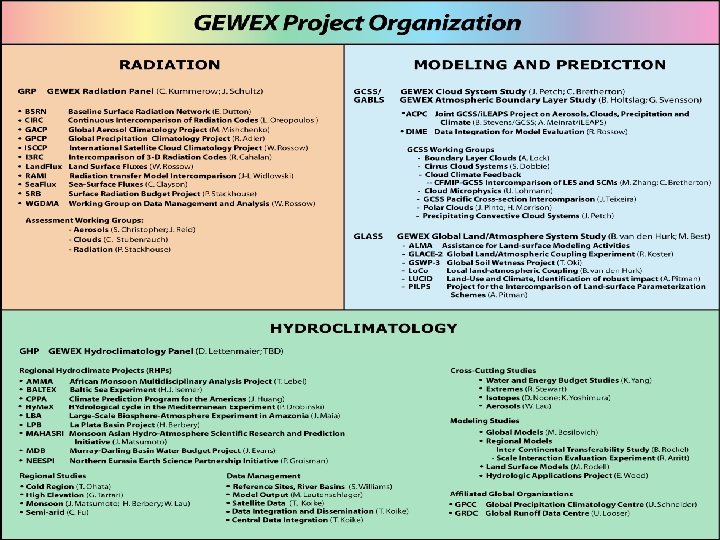
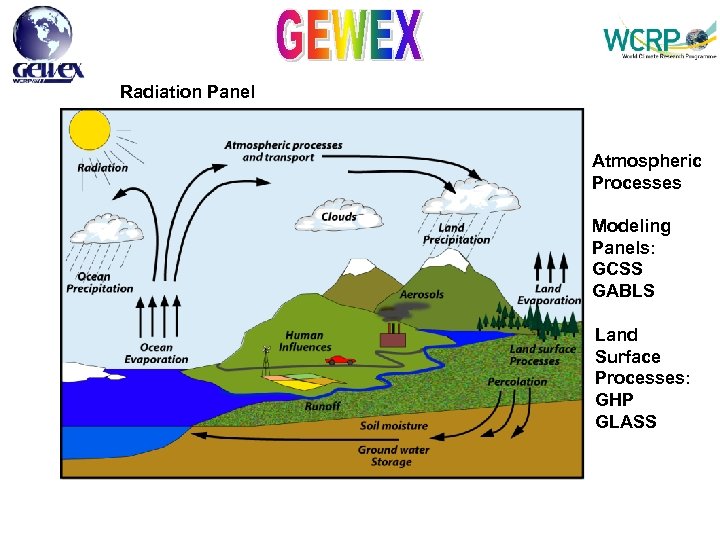 Radiation Panel Atmospheric Processes Modeling Panels: GCSS GABLS Land Surface Processes: GHP GLASS
 How do GEWEX activities fit into a new WCRP structure? Main proposals from JSC-31 • Core projects retained but with revised responsibilities to facilitate climate system research at the interface of the physical Earth system components: o Ocean-atmosphere (think CLIVAR) o Land-atmosphere (think GEWEX) o Cryosphere (think Cli. C) o Stratosphere-troposphere (think SPARC) • Within each core project there is a common set of basic “themes”: o Observations and analysis o Model development, evaluation and experiments o Processes and understanding o Applications and services o Capacity building
 Some Key Issues for GEWEX • The new GEWEX has adopted the mission of “land-atmosphere” However GEWEX has also decided to be much more: • GEWEX will continue to embrace the global energy and water cycles • GEWEX also embraces activities spanning Earth system domains and other integrating themes monsoons o extremes … o
 GEWEX : post 2013 Possible new name mooted: Global and Regional Energy and Water project (GREW) • [GEWEX grew] or Global and regional Energy and Water Existentialism: GEWEX Exchanges: GEWEX 9
 GEWEX: post 2013 Mission statement To measure and predict global and regional energy and water variations, trends, and extremes (such as heat waves, floods and droughts), through improved observations and modeling of land, atmosphere and their interactions; thereby providing the scientific underpinnings of climate services. 10
 Imperatives: Headlines Datasets: Foster development of climate data records of atmosphere, water, land, and energy -related quantities, including metadata and uncertainty estimates. Analysis: Describe and analyze observed variations, trends and extremes (such as heat waves, floods and droughts) in water and energy-related quantities. Processes: Develop approaches to improve process-level understanding of energy and water cycles in support of improved land atmosphere models. Modeling: Improve global and regional simulations and predictions of precipitation, clouds, and land hydrology, and thus the entire climate system, through accelerated development of models of the land atmosphere. Applications: Attribute causes of variability, trends and extremes, and determine the predictability of energy and water cycles on global and regional bases in collaboration with the wider WCRP community. Technology transfer: Develop diagnostic tools and methods, new observations, models, data management, and other research products for multiple uses and transition to operational applications in partnership with climate and hydro-meteorological service providers. Capacity building: Promote and foster capacity building through training of scientists and outreach to the user community.
 Imperatives: Headlines Datasets: Foster development of climate data records of atmosphere, water, land, and energy -related quantities, including metadata and uncertainty estimates. Analysis: Describe and analyze observed variations, trends and extremes (such as heat waves, floods and droughts) in water and energy-related quantities. Processes: Develop approaches to improve process-level understanding of energy and water cycles in support of improved land atmosphere models. Modeling: Improve global and regional simulations and predictions of precipitation, clouds, and land hydrology, and thus the entire climate system, through accelerated development of models of the land atmosphere. Applications: Attribute causes of variability, trends and extremes, and determine the predictability of energy and water cycles on global and regional bases in collaboration with the wider WCRP community. Technology transfer: Develop diagnostic tools and methods, new observations, models, data management, and other research products for multiple uses and transition to operational applications in partnership with climate and hydro-meteorological service providers. Capacity building: Promote and foster capacity building through training of scientists and outreach to the user community.
 Short-term priorities • GRP: reprocessing of products, transition to operations (e. g. through SCOPE-CM), production of a consistent multi-product dataset for water and energy studies; expanding GRP tools for broader use. Revisit water vapour product and continue to promote improvement in polar regions. • GHP (Formerly CEOP): evolution of the regional hydroclimate projects, enhance integration of in-situ and satellite data and more focus on regional studies (monsoons, high elevation, extremes, semi-arid regions) and hydrological applications. • GLASS and GCSS/GABLS: atmosphere and land surface processes; model diagnosis and development. • Cross-cutting activities – “Monsoons in a changing climate” – Extremes and, in particular, drought. 13
 Frontiers • Understanding and modeling: • anthropogenic influences on land water use, including urbanization • effects of climate variability and change on land surface properties and processes • anthropogenic aerosols • Improved representation of hydrological processes in land surface schemes, including groundwater • Assimilation of local and regional data to constrain global model parameterizations • Extremes in water cycle effects on, for example, ecosystems, land forms, food systems, human health, . . . • Linkages with biogeochemical processes, including modeling of water quality and other non physical variables • Geo-engineering 14
 Imperatives implementation • Each Imperative has with it a list of the lead group, partners and actions • This needs to be developed (draft exists) • Buy in needed by Panels and WGs • Plan for how to get there from here at Pan. GEWEX mtg 15
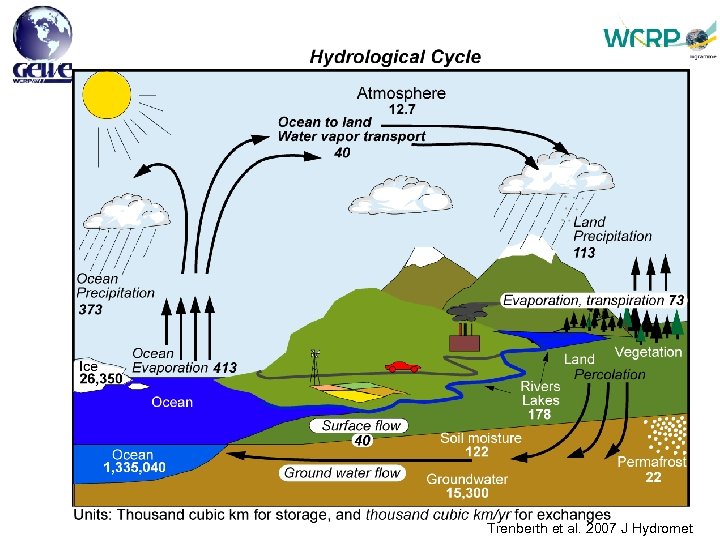 Trenberth et al. 2007 J Hydromet
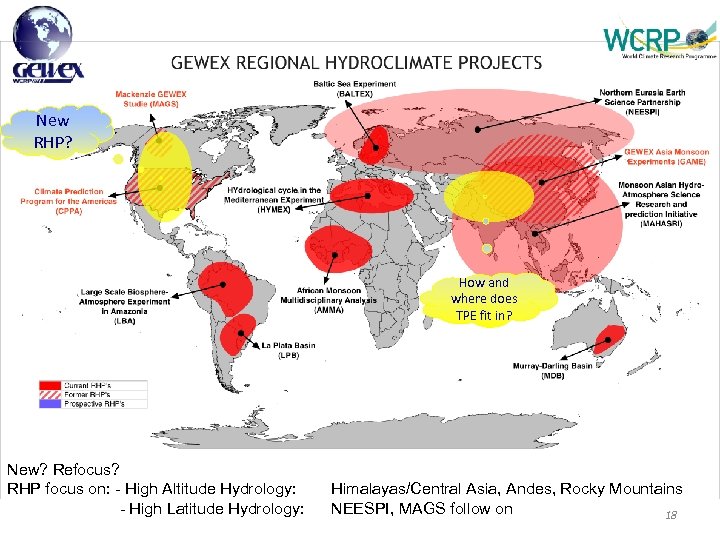 New RHP? How and where does TPE fit in? New? Refocus? RHP focus on: - High Altitude Hydrology: - High Latitude Hydrology: Himalayas/Central Asia, Andes, Rocky Mountains NEESPI, MAGS follow on 18
 CEOP GHP • Continental Scale Experiment (CSE) concept developed (1990 s) – development, diagnosis, and testing of coupled land-atmosphere models – focus on water and energy budget closure at near-continental scale. – E. g. Mississippi basin well instrumented analyzed GAPP • Regional Hydrometeorological Programs to extend this concept to other regions: MAGS, BALTEX, GAME, LBA, AMMA • GEWEX Hydrometeorological Program (GHP) coordinated these • Coordinated Enhanced Observing Period: second phase of GEWEX 2001 -2006 • Combined with GHP and evolved to Coordinated Energy and Water Cycle Observations Project (CEOP) in 2007 -2008 • GEWEX Hydroclimatology Program (GHP) in 2010 19
 CEOP GHP There has been considerable modeling within CEOP of 2 kinds: 1. Regional Hydrological Project modeling, which can range from detailed hydrologic models over catchments or river basins, to regional climate modeling such as now given by CORDEX 2. Global and intercontinental transferability • The MAC: Multi-model Analysis for CEOP (Bosilovich et al 2009) Global models in GCSS/GABLS and GLASS should enable interactions with RHPs to provide local expertise and datasets for validation etc, in the context of global processes. • How to do this remains a challenge? 20
 Revitalizing GHP • CEOP reference sites vs flux towers • 10 year data set; mission creep • Archive for regional projects New Phase • Need to reinvigorate RHPs – Type I (core; criteria) and type II (affiliated) • Stronger hydrological activities: foster the next generation of hydrologically realistic land surface schemes (cf home for PILPS) 21
 Future ? • Fresh water in the arctic • Cold Climate Studies and Modeling • Hydro-chemical Response of High Elevation Watersheds to Climate Change and Atmospheric Deposition • Mountain Hydrology • Link to Cli. C, (CLIVAR), ESSP (GWSP, GCP, IHDP? ) 22
 Thank You 23