 Скачать презентацию The functional styles Informal and Formal styles By
Functional style[1].Чутковой Анастасии 4АОД.ppt
- Количество слайдов: 14



The functional styles Informal and Formal styles By Chutkova Anastasia 4 AOD
Functional styles is a system of expressive means peculiar to a specific sphere of communication. All kinds of communication can be classified into two types: formal (a lecture, an official letter) and informal (an informal talk).
Informal style Informal vocabulary is used in one's immediate circle: family, relatives or friends. One uses informal words when at home or when feeling at home. Informal style is relaxed, free-and -easy, familiar and unpretentious.
v. The choice of words is determined in each particular case not only by an informal (or formal) situation, but also by §the speaker's educational, §cultural background, §age group §his occupational §and regional characteristics. v. Informal words and wordgroups are traditionally divided into types: colloquial, slang and dialect words and word-groups.
Among other informal words, colloquialisms are the least exclusive: they are used by everybody, and their sphere of communication is comparatively wide, at least of literary colloquial words. These are informal words that are used in everyday conversational speech both by cultivated and uneducated people of all age groups.
Here are some examples of literary colloquial words: Pal and chum are colloquial equivalents of friend; girl, when used colloquially, denotes a woman of any age; bite and snack stand for meal; hi, hello are informal greetings; start, go on, finish and be through are also literary colloquialisms; to have a crush on somebody is a colloquial equivalent of to be in love.
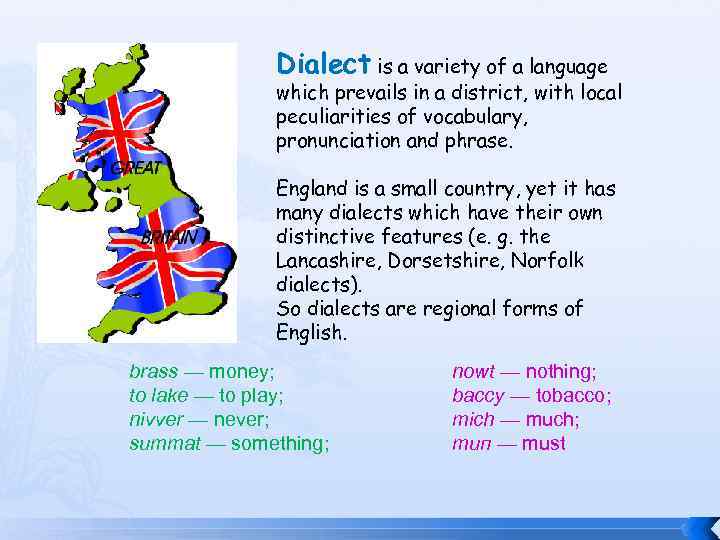
Dialect is a variety of a language which prevails in a district, with local peculiarities of vocabulary, pronunciation and phrase. England is a small country, yet it has many dialects which have their own distinctive features (e. g. the Lancashire, Dorsetshire, Norfolk dialects). So dialects are regional forms of English. brass — money; to lake — to play; nivver — never; summat — something; nowt — nothing; baccy — tobacco; mich — much; тип — must
Slang is language of a highly colloquial style, considered as below the level of standard educated speech, and consisting either of new words or of current words employed in some special sense. e. g. mug (for face), saucers, blinkers (for eyes), trap (for mouth), e. g. Keep your trap shut! All these meanings are certainly based on metaphor, yet they strike one as singularly unpoetical.
Formal style Is used in formal situations. Formal words fall into two main groups: words associated with professional communication and a less exclusive group of so-called learned words. Learned Words are mainly associated with the printed page. We call this category ‘bookish’, 'erudite', 'learned', 'scholarly‘. . We find here numerous words that are used in scientific prose and can be identified by their dry, matter-of-fact flavour (e. g. comprise, compile, experimental, heterogeneous, homogeneous, conclusive, divergent, etc. ) To this group also belongs so-called "officialese“: assist (for help), endeavour (for try), proceed (for go), approximately (for about), sufficient (for enough), attired (for dressed), inquire (for ask).
Archaic and Obsolete Words Learned words and archaisms are both associated with the printed page. Examples of archaisms are: morn (for morning), eve (for evening), moon (for month), damsel (for girl), errant (for wandering, e. g. errant knights), etc. The Random House Dictionary defines an obsolete word as one "no longer in use, esp. out of use for at least a century", whereas an archaism is referred to as "current in an earlier time but rare in present usage".
Professional Terminology Hundreds of thousands of words belong to special scientific, professional or trade terminological systems and are not used or even understood by people outside the particular speciality. There is a special medical vocabulary, and similarly special terminologies for psychology, botany, music, linguistics, teaching methods and many others. Basic Vocabulary These words are stylistically neutral, and, in this respect, opposed to formal and informal words described above. Their stylistic neutrality makes it possible to use them in all kinds of situations, both formal and informal, in verbal and written communication.
Formal style The following styles within the English literary language are distinguished: 1. The belleletters style which falls into three varieties: poetry proper, emotive prose, drama in which embrace numerous and versatile genres of creative writing. 2. The publicistic style which comprises the following subtypes: speeches (oratory), essays and articles in journals and newspapers.
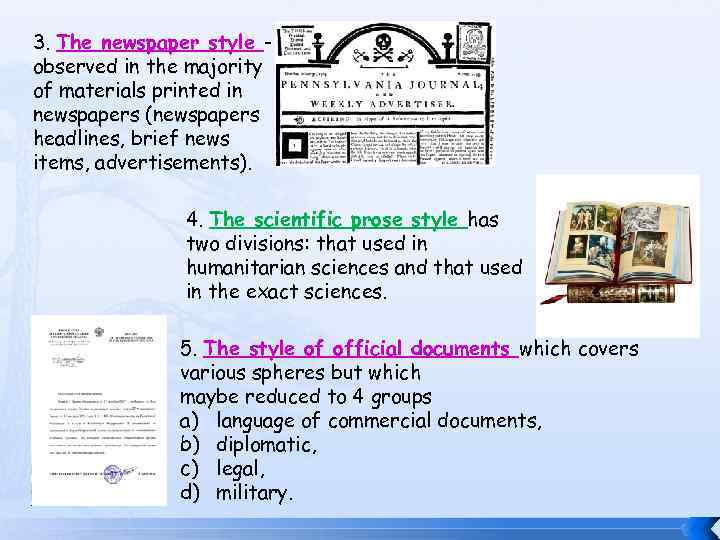
3. The newspaper style observed in the majority of materials printed in newspapers (newspapers headlines, brief news items, advertisements). 4. The scientific prose style has two divisions: that used in humanitarian sciences and that used in the exact sciences. 5. The style of official documents which covers various spheres but which maybe reduced to 4 groups a) language of commercial documents, b) diplomatic, c) legal, d) military.
Thank you for attention! By Chutkova Anastasia 4 AOD
Скачать презентацию The functional styles Informal and Formal styles By
Functional style[1].Чутковой Анастасии 4АОД.ppt