


 Скачать презентацию The Foundations of African American Literature Anna Oldfield
African_American.ppt
- Количество слайдов: 15
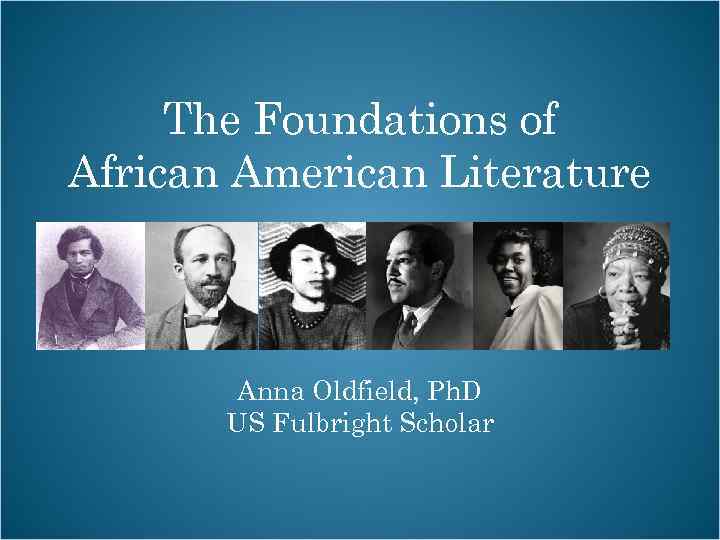 The Foundations of African American Literature Anna Oldfield, Ph. D US Fulbright Scholar
 African American Literature and History Before the Civil War – Slave Narratives Olaudah Equiano, Frederick Douglass, Harriet Jacobs Turn of the Century –Black in a White World WEB Du. Bois, Booker T. Washington 1920 s-30 s- Harlem Renaissance Zora Neale Hurston, Langston Hughes, James Baldwin 20 th Century – Real Life and Civil Rights Gwendolyn Brooks, Maya Angelou, Alice Walker
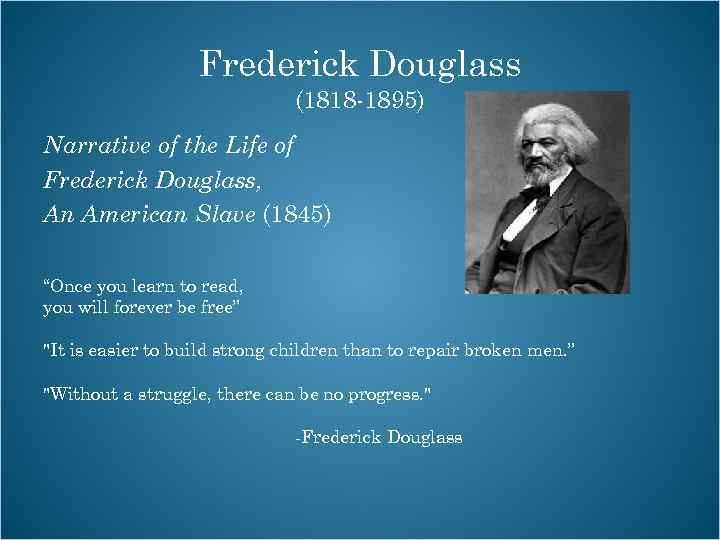 Frederick Douglass (1818 -1895) Narrative of the Life of Frederick Douglass, An American Slave (1845) “Once you learn to read, you will forever be free” "It is easier to build strong children than to repair broken men. ” "Without a struggle, there can be no progress. " -Frederick Douglass
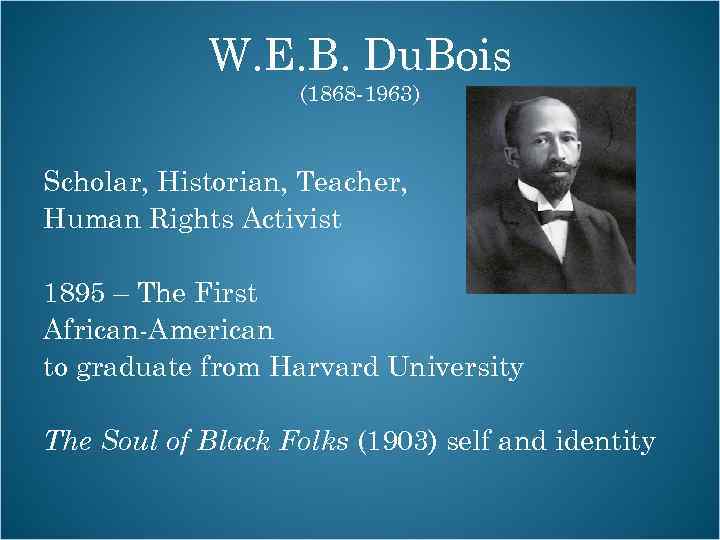 W. E. B. Du. Bois (1868 -1963) Scholar, Historian, Teacher, Human Rights Activist 1895 – The First African-American to graduate from Harvard University The Soul of Black Folks (1903) self and identity
 The Soul of Black Folks Concept of “Double consciousness” – The idea that African. Americans develop a “divided self” because of racism Double consciousness is "always looking at one's self through the eyes of others…“measuring one's soul by the tape of a world that looks on in amused contempt and pity. ” This produces what Du Bois calls a "twoness, - an American, a Negro; two souls, two thoughts, two unreconciled strivings; two warring ideals in one dark body. ” These two views are often in conflict with one another. Their struggle, says Du Bois, is that they want to be both "Negro and. . . American, without being cursed and spit upon by his fellows, without having the doors of Opportunity closed roughly in his face. ”
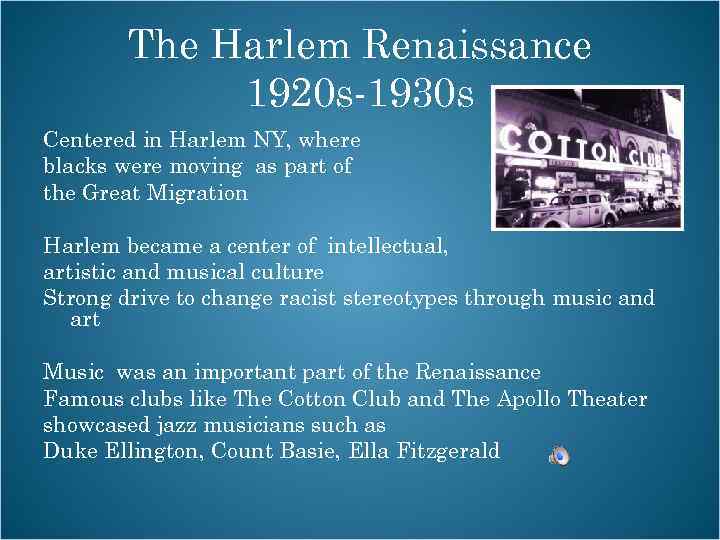 The Harlem Renaissance 1920 s-1930 s Centered in Harlem NY, where blacks were moving as part of the Great Migration Harlem became a center of intellectual, artistic and musical culture Strong drive to change racist stereotypes through music and art Music was an important part of the Renaissance Famous clubs like The Cotton Club and The Apollo Theater showcased jazz musicians such as Duke Ellington, Count Basie, Ella Fitzgerald
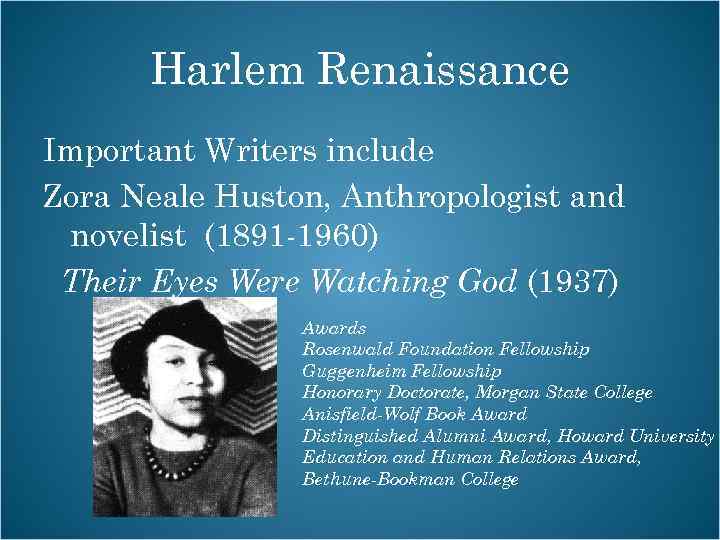 Harlem Renaissance Important Writers include Zora Neale Huston, Anthropologist and novelist (1891 -1960) Their Eyes Were Watching God (1937) Awards Rosenwald Foundation Fellowship Guggenheim Fellowship Honorary Doctorate, Morgan State College Anisfield-Wolf Book Award Distinguished Alumni Award, Howard University Education and Human Relations Award, Bethune-Bookman College
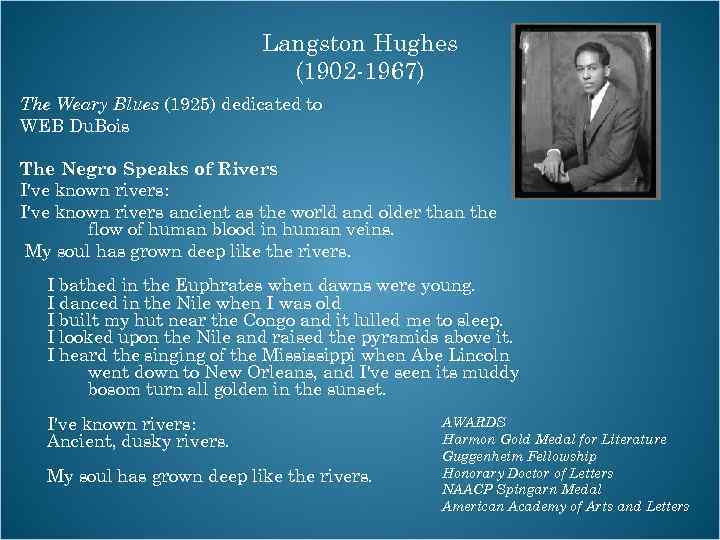 Langston Hughes (1902 -1967) The Weary Blues (1925) dedicated to WEB Du. Bois The Negro Speaks of Rivers I've known rivers: I've known rivers ancient as the world and older than the flow of human blood in human veins. My soul has grown deep like the rivers. I bathed in the Euphrates when dawns were young. I danced in the Nile when I was old I built my hut near the Congo and it lulled me to sleep. I looked upon the Nile and raised the pyramids above it. I heard the singing of the Mississippi when Abe Lincoln went down to New Orleans, and I've seen its muddy bosom turn all golden in the sunset. I've known rivers: Ancient, dusky rivers. My soul has grown deep like the rivers. AWARDS Harmon Gold Medal for Literature Guggenheim Fellowship Honorary Doctor of Letters NAACP Spingarn Medal American Academy of Arts and Letters
 Langston Hughes The Weary Blues Droning a drowsy syncopated tune, Rocking back and forth to a mellow croon, I heard a Negro play. Down on Lenox Avenue the other night By the pale dull pallor of an old gas light He did a lazy sway. . . To the tune o' those Weary Blues. With his ebony hands on each ivory key He made that poor piano moan with melody. O Blues! Swaying to and fro on his rickety stool He played that sad raggy tune like a musical fool. Sweet Blues! Coming from a black man's soul. O Blues!. . .
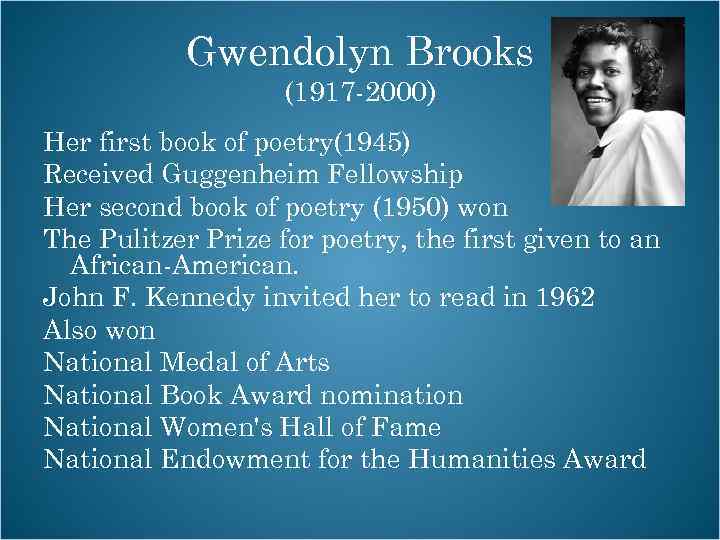 Gwendolyn Brooks (1917 -2000) Her first book of poetry(1945) Received Guggenheim Fellowship Her second book of poetry (1950) won The Pulitzer Prize for poetry, the first given to an African-American. John F. Kennedy invited her to read in 1962 Also won National Medal of Arts National Book Award nomination National Women's Hall of Fame National Endowment for the Humanities Award
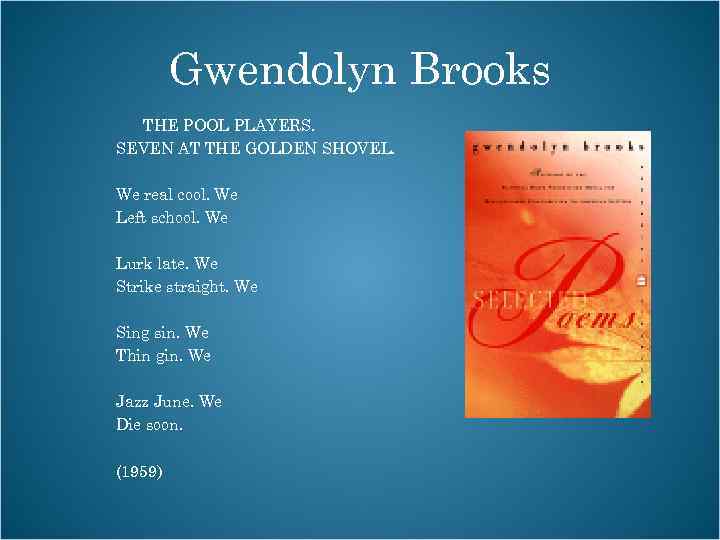 Gwendolyn Brooks THE POOL PLAYERS. SEVEN AT THE GOLDEN SHOVEL. We real cool. We Left school. We Lurk late. We Strike straight. We Sing sin. We Thin gin. We Jazz June. We Die soon. (1959)
 Gwendolyn Brooks The Bean Eaters They eat beans mostly, this old yellow pair. Dinner is a casual affair. Plain chipware on a plain and creaking wood, Tin flatware. Two who are Mostly Good. Two who have lived their day, But keep on putting on their clothes And putting things away. And remembering. . . Remembering, with twinklings and twinges, As they lean over the beans in their rented back room that is full of beads and receipts and dolls and cloths, tobacco crumbs, vases and fringes. (1959)
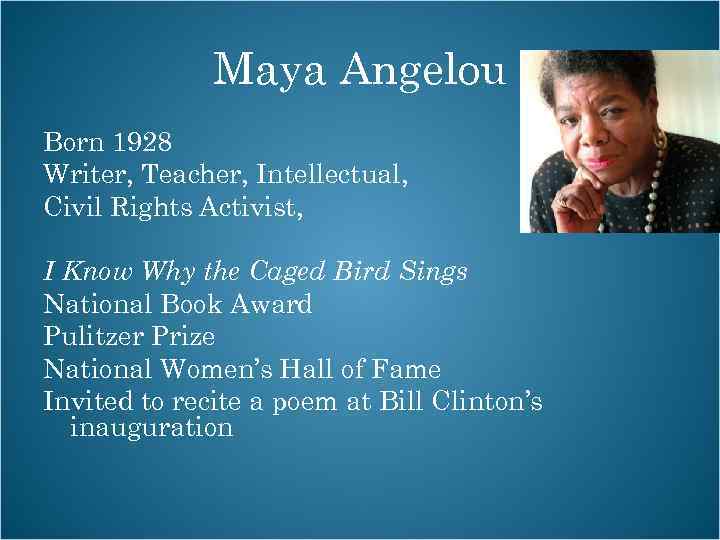 Maya Angelou Born 1928 Writer, Teacher, Intellectual, Civil Rights Activist, I Know Why the Caged Bird Sings National Book Award Pulitzer Prize National Women’s Hall of Fame Invited to recite a poem at Bill Clinton’s inauguration
 I Know Why the Caged Bird Sings The free bird leaps on the back of the win and floats downstream till the current ends and dips his wings in the orange sun rays and dares to claim the sky. But a bird that stalks down his narrow cage can seldom see through his bars of rage his wings are clipped and his feet are tied so he opens his throat to sing. The caged bird sings with fearful trill of the things unknown but longed for still and is tune is heard on the distant hill for the caged bird sings of freedom The free bird thinks of another breeze an the trade winds soft through the sighing trees and the fat worms waiting on a dawn-bright lawn and he names the sky his own. But a caged bird stands on the grave of dreams his shadow shouts on a nightmare scream his wings are clipped and his feet are tied so he opens his throat to sing The caged bird sings with a fearful trill of things unknown but longed for still and his tune is heard on the distant hill for the caged bird sings of freedom (1969)
 And many, many more! Toni Morrison, Alice Walker, James Baldwin, Ralph Ellison, Malcolm X, Eldridge Cleaver, Martin Luther King Jr. , Rita Dove, Angela Davis, Jamaica Kincaid, Audre Lorde, Richard Wright, Ida Wells, Alex Haley…