


 Скачать презентацию THE FOSSIL RECORD The Rank and Order of
5cd3553b08e4cc29b8d3ed469b4ad54b.ppt
- Количество слайдов: 26
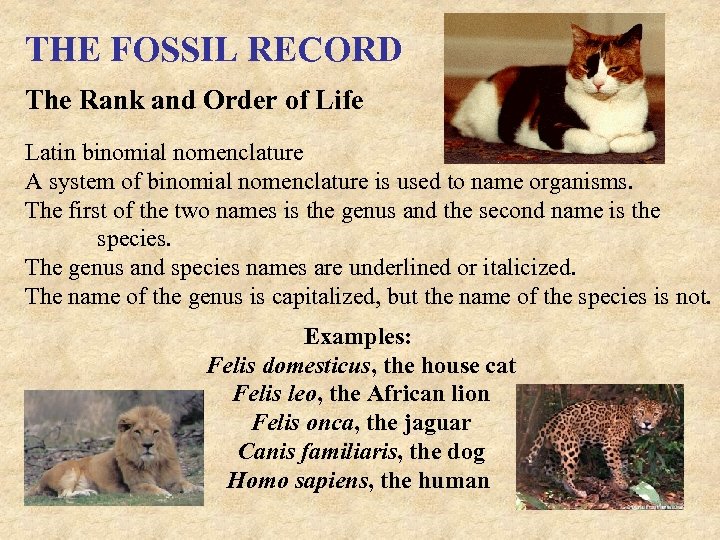 THE FOSSIL RECORD The Rank and Order of Life Latin binomial nomenclature A system of binomial nomenclature is used to name organisms. The first of the two names is the genus and the second name is the species. The genus and species names are underlined or italicized. The name of the genus is capitalized, but the name of the species is not. Examples: Felis domesticus, the house cat Felis leo, the African lion Felis onca, the jaguar Canis familiaris, the dog Homo sapiens, the human
 THE FOSSIL RECORD The Rank and Order of Life The Species Fundamental unit of biological classification A species is a group of organisms that have structural, functional, and developmental similarities, and that are able to interbreed and produce fertile offspring. Doesn’t include sexual dimorphism, differences in developmental stages and individual variation.
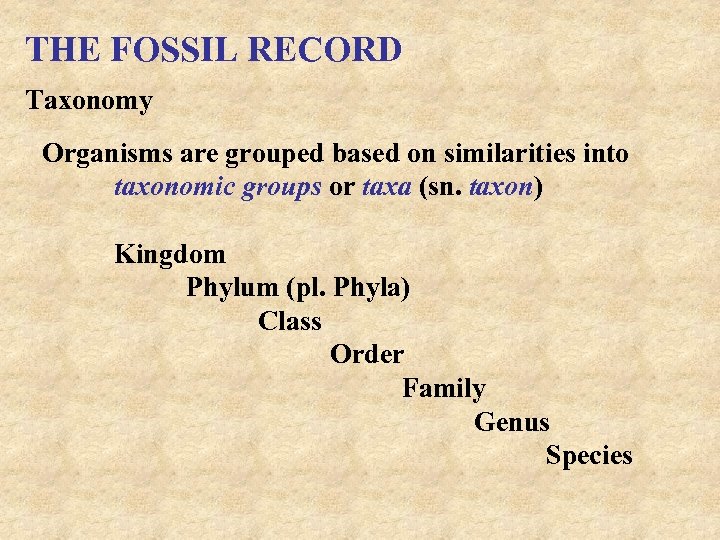 THE FOSSIL RECORD Taxonomy Organisms are grouped based on similarities into taxonomic groups or taxa (sn. taxon) Kingdom Phylum (pl. Phyla) Class Order Family Genus Species
 THE FOSSIL RECORD Taxonomy Five kingdoms of organisms Animalia (animals) Plantae (plants) Monera (blue-green algae and bacteria) Fungi (mushrooms, fungus) Protoctista (single celled organisms) Organisms from all five Kingdoms found as fossils
 THE FOSSIL RECORD Taxonomy More recent classifications recognize three superkingdoms or domains based on evolutionary relationships. Bacteria – bacteria and blue-green algae Archaea – primitive bacteria, live under extreme conditions Eucarya – animals, plants, fungi, protists
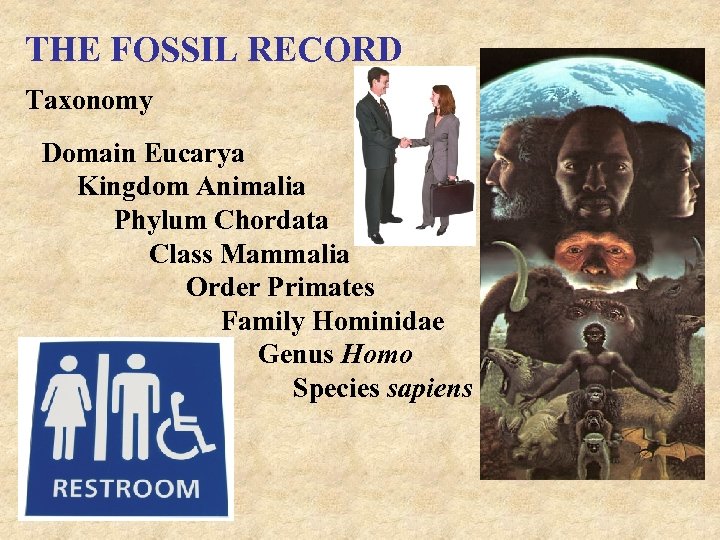 THE FOSSIL RECORD Taxonomy Domain Eucarya Kingdom Animalia Phylum Chordata Class Mammalia Order Primates Family Hominidae Genus Homo Species sapiens
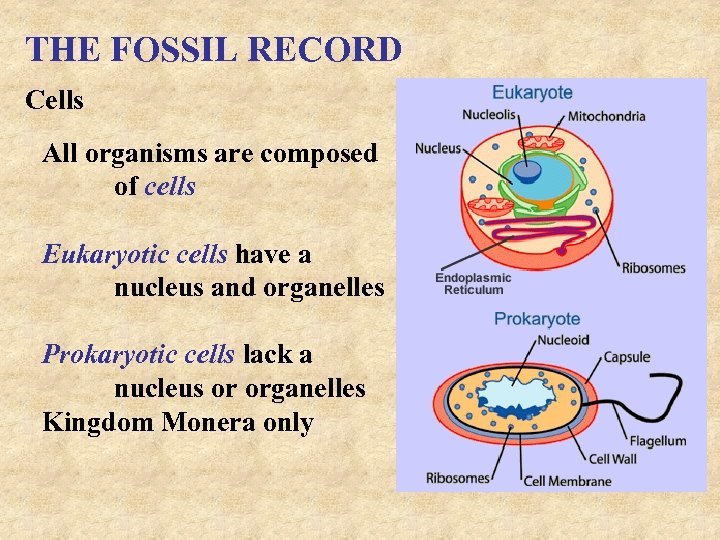 THE FOSSIL RECORD Cells All organisms are composed of cells Eukaryotic cells have a nucleus and organelles Prokaryotic cells lack a nucleus or organelles Kingdom Monera only
 THE FOSSIL RECORD Organic Evolution is change over time Organic evolution refers to changes in populations
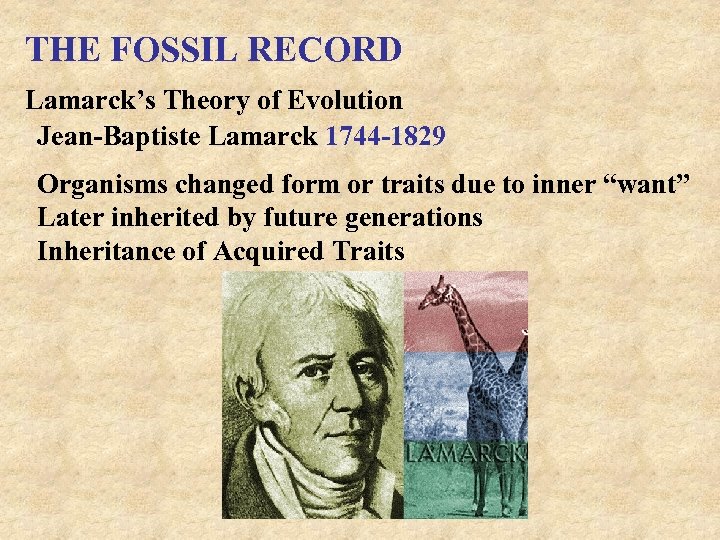 THE FOSSIL RECORD Lamarck’s Theory of Evolution Jean-Baptiste Lamarck 1744 -1829 Organisms changed form or traits due to inner “want” Later inherited by future generations Inheritance of Acquired Traits
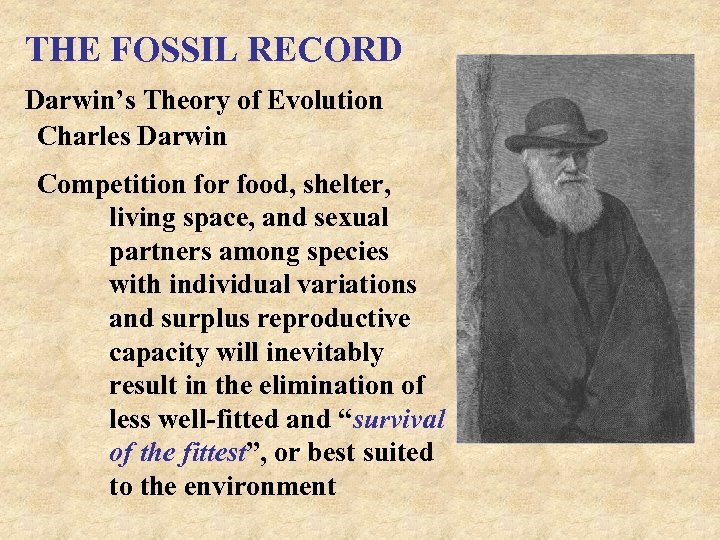 THE FOSSIL RECORD Darwin’s Theory of Evolution Charles Darwin Competition for food, shelter, living space, and sexual partners among species with individual variations and surplus reproductive capacity will inevitably result in the elimination of less well-fitted and “survival of the fittest”, or best suited to the environment
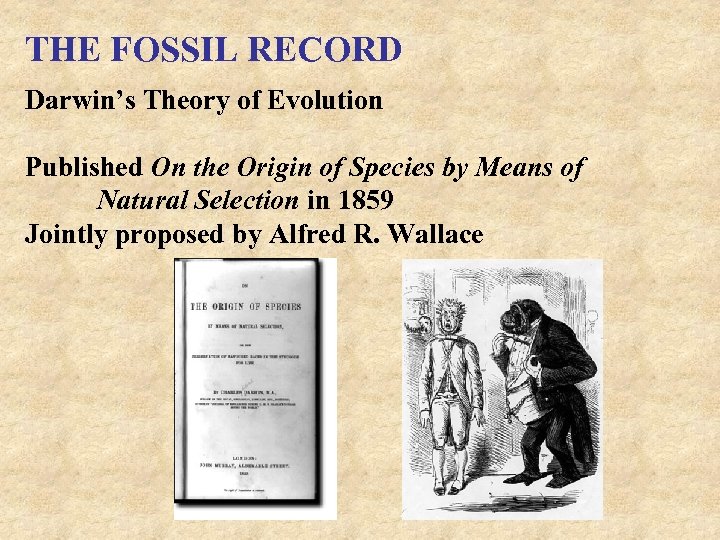 THE FOSSIL RECORD Darwin’s Theory of Evolution Published On the Origin of Species by Means of Natural Selection in 1859 Jointly proposed by Alfred R. Wallace
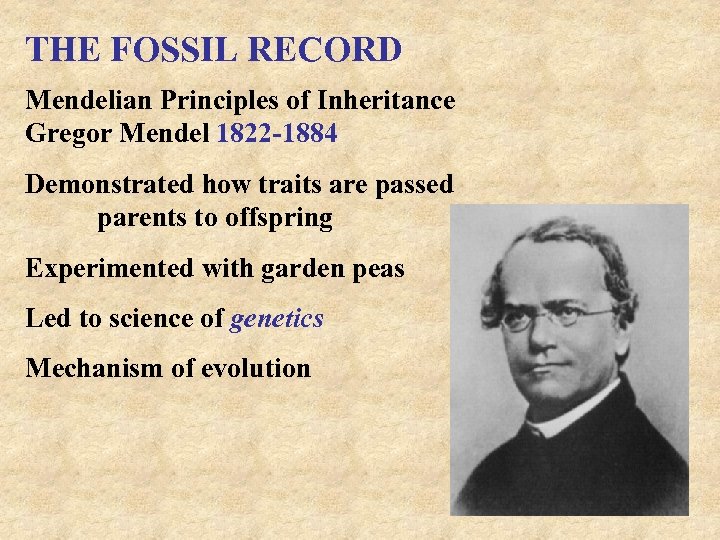 THE FOSSIL RECORD Mendelian Principles of Inheritance Gregor Mendel 1822 -1884 Demonstrated how traits are passed parents to offspring Experimented with garden peas Led to science of genetics Mechanism of evolution
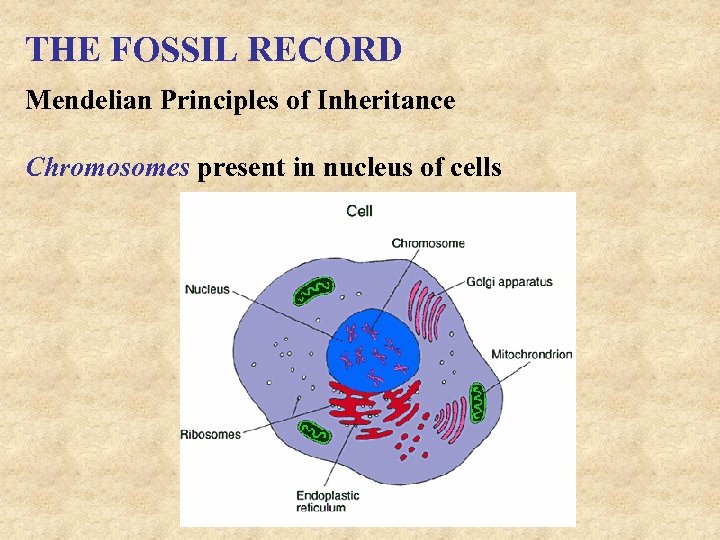 THE FOSSIL RECORD Mendelian Principles of Inheritance Chromosomes present in nucleus of cells
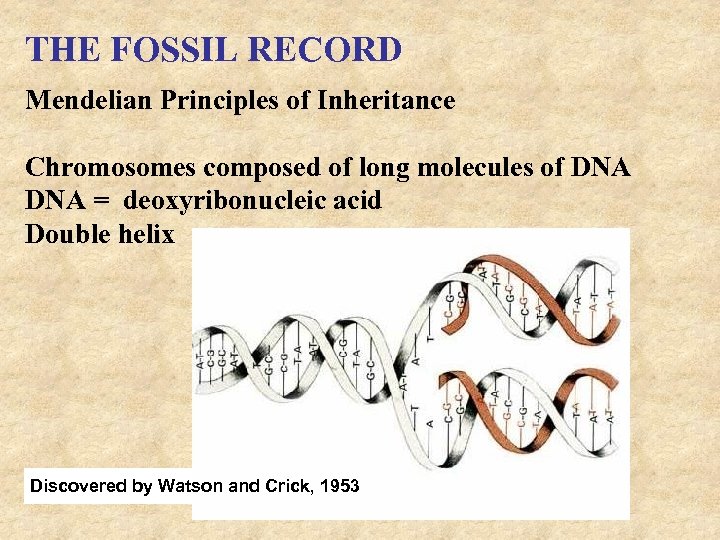 THE FOSSIL RECORD Mendelian Principles of Inheritance Chromosomes composed of long molecules of DNA = deoxyribonucleic acid Double helix Discovered by Watson and Crick, 1953
 THE FOSSIL RECORD Mendelian Principles of Inheritance DNA carries chemically coded information from generation to generation Provides instructions for growth, development, and functioning.
 THE FOSSIL RECORD Reproduction and Cell Division Reproduction in organisms may be: Sexual Asexual Alternation of sexual and asexual generations All involve division of cells
 THE FOSSIL RECORD Asexual Reproduction Asexual reproduction can occur by: Binary fission – cells split in two (single celled) Budding – parent sprouts an appendage that may later separate from the parent or remain attached (colonial) Spores – alternation of generations
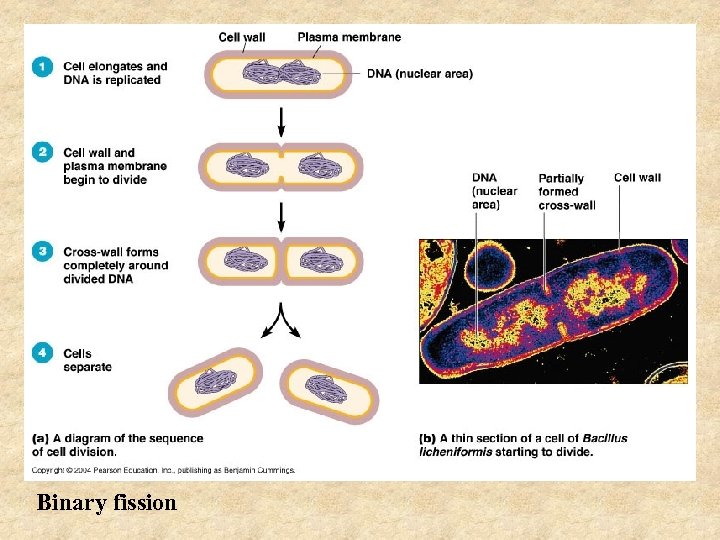 Binary fission
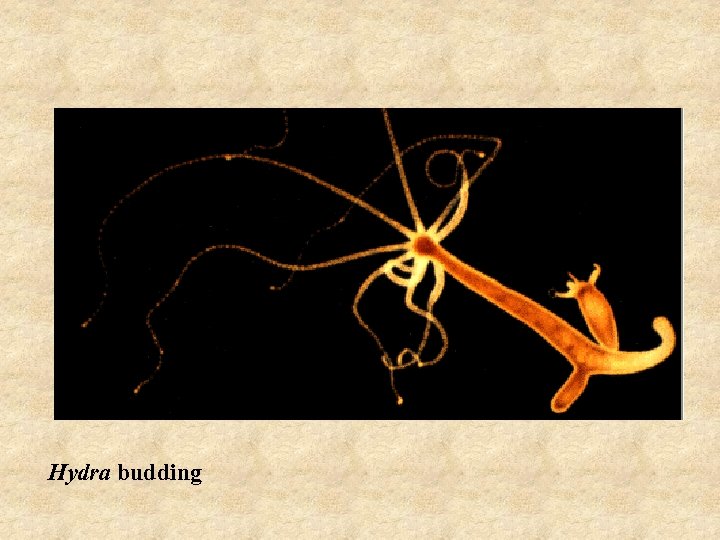 Hydra budding
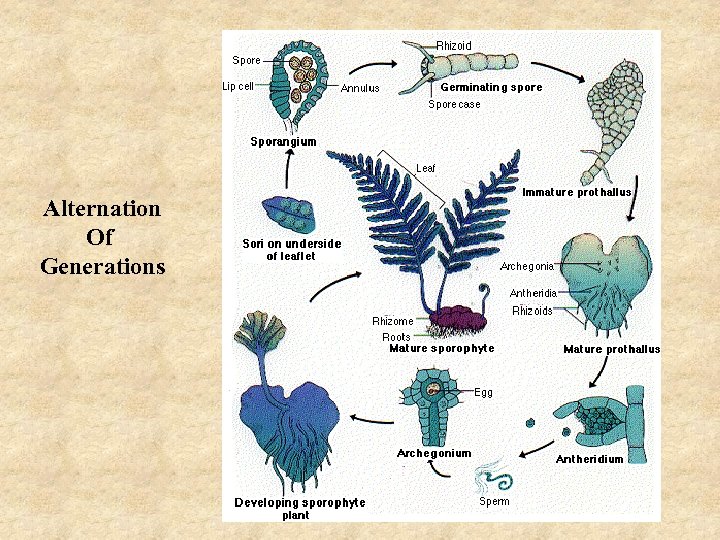 Alternation Of Generations
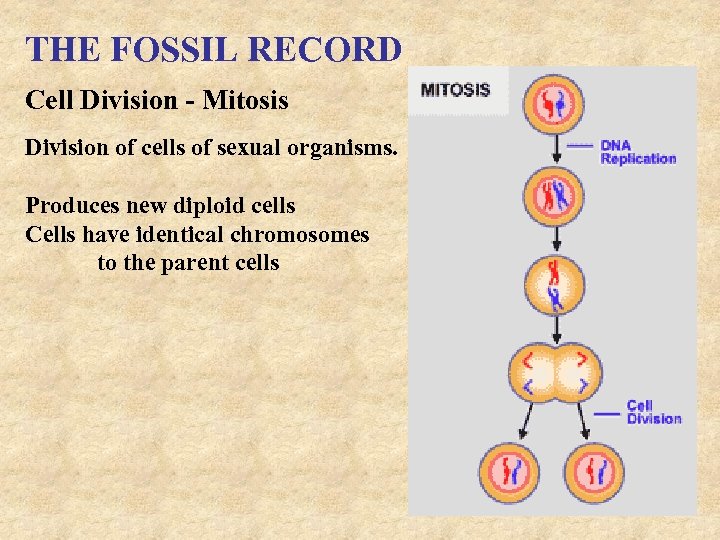 THE FOSSIL RECORD Cell Division - Mitosis Division of cells of sexual organisms. Produces new diploid cells Cells have identical chromosomes to the parent cells
 THE FOSSIL RECORD Sexual Reproduction and Cell Division Sexual reproduction allows new combination of chromosomes to result One member of each pair of chromosomes is inherited from each parent Allows variability within the species
 THE FOSSIL RECORD Sexual Reproduction One diploid "parent" cell divides to produce four genetically unique "daughter" cells which will then be processed into gametes (the sex cells we usually know as "ova" and "sperm") Requires the halving of the genetic material (DNA) in preparation for recombination with an equal amount of DNA from the same species
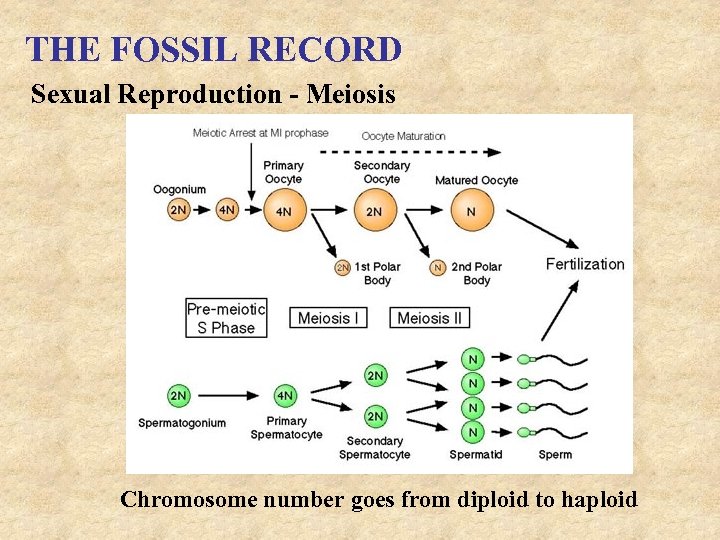 THE FOSSIL RECORD Sexual Reproduction - Meiosis Chromosome number goes from diploid to haploid
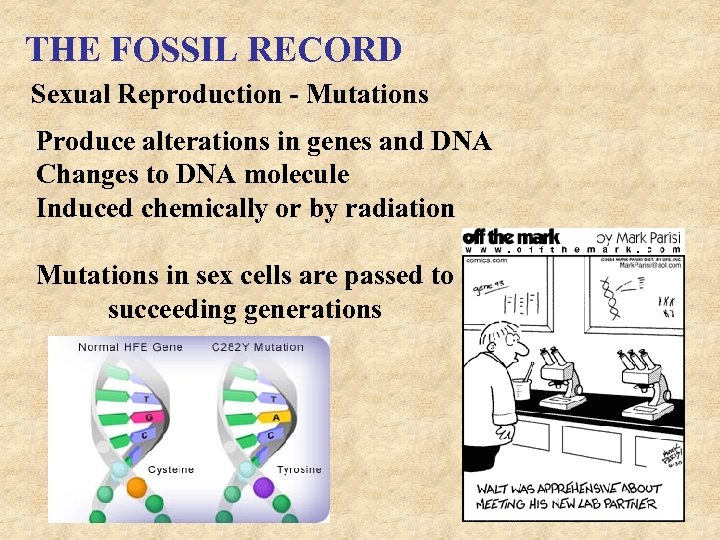 THE FOSSIL RECORD Sexual Reproduction - Mutations Produce alterations in genes and DNA Changes to DNA molecule Induced chemically or by radiation Mutations in sex cells are passed to succeeding generations
 EVOLUTION POPULATIONS, SPECIATION AND ADAPTIVE RADIATION Population – a group of interbreeding organisms Gene pool – the sum of all of the genetic components in a population Speciation – the origin of new species Species – a collection of populations within which there is free flow of genes