 Скачать презентацию THE FOREIGN EXCHANGE MARKET by Veprev Andrey
The Foreign Exchange market.pptx
- Количество слайдов: 13



THE FOREIGN EXCHANGE MARKET by Veprev Andrey
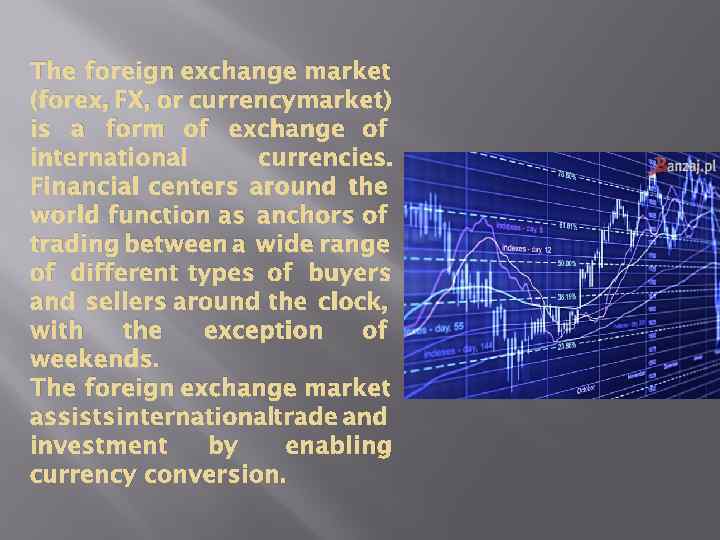
The foreign exchange market (forex, FX, or currencymarket) is a form of exchange of international currencies. Financial centers around the world function as anchors of trading between a wide range of different types of buyers and sellers around the clock, with the exception of weekends. The foreign exchange market assists internationaltrade and investment by enabling currency conversion.
Market size and liquidity The foreign exchange market is the most liquid financial market in the world. Traders include large banks, central banks, institutional investors, currency speculators, corporations, governments, other financial institutions, and retail investors. The average daily turnover in the global foreign exchange and related markets is continuously growing.
Market participants The foreign exchange market is divided into levels of access. At the top is the interbank market, which is made up of the largest commercial banks and securities dealers. The levels of access are determined by the size of the "line" (the amount of money with which they are trading). The top-tier interbank market accounts for 53% of all transactions.
Commercial companies An important part of this market comes from the financial activities of companies seeking foreign exchange to pay for goods or services. Commercial companies often trade fairly small amounts and their trades often have little short term impact on market rates. Nevertheless, trade flows are an important factor in the long -term direction of a currency's exchange rate.
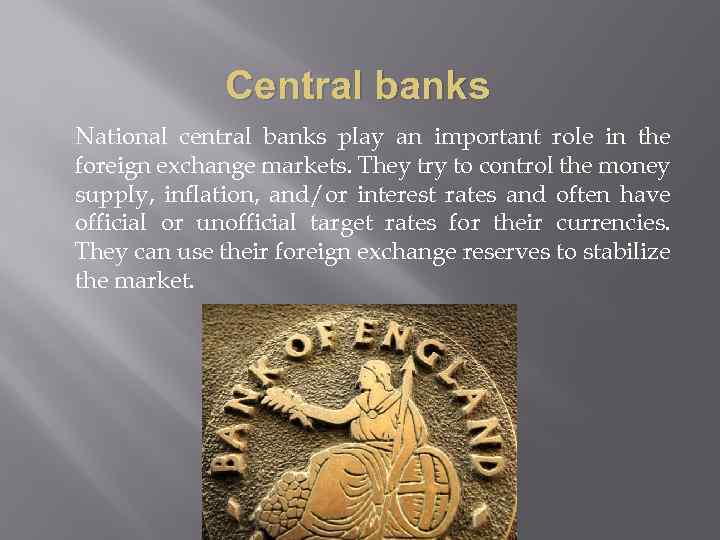
Central banks National central banks play an important role in the foreign exchange markets. They try to control the money supply, inflation, and/or interest rates and often have official or unofficial target rates for their currencies. They can use their foreign exchange reserves to stabilize the market.
Hedge funds as speculators About 70% to 90% of the foreign exchange transactions are speculative. In other words, the person or institution that bought or sold the currency has no plan to actually take delivery of the currency in the end; rather, they were solely speculating on the movement of that particular currency.
Investment management firms use the foreign exchange market to facilitate transactions in foreign securities.
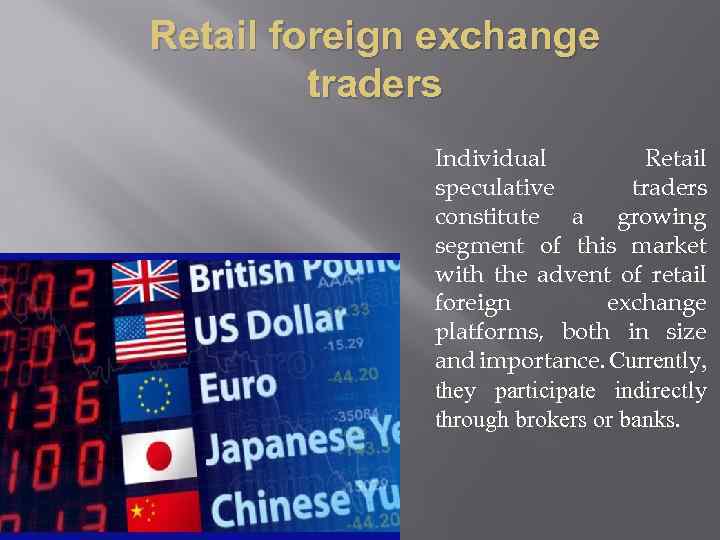
Retail foreign exchange traders Individual Retail speculative traders constitute a growing segment of this market with the advent of retail foreign exchange platforms, both in size and importance. Currently, they participate indirectly through brokers or banks.

Non-bank foreign exchange companies offer currency exchange and international payments to private individuals and companies. These are also known as foreign exchange brokers but are distinct in that they do not offer speculative trading but rather currency exchange with payments
Trading characteristics The main trading centers are New York and London, Tokyo, Hong Kong and Singapore. Currency trading happens continuously throughout the day. Fluctuations in exchange rates are usually caused by actual monetary flows as well as by expectations of changes in monetary flows. Currencies are traded against one another in pairs. Each currency pair thus constitutes an individual trading product.
The foreign exchange market is unique because of the following characteristics: • its huge trading volume representing the largest asset class in the world leading to high liquidity; • its geographical dispersion; • its continuous operation: 24 hours a day except weekends, i. e. , trading from 20: 15 GMT on Sunday until 22: 00 GMT Friday; • the variety of factors that affect exchange rates; • the low margins of relative profit compared with other markets of fixed income; and • the use of leverage to enhance profit and loss margins and with respect to account size.
Thank you for listening!
Скачать презентацию THE FOREIGN EXCHANGE MARKET by Veprev Andrey
The Foreign Exchange market.pptx