 Скачать презентацию The Food-Climate Connection Building just and sustainable agricultural
7c10a5e6d6cc336ee09d9f047e3023ea.ppt
- Количество слайдов: 15



The Food-Climate Connection: Building just and sustainable agricultural and food systems Interfaith Climate Justice “Inquiry to Action” series 12 February 2014 First Presbyterian Church of Ithaca Megan Gregory & Gary Fick
Outline • How do current agricultural and food systems contribute to global climate change? % of GHG emissions from ag & food systems Sources of food-related GHG emissions. • How can we build more just, sustainable, and resilient agricultural and food systems? Focus on climate impact; important to integrate other environmental & social values!
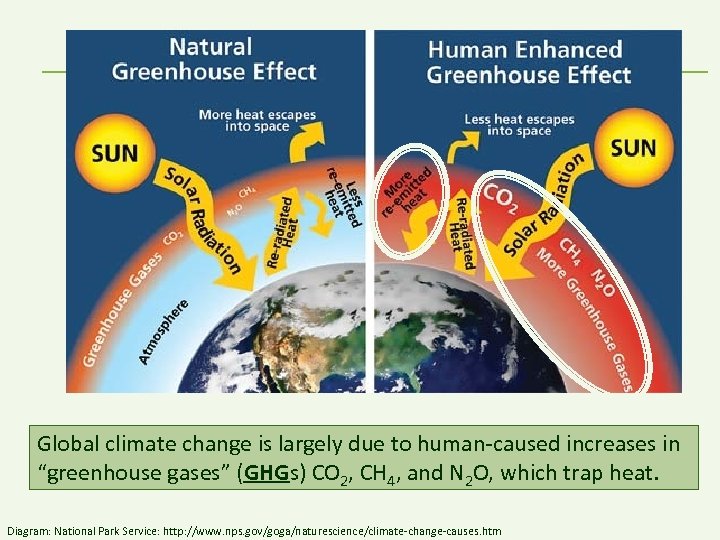
Global climate change is largely due to human-caused increases in “greenhouse gases” (GHGs) CO 2, CH 4, and N 2 O, which trap heat. Diagram: National Park Service: http: //www. nps. gov/goga/naturescience/climate-change-causes. htm
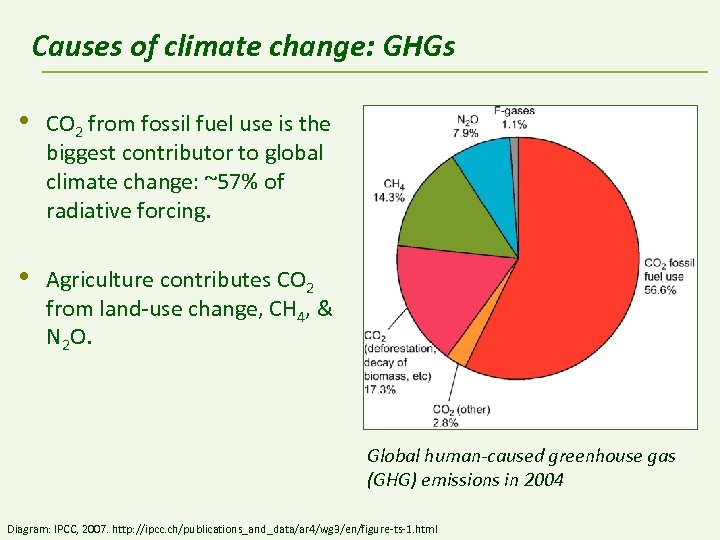
Causes of climate change: GHGs • CO 2 from fossil fuel use is the biggest contributor to global climate change: ~57% of radiative forcing. • Agriculture contributes CO 2 from land-use change, CH 4, & N 2 O. Global human-caused greenhouse gas (GHG) emissions in 2004 Diagram: IPCC, 2007. http: //ipcc. ch/publications_and_data/ar 4/wg 3/en/figure-ts-1. html
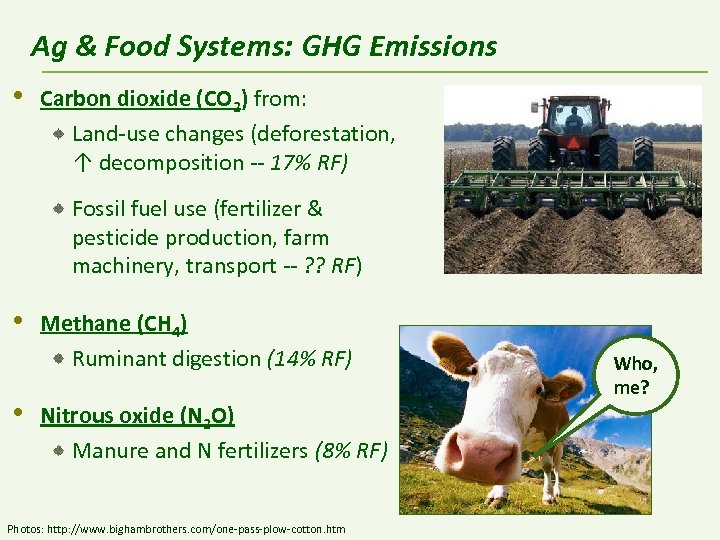
Ag & Food Systems: GHG Emissions • Carbon dioxide (CO 2) from: Land-use changes (deforestation, ↑ decomposition -- 17% RF) Fossil fuel use (fertilizer & pesticide production, farm machinery, transport -- ? ? RF) • • Methane (CH 4) Ruminant digestion (14% RF) Nitrous oxide (N 2 O) Manure and N fertilizers (8% RF) Photos: http: //www. bighambrothers. com/one-pass-plow-cotton. htm Who, me?
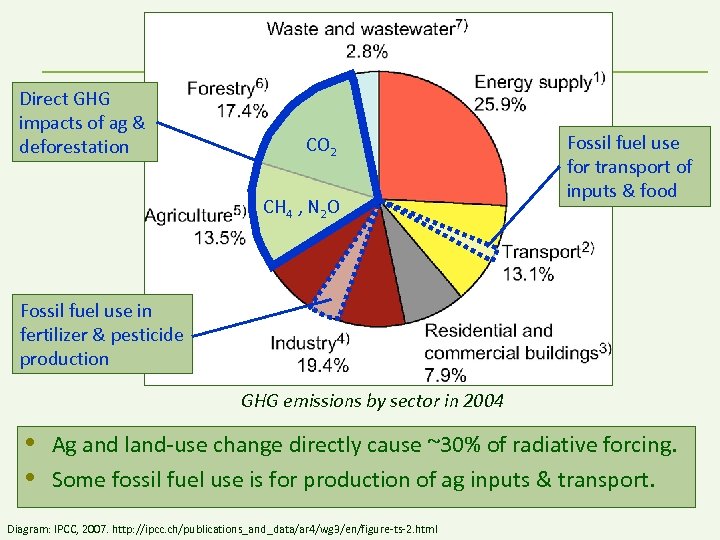
Direct GHG impacts of ag & deforestation CO 2 CH 4 , N 2 O Fossil fuel use for transport of inputs & food Fossil fuel use in fertilizer & pesticide production GHG emissions by sector in 2004 • • Ag and land-use change directly cause ~30% of radiative forcing. Some fossil fuel use is for production of ag inputs & transport. Diagram: IPCC, 2007. http: //ipcc. ch/publications_and_data/ar 4/wg 3/en/figure-ts-2. html
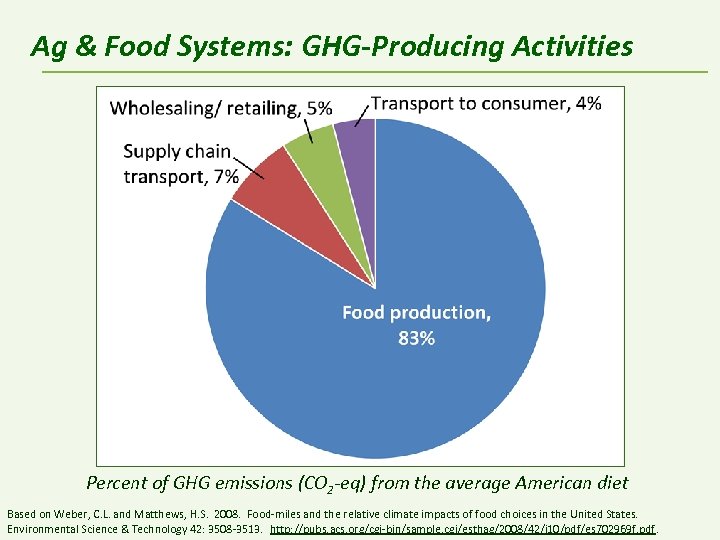
Ag & Food Systems: GHG-Producing Activities Percent of GHG emissions (CO 2 -eq) from the average American diet Based on Weber, C. L. and Matthews, H. S. 2008. Food-miles and the relative climate impacts of food choices in the United States. Environmental Science & Technology 42: 3508 -3513. http: //pubs. acs. org/cgi-bin/sample. cgi/esthag/2008/42/i 10/pdf/es 702969 f. pdf.
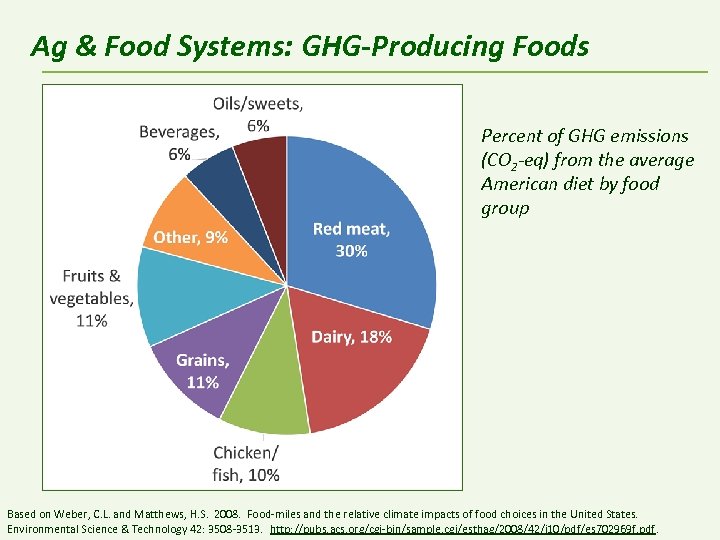
Ag & Food Systems: GHG-Producing Foods Percent of GHG emissions (CO 2 -eq) from the average American diet by food group Based on Weber, C. L. and Matthews, H. S. 2008. Food-miles and the relative climate impacts of food choices in the United States. Environmental Science & Technology 42: 3508 -3513. http: //pubs. acs. org/cgi-bin/sample. cgi/esthag/2008/42/i 10/pdf/es 702969 f. pdf.
Summary: GHG impacts of ag & food systems • Agriculture and food systems contribute > 30% of GHG emissions. • Most of the climate impact of our food (83%) comes from the production phase. • Red meat and dairy are GHG-intensive due to CH 4 and N 2 O production from ruminant digestion and manure management.
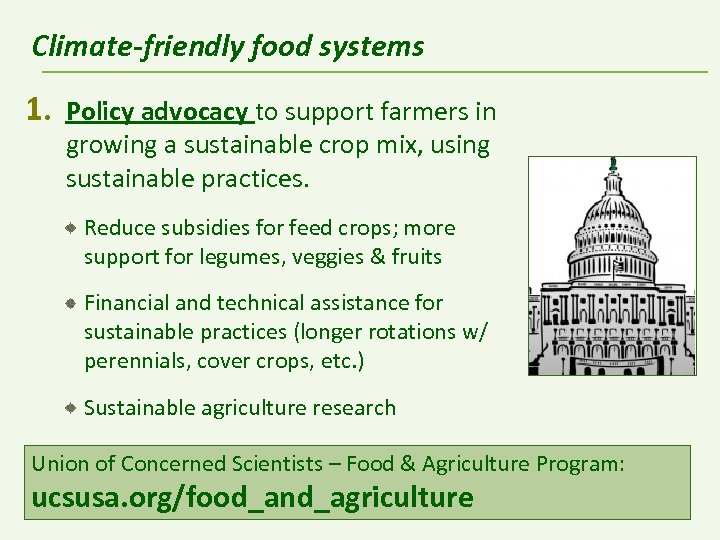
Climate-friendly food systems 1. Policy advocacy to support farmers in growing a sustainable crop mix, using sustainable practices. Reduce subsidies for feed crops; more support for legumes, veggies & fruits Financial and technical assistance for sustainable practices (longer rotations w/ perennials, cover crops, etc. ) Sustainable agriculture research Union of Concerned Scientists – Food & Agriculture Program: ucsusa. org/food_and_agriculture
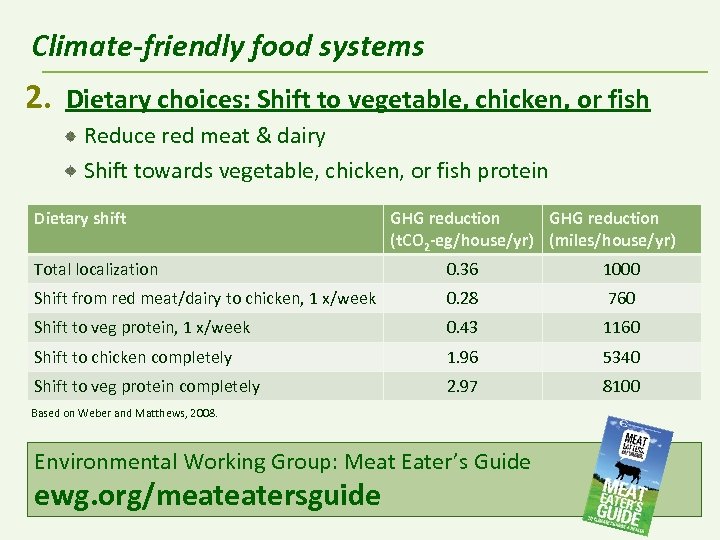
Climate-friendly food systems 2. Dietary choices: Shift to vegetable, chicken, or fish Reduce red meat & dairy Shift towards vegetable, chicken, or fish protein Dietary shift GHG reduction (t. CO 2 -eg/house/yr) (miles/house/yr) Total localization 0. 36 1000 Shift from red meat/dairy to chicken, 1 x/week 0. 28 760 Shift to veg protein, 1 x/week 0. 43 1160 Shift to chicken completely 1. 96 5340 Shift to veg protein completely 2. 97 8100 Based on Weber and Matthews, 2008. Environmental Working Group: Meat Eater’s Guide ewg. org/meateatersguide
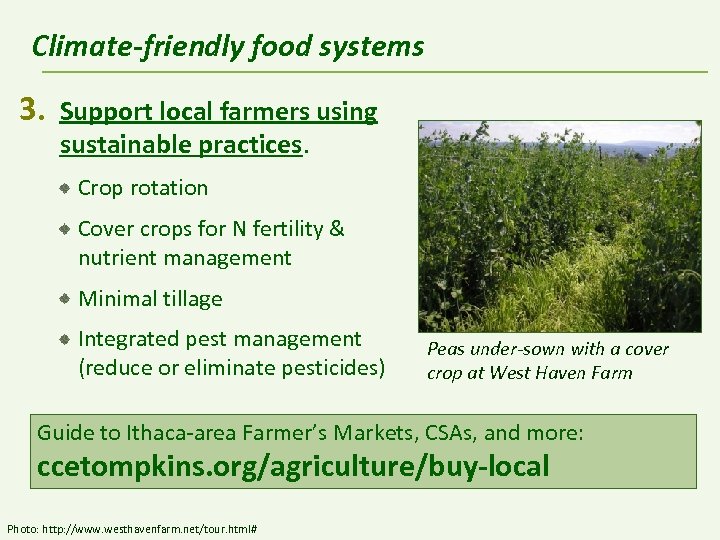
Climate-friendly food systems 3. Support local farmers using sustainable practices. Crop rotation Cover crops for N fertility & nutrient management Minimal tillage Integrated pest management (reduce or eliminate pesticides) Peas under-sown with a cover crop at West Haven Farm Guide to Ithaca-area Farmer’s Markets, CSAs, and more: ccetompkins. org/agriculture/buy-local Photo: http: //www. westhavenfarm. net/tour. html#
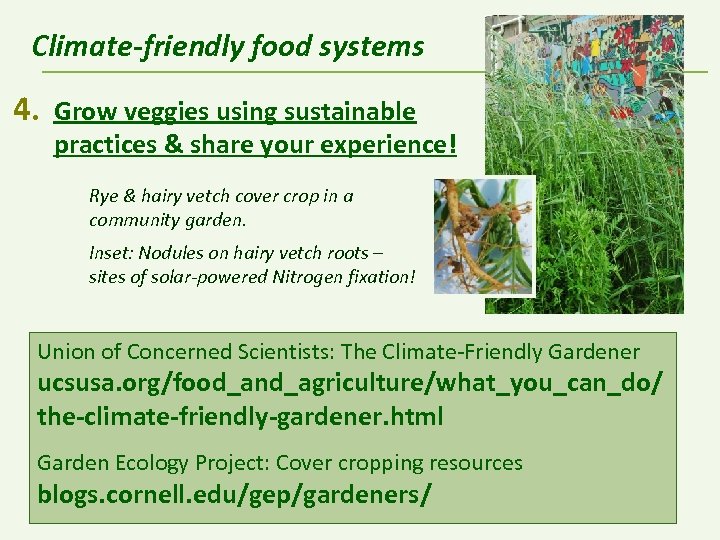
Climate-friendly food systems 4. Grow veggies using sustainable practices & share your experience! Rye & hairy vetch cover crop in a community garden. Inset: Nodules on hairy vetch roots – sites of solar-powered Nitrogen fixation! Union of Concerned Scientists: The Climate-Friendly Gardener ucsusa. org/food_and_agriculture/what_you_can_do/ the-climate-friendly-gardener. html Garden Ecology Project: Cover cropping resources blogs. cornell. edu/gep/gardeners/
Climate-friendly food systems 5. Support efforts to expand access to healthy, sustainably grown food to all people. Policy advocacy Local efforts: youth urban agriculture programs, affordable CSA shares, etc. Youth Farm Project: youthfarmproject. org/index. html Healthy Food For All Program with local farms & CCE: healthyfoodforall. org
Summary: Climate-friendly food systems • Policy advocacy to support diversified, sustainable agriculture • Dietary shift towards vegetable, chicken, and fish protein sources • Support local farmers using sustainable practices Crop rotation, cover crops, minimal tillage, integrated pest management • Grow veggies using sustainable practices • Support efforts to expand access to healthy, sustainably grown food
Скачать презентацию The Food-Climate Connection Building just and sustainable agricultural
7c10a5e6d6cc336ee09d9f047e3023ea.ppt