 Скачать презентацию The Five-Year Forecast Where Fiscal Accountability Begins
04aad43ee8d4323d84b79582716f595f.ppt
- Количество слайдов: 79



The Five-Year Forecast – Where Fiscal Accountability Begins Ohio Department of Education Quality School Choice and Funding Region 5 Coordinator Office
Fiscal Accountability The Bottom Line • Section 5705. 36(A)(5) requires that school expenditures do not exceed available resources. • Section 3313. 483(C) prohibits schools from shortening the school year to avoid a deficit. • In 1997, H. B. 412 removed the authority for schools to borrow to avoid a deficit (ORC sections 3313. 48. 3 to 3313. 48. 11). • H. B. 412 also created the School District Solvency Advancement Fund (SAF).
The Five-Year Forecast Where It All Begins • Statutory References: – – Sub HB 412 of the 122 nd General Assembly (1997 -98) Ohio Revised Code 5705. 391 Administrative Rule 3301 -92 -04 Auditor of State Bulletin 98 -015
Intended Purpose of the Five-Year Forecast • At Least Three Purposes: – Provide a method for ODE and the Auditor of State to identify districts with potential financial problems. – Serve as a basis for determining ability to sign the “ 412 certificate”. – Provide a standardized tool for long range planning at the local level.
Objectives of the Five-Year Forecast • Project district revenue and expenditures based on a reasonable set of assumptions. • Reduce or eliminate financial deficits by identifying potential problems before they occur. • Engage the local board of education and the community in long range financial planning.
What the Law Requires • A five-year forecast is required of all city, local, exempted village, and joint vocational school districts plus each community school. • Requires three years of historical data, five years of projections, and a summary of key assumptions. • Forecast must be approved by the local board of education. • Includes the general fund and “those funds that may impact the general fund balance”.
• Electronic submission of both projections and assumptions to ODE by October 31 st. • All districts must update the forecast between April 1 st and May 31 st. Same procedures are followed. • ODE must examine the five-year forecasts and determine if a district has the potential to incur a deficit during the first three forecast years. • ODE may conduct any further analysis necessary to assess the district’s financial condition. • ODE must notify the district and AOS if it determines that there is the potential for a deficit during the first three years of the forecast. • Districts must take immediate steps to eliminate any potential deficit once notified by ODE.
Who is Responsible? • The treasurers, with assistance from the school administration, is responsible for the preparation of the forecast, the accuracy of the numbers, and the reasonableness of the assumptions. • The treasurer, with assistance from the data acquisition site, is responsible for ensuring that the forecast projections and assumptions are successfully transmitted through EMIS. • ODE (Quality School Choice and Funding) is responsible for coordinating and supporting the forecast process; analyzing the forecast data; and working with school districts and the Auditor of State to help ensure potential deficits do not occur.
Funds Included • General (001), Emergency (016), Textbooks/Instructional Material (455) funds and currently SFSF (504) and Ed Jobs (532) • Any special cost centers associated with general fund money. • Any debt service (002) payments paid from money that otherwise would have gone to the general fund. • Any other money that was diverted from the general fund or designated by the Auditor of State.
Forecast Format • The forecast projections are required to be in a certain format with specific line numbers and subtotals. • There is no state required or recommended spreadsheet. • Each line number of the forecast represents the sum of specific USAS codes. Chapter 4. 2. 2 of the EMIS Guide lists the USAS codes that are to be included on each line of the forecast.
“Good” Forecasting Practices and Helpful Hints • ODE believes there are certain practices that help make the forecast a more accurate management tool, allowing decision makers and stake holders to use it with greater confidence. Following are tips to prepare a better forecast: – Be aware of your school district’s Average Daily Membership (ADM) and whether the number of students is increasing or decreasing. The ADM contributes to the state’s foundation formula as much as the formula funding is based on a per pupil amount. – Look specifically at Line 6. 010. This line shows the school district’s expenditures as “over or under revenue”. A school district expenditures exceeding revenues (overspending) will almost always experience fiscal concerns or insolvency. Positive numbers on this line are a good sign!
– A clear, concise narrative is critical to understanding the Assumptions used by the local BOE and treasurer in preparing the forecast. Unexplained variances or variances that do not seem to make sense are cause for concern. – Think long term and look at many data sources to make informed decisions. For example, new housing developments may bring additional students into the district (and additional revenue) but may required new buildings and/or staff (increased expenditures). Conversely, a factory closing may reduce funding and population causing the need for buildings and/or staff to decrease. Economic and population projections are essential factors in determining future requirements for educational services from the district. – It is not uncommon to see deficits in years four and five of a forecast. Given the uncertainty of future state budgets, local economic factors, state of federal mandates, years four and five are difficult to project. The key is recognizing how these conditions relate to current operations. Identifying future years’ deficits allows districts to engage in planning for those conditions prior to their arrival, to avoid, or at least, minimize the projected deficit. Remember, the longer the period of time allotted to deal with a potential financial problem the better. Longer time horizons allow reductions in expenditures to be spread out over several years, reducing their impact on students and staff. Also, some reductions may take many years before realizing their full impact.
Verifying the Data in EMIS • Make sure the data acquisition site (DAS) knows it has permission to submit the forecast spreadsheet and assumptions to EMIS. • If you changed spreadsheets, make sure DAS is familiar with the layout of the new spreadsheet. • Confirm with the data acquisition site that there are no formula “validation errors”. • Allow time to correct any errors by submitting the forecast before the due date. • Ask the DAS for a print out of what was submitted to EMIS. • A couple of days after EMIS runs, the ODE web site will reflect the updated five-year forecasts that are currently in EMIS. • Use the web site as a final check to verify correct data in EMIS.
Processing Forecast Data • The five-year forecast data are processed when EMIS runs. • The EMIS processing schedule is available on the ODE web site (period P data). • As long as forecast data are being processed, you can update and resubmit a new forecast.
When to Submit the Forecast? • The law requires: – The initial forecast to be submitted by October 31 st of each year. – Every district to update its forecast between April 1 st and May 31 st of each year. – The forecast on file with ODE to be the same as the forecast attached to the “ 412 certificate”. • ODE recommends: • Updating the forecast whenever the projected ending balances for any one of the first three fiscal years goes from positive to negative or vise versa. • Updating the forecast whenever the board of education approves a new one. • Updating the forecast to include the school board’s latest levy proposal plans. • Updating the forecast whenever the district feels that there has been a significant change in estimated revenue or expenditures.
What Happens if Deadline is Missed? • Because the Department does not receive the forecasts until EMIS data are processed, ODE will use the EMIS processing date on or immediately following the statutory due date to identified districts that are out of compliance with R. C. 5705. 391. • It is the intent of the Department to not include districts that are experiencing “technical problems” submitting their data. • A list of “non-compliant” districts is given to State Superintendent and Auditor of State. • Treasurers will be notified via fax if their district is considered “non-compliant”. • Notification will indicate that Fiscal Caution will be declared if forecast is not submitted electronically.
How can BOE use the five year forecast? • Reflection of goals • Aid in planning – short and long term • Aid in negotiations
How does ODE use the five-year forecast? • ODE is required by R. C. 5705. 391 to identify districts with the potential to incur a deficit during the first three years of the forecast period. • ODE uses the forecasts to provide assistance to districts so that potential deficits can be avoided.
Identifying Districts with Potential Deficits • 5705. 391 R. C. ODE mandated to examine forecast to determine potential to incur deficit in first three years. • Current year – line 10. 01 less than 2% of line 1. 07 • Year two – line 12. 01 if deficit exceeding 2% of line 1. 07 in second forecast year • Year three – line 15. 01 if deficit exceeding 2% of line 1. 07 in the third forecast year • Line 12. 01 takes into account replacement or renewal levies • Line 15. 01 takes into account replacement, renewal, and new levies
How will ODE use the five-year forecast? • In general, districts with a potential current year deficit will be contacted by an ODE consultant who will assess the financial situation and offer assistance. (Line 10. 010 – Certification of Appropriations) • Districts with potential deficits in future years will receive a letter requesting the district to submit a written proposal that addresses the future year deficit(s). Second year (Line 12. 010 – Certification of contracts, salary schedule, other obligations) Third year (Line 15. 010 – Unreserved Fund Balance)
Potential Current Year Deficit • Region Office reviews forecast and assumptions. • Region Office notifies district’s treasurer: A contact is made by the fiscal consultant questioning whether the district will be able to end the fiscal year without debt (i. e. , positive ending balance) • If projections do not appear accurate, opportunity to revise. • If projections of a deficit appear accurate, district confirm in writing how district plans to avoid projected deficit. District must submit an updated five year forecast. • If district doe not provide adequate written explanation, district should be referred for consideration for Fiscal Caution. • Region Office may conduct financial analysis.
Potential Future Year Deficit • Proposal requested if line 12. 01 in the second year of the forecast shows a deficit exceeding 2% of projected revenue. • Proposal requested if line 15. 01 in the third year of the forecast shows a deficit exceeding 2% of projected revenue. • Proposals reviewed by Region Office and either accepted or rejected within 30 days. • If proposal is rejected, Region Office will respond in writing, making it clear to the district what will make proposal acceptable. • District has 30 days to re-submit or request extension. • Fiscal consultant will conduct a financial analysis to verify district’s projections. • Letter to Board President indicating Department’s intent to place district in Fiscal Caution.
Written Proposals • Written proposals demonstrate that the local board and the administration are aware of and are discussing ways to avoid the potential deficit(s). • Proposals are amendable as specifics and exact numbers are identified. • Proposals are to be submitted to the district’s Regional Fiscal Consultant.
Financial Analysis • Service provided by ODE at no cost to the district • Superintendent or Treasurer may request in writing to Region Office • Consultant will contact district to set date to conduct the financial analysis • List of documents and reports needed will be sent to the district • Upon arriving in district, Consultant will consult with Superintendent and Treasurer to complete opening interview questions • General Fund, Emergency Levy Funds, portion of Bond Retirement Fund applicable to servicing of General Fund debt charges, SFSF (504) and Ed Jobs (532). • Financial Analysis includes four years of history • Current year and following year projections • Financial completed, draft will be reviewed with Superintendent and Treasurer • Financial completed financial analysis sent to Superintendent and Treasurer from Region Office • Consultant available to review financial analysis with the Board of Education if requested by district
The Bottom Line • School district expenditures cannot exceed available resources. ORC Section 5705. 36(A)(5) • School districts cannot shorten the school year to avoid a deficit. ORC Section 3313. 483(C) • School districts cannot borrow money to avoid a year end deficit. In 1997, HB 412 removed the authority for school districts to borrow by deleting ORC Sections 3313. 48. 3 to 3313. 48. 11 • Districts that cannot avoid a current year deficit may need to be placed in Fiscal Emergency in order to remain solvent. • Districts in fiscal emergency are eligible for a two-year interest free advance of their state foundation money. ORC Section 3316. 20
Fiscal Caution • ORC 3316. 031, effective 4/10/01 • Guidelines for State Superintendent to place district in Fiscal Caution • Failure to submit five-year forecast (RC 5705. 391) or Administrative Rule (3301 -92 -04) • Line 10. 01 current year ending fund balance 2% or less of projected revenue • Failure to submit an acceptable plan to address future year deficit (Line 12. 01) • Department discovers fiscal practices or conditions that could lead to Fiscal Watch or Emergency • Auditor of State certifies a deficit between 2% and 8% and elects not to place district in Fiscal Watch, district must be placed in Fiscal Caution (3316. 031(B)(3)RC)
• Auditor of State declares district’s financial records are unauditable • Auditor of State reports district failed to submit financial statements according to GAAP • State Auditor reports district has not complied with Section 5705. 412 RC attaching signed certificate to appropriation measure, qualifying contract or salary schedule • Auditor of State identifies conditions, weaknesses, legal noncompliance or management letter comments that have significant effect on the financial condition of the district. • Board of Education will receive written notice 10 business days prior to State Superintendent placing the district in Fiscal Caution. • District will be monitoring on a monthly basis • District will be given 60 days to submit a written proposal (extension may be granted upon request) • District cannot be released from Fiscal Caution within same fiscal year in which declaration was made
• If the Department finds that a district has not made reasonable proposals or has not taken action to discontinue or correct the practices or conditions that led to Fiscal Caution, the State Superintendent may recommend to the Auditor of State that the district be placed in Fiscal Watch or Emergency. • The law, further allows the Auditor of State to conduct a performance audit or the district at the Department’s expense. • ODE declares districts to be in Fiscal Caution • The Auditor of State declares to be in Fiscal Watch or Emergency.
Fiscal Caution: What does it mean? • District is labeled a fiscal caution district. • District must submit a written proposal that eliminates the conditions that led to the declaration of fiscal caution. • ODE will monitor the district to ensure implementation of the written proposal. • AOS may conduct a performance audit at no cost to the district. • AOS may place the district in fiscal watch if an acceptable proposal is not submitted or if the district does not comply with its proposal.
Fiscal Caution: How is it different from Watch or Emergency? • Declaration and termination of fiscal caution is controlled by ODE (as opposed to AOS). • Guidelines for declaring fiscal caution are more general then the laws for declaring fiscal watch or emergency. • Termination of fiscal caution can happen when positive fund balances are projected for the current and next two fiscal years. • No solvency assistance advance is available under fiscal caution.
Fiscal Caution: How is it similar to Watch and Emergency? • The financial aspects of districts in fiscal caution, watch or emergency are monitored by ODE. • A “plan” to eliminate any current year deficit and avoid future year deficits will need to be developed. • A performance audit may be conducted under caution, watch or emergency.
Declaration of “Fiscal Watch” Section 3316. 03(A) ORC The Auditor of State shall determine a state of fiscal watch if it is determined that: – The Auditor has certified an operating deficit for the current fiscal year that exceeds 8% of the district’s general fund revenue for the preceding fiscal year; – That the unencumbered cash balance in the district’s general fund at the end of the prior fiscal year, less any advances of property taxes, was less than 8% of the district’s general fund expenditure for such prior year; – The district voters have not passed a tax levy that the Auditor of State expects will raise enough additional money in the next fiscal year so that the preceding two conditions will not exist in the next fiscal year.
The Auditor of State may declare fiscal watch if all of the following exist: • An operating deficit has been certified for the current fiscal year by the Auditor of State, and the certified operating deficit exceeds 2%, but does not exceed 8% of the school district’s general fund revenue for the preceding fiscal year. • The voters have not approved a levy that would raise enough money in the next fiscal year to eliminate the deficit. • The Auditor of State determines there is no reasonable cause for the deficit or fiscal watch is necessary to prevent further fiscal decline.
Fiscal Watch: What does it mean? • Only the Auditor of State can declare or terminate fiscal watch. • The Board of Education must submit a financial recovery plan to ODE within 60 days. • The financial recovery plan must be approved by State Superintendent of Public Instruction. • Failure to submit, update or implement the financial recover plan could result in AOS placing the district in fiscal emergency.
Fiscal Watch: Financial Plan Section 3316. 04 • Submit a financial recovery plan to State Superintendent within 60 days of Auditor’s declaration • Plan must include steps the Board of Education will take to eliminate current deficit and avoid future year deficits • Plan may include revenue enhancing strategy bust must include an expenditure reduction plan sufficient to offset any deficit in the event that the revenue enhancing strategy is not completely successful • Update five-year forecast submitted with recovery plan
Fiscal Watch: Financial Plan • State Superintendent will review the plan within 30 days • If State Superintendent rejects plan, it will be returned to the district for revision • If district does not submit an acceptable plan within 120 days of the Auditor’s declaration, the district will be placed in Fiscal Emergency • District will be monitored on a month basis by ODE (your region’s fiscal consultant) to determine if they are complying with the terms of the financial recovery plan • Solvency assistance advances are not available to districts in fiscal watch. • Accounting and reporting compliance issues identified by the Auditor of State must be appropriately address before termination of Watch • If district is not complying, the district will be placed in Fiscal Emergency
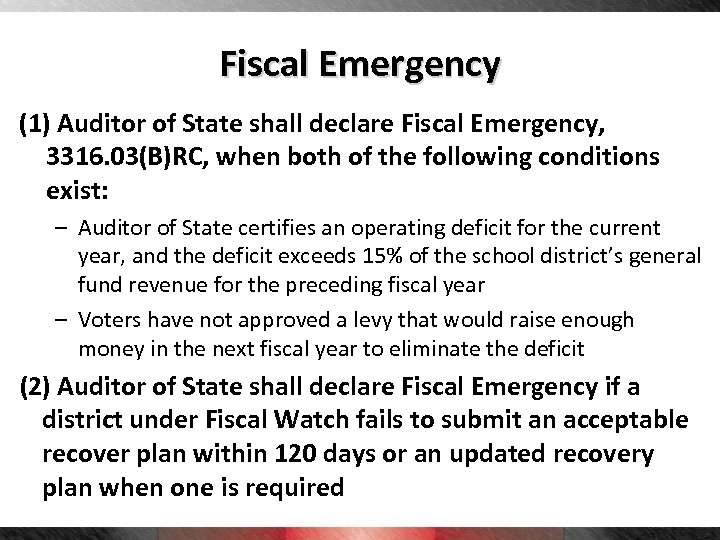
Fiscal Emergency (1) Auditor of State shall declare Fiscal Emergency, 3316. 03(B)RC, when both of the following conditions exist: – Auditor of State certifies an operating deficit for the current year, and the deficit exceeds 15% of the school district’s general fund revenue for the preceding fiscal year – Voters have not approved a levy that would raise enough money in the next fiscal year to eliminate the deficit (2) Auditor of State shall declare Fiscal Emergency if a district under Fiscal Watch fails to submit an acceptable recover plan within 120 days or an updated recovery plan when one is required
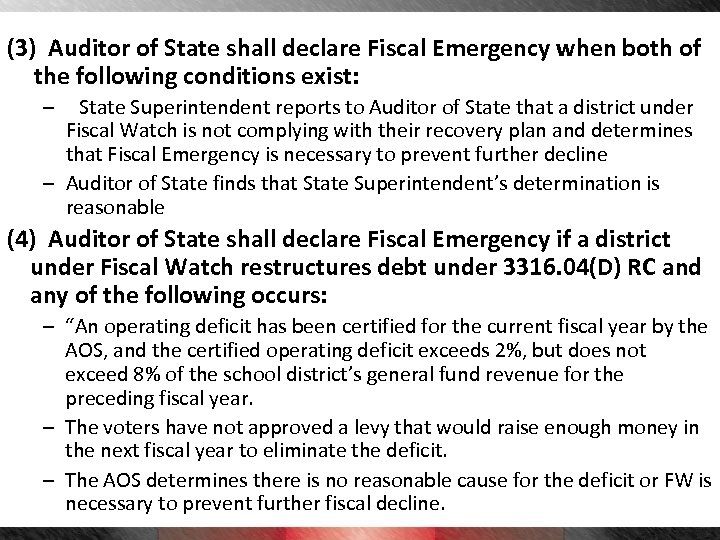
(3) Auditor of State shall declare Fiscal Emergency when both of the following conditions exist: – State Superintendent reports to Auditor of State that a district under Fiscal Watch is not complying with their recovery plan and determines that Fiscal Emergency is necessary to prevent further decline – Auditor of State finds that State Superintendent’s determination is reasonable (4) Auditor of State shall declare Fiscal Emergency if a district under Fiscal Watch restructures debt under 3316. 04(D) RC and any of the following occurs: – “An operating deficit has been certified for the current fiscal year by the AOS, and the certified operating deficit exceeds 2%, but does not exceed 8% of the school district’s general fund revenue for the preceding fiscal year. – The voters have not approved a levy that would raise enough money in the next fiscal year to eliminate the deficit. – The AOS determines there is no reasonable cause for the deficit or FW is necessary to prevent further fiscal decline.
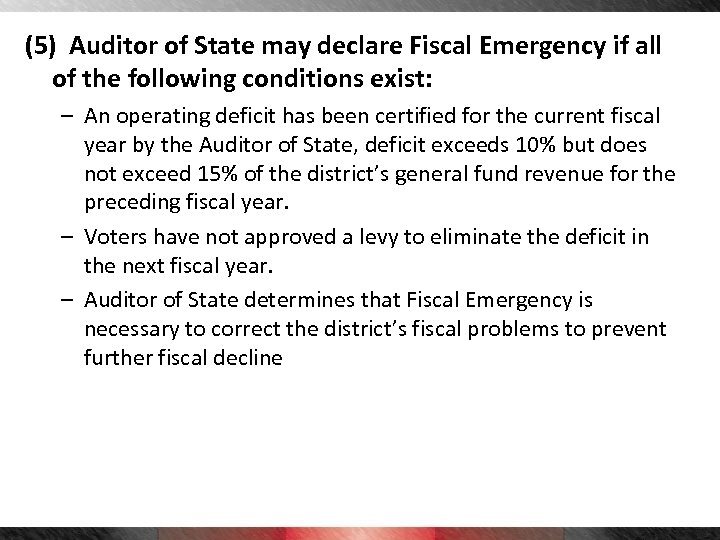
(5) Auditor of State may declare Fiscal Emergency if all of the following conditions exist: – An operating deficit has been certified for the current fiscal year by the Auditor of State, deficit exceeds 10% but does not exceed 15% of the district’s general fund revenue for the preceding fiscal year. – Voters have not approved a levy to eliminate the deficit in the next fiscal year. – Auditor of State determines that Fiscal Emergency is necessary to correct the district’s fiscal problems to prevent further fiscal decline
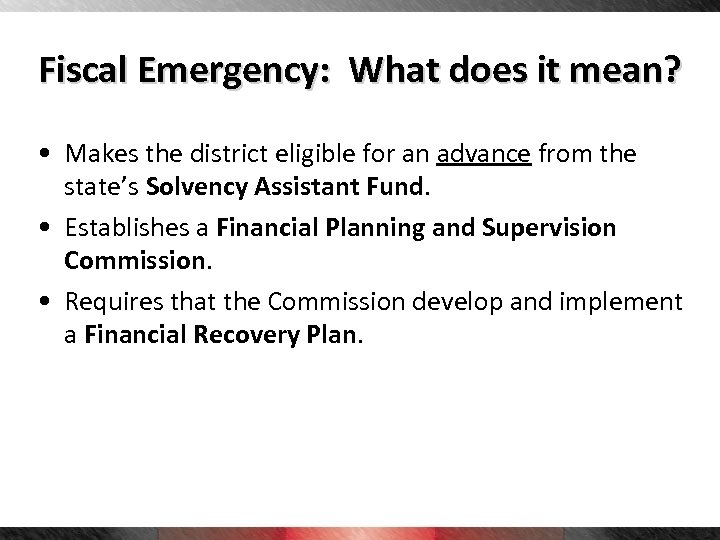
Fiscal Emergency: What does it mean? • Makes the district eligible for an advance from the state’s Solvency Assistant Fund. • Establishes a Financial Planning and Supervision Commission. • Requires that the Commission develop and implement a Financial Recovery Plan.
The Solvency Assistance Fund • Two year, interest free advance on the district’s state foundation payments. • Must be in fiscal emergency to be eligible. • Requires State Controlling Board approval. • Repayment starts in the next fiscal year.
The Financial Planning and Supervision Commission • Consists of five voting members: – State Superintendent of Public Instruction or designee – Director of the Office of Budget & Management or designee – Parent with a child enrolled in district appointed by the State Superintendent of Public Instruction – Business person that lives or works in the district appointed by the Governor – Business person that lives or works in the district appointed by the Mayor or County Auditor
• The Commission is to be appointed within 15 days of the declaration of fiscal emergency. • The Superintendent of Public Instruction or designee serves as chairperson. • The Commission shall elect a vice-chair. • The Commission shall appoint a secretary who need not be a member of the Commission. • Within 120 days of its first meeting, the Commission must adopt a Financial Recovery Plan. • The Commission receives legal representation from the Ohio Attorney General and financial advice from the Ohio Auditor of State.
The Financial Planning & Supervision Commission • Has following powers: – Review or assume responsibility for the development of all tax budgets, tax levy and not resolution, appropriation measures and certificates of estimated resources, R. C. 3316. 07(A)(1); – Inspect and secure copies of any document pertaining to the financial records of the district, R. C. 3316. 07(A)(2)(3); – Review, revise and approve determinations and certifications affecting the school district made by the county budget commission or county auditor, R. C. 3316. 07(A)(4); – Bring civil actions, including mandamus, to enforce the bill’s provisions, R. C. 3316. 07(A)(5); – Implement steps necessary to bring the accounting, financial, and reporting procedures and systems of the district into compliance with the Auditor’s rules, R. C. 3316. 07(A)(6);
– Assist the school district or assume responsibility for structuring the terms and placement for sale of the district’s obligations, R. C. 3316. 07(A)(7); – Make and enter into all contracts necessary or incidental to the performance of its duties and the exercise of it powers, R. C. 3316. 07(A)(9); – Consult with officials of the district and make recommendations or assume responsibility for implementing cost reductions and revenue increases to achieve balance budgets and carry out the financial recovery plan, R. C. 3316. 07(A)(10); – Approve the issuance of any debt obligation, R. C. 3316. 14; – Remove, if necessary, the school treasurer or superintendent for failing to comply with the terms of the law, R. C. 3316. 17; – Perform all other powers, duties, and functions as provided under Chapter 3316 ORC, R. C. 3316. 07(A)(8).
Powers of the Commission ORC 3316. 07 • Make recommendations and implement cost reductions and revenue increases to achieve balanced budgets and carry out the recovery plan. • Make reductions in force to bring the district’s budget into balance not withstanding any provisions to the contrary in the collective bargaining agreement. • In making reductions in force, the Commission must first consider reductions among administrative and nonteaching employees. • Remove the superintendent or treasurer for failing to comply with the Commission’s orders concerning the preparation or implementation of the financial recovery plan (ORC 3316. 17)
The Financial Recovery Plan • The Plan must be approved by the Superintendent of Public Instruction. • The Plan can not be implemented until it is approved. • The Plan can be amended at anytime but must be updated annually. • The Department of Education will monitor the implementation of the Plan and will inform the Commission as to the progress. • If the Commission fails to submit an acceptable Plan or does not materially comply with the Plan, the Commission can be dissolved an arbitrator can be appointed. • Details the actions that will be taken to restore the fiscal integrity of the school district. • Specifies the level of fiscal and management control that the Commission will exercise. • Sets target dates for implementation of action plans. • Specifies the amount and purpose of any issuance of debt obligations.
Restoring Fiscal Integrity Through the Financial Recovery Plan Eliminate the conditions that promoted the Auditor’s declaration and avoid future fiscal emergency conditions. • Satisfy all of the current financial obligations of the school district. • Restore any money borrowed or transferred from other funds. • Eliminate any current year deficits in all funds. • Maintain a balanced budget. • Avoid deficits in future years. • Restore the district’s ability to market long-term general bond obligations.
Fiscal and Management Control Through the Financial Recovery Plan • The plan should specify the level of fiscal and management control the Commission will exercise during the period of fiscal emergency. • The Commission may assume any of the powers and duties of the school board it considers necessary in order to successfully implement the recovery plan.
Solvency Assistance Fund (SAF) for Districts in Fiscal Emergency Section 3316. 20 RC Provides assistance and grants to school districts to enable them to remain solvent – Through SAF, two-year, interest free advances on districts’ state foundation payments are made available to districts in Fiscal Emergency. – Advances of this sort must be repaid by the end of the second fiscal year following the year the advance was made – SAF advances require State Controlling Board approval – Repayment begins in the fiscal year following receipt of an advance.
Performance Audits Section 3316. 042 ORC – Auditor of State may conduct a Performance Audit of any district under Fiscal Caution, Watch, or Emergency – Shall conduct a Performance Audit if requested by the State Superintendent of Public Instruction
School District Benchmarking Report
Introduction • Spending and reporting requirements to provide insight on how districts manage the resources provided by the state. • Two key dimensions – Educational dimension involves how money is spent to directly support activities in the classroom – Operational dimension involves how money is spent to support the operations of schools
• Intent to provide a framework to provide districts with the ability to evaluate the operating costs of the district and identify possible areas for improvement in the allocation of district resources • All districts are required to report financial data to ODE within the system of revenue and expenditure codes defined by the Ohio Auditor of State in the Uniform School Accounting System (USAS) manual • ODE is currently working with the Auditor of State and district treasurers to develop more consistent reporting standards
How to Find Benchmark Report on ODE website: www. ode. state. oh. us Ø Finance Ø Special Finance Date Reports Ø Education Fiscal Data Project Ø District Fiscal Benchmark Report
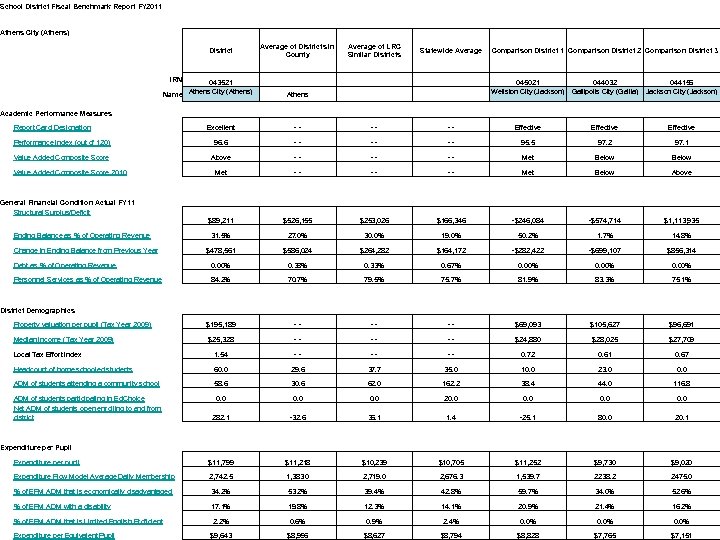
School District Fiscal Benchmark Report FY 2011 Athens City (Athens) Average of Districts in County Average of LRC Similar Districts Statewide Average Athens Excellent - - - Effective District IRN 043521 Name Athens City (Athens) Academic Performance Measures Comparison District 1 Comparison District 2 Comparison District 3 045021 044032 Wellston City (Jackson) Gallipolis City (Gallia) 044156 Jackson City (Jackson) Report Card Designation Performance Index (out of 120) 96. 6 - - - 95. 5 97. 2 97. 1 Value Added Composite Score Above - - - Met Below Value Added Composite Score 2010 Met - - - Met Below Above $89, 211 $526, 155 $253, 026 $166, 346 -$246, 084 -$574, 714 $1, 113, 935 31. 5% 27. 0% 30. 0% 19. 0% 50. 2% 1. 7% 14. 8% General Financial Condition Actual FY 11 Structural Surplus/Deficit Ending Balance as % of Operating Revenue Change in Ending Balance from Previous Year $478, 561 $586, 024 $264, 282 $164, 172 -$282, 422 -$699, 107 $856, 314 Debt as % of Operating Revenue 0. 00% 0. 38% 0. 33% 0. 67% 0. 00% Personnel Services as % of Operating Revenue 84. 2% 70. 7% 79. 5% 75. 7% 81. 9% 83. 3% 75. 1% District Demographics Property valuation per pupil (Tax Year 2009) $195, 189 - - - $69, 093 $105, 627 $96, 691 Median Income (Tax Year 2009) $25, 328 - - - $24, 880 $28, 025 $27, 709 Local Tax Effort Index 1. 54 - - - 0. 72 0. 61 0. 67 Headcount of home schooled students 60. 0 29. 6 37. 7 35. 0 10. 0 23. 0 0. 0 ADM of students attending a community school 58. 6 30. 6 62. 0 162. 2 38. 4 44. 0 116. 8 0. 0 20. 0 ADM of students participating in Ed. Choice Net ADM of students open enrolling to and from district 282. 1 -32. 6 36. 1 1. 4 -25. 1 80. 0 20. 1 Expenditure per Pupil Expenditure per pupil $11, 799 $11, 218 $10, 239 $10, 705 $11, 252 $9, 730 $9, 020 Expenditure Flow Model Average Daily Membership 2, 742. 5 1, 383. 0 2, 719. 0 2, 676. 3 1, 539. 7 2238. 2 2475. 0 % of EFM ADM that is economically disadvantaged 34. 2% 53. 2% 39. 4% 42. 8% 59. 7% 34. 0% 52. 6% % of EFM ADM with a disability 17. 1% 19. 8% 12. 3% 14. 1% 20. 9% 21. 4% 16. 2% % of EFM ADM that is Limited English Proficient 2. 2% 0. 6% 0. 9% 2. 4% 0. 0% Expenditure per Equivalent Pupil $9, 643 $8, 996 $8, 627 $8, 794 $8, 828 $7, 765 $7, 151
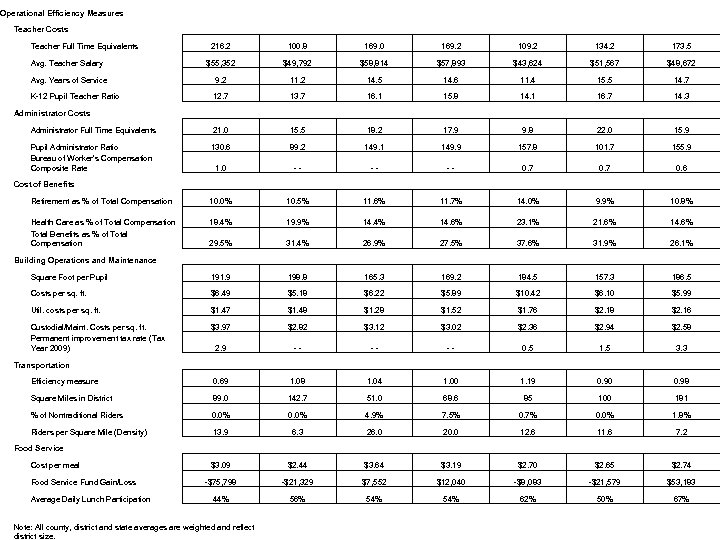
Operational Efficiency Measures Teacher Costs Teacher Full Time Equivalents 216. 2 100. 8 169. 0 169. 2 109. 2 134. 2 173. 5 Avg. Teacher Salary $55, 352 $49, 792 $58, 814 $57, 893 $43, 624 $51, 567 $48, 672 Avg. Years of Service 9. 2 11. 2 14. 5 14. 6 11. 4 15. 5 14. 7 K-12 Pupil Teacher Ratio 12. 7 13. 7 16. 1 15. 8 14. 1 16. 7 14. 3 Administrator Costs Administrator Full Time Equivalents 21. 0 15. 5 18. 2 17. 9 9. 8 22. 0 15. 9 130. 6 89. 2 149. 1 149. 9 157. 8 101. 7 155. 9 Pupil Administrator Ratio Bureau of Worker's Compensation Composite Rate 1. 0 - - - 0. 7 0. 6 Cost of Benefits Retirement as % of Total Compensation 10. 0% 10. 5% 11. 6% 11. 7% 14. 0% 9. 9% 10. 8% 18. 4% 19. 9% 14. 4% 14. 6% 23. 1% 21. 6% 14. 6% Health Care as % of Total Compensation Total Benefits as % of Total Compensation 29. 5% 31. 4% 26. 9% 27. 5% 37. 6% 31. 9% 26. 1% Building Operations and Maintenance Square Foot per Pupil 191. 9 198. 8 165. 3 169. 2 184. 5 157. 3 186. 5 Costs per sq. ft. $6. 49 $5. 18 $6. 22 $5. 89 $10. 42 $6. 10 $5. 99 Util. costs per sq. ft. $1. 47 $1. 48 $1. 28 $1. 52 $1. 76 $2. 18 $2. 16 $3. 97 $2. 82 $3. 12 $3. 02 $2. 36 $2. 94 $2. 58 Custodial/Maint. Costs per sq. ft. Permanent improvement tax rate (Tax Year 2009) 2. 9 - - - 0. 5 1. 5 3. 3 Transportation Efficiency measure 0. 69 1. 08 1. 04 1. 00 1. 19 0. 90 0. 98 Square Miles in District 89. 0 142. 7 51. 0 68. 6 85 100 181 % of Nontraditional Riders 0. 0% 4. 9% 7. 5% 0. 7% 0. 0% 1. 8% Riders per Square Mile (Density) 13. 9 6. 3 26. 0 20. 0 12. 6 11. 6 7. 2 Food Service Cost per meal $3. 09 $2. 44 $3. 64 $3. 19 $2. 70 $2. 65 $2. 74 Food Service Fund Gain/Loss -$75, 798 -$21, 329 $7, 552 $12, 040 -$8, 083 -$21, 579 $53, 183 Average Daily Lunch Participation 44% 56% 54% 62% 50% 67% Note: All county, district and state averages are weighted and reflect district size.
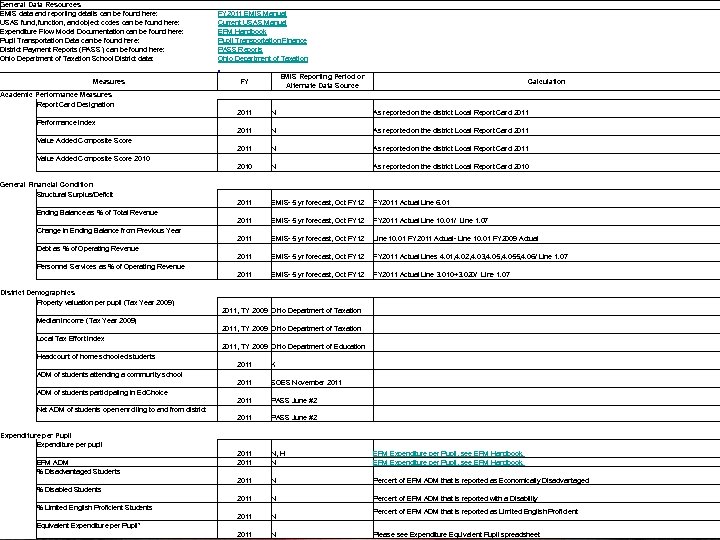
General Data Resources EMIS data and reporting details can be found here: USAS fund, function, and object codes can be found here: Expenditure Flow Model Documentation can be found here: Pupil Transportation Data can be found here: District Payment Reports (PASS ) can be found here: Ohio Department of Taxation School District data: Measures Academic Performance Measures Report Card Designation Performance Index Value Added Composite Score 2010 General Financial Condition Structural Surplus/Deficit Ending Balance as % of Total Revenue Change in Ending Balance from Previous Year Debt as % of Operating Revenue Personnel Services as % of Operating Revenue District Demographics Property valuation per pupil (Tax Year 2009) Median Income (Tax Year 2009) Local Tax Effort Index Headcount of home schooled students ADM of students attending a community school ADM of students participating in Ed. Choice Net ADM of students open enrolling to and from district Expenditure per Pupil Expenditure per pupil EFM ADM % Disadvantaged Students % Disabled Students % Limited English Proficient Students Equivalent Expenditure per Pupil* FY 2011 EMIS Manual Current USAS Manual EFM Handbook Pupil Transportation Finance PASS Reports Ohio Department of Taxation EMIS Reporting Period or FY Alternate Data Source Calculation 2011 N As reported on the district Local Report Card 2011 2010 N As reported on the district Local Report Card 2010 2011 EMIS- 5 yr forecast, Oct FY 12 FY 2011 Actual Line 6. 01 2011 EMIS- 5 yr forecast, Oct FY 12 FY 2011 Actual Line 10. 01/ Line 1. 07 2011 EMIS- 5 yr forecast, Oct FY 12 Line 10. 01 FY 2011 Actual- Line 10. 01 FY 2009 Actual 2011 EMIS- 5 yr forecast, Oct FY 12 FY 2011 Actual Lines 4. 01, 4. 02, 4. 03, 4. 055, 4. 06/ Line 1. 07 2011 EMIS- 5 yr forecast, Oct FY 12 FY 2011 Actual Line 3. 010+3. 020/ Line 1. 07 2011, TY 2009 Ohio Department of Taxation 2011, TY 2009 Ohio Department of Education 2011 K 2011 SOES November 2011 PASS June #2 2011 N, H N EFM Expenditure per Pupil, see EFM Handbook. 2011 N Percent of EFM ADM that is reported as Economically Disadvantaged 2011 N Percent of EFM ADM that is reported with a Disability 2011 N Percent of EFM ADM that is reported as Limited English Proficient Please see Expenditure Equivalent Pupil spreadsheet
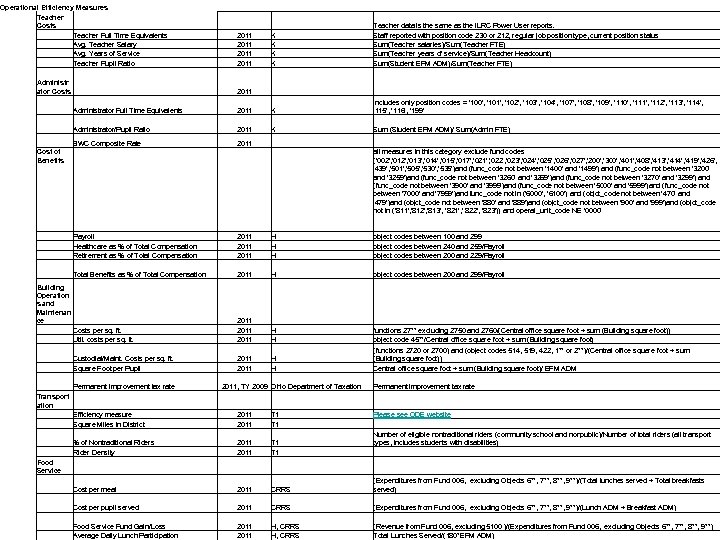
Operational Efficiency Measures Teacher Costs Teacher Full Time Equivalents Avg. Teacher Salary Avg. Years of Service Teacher Pupil Ratio 2011 K K Teacher data is the same as the i. LRC Power User reports. Staff reported with position code 230 or 212, regular job position type, current position status Sum(Teacher salaries)/Sum(Teacher FTE) Sum(Teacher years of service)/Sum(Teacher Headcount) Sum(Student EFM ADM)/Sum(Teacher FTE) Administr ator Costs 2011 Administrator Full Time Equivalents 2011 K Includes only position codes = '100', '101', '102', '103', '104', '107', '108', '109', '110', '111', '112', '113', '114', '115', '116', '199' Administrator/Pupil Ratio 2011 K Sum (Student EFM ADM)/ Sum(Admin FTE) Cost of Benefits BWC Composite Rate 2011 all measures in this category exclude fund codes ('002', '013', '014', '015', '017', '021', '022', '023', '024', '025', '026', '027', '200', '300', '401', '408', '413', '414', '419', '426', '439', '501', '505', '530', '535')and (func_code not between '1400' and '1499') and (func_code not between '3200' and '3259')and (func_code not between '3260' and '3269')and (func_code not between '3270' and '3299') and (func_code not between '3900' and '3999')and (func_code not between '5000' and '5999')and (func_code not between '7000' and '7999')and func_code not in ('6000', '6100') and (objct_code not between '470' and '479')and (objct_code not between '880' and '889')and (objct_code not between '900' and '999')and (objct_code not in ('811', '812', '813', '821', ' 822', '823')) and operal_unit_code NE '0000' Payroll Healthcare as % of Total Compensation Retirement as % of Total Compensation 2011 H H H object codes between 100 and 299 object codes between 240 and 259/Payroll object codes between 200 and 229/Payroll Total Benefits as % of Total Compensation 2011 H object codes between 200 and 299/Payroll Building Operation s and Maintenan ce Costs per sq. ft. Util. costs per sq. ft. 2011 H H functions 27** excluding 2750 and 2760/(Central office square foot + sum (Building square foot)) object code 45**/Central office square foot + sum (Building square foot) Custodial/Maint. Costs per sq. ft. Square Foot per Pupil 2011 H H (functions 2720 or 2700) and (object codes 514, 519, 422, 1** or 2**)/(Central office square foot + sum (Building square foot)) Central office square foot + sum (Building square foot)/ EFM ADM Transport ation Permanent improvement tax rate Efficiency measure Square Miles in District 2011 T 1 % of Nontraditional Riders Rider Density 2011 T 1 Food Service Cost per meal 2011 CRRS (Expenditures from Fund 006, excluding Objects 6**, 7**, 8**, 9**)/(Total lunches served + Total breakfasts served) Cost per pupil served 2011 CRRS (Expenditures from Fund 006, excluding Objects 6**, 7**, 8**, 9**)/(Lunch ADM + Breakfast ADM) Food Service Fund Gain/Loss Average Daily Lunch Participation 2011 H, CRRS (Revenue from Fund 006, excluding 5100 )/(Expenditures from Fund 006, excluding Objects 6**, 7**, 8**, 9**) Total Lunches Served/(180*EFM ADM) 2011, TY 2009 Ohio Department of Taxation Permanent improvement tax rate Please see ODE website Number of eligible nontraditional riders (community school and nonpublic)/Number of total riders (all transport types, includes students with disabilities)
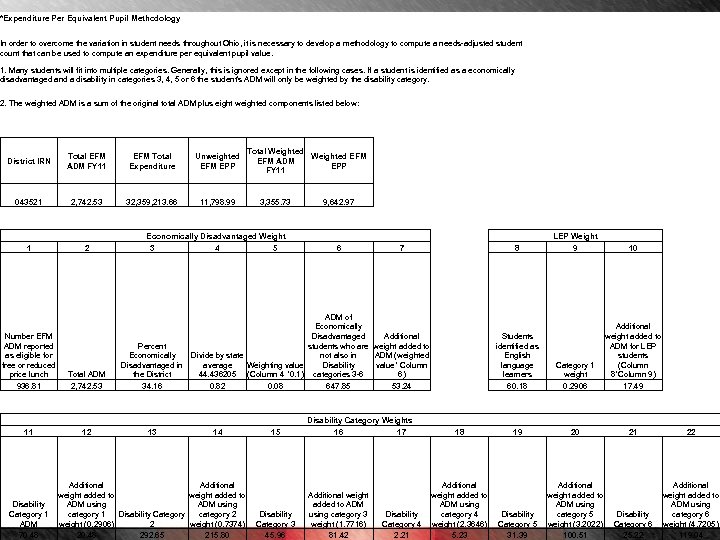
*Expenditure Per Equivalent Pupil Methodology In order to overcome the variation in student needs throughout Ohio, it is necessary to develop a methodology to compute a needs-adjusted student count that can be used to compute an expenditure per equivalent pupil value. 1. Many students will fit into multiple categories. Generally, this is ignored except in the following cases. If a student is identified as a economically disadvantaged and a disability in categories 3, 4, 5 or 6 the student's ADM will only be weighted by the disability category. 2. The weighted ADM is a sum of the original total ADM plus eight weighted components listed below: District IRN Total EFM ADM FY 11 EFM Total Expenditure Unweighted EFM EPP 043521 2, 742. 53 32, 359, 213. 66 11, 798. 99 1 2 Total Weighted EFM ADM EPP FY 11 Number EFM ADM reported as eligible for free or reduced price lunch 936. 81 Total ADM 2, 742. 53 11 12 3, 355. 73 Economically Disadvantaged Weight 3 4 5 9, 642. 97 6 7 8 ADM of Economically Additional Disadvantaged Percent students who are weight added to Economically Divide by state not also in ADM (weighted Disadvantaged in average value* Column Weighting value Disability the District 44. 436205 (Column 4 *0. 1) categories 3 -6 6) 34. 16 0. 82 0. 08 647. 85 53. 24 13 14 Additional weight added to Disability ADM using Category 1 category 1 Disability Category category 2 ADM weight (0. 2906) weight (0. 7374) 2 70. 48 292. 65 215. 80 15 Disability Category 3 45. 96 Disability Category Weights 16 17 Additional weight added to ADM using category 3 weight (1. 7716) 81. 42 Disability Category 4 2. 21 Students identified as English language learners 60. 18 18 19 Additional weight added to ADM using category 4 Disability weight (2. 3646) Category 5 5. 23 31. 39 LEP Weight 9 10 Additional weight added to ADM for LEP students Category 1 (Column weight 8*Column 9) 0. 2906 17. 49 20 21 Additional weight added to ADM using category 5 Disability weight (3. 2022) Category 6 100. 51 25. 22 22 Additional weight added to ADM using category 6 weight (4. 7205) 119. 04
How to Create a District Benchmarking Report • The District Benchmarking Report is an Excel workbook consisting of four worksheets: 1. Report – this worksheet provides the primary benchmarking and comparative data 2. Report_Trend – this worksheet provides two years of trend data for a single district 3. Data Info – this worksheet provides technical details on the data source and calculations used for the benchmarking report 4. Expenditure Equivalent Pupil – this worksheet provides details on the data source and calculations for the expenditure per equivalent pupil benchmark
Average of Local Report Card Similar Districts • Similar districts are a unique group of up to 20 “similar districts” that are most similar according to certain criteria. – District size – Poverty level – Socioeconomic status (median income, education, occupational data) – Factors related to urban or rural location – Overall property wealth
State Results (%) • An average of results for all Ohio traditional public school districts, excluding the island districts and College Corner, that submitted FY 2011 June data or Financial data. Community schools and joint vocational school districts are not included in this average
Understanding the Benchmarks: Academic Performance Measures • Report Card Designation: In August of each year, the district report card is released which provides an overall measure of the districts academic performance • Value Added Composite Score: Value added measures the growth in student learning over the course of a year • For accountability purposes, the state has grouped the results of the value added computation into three classification bands. “Above” means students have mastered more learning in the year set by state-level expectations. “Met” means students have mastered the learning in the year set by state-level expectations. “Below” means students have mastered less learning
Expenditure Per Pupil • ODE uses the Expenditure Flow Model (EFM) to report per-pupil spending for Ohio’s schools • The model uses the districts’ end-of-year financial reports
Expenditure Per Pupil • This number represents the overall expenditure of the district for all district operations and includes instructional programs, staff development (professional development programs), student support services (e. g. health service, guidance services), administration (e. g. central office, principals) and operating expenses (e. g. transportation, maintenance, utilities)
Expenditure Flow Model Average Daily Membership • The average daily membership is an annual measure of the number of students enrolled in the district
% of EFM ADM that are Economically Disadvantaged • A student is considered to be economically disadvantaged if the student is eligible for a free or reduced price lunch (the student’s family income is less than 185% of the federal poverty rate)
% of EFM ADM with a Disability • District’s are required to identify and offer services to any student with a disability to help alleviate any barriers created by the disability
% of EFM ADM that is Limited English Proficient • Students with Limited English Proficiency require additional services in order to develop language skills and complete the educational program
Expenditure per Equivalent Pupil • The expenditure per equivalent pupil provides a comparison that offsets differences caused by characteristics of the students as opposed to the operations of the district
Operational Efficiency Measures
Teacher Costs • Average Teacher Salary: For every staff member listed as a teacher, this is the sum of the annual salaries for all teachers divided by the number of full time equivalent teachers • Average Years of Service: Comparing the average salary between districts; differences in teacher salary may be due to difference in the average length of service • K-12 Pupil Teacher Ratio: This is the ratio of the ADM to the full time equivalent teachers in the district
Administrator Costs • Pupil Administrator Ratio: This is the ratio of ADM to the number of administrators in the district • Bureau of Worker’s Compensation Composite Rate: The composite rate is presented as measure of the comparative cost between districts and is impacted by historical claims and the districts participation in BWC rate reduction programs
Cost of Benefits • Retirement as % of Payroll: School districts contribute a percentage of each covered employees salary into the appropriate public pension plan • Health Care as % of Payroll: The cost of health insurance plans is influenced by the types of insurance offered and program costs • Total Benefits as % of Payroll: School districts contribute a percentage of each covered employees salary into an unemployed insurance fund. In addition, total benefits will include other employer provided benefits such as reimbursement for employee education, uniforms or tools, and employee recognition awards
Building Operations and Maintenance • Square Foot per Pupil: The square foot includes space available in all district buildings, including any buildings used to provide office space for the central administration (superintendent, treasurer, etc. ) or operational support (bus garage, maintenance shop, etc. ) • Cost per sq. ft: The cost per square foot measures the operational costs to operate and maintain the buildings in a district • Utility costs per sq. ft: The utilities cost per square foot measures the cost of providing gas, electricity, water, sewage and other utilities necessary to operate the buildings • Custodial/Maint. Costs per sq. ft: The custodial and maintenance costs per square foot include the cost of staff hired to care and maintain the buildings, garbage removal, and supplies for the upkeep of the buildings
Transportation • Efficiency measure: Number of regular education students that are transported on a school bus • Square Miles in District: The number of square miles within the district’s boundary • % of Nontraditional Riders: School districts are generally required to provide transportation services to students who live in the district but attend chartered non-public (private) schools and community schools • Riders per Square Mile (Density): Rider per square mile is calculated by dividing the district’s actual bus riders by its size in square miles
Food Service • Cost per meal: Dividing the total operating expenses charged to the food service fund by the number of meals served • Food Service Fund Gain/Loss: Difference between the revenue that is deposited into the food service fund and the operating expenses charged to the fund • Average Daily Lunch Participation: Rate is the number of lunches served during the school year divided by the ADM times 180 days which is used to approximate the number of days lunch is served

Questions? ? ?
Скачать презентацию The Five-Year Forecast Where Fiscal Accountability Begins
04aad43ee8d4323d84b79582716f595f.ppt