 Скачать презентацию THE FIRST INTERNATIONAL CONFERENCE ON BUSINESS VALUATION January
2a7a0b3e97b9dbb36e3224ad14de975c.ppt
- Количество слайдов: 23



THE FIRST INTERNATIONAL CONFERENCE ON BUSINESS VALUATION January 24 - 25, 2008, Thailand On issue of real value of business determined by cost approach Yu. V. Kozyr, Russian Society of Appraisers , General Director of Kopart 36 -86, Greena street, Моscow 117628, kozyr@kopart. ru Original article: http: //www. labrate. ru/kozyr/20080124 -25_business_valuation. ppt
Cost Approach: Status Quo • The procedure for business valuation by the cost -based approach includes identification of unaccounted (operating and/or non-operating) assets and revaluation of a company’s all assets at market value, whereby provided that a portion of business held by shareholders is valued, liabilities also revalued at market value (which composition is also added by non-accounted liabilities or encumbrances, if any) are subtracted from the value of assets. Original article: http: //www. labrate. ru/kozyr/20080124 -25_business_valuation. ppt
Principle of replacement • The cost-based approach itself operates the concept of the value and replacement principle: if any item can be created cheaper than the price offered by an owner seller, then it should be done so – to create independently. If costs incurred in independent creation of an item exceed the price offered by a seller of a target item or it is impossible to create the item independently for whatever reasons, it is advisable to buy the item, if required, in the market. Original article: http: //www. labrate. ru/kozyr/20080124 -25_business_valuation. ppt
Main shortcoming of the cost approach • • • Cost approach ignores as minimum one point, and, namely, the cost of lost opportunities. Application of the cost-based approach considers the factor of time at reassessment of assets and liabilities by means of corresponding adjustment of assets and liabilities. Still a potential buyer making decision on the basis of the replacement principle to independently "set up" business will run not only in direct costs due to acquisition of assets at the market value, but into imputed costs – for the time of independent "creation" of business an investor will lose profit which he could have earned if he had bought the already operating business. Besides, it is also necessary to take into account specific risks inherent in new companies upon entering the market: buying an operating business an investor-buyer gets rid of risks associated with the inception stage. In other words, costs of start up overcome difficulties is kind of intangible assets Original article: http: //www. labrate. ru/kozyr/20080124 -25_business_valuation. ppt
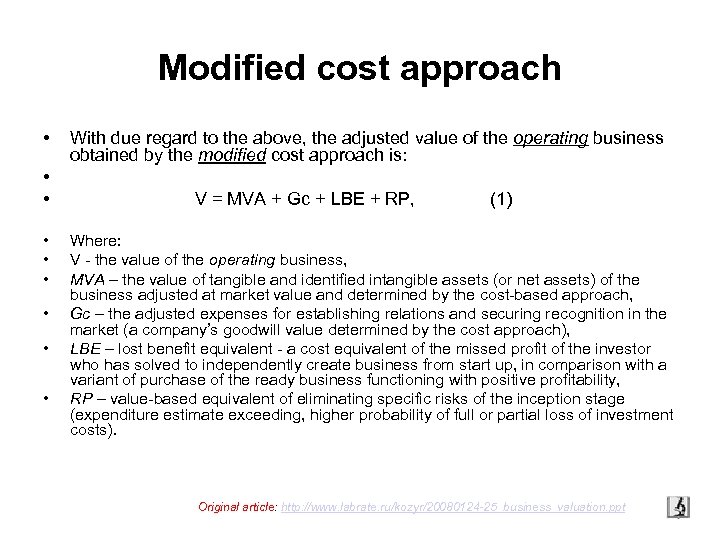
Modified cost approach • • • With due regard to the above, the adjusted value of the operating business obtained by the modified cost approach is: V = MVA + Gc + LBE + RP, (1) Where: V - the value of the operating business, MVA – the value of tangible and identified intangible assets (or net assets) of the business adjusted at market value and determined by the cost-based approach, Gc – the adjusted expenses for establishing relations and securing recognition in the market (a company’s goodwill value determined by the cost approach), LBE – lost benefit equivalent - a cost equivalent of the missed profit of the investor who has solved to independently create business from start up, in comparison with a variant of purchase of the ready business functioning with positive profitability, RP – value-based equivalent of eliminating specific risks of the inception stage (expenditure estimate exceeding, higher probability of full or partial loss of investment costs). Original article: http: //www. labrate. ru/kozyr/20080124 -25_business_valuation. ppt
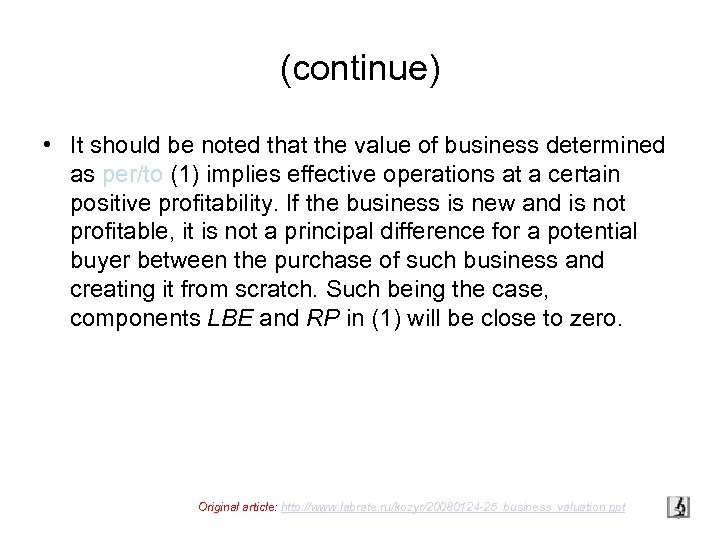
(continue) • It should be noted that the value of business determined as per/to (1) implies effective operations at a certain positive profitability. If the business is new and is not profitable, it is not a principal difference for a potential buyer between the purchase of such business and creating it from scratch. Such being the case, components LBE and RP in (1) will be close to zero. Original article: http: //www. labrate. ru/kozyr/20080124 -25_business_valuation. ppt
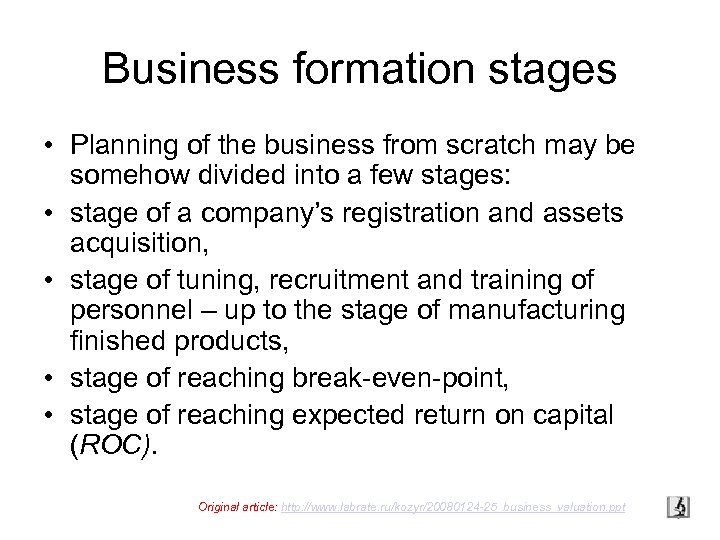
Business formation stages • Planning of the business from scratch may be somehow divided into a few stages: • stage of a company’s registration and assets acquisition, • stage of tuning, recruitment and training of personnel – up to the stage of manufacturing finished products, • stage of reaching break-even-point, • stage of reaching expected return on capital (RОС). Original article: http: //www. labrate. ru/kozyr/20080124 -25_business_valuation. ppt
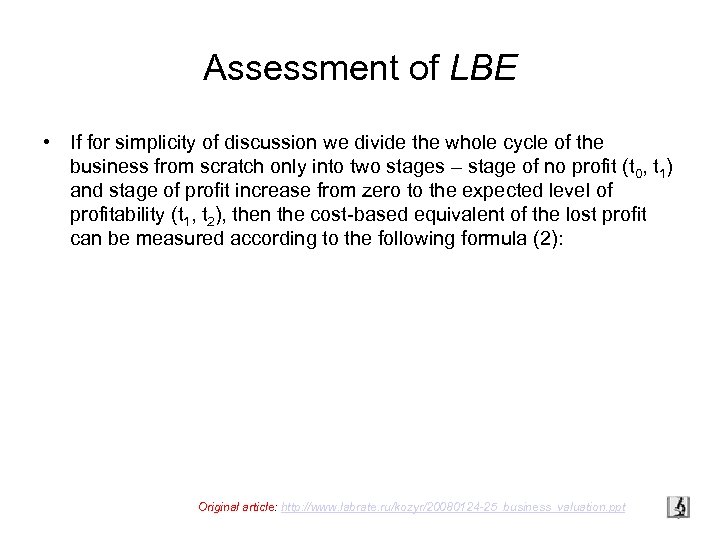
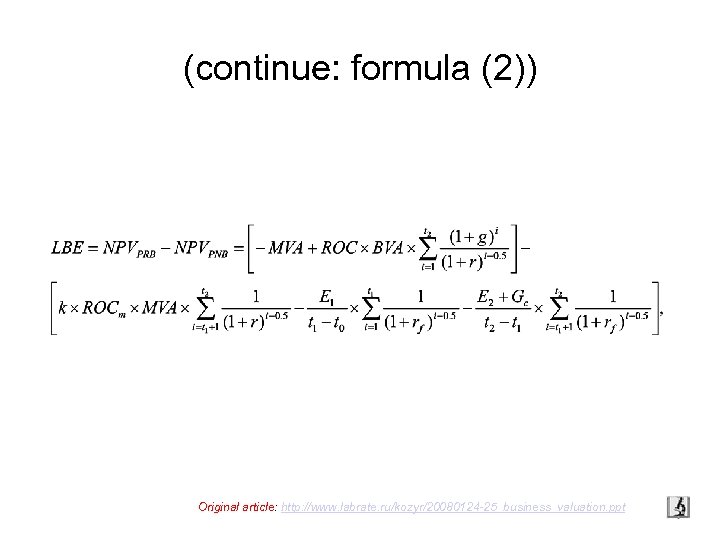
Assessment of LBE • If for simplicity of discussion we divide the whole cycle of the business from scratch only into two stages – stage of no profit (t 0, t 1) and stage of profit increase from zero to the expected level of profitability (t 1, t 2), then the cost-based equivalent of the lost profit can be measured according to the following formula (2): Original article: http: //www. labrate. ru/kozyr/20080124 -25_business_valuation. ppt
(continue: formula (2)) Original article: http: //www. labrate. ru/kozyr/20080124 -25_business_valuation. ppt
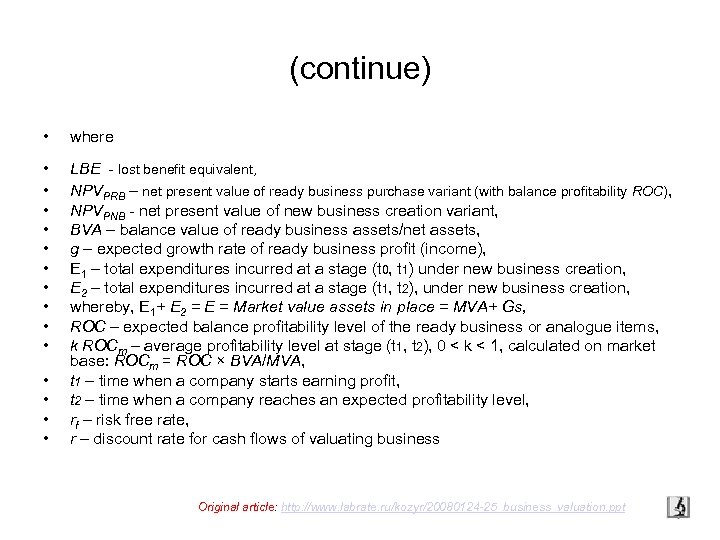
(continue) • where • • • LBE - lost benefit equivalent, NPVPRB – net present value of ready business purchase variant (with balance profitability ROC), NPVPNB - net present value of new business creation variant, BVA – balance value of ready business assets/net assets, g – expected growth rate of ready business profit (income), E 1 – total expenditures incurred at a stage (t 0, t 1) under new business creation, E 2 – total expenditures incurred at a stage (t 1, t 2), under new business creation, whereby, E 1+ E 2 = E = Market value assets in place = MVA+ Gs, RОС – expected balance profitability level of the ready business or analogue items, k RОСm – average profitability level at stage (t 1, t 2), 0 < k < 1, calculated on market base: ROCm = ROC × BVA/MVA, t 1 – time when a company starts earning profit, t 2 – time when a company reaches an expected profitability level, rf – risk free rate, r – discount rate for cash flows of valuating business • • Original article: http: //www. labrate. ru/kozyr/20080124 -25_business_valuation. ppt
Example of LBE calculation
Assessment of RP • The component RP in formula (1) from the point of the cost-based approach means an opportunity of additional contingent costs typical for inception stage (including additional costs LBE, arising from certain delayed sub-stages of business at the inception stage). In the author’s opinion, RP may be valued by two methods: • First, it is possible to be guided by the cost-based equivalent of the premium on investment risk to small business companies in view of the fact that newly established companies are usually small ones. • Second, it is possible to measure difference in the statistics of companies’ bankruptcies at the inception stage (start-up) and companies with an average market statistical lifetime from the inception point to the time being. Having obtained a difference in probabilities of bankruptcies, it should be transformed to relative risk markup (additional risk markup reflecting only specific risks of a new to be company) and then transform it to absolute (cost-based) expression. Original article: http: //www. labrate. ru/kozyr/20080124 -25_business_valuation. ppt
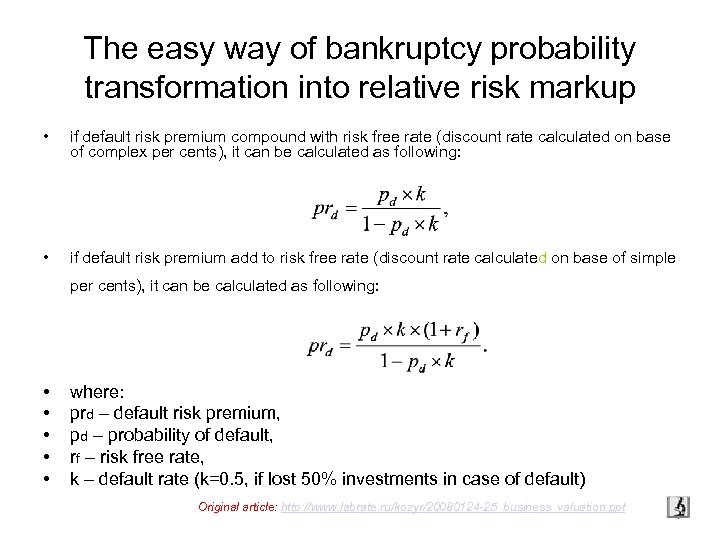
The easy way of bankruptcy probability transformation into relative risk markup • if default risk premium compound with risk free rate (discount rate calculated on base of complex per cents), it can be calculated as following: • if default risk premium add to risk free rate (discount rate calculated on base of simple per cents), it can be calculated as following: • • • where: prd – default risk premium, pd – probability of default, rf – risk free rate, k – default rate (k=0. 5, if lost 50% investments in case of default) Original article: http: //www. labrate. ru/kozyr/20080124 -25_business_valuation. ppt
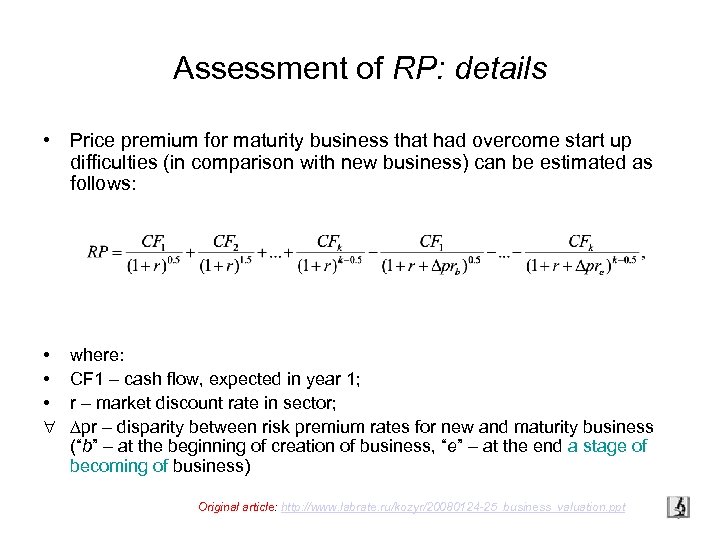
Assessment of RP: details • Price premium for maturity business that had overcome start up difficulties (in comparison with new business) can be estimated as follows: • • • where: CF 1 – cash flow, expected in year 1; r – market discount rate in sector; pr – disparity between risk premium rates for new and maturity business (“b” – at the beginning of creation of business, “e” – at the end a stage of becoming of business) Original article: http: //www. labrate. ru/kozyr/20080124 -25_business_valuation. ppt
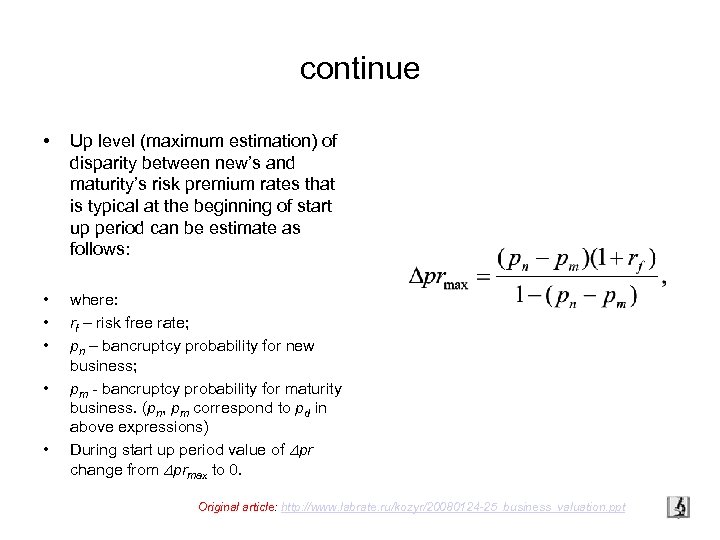
continue • Up level (maximum estimation) of disparity between new’s and maturity’s risk premium rates that is typical at the beginning of start up period can be estimate as follows: • • • where: rf – risk free rate; pn – bancruptcy probability for new business; pm - bancruptcy probability for maturity business. (pn, pm correspond to pd in above expressions) During start up period value of pr change from prmax to 0. • • Original article: http: //www. labrate. ru/kozyr/20080124 -25_business_valuation. ppt
Example of RP valuation Original article: http: //www. labrate. ru/kozyr/20080124 -25_business_valuation. ppt
Valuation of Gs (cost approach) • Usually, goodwill includes value obtained as difference between the results of the income-based and comparative approaches, on the one hand, and the result of the cost approach, on the other hand. • Yet such valuation does not make any sense of the use of the result of the cost-based approach, since its result in consideration of the goodwill valued in such way will virtually always match results of the other approaches. • Hence, it seems reasonable under the cost-based approach to measure goodwill value by purely cost approach, irrespective of other approaches. Original article: http: //www. labrate. ru/kozyr/20080124 -25_business_valuation. ppt
Valuation of Gs (promotional expenses) (cost approach: continue 1) • Intеrviewing of marketing and PR specialists may be one of such methods. • Some highly professional specialists can make an expert opinion about how much time and financing will be necessary for a company “from scratch” to establish relations with a certain number of business counterparties (of the company concerned) and effective recognition in the market, in general, and among the target audience, in particular, as well as to develop indepth knowledge of its products and customers in the market. Original article: http: //www. labrate. ru/kozyr/20080124 -25_business_valuation. ppt
Valuation of Gs (promotional expenses) (cost approach: continue 2) • If such costs differ much in time and there is a strong inflation in the region, the goodwill forming costs should be transformed to present value. • At the same time, since not all similar investments turn out to be effective and, besides, such investments are exposed to strong impairment due to impact of masking effects and “a consumer’s short-term memory”, those investments should be also amortized. • Adjustments of investments to goodwill – indexation and amortization – partially neutralize each other, but still, as a rule, (in the absence of hyperinflation) amortization effect considerably exceeds inflation impact. • • • The total of aggregate adjusted costs incurred in creating effective recognition, relations and reputation attributable to the company concerned should be interpreted as measurement of goodwill value[1] determined by the cost-based approach. [1] If somebody does not like such interpretation of the term goodwill which certainly does not match its interpretation according to IAS, the alternative term “promotional costs” may be used. Original article: http: //www. labrate. ru/kozyr/20080124 -25_business_valuation. ppt
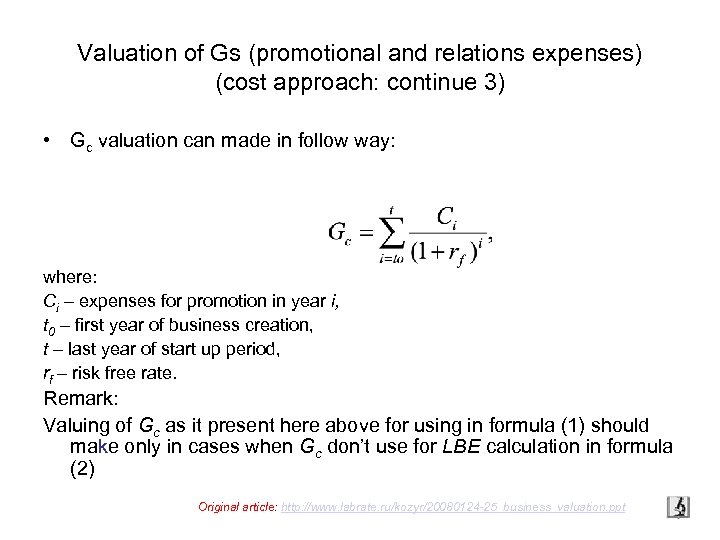
Valuation of Gs (promotional and relations expenses) (cost approach: continue 3) • Gc valuation can made in follow way: where: Ci – expenses for promotion in year i, t 0 – first year of business creation, t – last year of start up period, rf – risk free rate. Remark: Valuing of Gс as it present here above for using in formula (1) should make only in cases when Gс don’t use for LBE calculation in formula (2) Original article: http: //www. labrate. ru/kozyr/20080124 -25_business_valuation. ppt
Example of evaluation based on Modified cost approach Original article: http: //www. labrate. ru/kozyr/20080124 -25_business_valuation. ppt
Remarks • The above modified cost-based approach (as we call it) is similar to the structure of Edwards-Bell-Olson (EBO) and Economic Value Added (EVA) models: • in both there are two components – capital/invested capital component and income component. • However, unlike EBO and EVA, Modified cost approach limits income aggregation by the interval (t 0, t 2), which, given positive capital profitability, gives rise to lower business value as compared with the results of valuation with the help of the EBO/ EVA model, but higher as compared with the use of traditional cost-based approach. Short income aggregation period make cash flow forecast more simple procedure. Original article: http: //www. labrate. ru/kozyr/20080124 -25_business_valuation. ppt
Final Summary • On a final note, I would like to sum up the principal point covered during this presentation: • First of all, traditional cost approach (especially NAV method) usually underestimate value of business because it doesn’t take into account “dynamic” characteristics of business such as LBE, Gs and RP. It’s impossible apply principle of replacement without these characteristics: modified cost-based approach take into consideration these characteristics; • Secondly, short income aggregation period applied in this method make cash flow forecast more simple; • Finally, having done this, application of the modified cost-based approach reduces the gap between the results of the valuation by the use of cost and income-based approaches and, hence, improves adequacy of the total valuation of the business. Original article: http: //www. labrate. ru/kozyr/20080124 -25_business_valuation. ppt
Скачать презентацию THE FIRST INTERNATIONAL CONFERENCE ON BUSINESS VALUATION January
2a7a0b3e97b9dbb36e3224ad14de975c.ppt