 Скачать презентацию The First Branch of Government The United States
5bbea4e2fb729985d3f3d5caa98ddd98.ppt
- Количество слайдов: 27



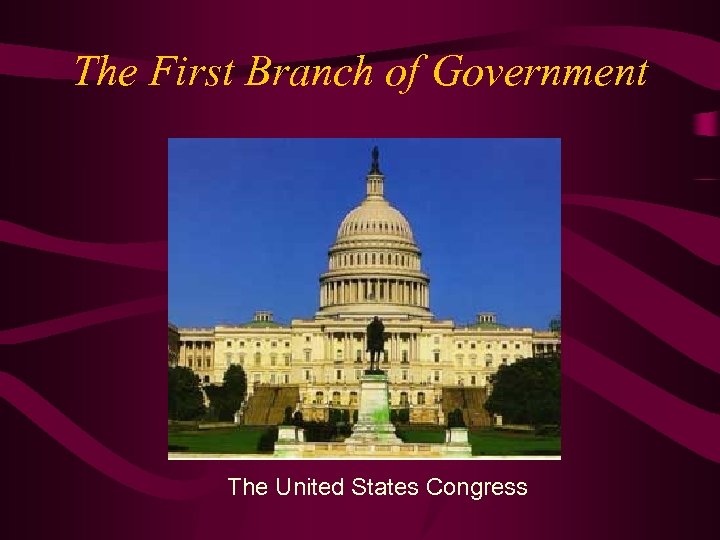
The First Branch of Government The United States Congress
3 types of behavior • Advertising – Nobody’s senator but yours • Credit claiming – Has to be credible – Pork barreling; casework • Position taking – Inherently costly • http: //www. house. gov
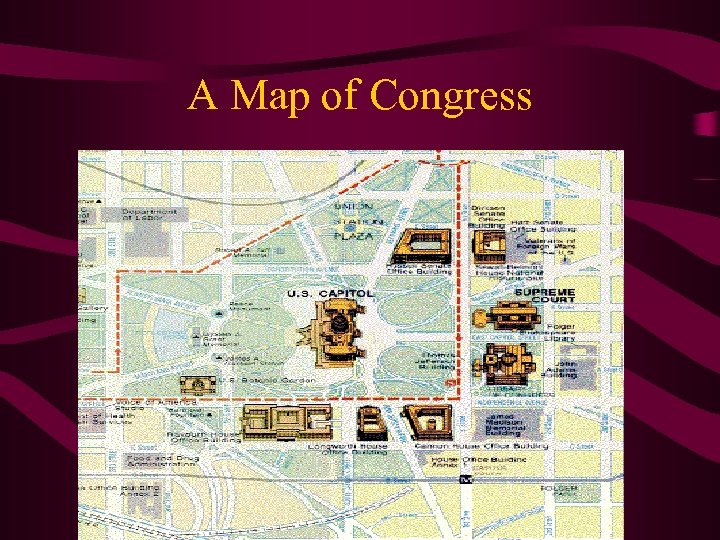
A Map of Congress
Congress is bicameral • Bicameral (House and Senate) – different time perspectives – different rules and norms
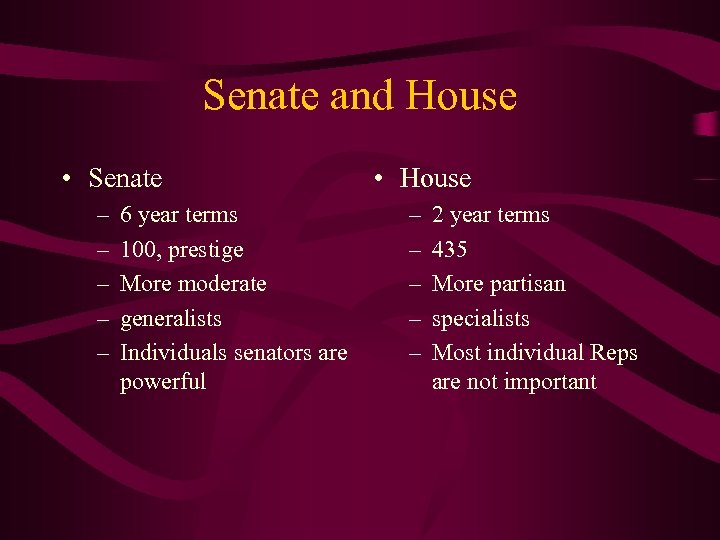
Senate and House • Senate – – – 6 year terms 100, prestige More moderate generalists Individuals senators are powerful • House – – – 2 year terms 435 More partisan specialists Most individual Reps are not important
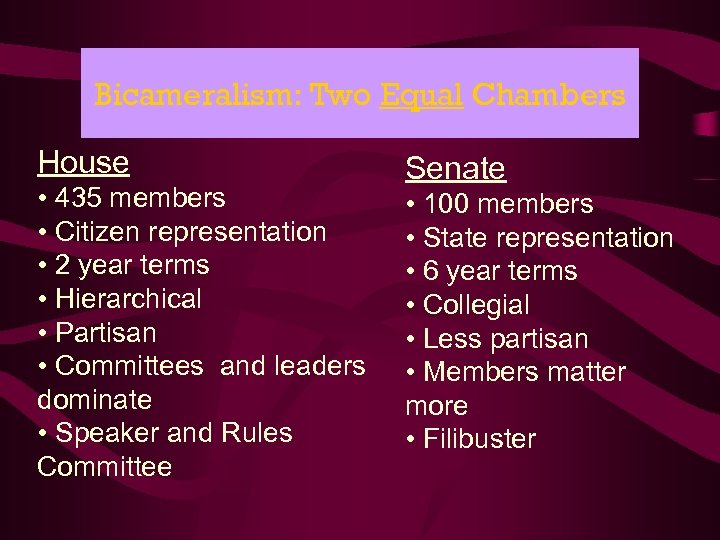
Bicameralism: Two Equal Chambers House • 435 members • Citizen representation • 2 year terms • Hierarchical • Partisan • Committees and leaders dominate • Speaker and Rules Committee Senate • 100 members • State representation • 6 year terms • Collegial • Less partisan • Members matter more • Filibuster
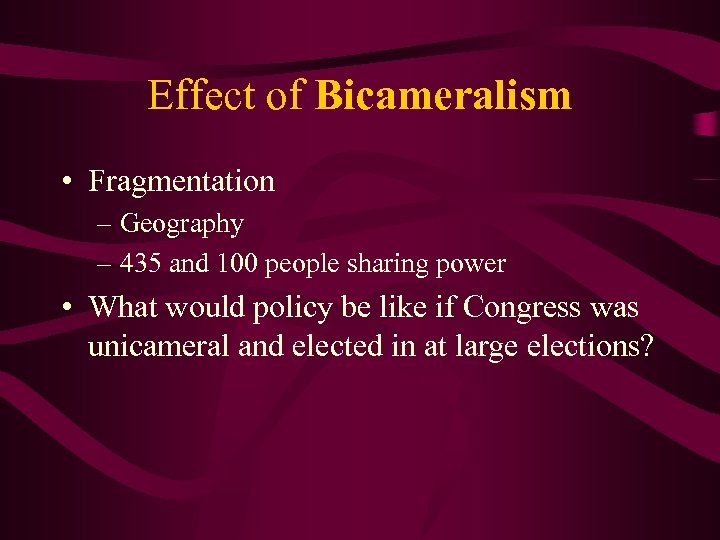
Effect of Bicameralism • Fragmentation – Geography – 435 and 100 people sharing power • What would policy be like if Congress was unicameral and elected in at large elections?
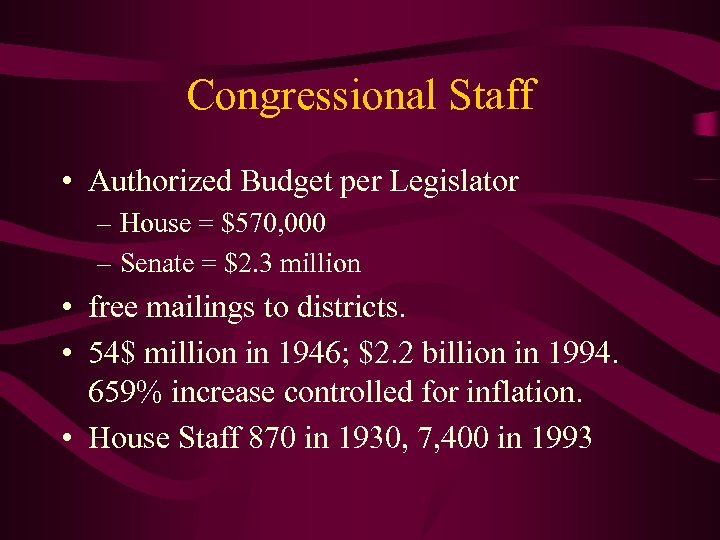
Congressional Staff • Authorized Budget per Legislator – House = $570, 000 – Senate = $2. 3 million • free mailings to districts. • 54$ million in 1946; $2. 2 billion in 1994. 659% increase controlled for inflation. • House Staff 870 in 1930, 7, 400 in 1993
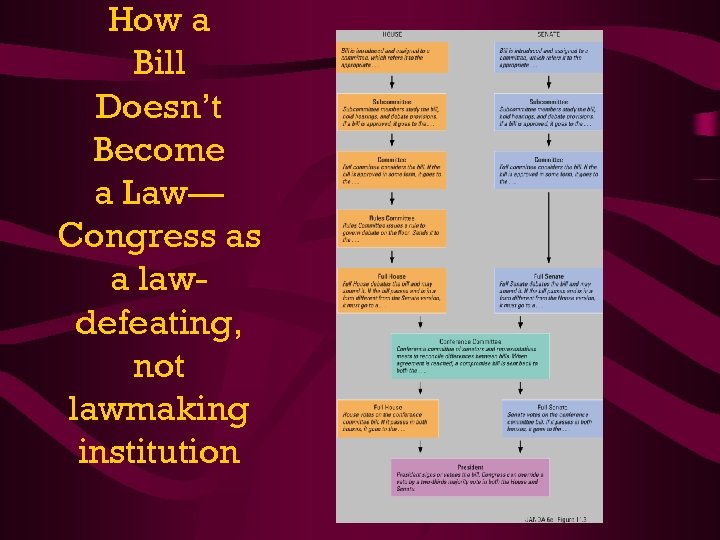
How a Bill Doesn’t Become a Law— Congress as a lawdefeating, not lawmaking institution
What does Congress do?
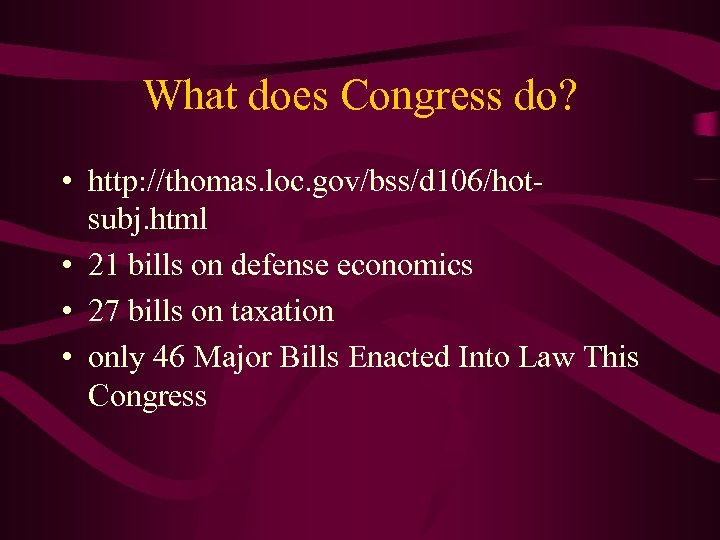
What does Congress do? • http: //thomas. loc. gov/bss/d 106/hotsubj. html • 21 bills on defense economics • 27 bills on taxation • only 46 Major Bills Enacted Into Law This Congress
Congressional Committees • W. Wilson, Congress in Committees is Congress at work • What do Committees do – Hold hearings – Write legislation – Exercise oversight
Committees • International Relations Committee • Agriculture Committee
Features of Committees • • • 19 committees, 84 subcommittees Division of labor Fixed membership Fixed jurisdiction, like a monopoly Manage flow of legislative business Importance of seniority
Committee Membership • Determined by Political Parties • Guided by members’ seniority and preference • Preferences based on constituency needs to better chances of reelection
Policy Consequences of Committees • PROs – more opportunities for credit claiming – Facilitate specialization serve institutional policy needs • Cons – reinforces fragmentation – Encourages log-rolling
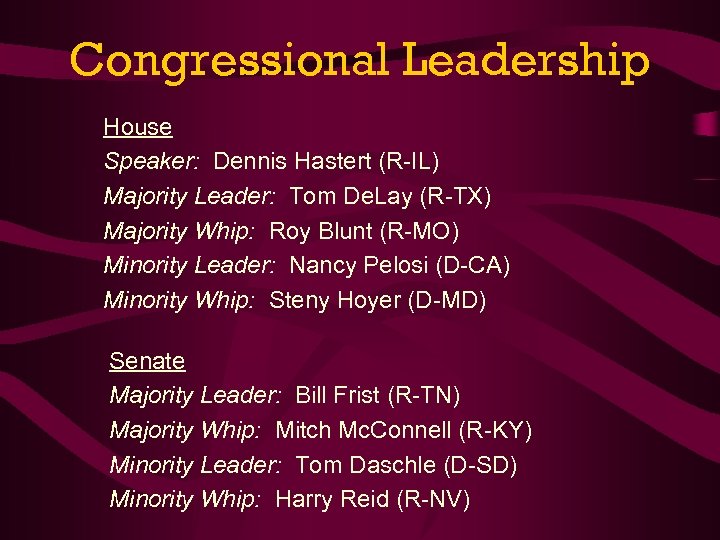
Congressional Leadership House Speaker: Dennis Hastert (R-IL) Majority Leader: Tom De. Lay (R-TX) Majority Whip: Roy Blunt (R-MO) Minority Leader: Nancy Pelosi (D-CA) Minority Whip: Steny Hoyer (D-MD) Senate Majority Leader: Bill Frist (R-TN) Majority Whip: Mitch Mc. Connell (R-KY) Minority Leader: Tom Daschle (D-SD) Minority Whip: Harry Reid (R-NV)
Leadership and Parties Party caucuses – Elect leaders and committee chairs – structure the workings of Congress – Develop common policy positions – Weaker in senate than House
Leadership powers • Control committee appointments • Refer bills to committees • Control Rules Committee
Party Discipline and Voting • US Congress – rose to near 70% in 1996 • UK Parliament --90% • German Bundestag -- 98%
Institutional Design of Congress • Institutions are designed by members who want to get reelected. • Staff • Committees • Leadership/political parties
Evaluating Leadership • More useful for what they are not than what they are – 1994 Freedom to Farm Act • No Sanctions • Do not do anything to undermine the electoral needs of members
Informal Norms • • Seniority and seniority system Specialization institutional loyalty reciprocity (log rolling)
Criticisms of Congress • Process – Lengthy and inefficient – Favor policy minorities • Results – Members focus on getting constituency benefits, NAFTA – Process of bad legislation- ESEA, EDA
Why do we hate congress, but love our senator/representative • Evaluate Congress by collective standards • Evaluate Senator/Representative in representative term • Standards are mutually exclusive
Representation vs. Lawmaking • Congress plays two important roles – Lawmaking or getting things done – Representation or Legitimacy- airing points of view
Impact on Institutions • Congress is a reelection machine. • Mayhew-- "If a group of planner sat down and tried to design a pair of American national assemblies with the goal of serving members' electoral needs year in and year out, they would be hard pressed to improve on what exists. "
Скачать презентацию The First Branch of Government The United States
5bbea4e2fb729985d3f3d5caa98ddd98.ppt