


 Скачать презентацию The Firm Profit and the Costs of Production
The Firm, Profit and the Costs of.pptx
- Количество слайдов: 11
 The Firm, Profit and the Costs of Production Calculating COSTS, REVENUE and PROFIT
 BROAD OBJECTIVES: 1) Explore the term “PROFIT” 2) Differentiate between the types of profit 3) Draw up a basic formula for profit & use to calculate profit 4) Critically evaluate the implication of profit LEARNING OUTCOMES
 PROFIT • Is Surplus Value • It drives efficiency • Is often the primary goal of business • Is basis on which tax n dividend is determined • Often measures the success (or failure) of a firm • Is the positive difference between revenue and costs PROFIT DESCRIPTION
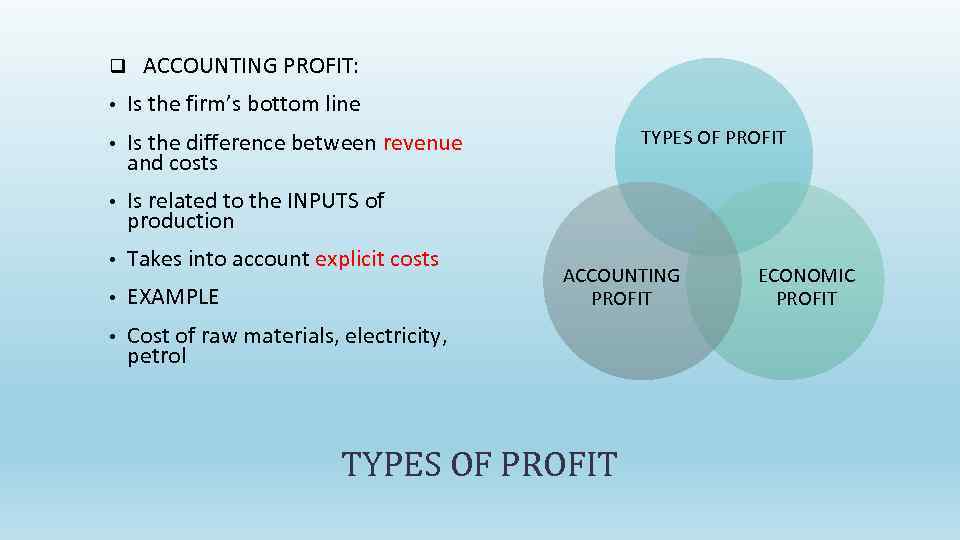 q ACCOUNTING PROFIT: • Is the firm’s bottom line • Is the difference between revenue and costs • Is related to the INPUTS of production • Takes into account explicit costs • EXAMPLE • Cost of raw materials, electricity, petrol TYPES OF PROFIT ACCOUNTING PROFIT TYPES OF PROFIT ECONOMIC PROFIT
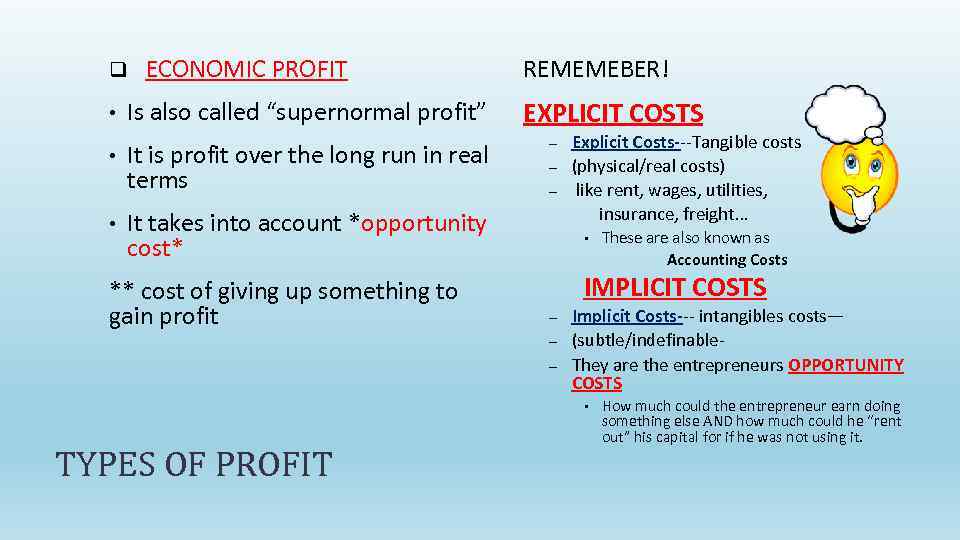 q • ECONOMIC PROFIT Is also called “supernormal profit” • It is profit over the long run in real terms • It takes into account *opportunity cost* ** cost of giving up something to gain profit REMEMEBER! EXPLICIT COSTS Explicit Costs---Tangible costs – (physical/real costs) – like rent, wages, utilities, insurance, freight… – • IMPLICIT COSTS Implicit Costs--- intangibles costs— – (subtle/indefinable– They are the entrepreneurs OPPORTUNITY COSTS – • TYPES OF PROFIT These are also known as Accounting Costs How much could the entrepreneur earn doing something else AND how much could he “rent out” his capital for if he was not using it.
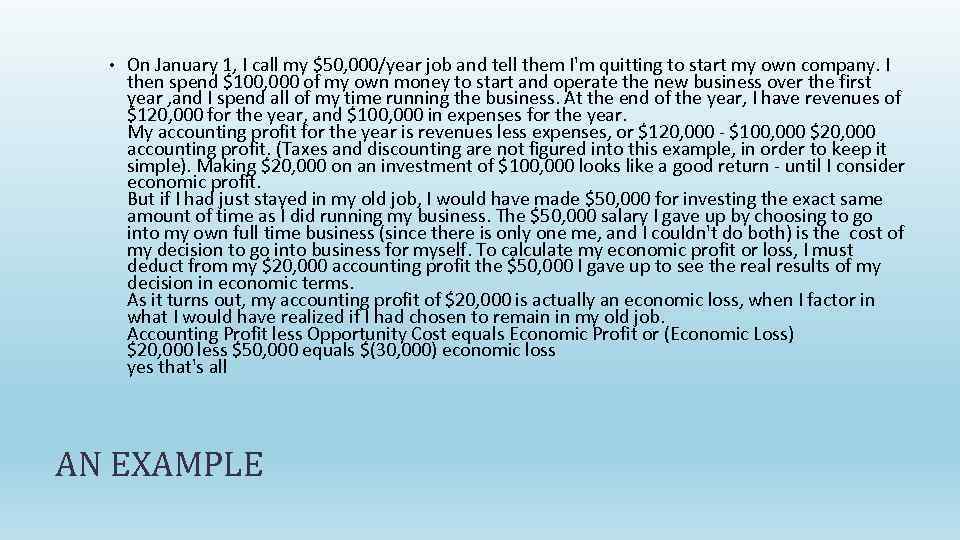 • On January 1, I call my $50, 000/year job and tell them I'm quitting to start my own company. I then spend $100, 000 of my own money to start and operate the new business over the first year , and I spend all of my time running the business. At the end of the year, I have revenues of $120, 000 for the year, and $100, 000 in expenses for the year. My accounting profit for the year is revenues less expenses, or $120, 000 - $100, 000 $20, 000 accounting profit. (Taxes and discounting are not figured into this example, in order to keep it simple). Making $20, 000 on an investment of $100, 000 looks like a good return - until I consider economic profit. But if I had just stayed in my old job, I would have made $50, 000 for investing the exact same amount of time as I did running my business. The $50, 000 salary I gave up by choosing to go into my own full time business (since there is only one me, and I couldn't do both) is the cost of my decision to go into business for myself. To calculate my economic profit or loss, I must deduct from my $20, 000 accounting profit the $50, 000 I gave up to see the real results of my decision in economic terms. As it turns out, my accounting profit of $20, 000 is actually an economic loss, when I factor in what I would have realized if I had chosen to remain in my old job. Accounting Profit less Opportunity Cost equals Economic Profit or (Economic Loss) $20, 000 less $50, 000 equals $(30, 000) economic loss yes that's all AN EXAMPLE
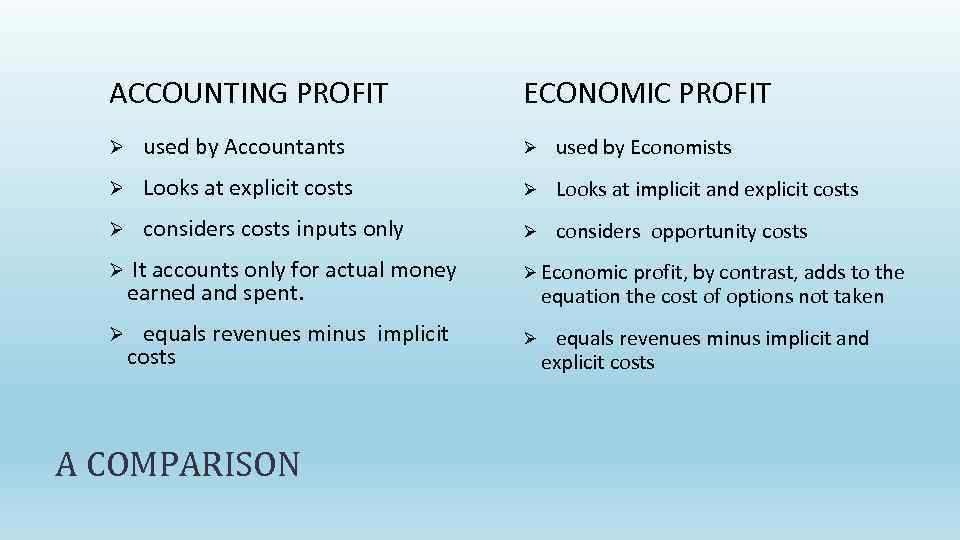 ACCOUNTING PROFIT ECONOMIC PROFIT Ø used by Accountants Ø used by Economists Ø Looks at explicit costs Ø Looks at implicit and explicit costs Ø considers costs inputs only Ø considers opportunity costs Ø Ø It accounts only for actual money earned and spent. Ø Economic profit, by contrast, adds to the equals revenues minus implicit costs Ø A COMPARISON equation the cost of options not taken equals revenues minus implicit and explicit costs
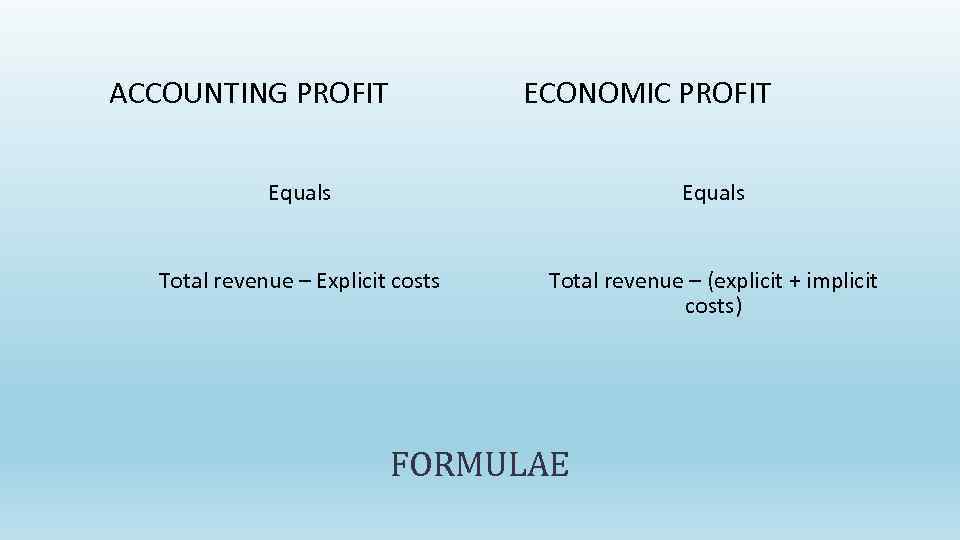 ACCOUNTING PROFIT ECONOMIC PROFIT Equals Total revenue – Explicit costs Total revenue – (explicit + implicit costs) FORMULAE
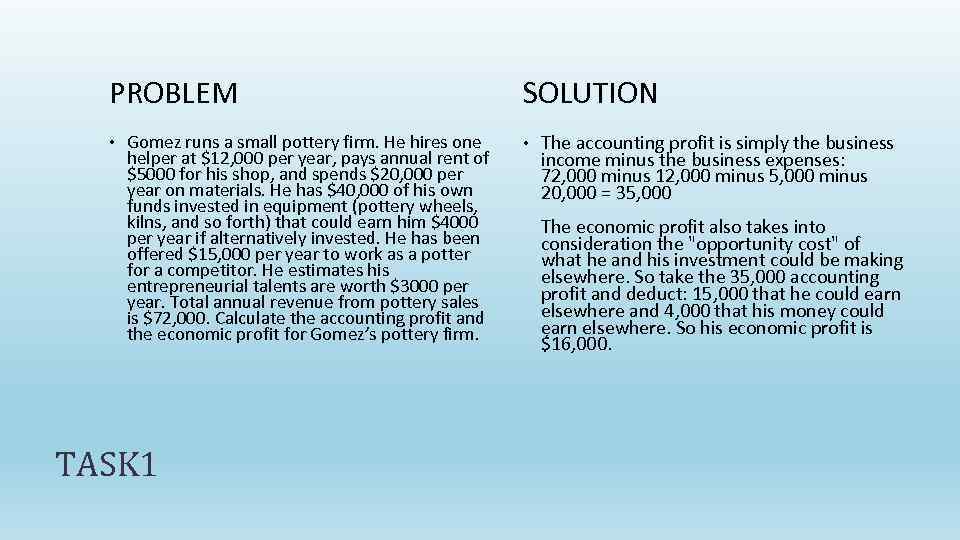 PROBLEM • Gomez runs a small pottery firm. He hires one helper at $12, 000 per year, pays annual rent of $5000 for his shop, and spends $20, 000 per year on materials. He has $40, 000 of his own funds invested in equipment (pottery wheels, kilns, and so forth) that could earn him $4000 per year if alternatively invested. He has been offered $15, 000 per year to work as a potter for a competitor. He estimates his entrepreneurial talents are worth $3000 per year. Total annual revenue from pottery sales is $72, 000. Calculate the accounting profit and the economic profit for Gomez’s pottery firm. TASK 1 SOLUTION • The accounting profit is simply the business income minus the business expenses: 72, 000 minus 12, 000 minus 5, 000 minus 20, 000 = 35, 000 The economic profit also takes into consideration the "opportunity cost" of what he and his investment could be making elsewhere. So take the 35, 000 accounting profit and deduct: 15, 000 that he could earn elsewhere and 4, 000 that his money could earn elsewhere. So his economic profit is $16, 000.
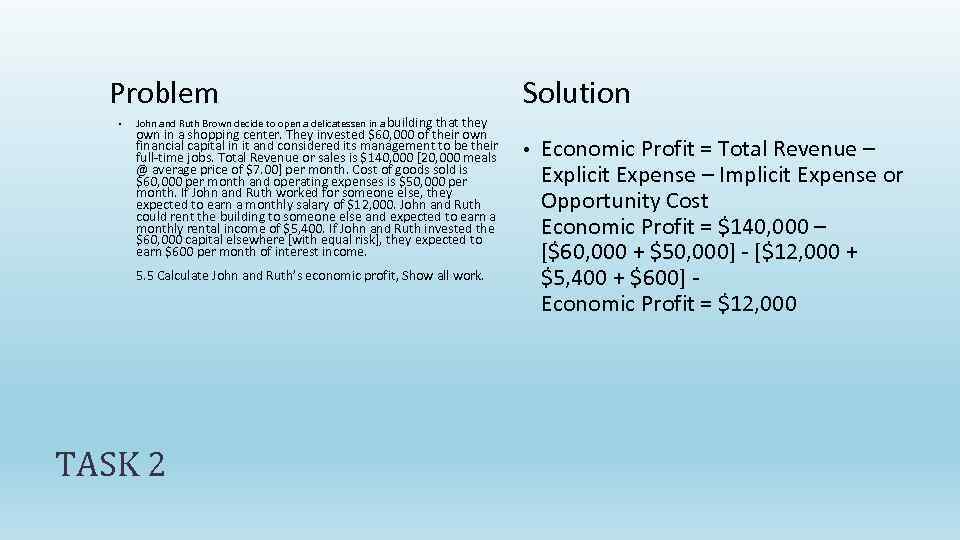 Problem • Solution John and Ruth Brown decide to open a delicatessen in a building that they own in a shopping center. They invested $60, 000 of their own financial capital in it and considered its management to be their full-time jobs. Total Revenue or sales is $140, 000 [20, 000 meals @ average price of $7. 00] per month. Cost of goods sold is $60, 000 per month and operating expenses is $50, 000 per month. If John and Ruth worked for someone else, they expected to earn a monthly salary of $12, 000. John and Ruth could rent the building to someone else and expected to earn a monthly rental income of $5, 400. If John and Ruth invested the $60, 000 capital elsewhere [with equal risk], they expected to earn $600 per month of interest income. 5. 5 Calculate John and Ruth’s economic profit, Show all work. TASK 2 • Economic Profit = Total Revenue – Explicit Expense – Implicit Expense or Opportunity Cost Economic Profit = $140, 000 – [$60, 000 + $50, 000] - [$12, 000 + $5, 400 + $600] Economic Profit = $12, 000
 PROBLEM TASK 3 SOLUTION