


 Скачать презентацию The Finland Success Story Great Schools Patrick F
2c4e44e6d3cee23659f1059bed982eca.ppt
- Количество слайдов: 19
 The Finland Success Story: Great Schools Patrick F. Bassett, NAIS President bassett@nais. org www. nais. org
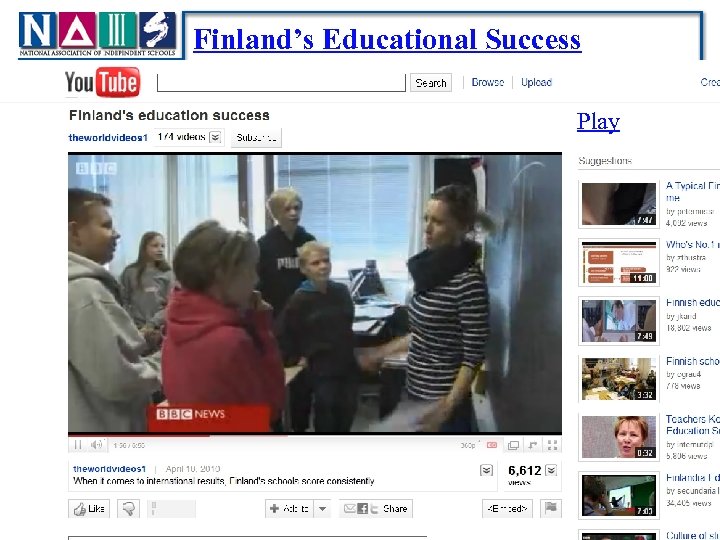 Finland’s Educational Success Play
 Finland’s Success Model Sources: The Economist, July 18, 2007 “How To Be Top” (based on the Mc. Kinsey Report) & October 30, 2007 Microsoft School of the Future Summit presentation by Finnish officials, Helsinki, Finland & PFB school visit) § PFB’s Visit Observations: Unique Factors in Play in Finland. – Finland is a small, homogenous country of five million, with a common value of valuing education. – Literacy and fluency are a national priority, contributing to good results in literacy examinations. – Children see adults reading all the time, since Finns check out on average 18 books per year. (It’s minus forty degrees for long spells in the winter, so indoor activities like reading are popular. ) – The Finns by policy are committed to fluency in foreign language, as there are two national languages, Finnish and Swedish, taught throughout school. – Everyone I met also spoke English, in part because Finnish TV uses no dubbing—only subtitles, so children hear English all the time.
 Finland’s Success Model Sources: The Economist, July 18, 2007 “How To Be Top” (based on the Mc. Kinsey Report) & October 30, 2007 Microsoft School of the Future Summit presentation by Finnish officials, Helsinki, Finland & PFB school visit) § PFB’s Visit Observations: Unique Factors in Play in Finland. – Children feel safe and supported in Finnish schools: the environment is colorful, filled with light and the children have a single teacher in multi-age learning groups “where differences are taken for granted, ” and no grading is used in assessments. – Few textbooks are used, the Finns preferring project- and problembased approaches integrated with learning in the larger community, and tempered with lots of practical education elements, and daily chores at the school. – ICT (Information and Communication Technology) is integrated at all levels, including media literacy. – The Finns are naturalists and the eco-system important to them, so field trips focus on nature & produce a country of environmentalists. – Play is important. There is universal support for high-quality preschools which most students attend, but whose emphasis is play, not early-prep. In schools, 30 -minute recess for unstructured play every day, including all winter long. – After school, students walk to nearby recreation centers for more sports and play.
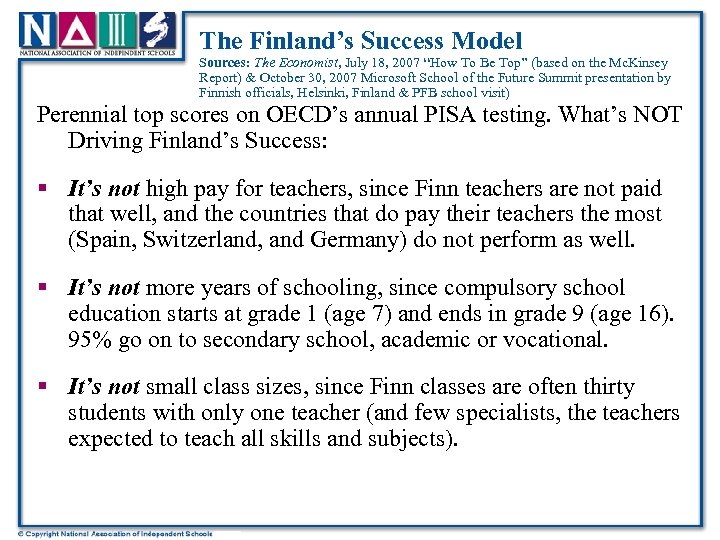 The Finland’s Success Model Sources: The Economist, July 18, 2007 “How To Be Top” (based on the Mc. Kinsey Report) & October 30, 2007 Microsoft School of the Future Summit presentation by Finnish officials, Helsinki, Finland & PFB school visit) Perennial top scores on OECD’s annual PISA testing. What’s NOT Driving Finland’s Success: § It’s not high pay for teachers, since Finn teachers are not paid that well, and the countries that do pay their teachers the most (Spain, Switzerland, and Germany) do not perform as well. § It’s not more years of schooling, since compulsory school education starts at grade 1 (age 7) and ends in grade 9 (age 16). 95% go on to secondary school, academic or vocational. § It’s not small class sizes, since Finn classes are often thirty students with only one teacher (and few specialists, the teachers expected to teach all skills and subjects).
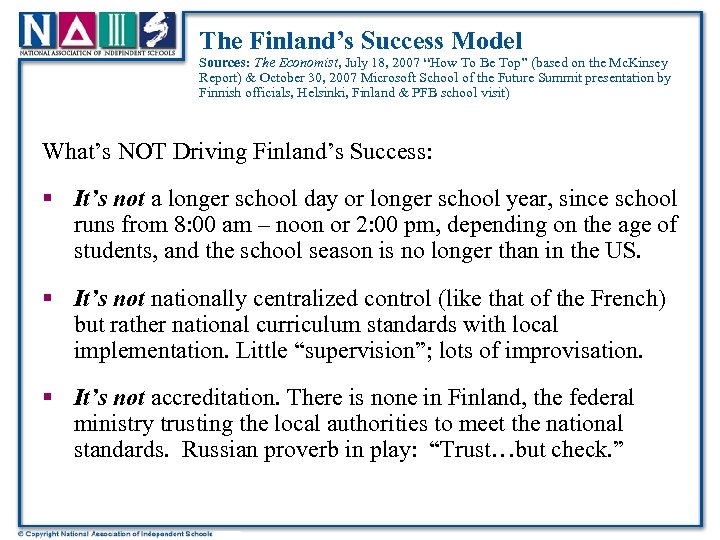 The Finland’s Success Model Sources: The Economist, July 18, 2007 “How To Be Top” (based on the Mc. Kinsey Report) & October 30, 2007 Microsoft School of the Future Summit presentation by Finnish officials, Helsinki, Finland & PFB school visit) What’s NOT Driving Finland’s Success: § It’s not a longer school day or longer school year, since school runs from 8: 00 am – noon or 2: 00 pm, depending on the age of students, and the school season is no longer than in the US. § It’s not nationally centralized control (like that of the French) but rather national curriculum standards with local implementation. Little “supervision”; lots of improvisation. § It’s not accreditation. There is none in Finland, the federal ministry trusting the local authorities to meet the national standards. Russian proverb in play: “Trust…but check. ”
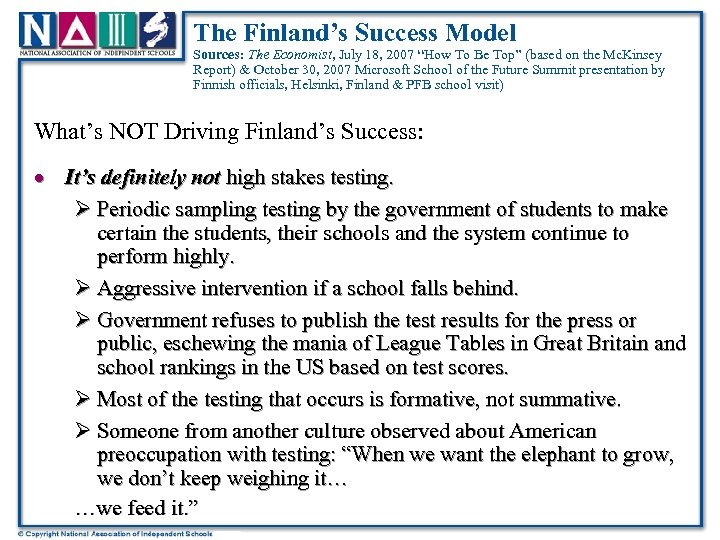 The Finland’s Success Model Sources: The Economist, July 18, 2007 “How To Be Top” (based on the Mc. Kinsey Report) & October 30, 2007 Microsoft School of the Future Summit presentation by Finnish officials, Helsinki, Finland & PFB school visit) What’s NOT Driving Finland’s Success: It’s definitely not high stakes testing. Ø Periodic sampling testing by the government of students to make certain the students, their schools and the system continue to perform highly. Ø Aggressive intervention if a school falls behind. Ø Government refuses to publish the test results for the press or public, eschewing the mania of League Tables in Great Britain and school rankings in the US based on test scores. Ø Most of the testing that occurs is formative, not summative. Ø Someone from another culture observed about American preoccupation with testing: “When we want the elephant to grow, we don’t keep weighing it… …we feed it. ”
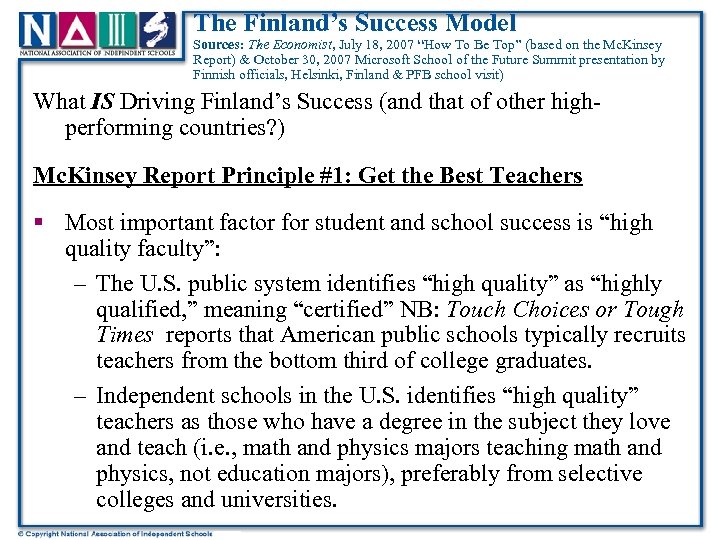 The Finland’s Success Model Sources: The Economist, July 18, 2007 “How To Be Top” (based on the Mc. Kinsey Report) & October 30, 2007 Microsoft School of the Future Summit presentation by Finnish officials, Helsinki, Finland & PFB school visit) What IS Driving Finland’s Success (and that of other highperforming countries? ) Mc. Kinsey Report Principle #1: Get the Best Teachers § Most important factor for student and school success is “high quality faculty”: – The U. S. public system identifies “high quality” as “highly qualified, ” meaning “certified” NB: Touch Choices or Tough Times reports that American public schools typically recruits teachers from the bottom third of college graduates. – Independent schools in the U. S. identifies “high quality” teachers as those who have a degree in the subject they love and teach (i. e. , math and physics majors teaching math and physics, not education majors), preferably from selective colleges and universities.
 The Finland’s Success Model Sources: The Economist, July 18, 2007 “How To Be Top” (based on the Mc. Kinsey Report) & October 30, 2007 Microsoft School of the Future Summit presentation by Finnish officials, Helsinki, Finland & PFB school visit) § Most important factor for student and school success is “high quality faculty” (cont. ): – Also the strategy of Teach for America, which attracts the top echelon of graduates from America’s most selective universities to teach in public schools. – South Korean official notes that, “The quality of an education system cannot exceed the quality of its teachers” – The Economist cites studies in Tennessee and Dallas: pupils of average ability and give them to teachers deemed in the top fifth of the profession, they end up in the top 10% of student performers; if you give them to teachers from the bottom fifth, they end up at the bottom.
 The Finland’s Success Model Sources: The Economist, July 18, 2007 “How To Be Top” (based on the Mc. Kinsey Report) & October 30, 2007 Microsoft School of the Future Summit presentation by Finnish officials, Helsinki, Finland) § Most important factor for student and school success is “high quality faculty” (cont. ): – South Korea which recruits primary-school teachers from the top 5% of graduates and Singapore and Hong Kong from the top 30%, and the top 10% in Finland (which also requires a master’s degree for all teachers). – All restrict access to teaching to the most talented: the attraction increases. – In Finland, it’s not the money but the status and prestige of teaching that attracts the best and brightest into the profession.
 The Finland’s Success Model Sources: The Economist, July 18, 2007 “How To Be Top” (based on the Mc. Kinsey Report) & October 30, 2007 Microsoft School of the Future Summit presentation by Finnish officials, Helsinki, Finland & PFB school visit) Mc. Kinsey Report Principle #1: Get the Best Teachers (cont. ) – Ditto for Japan, Singapore, and Hong Kong, where teachers are also revered – True as well for independent schools in the US, where faculty status, power, and influence are high and unionization virtually non -existent. § Takeaway #1: Develop a strategy for winning the war for talent. – For cultures that don’t give high status to teaching, more money will have to do. – We have an opportunity to front-end load higher starting salaries as our more highly paid veteran boomer teachers are about to retire. – Recruit on the campuses of the 250 or so colleges and universities in the US with highly selective admissions standards for the undergraduate academic and leadership elite who “want to give back. ” – Pay college loan principal & interest while teachers stay at your school.
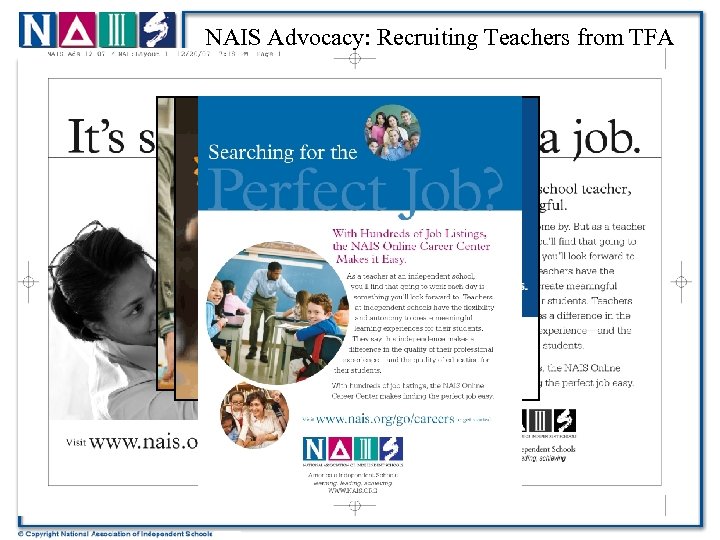 NAIS Advocacy: Recruiting Teachers from TFA
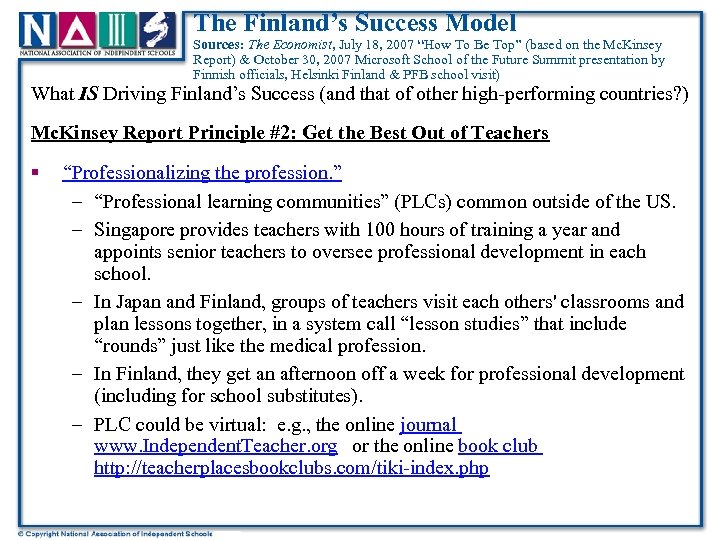 The Finland’s Success Model Sources: The Economist, July 18, 2007 “How To Be Top” (based on the Mc. Kinsey Report) & October 30, 2007 Microsoft School of the Future Summit presentation by Finnish officials, Helsinki Finland & PFB school visit) What IS Driving Finland’s Success (and that of other high-performing countries? ) Mc. Kinsey Report Principle #2: Get the Best Out of Teachers § “Professionalizing the profession. ” – “Professional learning communities” (PLCs) common outside of the US. – Singapore provides teachers with 100 hours of training a year and appoints senior teachers to oversee professional development in each school. – In Japan and Finland, groups of teachers visit each others' classrooms and plan lessons together, in a system call “lesson studies” that include “rounds” just like the medical profession. – In Finland, they get an afternoon off a week for professional development (including for school substitutes). – PLC could be virtual: e. g. , the online journal www. Independent. Teacher. org or the online book club http: //teacherplacesbookclubs. com/tiki-index. php
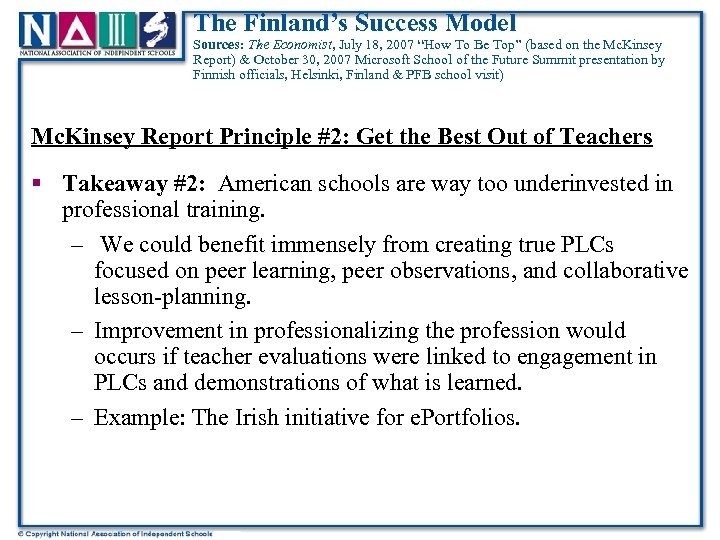 The Finland’s Success Model Sources: The Economist, July 18, 2007 “How To Be Top” (based on the Mc. Kinsey Report) & October 30, 2007 Microsoft School of the Future Summit presentation by Finnish officials, Helsinki, Finland & PFB school visit) Mc. Kinsey Report Principle #2: Get the Best Out of Teachers § Takeaway #2: American schools are way too underinvested in professional training. – We could benefit immensely from creating true PLCs focused on peer learning, peer observations, and collaborative lesson-planning. – Improvement in professionalizing the profession would occurs if teacher evaluations were linked to engagement in PLCs and demonstrations of what is learned. – Example: The Irish initiative for e. Portfolios.
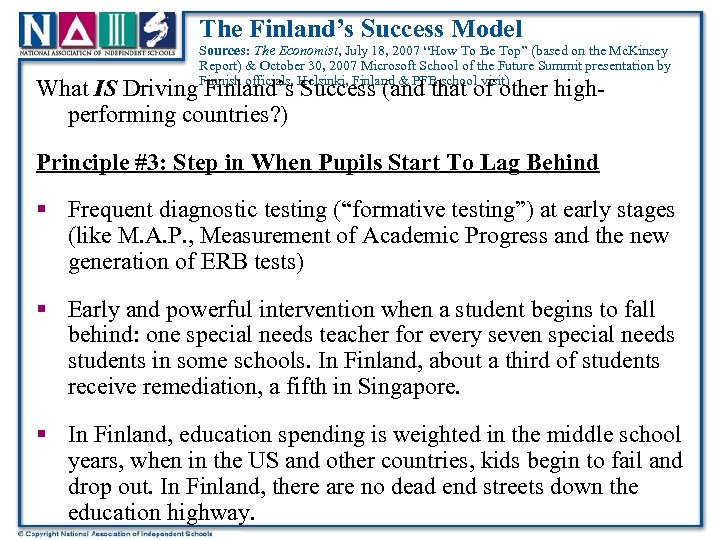 The Finland’s Success Model Sources: The Economist, July 18, 2007 “How To Be Top” (based on the Mc. Kinsey Report) & October 30, 2007 Microsoft School of the Future Summit presentation by Finnish officials, Helsinki, Finland & PFB school visit) What IS Driving Finland’s Success (and that of other highperforming countries? ) Principle #3: Step in When Pupils Start To Lag Behind § Frequent diagnostic testing (“formative testing”) at early stages (like M. A. P. , Measurement of Academic Progress and the new generation of ERB tests) § Early and powerful intervention when a student begins to fall behind: one special needs teacher for every seven special needs students in some schools. In Finland, about a third of students receive remediation, a fifth in Singapore. § In Finland, education spending is weighted in the middle school years, when in the US and other countries, kids begin to fail and drop out. In Finland, there are no dead end streets down the education highway.
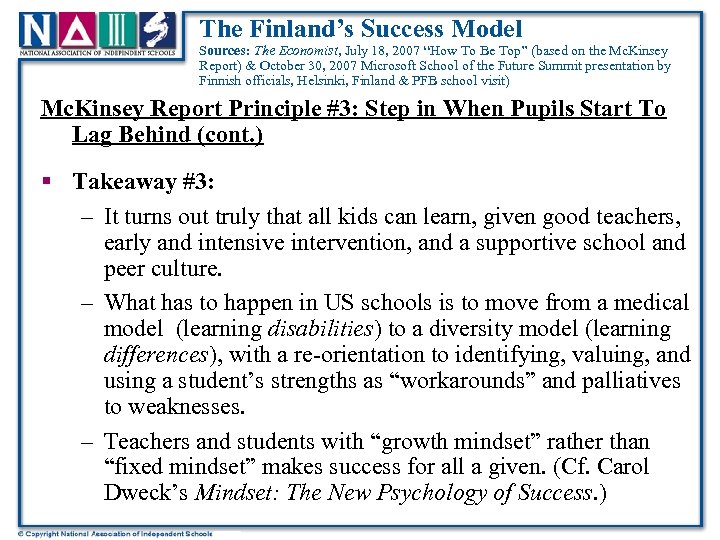 The Finland’s Success Model Sources: The Economist, July 18, 2007 “How To Be Top” (based on the Mc. Kinsey Report) & October 30, 2007 Microsoft School of the Future Summit presentation by Finnish officials, Helsinki, Finland & PFB school visit) Mc. Kinsey Report Principle #3: Step in When Pupils Start To Lag Behind (cont. ) § Takeaway #3: – It turns out truly that all kids can learn, given good teachers, early and intensive intervention, and a supportive school and peer culture. – What has to happen in US schools is to move from a medical model (learning disabilities) to a diversity model (learning differences), with a re-orientation to identifying, valuing, and using a student’s strengths as “workarounds” and palliatives to weaknesses. – Teachers and students with “growth mindset” rather than “fixed mindset” makes success for all a given. (Cf. Carol Dweck’s Mindset: The New Psychology of Success. )
 Mixed Weather Forecast for Teachers a General Indicators of Well-Being: Sunshine with a… Good Chance of Rain (and related strategic issues) § Climate for Public School Teacher is Stormy: NCLB a disaster for kids and the profession. Teacher autonomy disappearing. Great teachers leaving the profession or jumping ship. § What teacher shortage? Prospects for hiring excellent: Independent schools offer security, decent pay, great benefits, data-driven vs. opinion-driven leadership; meaningful work. College grads with amazing credentials living at home—looking for work. Cf. Dan Pink’s new You. Tube on science of motivation: autonomy, mastery, purpose. § The End of Retirement: Whoops—your pension has shrunk, and you can’t retire: Cf Encore. § Trends in Happiness: Men tracking up; women tracking down, in both absolute and relative terms.
 The End
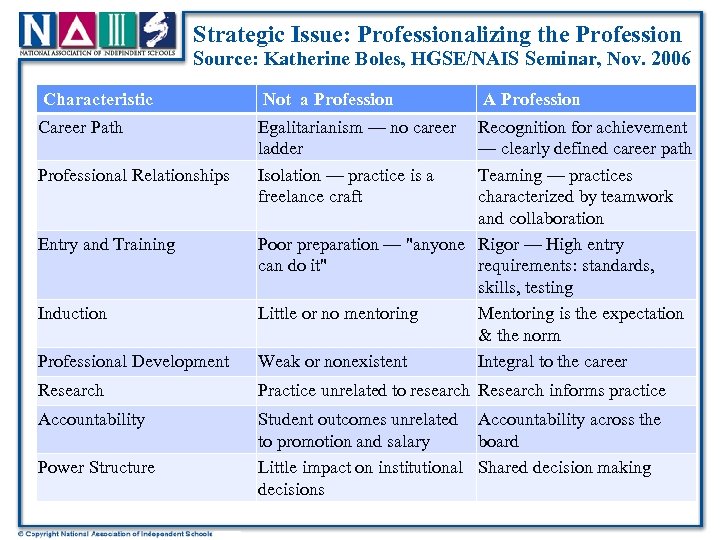 Strategic Issue: Professionalizing the Profession Source: Katherine Boles, HGSE/NAIS Seminar, Nov. 2006 Characteristic Not a Profession Career Path A Profession Egalitarianism — no career ladder Isolation — practice is a freelance craft Professional Development Recognition for achievement — clearly defined career path Teaming — practices characterized by teamwork and collaboration Poor preparation — "anyone Rigor — High entry can do it" requirements: standards, skills, testing Little or no mentoring Mentoring is the expectation & the norm Weak or nonexistent Integral to the career Research Practice unrelated to research Research informs practice Accountability Student outcomes unrelated Accountability across the to promotion and salary board Little impact on institutional Shared decision making decisions Professional Relationships Entry and Training Induction Power Structure