


 Скачать презентацию The Financial Market Environment Financial Institutions and Markets
2. Financial markets.pptx
- Количество слайдов: 7
 The Financial Market Environment Financial Institutions and Markets The Financial Crisis Regulation of Financial Institutions Business Taxes
 Learning Goals • Understand the role that financial institutions play in managerial finance. • Contrast the functions of financial institutions and financial markets. • Describe the differences between the capital markets and the • money markets. • Explain the root causes of the 2008 financial crisis and recession. • Understand the major regulations and regulatory bodies that affect financial institutions and markets. • Discuss business taxes and their importance in financial decisions.
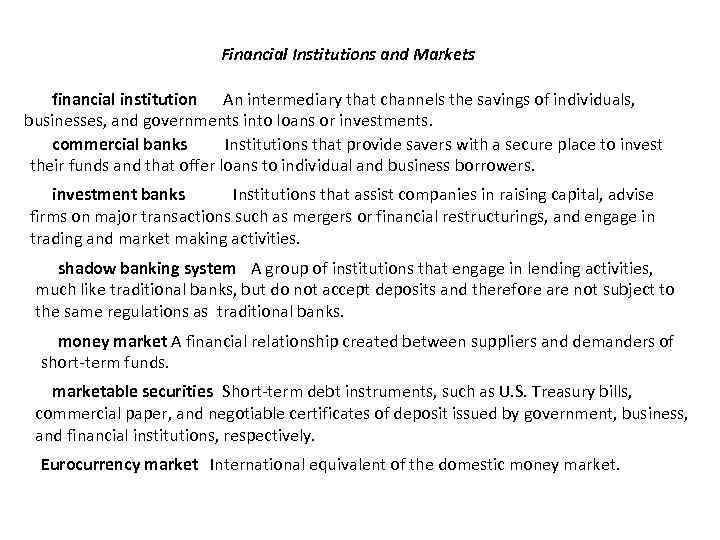 Financial Institutions and Markets financial institution An intermediary that channels the savings of individuals, businesses, and governments into loans or investments. commercial banks Institutions that provide savers with a secure place to invest their funds and that offer loans to individual and business borrowers. Institutions that assist companies in raising capital, advise investment banks firms on major transactions such as mergers or financial restructurings, and engage in trading and market making activities. shadow banking system A group of institutions that engage in lending activities, much like traditional banks, but do not accept deposits and therefore are not subject to the same regulations as traditional banks. money market A financial relationship created between suppliers and demanders of short-term funds. marketable securities Short-term debt instruments, such as U. S. Treasury bills, commercial paper, and negotiable certificates of deposit issued by government, business, and financial institutions, respectively. Eurocurrency market International equivalent of the domestic money market.
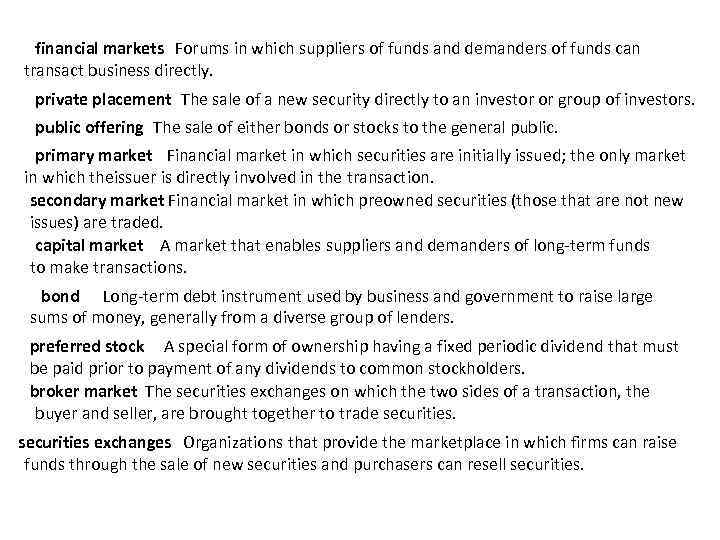 financial markets Forums in which suppliers of funds and demanders of funds can transact business directly. private placement The sale of a new security directly to an investor or group of investors. public offering The sale of either bonds or stocks to the general public. primary market Financial market in which securities are initially issued; the only market in which theissuer is directly involved in the transaction. secondary market Financial market in which preowned securities (those that are not new issues) are traded. capital market A market that enables suppliers and demanders of long-term funds to make transactions. bond Long-term debt instrument used by business and government to raise large sums of money, generally from a diverse group of lenders. preferred stock A special form of ownership having a fixed periodic dividend that must be paid prior to payment of any dividends to common stockholders. broker market The securities exchanges on which the two sides of a transaction, the buyer and seller, are brought together to trade securities exchanges Organizations that provide the marketplace in which firms can raise funds through the sale of new securities and purchasers can resell securities.
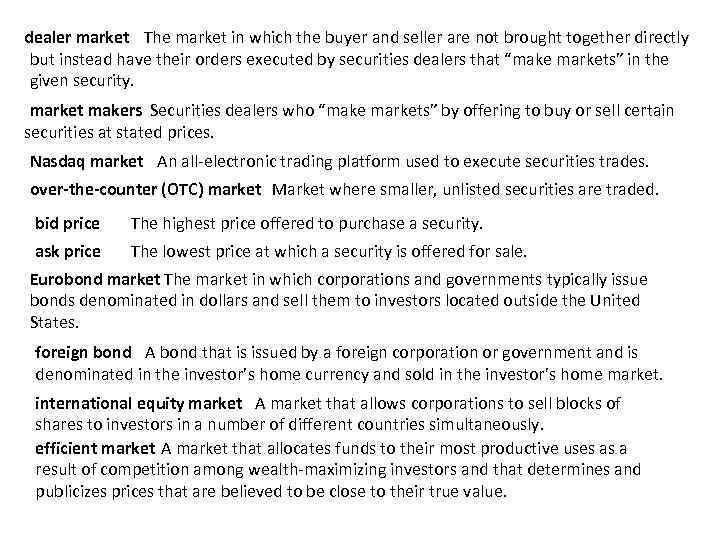 dealer market The market in which the buyer and seller are not brought together directly but instead have their orders executed by securities dealers that “make markets” in the given security. market makers Securities dealers who “make markets” by offering to buy or sell certain securities at stated prices. Nasdaq market An all-electronic trading platform used to execute securities trades. over-the-counter (OTC) market Market where smaller, unlisted securities are traded. bid price The highest price offered to purchase a security. ask price The lowest price at which a security is offered for sale. Eurobond market The market in which corporations and governments typically issue bonds denominated in dollars and sell them to investors located outside the United States. foreign bond A bond that is issued by a foreign corporation or government and is denominated in the investor’s home currency and sold in the investor’s home market. international equity market A market that allows corporations to sell blocks of shares to investors in a number of different countries simultaneously. efficient market A market that allocates funds to their most productive uses as a result of competition among wealth-maximizing investors and that determines and publicizes prices that are believed to be close to their true value.
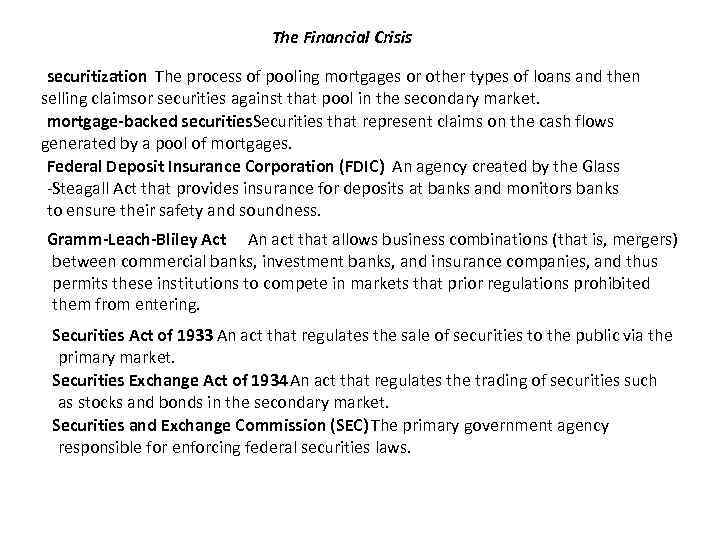 The Financial Crisis securitization The process of pooling mortgages or other types of loans and then selling claimsor securities against that pool in the secondary market. mortgage-backed securities. Securities that represent claims on the cash flows generated by a pool of mortgages. Federal Deposit Insurance Corporation (FDIC) An agency created by the Glass -Steagall Act that provides insurance for deposits at banks and monitors banks to ensure their safety and soundness. Gramm-Leach-Bliley Act An act that allows business combinations (that is, mergers) between commercial banks, investment banks, and insurance companies, and thus permits these institutions to compete in markets that prior regulations prohibited them from entering. Securities Act of 1933 An act that regulates the sale of securities to the public via the primary market. Securities Exchange Act of 1934 An act that regulates the trading of securities such as stocks and bonds in the secondary market. Securities and Exchange Commission (SEC) The primary government agency responsible for enforcing federal securities laws.
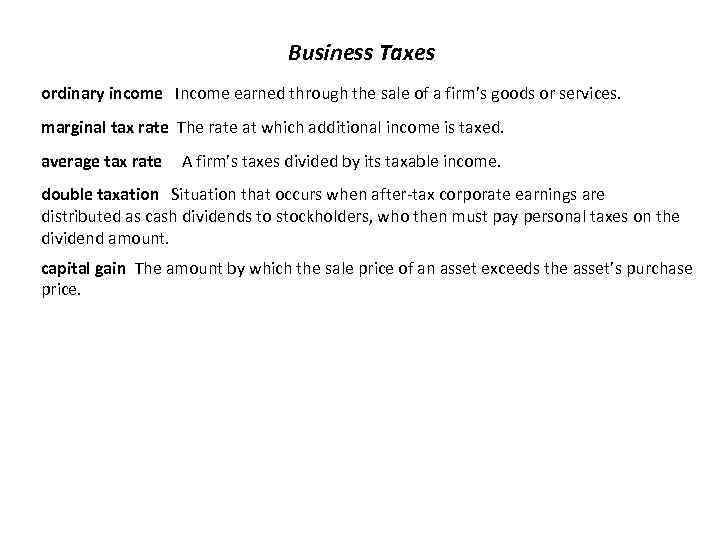 Business Taxes ordinary income Income earned through the sale of a firm’s goods or services. marginal tax rate The rate at which additional income is taxed. average tax rate A firm’s taxes divided by its taxable income. double taxation Situation that occurs when after-tax corporate earnings are distributed as cash dividends to stockholders, who then must pay personal taxes on the dividend amount. capital gain The amount by which the sale price of an asset exceeds the asset’s purchase price.