


 Скачать презентацию The Financial Crisis 2009 Steinar Holden Økonomisk institutt
3c74620f2a8484ff43a67b410e7b0952.ppt
- Количество слайдов: 23
 The Financial Crisis 2009 Steinar Holden Økonomisk institutt, Ui. O http: //folk. uio. no/sholden/ ECON 4325
 Outline l l Macroeconomic imbalances Weaknesses in financial markets l l Weaknesses in regulation What happened? Historical experiences Some lessons 2009 l Securitization
 Predicted growth in world GDP, given at different points in time (IMF) 2009
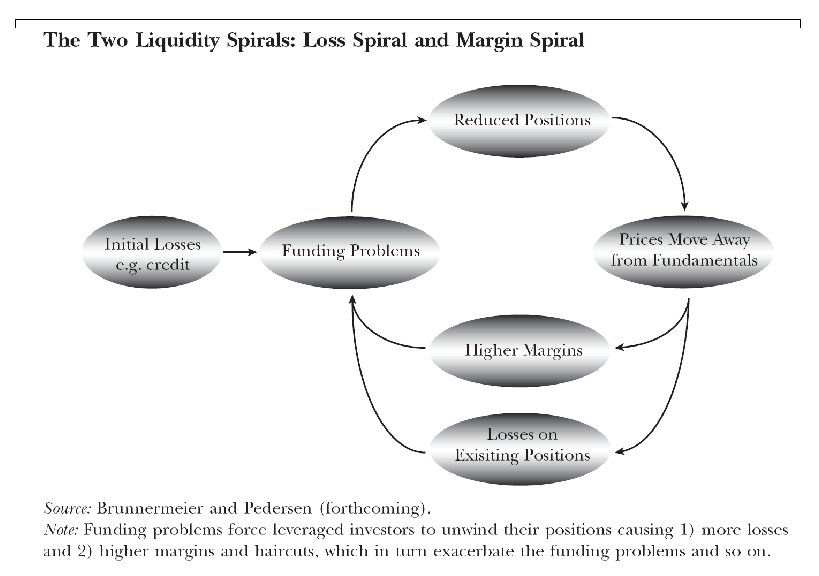
 Amplification mechanisms 2009
 Background - macroeconomics l Macroeconomic imbalances l l Fairly high economic growth at world level, yet low inflation partly due to cheap imports from low-cost countries l l Central banks set low interest rates in 20022005 Economic growth and low interest rates l l High growth in asset values ”Search for yield” 2009 l High saving in China, Japan, Germany and oil exporting countries High borrowing in the U. S, UK, Spain, etc
 House prices 2009
 Background – financial markets l Extensive changes in financial markets last 20 -30 years l l Advantages l l l Easier to borrow, better funding of investments Broader spectre of assets, diversification Increased efficiency and profitability 2009 l Institutional changes (e. g. hedge funds, private equity funds) Deregulation – removal of artificial barriers Technology – increased access to information, communication, computer power, financial innovation Strong profit motives and incentive based remuneration
 Securitization l l l Pension funds hold AAA rated assets due to restriction by charter Hedge fund focus on more risky pieces Banks hold ”equity tranch” to ensure monitoring But: l l most of risk stayed within banking sector (although spread across the world) banks held leveraged AAA assets – tail risk 2009 l Diversified portfolios formed on basis of mortgages, corporate bonds and other assets Portfolios are sliced into tranches, sold to investors with different appetites for risk
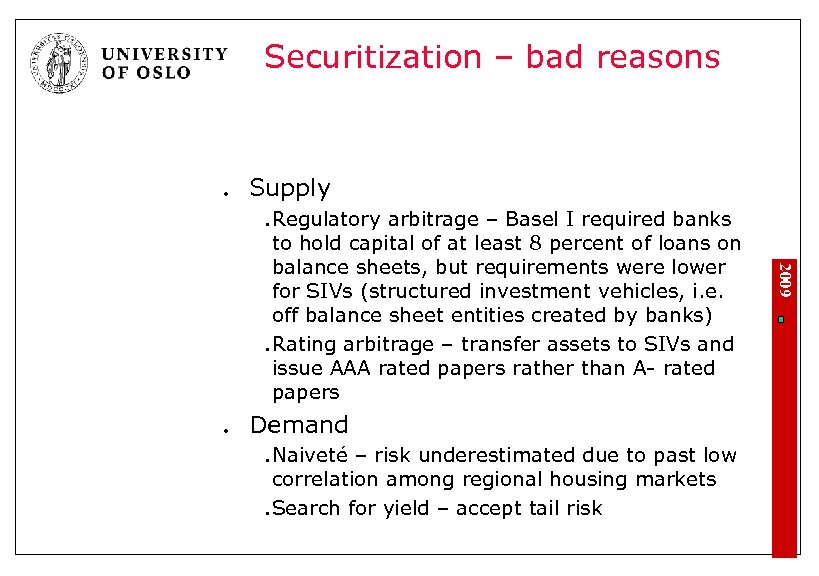 Securitization – bad reasons l Supply l l Demand l l Naiveté – risk underestimated due to past low correlation among regional housing markets Search for yield – accept tail risk 2009 l Regulatory arbitrage – Basel I required banks to hold capital of at least 8 percent of loans on balance sheets, but requirements were lower for SIVs (structured investment vehicles, i. e. off balance sheet entities created by banks) Rating arbitrage – transfer assets to SIVs and issue AAA rated papers rather than A- rated papers
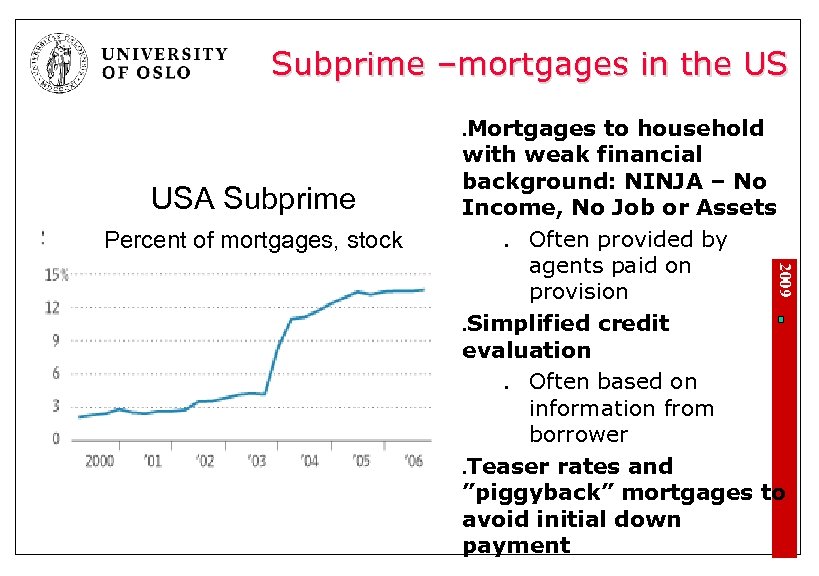 Subprime –mortgages in the US Mortgages to household with weak financial background: NINJA – No Income, No Job or Assets Often provided by agents paid on provision Simplified credit evaluation Often based on information from borrower Teaser rates and ”piggyback” mortgages to avoid initial down payment l USA Subprime Percent of mortgages, stock l 2009 l l l
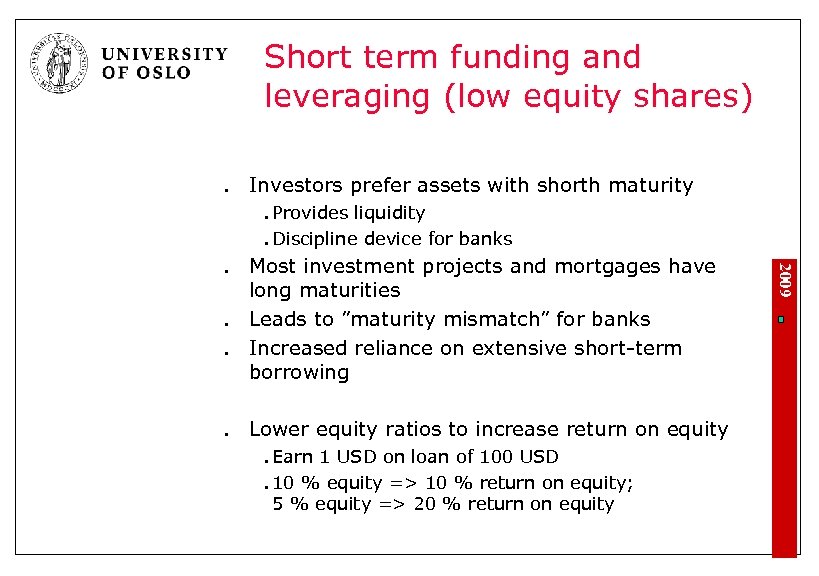 Short term funding and leveraging (low equity shares) l Investors prefer assets with shorth maturity l l l Most investment projects and mortgages have long maturities Leads to ”maturity mismatch” for banks Increased reliance on extensive short-term borrowing Lower equity ratios to increase return on equity l l Earn 1 USD on loan of 100 USD 10 % equity => 10 % return on equity; 5 % equity => 20 % return on equity 2009 l Provides liquidity Discipline device for banks
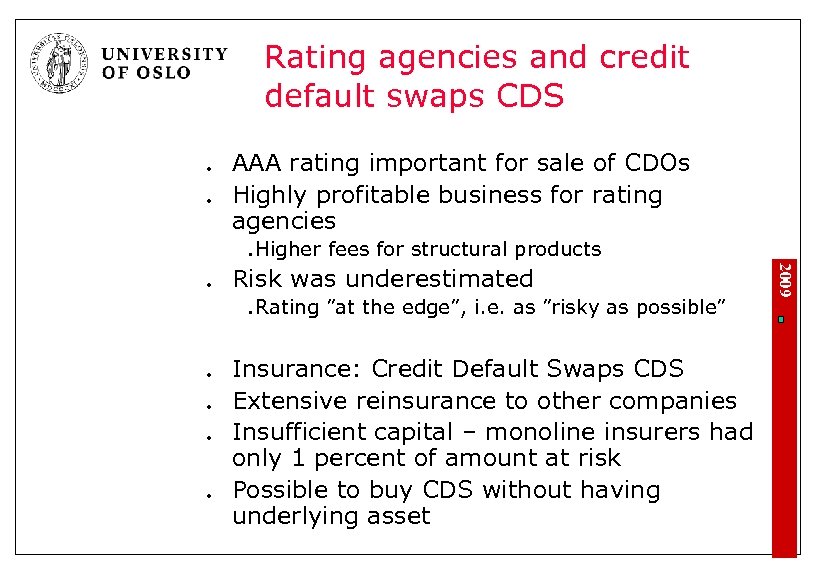 Rating agencies and credit default swaps CDS l l AAA rating important for sale of CDOs Highly profitable business for rating agencies l Risk was underestimated l l l Rating ”at the edge”, i. e. as ”risky as possible” Insurance: Credit Default Swaps CDS Extensive reinsurance to other companies Insufficient capital – monoline insurers had only 1 percent of amount at risk Possible to buy CDS without having underlying asset 2009 l Higher fees for structural products
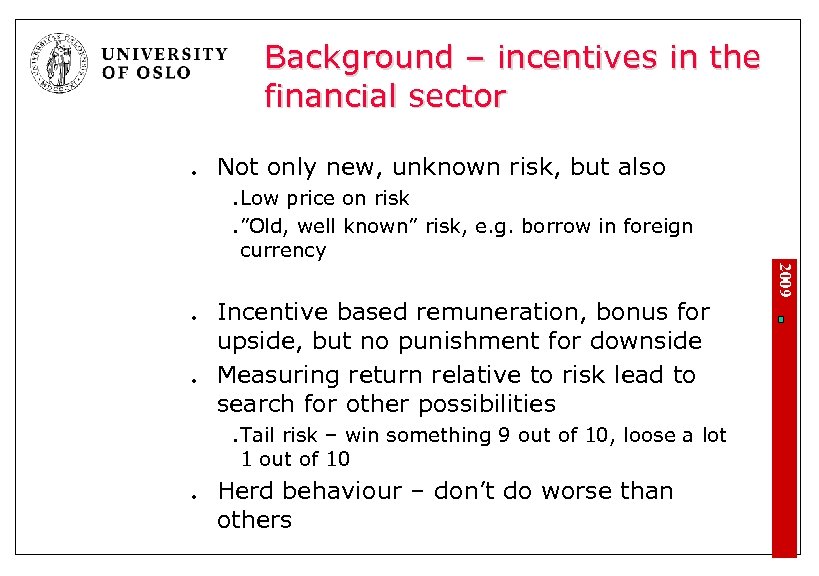 Background – incentives in the financial sector l Not only new, unknown risk, but also l l l Incentive based remuneration, bonus for upside, but no punishment for downside Measuring return relative to risk lead to search for other possibilities l l Tail risk – win something 9 out of 10, loose a lot 1 out of 10 Herd behaviour – don’t do worse than others 2009 l Low price on risk ”Old, well known” risk, e. g. borrow in foreign currency
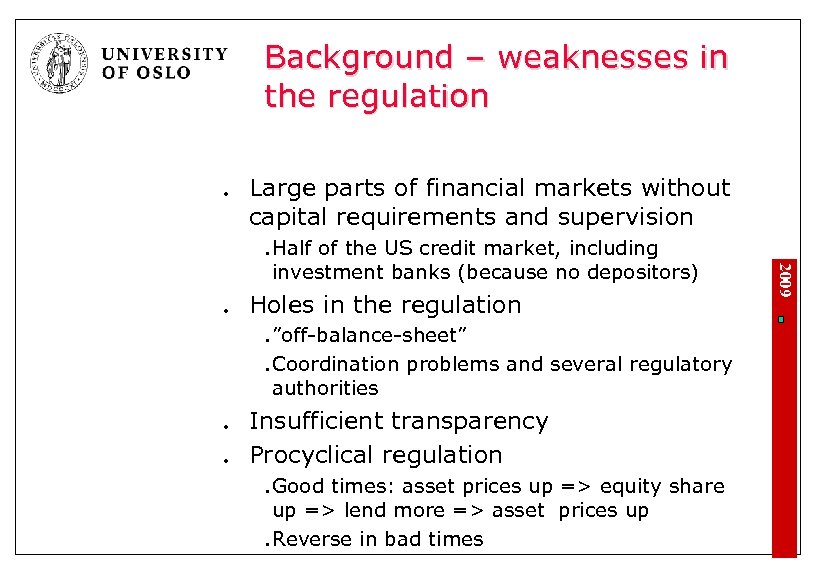 Background – weaknesses in the regulation l Large parts of financial markets without capital requirements and supervision l Holes in the regulation l l ”off-balance-sheet” Coordination problems and several regulatory authorities Insufficient transparency Procyclical regulation l l Good times: asset prices up => equity share up => lend more => asset prices up Reverse in bad times 2009 l Half of the US credit market, including investment banks (because no depositors)
 House prices in the US, annual growth rates 1988 - 2008. 2009 Årsvekst i 4. kvartal 2008 for 10 byområder: -19, 2 prosent Kilde: Reuters Eco. Win 16
 Difference 3 -month money market rates and policy rates 1. januar 2008 – 2. februar 2009. Prosentpoeng 2009 Kilde: Reuters Eco. Win
 Credit default swaps 2009
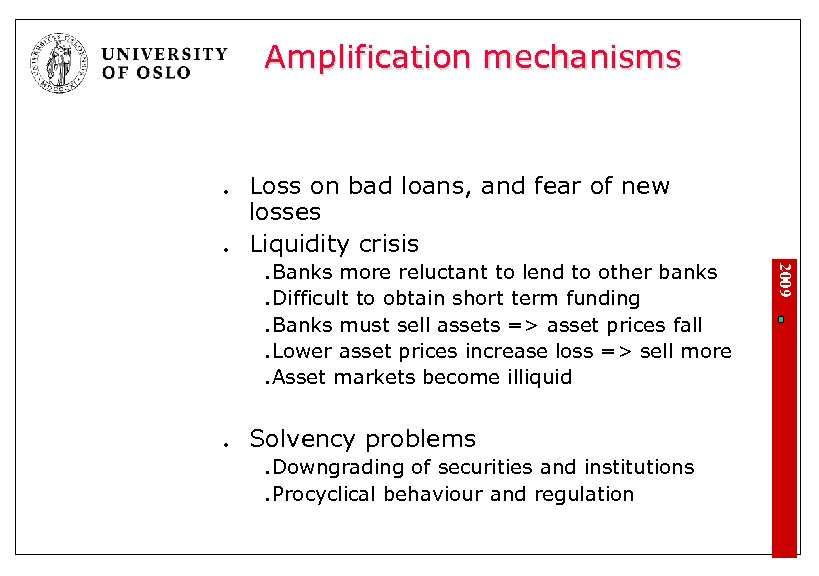 Amplification mechanisms l l Loss on bad loans, and fear of new losses Liquidity crisis l l l Banks more reluctant to lend to other banks Difficult to obtain short term funding Banks must sell assets => asset prices fall Lower asset prices increase loss => sell more Asset markets become illiquid Solvency problems l l Downgrading of securities and institutions Procyclical behaviour and regulation 2009 l
 2009
2009
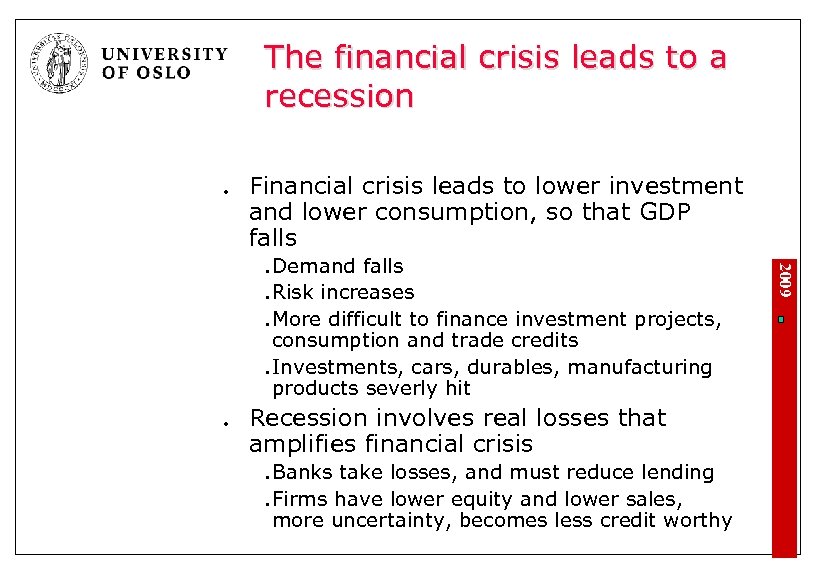 The financial crisis leads to a recession l Financial crisis leads to lower investment and lower consumption, so that GDP falls l l Demand falls Risk increases More difficult to finance investment projects, consumption and trade credits Investments, cars, durables, manufacturing products severly hit Recession involves real losses that amplifies financial crisis l l Banks take losses, and must reduce lending Firms have lower equity and lower sales, more uncertainty, becomes less credit worthy 2009 l
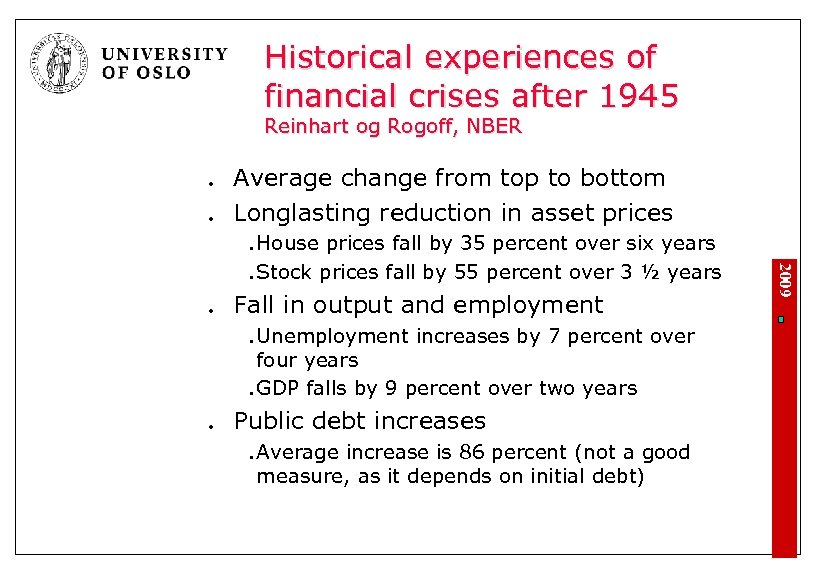 Historical experiences of financial crises after 1945 Reinhart og Rogoff, NBER l l Average change from top to bottom Longlasting reduction in asset prices l l Fall in output and employment l l l Unemployment increases by 7 percent over four years GDP falls by 9 percent over two years Public debt increases l Average increase is 86 percent (not a good measure, as it depends on initial debt) 2009 l House prices fall by 35 percent over six years Stock prices fall by 55 percent over 3 ½ years
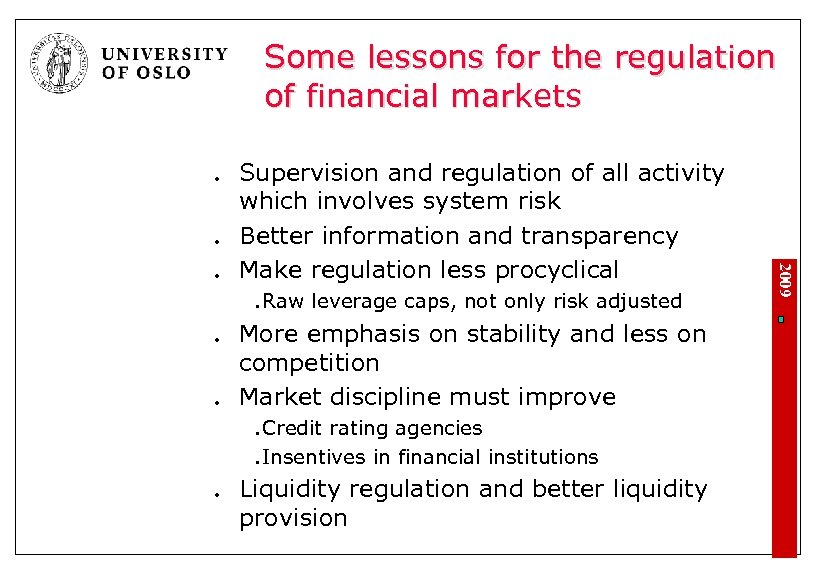 Some lessons for the regulation of financial markets l l l More emphasis on stability and less on competition Market discipline must improve l l l Raw leverage caps, not only risk adjusted Credit rating agencies Insentives in financial institutions Liquidity regulation and better liquidity provision 2009 l Supervision and regulation of all activity which involves system risk Better information and transparency Make regulation less procyclical
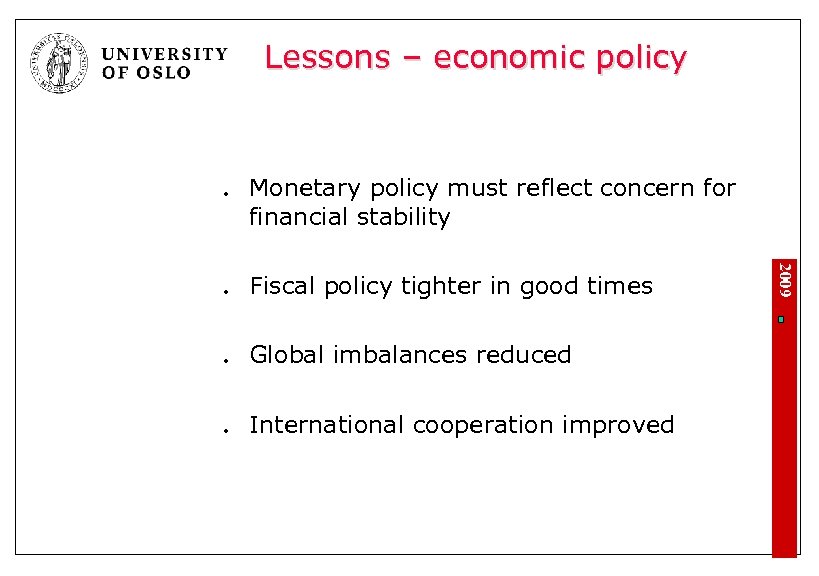 Lessons – economic policy l l l Fiscal policy tighter in good times Global imbalances reduced International cooperation improved 2009 l Monetary policy must reflect concern for financial stability