


 Скачать презентацию The Final Days Keeping the Promise of Comfort
854c23eefbe80946ed7aaf2c79b4ff38.ppt
- Количество слайдов: 38
 The Final Days Keeping the Promise of Comfort
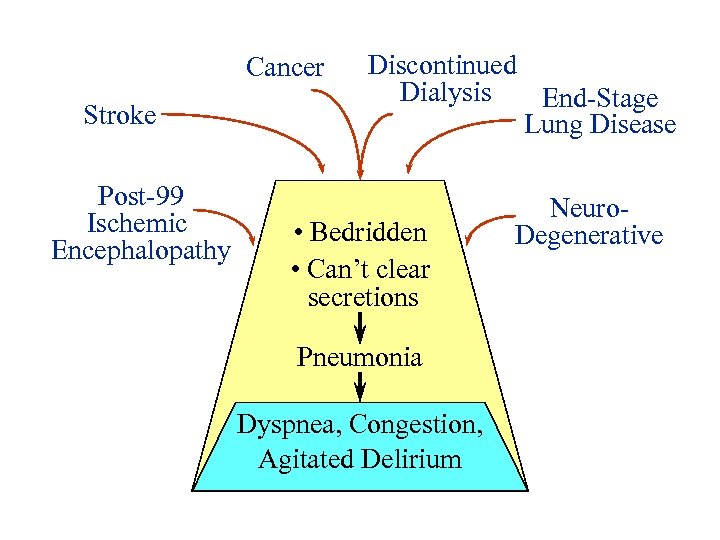 Cancer Stroke Post-99 Ischemic Encephalopathy Discontinued Dialysis End-Stage Lung Disease • Bedridden • Can’t clear secretions Pneumonia Dyspnea, Congestion, Agitated Delirium Neuro. Degenerative
 Main Features of Approach to Care • Perceptive and vigilant regarding changes • “Proactive” communication with patient and family » anticipate questions and concerns » available » don’t present “non-choices” as choices • Aggressive pursuit of comfort • Don’t be caught off-guard by predictable problems
 Predictable Challenges in the Final Days • Functional decline- transfers, toileting • Can’t swallow meds- route of administration • Terminal pneumonia Ø dyspnea Ø congestion Ø delirium: > 80% At times ++ agitation • Concerns of family and friends
 Concerns of Patients, Family, and Friends • How could this be happening so fast? • What about food & fluids? • Things were fine until that medicine was started! • Isn’t the medicine speeding this up? • Too drowsy! Too restless! • Confusion… he’s not himself, lost him already • What will it be like? How will we know? • We’ve missed the chance to say goodbye
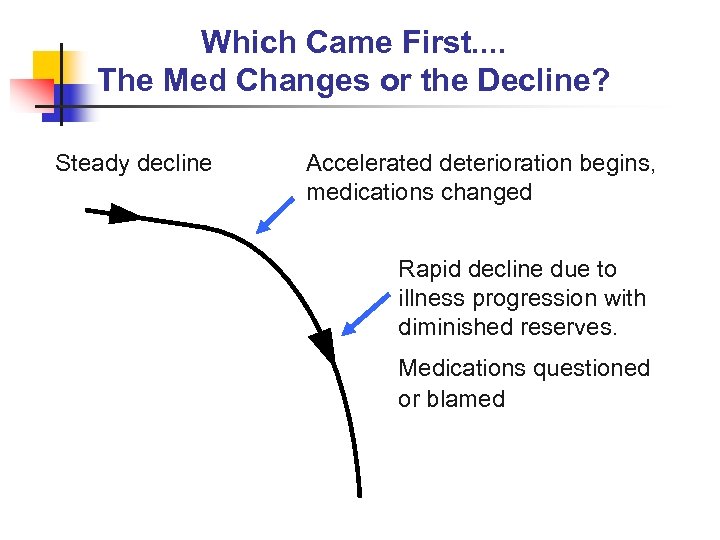 Which Came First. . The Med Changes or the Decline? Steady decline Accelerated deterioration begins, medications changed Rapid decline due to illness progression with diminished reserves. Medications questioned or blamed
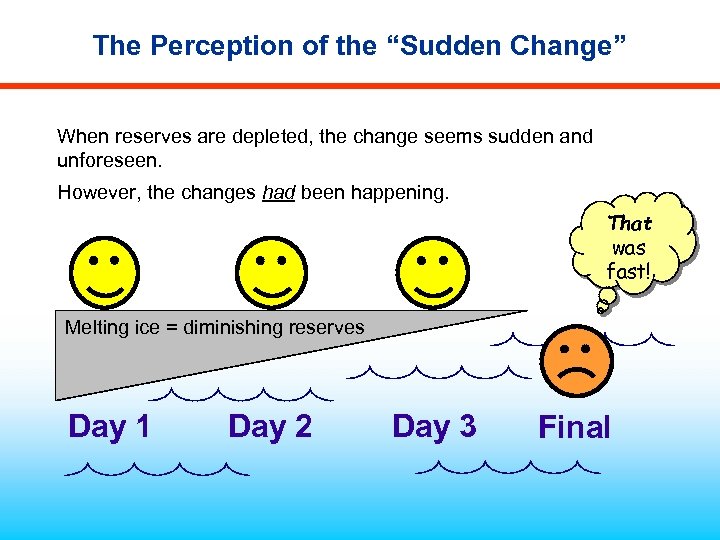 The Perception of the “Sudden Change” When reserves are depleted, the change seems sudden and unforeseen. However, the changes had been happening. That was fast! Melting ice = diminishing reserves Day 1 Day 2 Day 3 Final
 Family / Friends Wanting to Intervene With Food and / or Fluids • discuss goals • distinguish between prolonging living vs. prolonging dying • parenteral fluids generally not needed for comfort • pushing calories in terminal phase does not improve function or outcome
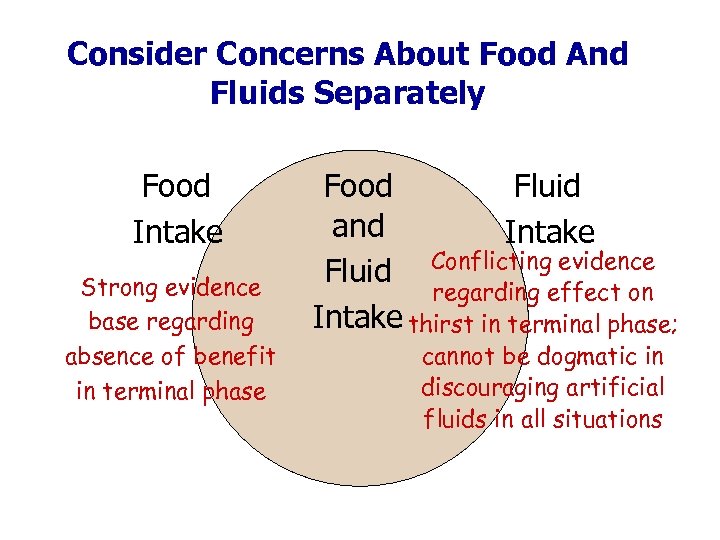 Consider Concerns About Food And Fluids Separately Food Intake Strong evidence base regarding absence of benefit in terminal phase Food Fluid and Intake Fluid Conflicting evidence regarding effect on Intake thirst in terminal phase; cannot be dogmatic in discouraging artificial fluids in all situations
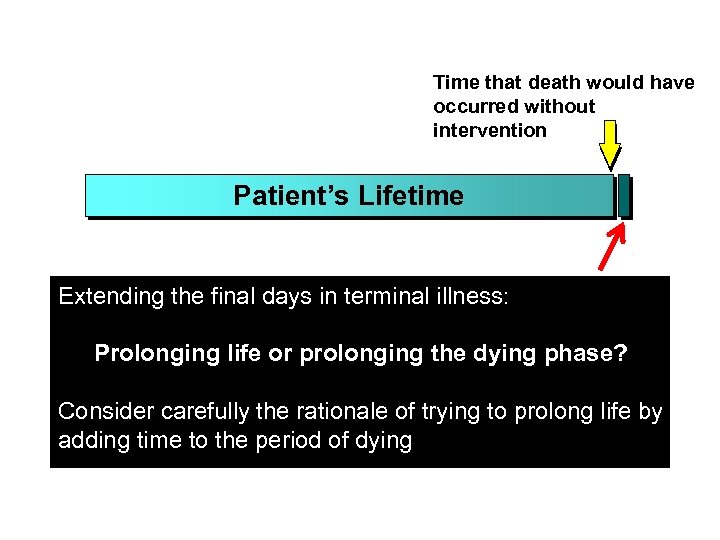 Time that death would have occurred without intervention Patient’s Lifetime Extending the final days in terminal illness: Prolonging life or prolonging the dying phase? Consider carefully the rationale of trying to prolong life by adding time to the period of dying
 OBTAINING SUBSTITUTED JUDGMENT You are seeking their thoughts on what the patient would want, not what they feel is “the right thing to do”.
 PHRASING REQUEST: SUBSTITUTED JUDGMENT “If he could come to the bedside as healthy as he was a year ago, and look at the situation for himself now, what would he tell us to do? ” Or “If you had in your pocket a note from him telling you what to do under these circumstances, what would it say? ”
 TALKING ABOUT DYING “Many people think about what they might experience as things change, and they become closer to dying. Have you thought about this regarding yourself? Do you want me to talk about what changes are likely to happen? ”
 First, let’s talk about what you should not expect. You should not expect: v pain that can’t be controlled. v breathing troubles that can’t be controlled. v “going crazy” or “losing your mind”
 If any of those problems come up, I will make sure that you’re comfortable and calm, even if it means that with the medications that we use you’ll be sleeping most of the time, or possibly all of the time. Do you understand that? Is that approach OK with you?
 You’ll find that your energy will be less, as you’ve likely noticed in the last while. You’ll want to spend more of the day resting, and there will be a point where you’ll be resting (sleeping) most or all of the day.
 Gradually your body systems will shut down, and at the end your heart will stop while you are sleeping. No dramatic crisis of pain, breathing, agitation, or confusion will occur - we won’t let that happen.
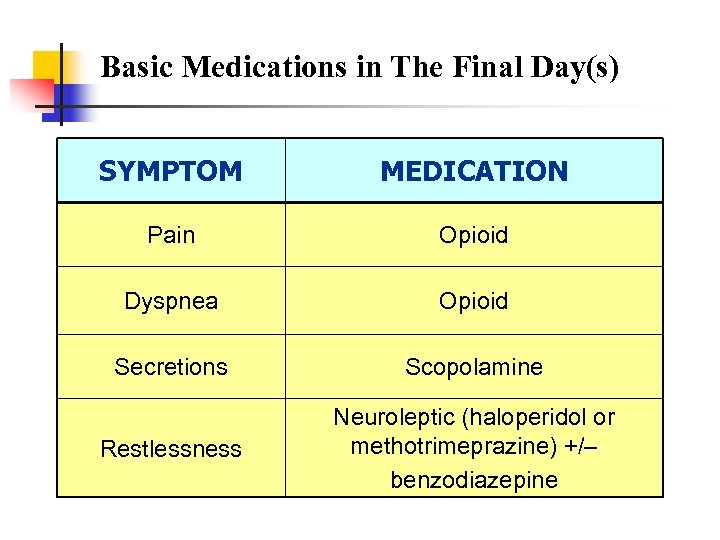 Basic Medications in The Final Day(s) SYMPTOM MEDICATION Pain Opioid Dyspnea Opioid Secretions Scopolamine Restlessness Neuroleptic (haloperidol or methotrimeprazine) +/– benzodiazepine
 DYSPNEA: An uncomfortable awareness of breathing
 DYSPNEA: “. . . the most common severe symptom in the last days of life” Davis C. L. The therapeutics of dyspnoea Cancer Surveys 1994 Vol. 21 p 85 - 98
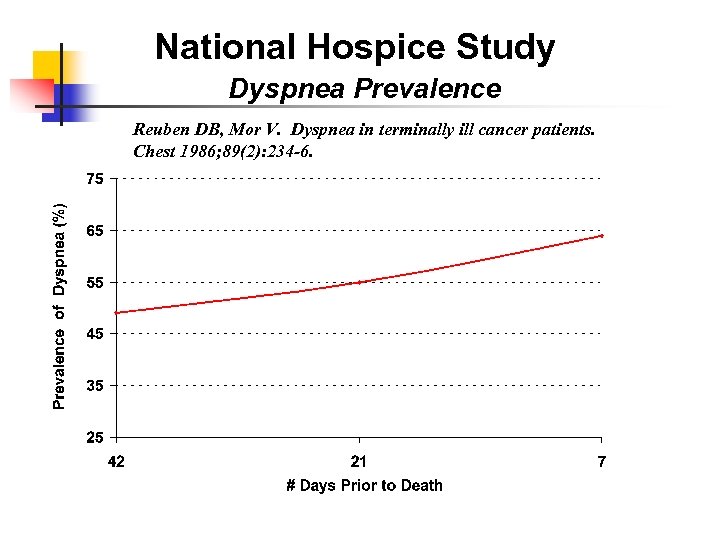 National Hospice Study Dyspnea Prevalence Reuben DB, Mor V. Dyspnea in terminally ill cancer patients. Chest 1986; 89(2): 234 -6.
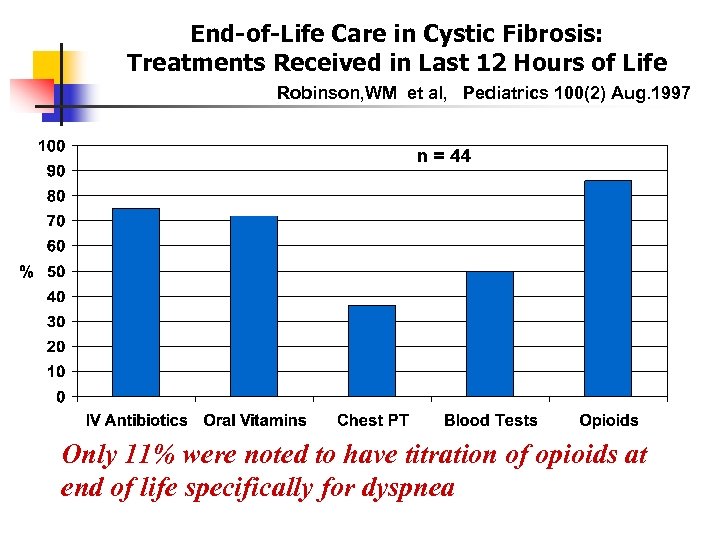 End-of-Life Care in Cystic Fibrosis: Treatments Received in Last 12 Hours of Life Robinson, WM et al, Pediatrics 100(2) Aug. 1997 Only 11% were noted to have titration of opioids at end of life specifically for dyspnea
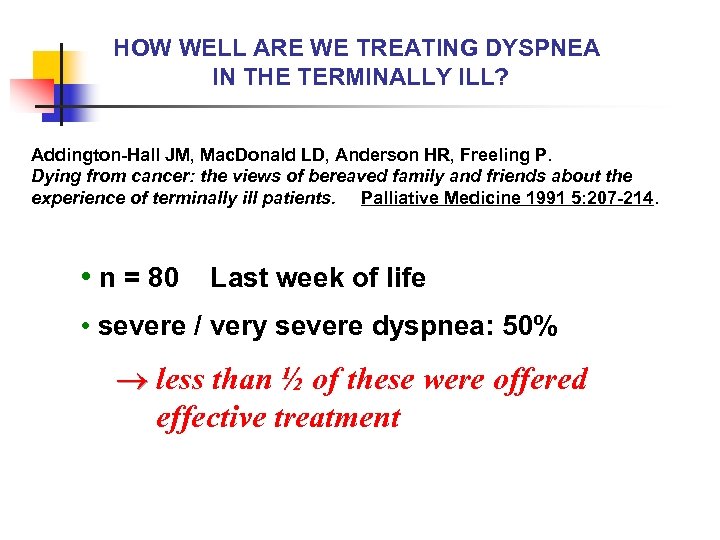 HOW WELL ARE WE TREATING DYSPNEA IN THE TERMINALLY ILL? Addington-Hall JM, Mac. Donald LD, Anderson HR, Freeling P. Dying from cancer: the views of bereaved family and friends about the experience of terminally ill patients. Palliative Medicine 1991 5: 207 -214. • n = 80 Last week of life • severe / very severe dyspnea: 50% ® less than ½ of these were offered effective treatment
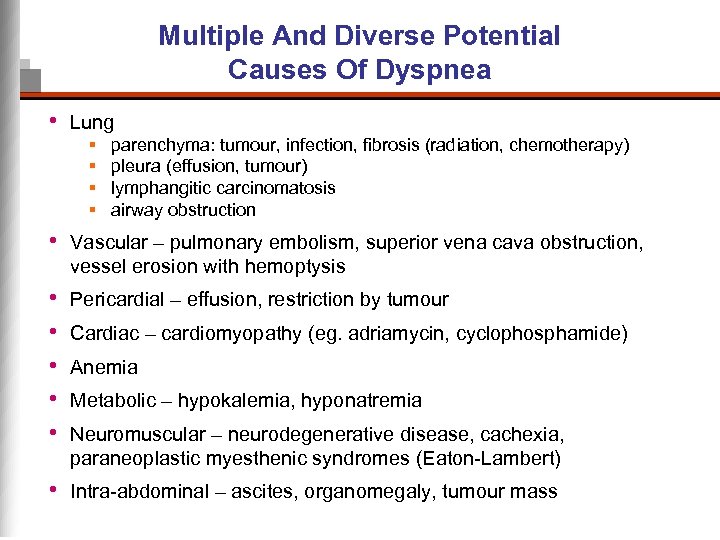 Multiple And Diverse Potential Causes Of Dyspnea • Lung § § parenchyma: tumour, infection, fibrosis (radiation, chemotherapy) pleura (effusion, tumour) lymphangitic carcinomatosis airway obstruction • Vascular – pulmonary embolism, superior vena cava obstruction, vessel erosion with hemoptysis • • • Pericardial – effusion, restriction by tumour • Intra-abdominal – ascites, organomegaly, tumour mass Cardiac – cardiomyopathy (eg. adriamycin, cyclophosphamide) Anemia Metabolic – hypokalemia, hyponatremia Neuromuscular – neurodegenerative disease, cachexia, paraneoplastic myesthenic syndromes (Eaton-Lambert)
 Approach To The Dyspneic Palliative Patient Two basic intervention types: 1. Non-specific, symptom-oriented 2. Disease-specific
 Simple Non-Specific Measures In Managing Dyspnea • calm reassurance • patient sitting up / semi-reclined • open window • fan
 Non-Specific Pharmacologic Interventions In Dyspnea • Oxygen - hypoxic and ? non-hypoxic • Opioids - complex variety of central effects • Chlorpromazine or Methotrimeprazine some evidence in adult literature; caution in children due to potential for dystonic reactions • Benzodiazepines - literature inconsistent but clinical experience extensive and supportive
 TREAT THE CAUSE OF DYSPNEA IF POSSIBLE AND APPROPRIATE • Anti-tumor: chemo/rad. Tx, hormone, laser • Infection • Anemia • CHF • SVCO • Pleural effusion • Pulmonary embolism • Airway obstruction
 Opioids in Dyspnea n n n Uncertain mechanism Comfort achieved before resp compromise; rate often unchanged Often patient already on opioids for analgesia; if dyspnea develops it will usually be the symptom that leads the need for titration Dosage should be titrated empirically; may easily reach doses commonly seen in adults May need rapid dose escalation in order to keep up with rapidly progressing distress
 CONGESTION IN THE FINAL HOURS “Death Rattle” • Positioning • ANTISECRETORY: Scopolamine, glycopyrrolate • Consider suctioning if secretions are: - distressing, proximal, accessible - not responding to antisecretory agents
 A COMMON CONCERN ABOUT AGGRESSIVE USE OF OPIOIDS IN THE FINAL HOURS How do you know that the aggressive use of opioids doesn't actually bring about or speed up the patient's death?
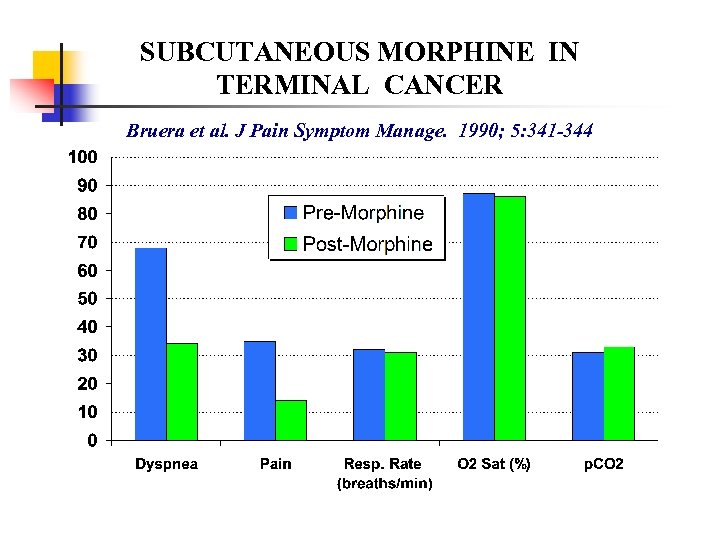 SUBCUTANEOUS MORPHINE IN TERMINAL CANCER Bruera et al. J Pain Symptom Manage. 1990; 5: 341 -344
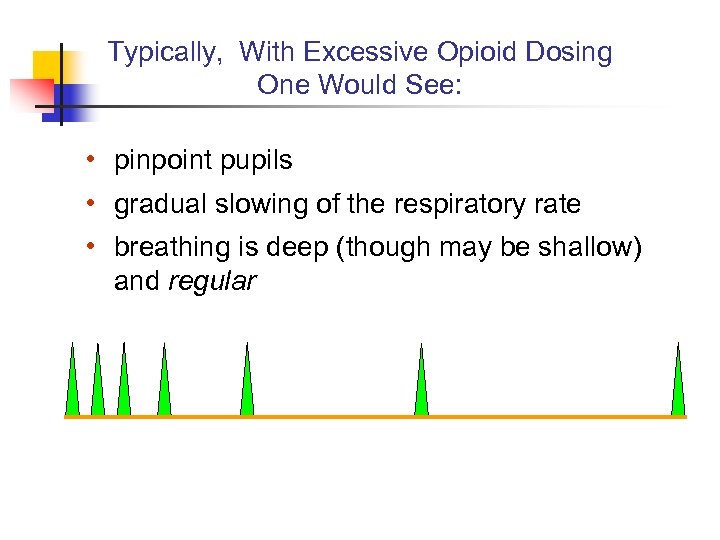 Typically, With Excessive Opioid Dosing One Would See: • pinpoint pupils • gradual slowing of the respiratory rate • breathing is deep (though may be shallow) and regular
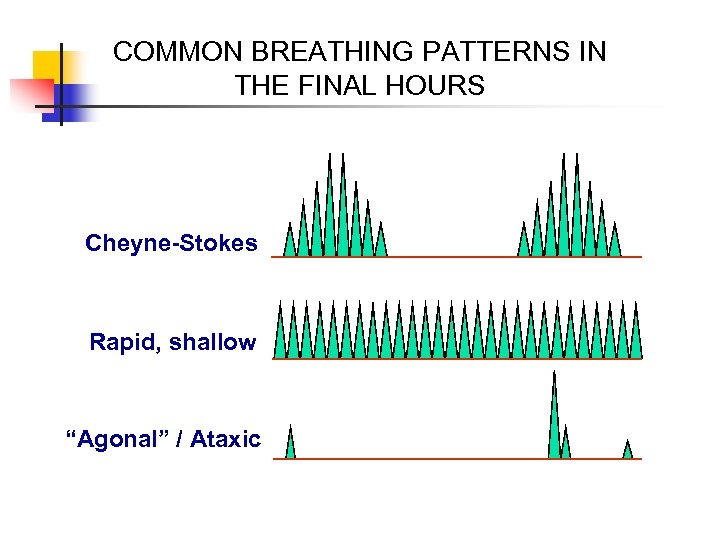 COMMON BREATHING PATTERNS IN THE FINAL HOURS Cheyne-Stokes Rapid, shallow “Agonal” / Ataxic
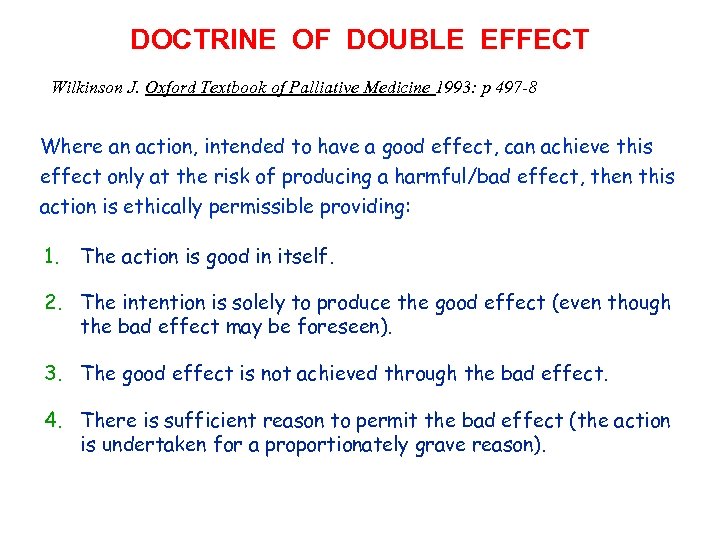 DOCTRINE OF DOUBLE EFFECT Wilkinson J. Oxford Textbook of Palliative Medicine 1993: p 497 -8 Where an action, intended to have a good effect, can achieve this effect only at the risk of producing a harmful/bad effect, then this action is ethically permissible providing: 1. The action is good in itself. 2. The intention is solely to produce the good effect (even though the bad effect may be foreseen). 3. The good effect is not achieved through the bad effect. 4. There is sufficient reason to permit the bad effect (the action is undertaken for a proportionately grave reason).
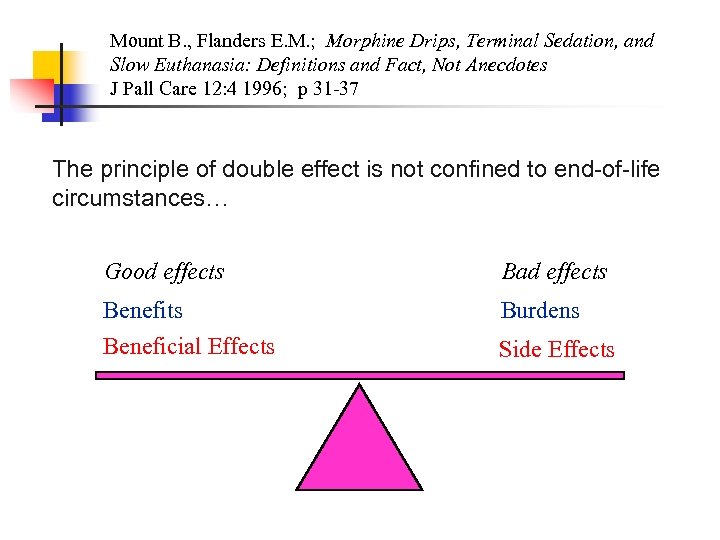 Mount B. , Flanders E. M. ; Morphine Drips, Terminal Sedation, and Slow Euthanasia: Definitions and Fact, Not Anecdotes J Pall Care 12: 4 1996; p 31 -37 The principle of double effect is not confined to end-of-life circumstances… Good effects Bad effects Beneficial Effects Burdens Side Effects
 • The difference in aggressive opioid use in end-of-life circumstances is that the “bad effect” = Death • The doctrine of double effect exists to support those health care providers who may otherwise withhold opioids in the dying out of fear that the opioid may hasten the dying process • A problem with the emphasis on double effect is that there in an implication that this is a common scenario…. in day-to-day palliative care it is extremely rare to need to even consider its implications
 DON’T FORGET. . . For death at home • Health Care Directive: no CPR • Letters (regarding anticipated home death) to: Ø Funeral Home Ø Office of the Chief Medical Examiner Ø Copy in the home • physician not required to pronounce death in the home, but be available to sign death certificate