 Скачать презентацию The FGFOA Free Internet Based Webinar Series presents
668c65adb1b8bd7129054bf2801d80eb.ppt
- Количество слайдов: 41



The FGFOA Free Internet Based Webinar Series presents Strategic Planning, Performance Measures, and Benchmarks Thursday, August 18 th, 2: 00 p. m. – 3: 40 p. m. EDT CPE: 2 Hours TB
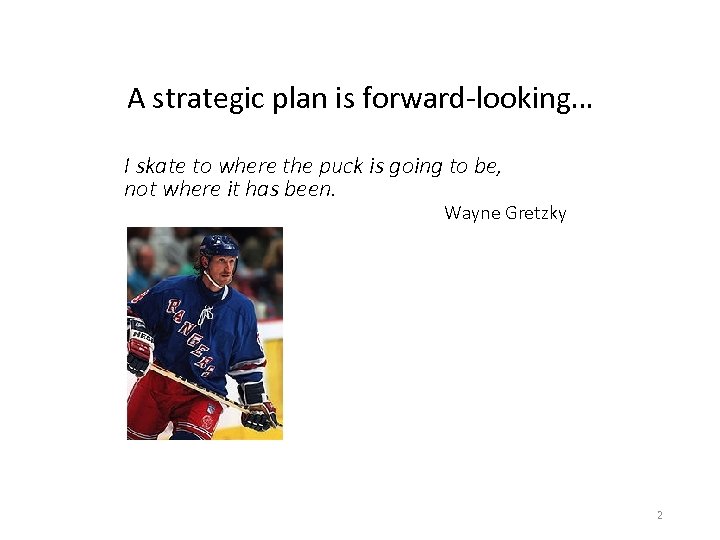
A strategic plan is forward-looking… I skate to where the puck is going to be, not where it has been. Wayne Gretzky 2
Strategic Planning Recommendation. The Government Finance Officers Association (GFOA) recommends that all governmental entities use some form of strategic planning to provide a long-term perspective for service delivery and budgeting, thus establishing logical links between authorized spending and broad organizational goals. Best Practice: Recommended Budget Practice on the Establishment of Strategic Plans, Government Finance Officers Association, 2005. 3
What is it? Typical Components of a Strategic Plan 1. Vision for the community’s future. 2. Mission statement for the government – a statement of purpose. 3. “Environmental scan. ” 4. Listing of community strengths, weaknesses, opportunities and threats: “SWOT” analysis. 5. Goals for the selected timeframe. 6. Measureable objectives for each goal. Gerald L. Gordon. Strategic Planning for Local Government, Second Edition, International City/County Management Association (ICMA), Washington, D. C. , 2005. 4
7. Strategies to address each objective. 8. Implementation plan - timelines and assignments. 9. Relationship to budget and personnel resources. 10. Contingency plan for the unexpected. 11. Scheduled performance assessments, periodic reviews, and updates. Gerald L. Gordon. Strategic Planning for Local Government, Second Edition, International City/County Management Association (ICMA), Washington, D. C. , 2005. 5
Purpose/Linkages In July 2010, the King County Council adopted the King County Strategic Plan, 2010– 2014. How will the plan be used? This Plan is intended to speak to and include something for a variety of audiences. For the public, this plan is meant to: • Communicate the county’s vision and show our intended direction and emphasis over the next five years. • Reflect your ideas and suggestions for services that are important or need improvement. • Signify our commitment to customer satisfaction. • Serve as a baseline to show progress and allow you to hold us accountable for our actions and principles over time. For cities, businesses, and community organizations, this plan is additionally meant to: • Reflect our commitment to working with you as partners in helping to achieve community goals. 6
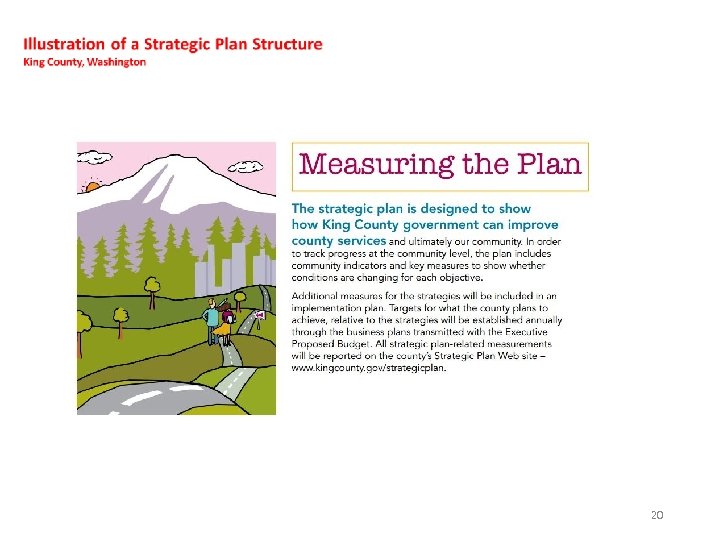
For King County officials, managers, and employees, the plan is additionally meant to: • Align county employees, services and programs with high-level Goals. • Inform policy, operational, and budget decisions. • Provide a structure to ensure oversight and management of county programs and services. • Create a countywide planning framework to guide subsequent plans. Updating the Plan: During late 2013 through 2014, the office of Performance, Strategy, and Budget conducted community and employee engagement and collaborated with council and the county’s separately elected officials to develop an update for the Strategic Plan. In , 2015, the Council updated and revised the County’s Vision, Mission, Guiding Principles, and Goals. County staff continues to work to develop more specific objectives and a measurement system that will show well the County is achieving each of its goals. 7
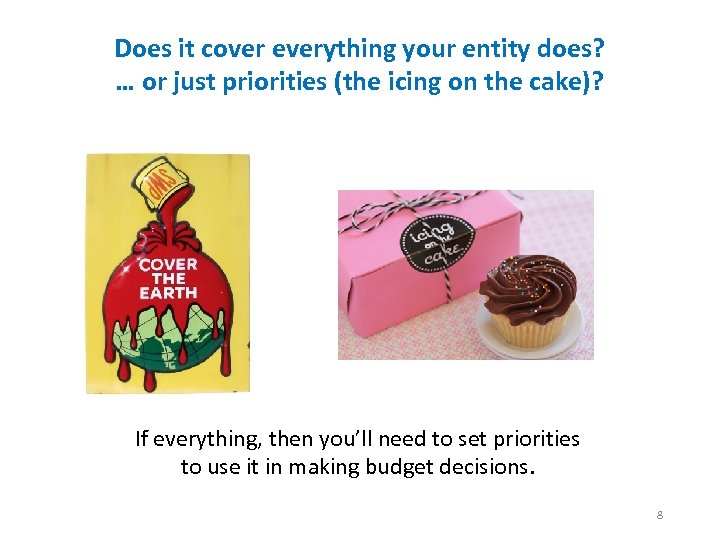
Does it cover everything your entity does? … or just priorities (the icing on the cake)? If everything, then you’ll need to set priorities to use it in making budget decisions. 8
Whose input does it reflect? Stakeholders. The Community – business and the public at large Elected officials Management Other public entities (cities, county, school district, special districts, colleges) • Collective bargaining units • Suppliers • Who else? (We targeted site selection firms who work with companies considering relocating to our community. ) • • Who owns it? (see above list) As importantly, who really embraces it and will keep it current and relevant? 9
What is unique to your community and organization? An Environmental Scan is the identification and monitoring of factors from both inside and outside the organization that may impact the long-term viability of the organization. During this step you are essentially attempting to develop the “big picture”. A SWOT analysis examines an organization’s processes by reviewing its (internal) strengths and weaknesses and matching these to its (external) opportunities and threats. Compiling this information enables you to identify all major factors affecting your organization’s operations, and act as a decision-making aid to formulate an effective response strategy. Source: http: //www. doh. wa. gov/portals/1/documents/mtgs/20110214 -pr-pmc-mod-02 -14 -11 swot 08. pd 10
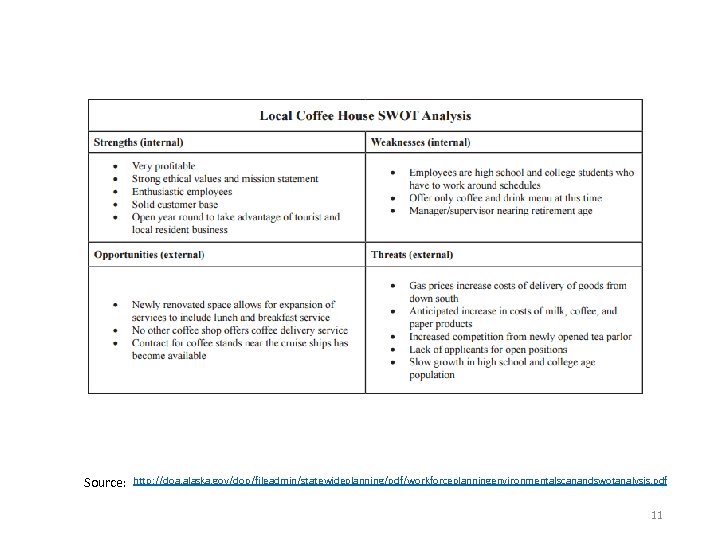
Source: http: //doa. alaska. gov/dop/fileadmin/statewideplanning/pdf/workforceplanningenvironmentalscanandswotanalysis. pdf 11
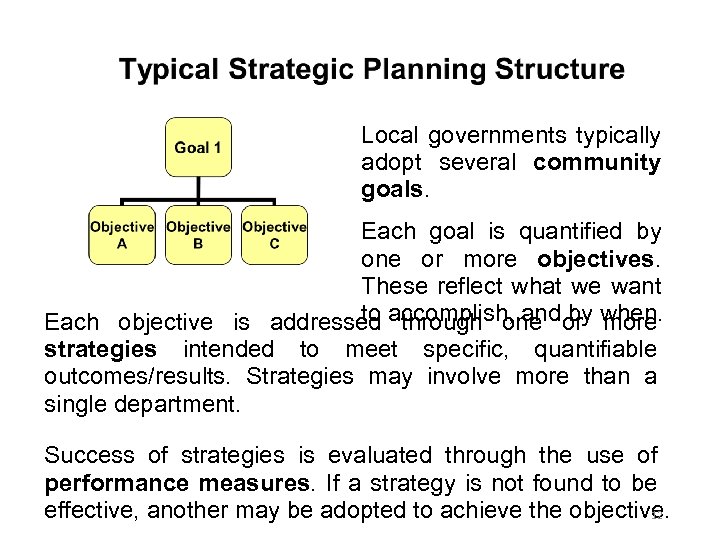
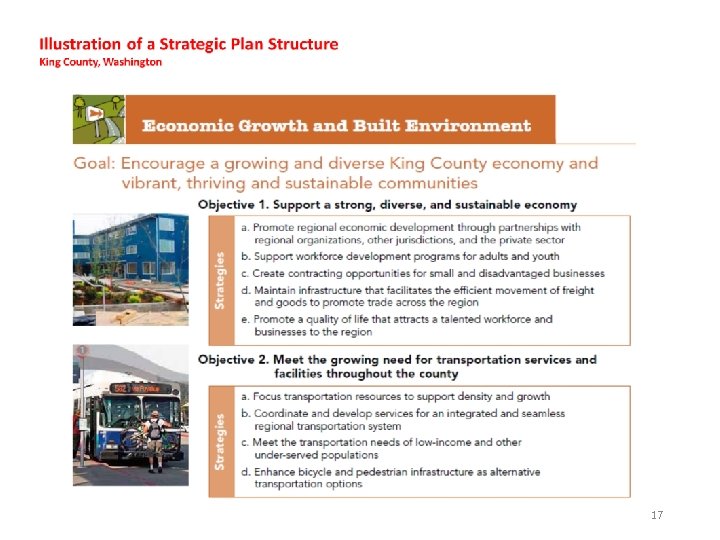
Local governments typically adopt several community goals. Each goal is quantified by one or more objectives. These reflect what we want to through one by more Each objective is addressed accomplish, andor when. strategies intended to meet specific, quantifiable outcomes/results. Strategies may involve more than a single department. Success of strategies is evaluated through the use of performance measures. If a strategy is not found to be effective, another may be adopted to achieve the objective. 12
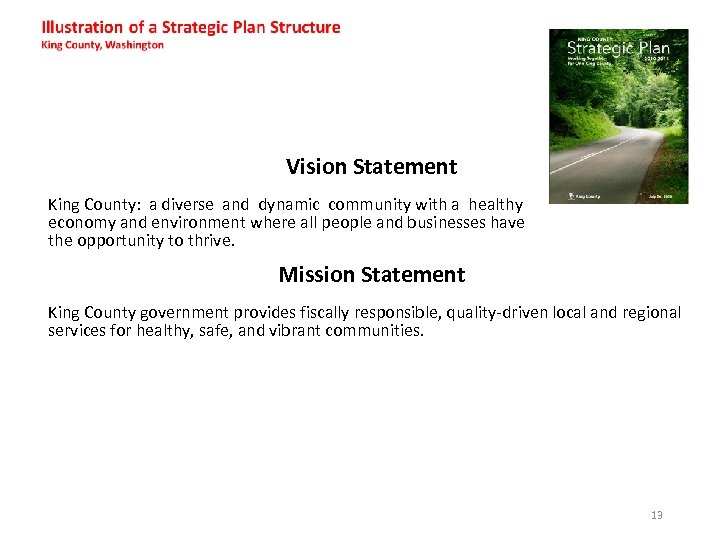
Vision Statement King County: a diverse and dynamic community with a healthy economy and environment where all people and businesses have the opportunity to thrive. Mission Statement King County government provides fiscally responsible, quality-driven local and regional services for healthy, safe, and vibrant communities. 13
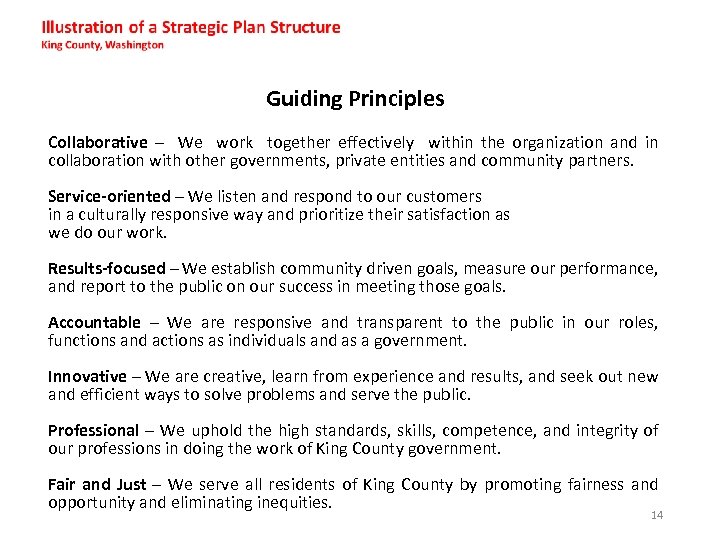
Guiding Principles Collaborative – We work together effectively within the organization and in collaboration with other governments, private entities and community partners. Service-oriented – We listen and respond to our customers in a culturally responsive way and prioritize their satisfaction as we do our work. Results-focused – We establish community driven goals, measure our performance, and report to the public on our success in meeting those goals. Accountable – We are responsive and transparent to the public in our roles, functions and actions as individuals and as a government. Innovative – We are creative, learn from experience and results, and seek out new and efficient ways to solve problems and serve the public. Professional – We uphold the high standards, skills, competence, and integrity of our professions in doing the work of King County government. Fair and Just – We serve all residents of King County by promoting fairness and opportunity and eliminating inequities. 14
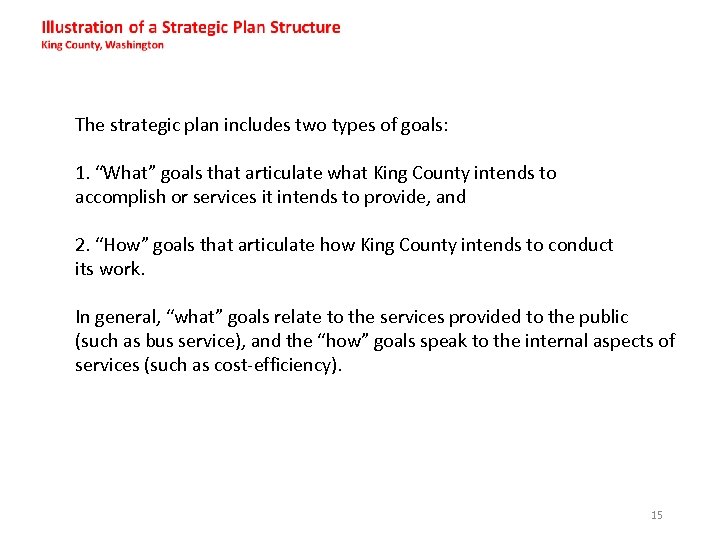
The strategic plan includes two types of goals: 1. “What” goals that articulate what King County intends to accomplish or services it intends to provide, and 2. “How” goals that articulate how King County intends to conduct its work. In general, “what” goals relate to the services provided to the public (such as bus service), and the “how” goals speak to the internal aspects of services (such as cost-efficiency). 15
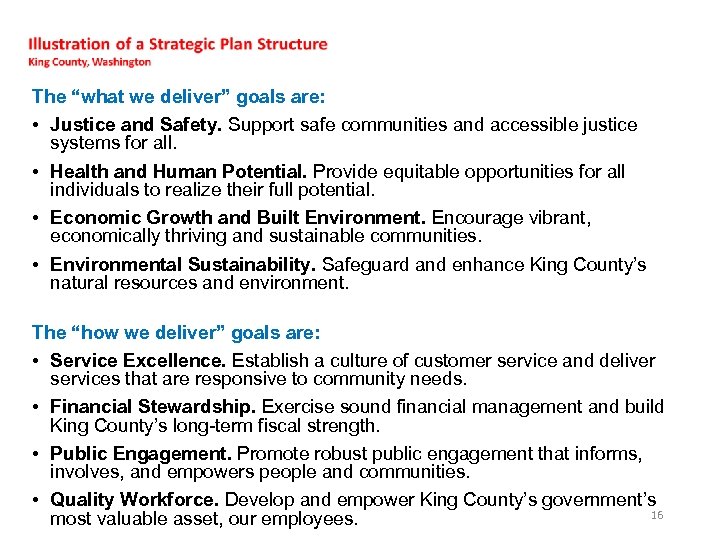
The “what we deliver” goals are: • Justice and Safety. Support safe communities and accessible justice systems for all. • Health and Human Potential. Provide equitable opportunities for all individuals to realize their full potential. • Economic Growth and Built Environment. Encourage vibrant, economically thriving and sustainable communities. • Environmental Sustainability. Safeguard and enhance King County’s natural resources and environment. The “how we deliver” goals are: • Service Excellence. Establish a culture of customer service and deliver services that are responsive to community needs. • Financial Stewardship. Exercise sound financial management and build King County’s long-term fiscal strength. • Public Engagement. Promote robust public engagement that informs, involves, and empowers people and communities. • Quality Workforce. Develop and empower King County’s government’s 16 most valuable asset, our employees.
17
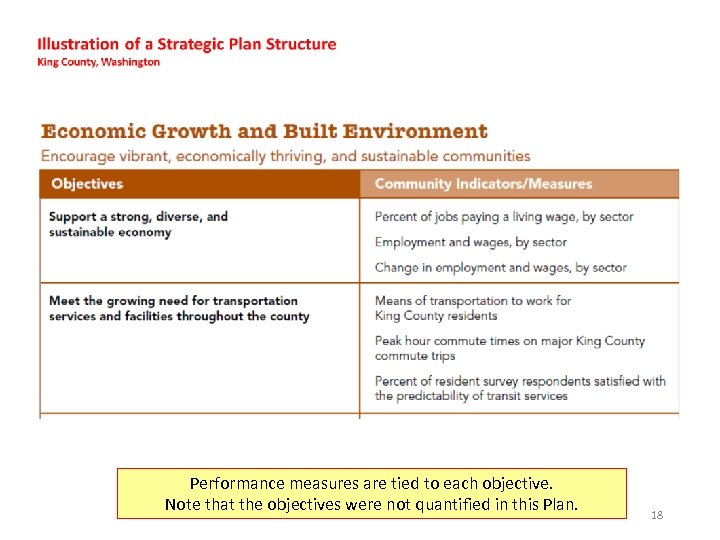
Performance measures are tied to each objective. Note that the objectives were not quantified in this Plan. 18
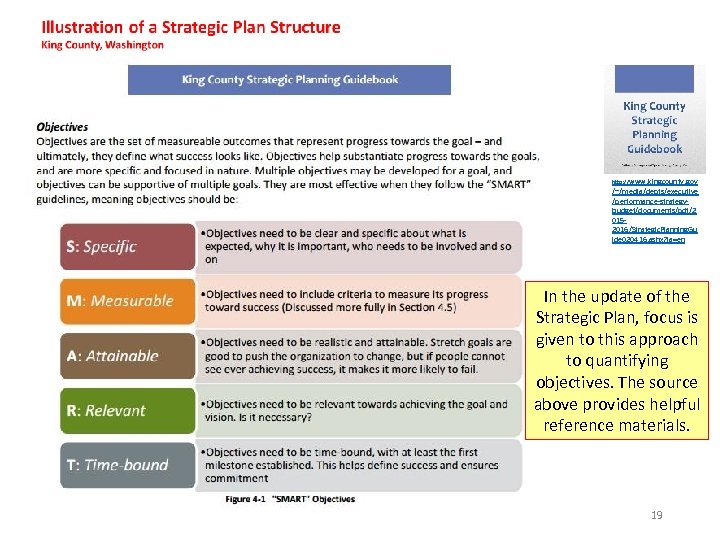
http: //www. kingcounty. gov /~/media/depts/executive /performance-strategybudget/documents/pdf/2 0152016/Strategic. Planning. Gu ide 020416. ashx? la=en In the update of the Strategic Plan, focus is given to this approach to quantifying objectives. The source above provides helpful reference materials. 19
20
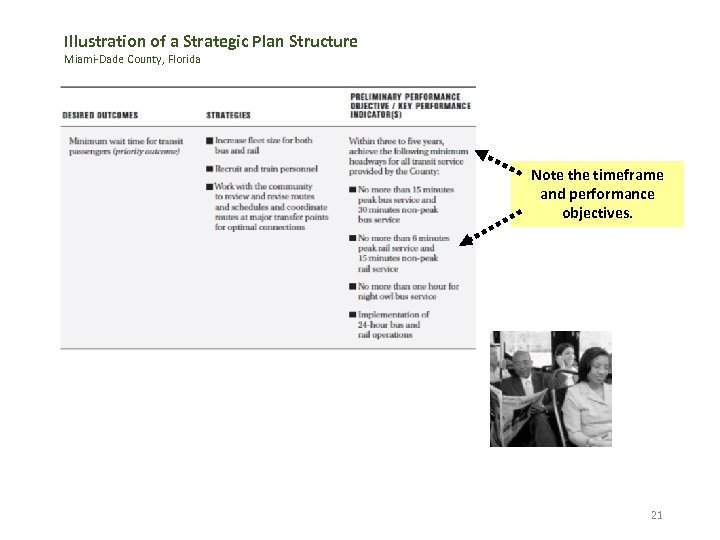
Illustration of a Strategic Plan Structure Miami-Dade County, Florida Note the timeframe and performance objectives. 21
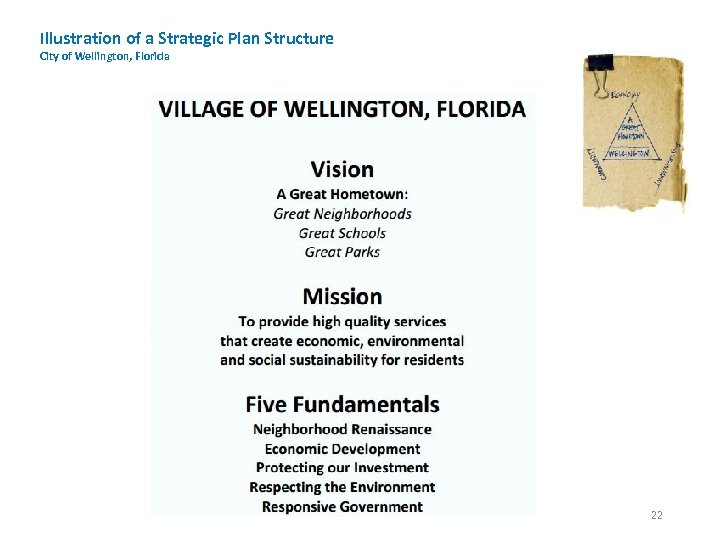
Illustration of a Strategic Plan Structure City of Wellington, Florida 22
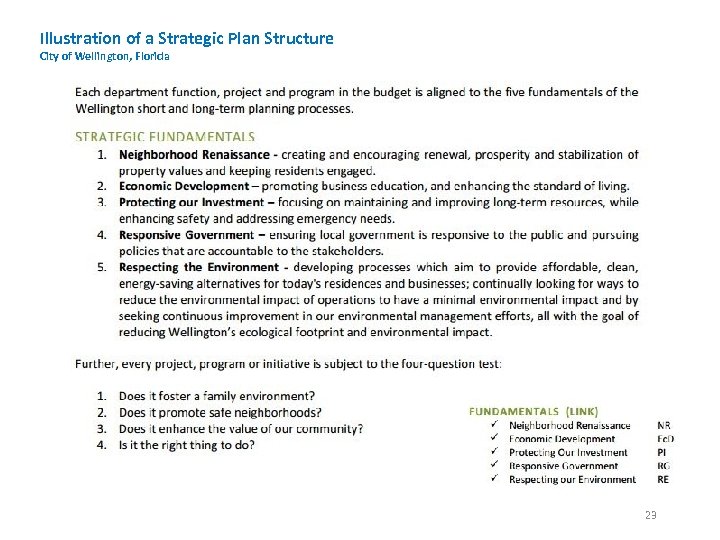
Illustration of a Strategic Plan Structure City of Wellington, Florida 23
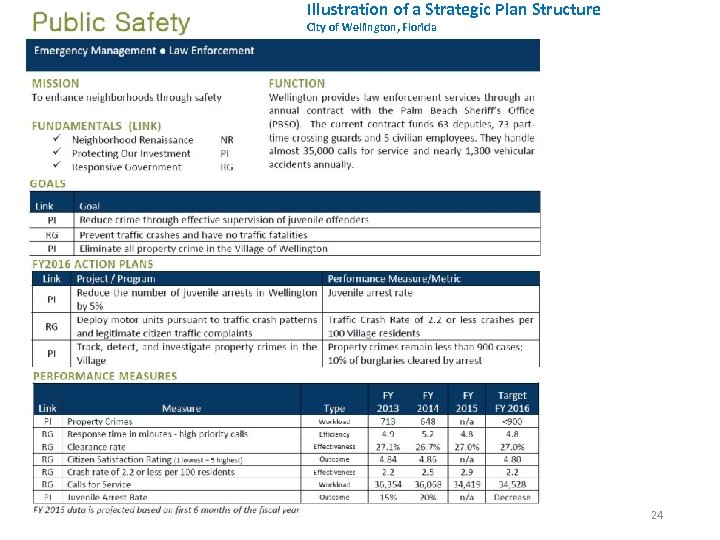
Illustration of a Strategic Plan Structure City of Wellington, Florida 24
Sustainability/durability vs. Keeping Current How long the Plan lasts depends on who embraces it – ensuring that actions and activities are regularly tested against the vision, values and goals reflected in the plan – and whether they remain in place – for example, a Mayor or a City Manager. At the same time, strategies to achieve objectives may fail and need to be replaced, objectives may change as priorities become redefined, and performance measures may be refined. 25
Performance Measures Performance measures, including efficiency and effectiveness measures, should be presented in basic budget materials, including the operating budget document, and should be available to stakeholders. Performance measures should be reported using actual data, where possible. At least some of these measures should document progress toward achievement of previously developed goals and objectives. More formal reviews and documentation of those reviews should be carried out as part of the overall planning, decision-making, and budget process. National Advisory Council on State and Local Budgeting (1998), Recommended Budget Practices: A Framework for Improved State and Local Budgeting 26
Performance Measures Types of performance measures: • • • Inputs (what we budget) Outputs produced Efficiency – unit cost or timeframe Effectiveness – a measure of quality Outcomes/results Outcomes are the most meaningful to our clients (but outputs are frequently mistaken as outcomes). We can be both inefficient and ineffective, but as we improve in both areas, we reach a point where we can improve one at the expense of the other. Disclosure: People disagree on terminology. 27
Benchmarking Opportunities • • • Florida Benchmarking Consortium International City/County Management Association (ICMA) Professional associations Industry leader – the best in a functional area Comparable community A challenge with any approach is normalizing data – i. e. , agreeing on what and how to measure so that your data is comparable to others’ data. Participants in formal benchmarking groups spend extensive time on this as each new measure is adopted. Retaining the momentum – collecting the data, retaining documentation, and reporting – requires dedication. 28
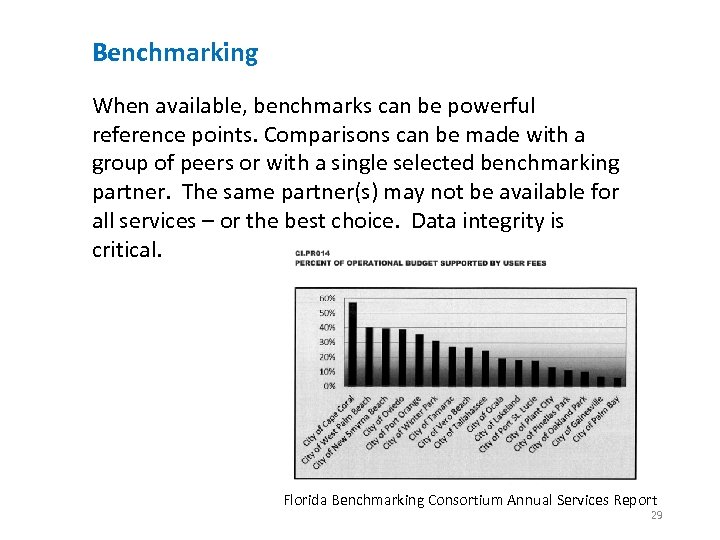
Benchmarking When available, benchmarks can be powerful reference points. Comparisons can be made with a group of peers or with a single selected benchmarking partner. The same partner(s) may not be available for all services – or the best choice. Data integrity is critical. Florida Benchmarking Consortium Annual Services Report 29
Can we compare against others? The case for common definitions. Benchmarking against other jurisdictions provides context. In the case of library services, the Public Libraries Survey is a voluntary survey conducted annually in accordance with the Museum and Library Services Act of 2003, and the U. S. Census Bureau is the data collection agent. Comparisons such as this one cannot be made unless either common definitions are used or data can be converted to a comparable form. 9, 091 libraries were surveyed in 2013, as published in this 2016 report. 30
Usability of Performance Measures: Frequency/timeliness, understandability, measurement Is the data worth the effort/cost to collect it? § Is it electronically or manually collected? § How is documentation retained? § Is it available daily, weekly, monthly, annually? With how much of a lag? § How will it be used: budget process, budget document, employee evaluations, reallocation of resources, web site? § Who will understand what it reflects? Audit and verification of measures? § How easy can the data and methodology be verified? Is it even collected or simply estimated? § Is there a formal audit process in place? 31
Illustration of Auditing Performance Measures Texas State Auditor Report Number 14 -032 The Department of Aging and Disability Services (Department) reported reliable results for two of the four key performance measures tested for fiscal year 2013. A performance measure result is considered reliable if it is certified or certified with qualification. Two key performance measures tested for fiscal year 2013 were certified with qualification. The reported results for one key performance measure were inaccurate for fiscal year 2013 because the local authorities with which the Department contracted did not retain the required identification of preference forms for 4 (6. 67 percent) of 60 items tested. Factors prevented certification of a key performance measure for fiscal year 2013 because the Department: - Did not retain required supporting documentation. - Deviated from the performance measure definition. For all four performance measures tested, the Department did not have complete policies and procedures for calculating and reporting the performance measures. In addition, while the Department maintained evidence of performing a documented review of performance measure data, the Department did not have policies and procedures requiring that review. In addition, for two performance measures tested, the performance measure definitions contain outdated and incorrect data sources and calculation methodologies that are not consistent with how the Department actually calculates the reported results. 32
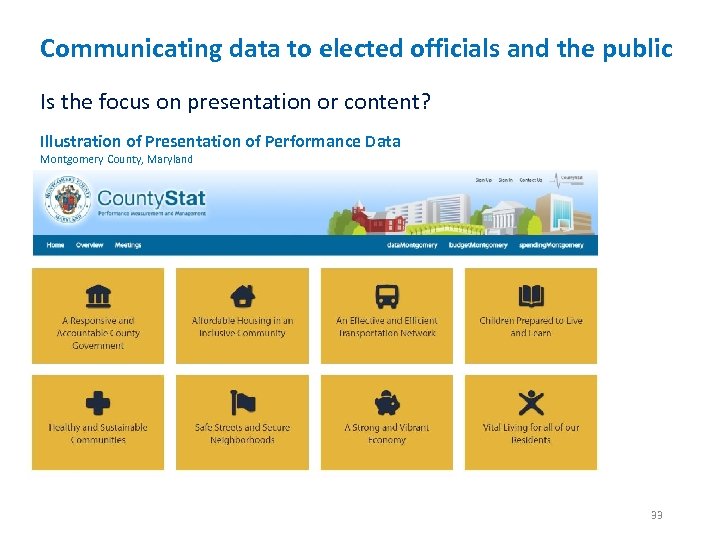
Communicating data to elected officials and the public Is the focus on presentation or content? Illustration of Presentation of Performance Data Montgomery County, Maryland 33
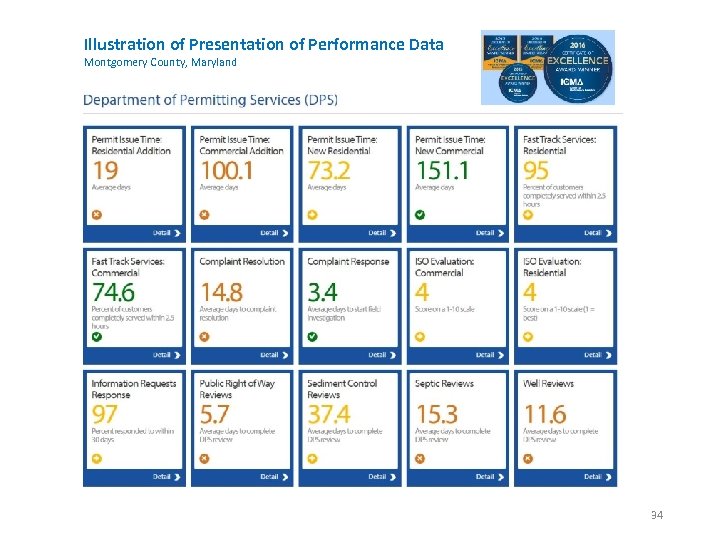
Illustration of Presentation of Performance Data Montgomery County, Maryland 34
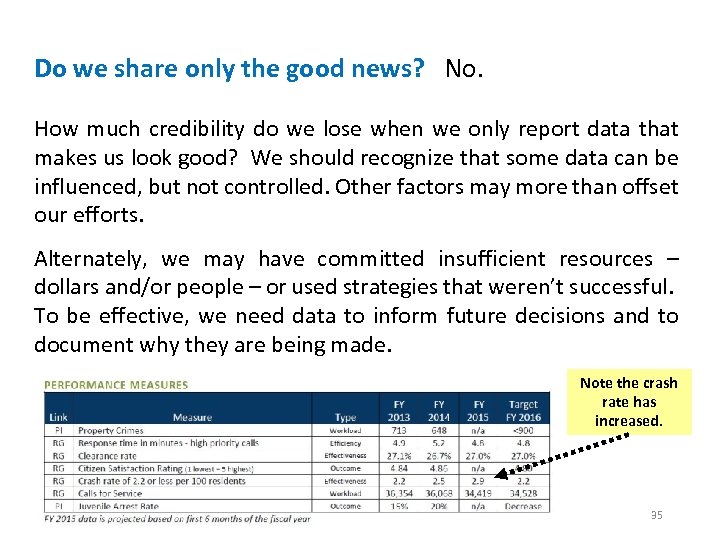
Do we share only the good news? No. How much credibility do we lose when we only report data that makes us look good? We should recognize that some data can be influenced, but not controlled. Other factors may more than offset our efforts. Alternately, we may have committed insufficient resources – dollars and/or people – or used strategies that weren’t successful. To be effective, we need data to inform future decisions and to document why they are being made. Note the crash rate has increased. 35
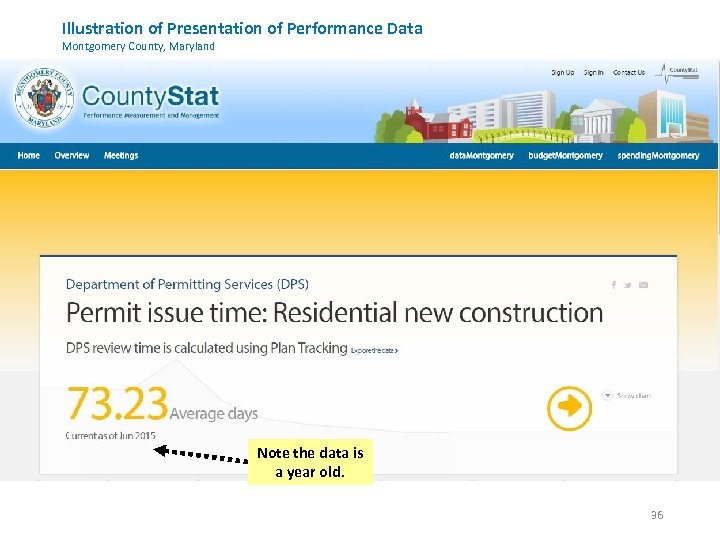
Illustration of Presentation of Performance Data Montgomery County, Maryland Note the data is a year old. 36
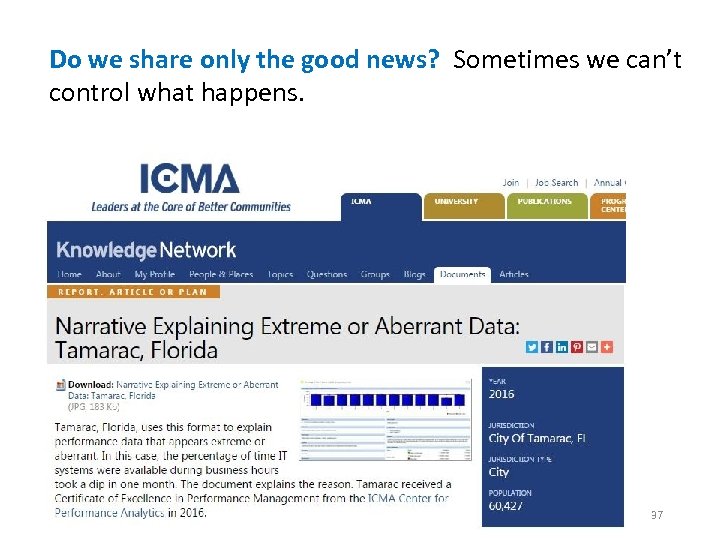
Do we share only the good news? Sometimes we can’t control what happens. 37
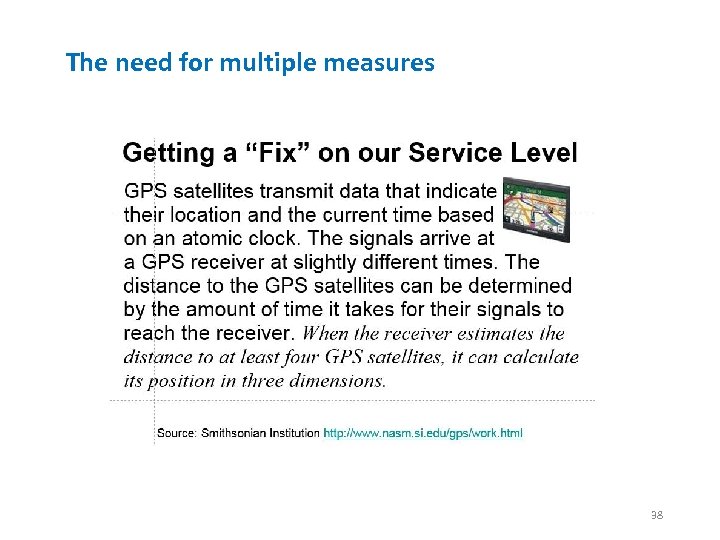
The need for multiple measures 38
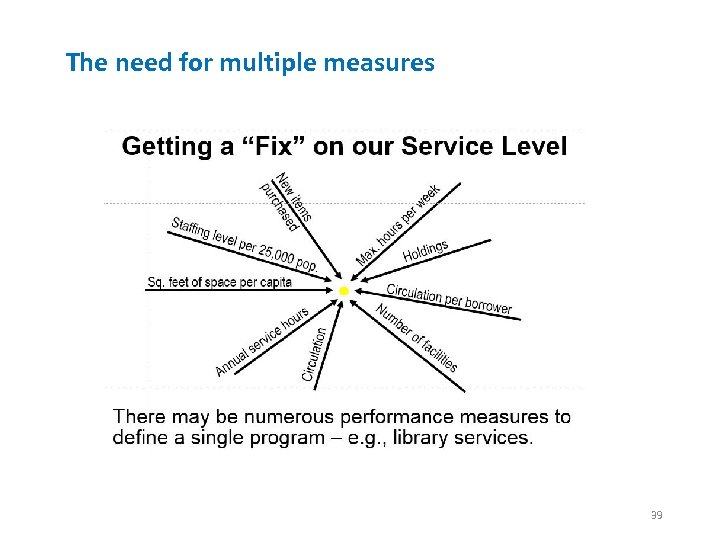
The need for multiple measures 39
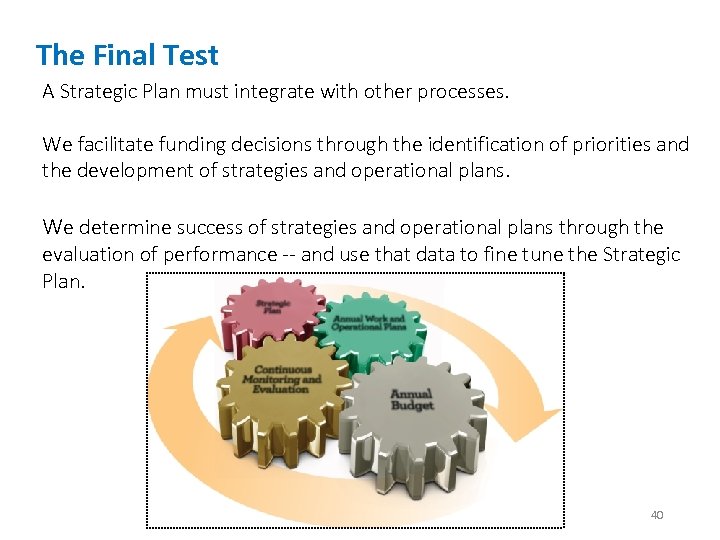
The Final Test A Strategic Plan must integrate with other processes. We facilitate funding decisions through the identification of priorities and the development of strategies and operational plans. We determine success of strategies and operational plans through the evaluation of performance -- and use that data to fine tune the Strategic Plan. 40
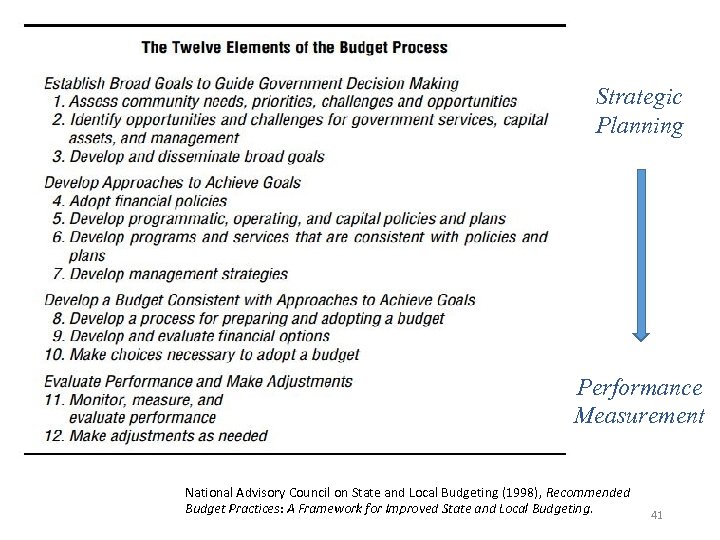
Strategic Planning Performance Measurement National Advisory Council on State and Local Budgeting (1998), Recommended Budget Practices: A Framework for Improved State and Local Budgeting. 41
Скачать презентацию The FGFOA Free Internet Based Webinar Series presents
668c65adb1b8bd7129054bf2801d80eb.ppt