


 Скачать презентацию The Fed and Money Supply Lecture 16 Jennifer
f79d35447578023b1fe3735834e50c18.ppt
- Количество слайдов: 32
 The Fed and Money Supply Lecture 16 Jennifer P. Wissink © 2017 Jennifer P. Wissink, all rights reserved. October 19, 2017
 Announcements: MACRO Fall 2017 u Make-Up Exam Registration Forms – Don’t forget to submit form for Prelim 2 if you need to. – Prelim 2 is two weeks from today! Yikes! u Upcoming MEL Quiz Due Dates – please take note. – Quiz#07 due 10/24 at 10 am – Quiz#08 due 10/31 at 10 am – Quiz#09 due 11/2 at 10 am » this one you can only do once, and you can review immediately once you submit » It is a review of chapters 8 -10. Everyone is welcomed to do it and grab more points towards the magic number of 600. u Prelim 2 will cover from where we left off for Prelim 1 through chapter 10. – Probably up thru and including lecture on Oct 31.
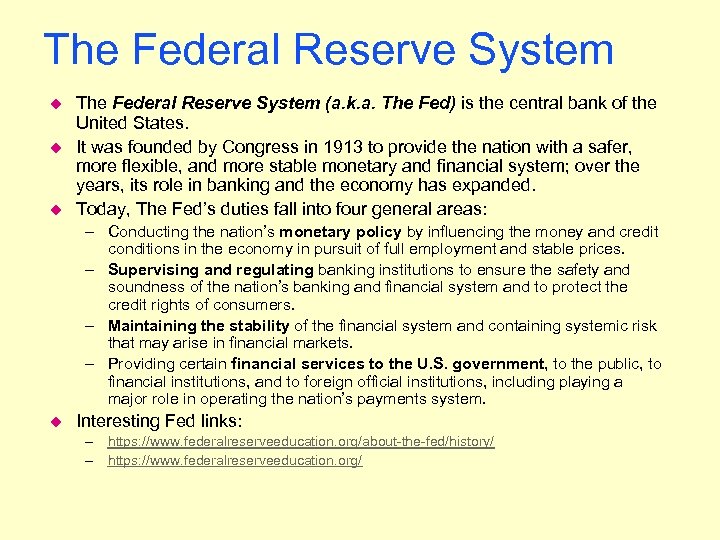 The Federal Reserve System u u u The Federal Reserve System (a. k. a. The Fed) is the central bank of the United States. It was founded by Congress in 1913 to provide the nation with a safer, more flexible, and more stable monetary and financial system; over the years, its role in banking and the economy has expanded. Today, The Fed’s duties fall into four general areas: – Conducting the nation’s monetary policy by influencing the money and credit conditions in the economy in pursuit of full employment and stable prices. – Supervising and regulating banking institutions to ensure the safety and soundness of the nation’s banking and financial system and to protect the credit rights of consumers. – Maintaining the stability of the financial system and containing systemic risk that may arise in financial markets. – Providing certain financial services to the U. S. government, to the public, to financial institutions, and to foreign official institutions, including playing a major role in operating the nation’s payments system. u Interesting Fed links: – https: //www. federalreserveeducation. org/about-the-fed/history/ – https: //www. federalreserveeducation. org/
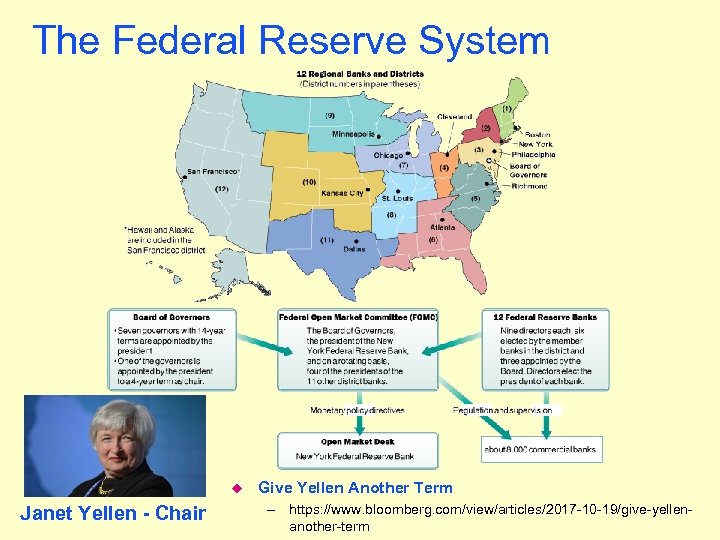 The Federal Reserve System u Janet Yellen - Chair Give Yellen Another Term – https: //www. bloomberg. com/view/articles/2017 -10 -19/give-yellenanother-term
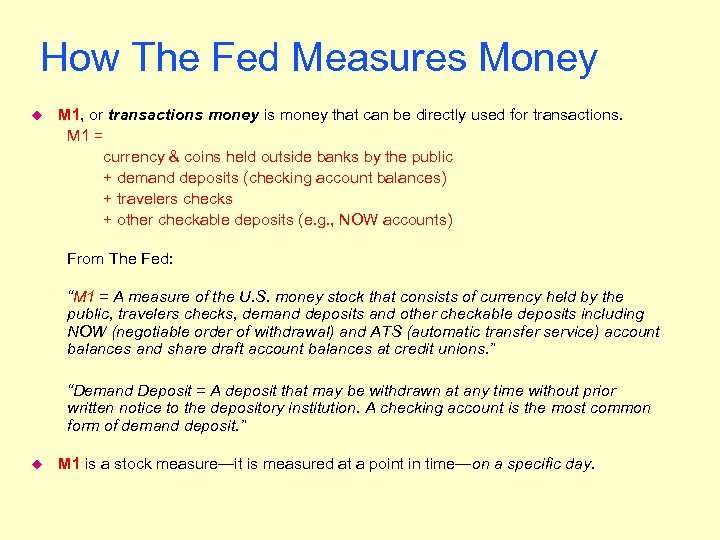 How The Fed Measures Money u M 1, or transactions money is money that can be directly used for transactions. M 1 = currency & coins held outside banks by the public + demand deposits (checking account balances) + travelers checks + other checkable deposits (e. g. , NOW accounts) From The Fed: “M 1 = A measure of the U. S. money stock that consists of currency held by the public, travelers checks, demand deposits and other checkable deposits including NOW (negotiable order of withdrawal) and ATS (automatic transfer service) account balances and share draft account balances at credit unions. ” “Demand Deposit = A deposit that may be withdrawn at any time without prior written notice to the depository institution. A checking account is the most common form of demand deposit. ” u M 1 is a stock measure—it is measured at a point in time—on a specific day.
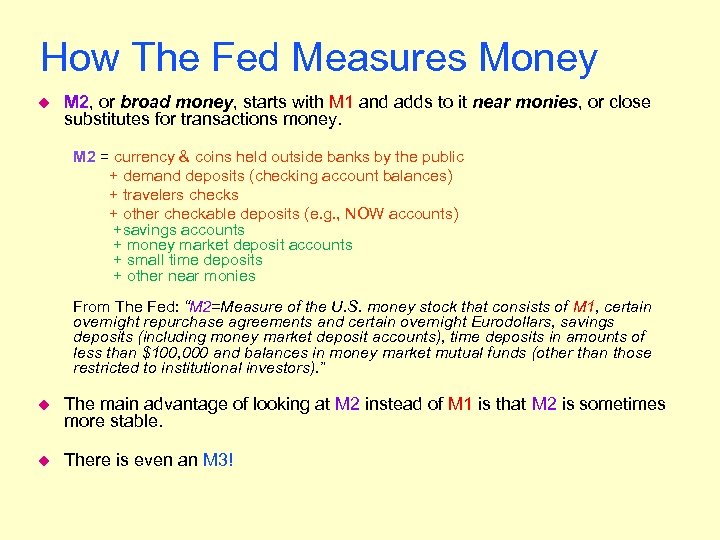 How The Fed Measures Money u M 2, or broad money, starts with M 1 and adds to it near monies, or close substitutes for transactions money. M 2 = currency & coins held outside banks by the public + demand deposits (checking account balances) + travelers checks + other checkable deposits (e. g. , NOW accounts) +savings accounts + money market deposit accounts + small time deposits + other near monies From The Fed: “M 2=Measure of the U. S. money stock that consists of M 1, certain overnight repurchase agreements and certain overnight Eurodollars, savings deposits (including money market deposit accounts), time deposits in amounts of less than $100, 000 and balances in money market mutual funds (other than those restricted to institutional investors). ” u The main advantage of looking at M 2 instead of M 1 is that M 2 is sometimes more stable. u There is even an M 3!
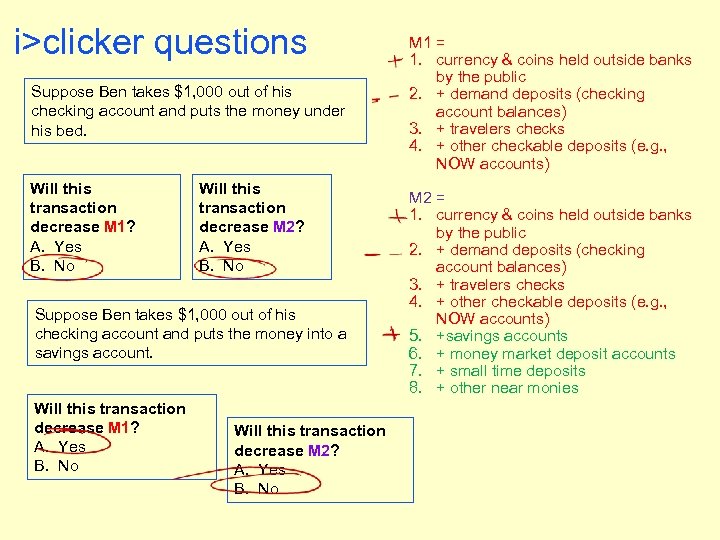 i>clicker questions Suppose Ben takes $1, 000 out of his checking account and puts the money under his bed. Will this transaction decrease M 1? A. Yes B. No Will this transaction decrease M 2? A. Yes B. No Suppose Ben takes $1, 000 out of his checking account and puts the money into a savings account. Will this transaction decrease M 1? A. Yes B. No Will this transaction decrease M 2? A. Yes B. No M 1 = 1. currency & coins held outside banks by the public 2. + demand deposits (checking account balances) 3. + travelers checks 4. + other checkable deposits (e. g. , NOW accounts) M 2 = 1. currency & coins held outside banks by the public 2. + demand deposits (checking account balances) 3. + travelers checks 4. + other checkable deposits (e. g. , NOW accounts) 5. +savings accounts 6. + money market deposit accounts 7. + small time deposits 8. + other near monies
 The Banking System u Banks want to make profits. u A really brief review of some accounting: Assets – Liabilities = Net Worth, or Assets = Liabilities + Net Worth u A bank’s most important assets are its loans. – Other assets include cash on hand (or vault cash), the bank’s deposits with The Fed and its securities. u A bank’s liabilities are its debts—what it owes. – Deposits are debts owed to the bank’s depositors. – Demand Deposits of the public (DDP) are checking accounts of the public. Westley: I've always been a quick healer. What are our liabilities? Inigo Montoya: There is but one working castle gate, and. . . and it is guarded by 60 men. Westley: And our assets? Inigo Montoya: Your brains, Fezzik's strength, my steel. Westley: I mean, if we only had a wheelbarrow, that would be something. Inigo Montoya: Where we did we put that wheelbarrow the albino had? Fezzik: Over the albino, I think. Westley: Well, why didn't you list that among our assets in the first place?
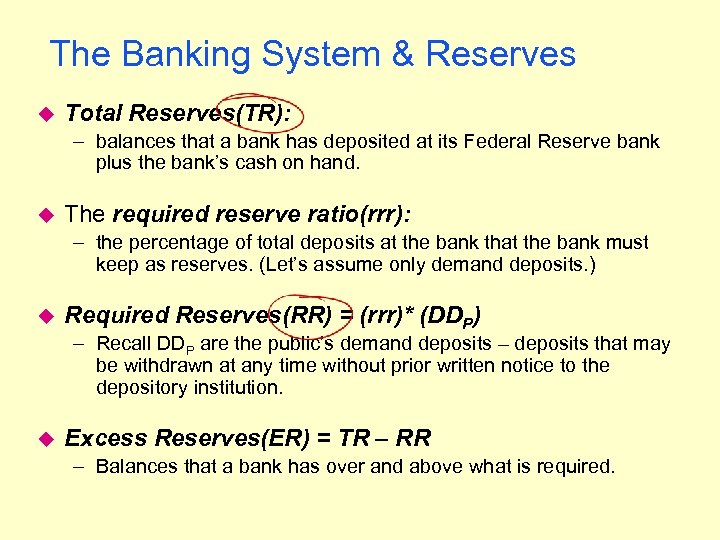 The Banking System & Reserves u Total Reserves(TR): – balances that a bank has deposited at its Federal Reserve bank plus the bank’s cash on hand. u The required reserve ratio(rrr): – the percentage of total deposits at the bank that the bank must keep as reserves. (Let’s assume only demand deposits. ) u Required Reserves(RR) = (rrr)* (DDP) – Recall DDP are the public’s demand deposits – deposits that may be withdrawn at any time without prior written notice to the depository institution. u Excess Reserves(ER) = TR – RR – Balances that a bank has over and above what is required.
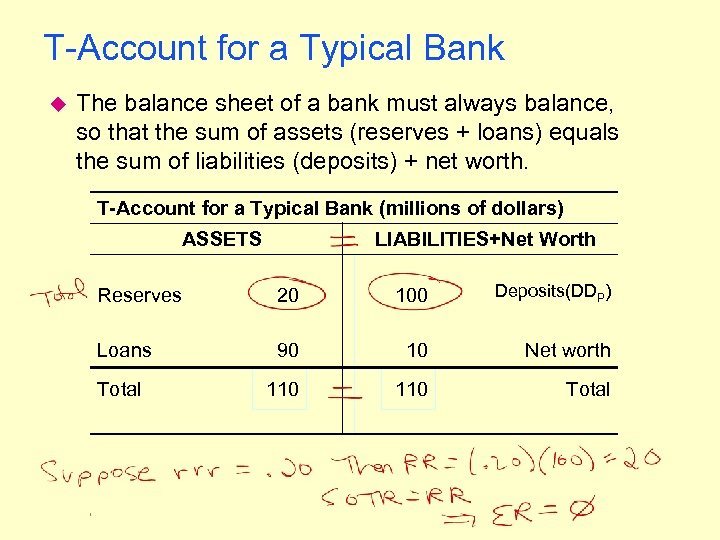 T-Account for a Typical Bank u The balance sheet of a bank must always balance, so that the sum of assets (reserves + loans) equals the sum of liabilities (deposits) + net worth. T-Account for a Typical Bank (millions of dollars) ASSETS LIABILITIES+Net Worth Reserves 20 100 Deposits(DDP) Loans 90 10 Net worth Total 110 Total
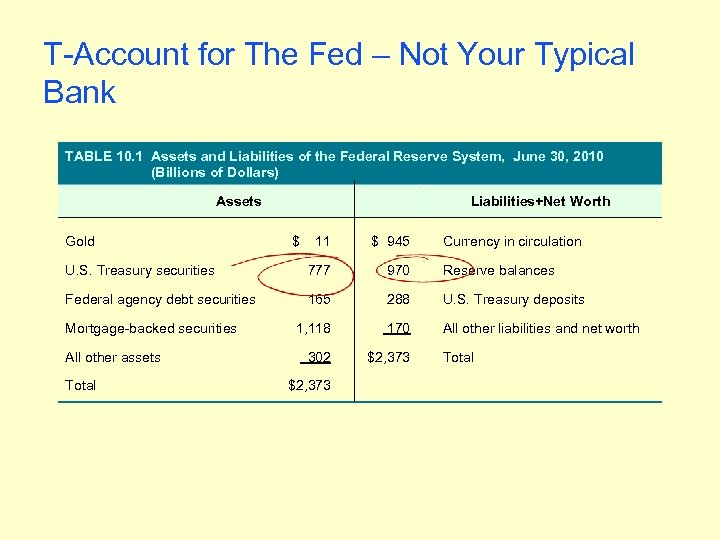 T-Account for The Fed – Not Your Typical Bank TABLE 10. 1 Assets and Liabilities of the Federal Reserve System, June 30, 2010 (Billions of Dollars) Assets Gold Liabilities+Net Worth 11 $ 945 U. S. Treasury securities 777 970 Reserve balances Federal agency debt securities 165 288 U. S. Treasury deposits 1, 118 170 All other liabilities and net worth 302 $2, 373 Mortgage-backed securities All other assets Total $ $2, 373 Currency in circulation Total
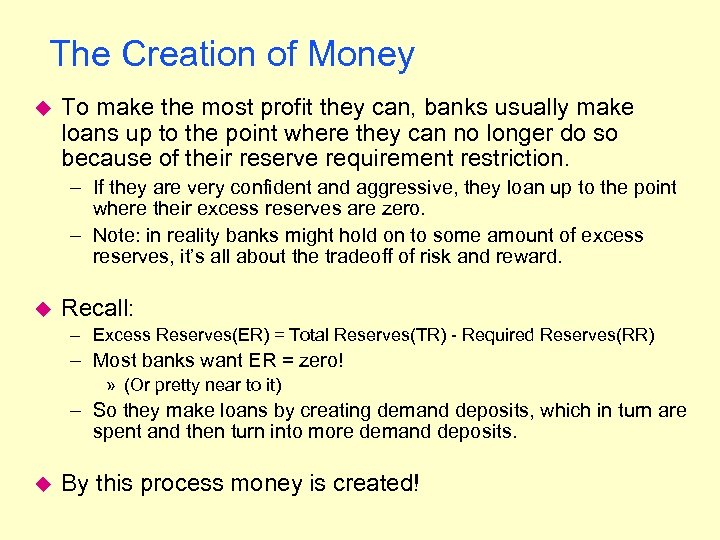 The Creation of Money u To make the most profit they can, banks usually make loans up to the point where they can no longer do so because of their reserve requirement restriction. – If they are very confident and aggressive, they loan up to the point where their excess reserves are zero. – Note: in reality banks might hold on to some amount of excess reserves, it’s all about the tradeoff of risk and reward. u Recall: – Excess Reserves(ER) = Total Reserves(TR) - Required Reserves(RR) – Most banks want ER = zero! » (Or pretty near to it) – So they make loans by creating demand deposits, which in turn are spent and then turn into more demand deposits. u By this process money is created!
 The Creation of Money w/only 1 Monopoly Bank u Suppose Abe has $100 in cash in his piggy bank on his book shelf. – So M 1=$100 + all the rest of everybody else’s stuff u Suppose Abe takes this $100 and deposits it into a checking account he opens at the one and only commercial bank in this economy – 1 st Nat. – So… we now have DDA = $100 in Abe’s name at 1 st Nat. – 1 st Nat deposits the $100 with its central bank. – 1 st Nat now has $100 in total reserves. u Suppose 1 st Nat then makes money off those reserves by making loans to other people, who then spend the money and pay people who ALSO bank at 1 st Nat – the “monopoly” bank. – When 1 st Nat makes someone a loan that person gets a checking account in their name. They immediately spend that money and the person who sold them something puts the money they received in their checking account at 1 st Nat. i>clicker question: Assume the rrr=20%, how much in total DDP can Abe’s $100 in reserves (created by Abe’s initial deposit at 1 st Nat) support? A. B. C. D. E. $100 $200 $300 $400 $500
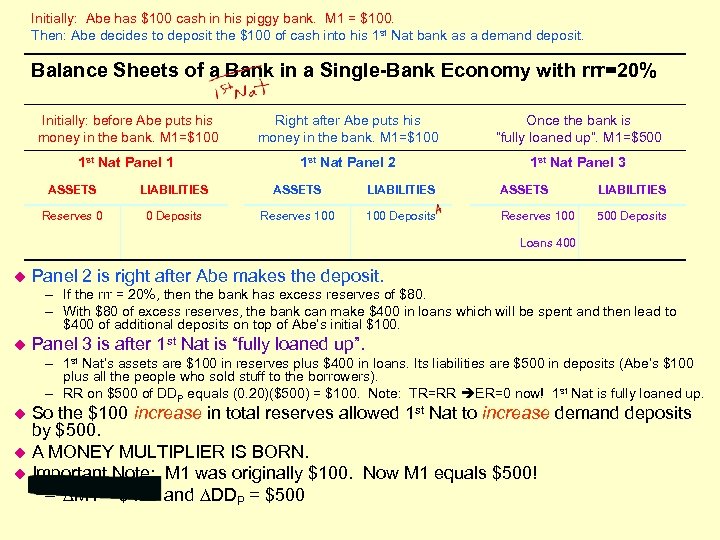 Initially: Abe has $100 cash in his piggy bank. M 1 = $100. Then: Abe decides to deposit the $100 of cash into his 1 st Nat bank as a demand deposit. Balance Sheets of a Bank in a Single-Bank Economy with rrr=20% Initially: before Abe puts his money in the bank. M 1=$100 Right after Abe puts his money in the bank. M 1=$100 Once the bank is “fully loaned up”. M 1=$500 1 st Nat Panel 1 1 st Nat Panel 2 1 st Nat Panel 3 ASSETS LIABILITIES Reserves 0 0 Deposits Reserves 100 500 Deposits Loans 400 u Panel 2 is right after Abe makes the deposit. – If the rrr = 20%, then the bank has excess reserves of $80. – With $80 of excess reserves, the bank can make $400 in loans which will be spent and then lead to $400 of additional deposits on top of Abe’s initial $100. u Panel 3 is after 1 st Nat is “fully loaned up”. – 1 st Nat’s assets are $100 in reserves plus $400 in loans. Its liabilities are $500 in deposits (Abe’s $100 plus all the people who sold stuff to the borrowers). – RR on $500 of DDP equals (0. 20)($500) = $100. Note: TR=RR ER=0 now! 1 st Nat is fully loaned up. So the $100 increase in total reserves allowed 1 st Nat to increase demand deposits by $500. u A MONEY MULTIPLIER IS BORN. u Important Note: M 1 was originally $100. Now M 1 equals $500! – M 1 = $400 and DDP = $500 u
 The Creation of Money – Many banks, Many People u Start with 3 banks – HSBC – Wells Fargo – Citi. Bank u Each bank wants to end the process with zero excess reserves. – Total Reserves = Required Reserves u A bunch of people – People with odd numbers put money in their bank. » Abe is Mr. 1. He is odd. – People with even numbers borrow money from their bank and buy stuff from odd people who immediately put that money in their checking accounts. » Each person is “used” only once.
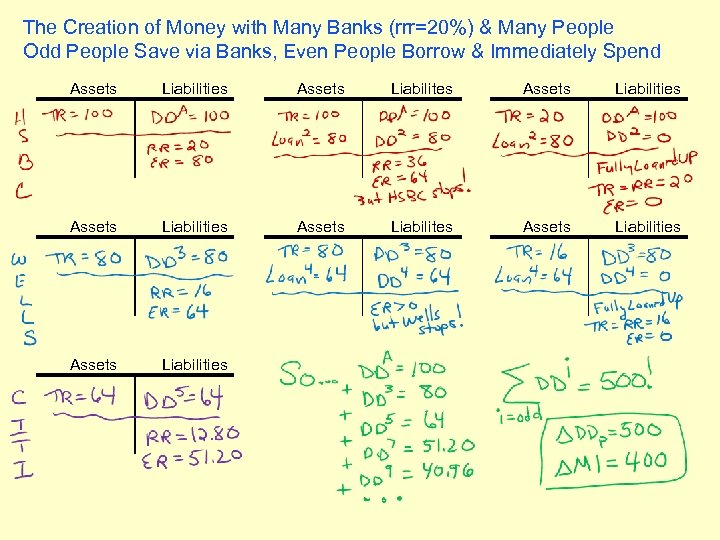 The Creation of Money with Many Banks (rrr=20%) & Many People Odd People Save via Banks, Even People Borrow & Immediately Spend Assets Liabilities Assets Liabilites Assets Liabilities
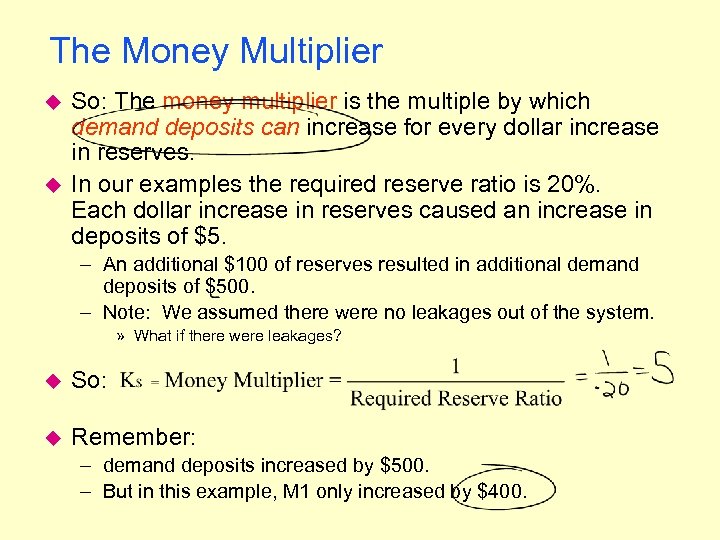 The Money Multiplier u u So: The money multiplier is the multiple by which demand deposits can increase for every dollar increase in reserves. In our examples the required reserve ratio is 20%. Each dollar increase in reserves caused an increase in deposits of $5. – An additional $100 of reserves resulted in additional demand deposits of $500. – Note: We assumed there were no leakages out of the system. » What if there were leakages? u So: u Remember: – demand deposits increased by $500. – But in this example, M 1 only increased by $400.
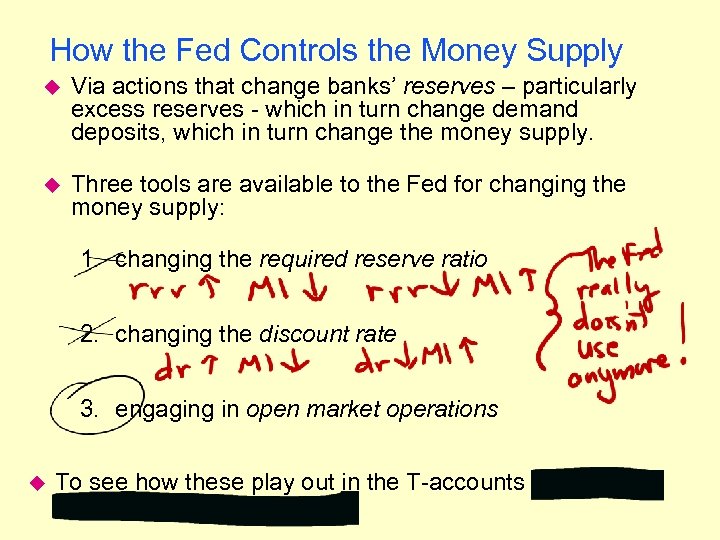 How the Fed Controls the Money Supply u Via actions that change banks’ reserves – particularly excess reserves - which in turn change demand deposits, which in turn change the money supply. u Three tools are available to the Fed for changing the money supply: 1. changing the required reserve ratio 2. changing the discount rate 3. engaging in open market operations u To see how these play out in the T-accounts see “hidden slides” in this Power. Point.
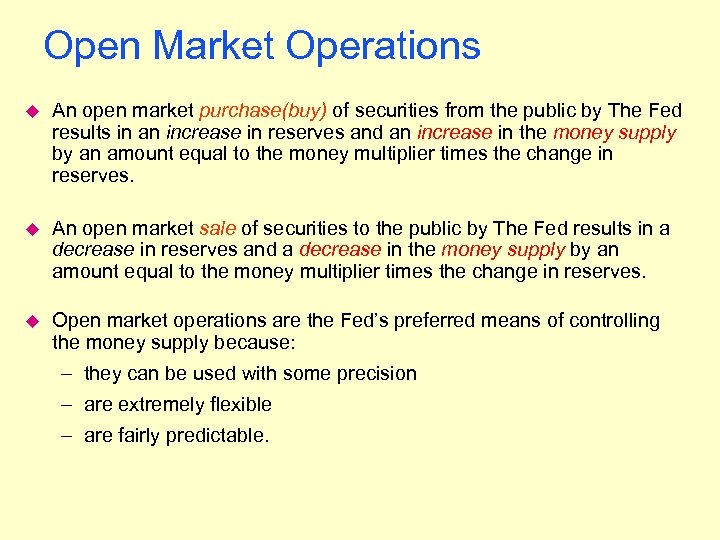
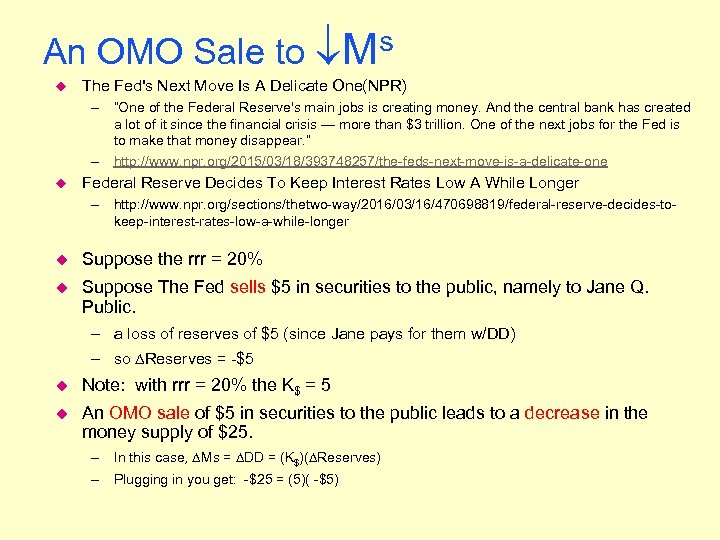
 Open Market Operations u Open market operations are when the Fed purchases(buys) or sells government securities in the open market. u Open market operations are used to expand or contract the amount of reserves in the system and thus alter the money supply. u Open market operations are by far and away the most significant tool of the Fed for controlling the supply of money.
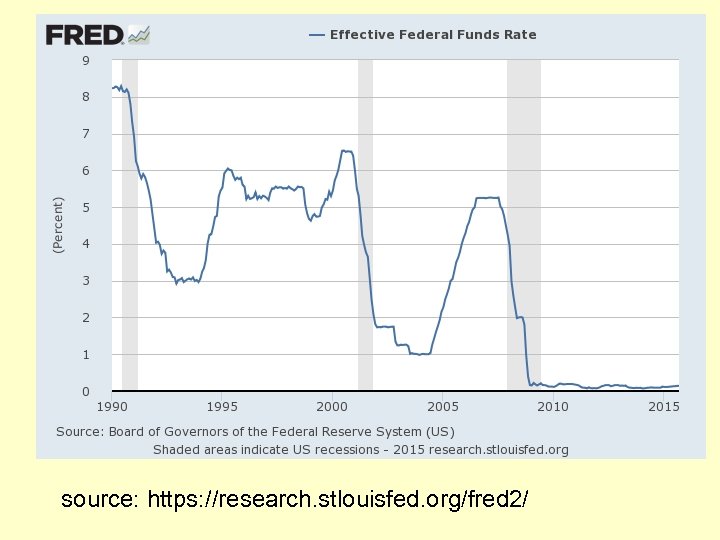
 The Federal Funds Rate & OMO u The Federal Reserve Act specifies that the FOMC should seek "to promote effectively the goals of maximum employment, stable prices, and moderate long-term interest rates. " u At each meeting, the FOMC closely examines a number of indicators of current and prospective economic developments. Then, cognizant that its actions affect economic activity with a lag, it must decide whether to alter the federal funds rate. u By trading government securities, the New York Fed affects the money supply and federal funds rate, which is the interest rate at which depository institutions lend balances to each other overnight. The Federal Open Market Committee establishes the target rate for trading in the federal funds market. u A decrease in the federal funds interest rate stimulates economic growth. u An increase in the federal funds interest rate will curb economic growth.
 source: https: //research. stlouisfed. org/fred 2/
 Open Market Operations u An open market purchase(buy) of securities from the public by The Fed results in an increase in reserves and an increase in the money supply by an amount equal to the money multiplier times the change in reserves. u An open market sale of securities to the public by The Fed results in a decrease in reserves and a decrease in the money supply by an amount equal to the money multiplier times the change in reserves. u Open market operations are the Fed’s preferred means of controlling the money supply because: – they can be used with some precision – are extremely flexible – are fairly predictable.
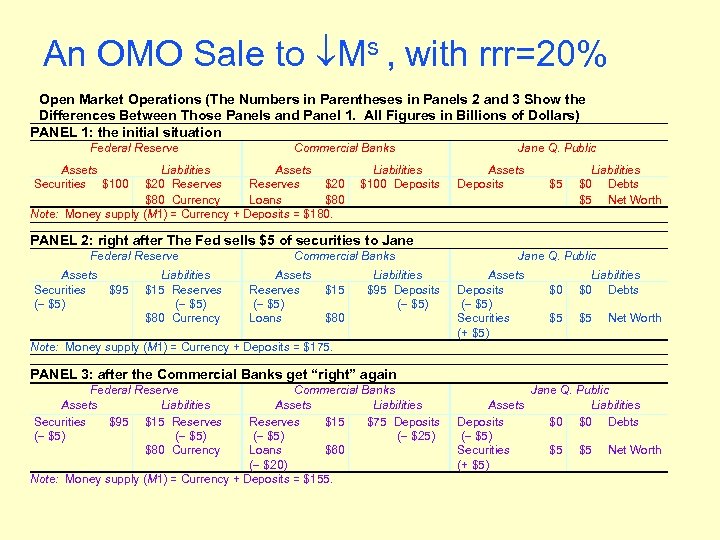
 An OMO Sale to u s M The Fed's Next Move Is A Delicate One(NPR) – “One of the Federal Reserve's main jobs is creating money. And the central bank has created a lot of it since the financial crisis — more than $3 trillion. One of the next jobs for the Fed is to make that money disappear. ” – http: //www. npr. org/2015/03/18/393748257/the-feds-next-move-is-a-delicate-one u Federal Reserve Decides To Keep Interest Rates Low A While Longer – http: //www. npr. org/sections/thetwo-way/2016/03/16/470698819/federal-reserve-decides-tokeep-interest-rates-low-a-while-longer u Suppose the rrr = 20% u Suppose The Fed sells $5 in securities to the public, namely to Jane Q. Public. – a loss of reserves of $5 (since Jane pays for them w/DD) – so Reserves = -$5 u Note: with rrr = 20% the K$ = 5 u An OMO sale of $5 in securities to the public leads to a decrease in the money supply of $25. – In this case, Ms = DD = (K$)( Reserves) – Plugging in you get: -$25 = (5)( -$5)
 An OMO Sale to Ms , with rrr=20% Open Market Operations (The Numbers in Parentheses in Panels 2 and 3 Show the Differences Between Those Panels and Panel 1. All Figures in Billions of Dollars) PANEL 1: the initial situation Federal Reserve Commercial Banks Assets Securities $100 Liabilities Assets $20 Reserves $20 $80 Currency Loans $80 Note: Money supply (M 1) = Currency + Deposits = $180. Liabilities $100 Deposits Jane Q. Public Assets Deposits $5 Liabilities $0 Debts $5 Net Worth PANEL 2: right after The Fed sells $5 of securities to Jane Federal Reserve Assets Securities $95 (- $5) Liabilities $15 Reserves (- $5) $80 Currency Commercial Banks Assets Reserves (- $5) Loans $15 Liabilities $95 Deposits (- $5) $80 Jane Q. Public Assets Deposits (- $5) Securities (+ $5) $0 Liabilities $0 Debts $5 $5 Net Worth Note: Money supply (M 1) = Currency + Deposits = $175. PANEL 3: after the Commercial Banks get “right” again Federal Reserve Assets Liabilities Securities $95 $15 Reserves (- $5) $80 Currency Commercial Banks Assets Liabilities Reserves $15 $75 Deposits (- $5) (- $25) Loans $60 (- $20) Note: Money supply (M 1) = Currency + Deposits = $155. Jane Q. Public Assets Liabilities Deposits $0 $0 Debts (- $5) Securities $5 $5 Net Worth (+ $5)
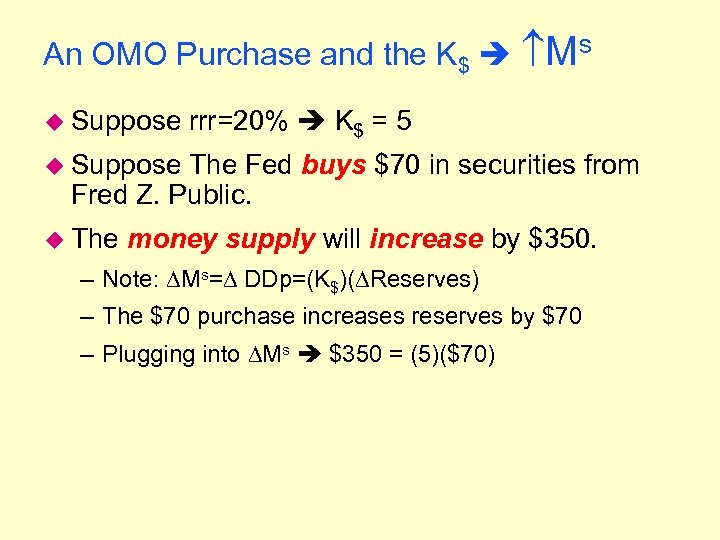 An OMO Purchase and the K$ Ms u Suppose rrr=20% K$ = 5 u Suppose The Fed buys $70 in securities from Fred Z. Public. u The money supply will increase by $350. – Note: Ms= DDp=(K$)( Reserves) – The $70 purchase increases reserves by $70 – Plugging into Ms $350 = (5)($70)
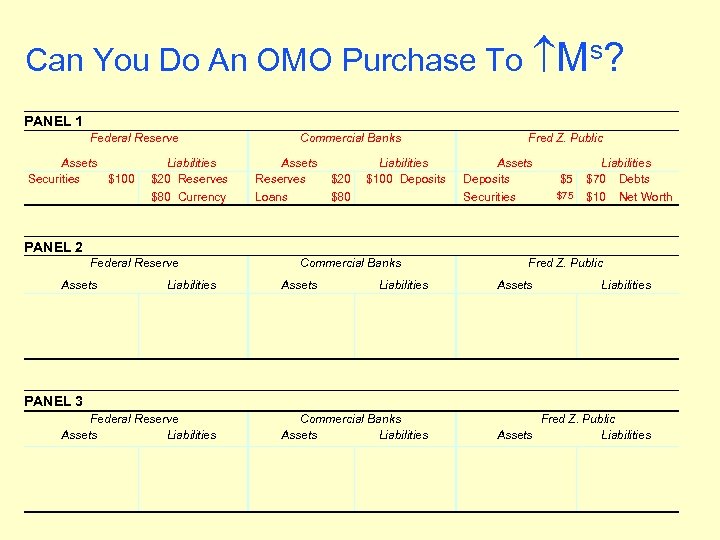 Can You Do An OMO Purchase To Ms? PANEL 1 Federal Reserve Assets Securities $100 Liabilities $20 Reserves $80 Currency Commercial Banks Assets Reserves Loans $20 $80 Liabilities $100 Deposits Fred Z. Public Assets Deposits Securities $5 $75 Liabilities $70 Debts $10 Net Worth PANEL 2 Federal Reserve Assets Liabilities Commercial Banks Assets Liabilities Fred Z. Public Assets Liabilities PANEL 3 Federal Reserve Assets Liabilities Commercial Banks Assets Liabilities Fred Z. Public Assets Liabilities
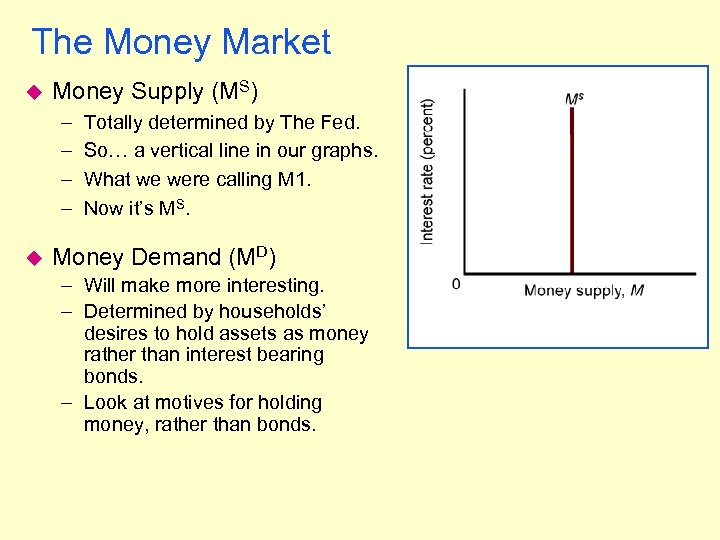 The Money Market u Money Supply (MS) – – u Totally determined by The Fed. So… a vertical line in our graphs. What we were calling M 1. Now it’s MS. Money Demand (MD) – Will make more interesting. – Determined by households’ desires to hold assets as money rather than interest bearing bonds. – Look at motives for holding money, rather than bonds.
 The Demand Function for Money u Simple model that asks: What determines how much of a person’s assets/wealth will be held as non-interest earning balances, i. e. , money? u Note, a households assets include: – money balances » 0 interest and perfectly liquid – bonds/securities » + interest and imperfectly liquid – claims on real capital (physical assets) » most of the time we will ignore this 3 rd category
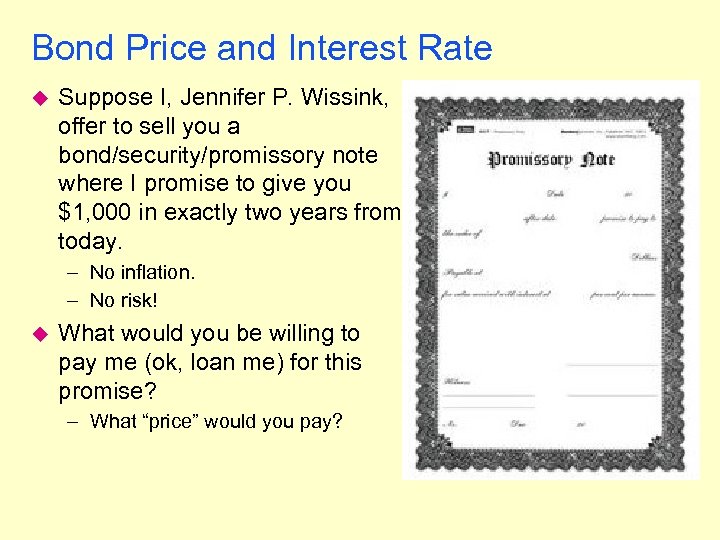 Bond Price and Interest Rate u Suppose I, Jennifer P. Wissink, offer to sell you a bond/security/promissory note where I promise to give you $1, 000 in exactly two years from today. – No inflation. – No risk! u What would you be willing to pay me (ok, loan me) for this promise? – What “price” would you pay?
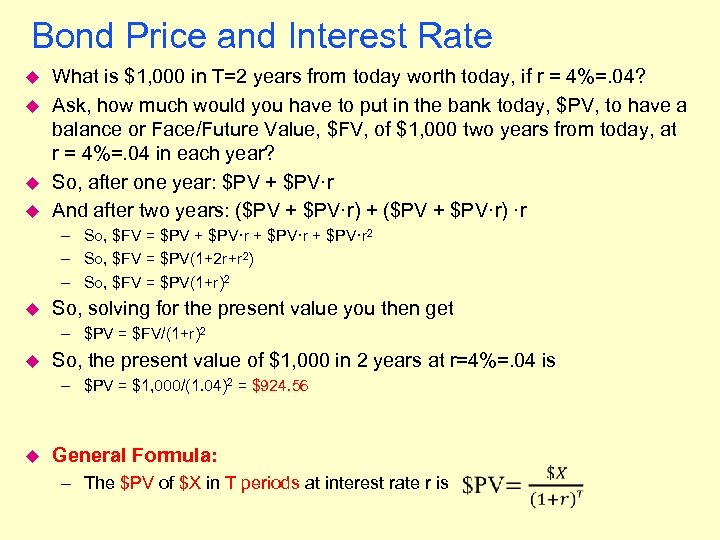 Bond Price and Interest Rate u u What is $1, 000 in T=2 years from today worth today, if r = 4%=. 04? Ask, how much would you have to put in the bank today, $PV, to have a balance or Face/Future Value, $FV, of $1, 000 two years from today, at r = 4%=. 04 in each year? So, after one year: $PV + $PV·r And after two years: ($PV + $PV·r) + ($PV + $PV·r) ·r – So, $FV = $PV + $PV·r 2 – So, $FV = $PV(1+2 r+r 2) – So, $FV = $PV(1+r)2 u So, solving for the present value you then get – $PV = $FV/(1+r)2 u So, the present value of $1, 000 in 2 years at r=4%=. 04 is – $PV = $1, 000/(1. 04)2 = $924. 56 u General Formula: – The $PV of $X in T periods at interest rate r is
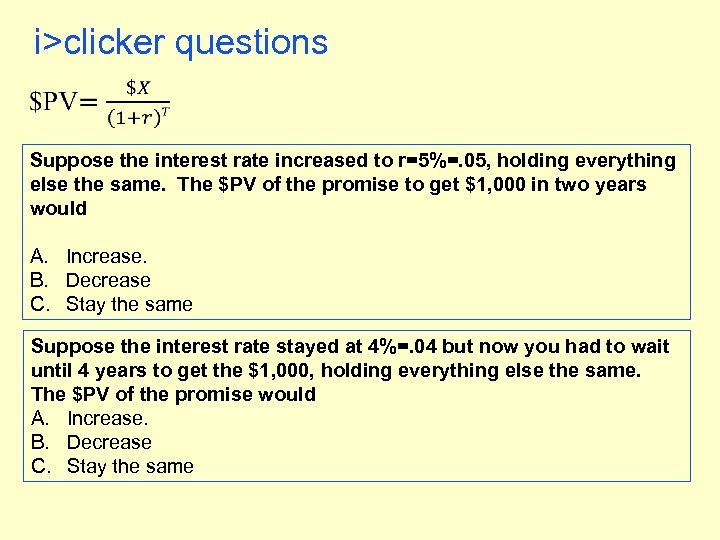 i>clicker questions Suppose the interest rate increased to r=5%=. 05, holding everything else the same. The $PV of the promise to get $1, 000 in two years would A. Increase. B. Decrease C. Stay the same Suppose the interest rate stayed at 4%=. 04 but now you had to wait until 4 years to get the $1, 000, holding everything else the same. The $PV of the promise would A. Increase. B. Decrease C. Stay the same
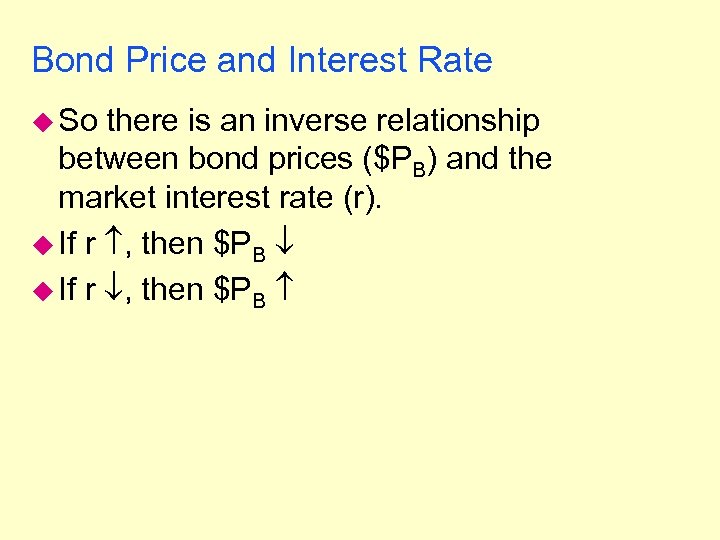 Bond Price and Interest Rate u So there is an inverse relationship between bond prices ($PB) and the market interest rate (r). u If r , then $PB