


 Скачать презентацию The Fall of the Soviet System u
The Fall of the Soviet System.ppt
- Количество слайдов: 51
 The Fall of the Soviet System
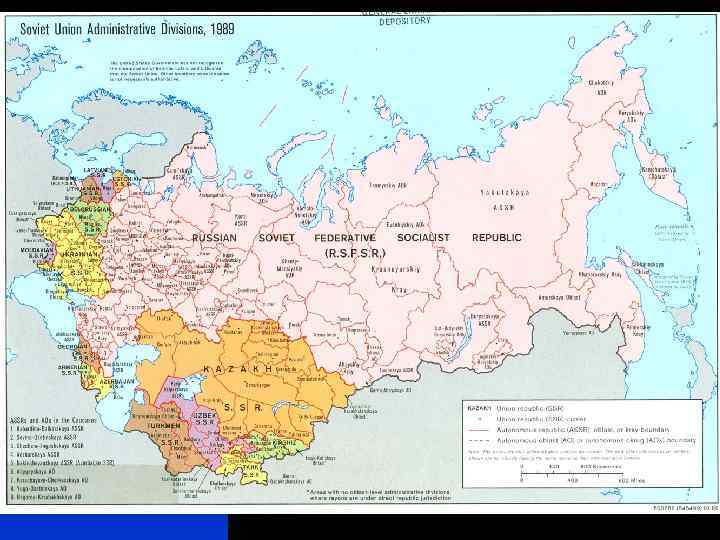
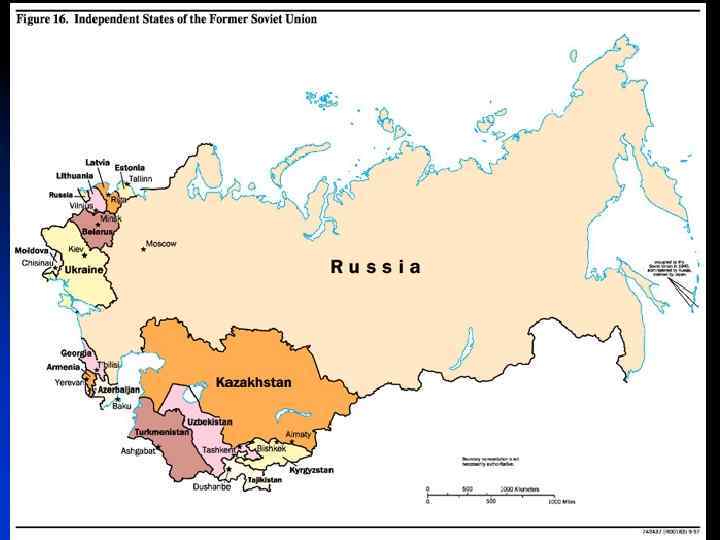
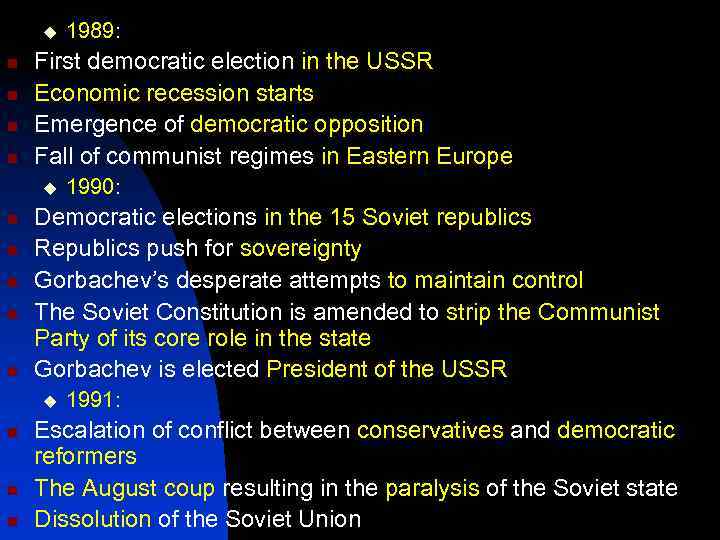 u n n First democratic election in the USSR Economic recession starts Emergence of democratic opposition Fall of communist regimes in Eastern Europe u n n n n 1990: Democratic elections in the 15 Soviet republics Republics push for sovereignty Gorbachev’s desperate attempts to maintain control The Soviet Constitution is amended to strip the Communist Party of its core role in the state Gorbachev is elected President of the USSR u n 1989: 1991: Escalation of conflict between conservatives and democratic reformers The August coup resulting in the paralysis of the Soviet state Dissolution of the Soviet Union
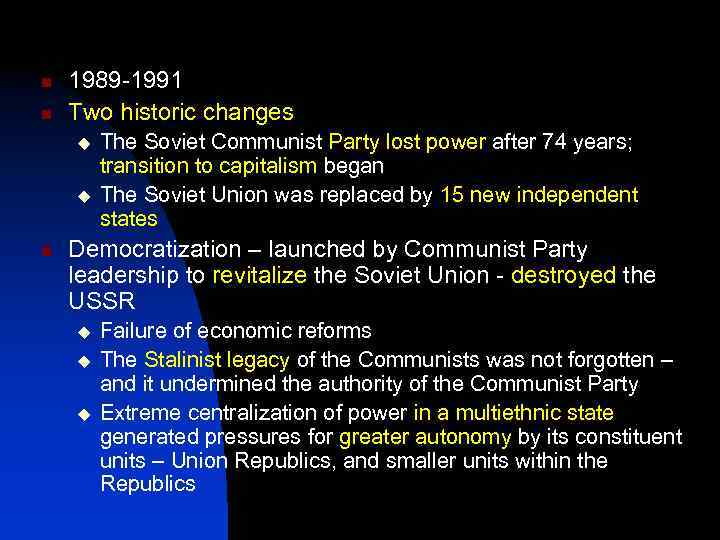 n n 1989 -1991 Two historic changes u u n The Soviet Communist Party lost power after 74 years; transition to capitalism began The Soviet Union was replaced by 15 new independent states Democratization – launched by Communist Party leadership to revitalize the Soviet Union - destroyed the USSR u u u Failure of economic reforms The Stalinist legacy of the Communists was not forgotten – and it undermined the authority of the Communist Party Extreme centralization of power in a multiethnic state generated pressures for greater autonomy by its constituent units – Union Republics, and smaller units within the Republics
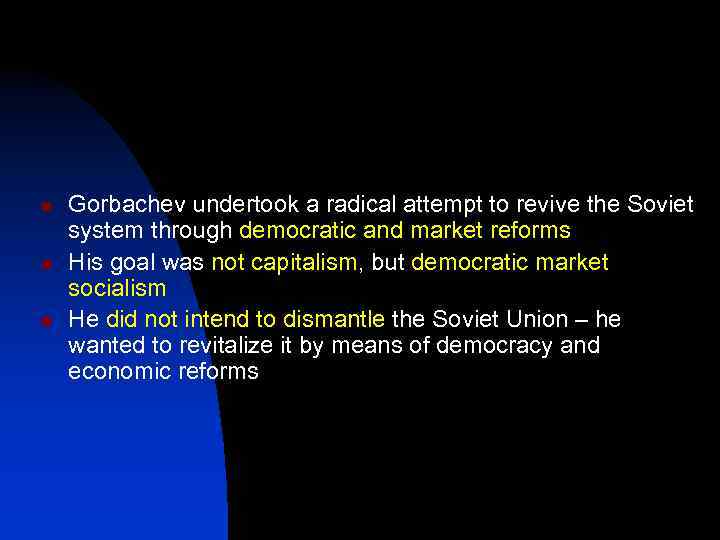 n n n Gorbachev undertook a radical attempt to revive the Soviet system through democratic and market reforms His goal was not capitalism, but democratic market socialism He did not intend to dismantle the Soviet Union – he wanted to revitalize it by means of democracy and economic reforms
 n n The Soviet system was subjected to a test And it failed it Why? Why did the economy go into a crisis as a result of market reforms – instead of booming? u u n Monopoly power in every sector of the economy Dominance of the military-industrial complex New market operators: exchange vs. production Bureaucracy’s determination to control the market forces – either by suppressing them or by using them in their own interests The logic of emerging bureau-capitalism
 n n How to counteract it? The Chinese model: u n This option requires: u u n A strong authoritarian political culture A disciplined and obedient bureaucracy In the Soviet Union: u u n The CP keeps a tight reign over the state, practices market authoritarianism Authoritarian political culture was decayed, desire for democratization was rising The bureaucracy was corrupt, self-serving, and falling out of control The only remaining option: u Open up the political system for popular participation and mobilize the people in support of reform
 n n n Democratizing the state Restore the original democratic power of the Soviets Enable the citizens to take control of the state through democratic procedures u u n n n Are the bureaucrats willing to give up power? Are the people ready to take power? NO and NO Emergence of a political spectrum (conservatives, liberals, democrats, fascists) Policy deadlocks
 n n n The territorial axis The 1990 elections empower regional bureaucracies Nationalism becomes their natural vehicle The unexpected surge of nationalism A natural component of democratization Demand for devolution of power: u u u n n n to Union Republics, to regions within Republics, to cities, to boroughs and villages, etc. The rise of identity politics Clashes over territory, distribution of resources The Union Government is seen by everyone as a target
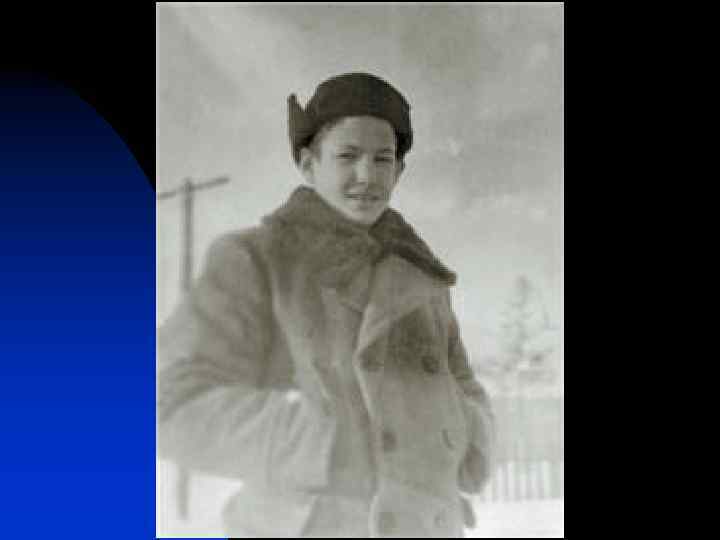
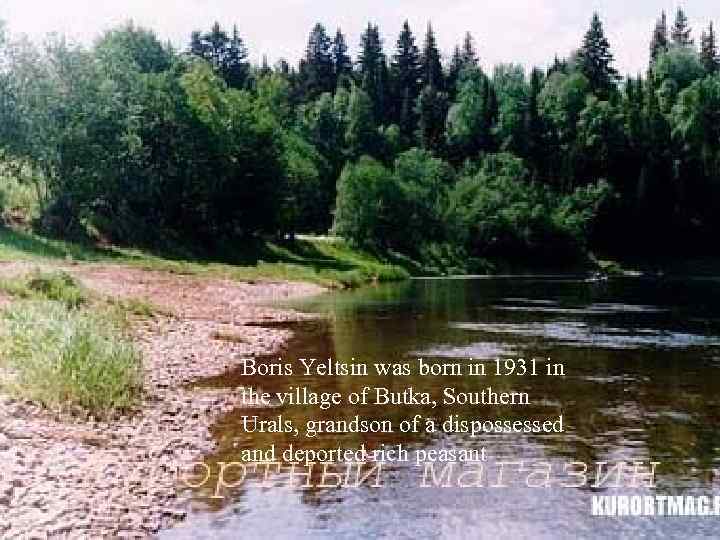 Boris Yeltsin was born in 1931 in the village of Butka, Southern Urals, grandson of a dispossessed and deported rich peasant
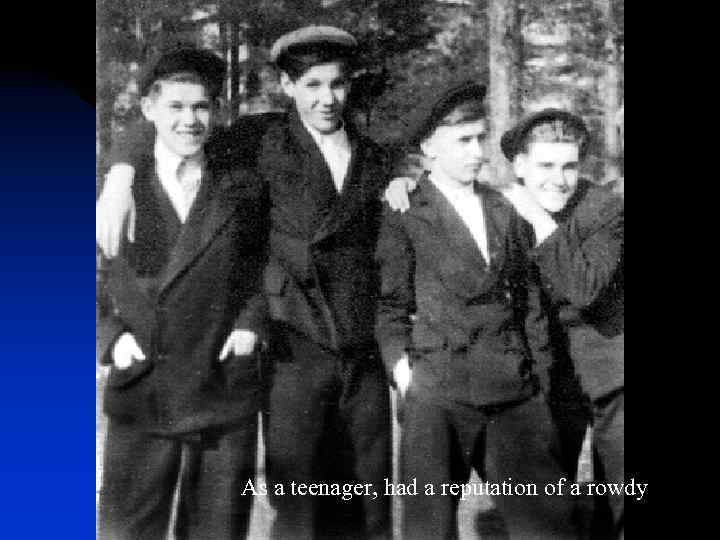 As a teenager, had a reputation of a rowdy
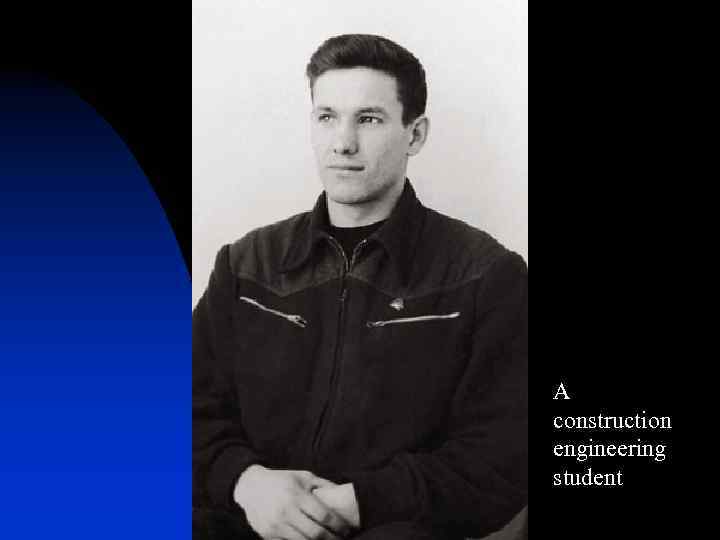 A construction engineering student
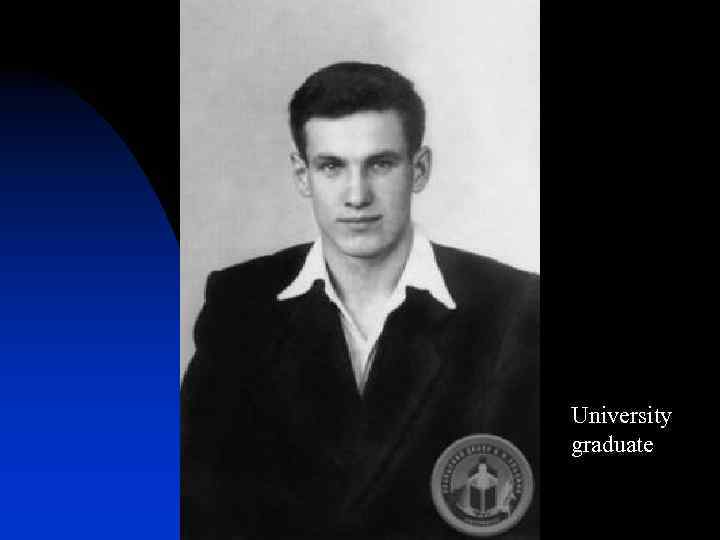 University graduate
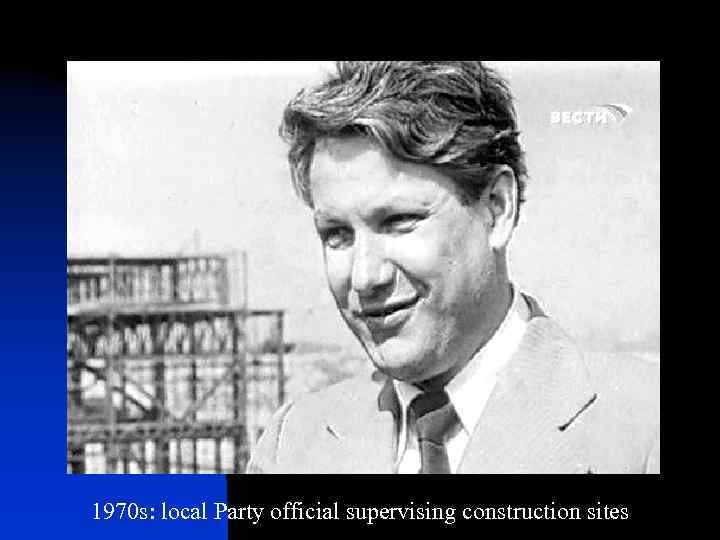 1970 s: local Party official supervising construction sites
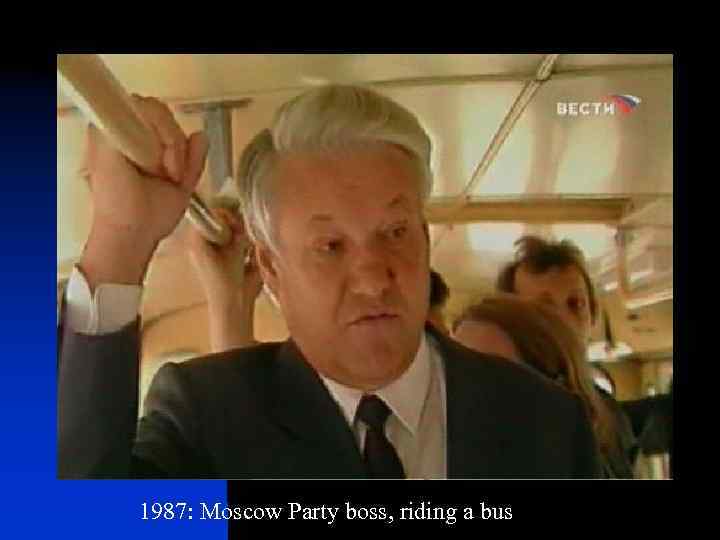 1987: Moscow Party boss, riding a bus
 n n n Jack Matlock, US Ambassador to Moscow, 1987 -1991: “I think he could have kept Yeltsin on the team a lot longer. Undoubtedly at some point Yeltsin, given the chance, would have tried to challenge him, but the best way to head that off would be to use him at least as long as you could and keep him on the team. Instead he opted, fairly early on in the game, to force him out. This left Yeltsin with no option, if he was to get political power, than taking Gorbachev on. http: //globetrotter. berkeley. edu/conversations/Matlock/matl ock-con 6. html
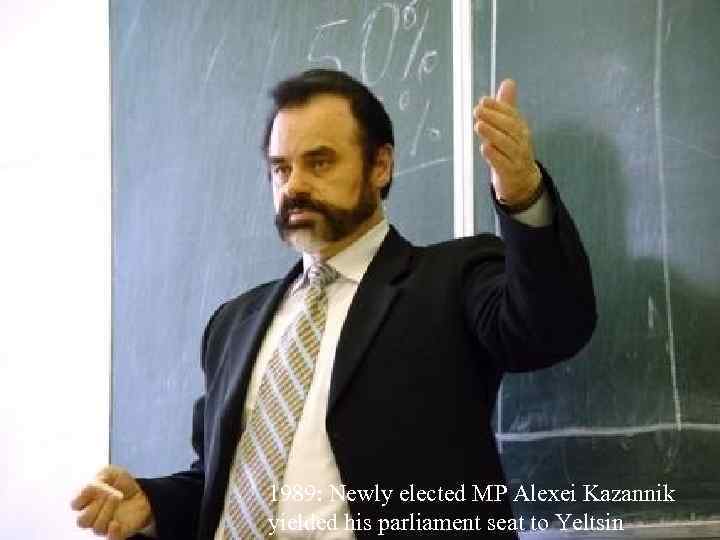 1989: Newly elected MP Alexei Kazannik yielded his parliament seat to Yeltsin
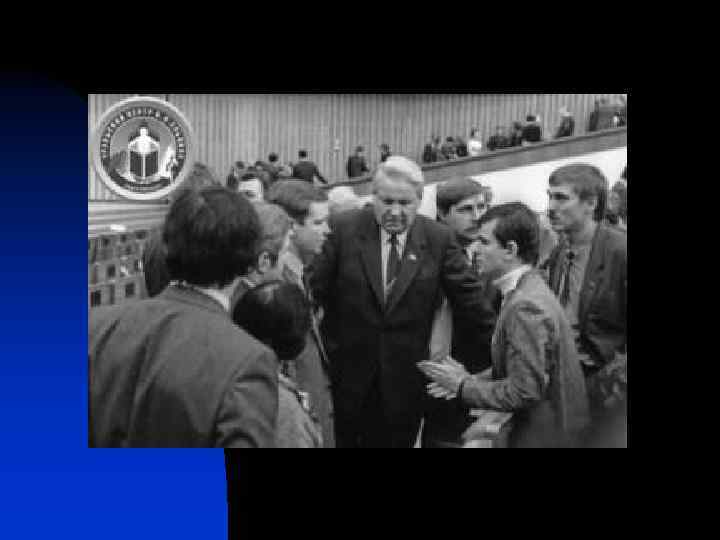
 n n n Decisive turn: March 1990 parliamentary elections in Russia and the other Union Republics Yeltsin and his supporters run on a populist-democratic platform and win control of the Russian parliament (Supreme Soviet of Russia) The Russian Supreme Soviet becomes a vehicle for Yeltsin’s struggle to reduce the power of the Federal Government and launch radical reforms Yeltsin makes alliances with like-minded forces in other Union Republics move to adopt Declarations of Sovereignty
 n n n n n Gorbachev’s maneouvers He is stuck between conservatives, on one side, and radical reformers, on the other September 1990: “ 500 Days” A coherent program of rapid planned transition to a market economy Wide autonomy for Union Republics A chance to save the Union through radical reforms Yeltsin’s parliament endorses it and proposes it to the Union parliament Gorbachev is inclined to support it Fierce opposition from conservatives forces him to adopt a compromise plan
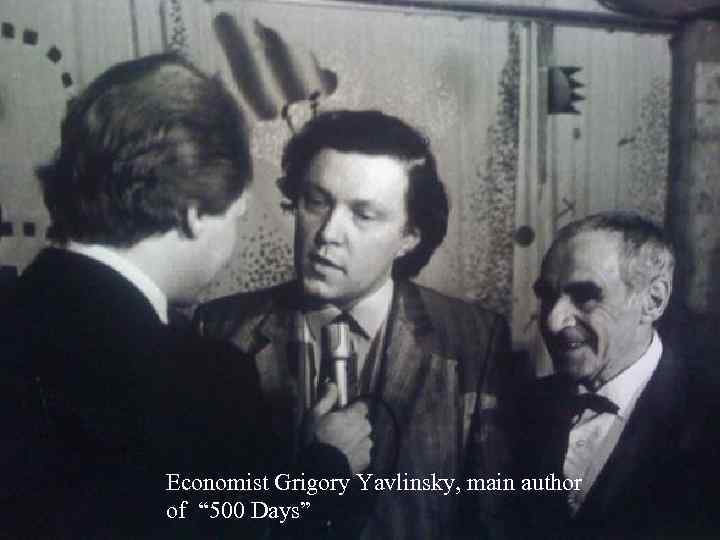 Economist Grigory Yavlinsky, main author of “ 500 Days”
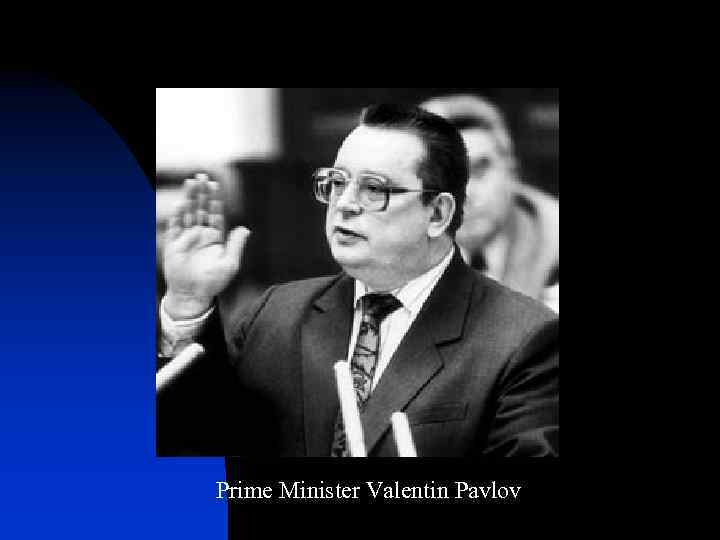 Prime Minister Valentin Pavlov
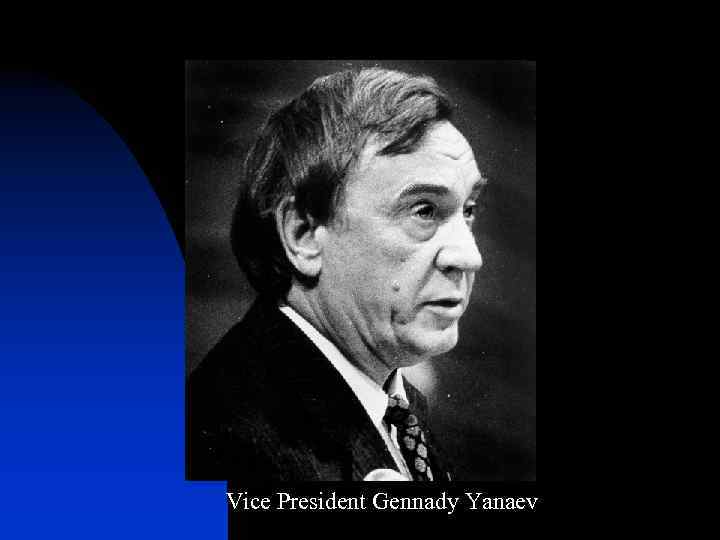 Vice President Gennady Yanaev
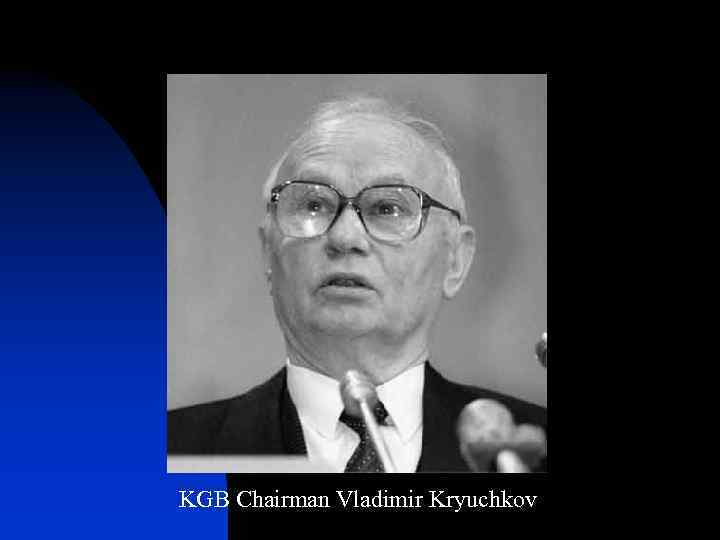 KGB Chairman Vladimir Kryuchkov
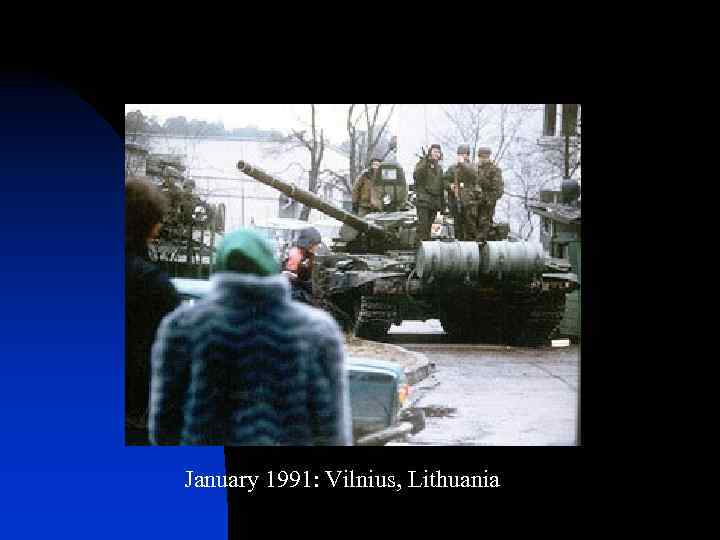 January 1991: Vilnius, Lithuania
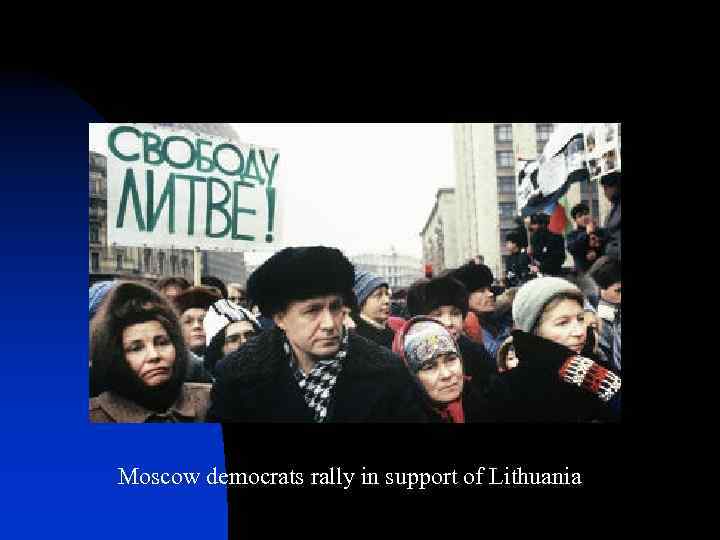 Moscow democrats rally in support of Lithuania
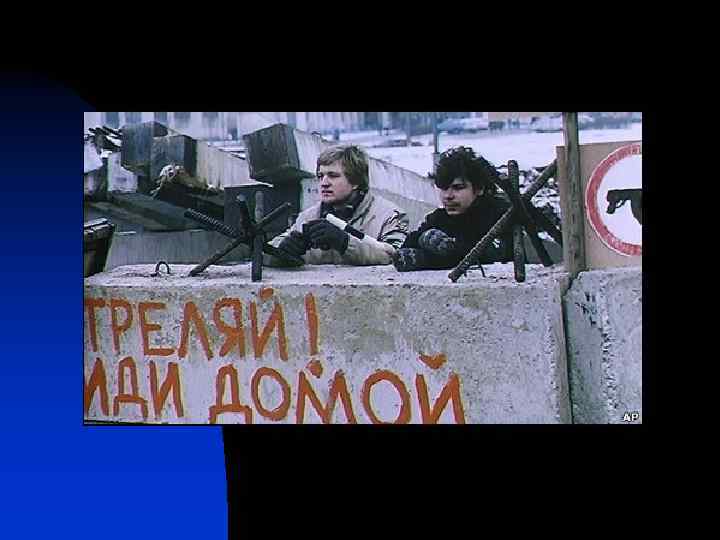
 n n n Spring 1991 Shocked at the bloodshed in Vilnius, and seeing a wave of protests against the attempted crackdown, Gorbachev moves to make an alliance with Yeltsin runs for President of Russia
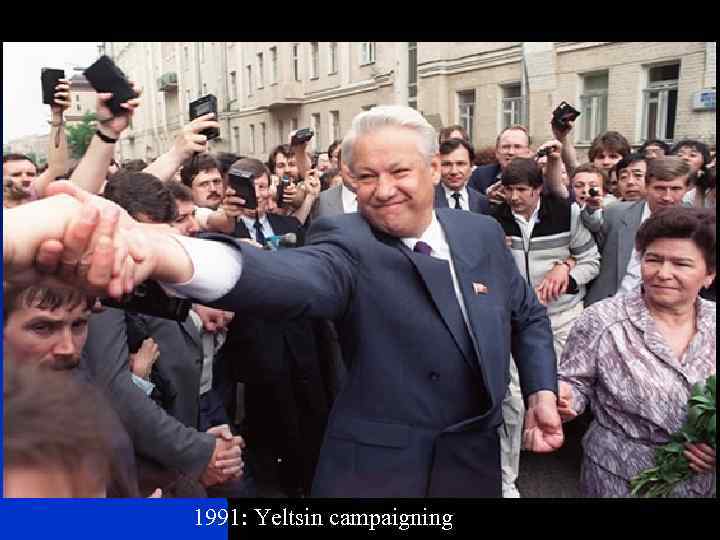 1991: Yeltsin campaigning
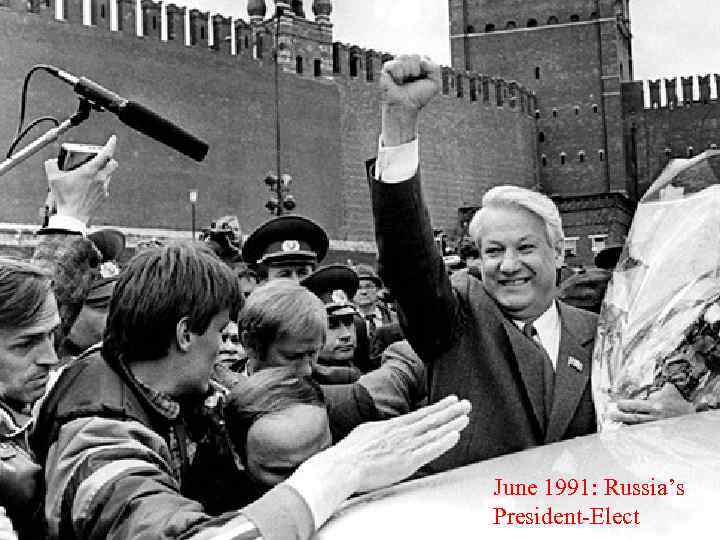 June 1991: Russia’s President-Elect
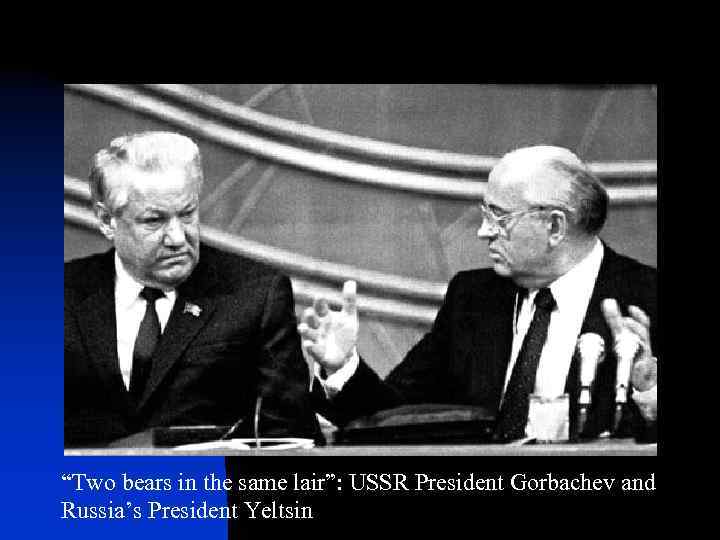 “Two bears in the same lair”: USSR President Gorbachev and Russia’s President Yeltsin
 n n n A new Union Treaty Worked out by Gorbachev’s and Yeltsin’s teams in summer of 1991 To be signed at the end of August 1991
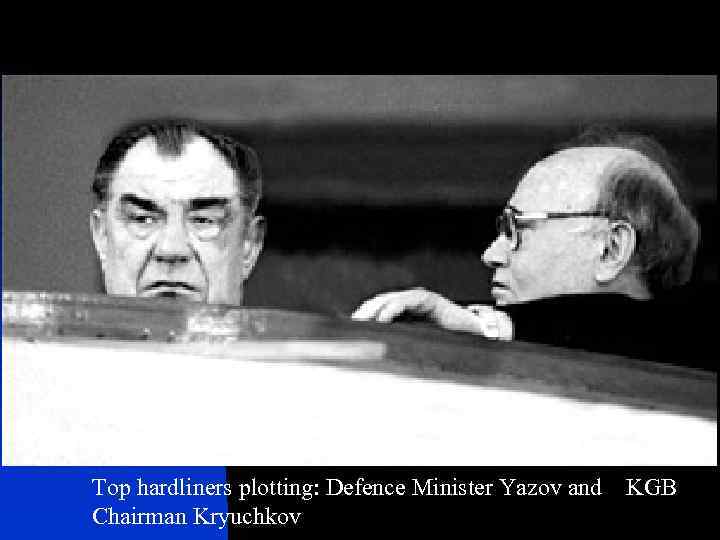 Top hardliners plotting: Defence Minister Yazov and Chairman Kryuchkov KGB
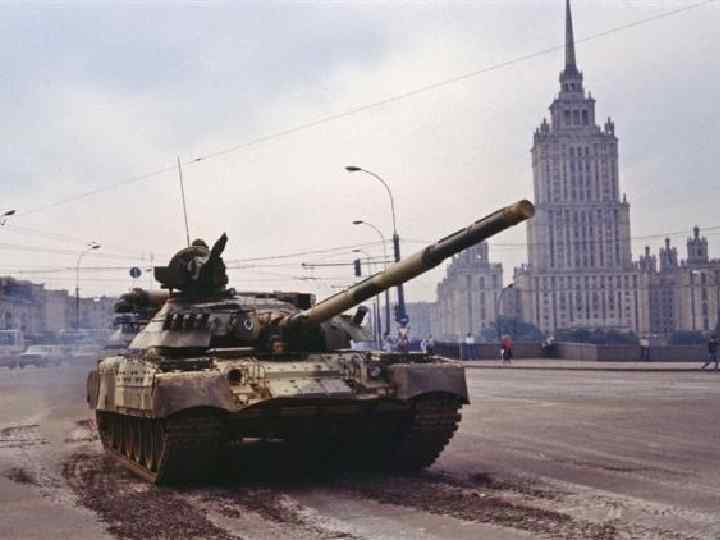
 n n The August 1991 coup: http: //www. youtube. com/watch? v=-XPj 3 d. KYRA
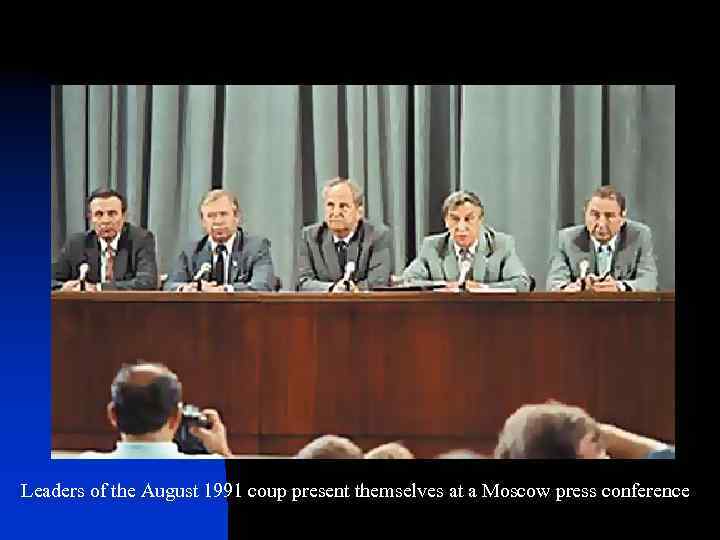 Leaders of the August 1991 coup present themselves at a Moscow press conference
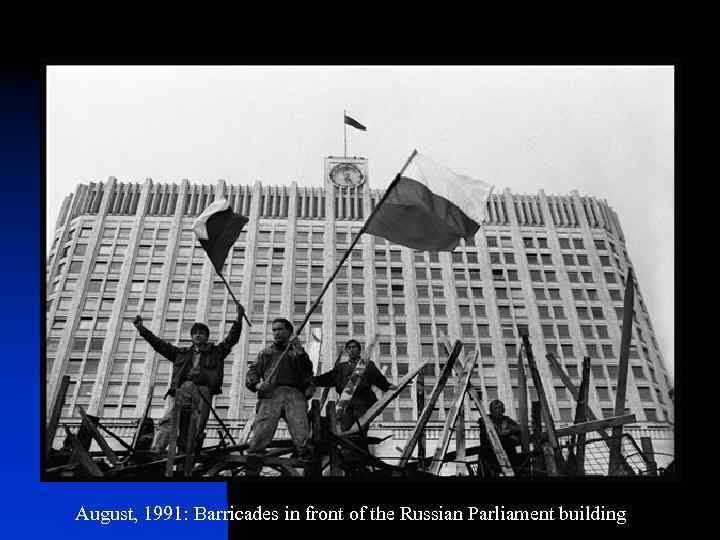 August, 1991: Barricades in front of the Russian Parliament building
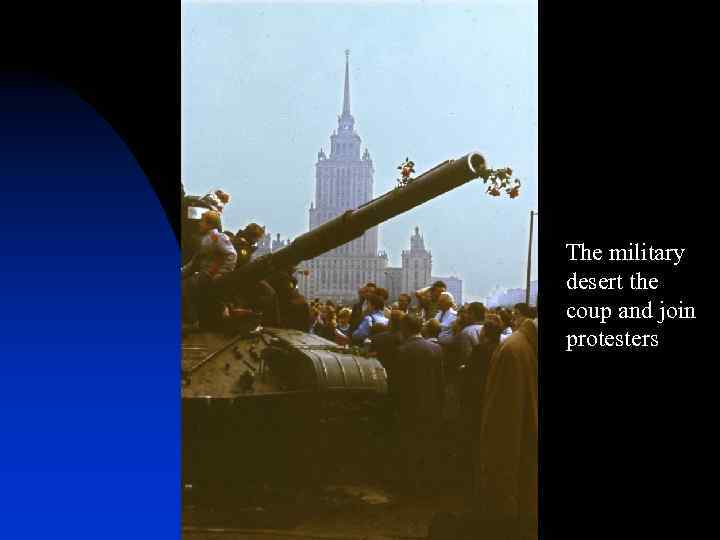 The military desert the coup and join protesters
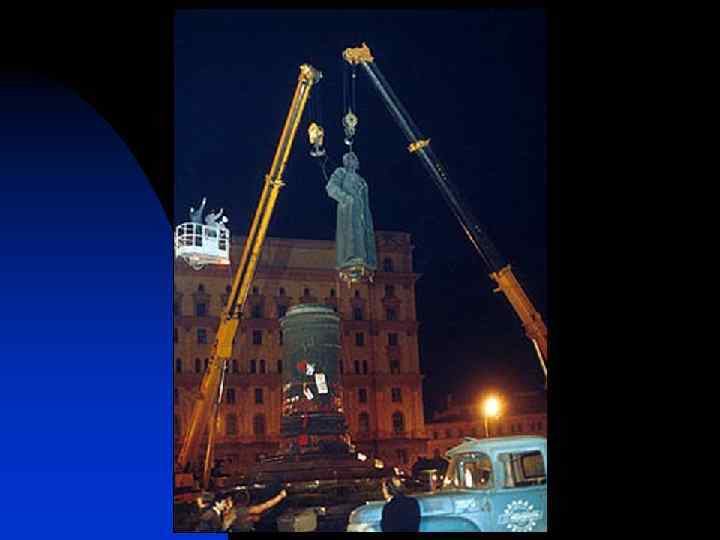
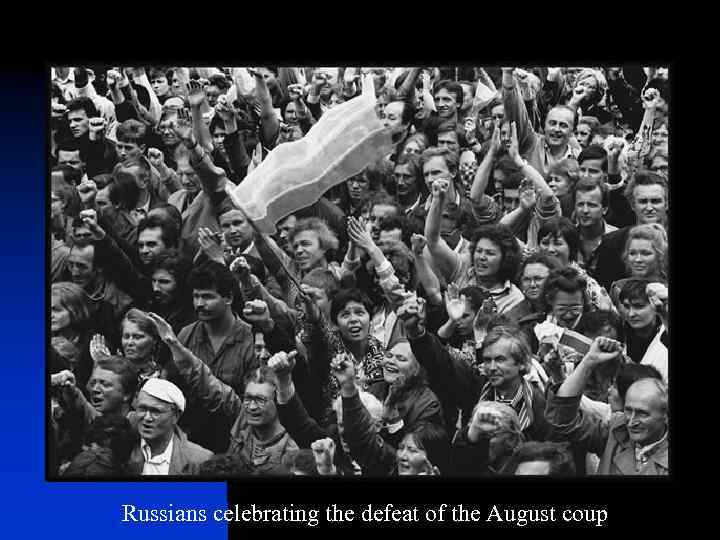 Russians celebrating the defeat of the August coup
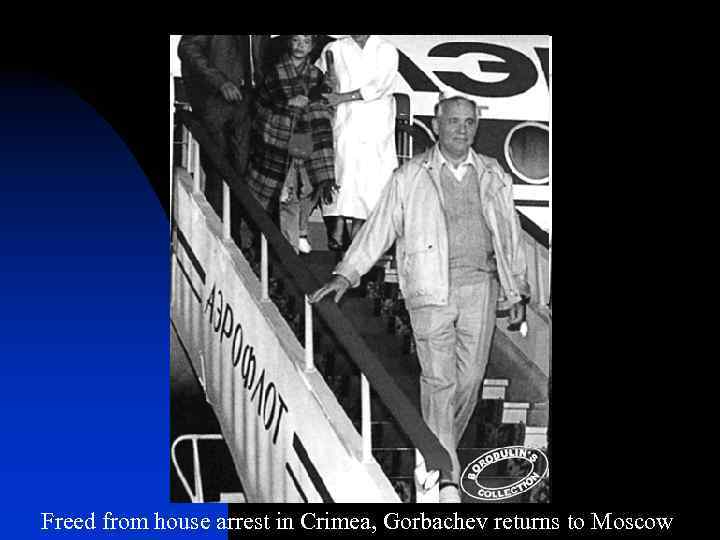 Freed from house arrest in Crimea, Gorbachev returns to Moscow
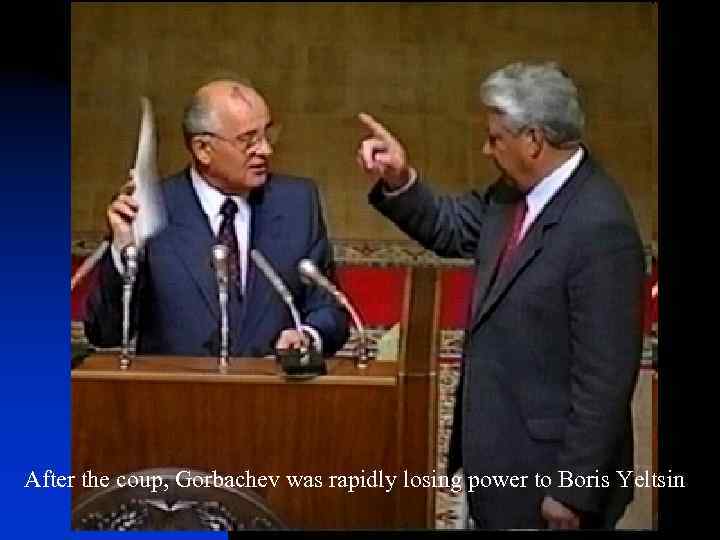 After the coup, Gorbachev was rapidly losing power to Boris Yeltsin
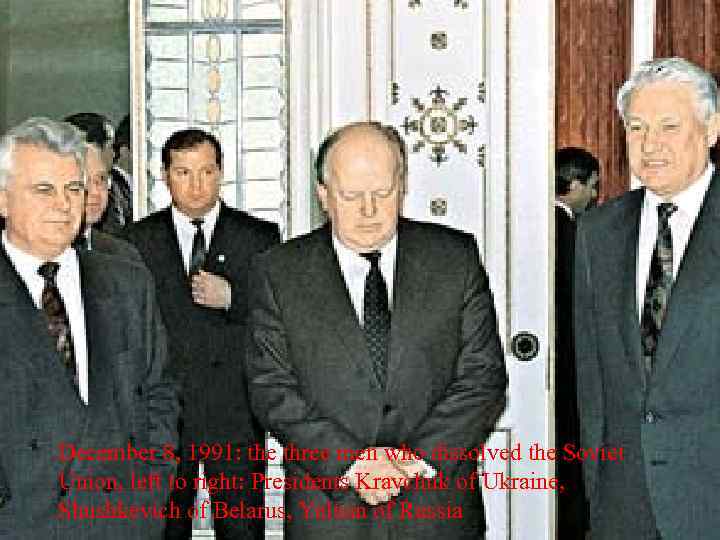 December 8, 1991: the three men who dissolved the Soviet Union, left to right: Presidents Kravchuk of Ukraine, Shushkevich of Belarus, Yeltsin of Russia
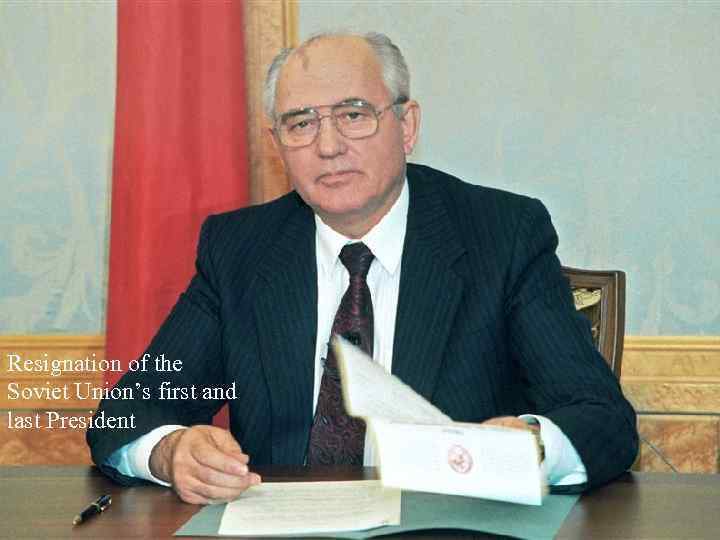 Resignation of the Soviet Union’s first and last President
 1917 and 1991 compared Collapse of the Romanov Empire and dissolution of the Soviet Union n The Romanov Empire collapsed as a result of a revolution, the elites were overthrown and replaced by new elites as a result of the civil war n The Soviet elites moved to divide the empire to recast themselves as leaders of independent nation-states – or of units of the Russian Federation A key reason why the Soviet empire made a relatively quiet exit was because key Soviet elites saw a future for themselves after communism