


 Скачать презентацию The Fall and Rise of the Independent Developer
ba1fbe7fb7e3f470e58858727379c75e.ppt
- Количество слайдов: 49
 The Fall and Rise of the Independent Developer Greg Costikyan CEO, Manifesto Games Game Developers e. Xchange 2008
 “Moore’s Wall” and the Decline of the 3 rd Party Developer • Spiralling hardware capabilities = competitive pressure to take advantage of them = spiralling budgets • What Raph Koster calls “Moore’s Wall” • $5 m now minimum buy-in for commercial release games – 15 years ago: $200, 000
 Moore’s Wall (con’t) • Publishers remain source of development funding • Typically ~15% royalties, recoupable, after retail discount & MDF (market development funding, a/k/a channel graft)
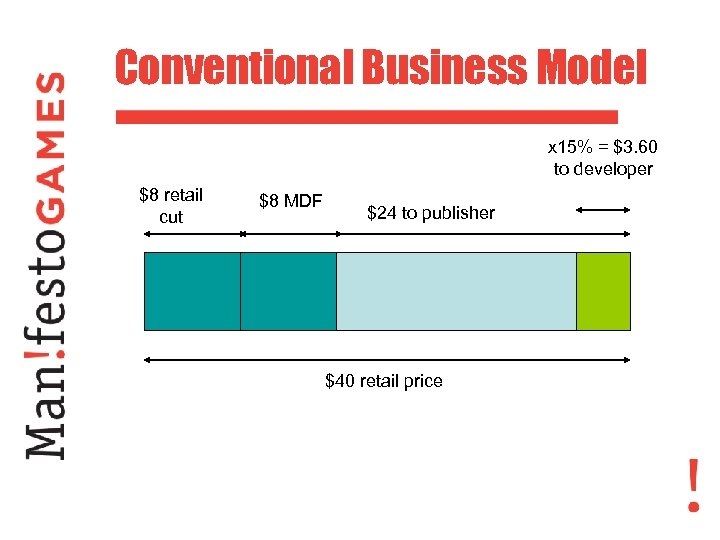 Conventional Business Model x 15% = $3. 60 to developer $8 retail cut $8 MDF $24 to publisher $40 retail price
 Why Developers are Screwed • $3. 60/game dev needs ~1. 4 m unit sales to recoup advance (very rare) • Publisher breaks even at ~400, 000 unit sales (assuming another $5 m on marketing) • Once upon a time, a hit game made the dev lot of money. – Vanishingly small chance today
 Result: The End of the Independent Developer • Staying independent = unprofitable treadmill – Have to land next development deal or die – No upside • Selling out only logical path – Assured access to dev funding – Only way for founders to cash out
 Or Is It? • “The Internet Changes Everything” • Major impact on industries from music to telephony • We sell bits. Why put them in a box when the net is designed to transmit bits? • But so far the impact on the game industry is marginal.
 1993 “All told, 15 m shareware copies of Doom were downloaded across the world. . . Doom was a watershed event. . . Because it changed the way videogames circulate and reproduce. ” -- JC Herz, Joystick Nation
 Doom was an Aberration • It didn’t change the way games are distributed, because – CD-ROMs came along, apps bloated by an order of magnitude – Internet users were stuck with dialup – Hours-long downloads for apps of any size. – The shareware model ruled for about 6 minutes.
 Web 1. 0 (circa 2000) • Free Internet play bolted on to RTS and FPS games • MMOs adopt hybrid model (retail distribution of apps, but play solely online, with subscription) • Ad-supported play of classic card & board games attract tens of millions of monthly uniques (unprofitably)
 Web 2. 0 (today) • We’re back in 1993, in terms of app size/bandwidth ratio • A success like id’s is again feasible • The market is about to be disrupted • Cui bono? – Consumers: greater choice, lower costs – (Some) creators: instant fame, but hard to make a buck
 Casual Game Market • $0 to $600 m (US domestic only) between 2000 and 2006 • 60 min demo, $20 purchase price • Mostly match-3 and word games • Portal distribution • $250 -500 k budgets • Middle-aged women
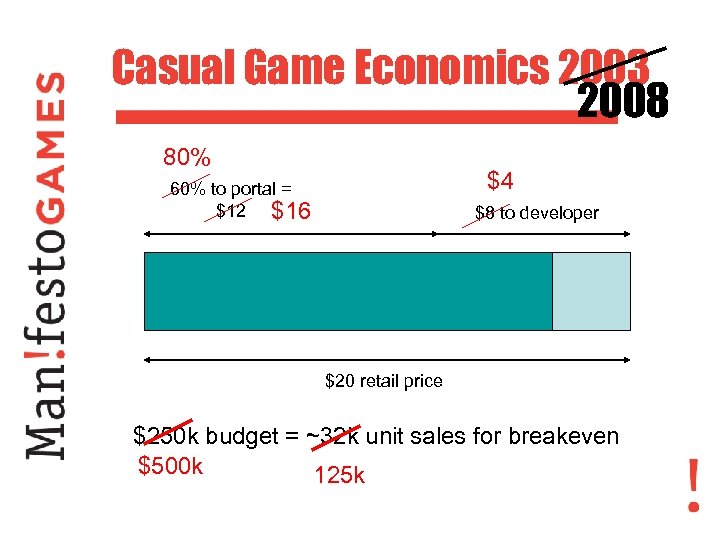 Casual Game Economics 2003 2008 80% $4 60% to portal = $12 $16 $8 to developer $20 retail price $250 k budget = ~32 k unit sales for breakeven $500 k 125 k
 Not a Panacea • But a sign post showing the potential. • It’s possible to create whole new game markets on the Net. • But as usual, the game industry has learned the wrong lessons:
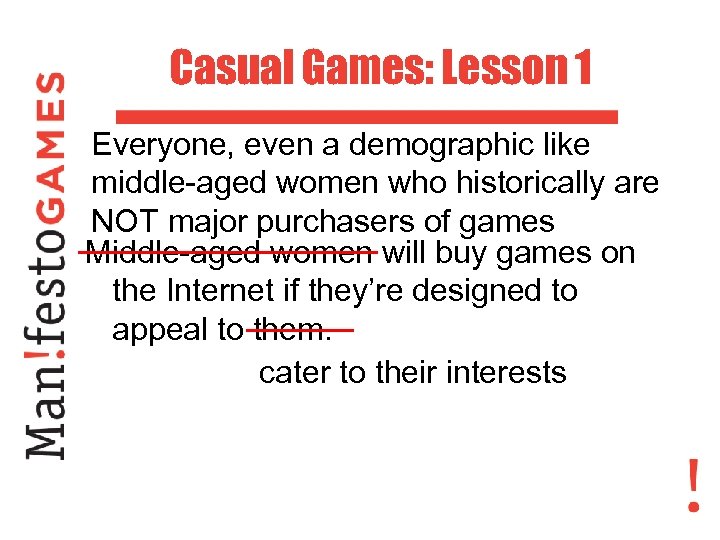 Casual Games: Lesson 1 Everyone, even a demographic like middle-aged women who historically are NOT major purchasers of games Middle-aged women will buy games on the Internet if they’re designed to appeal to them. cater to their interests
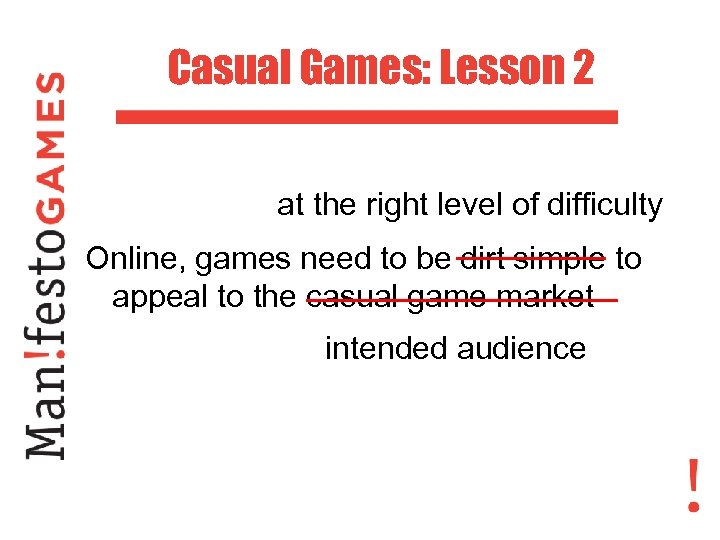 Casual Games: Lesson 2 at the right level of difficulty Online, games need to be dirt simple to appeal to the casual game market intended audience
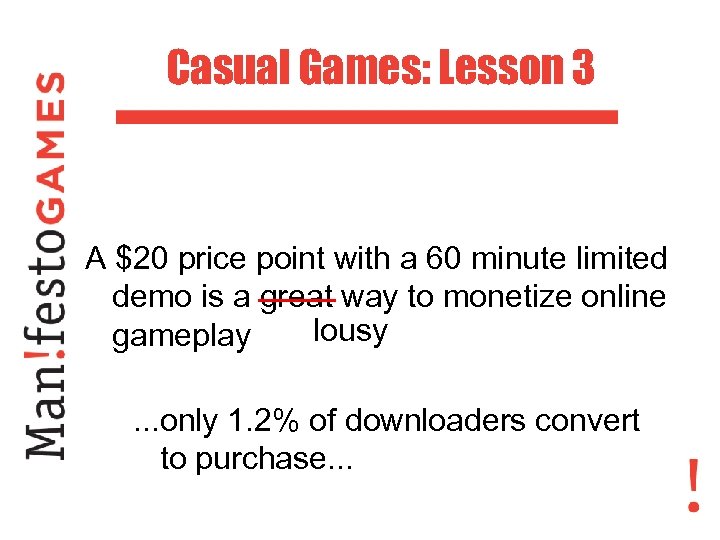 Casual Games: Lesson 3 A $20 price point with a 60 minute limited demo is a great way to monetize online lousy gameplay. . . only 1. 2% of downloaders convert to purchase. . .
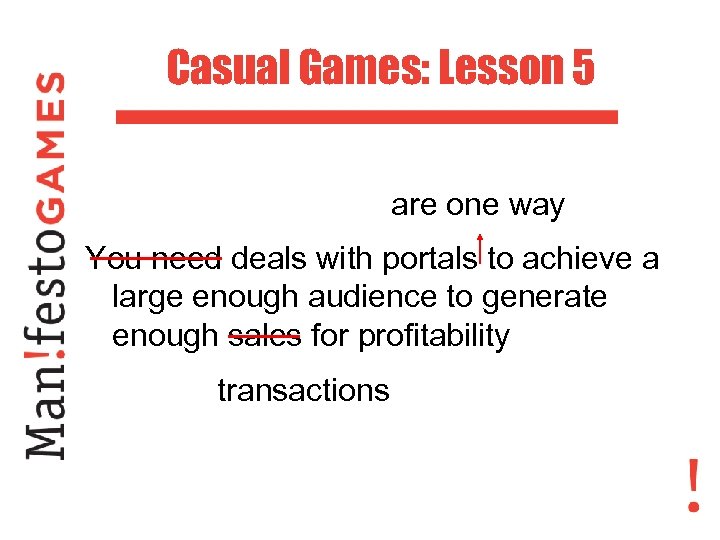 Casual Games: Lesson 5 are one way You need deals with portals to achieve a large enough audience to generate enough sales for profitability transactions
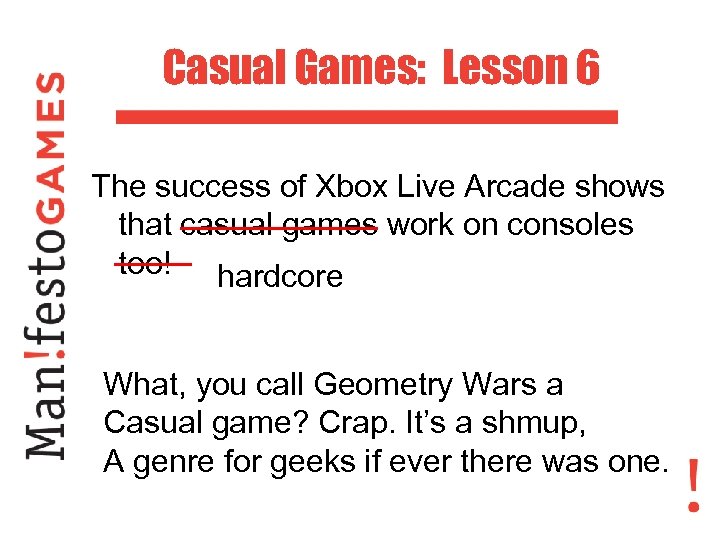 Casual Games: Lesson 6 The success of Xbox Live Arcade shows that casual games work on consoles too! hardcore What, you call Geometry Wars a Casual game? Crap. It’s a shmup, A genre for geeks if ever there was one.
 “Free” MMOs • The logic of the conventional MMO market: – 8 -figure budgets – Monthly subscriptions – Multi-year development times – Enormous technical complexity
 “Free” MMOs • The logic of light-weight MMOs: – 6 or 7 figure budgets (initially) – Free to play, upsell with status items (clothing, leaderboards, furniture, etc. ) – Far shorter development times – Modest technical complexity – 10 -20% of your audience will pay
 Example: Runescape • Browser-playable, traditional fantasy MMO • 9 m active players – Of which 1 m pay $5/month for premium services – Plus advertising revenue • Player acquisition largely by word of mouth
 Example: Club Penguin • Flash minigames aimed at kids held together with a virtual world metaphor • Free to play – $6/month premium membership for status items
 Club Penguin (con’t) • Key distribution arrangement with Miniclips – #1 free game site on the Internet, >40 m monthly uniques – Receives 50% of lifetime revenue from users who join CP via Miniclips • Sold to Disney for $350 m – Are you really sure you want another goddamn console deal?
 Webkinz • Plush toys with codes that allow you to “adopt” the critter as a Tamagotchi-like pet in an online virtual world • Clearly inspired by Neopets • Free to play online • $45 m in retail sales (06)
 Social Networking Games • Games built on APIs provided by social networks – Facebook today – Open. Social tomorrow • The average Facebook game has >2. 5 m installed users – Multiplayer ones see 11% of them active each day
 Social Networking Games • Social networks designed for virality – Minimal marketing/distribution costs • Turn-based, web pages – Straightforward (and cheap) web development • So far, advertising-supported • Opportunity not only here but as promotional for deeper game off the network
 Social Networking Games • Scrabulous: 500, 000 daily users – But being sued by Hasbro • Webs. com/Freewebs – Warbook: 15 m page-views/day • Already seeing VC interest: – Conduit Labs ($5. 5 m Series A) – Zynga ($10 m Series A)
 Micropayments • Common in “free” MMOs, of course • A way to monetize gameplay short of the $20 purchase • High proportion of casual gameplayers run up against the 60 minute limit
 Micropayments • Double. Trump – 60 minutes free, pay 1 cent/minute thereafter – After 2000 minutes, you own the game outright – Playonarcade. com as tech demo
 Micropayments • Wild Tangent – “Token” model – 1 token allows unlimited play until you quit from the application – 25 cents/token – Or watch ads to get tokens – Advertisers can “sponsor” play of games – Credit toward purchase
 Micropayments • These are models built for casual games – But expect to see “free” web games start to use micropayments – E. g. , first 12 levels free, another 12 for $3 – Some of this already on Kongregate & Miniclips
 Ad-Supported Web Games • Contract development for sites like Nickelodeon, Adult Swim – Not just crap any more – some of the Adult Swim stuff is actually good • Rev share with portals like Miniclips, Kongregate. com – Kongregate VC-funded startup to encourage this
 Ad-supported Web Games • Problem is that per-user revenues are small – Hit games can get millions of plays – But figure a few cents per play – Possible to support a small team, but not a path to riches – Does micropayment upsell change the picture?
 Second-Tier Genres. . . • Conventional retail channel not friendly to games that have no chance of selling 1 m units • Yet there are genres that have passionate fans but not enough – Computer wargames – Graphic adventures – 4 X – Etc.
 . . . Migrate Online • Now sold primarily as online downloads – Often with a retail SKU – but the bulk of sales online • Matrix Games – Computer wargames • Stardock – 4 X (Galactic Civilizations), RTS (Sins of a Solar Empire, currently #4 on the NPD PC Games best-sellers list)
 Secondary Genres (con’t) • Can sell in excess of 100, 000 units – Galactic Civilizations – Gary Grigsby’s World at War • Retailer disintermediation – Real (if modest) profitability • Opportunity for aggregation – Slitherine’s “Play History”
 Serious Games • Yes, there can be serious money here • Forterra – Spin-off from There. com – Virtual worlds as training environments for military, medical, transportation customers – Second Life may get the press, but this is where to look for actual success
 Serious Games • Peacemaker – Began as a student project at Carnegie Mellon – Modest VC investment, grants from nonprofits – Major press attention – 100, 000 copies distributed in Israel & Palestine by the Peres Center for Peace
 Re-Mission • Funded by Hope Lab, a medical nonprofit • Rather high budget FPS (shoot the cancer) • Clinically shown that players are better about taking their meds
 Serious Games • Increasing amounts of money available from government, non-profits • Most developers in the space have no clue • Clear opportunity for those who focus on it • Mostly contract work – little to no upside. . . – But psychic rewards, surely
 “Indie Games” • Ill-defined, but usually means casual game-like business model, but not casual games – Some indie developers have supported themselves for years at a modest level (Ape. Zone, Spiderweb, Chronic Logic)
 Increasing Attention • Both print and online media increasingly willing to cover indie games • High-volume sites like Fileplanet feature indie game demos • Playfirst deal for Dave Gilbert graphic adventures.
 Emerging Distribution Channels • Steam first really successful distribution channels (can generate sales of tens of thousands) • Gleemax/WOTC • Penny Arcade/Greenhouse
 Indie Games (con’t) • Still a small market by comparison to, say, casual games • But why should middle-aged women have all the fun? • Critical factor: establishing the “indie is good” meme in the minds of gamers • Relentless PR critical – The lesson of Uplink
 Indie Games (con’t) • IGF • Possibility of upsell to XBLA, Nintendo Virtual Console, etc. • “Blue ocean” – don’t try to compete with big budget titles • Bandwidth problem • Some “casual” channels open (e. g. , Oberon) – But sucky margins
 Ten Years from Now. . . • The retail channel will be minor • Console titles will be sold via download – The hardware manufacturers will be the key gatekeepers • PC gaming, broadly defined, will see an enormous resurgence, all online • There will be vast diversity in successful game styles
 Ten Years from Now. . . • There will still be multi-million unit hits. . . • But a huge “midlist” of games that sell far fewer numbers, profitably, will exist • Application sale will be only one of many successful business models • Conventional wisdom will have reversed – major publishers are dinosaurs
 The Independent Developer Shall Rise Again • Take the creativity you bring to development – and apply it to business models and distribution strategy • Get off the treadmill • The future’s so bright you gotta wear shades