


 Скачать презентацию The Faerie Queene Edmund Spenser Contents —
049ed962568ab19ba2ed81b1562d1684.ppt
- Количество слайдов: 20
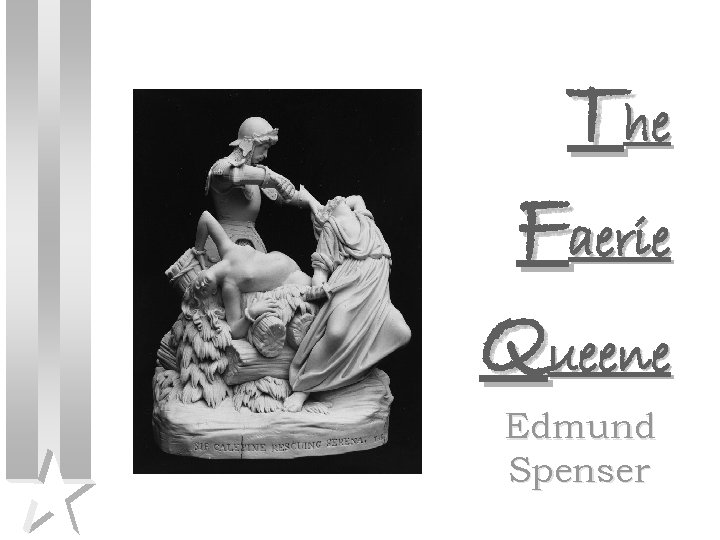 The Faerie Queene Edmund Spenser
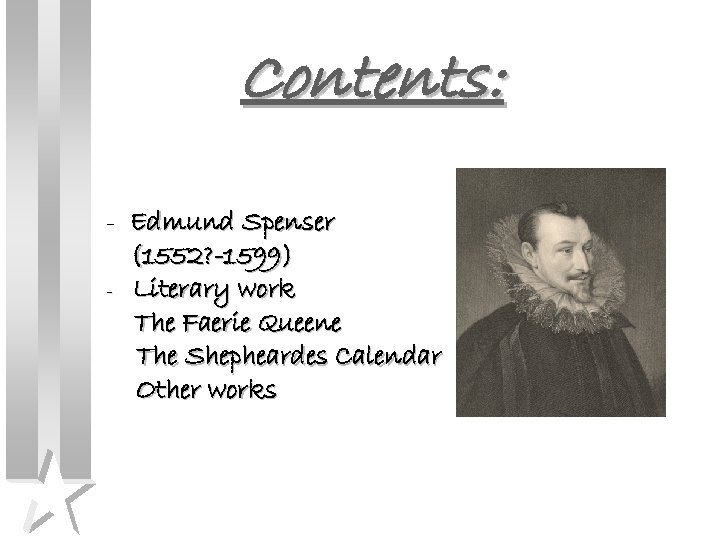 Contents: - Edmund Spenser (1552? -1599) - Literary work The Faerie Queene The Shepheardes Calendar Other works
 Edmund Spenser was born around 1552 in London, England. Very little is known about his family, some speculate that he was possibly the son of John Spenser, a free journeyman clothmaker resident in East Smithfield, London. He received quality education –Merchant Taylor’s school, where he studied classical works of literature and languages. In 1576 he took his Masters at Cambridge. He began writing poetry at this time and was employed as a secretary, first to the Bishop of Kent and then to nobles in Queen Elizabeth’s court. He died on a Saturday in January 1599.
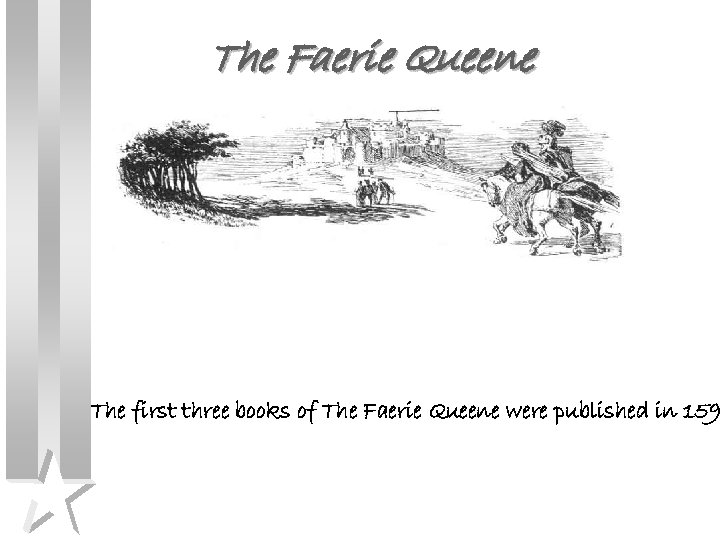 The Faerie Queene The first three books of The Faerie Queene were published in 159
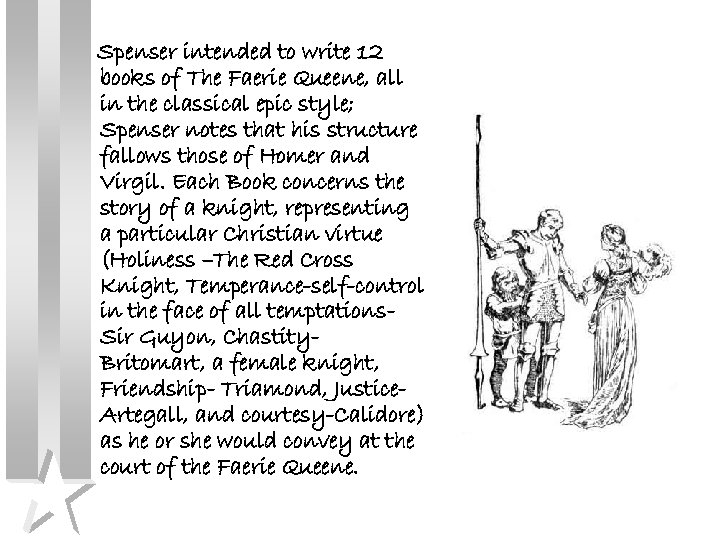 Spenser intended to write 12 books of The Faerie Queene, all in the classical epic style; Spenser notes that his structure fallows those of Homer and Virgil. Each Book concerns the story of a knight, representing a particular Christian virtue (Holiness –The Red Cross Knight, Temperance-self-control in the face of all temptations. Sir Guyon, Chastity. Britomart, a female knight, Friendship- Triamond, Justice. Artegall, and courtesy-Calidore) as he or she would convey at the court of the Faerie Queene.
 Spencer’s political awareness Though it takes place in a mythical land, The Faerie Queen was intended to relate to Spenser's England, most importantly in the area of religion. Spenser lived in post. Reformation England, which had recently replaced Roman Catholicism with Protestantism (specifically, Anglicanism) as the national religion. There were still many Catholics living in England, thus, religious protest was a part of Spenser's life. A devout Protestant and a devotee of the Protestant Queen Elizabeth (Tudor dynasty), Spenser was particularly offended by the anti. Elizabethan propaganda that some Catholics circulated. Like most Protestants near the time of the Reformation, Spenser saw a Catholic Church full of corruption, and he determined that it was not only the wrong religion but the anti-religion. This sentiment is an important backdrop for the battles of The Faerie Queene, which often represent the "battles" between London and Rome.
 Plot Book 1. The legend of the Knight of the Red Crosse, or of Holinesse Canto i Redcrosse and Una are travelling, when a storm drives them into a wood where Redcrosse kills the dragon Error. Archimage welcomes them in his hermitage, but produces sexual illusions that destroy their mutual trust, and Una goes on alone. Canto ii Archimage disguises himself as Redcrosse and follows Una, while Redcrosse accompanies Duessa whom he takes for Una, after killing Sansfoy. Canto iii Una, alone, is befriended by a lion and finds refuge with Ignorance and Blind Devotion. Archimage finds Una, but is defeated by Sansloy who carries her off. Canto iv Redcrosse with Duessa comes to the House of Pride and sees the procession of the Deadly Sins. Sansjoy challenges Redcrosse, and receives favours from Duessa. Canto v After the battle, Duessa and Night carry the wounded Sansjoy to the Underworld for healing. Redcrosse escapes from the House of Pride, still with Duessa.
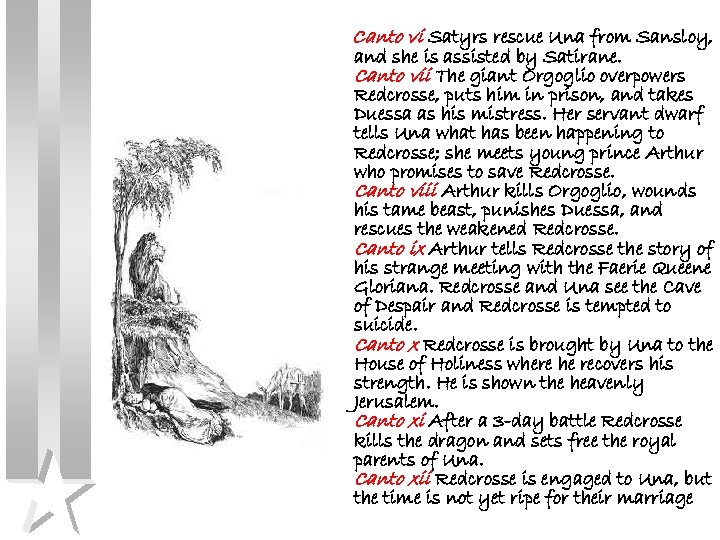 Canto vi Satyrs rescue Una from Sansloy, and she is assisted by Satirane. Canto vii The giant Orgoglio overpowers Redcrosse, puts him in prison, and takes Duessa as his mistress. Her servant dwarf tells Una what has been happening to Redcrosse; she meets young prince Arthur who promises to save Redcrosse. Canto viii Arthur kills Orgoglio, wounds his tame beast, punishes Duessa, and rescues the weakened Redcrosse. Canto ix Arthur tells Redcrosse the story of his strange meeting with the Faerie Queene Gloriana. Redcrosse and Una see the Cave of Despair and Redcrosse is tempted to suicide. Canto x Redcrosse is brought by Una to the House of Holiness where he recovers his strength. He is shown the heavenly Jerusalem. Canto xi After a 3 -day battle Redcrosse kills the dragon and sets free the royal parents of Una. Canto xii Redcrosse is engaged to Una, but the time is not yet ripe for their marriage
 Book II. Sir Guyon, or of Temperance Canto i Archimage urges Guyon to attack Redcrosse; they become friends instead, before Redcrosse rides away. Guyon and the Palmer accompanying him find Amavia with her baby, its hands bloodstained. Canto ii The fountain cannot cleanse its hands. Canto iii The baby is left at the castle of Medina. Braggadochio steals Guyon's horse, meets Trompart with Archimage. Belphoebe encounters Braggadochio with Trompart. Canto iv Guyon overpowers Furor, stops Occasion, and rescues Phedon who tells his story. Pyrochles approaches. Canto v Pyrochles fights Guyon and frees Furor before going to Acrasia's bower in search of Cymochles.
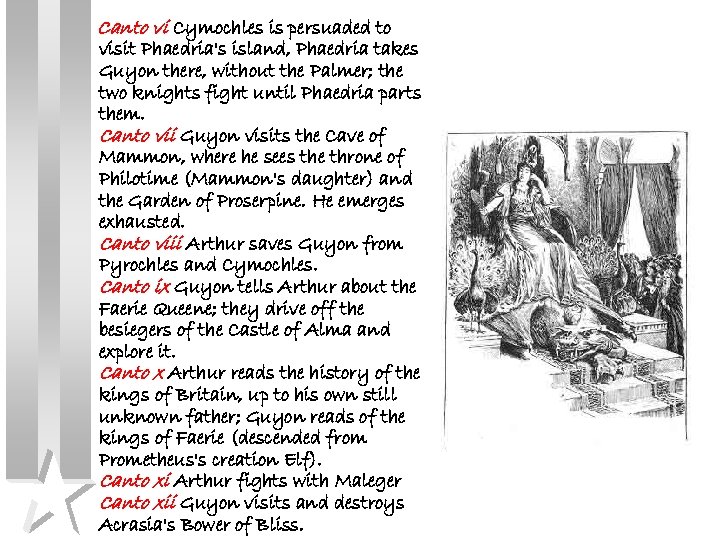 Canto vi Cymochles is persuaded to visit Phaedria's island, Phaedria takes Guyon there, without the Palmer; the two knights fight until Phaedria parts them. Canto vii Guyon visits the Cave of Mammon, where he sees the throne of Philotime (Mammon's daughter) and the Garden of Proserpine. He emerges exhausted. Canto viii Arthur saves Guyon from Pyrochles and Cymochles. Canto ix Guyon tells Arthur about the Faerie Queene; they drive off the besiegers of the Castle of Alma and explore it. Canto x Arthur reads the history of the kings of Britain, up to his own still unknown father; Guyon reads of the kings of Faerie (descended from Prometheus's creation Elf). Canto xi Arthur fights with Maleger Canto xii Guyon visits and destroys Acrasia's Bower of Bliss.
 Book III. Britomartis, or of Chastity In Canto i Guyon and Arthur meet Britomart, disguised as a knight; as they pursue Florimell they are separated. Britomart arrives at the Castle Joyeous and meets Redcrosse. Britomart tells of her quest for Arthegall; in retrospect we learn how she fell in love with Arthegall after seeing him in a magic mirror, left home, and consulted Merlin in his cave. He told her the identity of her lover, as well as describing the future destiny of their descendants, the British kings. After this, she set out disguised as a knight. Encountering Marinell, she wounds him. Meanwhile, Arthur has gone on following Florimell, whose story he hears. His squire Timias has been pursuing a forester, who wounds him.
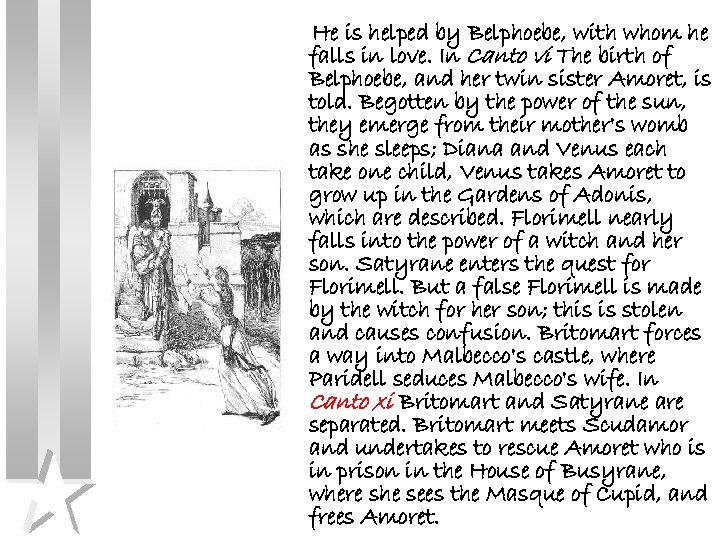 He is helped by Belphoebe, with whom he falls in love. In Canto vi The birth of Belphoebe, and her twin sister Amoret, is told. Begotten by the power of the sun, they emerge from their mother's womb as she sleeps; Diana and Venus each take one child, Venus takes Amoret to grow up in the Gardens of Adonis, which are described. Florimell nearly falls into the power of a witch and her son. Satyrane enters the quest for Florimell. But a false Florimell is made by the witch for her son; this is stolen and causes confusion. Britomart forces a way into Malbecco's castle, where Paridell seduces Malbecco's wife. In Canto xi Britomart and Satyrane are separated. Britomart meets Scudamor and undertakes to rescue Amoret who is in prison in the House of Busyrane, where she sees the Masque of Cupid, and frees Amoret.
 Book IV. Cambel and Telamond, or of Friendship Amoret at last discovers that Britomart is a woman; Duessa and Ate riding with Blandamour and Paridell encounter them, then a fight begins when they meet up with Scudamour and Glauce. Finally they meet Cambell and Triamond with their wives Canacee and Cambine (from Chaucer's The Squire's Tale); their story is told. The false Florimell chooses Braggadochio after a tournament for Florimell's girdle. In Canto v Satyrane visits the House of Care. In Canto vi Britomart fights with Arthegall, who then begins to woo her before setting out on his quest, while Britomart and Scudamour go looking for Amoret. Belphoebe and Timias rescue Amoret from Lust, Arthur finds Amoret with Aemilia, they set out together. In Canto x Scudamour tells how he wooed Amoret in the Temple of Love. Canto xi celebrates the marriage of the Thames and the Medway. Marinell falls in love with Florimell, she is released.
 Book V. Artegall, or of Justice Artegall, brought up by Astraea, sets out on his quest, and after various adventures overthrows the giant Democracy. In Canto v he is imprisoned by Radigund. Britomart is told of this, and in Canto vii visits Isis Church before killing Radigund and rescuing Artegall. Arthur and Artegall rescue a prisoner, catch Guile, and see the trial of Duessa. The rest of the book tells of Artegall's adventures until at last he meets Envy, Detraction, and the Blatant Beast.
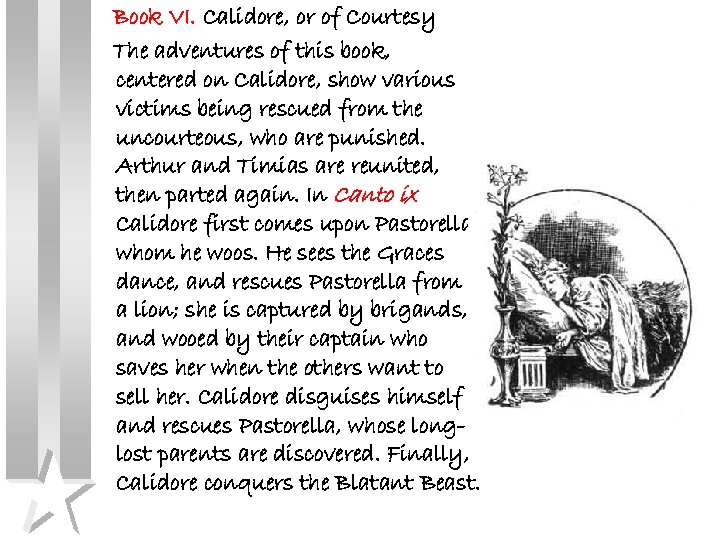 Book VI. Calidore, or of Courtesy The adventures of this book, centered on Calidore, show various victims being rescued from the uncourteous, who are punished. Arthur and Timias are reunited, then parted again. In Canto ix Calidore first comes upon Pastorella, whom he woos. He sees the Graces dance, and rescues Pastorella from a lion; she is captured by brigands, and wooed by their captain who saves her when the others want to sell her. Calidore disguises himself and rescues Pastorella, whose longlost parents are discovered. Finally, Calidore conquers the Blatant Beast.
 Allegory In The Faerie Queene, Spenser creates an allegory: The characters of his far-off, fanciful "Faerie Land" are meant to have a symbolic meaning in the real world. In Books I and III, the poet follows the journeys of two knights, Redcrosse and Britomart, and in doing so he examines the two virtues he considers most important to Christian life--Holiness and Chastity. Redcrosse, the knight of Holiness, is much like the Apostle Peter: In his eagerness to serve his Lord, he gets himself into unforeseen trouble that he is not yet virtuous enough to handle. His quest is to be united with Una, who signifies Truth--Holiness cannot be attained without knowledge of Christian truth. In his immature state, he mistakes falsehood for truth by following the deceitful witch Duessa. He pays for this mistake with suffering, but in the end, this suffering makes way for his recovery in the House of Holiness, aided by Faith, Hope, and Charity. With newfound strength and the grace of God, he is able to conquer the dragon that represents all the evil in the world.
 In a different manner, Britomart also progresses in her virtue of chastity. She already has the strength to resist lust, but she is not ready to accept love, the love she feels when she sees a vision of her future husband in a magic mirror. She learns to incorporate chaste resistance with active love, which is what Spenser sees as true Christian love: moderation. Whereas Redcrosse made his own mistakes (to show to us the consequences of an unholy life), it is not Britomart but the other characters in Book III who show the destructive power of an unchaste life. Spenser says in his Preface to the poem that his goal is to show a virtuous man should live. The themes of Book I and Book III come together in the idea that our native virtue must be augmented or transformed if it is to become true Christian virtue. Spenser has a high regard for the natural qualities of creatures; he shows that the satyrs, the lion, and many human characters have an inborn inclination toward the good. And yet, he consistently shows their failure when faced with the worst evils. These evils can only be defeated by the Christian good.
 High on Spenser's list of evils is the Catholic Church, and this enmity lends a political overtone to the poem, since the religious conflicts of the time were inextricably tied to politics. The poet is unashamed in his promotion of his beloved monarch, Queen Elizabeth; he takes considerable historical license in connecting her line with King Arthur. Spenser took a great pride in his country and in his Protestant faith. He took aim at very real corruption within the Catholic Church; such attacks were by no means unusual in his day, but his use of them in an epic poem raised his criticism above the level of the propagandists.
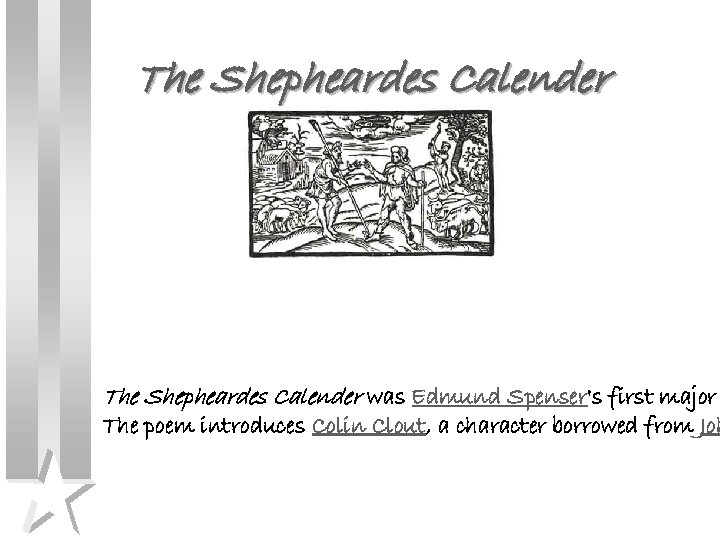 The Shepheardes Calender was Edmund Spenser's first major The poem introduces Colin Clout, a character borrowed from Joh
 Spenserian stanza The English Renaissance poet Edmund Spenser wrote his greatest work, the epic called The Faerie Queene, in a stanza form since named for him. The nine-line stanza rhymes ababbcbc. C, where the capital "C" means the last verse is an Alexandrine: it has six feet instead of five, which is to say, it's hexameter instead of pentameter. This complex form can be difficult to handle: it demands that only three words account for nine lines' worth of rhymes, and the "b" word needs four rhymes. An example from Spenser himself: Forth came that auncient Lord and aged Queene, Arayd in antique robes downe to the ground, And sad habiliments right well beseene; A noble crew about them waited round Of sage and sober Peres, all gravely gownd; Whom farre before did march a goodly band Of tall young men, all hable armes to sownd, But now they laurell braunches bore in hand; Glad signe of victorie and peace in all their land. — The Faerie Queene, I. xii. 5.