


 Скачать презентацию The Experimental Challenge STAR l ONE central Au Au
cb741507b05733654d0c60f1d2a0524c.ppt
- Количество слайдов: 30
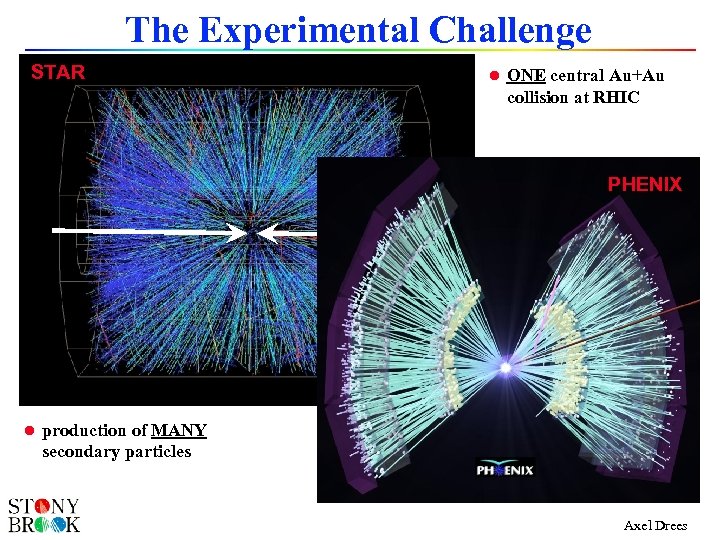 The Experimental Challenge STAR l ONE central Au+Au collision at RHIC PHENIX l production of MANY secondary particles Axel Drees
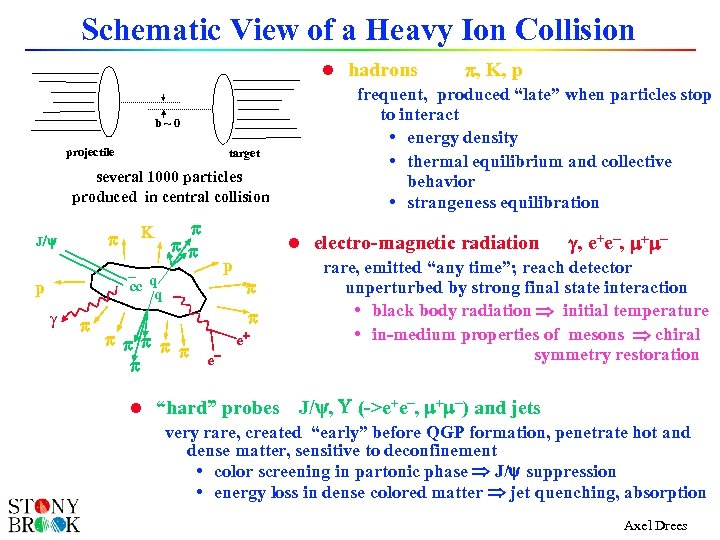 Schematic View of a Heavy Ion Collision b~0 projectile target several 1000 particles produced in central collision p J/ K p p cc q q p g p p p p p e- e+ l hadrons p, K, p frequent, produced “late” when particles stop to interact • energy density • thermal equilibrium and collective behavior • strangeness equilibration l electro-magnetic radiation g, e+e-, m+mrare, emitted “any time”; reach detector unperturbed by strong final state interaction • black body radiation initial temperature • in-medium properties of mesons chiral symmetry restoration l “hard” probes J/ , (->e+e-, m+m-) and jets very rare, created “early” before QGP formation, penetrate hot and dense matter, sensitive to deconfinement • color screening in partonic phase J/ suppression • energy loss in dense colored matter jet quenching, absorption Axel Drees
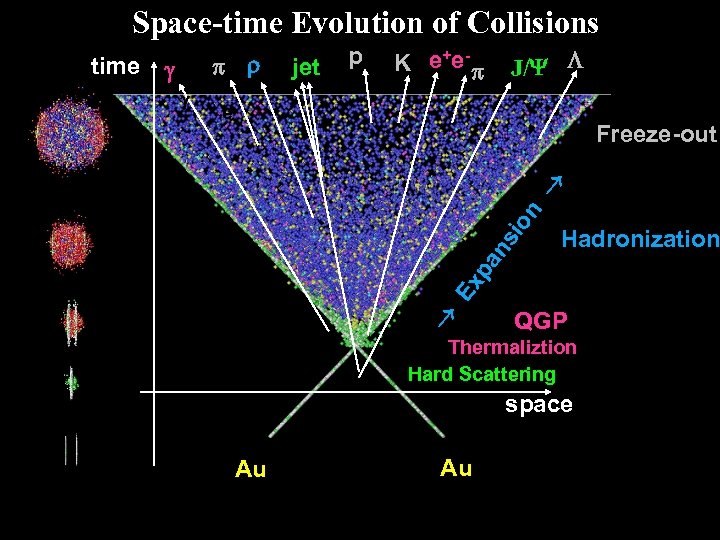 Space-time Evolution of Collisions p r J/Y L K e+ e- p e si o n Freeze-out an g p Hadronization Ex p g jet time QGP Thermaliztion Hard Scattering space Au Au Axel Drees
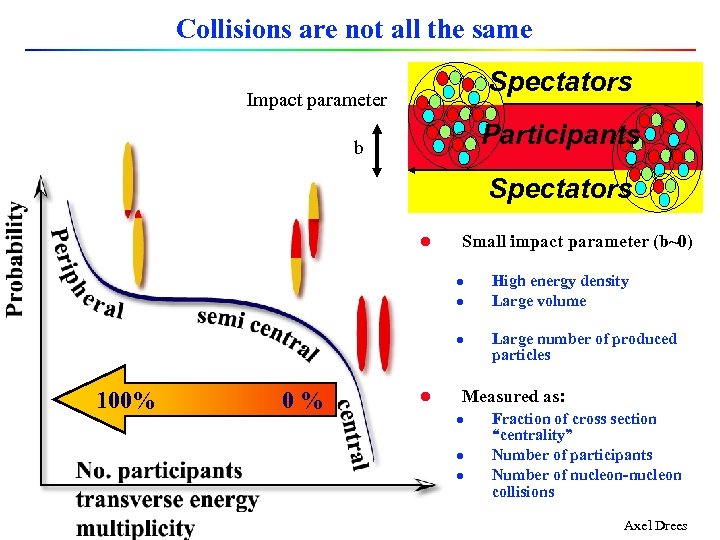 Collisions are not all the same Spectators Impact parameter Participants b Spectators l Small impact parameter (b~0) l l l 100% 0% l High energy density Large volume Large number of produced particles Measured as: l l l Fraction of cross section “centrality” Number of participants Number of nucleon-nucleon collisions Axel Drees
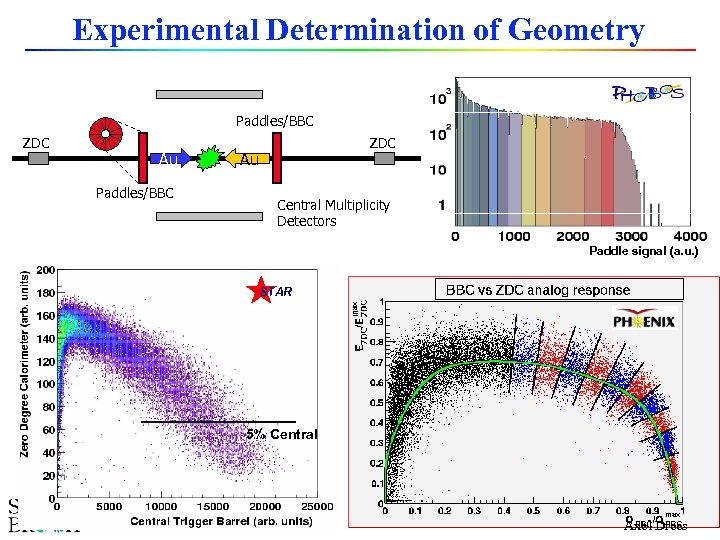 Experimental Determination of Geometry Paddles/BBC ZDC Au Central Multiplicity Detectors Paddle signal (a. u. ) STAR 5% Central Axel Drees
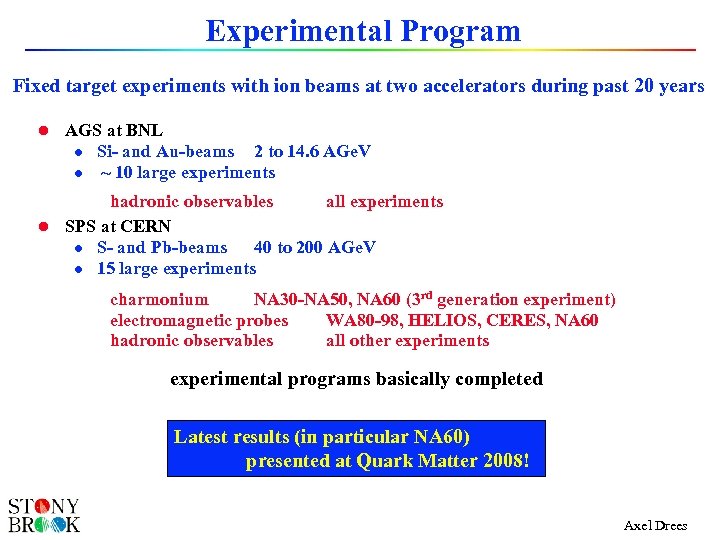 Experimental Program Fixed target experiments with ion beams at two accelerators during past 20 years l AGS at BNL l l Si- and Au-beams 2 to 14. 6 AGe. V ~ 10 large experiments hadronic observables all experiments l SPS at CERN l S- and Pb-beams 40 to 200 AGe. V l 15 large experiments charmonium NA 30 -NA 50, NA 60 (3 rd generation experiment) electromagnetic probes WA 80 -98, HELIOS, CERES, NA 60 hadronic observables all other experiments experimental programs basically completed Latest results (in particular NA 60) presented at Quark Matter 2008! Axel Drees
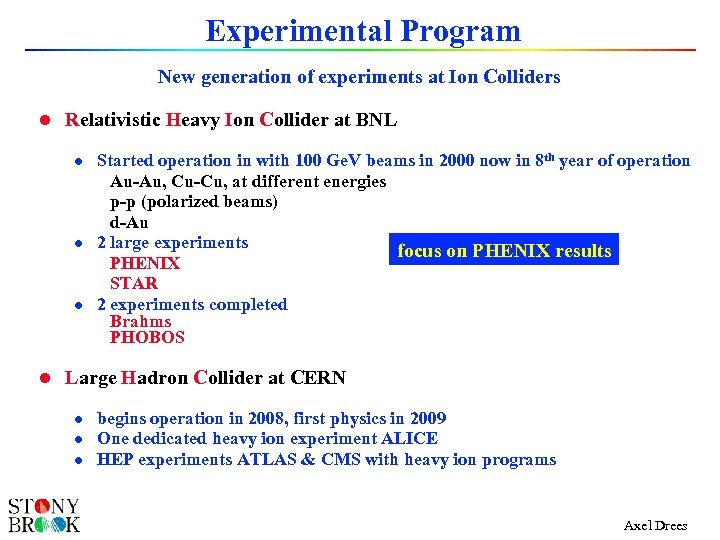 Experimental Program New generation of experiments at Ion Colliders l Relativistic Heavy Ion Collider at BNL l l l Started operation in with 100 Ge. V beams in 2000 now in 8 th year of operation Au-Au, Cu-Cu, at different energies p-p (polarized beams) d-Au 2 large experiments focus on PHENIX results PHENIX STAR 2 experiments completed Brahms PHOBOS l Large Hadron Collider at CERN l l l begins operation in 2008, first physics in 2009 One dedicated heavy ion experiment ALICE HEP experiments ATLAS & CMS with heavy ion programs Axel Drees
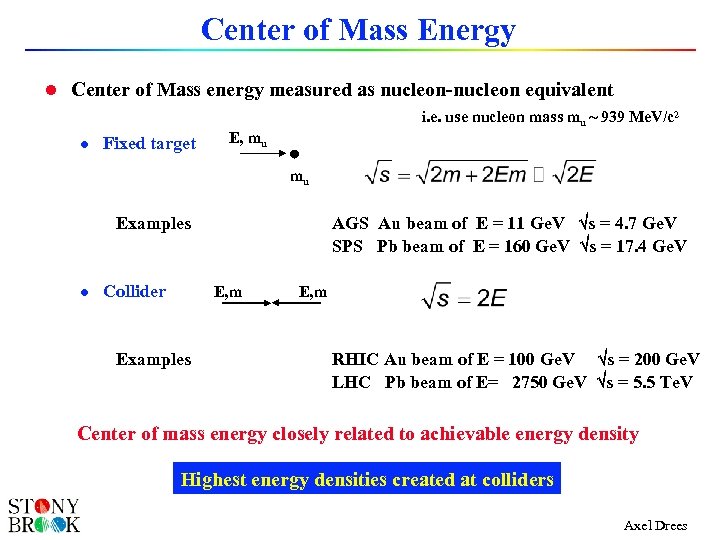 Center of Mass Energy l Center of Mass energy measured as nucleon-nucleon equivalent l Fixed target i. e. use nucleon mass mu ~ 939 Me. V/c 2 E, mu mu AGS Au beam of E = 11 Ge. V s = 4. 7 Ge. V SPS Pb beam of E = 160 Ge. V s = 17. 4 Ge. V Examples l Collider E, m Examples E, m RHIC Au beam of E = 100 Ge. V s = 200 Ge. V LHC Pb beam of E= 2750 Ge. V s = 5. 5 Te. V Center of mass energy closely related to achievable energy density Highest energy densities created at colliders Axel Drees
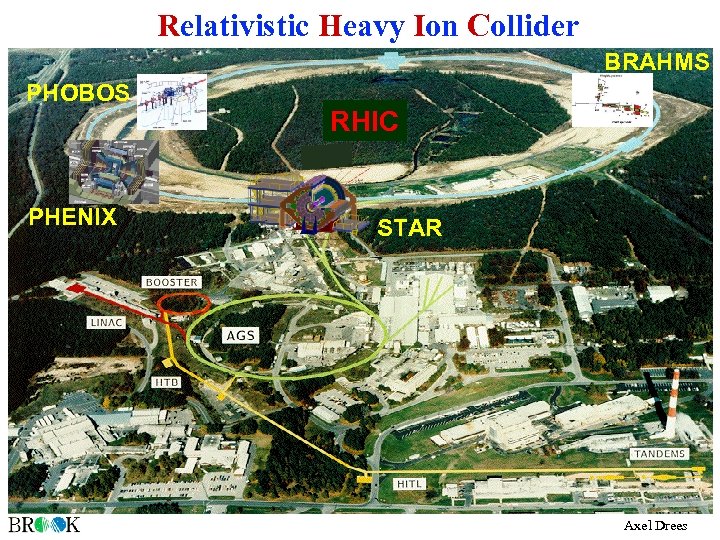 Relativistic Heavy Ion Collider BRAHMS PHOBOS PHENIX RHIC STAR Axel Drees
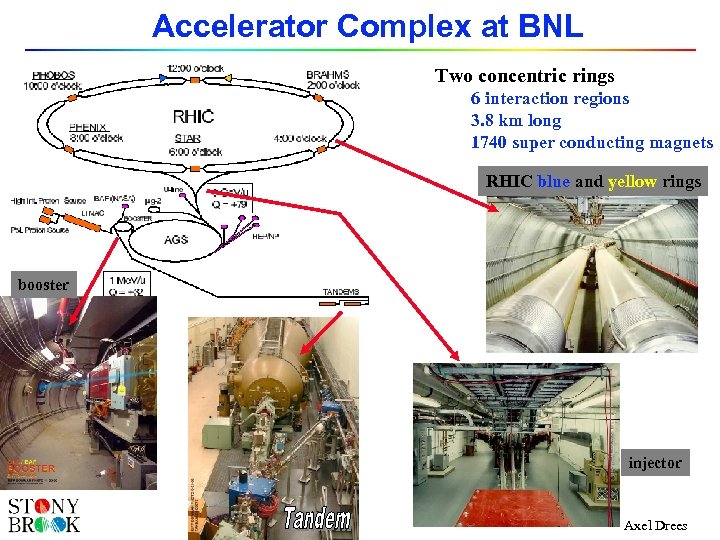 Accelerator Complex at BNL Two concentric rings 6 interaction regions 3. 8 km long 1740 super conducting magnets RHIC blue and yellow rings booster injector Axel Drees
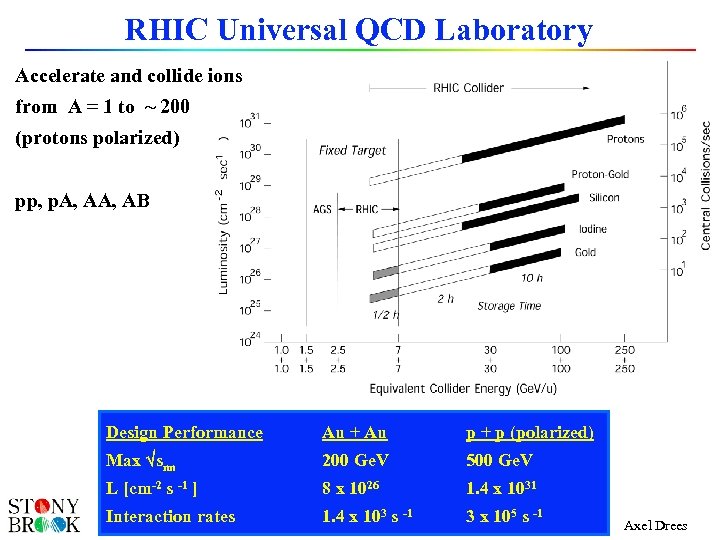 RHIC Universal QCD Laboratory Accelerate and collide ions from A = 1 to ~ 200 (protons polarized) pp, p. A, AB Design Performance Au + Au p + p (polarized) Max snn 200 Ge. V 500 Ge. V L [cm-2 s -1 ] 8 x 1026 1. 4 x 1031 Interaction rates 1. 4 x 10³ s -1 3 x 10⁵ s -1 Axel Drees
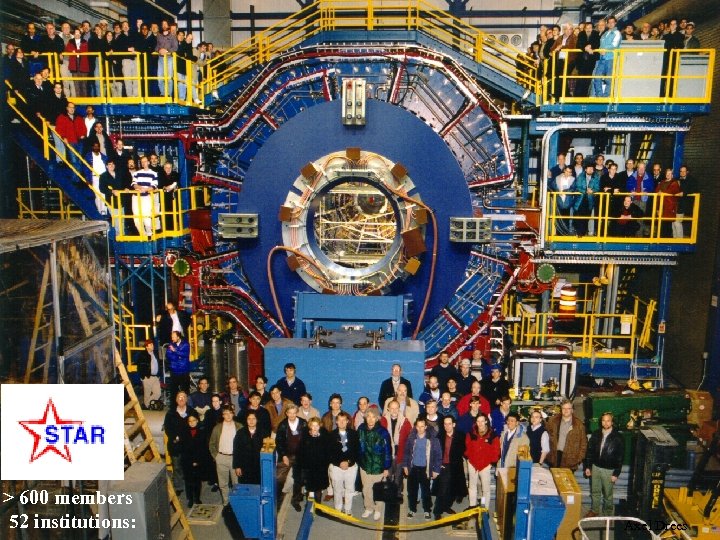 > 600 members 52 institutions: Axel Drees
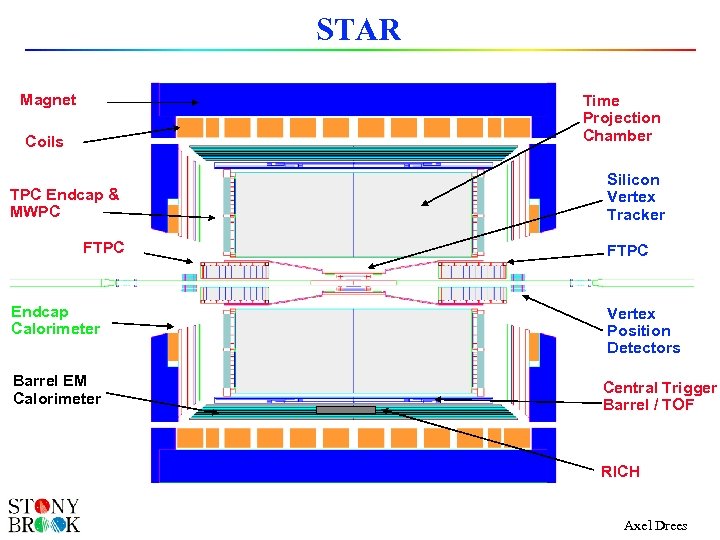 STAR Magnet Time Projection Chamber Coils TPC Endcap & MWPC FTPC Silicon Vertex Tracker FTPC Endcap Calorimeter Vertex Position Detectors Barrel EM Calorimeter Central Trigger Barrel / TOF RICH Axel Drees
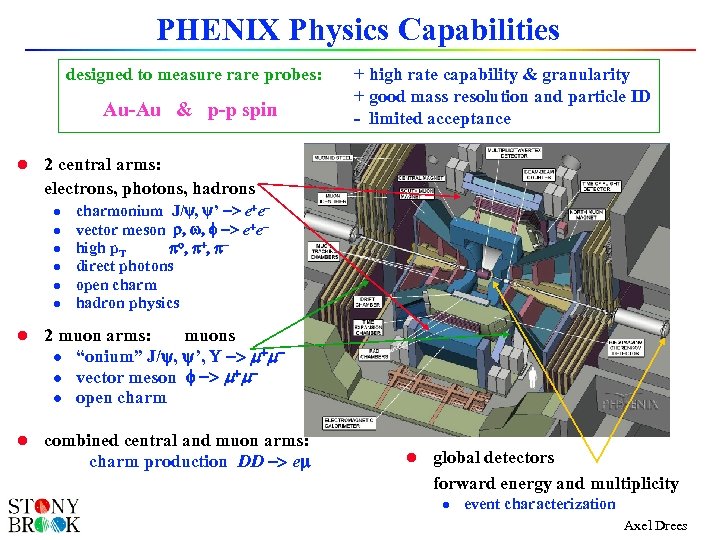 PHENIX Physics Capabilities designed to measure rare probes: Au-Au & p-p spin + high rate capability & granularity + good mass resolution and particle ID - limited acceptance l 2 central arms: electrons, photons, hadrons l l l charmonium J/ , ’ -> e+evector meson r, w, -> e+ehigh p. T po, p+, pdirect photons open charm hadron physics l 2 muon arms: l l l muons “onium” J/ , ’, -> m+mvector meson -> m+mopen charm l combined central and muon arms: charm production DD -> em l global detectors forward energy and multiplicity l event characterization Axel Drees
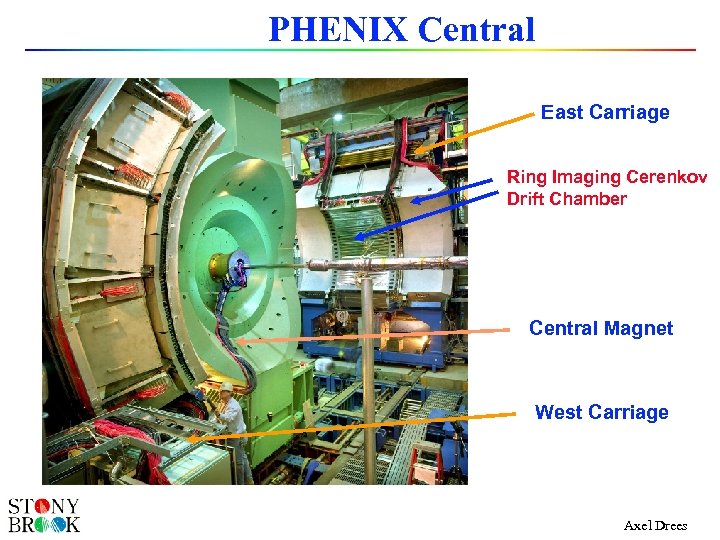 PHENIX Central East Carriage Ring Imaging Cerenkov Drift Chamber Central Magnet West Carriage Axel Drees
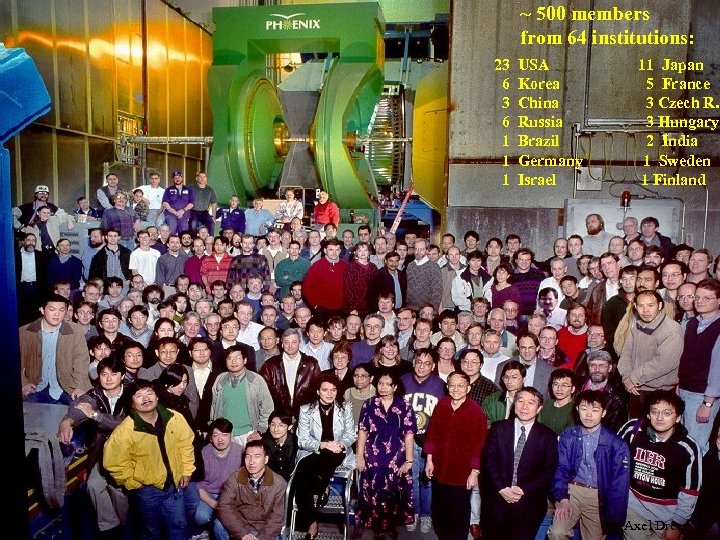 ~ 500 members from 64 institutions: 23 6 1 1 1 USA Korea China Russia Brazil Germany Israel 11 Japan 5 France 3 Czech R. 3 Hungary 2 India 1 Sweden 1 Finland Axel Drees
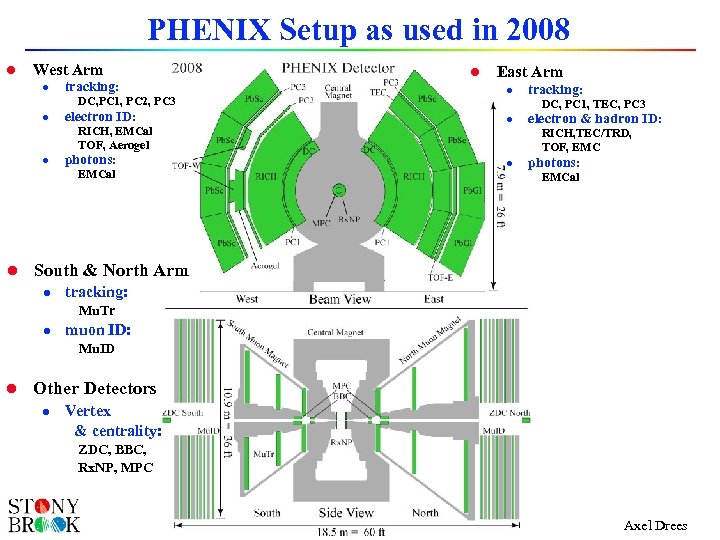 PHENIX Setup as used in 2008 l West Arm l tracking: DC, PC 1, PC 2, PC 3 l electron ID: RICH, EMCal TOF, Aerogel l photons: EMCal l East Arm l tracking: DC, PC 1, TEC, PC 3 l electron & hadron ID: RICH, TEC/TRD, TOF, EMC l photons: EMCal l South & North Arm l tracking: Mu. Tr l muon ID: Mu. ID l Other Detectors l Vertex & centrality: ZDC, BBC, Rx. NP, MPC Axel Drees
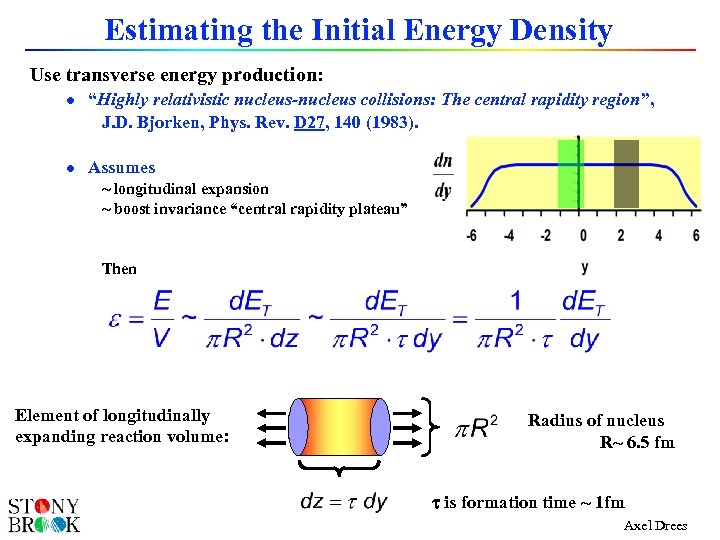 Estimating the Initial Energy Density Use transverse energy production: l l “Highly relativistic nucleus-nucleus collisions: The central rapidity region”, J. D. Bjorken, Phys. Rev. D 27, 140 (1983). Assumes ~ longitudinal expansion ~ boost invariance “central rapidity plateau” Then Element of longitudinally expanding reaction volume: Radius of nucleus R~ 6. 5 fm is formation time ~ 1 fm Axel Drees
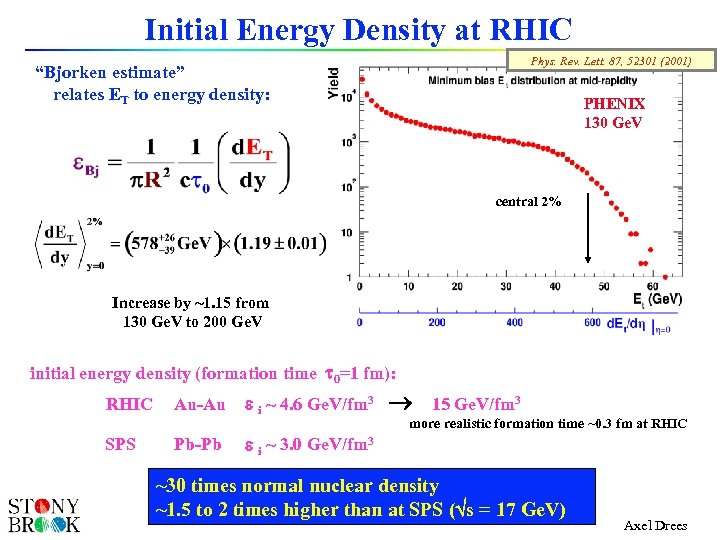 Initial Energy Density at RHIC Phys. Rev. Lett. 87, 52301 (2001) “Bjorken estimate” relates ET to energy density: PHENIX 130 Ge. V central 2% Increase by ~1. 15 from 130 Ge. V to 200 Ge. V initial energy density (formation time 0=1 fm): RHIC SPS Au-Au Pb-Pb i ~ 4. 6 Ge. V/fm 3 15 Ge. V/fm 3 more realistic formation time ~0. 3 fm at RHIC i ~ 3. 0 Ge. V/fm 3 ~30 times normal nuclear density ~1. 5 to 2 times higher than at SPS ( s = 17 Ge. V) Axel Drees
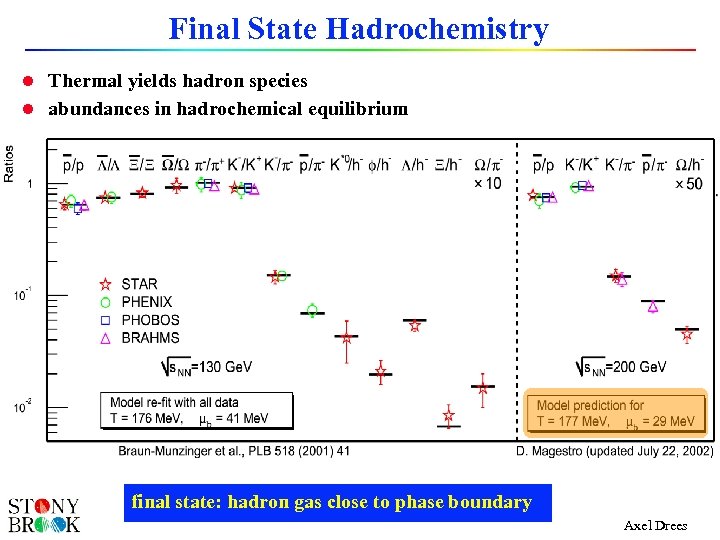 Final State Hadrochemistry l Thermal yields hadron species l abundances in hadrochemical equilibrium spin isospin degeneracy baryochemical potential temperature at chemical freezeout l one particle ratio (e. g. p/p) determines m. B/T l a second ratio (e. g. p/p) then determines T l predict all other hadron abundances and ratios final state: hadron gas close to phase boundary Axel Drees
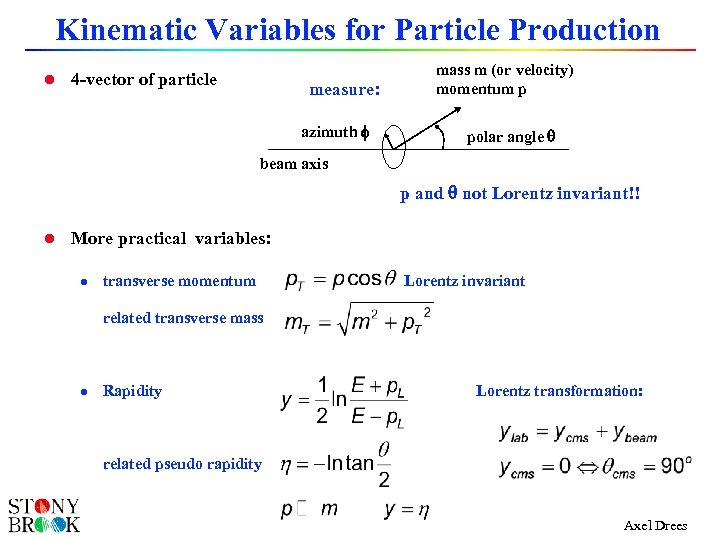 Kinematic Variables for Particle Production l 4 -vector of particle measure: azimuth mass m (or velocity) momentum p polar angle q beam axis p and q not Lorentz invariant!! l More practical variables: l transverse momentum Lorentz invariant related transverse mass l Rapidity Lorentz transformation: related pseudo rapidity Axel Drees
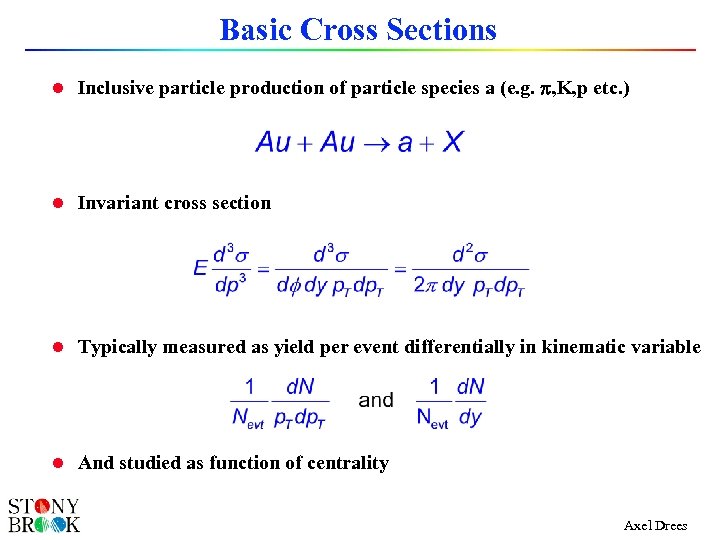 Basic Cross Sections l Inclusive particle production of particle species a (e. g. p, K, p etc. ) l Invariant cross section l Typically measured as yield per event differentially in kinematic variable l And studied as function of centrality Axel Drees
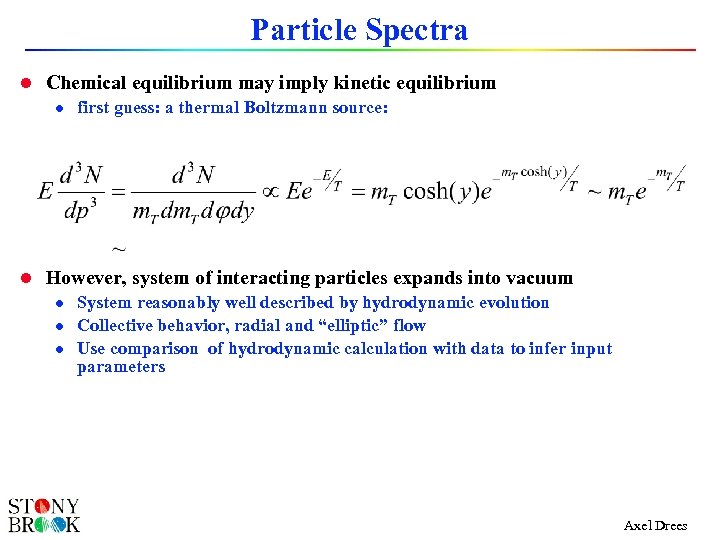 Particle Spectra l Chemical equilibrium may imply kinetic equilibrium l first guess: a thermal Boltzmann source: l However, system of interacting particles expands into vacuum l System reasonably well described by hydrodynamic evolution l Collective behavior, radial and “elliptic” flow l Use comparison of hydrodynamic calculation with data to infer input parameters Axel Drees
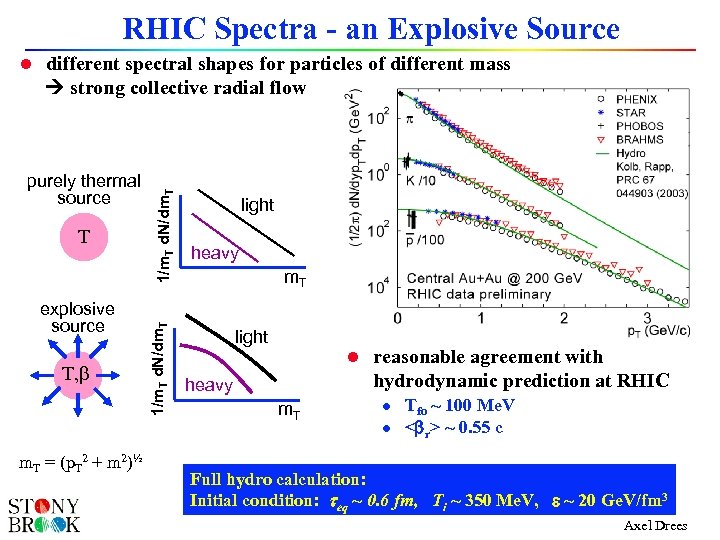 RHIC Spectra - an Explosive Source l different spectral shapes for particles of different mass T explosive source T, b 1/m. T d. N/dm. T purely thermal source 1/m. T d. N/dm. T strong collective radial flow light heavy m. T light l reasonable agreement with hydrodynamic prediction at RHIC heavy m. T l l m. T = (p. T 2 + m 2)½ Tfo ~ 100 Me. V ~ 0. 55 c Full hydro calculation: Initial condition: teq ~ 0. 6 fm, Ti ~ 350 Me. V, ~ 20 Ge. V/fm 3 Axel Drees
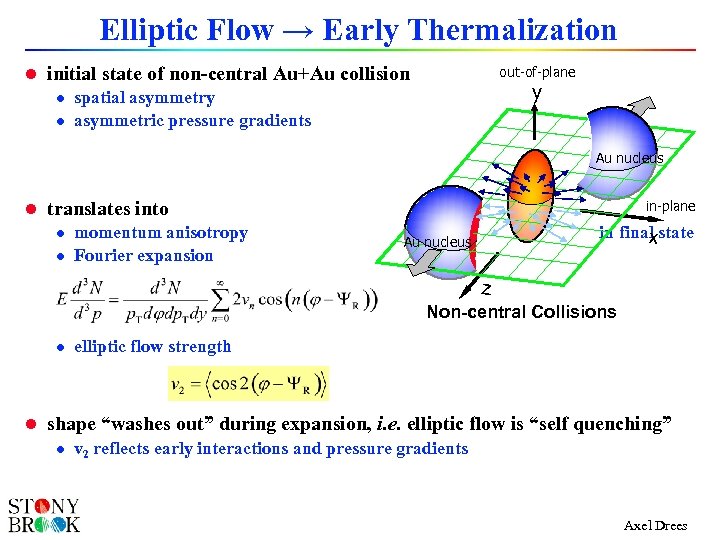 Elliptic Flow → Early Thermalization l initial state of non-central Au+Au collision l spatial asymmetry l asymmetric pressure gradients out-of-plane y Au nucleus l translates into l momentum anisotropy l Fourier expansion in-plane in final state x Au nucleus z Non-central Collisions l elliptic flow strength l shape “washes out” during expansion, i. e. elliptic flow is “self quenching” l v 2 reflects early interactions and pressure gradients Axel Drees
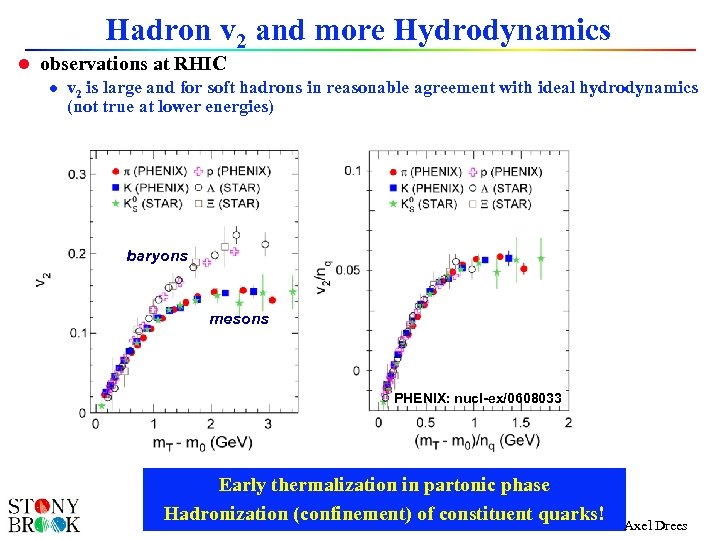 Hadron v 2 and more Hydrodynamics l observations at RHIC l v 2 is large and for soft hadrons in reasonable agreement with ideal hydrodynamics (not true at lower energies) baryons mesons PHENIX: nucl-ex/0608033 Early thermalization in partonic phase Hadronization (confinement) of constituent quarks! Axel Drees
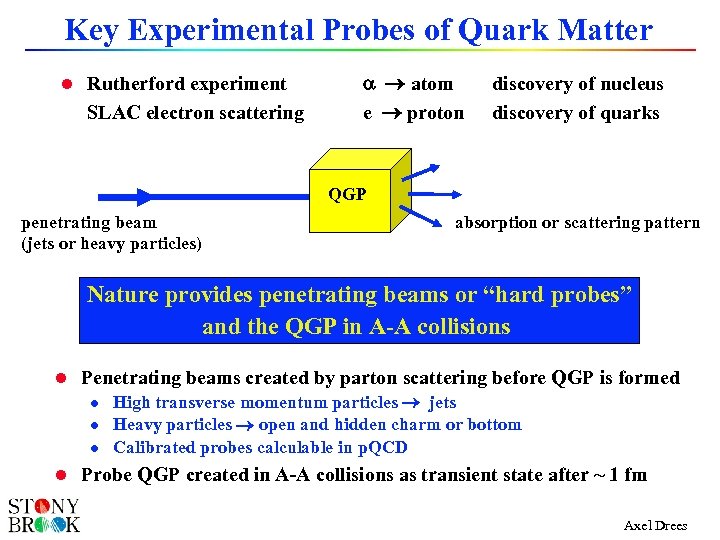 Key Experimental Probes of Quark Matter l Rutherford experiment SLAC electron scattering a atom e proton discovery of nucleus discovery of quarks QGP penetrating beam (jets or heavy particles) absorption or scattering pattern Nature provides penetrating beams or “hard probes” and the QGP in A-A collisions l Penetrating beams created by parton scattering before QGP is formed l High transverse momentum particles jets l Heavy particles open and hidden charm or bottom l Calibrated probes calculable in p. QCD l Probe QGP created in A-A collisions as transient state after ~ 1 fm Axel Drees
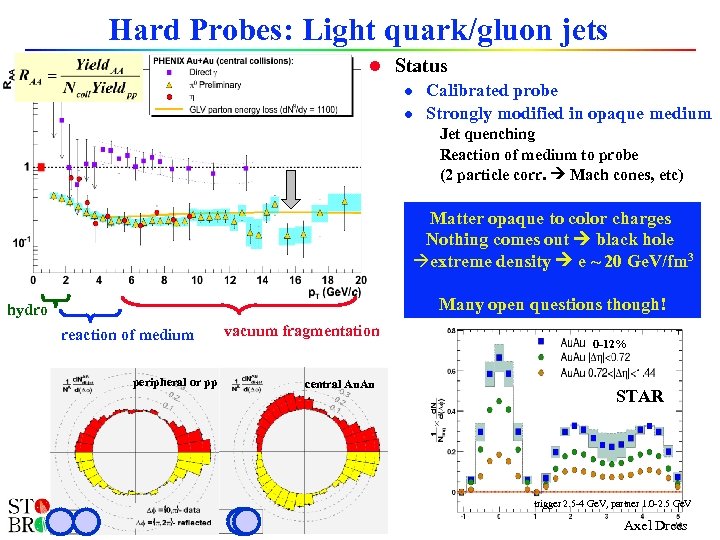 Hard Probes: Light quark/gluon jets l Status l Calibrated probe l Strongly modified in opaque medium Jet quenching Reaction of medium to probe (2 particle corr. Mach cones, etc) Matter opaque to color charges Nothing comes out black hole àextreme density e ~ 20 Ge. V/fm 3 Many open questions though! hydro reaction of medium peripheral or pp vacuum fragmentation central Au. Au 0 -12% STAR trigger 2. 5 -4 Ge. V, partner 1. 0 -2. 5 Ge. V Axel Drees
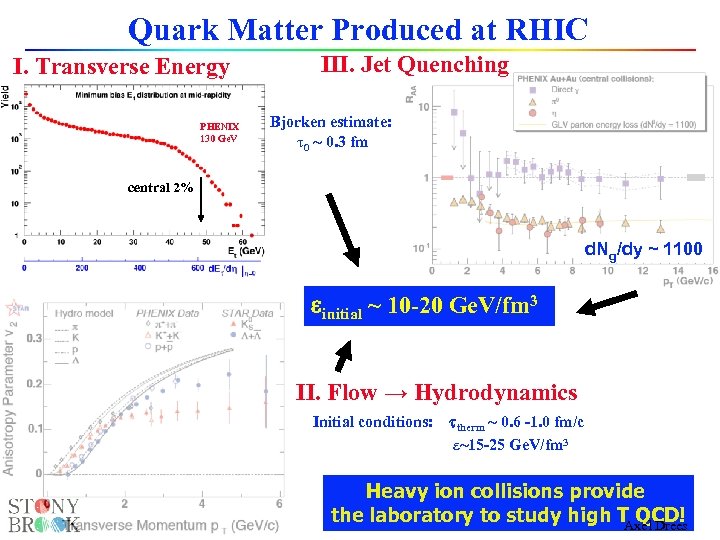 Quark Matter Produced at RHIC I. Transverse Energy PHENIX 130 Ge. V III. Jet Quenching Bjorken estimate: t 0 ~ 0. 3 fm central 2% d. Ng/dy ~ 1100 initial ~ 10 -20 Ge. V/fm 3 II. Flow → Hydrodynamics Initial conditions: therm ~ 0. 6 -1. 0 fm/c ~15 -25 Ge. V/fm 3 Heavy ion collisions provide the laboratory to study high T QCD! Axel Drees
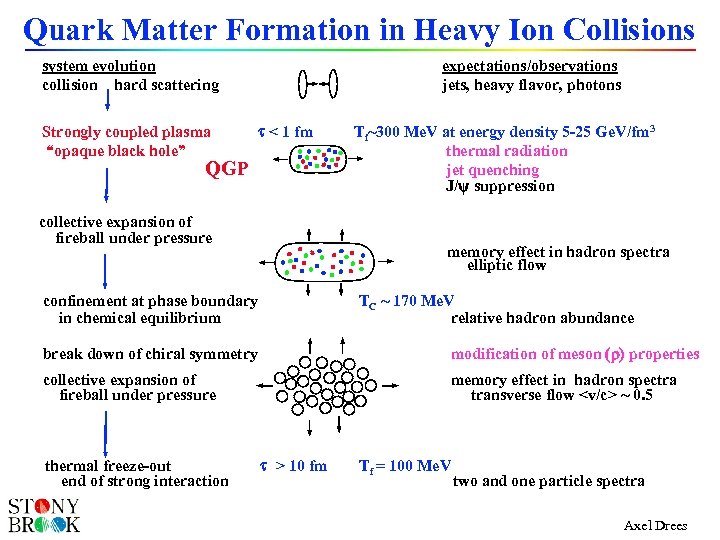 Quark Matter Formation in Heavy Ion Collisions system evolution collision hard scattering Strongly coupled plasma “opaque black hole” expectations/observations jets, heavy flavor, photons < 1 fm QGP collective expansion of fireball under pressure Ti~300 Me. V at energy density 5 -25 Ge. V/fm 3 thermal radiation jet quenching J/ suppression memory effect in hadron spectra elliptic flow confinement at phase boundary in chemical equilibrium TC ~ 170 Me. V relative hadron abundance break down of chiral symmetry modification of meson (r) properties collective expansion of fireball under pressure memory effect in hadron spectra transverse flow