 Скачать презентацию The Exciting World of Natural Deduction By Dylan
769e97ab3e7c315134c55370eecf40d0.ppt
- Количество слайдов: 25



The Exciting World of Natural Deduction!!! By: Dylan Kane Jordan Bradshaw Virginia Walker
Natural Deduction Gerhard Gentzen n Stanislaw Jaskowski n 1934 n Mimics the natural reasoning process, inference rules natural to humans n Called “natural” because does not require conversion to (unreadable) normal form n
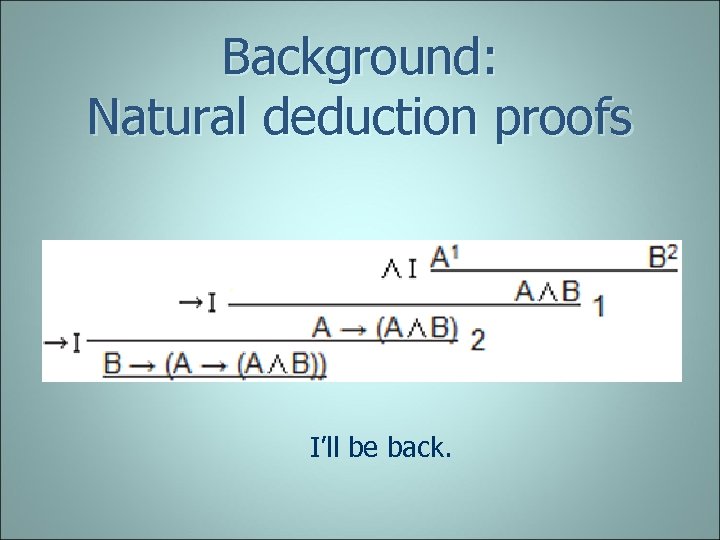
Background: Natural deduction proofs I’ll be back.
Natural Deduction n Proof system for first-order logic Designed to mimic the natural reasoning process Process: n Make assumptions (“A” is true) n n Letters like “A” can represent larger propositional phrases The set of assumptions being relied on at a given step is called the context. Use rules to draw conclusions. Discharge assumptions as they become no longer necessary.
Natural Deduction n Natural deduction is done in step by step: Rule n Premises n Conclusion n … n
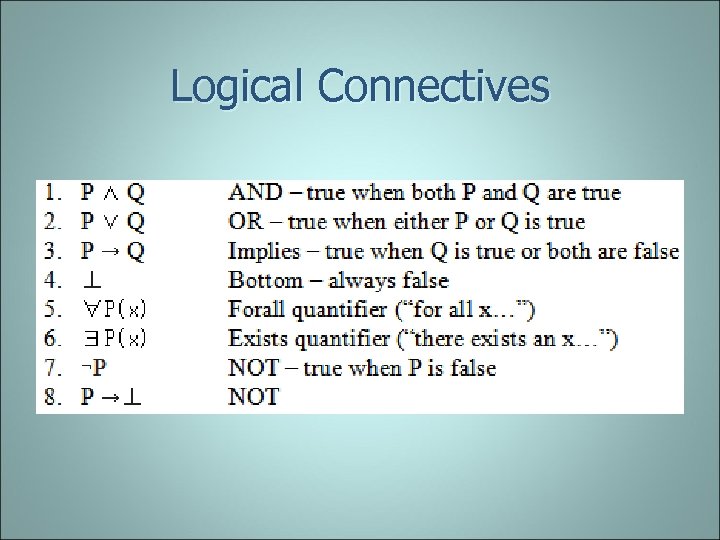
Logical Connectives
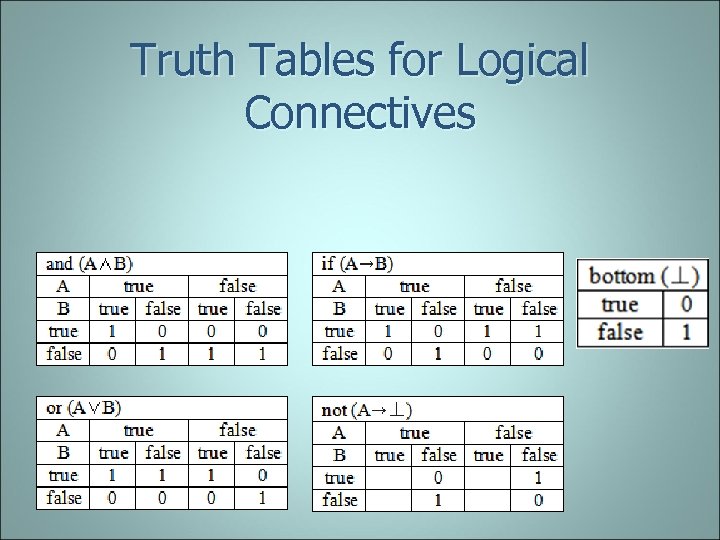
Truth Tables for Logical Connectives
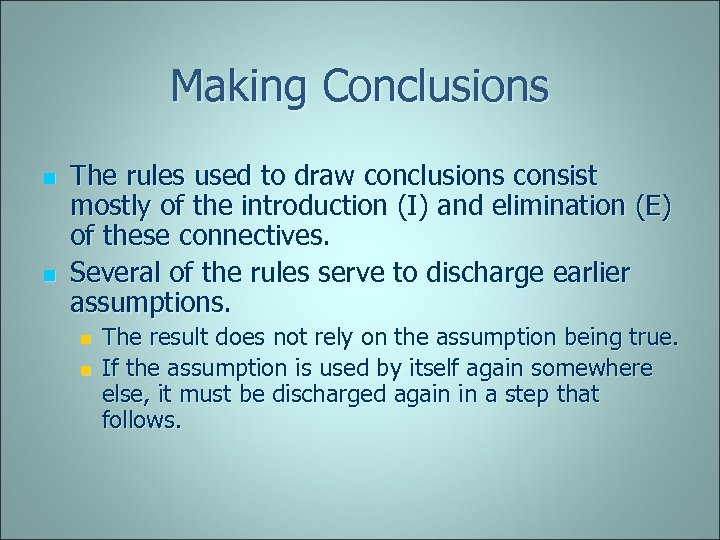
Making Conclusions n n The rules used to draw conclusions consist mostly of the introduction (I) and elimination (E) of these connectives. Several of the rules serve to discharge earlier assumptions. n n The result does not rely on the assumption being true. If the assumption is used by itself again somewhere else, it must be discharged again in a step that follows.
Introduction and Elimination n n Introduction builds the conclusion out of the logical connective and the premises. Elimination eliminates the logical connective from a premise.
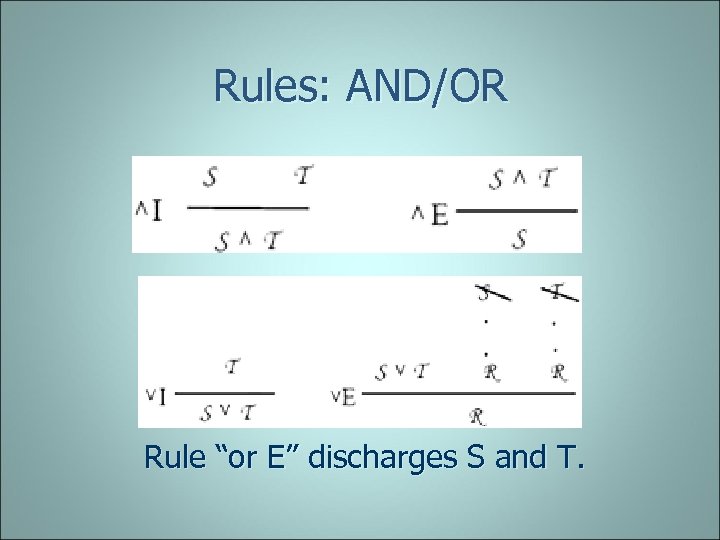
Rules: AND/OR Rule “or E” discharges S and T.
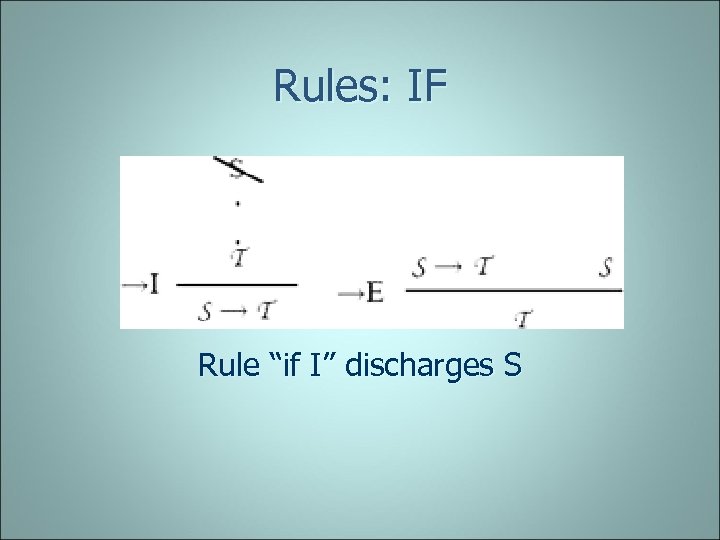
Rules: IF Rule “if I” discharges S
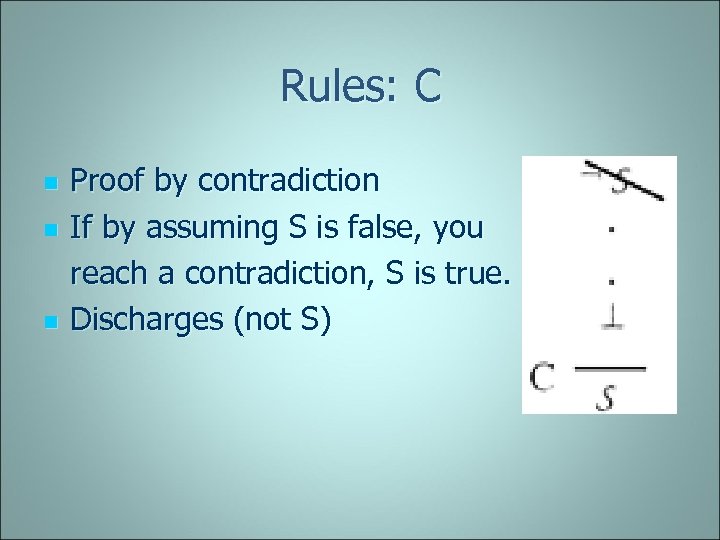
Rules: C n n n Proof by contradiction If by assuming S is false, you reach a contradiction, S is true. Discharges (not S)
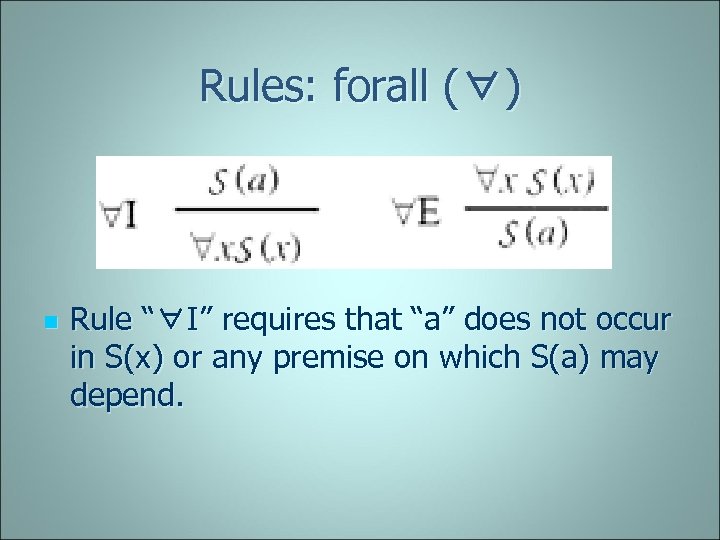
Rules: forall (∀) n Rule “∀I” requires that “a” does not occur in S(x) or any premise on which S(a) may depend.
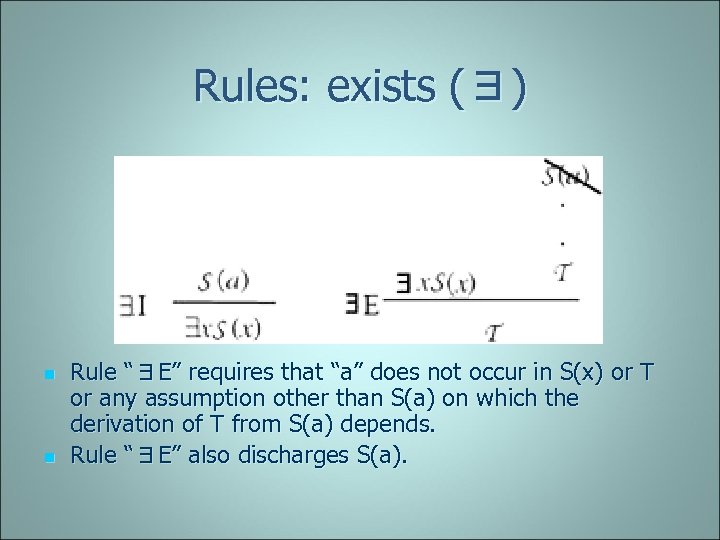
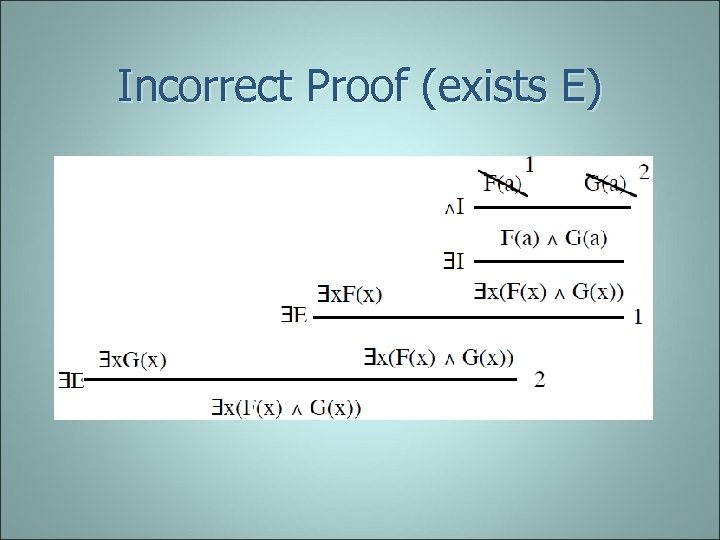
Rules: exists (∃) n n Rule “∃E” requires that “a” does not occur in S(x) or T or any assumption other than S(a) on which the derivation of T from S(a) depends. Rule “∃E” also discharges S(a).
Tautology n n n Always true. The proof of a tautology ultimately relies on no assumptions. The assumptions are discharged throughout the proof.
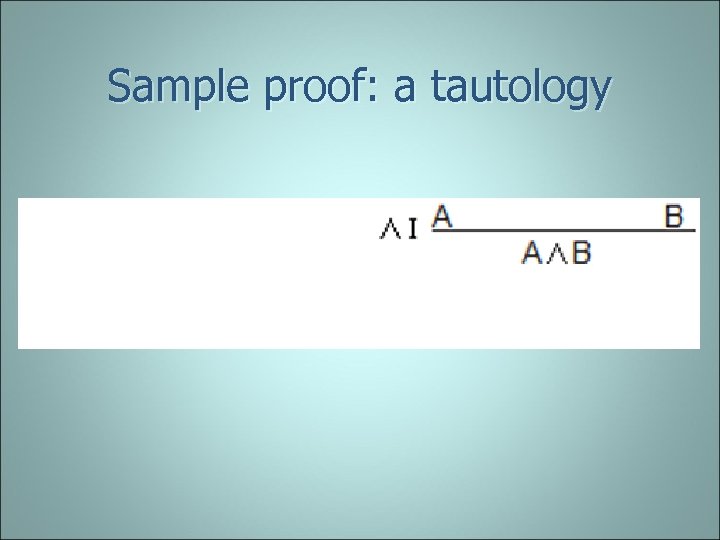
Sample proof: a tautology
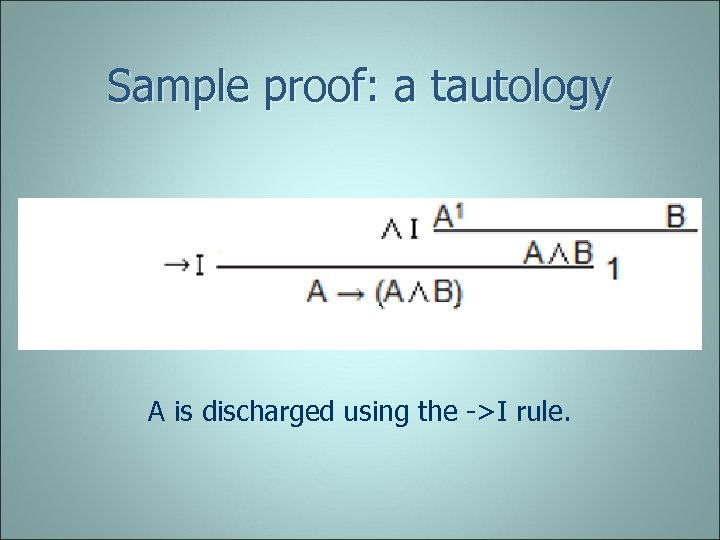
Sample proof: a tautology A is discharged using the ->I rule.
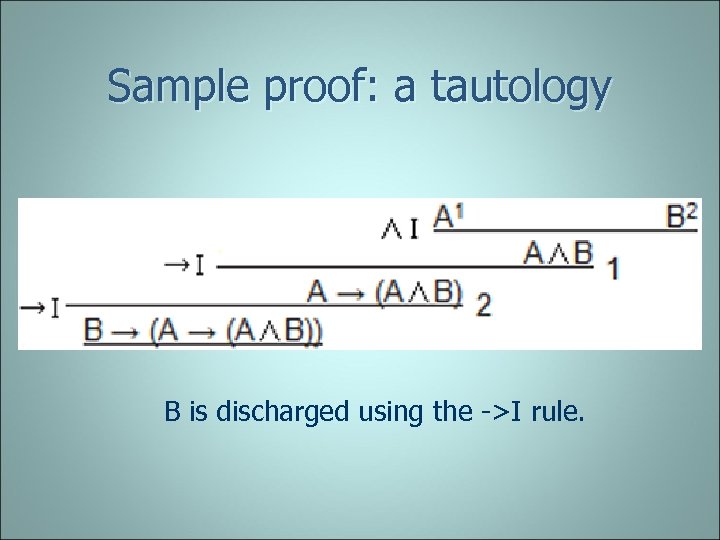
Sample proof: a tautology B is discharged using the ->I rule.
Example using Quantifiers n n “Imagine how you would convince someone else, who didn’t know any formal logic, of the validity of the entailment you are trying to demonstrate. ” a. k. a. That a knowledge base entails a sentence.
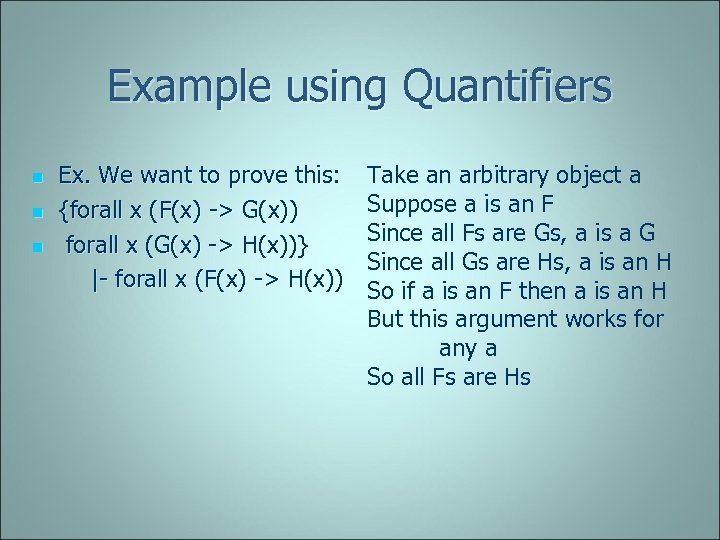
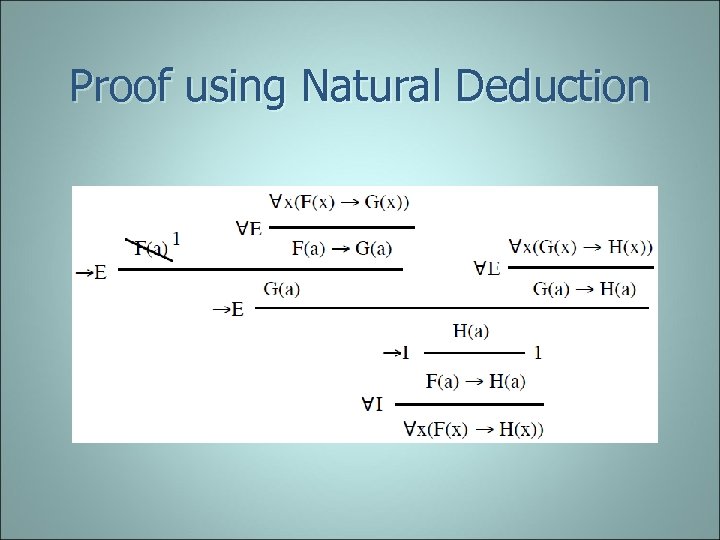
Example using Quantifiers n n n Ex. We want to prove this: {forall x (F(x) -> G(x)) forall x (G(x) -> H(x))} |- forall x (F(x) -> H(x)) Take an arbitrary object a Suppose a is an F Since all Fs are Gs, a is a G Since all Gs are Hs, a is an H So if a is an F then a is an H But this argument works for any a So all Fs are Hs
Proof using Natural Deduction
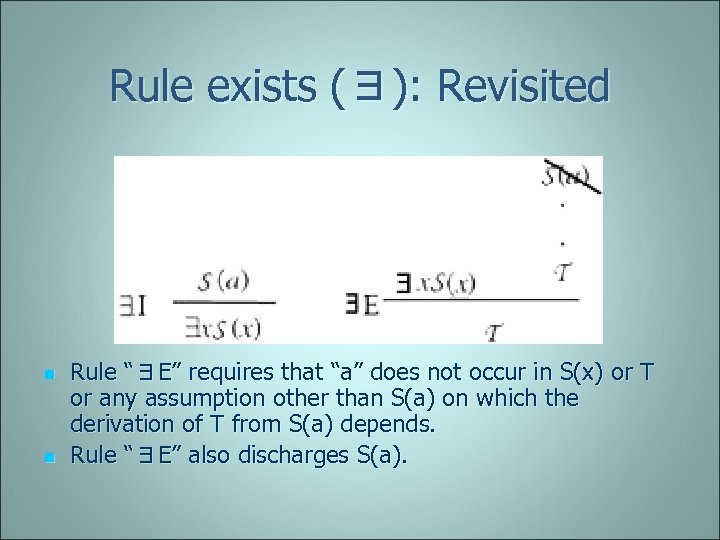
Rule exists (∃): Revisited n n Rule “∃E” requires that “a” does not occur in S(x) or T or any assumption other than S(a) on which the derivation of T from S(a) depends. Rule “∃E” also discharges S(a).
Incorrect Proof (exists E)
Interesting Tidbits for Further Reading n n Natural Deduction book written in 1965 by Prawitz Gallier in 1986 used Gentzen’s approach to expound theoretical underpinning so f automated deduction.
Credits n n Reeves, Steve and Mike Clarke. Logic for Computer Science. 2003. Russell, Stuart and Peter Norvig. Artificial Intelligence: A modern Approach. 2 nd edition. 2003
Скачать презентацию The Exciting World of Natural Deduction By Dylan
769e97ab3e7c315134c55370eecf40d0.ppt