 Скачать презентацию The Evolving Role of the World Bank for
c06dcba4cfed23ebdd088b1e7b0bd5a3.ppt
- Количество слайдов: 28



The Evolving Role of the World Bank for Countries like Sri Lanka The 25 th Anniversary Lecture of the Centre for Banking Studies 14 Dec 2006 World Bank, Naoko Ishii 1
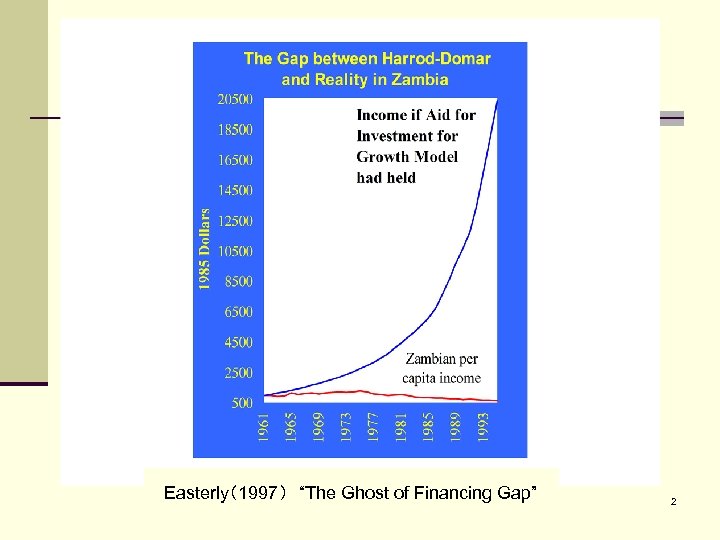
Easterly(1997) “The Ghost of Financing Gap” 2
WB’s Role is “Evolving” n In 1990’s – criticism towards lack of progress in poverty reduction n From projects to programs n From Bank-dictated projects / programs to supporting country strategies n Emphasis on ownership and partnership n Decentralization of offices and operations n Combining global knowledge with local expertise 3
World is Changing n WB no longer has “monopoly” in development Private capital is 5 -6 times larger than aid flows n Consultancy services are readily available n Globalization and interdependence n Booming Asia n Role of state changing n 4
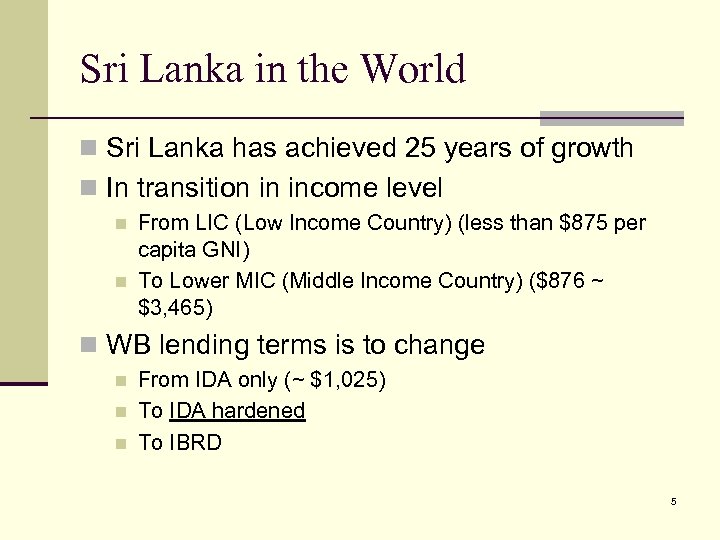
Sri Lanka in the World n Sri Lanka has achieved 25 years of growth n In transition in income level n n From LIC (Low Income Country) (less than $875 per capita GNI) To Lower MIC (Middle Income Country) ($876 ~ $3, 465) n WB lending terms is to change n n n From IDA only (~ $1, 025) To IDA hardened To IBRD 5
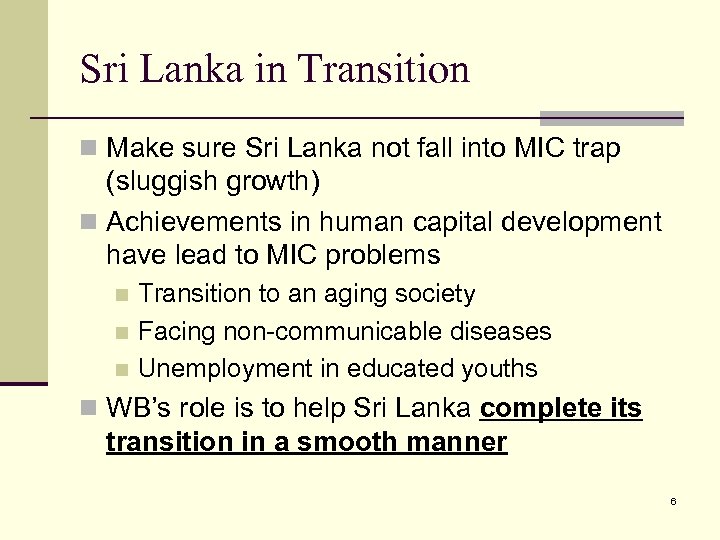
Sri Lanka in Transition n Make sure Sri Lanka not fall into MIC trap (sluggish growth) n Achievements in human capital development have lead to MIC problems Transition to an aging society n Facing non-communicable diseases n Unemployment in educated youths n n WB’s role is to help Sri Lanka complete its transition in a smooth manner 6
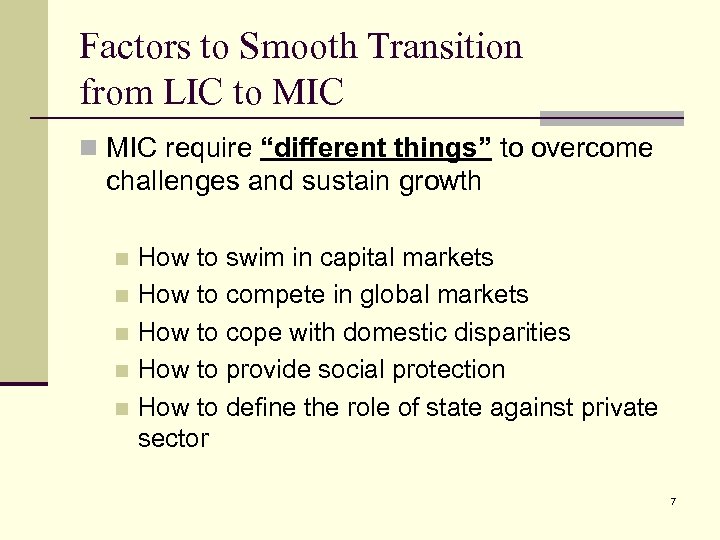
Factors to Smooth Transition from LIC to MIC n MIC require “different things” to overcome challenges and sustain growth How to swim in capital markets n How to compete in global markets n How to cope with domestic disparities n How to provide social protection n How to define the role of state against private sector n 7
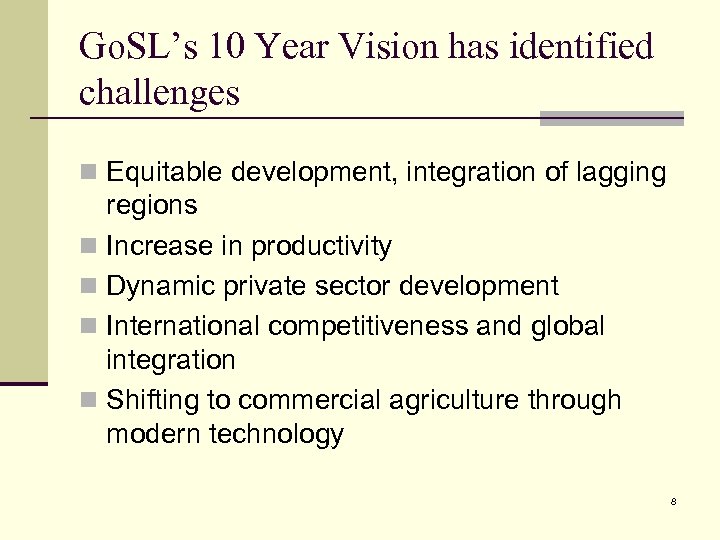
Go. SL’s 10 Year Vision has identified challenges n Equitable development, integration of lagging regions n Increase in productivity n Dynamic private sector development n International competitiveness and global integration n Shifting to commercial agriculture through modern technology 8
World Bank’s role is: n To help GOSL identify institutions required for smooth transition and develop, regulate and manage them n To help GOSL think through cross-cutting issues and formulate strategy to cope with Integration with global markets n Increase in competitiveness and productivity n Dealing with disparities n 9
How World Bank delivers: n Conduct studies before lending n Combine global knowledge with local expertise n Leverage lending (project or program) with policy dialogue, advisory services, capacity building and technical assistance n Maximize impact beyond direct impact of original project n Partnership with other partners under “strategic complementarity” 10
11
12
13
14
15
Macroeconomic Institutions n Support macroeconomic stability in the context of more liberalized capital markets n Modernization of Ministry of Finance n Public financial management n Debt management n Output-based budgeting n Monitoring and evaluation n Modernization of Central Bank & Non. Financial Regulatory Bodies 16
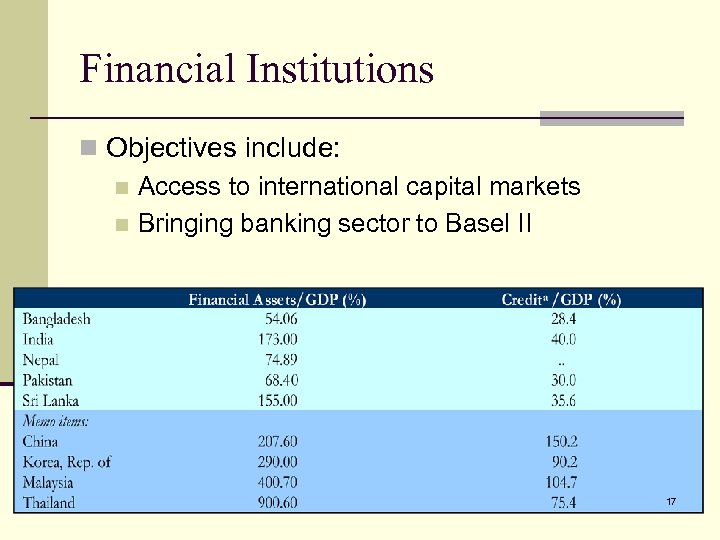
Financial Institutions n Objectives include: n Access to international capital markets n Bringing banking sector to Basel II 17
Increasing Long-term Financing n Infrastructure, Industry, Housing, Agriculture, etc, require more efficient and effective private sources of long term finance n Equity & Bond Market Development (report on India) n Securitization & Derivative Markets n Developing the Institutional Investor base n introduction of risk based supervision for the insurance sector; legal frameworks for the mutual funds industry 18
Increasing Access to Finance n The considerable segments of the population currently excluded from the formal financial system need to be provided with greater access to a full range of services n New approaches for SME financing to be developed n Rural Financing and agricultural insurance to be designed n Strong and viable MFIs for Microfinance to be built 19
Improving Financial Sector Infrastructure n n n Improve the legal framework for market regulation and supervision Help move towards international accounting and auditing standards Assess and strengthen corporate governance and disclosure of banks and non-bank financial institutions, and also of non-financial firms. Support efficient payments systems and credit bureaus Develop sounder markets for risk sharing 20
Raising Competitiveness n Investment climate to attract FDI and knowledge Regulatory regime and enforcement n Political and macro-stability n Infrastructure n “Stronger” state as “regulator” n n Meeting global standards (food, environment) n Focus on R& D in partnership with private sector n A high quality education system to move up the value chain of industrial and service activities n Increase in productivity of labor, land water resources 21
PPP for Infrastructure n What are PPPs? n Form of government procurement involving private sector participation for the delivery of specific public services n Agreement between the government and a private sector entity to share in the risk and rewards of a business venture involving public services n Areas: ICT, power, transport, water/urban 22
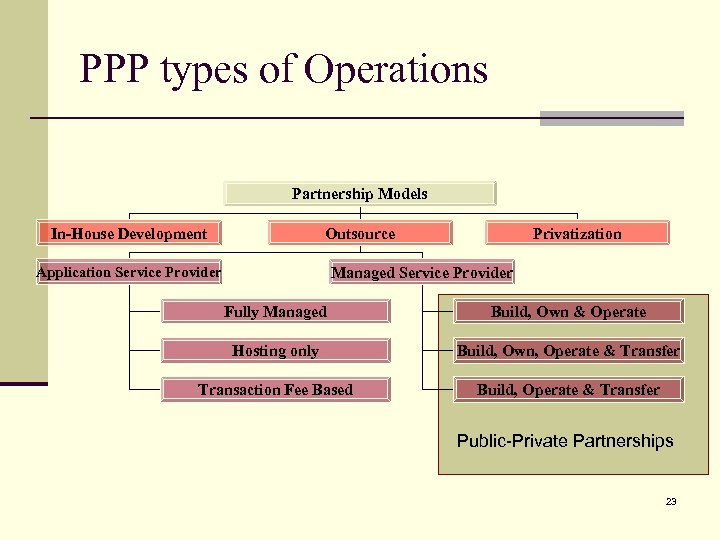
PPP types of Operations Partnership Models In-House Development Outsource Privatization Managed Service Provider Application Service Provider Fully Managed Build, Own & Operate Hosting only Build, Own, Operate & Transfer Transaction Fee Based Build, Operate & Transfer Public-Private Partnerships 23
WB group role in infra-PPP n Develop consensus and frameworks -- TA n PPP approach defined, political buy-in established n Develop pilot transactions – IFC advisory, investment and WB lending n The first sets of transactions developed and brought to the market n Scale-up successful pilots – evaluation TA, lending n Larger scale programs based on the lessons from the pilot 24
Coping with Disparities n Identify sources of economic disparities n Create opportunities through rural development n Commercial orientation of R&E n Scaling up of CDD (community empowerment) n Make service delivery work for the poor n Provide social safety net 25
Addressing Governance n Help countries to improve governance through entry-points n Demand for governance n Core governance n Private sector development n Local governance n Governance in sectors n Anti-corruption in WB operations 26
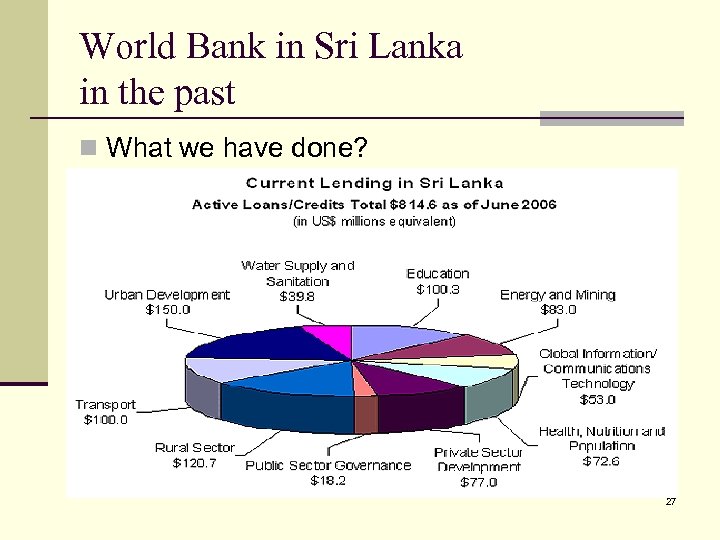
World Bank in Sri Lanka in the past n What we have done? 27
World Bank in Sri Lanka in the future n What we will do? n CAS (Country Assistance Strategy) for 20072010 n Annual lending level – $150 million n Build on government’s 10 Year Vision n Focus on areas / theme where WB has comparative advantage n Work with the government counterparts n Explore the possibility of partnership 28
Скачать презентацию The Evolving Role of the World Bank for
c06dcba4cfed23ebdd088b1e7b0bd5a3.ppt