 Скачать презентацию THE EVOLVING REGISTRAR S OFFICE Bruce W Cunningham Assistant
928c55bb6a5ddf590cdd9549d194ccb4.ppt
- Количество слайдов: 31



THE EVOLVING REGISTRAR’S OFFICE Bruce W. Cunningham Assistant Vice Provost and University Registrar Duke University 2015 SACRAO Annual Meeting Mobile, Alabama
A Little History – Where Did it All Start? • Twelfth Century Europe – Bedel or Beadle (Herald) ▫ “An official to proclaim messages and execute the mandates of the authorities. ” (Quann) ▫ Bologna (Italy), Paris (France), Oxford (England) • First use of the term Registrar was in 1446 at Oxford ▫ ▫ Give form and permanence to university’s acts Draft its letters Make copies of documents Register names of graduates
A Little History – Where Did it All Start? • United Sates ▫ One of the first administrative officers to become a specialist - Positions created prior to deans, bursars , etc. ▫ Part-time faculty member at Harvard until mid-19 th century ▫ 1891 – Stanford opened with a full-time Registrar, 2 nd in command to the President ▫ Duke – First full-time Registrar hired in 1996!!
A Little History – Where Did it All Start? • AAU ▫ ▫ 1880 – 10 percent of AAU institutions had registrars 1890 – 25 percent of AAU institutions had registrars 1900 – 42 percent of AAU institutions had registrars 1910 – 76 percent of AAU institutions had registrars • AACRAO ▫ Formed as AACR, American Association of Collegiate Registrars, in 1910 ▫ 1949 – added “and Admissions Officers, ” to become AACRAO
A Little History – Where Did it All Start? • Explosion of enrollments related to the GI Bill after WW II led to expansion of administrative positions, including Financial Aid Officers and continued growth of Admissions as a separate office ▫ Separate Admissions offices had been around at some schools, but not many until the GI Bill
Early Responsibilities • Care for student records • Official communications between students and academic committees • Prepared official publications • Central bureau of information about the academic work of the institution • Admissions actions • Awarding of scholarships and financial aid • Orientation • Advising • Schedule classes • Analysis of data/teaching loads. , etc.
Who Are Our Constituents? • • • Students (and their parents!) Faculty Academic department staff Fellow administrators Alumni External entities ▫ Employers ▫ Government ▫ Loan agencies
Where Do We Report? • Academic Affairs • Student Affairs • Enrollment Management/Services • Administrative Services • Financial Services
Where Do We Report? • AAU Survey ▫ 2002 – 46 respondents 25 (55%) 13 (28%) 8 (17%) Academic Affairs Student Affairs Other (EM, Administrative, Finance) ▫ 2008 - 54 respondents 23 (43%) 13 (24%) 12 (22%) 6 (11%) Academic Affairs Student Affairs Enrollment Management Other (Administrative, Finance)
Where SHOULD We Report? • Academic Affairs!! • Why? ▫ Faculty are important constituents – just as important as students ▫ Almost everything we do involves academics ▫ Faculty will accept us more as colleagues if we all report up the same ladder ▫ More influence on academic policy if we are part of the academic community
What About Enrollment Management? • Enrollment Management often reports to the academic side, and is a contributor to the academic mission of the institution • Sometimes Enrollment Management reports directly to President • Enrollment Managers can sometimes lose sight of the academic mission – it’s not all about numbers • Ultimately, Enrollment Management is an academic exercise – the goal is to manage enrollments and get the best possible fit between student and institution
Background Needed to Be a Registrar • Educational Background ▫ Degree in Registraring (? ? ? ) ▫ Master’s Degree in College Student Personnel, Higher Education Administration, etc. Doctorate in the same fields can prove advantageous, though few schools require a Doctorate ▫ Technology? ▫ Registrars have a variety of educational backgrounds
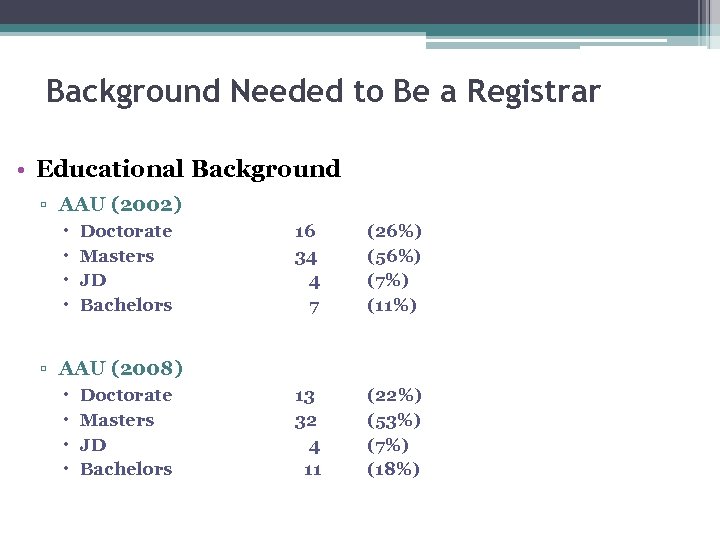
Background Needed to Be a Registrar • Educational Background ▫ AAU (2002) Doctorate Masters JD Bachelors 16 34 4 7 (26%) (56%) (7%) (11%) 13 32 4 11 (22%) (53%) (7%) (18%) ▫ AAU (2008) Doctorate Masters JD Bachelors
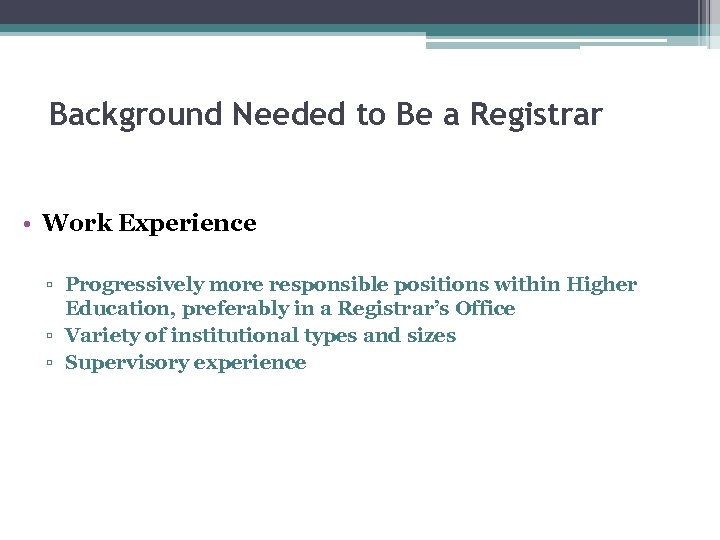
Background Needed to Be a Registrar • Work Experience ▫ Progressively more responsible positions within Higher Education, preferably in a Registrar’s Office ▫ Variety of institutional types and sizes ▫ Supervisory experience
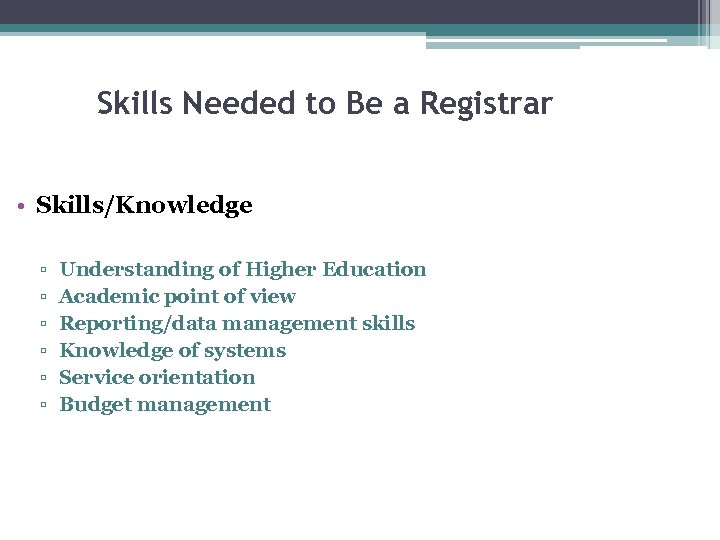
Skills Needed to Be a Registrar • Skills/Knowledge ▫ ▫ ▫ Understanding of Higher Education Academic point of view Reporting/data management skills Knowledge of systems Service orientation Budget management
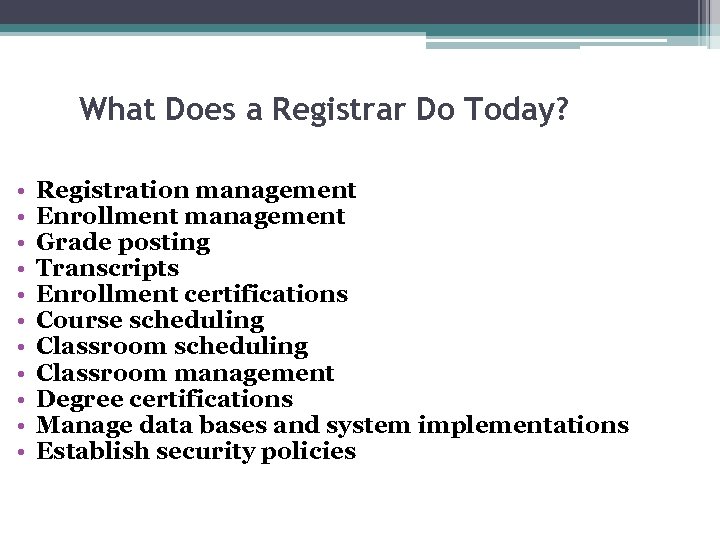
What Does a Registrar Do Today? • • • Registration management Enrollment management Grade posting Transcripts Enrollment certifications Course scheduling Classroom management Degree certifications Manage data bases and system implementations Establish security policies
What Does a Registrar Do Today? • • • Bulletin production – printed vs. on-line Commencement management Degree/auditing and posting Retention tracking Calendar management Veterans’ benefits Athletic eligibility Transfer credit processing and posting Institutional Research Residency determination FERPA Coordinator
What Does a Registrar Do Today? • Academic policy process development ▫ ▫ Participate in development of academic policy Manage academic policy Evaluate academic policy Inform students, faculty, and others about academic policy ▫ Interpret and enforce academic policy
What Does All of This Have in Common? • Administration of the academic enterprise ▫ Almost everything we do involves some aspect of the academic mission of the institution ▫ We are service providers, in support of the academic enterprise
Our Role in the Academic Policy Continuum • We interpret and enforce academic policies, but are also involved in the establishment and evaluation of these policies • We are in a unique position to know… ▫ The needs of the faculty and of the students ▫ How a policy might affect students and faculty ▫ If a policy can be carried out/enforced
How Can We Impact Policy Decisions? • Establish ourselves as knowledgeable academicians ▫ Study higher education ▫ Know the history of policies at your institution - Why, When, How? ▫ Know best practices in the profession (Participate in the “CRAOs”) ▫ Evaluate the impacts of a specific policy – current, as well as proposed – use the data!
How Can We Impact Policy Decisions? • Get to know the academic side of the institution ▫ Learn about and meet faculty (Helps to have a faculty member as a reference) ▫ Look for new opportunities for learning about the needs of the institution, both within and outside the office
How Can We Impact Policy Decisions? • Get involved in academic decision making ▫ Be proactive ▫ Raise issues – don’t just deal with the ones that come to us ▫ Provide useful data as part of the decision making process – get folks to realize the data is available and useful in decision making
How Can We Impact Policy Decisions? • Committee work ▫ Welcome committee work ▫ Committee membership and leadership is part of our role ▫ Ask to be placed on committees related to the academic enterprise ▫ Even junior staff members can get involved
What’s on the Horizon? • Most of what we do now – we might do it differently, but we will still do it ▫ Different service models One stop On-line Self service Expanded/enhanced transcripts Use of external service providers Use of cloud based and hosted solutions Managing services, instead of providing them?
What’s on the Horizon? • Most of what we do now – we might do it differently, but we will still do it ▫ Different educational delivery models On-line, hybrid, flipped MOOCs Impact on traditional time periods – will semesters still exist in the future? New accreditation models? International campuses
What’s on the Horizon? • New Tasks ▫ Competency-based education – impact on academic record keeping ▫ Prior learning assessment ▫ Assessment, evaluations, etc.
What’s on the Horizon? • How we work ▫ Flexibility in the workplace – hours, working from home, working from a distance ▫ Staff background As we’ve moved from data entry to managing processes do we need a different type of staff? Is a Bachelor’s degree required for “front line” staff? Technological skills ▫ The future of one stop models
Has Our Role Changed Over the Years? • Compliance, compliance! • Added emphasis on systems, data, and enrollment management – data management vs. data entry • 24/7 accessibility – I want an answer now! • Use of external vendors to provide services ▫ Transcript processing ▫ Call centers ▫ ERPs vs. home grown systems • Internationalization • Different instructional delivery methods • Different ways to assess and report learning
Has Our Role Changed Over the Years? ▫ Still, though, support of the academic enterprise remains the number one function of the Registrar
Our Role in the Academic Enterprise “The registrar’s office encompasses a broad range of services and systems central to the core functions of the institution. Full advantage should be taken of this position to influence and direct policy decisions…. . The registrar is perfectly positioned to provide leadership in this endeavor – to be a bridge between the wants and needs of students and the demands and concerns of faculty. ” (Schipporeit, AACRAO Registrar’s Guide, 2006)
Скачать презентацию THE EVOLVING REGISTRAR S OFFICE Bruce W Cunningham Assistant
928c55bb6a5ddf590cdd9549d194ccb4.ppt