


 Скачать презентацию The Evolving Heliophysics Data Environment Vx O Kickoff
52a6f3b8f19eb71e9bf7b999b5fabb0e.ppt
- Количество слайдов: 13
 The Evolving Heliophysics Data Environment: “Vx. O Kickoff” Chuck Holmes Joe Bredekamp May 22, 2006 Vx. O Kickoff Meeting - May 22, 2006
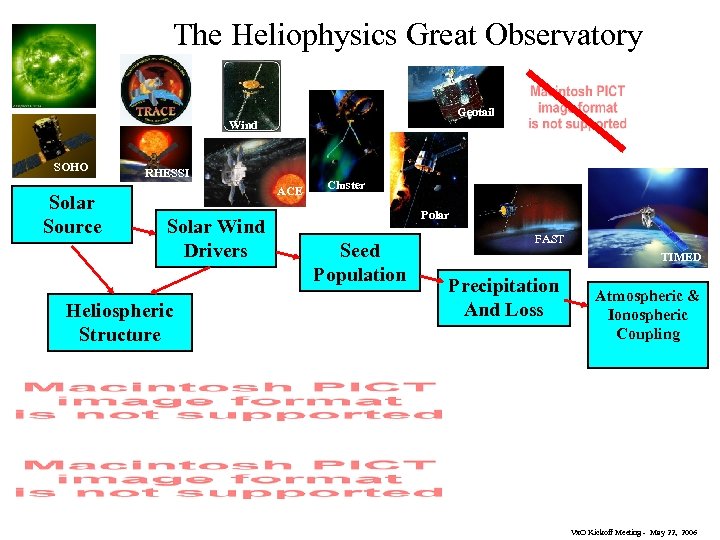 The Heliophysics Great Observatory Geotail Wind IMAGE SOHO Solar Source RHESSI ACE Solar Wind Drivers Heliospheric Structure Cluster Polar Seed Population FAST TIMED Precipitation And Loss Atmospheric & Ionospheric Coupling Vx. O Kickoff Meeting - May 22, 2006
 S 3 C Missions Under Development Vx. O Kickoff Meeting - May 22, 2006
 The HP Data Environment • Data from the Great Observatory reside in a distributed environment and are served from multiple sources. • Multimission Data Centers – Solar Data Analysis Center – Space Physics Data Facility [CDAWeb, OMNIWeb, etc. ] – The Community Coordinated Modeling Center • • Mission-level active archives: e. g. ACE, TIMED, TRACE, Cluster, etc. Much of our data are served from the individual instrument sites. • We are moving into a new data environment of – Virtual Observatories for convenient search and access of the distributed data, and – Resident Archives to retain the distributed data sources even after mission termination. • We have a Data and Computing Working Group to help us move ahead. Vx. O Kickoff Meeting - May 22, 2006
 Vision for the Heliophysics Data Environment • “Report and Recommendations of the LWS Data System Planning Team”, Winter, 2002. • The Heliophysics (nee SEC, Sun-Solar System Connection) Data Environment: – Will be based on existing services and evolve in response to user needs -> no new data system – Will allow for the selective inclusion of essential data sets and modeling from other sources. – Requires science participation in data management -> no new data system management group – The environment will be distributed and virtual. – Will have peer-reviewed process for elements of the environment. Vx. O Kickoff Meeting - May 22, 2006
 Corollaries to the Vision • Heliophysics data environment needs to support all heliophysics research activities and programs. • The “Right Amount of Glue” sets the philosophy. – – J. B. Gurman (Fall 2002 AGU, SH 52 C-03) Technology is or will be ready XML plus software tools become the new standard (the ‘glue’) A standard of behavior - share one’s data with everyone • The Virtual Solar Observatory is a path-finder. • Activate/Energize discipline-based approaches to the evolution of the data environment. • The SPASE dictionary will be the ‘Rosetta Stone’ for HP data models. • Distributed funding and implementation activities. • Blend ‘bottoms-up’ implementation approaches with ‘top-down’ vision for the whole scope of an integrated data environment. Vx. O Kickoff Meeting - May 22, 2006
 Agenda • • Welcome (Mc. Guire & Roberts) Introduction (Holmes & Bredekamp) The Invocation (Gurman) Status and plans reports from funded Vx. O Activities (~10 -15 min) – VSO, VSPO, GAIA, VSTO – VHO, VITMO, VIRBO, VMO/G, VMO/U • • Science constituency served Who’s Doing What (People and Institutions) Datasets to be made available Services Overall architecture including Technology, Data Model, etc. Milestones/Timeline Methodology for user feedback Vx. O Kickoff Meeting - May 22, 2006
 Agenda (cont’d) • A conversation about SPASE and the Vx. Os and other Data Centers (Roberts, Thieman, T. King) – – What is SPASE and its Data Model? Status of the Data Model and tools for its use Proposed plan for populating registries and for model feedback Open discussion of suggestions and plans • Value-added services for Vx. Os (10 -15 min each) – SPDF, COSEC, tbd • Future directions – – – Ideas for coordination and collaborations Approaches for evolving to THE VHPO Ideas/models for transitioning capabilities developed to operating infrastructure Next steps in gathering user requirements, priorities, concerns for data and services Building community buy-in and enthusiasm to data environment efforts • Community Workshop Planning – Next Vx. O technical workshop – Ideas and volunteers for organization, timing, topics etc Vx. O Kickoff Meeting - May 22, 2006
 Charge to the Workshop • What we are trying to accomplish: – Promote the Vx. Os to collaborate [sharing info and how to], – Start the dialog for integrating upwards in order to break down the barriers between the sub-disciplines, and – As we proliferate the Vx. Os: assist the data services - don’t confuse them. • Our researchers don't know the barriers; why should we impose artificial ones? Vx. O Kickoff Meeting - May 22, 2006
 Vx. O Kickoff Meeting - May 22, 2006
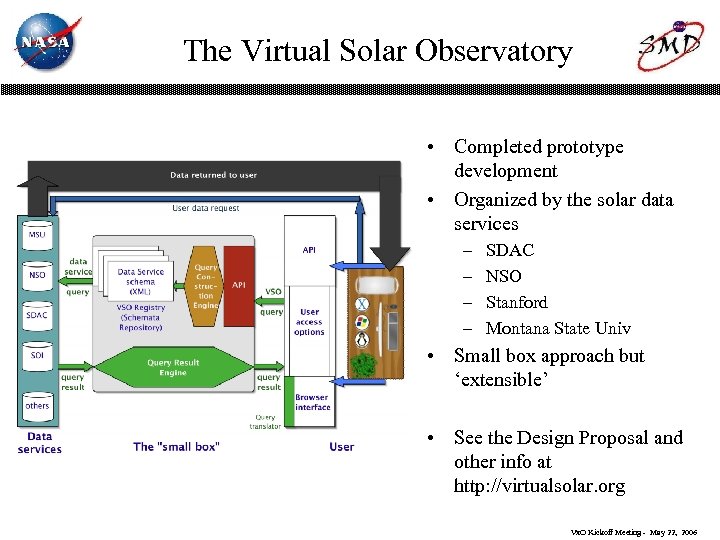 The Virtual Solar Observatory • Completed prototype development • Organized by the solar data services – – SDAC NSO Stanford Montana State Univ • Small box approach but ‘extensible’ • See the Design Proposal and other info at http: //virtualsolar. org Vx. O Kickoff Meeting - May 22, 2006
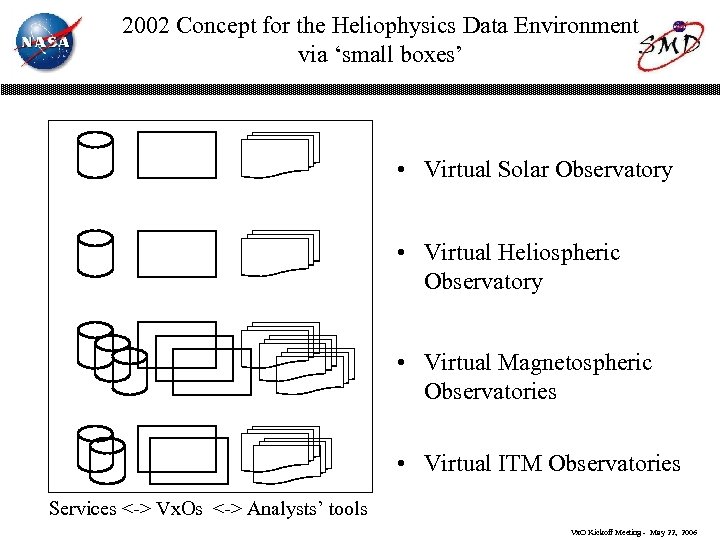 2002 Concept for the Heliophysics Data Environment via ‘small boxes’ • Virtual Solar Observatory • Virtual Heliospheric Observatory • Virtual Magnetospheric Observatories • Virtual ITM Observatories Services <-> Vx. Os <-> Analysts’ tools Vx. O Kickoff Meeting - May 22, 2006
 Think ‘small box’ • Limit the initial set of data services – Place additional or future data services on the ‘to do’ list • Limit functionality and capability – Focus on the core functions of data query and retrieval • Share (publish) the schemata – Schemata are referenced via registered URLs • Vx. Os work w/ data services to create and maintain schemata • Analysts work w/ the Vx. Os to create, debug and update the query engines and APIs • Each Vx. O needs an associated software library of data manipulation and analysis tools – E. g. Solar. Soft library serves the solar research community Vx. O Kickoff Meeting - May 22, 2006