 Скачать презентацию The Evolution of Cyberinfrastructure for Science from IP
9cf82620b8bea53349b4a778e3e4911a.ppt
- Количество слайдов: 35



The Evolution of Cyberinfrastructure for Science: from IP to OIL William E. Johnston http: //www-itg. lbl. gov/~wej/ Computational Research Division, DOE Lawrence Berkeley National Lab and NASA Advanced Supercomputing Division, NASA Ames Research Center doesciencegrid. org www. ipg. nasa. gov
The Process of Large-Scale Science is Changing • Distributed data, computing, people, instruments • Instruments integrated with large-scale computing and data systems • In some fields – e. g. astronomy and astrophysics – science is being done by mining data from dozens of instruments, instead of the direct use of a single instrument like a telescope 2
Change Drives the Evolution of Cyberinfrastructure • Large-scale science and engineering problems require collaborative use of many compute and data resources, including supercomputers and large-scale data storage systems, all of which must be integrated with applications and data that are – developed by different teams of researchers – or that are obtained from different instruments and all of which are at different geographic locations. 3
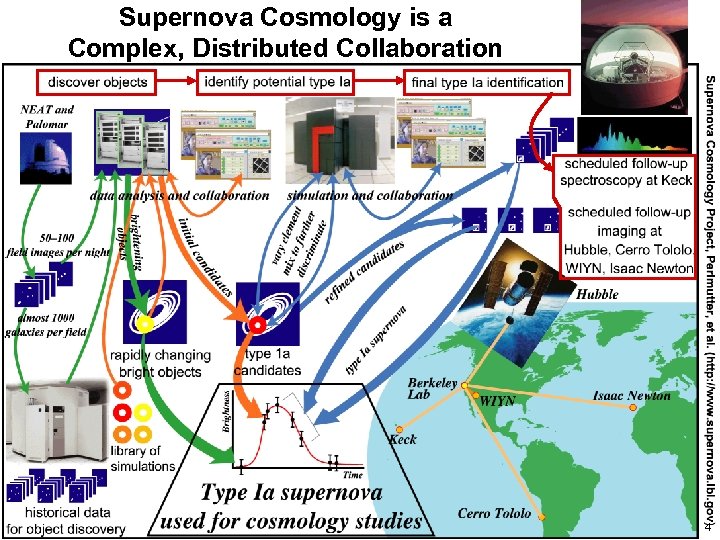
Supernova Cosmology is a Complex, Distributed Collaboration 4
Cyberinfrastructure • Such complex scenarios require sophisticated infrastructure – high-speed networks, very highspeed computers, and highly capable middleware – to support the application frameworks that are needed to successfully describe and manage the many operations needed to carry out the science. 5
Cyberinfrastructure • In order to inform the development and deployment of technology, a set of high-impact science applications in the areas of high energy physics, climate, chemical sciences, magnetic fusion energy, and molecular biology have been analyzed* to characterize their visions for the future process of science, and the networking and middleware capabilities needed to support those visions *DOE Office of Science, High Performance Network Planning Workshop. August 13 -15, 2002: Reston, Virginia, USA. http: //doecollaboratory. pnl. gov/meetings/hpnpw 6
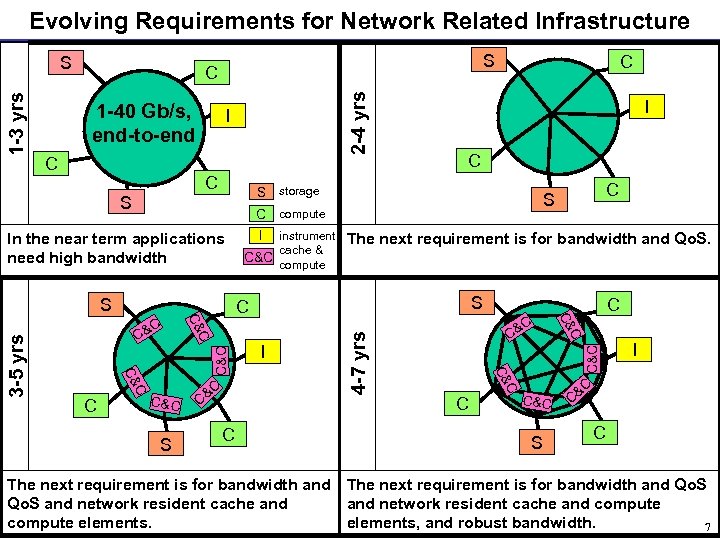
Evolving Requirements for Network Related Infrastructure S 1 -40 Gb/s, end-to-end C I C S I C I instrument cache & C&C compute The next requirement is for bandwidth and Qo. S. S The next requirement is for bandwidth and Qo. S and network resident cache and compute elements. C&C C C& S C C& C&C I C C& C S C compute S 3 -5 yrs C S storage In the near term applications need high bandwidth C 2 -4 yrs C 4 -7 yrs 1 -3 yrs S C&C S I &C C C The next requirement is for bandwidth and Qo. S and network resident cache and compute elements, and robust bandwidth. 7
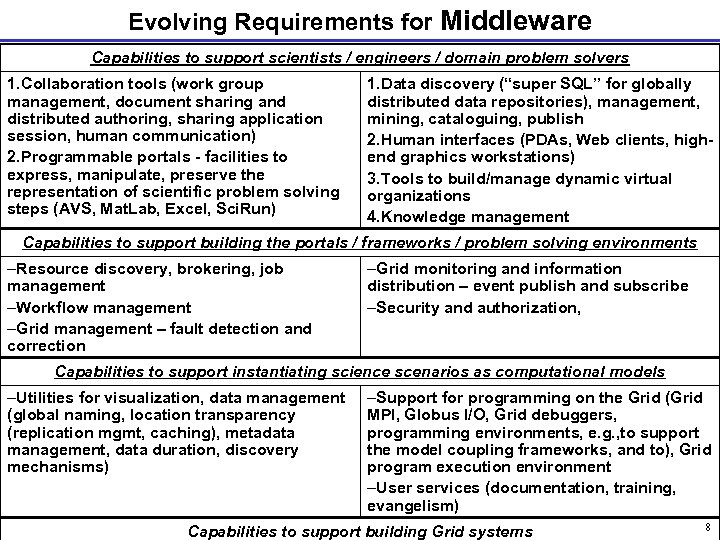
Evolving Requirements for Middleware Capabilities to support scientists / engineers / domain problem solvers 1. Collaboration tools (work group management, document sharing and distributed authoring, sharing application session, human communication) 2. Programmable portals - facilities to express, manipulate, preserve the representation of scientific problem solving steps (AVS, Mat. Lab, Excel, Sci. Run) 1. Data discovery (“super SQL” for globally distributed data repositories), management, mining, cataloguing, publish 2. Human interfaces (PDAs, Web clients, highend graphics workstations) 3. Tools to build/manage dynamic virtual organizations 4. Knowledge management Capabilities to support building the portals / frameworks / problem solving environments –Resource discovery, brokering, job management –Workflow management –Grid management – fault detection and correction –Grid monitoring and information distribution – event publish and subscribe –Security and authorization, Capabilities to support instantiating science scenarios as computational models –Utilities for visualization, data management (global naming, location transparency (replication mgmt, caching), metadata management, data duration, discovery mechanisms) –Support for programming on the Grid (Grid MPI, Globus I/O, Grid debuggers, programming environments, e. g. , to support the model coupling frameworks, and to), Grid program execution environment –User services (documentation, training, evangelism) Capabilities to support building Grid systems 8
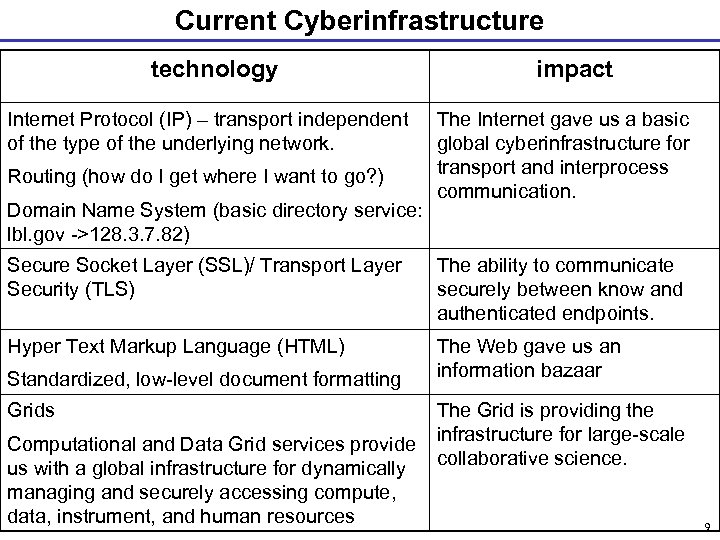
Current Cyberinfrastructure technology Internet Protocol (IP) – transport independent of the type of the underlying network. Routing (how do I get where I want to go? ) Domain Name System (basic directory service: lbl. gov ->128. 3. 7. 82) impact The Internet gave us a basic global cyberinfrastructure for transport and interprocess communication. Secure Socket Layer (SSL)/ Transport Layer Security (TLS) The ability to communicate securely between know and authenticated endpoints. Hyper Text Markup Language (HTML) The Web gave us an information bazaar Standardized, low-level document formatting Grids Computational and Data Grid services provide us with a global infrastructure for dynamically managing and securely accessing compute, data, instrument, and human resources The Grid is providing the infrastructure for large-scale collaborative science. 9
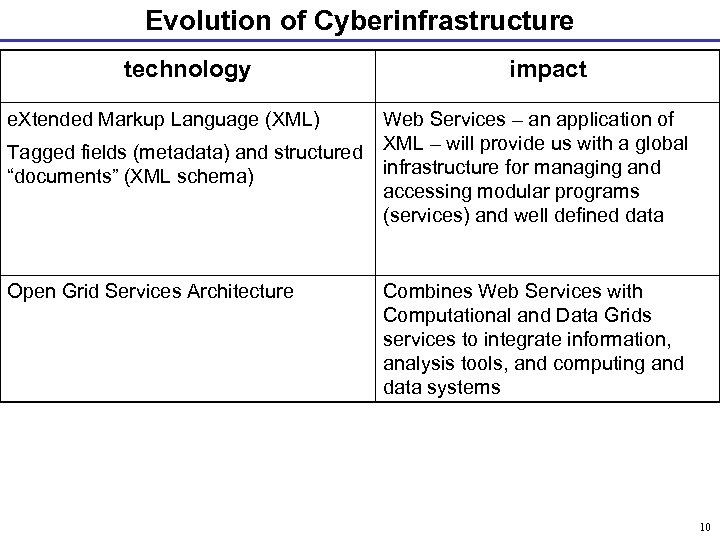
Evolution of Cyberinfrastructure technology e. Xtended Markup Language (XML) Tagged fields (metadata) and structured “documents” (XML schema) Open Grid Services Architecture impact Web Services – an application of XML – will provide us with a global infrastructure for managing and accessing modular programs (services) and well defined data Combines Web Services with Computational and Data Grids services to integrate information, analysis tools, and computing and data systems 10
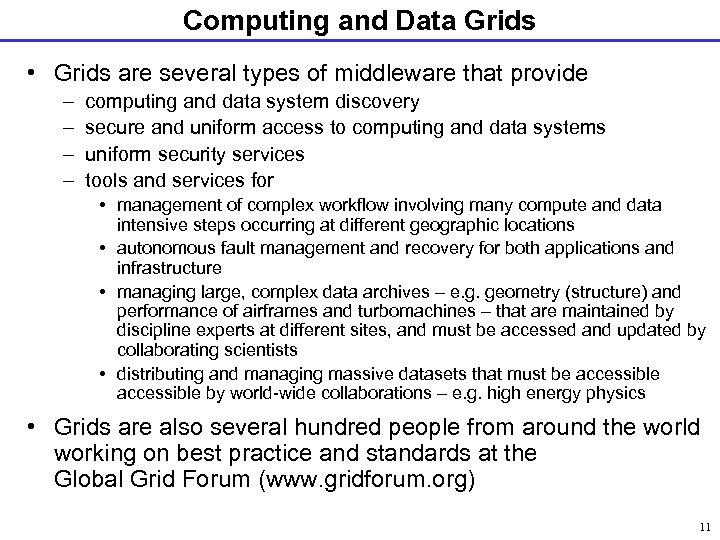
Computing and Data Grids • Grids are several types of middleware that provide – – computing and data system discovery secure and uniform access to computing and data systems uniform security services tools and services for • management of complex workflow involving many compute and data intensive steps occurring at different geographic locations • autonomous fault management and recovery for both applications and infrastructure • managing large, complex data archives – e. g. geometry (structure) and performance of airframes and turbomachines – that are maintained by discipline experts at different sites, and must be accessed and updated by collaborating scientists • distributing and managing massive datasets that must be accessible by world-wide collaborations – e. g. high energy physics • Grids are also several hundred people from around the world working on best practice and standards at the Global Grid Forum (www. gridforum. org) 11
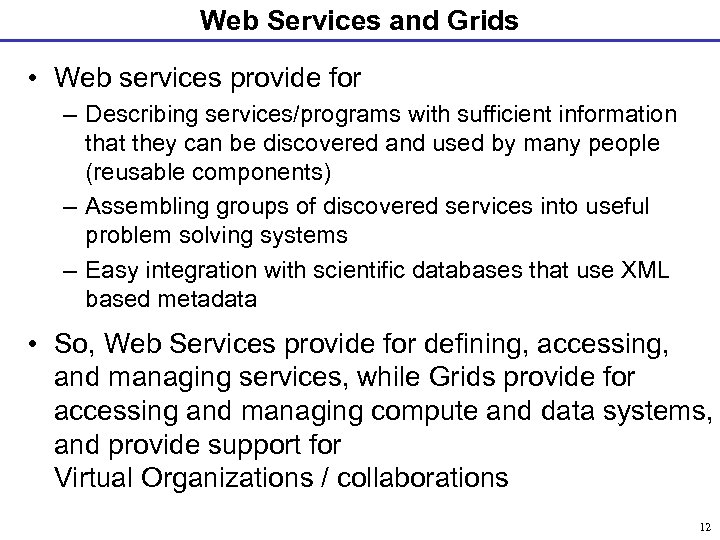
Web Services and Grids • Web services provide for – Describing services/programs with sufficient information that they can be discovered and used by many people (reusable components) – Assembling groups of discovered services into useful problem solving systems – Easy integration with scientific databases that use XML based metadata • So, Web Services provide for defining, accessing, and managing services, while Grids provide for accessing and managing compute and data systems, and provide support for Virtual Organizations / collaborations 12
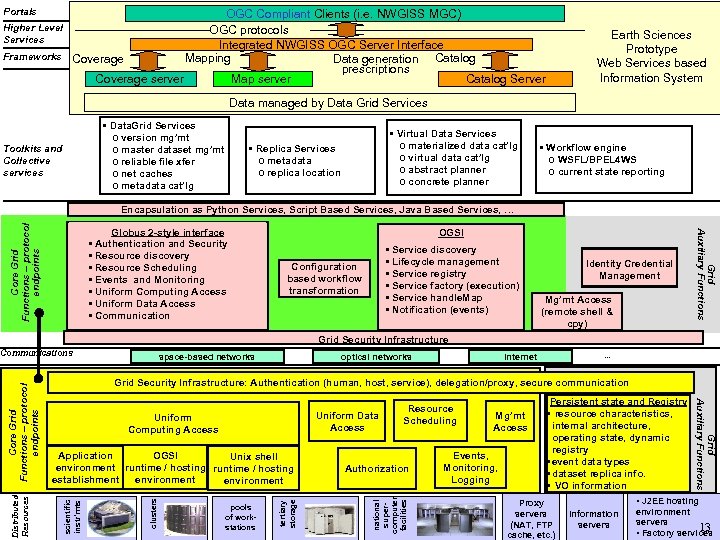
Portals OGC Compliant Clients (i. e. NWGISS MGC) OGC protocols Integrated NWGISS OGC Server Interface Frameworks Coverage Mapping Data generation Catalog prescriptions Coverage server Map server Catalog Server Higher Level Services Earth Sciences Prototype Web Services based Information System Data managed by Data Grid Services • Data. Grid Services o version mg’mt o master dataset mg’mt o reliable file xfer o net caches o metadata cat’lg Toolkits and Collective services • Virtual Data Services o materialized data cat’lg o virtual data cat’lg o abstract planner o concrete planner • Replica Services o metadata o replica location • Workflow engine o WSFL/BPEL 4 WS o current state reporting Globus 2 -style interface • Authentication and Security • Resource discovery • Resource Scheduling • Events and Monitoring • Uniform Computing Access • Uniform Data Access • Communication OGSI • Service discovery • Lifecycle management • Service registry • Service factory (execution) • Service handle. Map • Notification (events) Configuration based workflow transformation Identity Credential Management Mg’mt Access (remote shell & cpy) Grid Auxiliary Functions Core Grid Functions – protocol endpoints Encapsulation as Python Services, Script Based Services, Java Based Services, … Grid Security Infrastructure optical networks . . . Internet Grid Security Infrastructure: Authentication (human, host, service), delegation/proxy, secure communication Uniform Data Access pools of workstations tertiary storage clusters OGSI Application Unix shell environment runtime / hosting environment establishment environment Resource Scheduling Authorization national supercomputer facilities Uniform Computing Access scientific instr’mts Distributed Resources space-based networks Mg’mt Access Events, Monitoring, Logging Persistent state and Registry • resource characteristics, internal architecture, operating state, dynamic registry • event data types • dataset replica info. • VO information Proxy servers (NAT, FTP cache, etc. ) Grid Auxiliary Functions Core Grid Functions – protocol endpoints Communications • J 2 EE hosting information servers environment servers 13 • Factory services
Implications of combining Web Services and Grids There is considerable potential benefit to combining Grid Services and Web services. 14
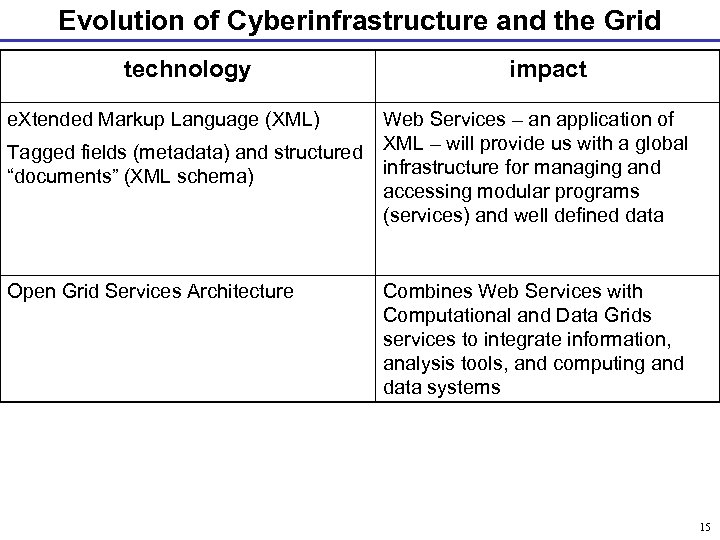
Evolution of Cyberinfrastructure and the Grid technology e. Xtended Markup Language (XML) Tagged fields (metadata) and structured “documents” (XML schema) Open Grid Services Architecture impact Web Services – an application of XML – will provide us with a global infrastructure for managing and accessing modular programs (services) and well defined data Combines Web Services with Computational and Data Grids services to integrate information, analysis tools, and computing and data systems 15
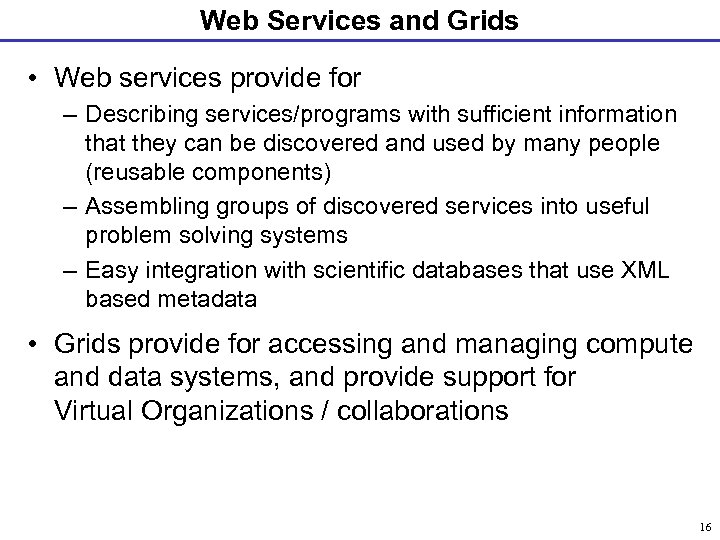
Web Services and Grids • Web services provide for – Describing services/programs with sufficient information that they can be discovered and used by many people (reusable components) – Assembling groups of discovered services into useful problem solving systems – Easy integration with scientific databases that use XML based metadata • Grids provide for accessing and managing compute and data systems, and provide support for Virtual Organizations / collaborations 16
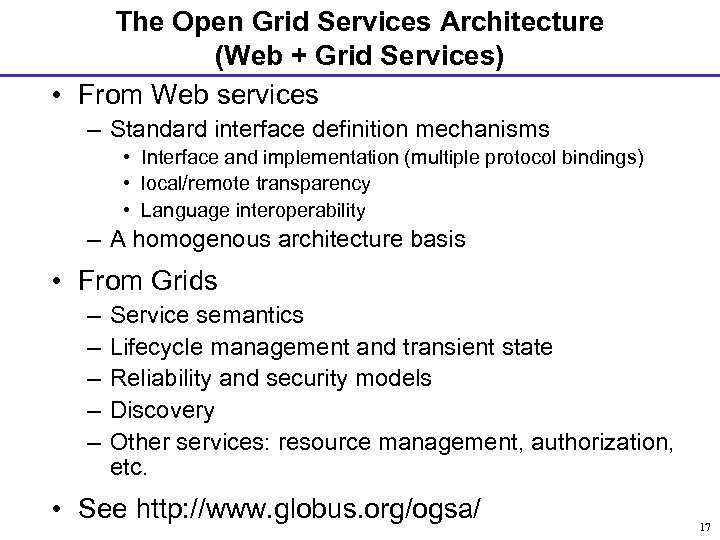
The Open Grid Services Architecture (Web + Grid Services) • From Web services – Standard interface definition mechanisms • Interface and implementation (multiple protocol bindings) • local/remote transparency • Language interoperability – A homogenous architecture basis • From Grids – – – Service semantics Lifecycle management and transient state Reliability and security models Discovery Other services: resource management, authorization, etc. • See http: //www. globus. org/ogsa/ 17
Combining Web Services and Grids • Combining Grid and Web services provides a dynamic and powerful computing and data environment that is rich in descriptions, services, data, and computing capabilities • This infrastructure will give us the basic tools to deal with complex, multi-disciplinary, data rich science modeling problems 18
Combining Web Services and Grids • Furthermore, the Web Services Description Language, et al, together with Grid services, should be able to provide standardized component descriptions and interface definitions so that compatible sub-models can be “plugged” together • The complexity of the modeling done in Terrestrial Biogeoscience is a touchstone for this stage of evolution of cyberinfrastructure 19
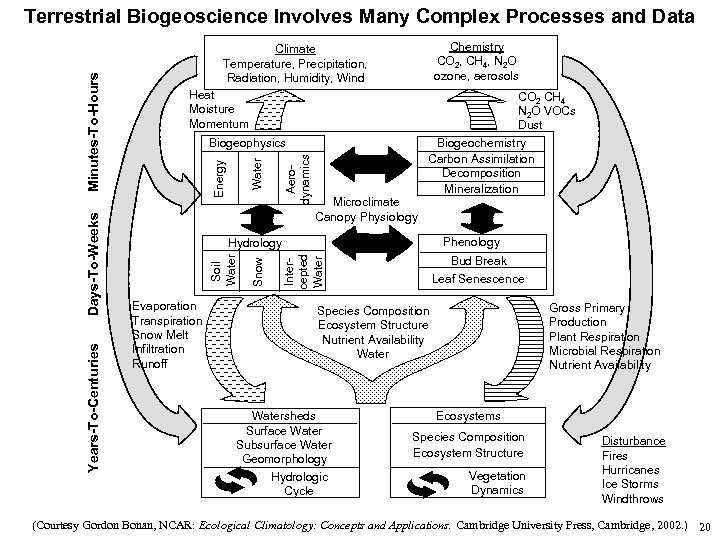
Years-To-Centuries Chemistry CO 2, CH 4, N 2 O ozone, aerosols Climate Temperature, Precipitation, Radiation, Humidity, Wind Heat Moisture Momentum CO 2 CH 4 N 2 O VOCs Dust Biogeochemistry Carbon Assimilation Decomposition Mineralization Energy Water Aerodynamics Biogeophysics Microclimate Canopy Physiology Phenology Evaporation Transpiration Snow Melt Infiltration Runoff Bud Break Intercepted Water Snow Hydrology Soil Water Days-To-Weeks Minutes-To-Hours Terrestrial Biogeoscience Involves Many Complex Processes and Data Leaf Senescence Gross Primary Production Plant Respiration Microbial Respiration Nutrient Availability Species Composition Ecosystem Structure Nutrient Availability Watersheds Surface Water Subsurface Water Geomorphology Hydrologic Cycle Ecosystems Species Composition Ecosystem Structure Vegetation Dynamics Disturbance Fires Hurricanes Ice Storms Windthrows (Courtesy Gordon Bonan, NCAR: Ecological Climatology: Concepts and Applications. Cambridge University Press, Cambridge, 2002. ) 20
Where to in the Future? The Semantic Grid: Beyond Web Services and Grids • Even when we have well integrated Web+Grid services we still do not provide enough structured information to let us ask “what if” questions, and then have the underlying system assemble the required components in a consistent way to answer such a question. 21
Beyond Web Services and Grids • A commercial example “what if” question: What does the itinerary look like if I wish to go SFO to Paris, CDG, and then to Bucharest. In Bucharest I want a 3 or 4 star hotel that is within 3 km of the Palace of the Parliament, and the hotel cost may not exceed the U. S. Dept. of State, Foreign Per Diem Rates. • To answer such a question – relatively easy, but tedious, for a human – the system must “understand” the relationships between maps and locations, between per diem charts and published hotel rates, and it must be able to apply constraints (< 3 km, 3 or 4 star, cost < $ per diem rates, etc. ) 22
Beyond Web Services and Grids • A science example (necessarily more complex) that is courtesy of Stewart Loken, LBNL is as follows: HEP experiments collect specific types of data for the particles that result from high energy collisions of the protons, electrons, ions, etc. that are produced by the accelerators. The types of data are a function of the detector and include things like particle charge, mass, energy, 3 D trajectory, etc. However much of science comes from inferring other aspects of the interactions by analyzing what can be observed. Many quantities are used in obtaining the scientific results of the experiment that are derived from what is observed. In doing this more abstract analysis, the physicist typically asks questions like : 23
Beyond Web Services and Grids Events of interest are usually characterized by a combination of jets of particles (coming from quark decays) and single particles like electrons and muons. In addition, we look for missing transverse energy (an apparent failure of momentum conservation) that would signal the presence of neutrinos that we cannot detect. The topologies of individual events follow some statistical distributions so it is really the averages over many events that are of interest. In doing the analysis, we specify what cone angle would characterize a jet, how far one jet needs to be from another (in 3 dimensions), how far from the single particles, how much missing transverse energy, the angles between the missing energy vector and the other particles What I would like to see is a set of tools to describe these topologies without typing in lots of code. A graphical interface that lets you draw the average event and trace out how statistical variations would affect that. We do simulation of interesting processes and they guide the selection of events, so we would want to learn from that. In order to transform these sorts of queries into combinations of existing tools and appropriate data queries, some sort of knowledge-based framework is needed. 24
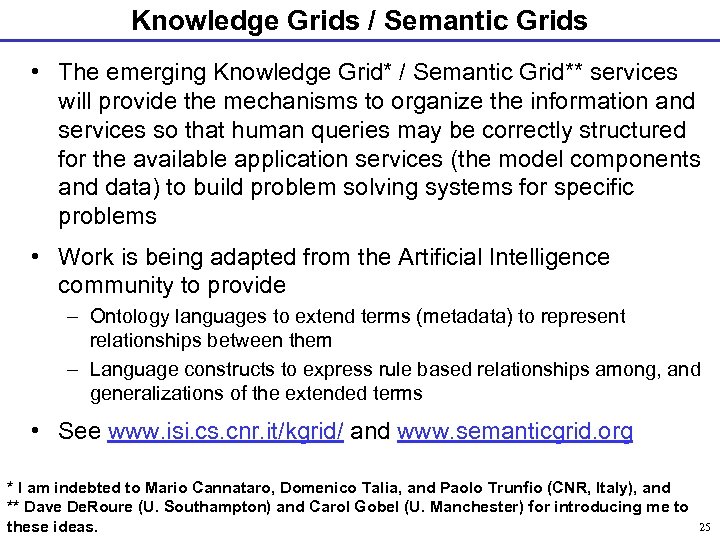
Knowledge Grids / Semantic Grids • The emerging Knowledge Grid* / Semantic Grid** services will provide the mechanisms to organize the information and services so that human queries may be correctly structured for the available application services (the model components and data) to build problem solving systems for specific problems • Work is being adapted from the Artificial Intelligence community to provide – Ontology languages to extend terms (metadata) to represent relationships between them – Language constructs to express rule based relationships among, and generalizations of the extended terms • See www. isi. cs. cnr. it/kgrid/ and www. semanticgrid. org * I am indebted to Mario Cannataro, Domenico Talia, and Paolo Trunfio (CNR, Italy), and ** Dave De. Roure (U. Southampton) and Carol Gobel (U. Manchester) for introducing me to these ideas. 25
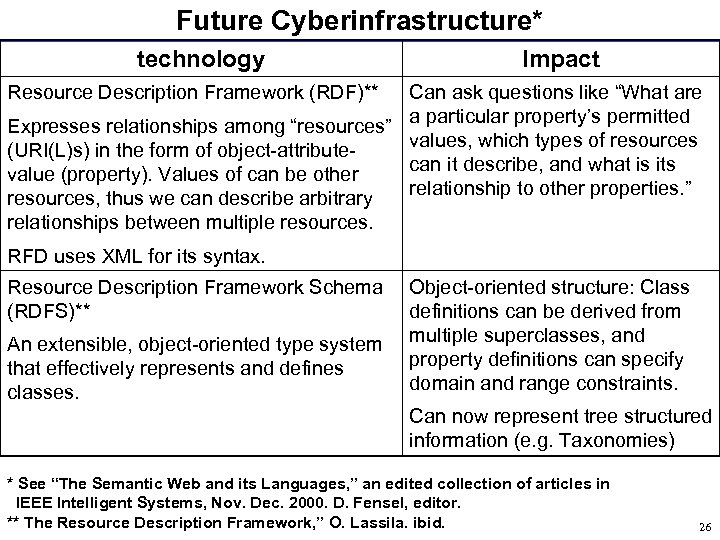
Future Cyberinfrastructure* technology Impact Resource Description Framework (RDF)** Can ask questions like “What are Expresses relationships among “resources” a particular property’s permitted values, which types of resources (URI(L)s) in the form of object-attributecan it describe, and what is its value (property). Values of can be other relationship to other properties. ” resources, thus we can describe arbitrary relationships between multiple resources. RFD uses XML for its syntax. Resource Description Framework Schema (RDFS)** An extensible, object-oriented type system that effectively represents and defines classes. Object-oriented structure: Class definitions can be derived from multiple superclasses, and property definitions can specify domain and range constraints. Can now represent tree structured information (e. g. Taxonomies) * See “The Semantic Web and its Languages, ” an edited collection of articles in IEEE Intelligent Systems, Nov. Dec. 2000. D. Fensel, editor. ** The Resource Description Framework, ” O. Lassila. ibid. 26
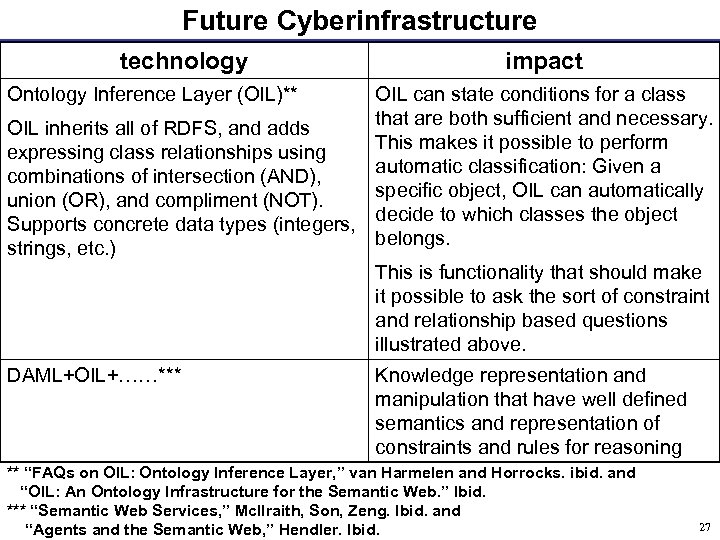
Future Cyberinfrastructure technology impact Ontology Inference Layer (OIL)** OIL can state conditions for a class that are both sufficient and necessary. OIL inherits all of RDFS, and adds This makes it possible to perform expressing class relationships using automatic classification: Given a combinations of intersection (AND), specific object, OIL can automatically union (OR), and compliment (NOT). Supports concrete data types (integers, decide to which classes the object belongs. strings, etc. ) This is functionality that should make it possible to ask the sort of constraint and relationship based questions illustrated above. DAML+OIL+……*** Knowledge representation and manipulation that have well defined semantics and representation of constraints and rules for reasoning ** “FAQs on OIL: Ontology Inference Layer, ” van Harmelen and Horrocks. ibid. and “OIL: An Ontology Infrastructure for the Semantic Web. ” Ibid. *** “Semantic Web Services, ” Mc. Ilraith, Son, Zeng. Ibid. and “Agents and the Semantic Web, ” Hendler. Ibid. 27
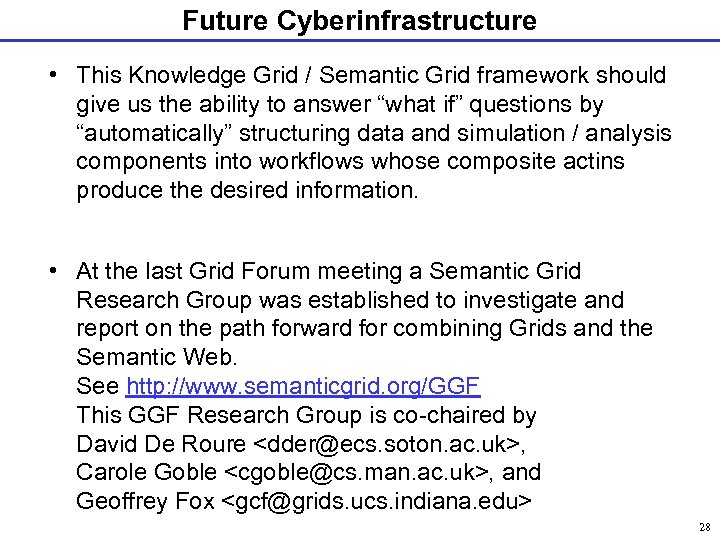
Future Cyberinfrastructure • This Knowledge Grid / Semantic Grid framework should give us the ability to answer “what if” questions by “automatically” structuring data and simulation / analysis components into workflows whose composite actins produce the desired information. • At the last Grid Forum meeting a Semantic Grid Research Group was established to investigate and report on the path forward for combining Grids and the Semantic Web. See http: //www. semanticgrid. org/GGF This GGF Research Group is co-chaired by David De Roure <dder@ecs. soton. ac. uk>, Carole Goble <cgoble@cs. man. ac. uk>, and Geoffrey Fox <gcf@grids. ucs. indiana. edu> 28
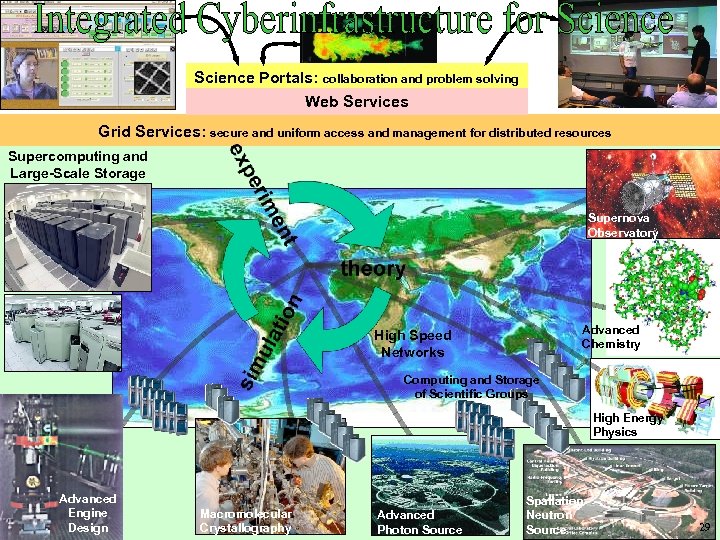
Science Portals: collaboration and problem solving Web Services Grid Services: secure and uniform access and management for distributed resources Supercomputing and Large-Scale Storage Supernova Observatory Advanced Chemistry High Speed Networks Computing and Storage of Scientific Groups High Energy Physics Advanced Engine Design Macromolecular Crystallography Advanced Photon Source Spallation Neutron Source 29
References 1) "The Computing and Data Grid Approach: Infrastructure for Distributed Science Applications, " William E. Johnston. http: //www. itg. lbl. gov/~johnston/Grids/homepage. html#CI 2002 2) "Implementing Production Grids for Science and Engineering, " William E. Johnston, Lawrence Berkeley National Laboratory, Berkeley, Calif. and NASA Ames Research Center, Moffett Field, Calif. (USA); John M. Brooke, Manchester Computing and Department of Computer Science, University of Manchester (UK); Randy Butler, National Center for Supercomputing Applications (NCSA), University of Illinois at Urbana-Champaign (USA); David Foster, CERN LHC Computing Grid Project, Geneva (Switzerland), and; Mirco Mazzucato, INFN-Padova (Italy) http: //www. itg. lbl. gov/~johnston/Grids/homepage. html#Grid 2 ed 3) NASA's Information Power Grid - www. ipg. nasa. gov 4) DOE Science Grid - www. doesciencegrid. org 5) European Union Data. Grid Project - www. eu-datagrid. org/ 6) UK e. Science Program - www. research-councils. ac. uk/escience/ 7) NSF Tera. Grid - www. teragrid. org/ 8) Gri. Phy. N (Grid Physics Network) - http: //www. griphyn. org 9) Particle Physics Data Grid, PPDG. http: //www. ppdg. net/ 10) European Union Data. Grid Project - www. eu-datagrid. org/ 30
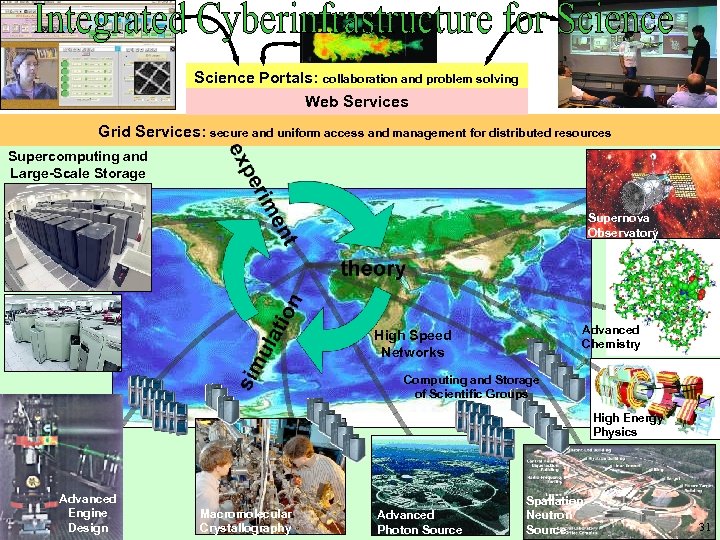
Science Portals: collaboration and problem solving Web Services Grid Services: secure and uniform access and management for distributed resources Supercomputing and Large-Scale Storage Supernova Observatory Advanced Chemistry High Speed Networks Computing and Storage of Scientific Groups High Energy Physics Advanced Engine Design Macromolecular Crystallography Advanced Photon Source Spallation Neutron Source 31
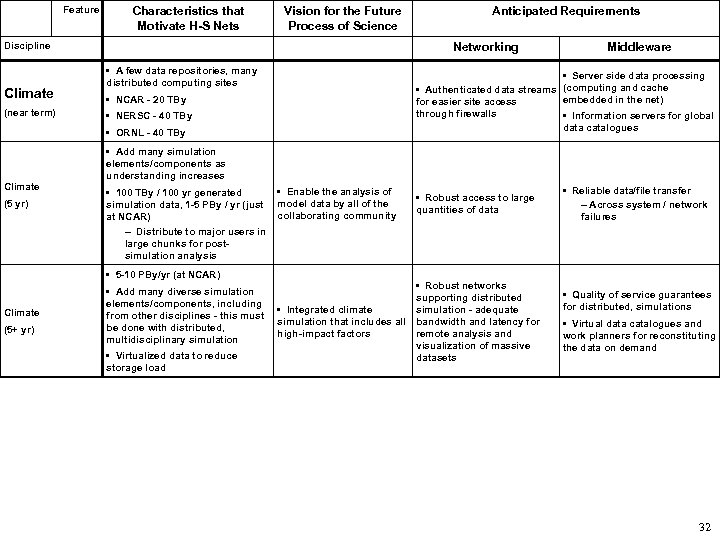
Feature Characteristics that Motivate H-S Nets Vision for the Future Process of Science Discipline Climate (near term) Networking • A few data repositories, many distributed computing sites (5 yr) • NCAR - 20 TBy • NERSC - 40 TBy • Add many simulation elements/components as understanding increases • 100 TBy / 100 yr generated simulation data, 1 -5 PBy / yr (just at NCAR) – Distribute to major users in large chunks for postsimulation analysis • 5 -10 PBy/yr (at NCAR) Climate (5+ yr) Middleware • Server side data processing • Authenticated data streams (computing and cache embedded in the net) for easier site access through firewalls • Information servers for global data catalogues • ORNL - 40 TBy Climate Anticipated Requirements • Add many diverse simulation elements/components, including from other disciplines - this must be done with distributed, multidisciplinary simulation • Virtualized data to reduce storage load • Enable the analysis of model data by all of the collaborating community • Robust access to large quantities of data • Robust networks supporting distributed • Integrated climate simulation - adequate simulation that includes all bandwidth and latency for high-impact factors remote analysis and visualization of massive datasets • Reliable data/file transfer – Across system / network failures • Quality of service guarantees for distributed, simulations • Virtual data catalogues and work planners for reconstituting the data on demand 32
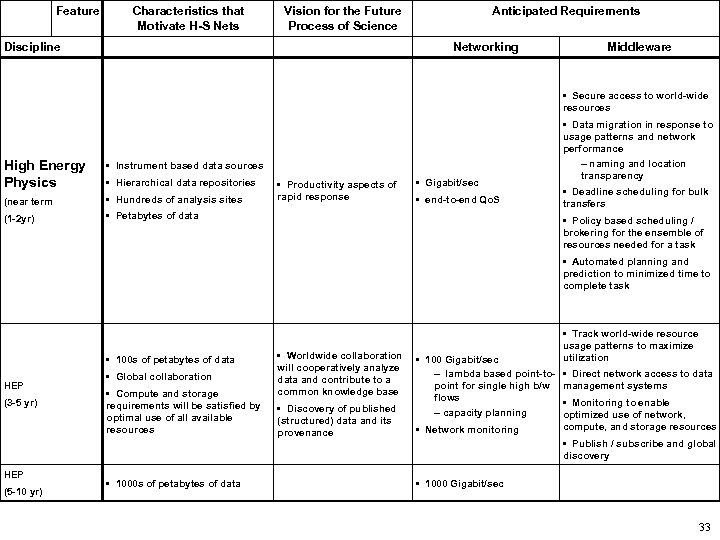
Feature Characteristics that Motivate H-S Nets Vision for the Future Process of Science Discipline Anticipated Requirements Networking Middleware • Secure access to world-wide resources High Energy Physics • Instrument based data sources (near term • Hundreds of analysis sites (1 -2 yr) • Petabytes of data • Hierarchical data repositories • Productivity aspects of rapid response • Gigabit/sec • end-to-end Qo. S • Data migration in response to usage patterns and network performance – naming and location transparency • Deadline scheduling for bulk transfers • Policy based scheduling / brokering for the ensemble of resources needed for a task • Automated planning and prediction to minimized time to complete task • 100 s of petabytes of data HEP (3 -5 yr) HEP (5 -10 yr) • Global collaboration • Compute and storage requirements will be satisfied by optimal use of all available resources • 1000 s of petabytes of data • Worldwide collaboration will cooperatively analyze data and contribute to a common knowledge base • Discovery of published (structured) data and its provenance • 100 Gigabit/sec – lambda based point-topoint for single high b/w flows – capacity planning • Network monitoring • Track world-wide resource usage patterns to maximize utilization • Direct network access to data management systems • Monitoring to enable optimized use of network, compute, and storage resources • Publish / subscribe and global discovery • 1000 Gigabit/sec 33
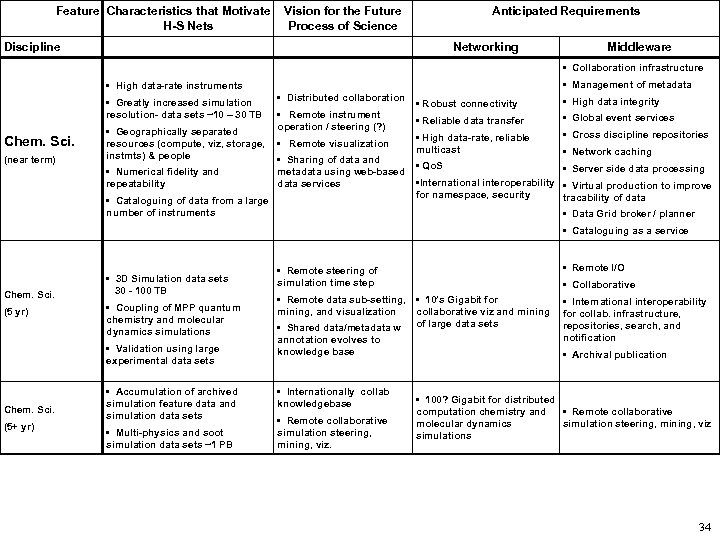
Feature Characteristics that Motivate H-S Nets Vision for the Future Process of Science Anticipated Requirements Discipline Networking Middleware • Collaboration infrastructure • Management of metadata • High data-rate instruments • Greatly increased simulation resolution- data sets ~10 – 30 TB Chem. Sci. (near term) • Geographically separated resources (compute, viz, storage, instmts) & people • Numerical fidelity and repeatability • Distributed collaboration • Remote instrument operation / steering (? ) • Remote visualization • Sharing of data and metadata using web-based data services • Cataloguing of data from a large number of instruments • Robust connectivity • High data integrity • Reliable data transfer • Global event services • High data-rate, reliable multicast • Cross discipline repositories • Qo. S • Server side data processing • Network caching • International interoperability • Virtual production to improve for namespace, security tracability of data • Data Grid broker / planner • Cataloguing as a service Chem. Sci. (5 yr) • 3 D Simulation data sets 30 - 100 TB • Coupling of MPP quantum chemistry and molecular dynamics simulations • Validation using large experimental data sets Chem. Sci. (5+ yr) • Accumulation of archived simulation feature data and simulation data sets • Multi-physics and soot simulation data sets ~1 PB • Remote steering of simulation time step • Remote I/O • Remote data sub-setting, • 10’s Gigabit for mining, and visualization collaborative viz and mining • Shared data/metadata w of large data sets • International interoperability for collab. infrastructure, repositories, search, and notification annotation evolves to knowledge base • Internationally collab knowledgebase • Remote collaborative simulation steering, mining, viz. • Collaborative • Archival publication • 100? Gigabit for distributed computation chemistry and • Remote collaborative simulation steering, mining, viz molecular dynamics simulations 34
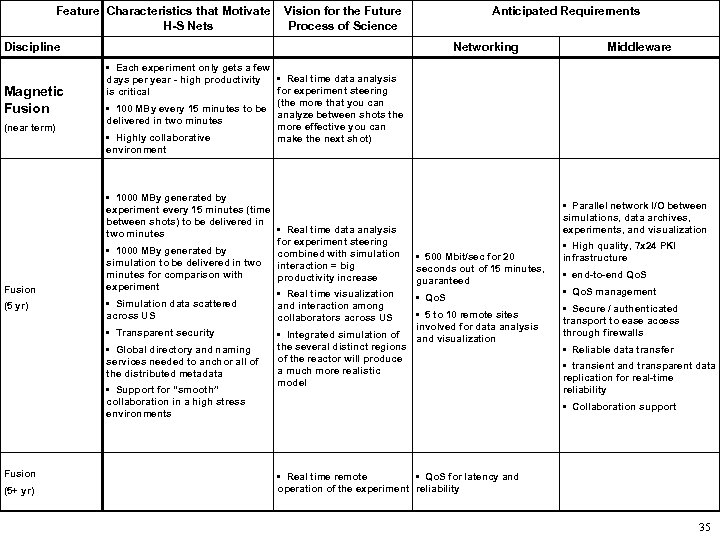
Feature Characteristics that Motivate H-S Nets Vision for the Future Process of Science Anticipated Requirements Discipline Magnetic Fusion (near term) Fusion (5 yr) Fusion (5+ yr) Networking Middleware • Each experiment only gets a few • Real time data analysis days per year - high productivity for experiment steering is critical (the more that you can • 100 MBy every 15 minutes to be analyze between shots the delivered in two minutes more effective you can • Highly collaborative make the next shot) environment • 1000 MBy generated by experiment every 15 minutes (time between shots) to be delivered in • Real time data analysis two minutes for experiment steering • 1000 MBy generated by combined with simulation to be delivered in two interaction = big minutes for comparison with productivity increase experiment • Real time visualization • Simulation data scattered and interaction among across US collaborators across US • Transparent security • Integrated simulation of the several distinct regions • Global directory and naming of the reactor will produce services needed to anchor all of a much more realistic the distributed metadata model • Support for “smooth” collaboration in a high stress environments • Parallel network I/O between simulations, data archives, experiments, and visualization • 500 Mbit/sec for 20 seconds out of 15 minutes, guaranteed • Qo. S • 5 to 10 remote sites involved for data analysis and visualization • High quality, 7 x 24 PKI infrastructure • end-to-end Qo. S • Qo. S management • Secure / authenticated transport to ease access through firewalls • Reliable data transfer • transient and transparent data replication for real-time reliability • Collaboration support • Real time remote • Qo. S for latency and operation of the experiment reliability 35
Скачать презентацию The Evolution of Cyberinfrastructure for Science from IP
9cf82620b8bea53349b4a778e3e4911a.ppt