


 Скачать презентацию The European Union Emissions Trading Scheme What can
674fa2fc1a5e6e6ae639e021714822d6.ppt
- Количество слайдов: 22
 The European Union Emissions Trading Scheme: What can we expect to 2012 - 2020? Emilie Alberola, Mission Climat of Caisse des Dépôts Toulouse - October, 5 September 29, 2009 Sagacarbon seminar, sofia.
 Agenda 1. Entering into Phase 2 of the EU ETS: what is new ? 2. Main compliance results from 2008 3. The European Commission’s proposal for Phase 3: changing the rules 2
 Agenda 1. Entering into Phase 2 of the EU ETS: what is new ? 2. Main compliance results from 2008 3. The European Commission’s proposal for Phase 3: changing the rules 3
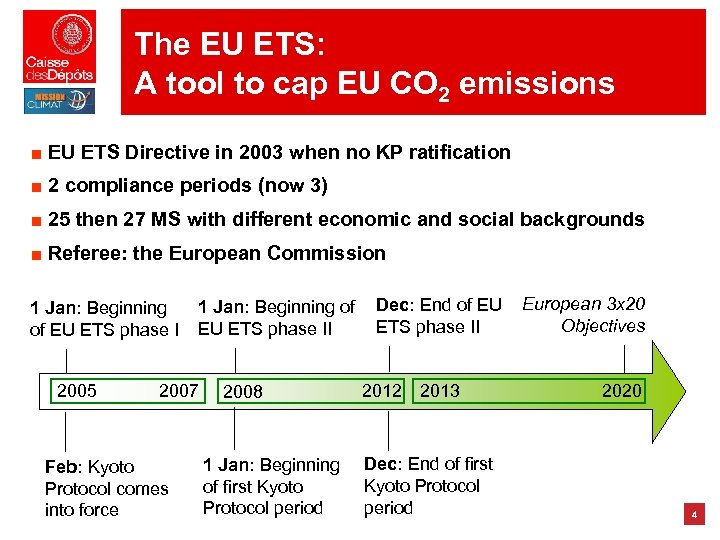 The EU ETS: A tool to cap EU CO 2 emissions ■ EU ETS Directive in 2003 when no KP ratification ■ 2 compliance periods (now 3) ■ 25 then 27 MS with different economic and social backgrounds ■ Referee: the European Commission 1 Jan: Beginning of EU ETS phase I 2005 1 Jan: Beginning of Dec: End of EU European 3 x 20 Objectives ETS phase II EU ETS phase II 2007 Feb: Kyoto Protocol comes into force 2008 1 Jan: Beginning of first Kyoto Protocol period 2012 2013 Dec: End of first Kyoto Protocol period 2020 4
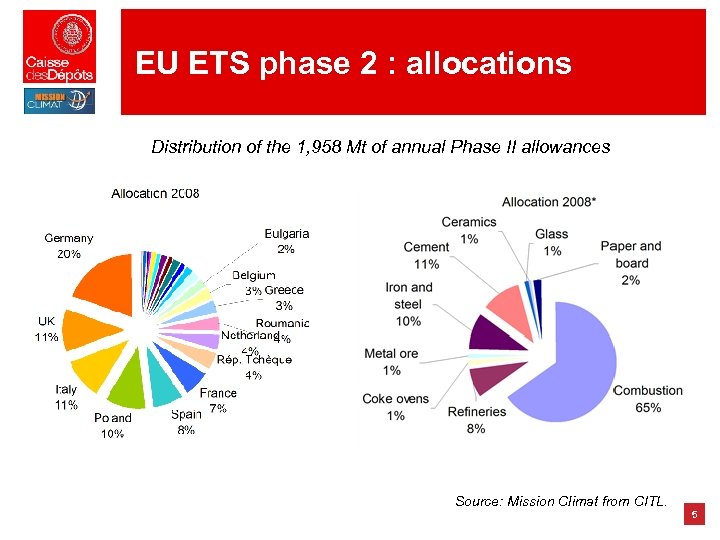 EU ETS phase 2 : allocations Distribution of the 1, 958 Mt of annual Phase II allowances Source: Mission Climat from CITL. 5
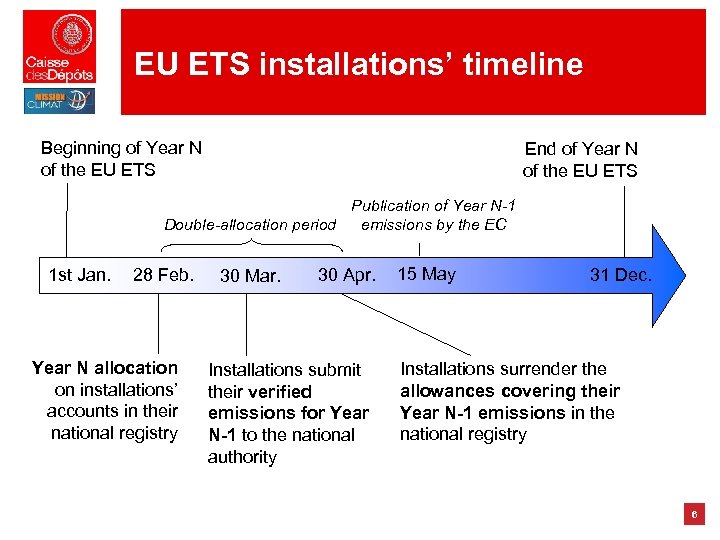 EU ETS installations’ timeline Beginning of Year N of the EU ETS End of Year N of the EU ETS Publication of Year N-1 Double-allocation period emissions by the EC 1 st Jan. 28 Feb. Year N allocation on installations’ accounts in their national registry 30 Mar. 30 Apr. Installations submit their verified emissions for Year N-1 to the national authority 15 May 31 Dec. Installations surrender the allowances covering their Year N-1 emissions in the national registry 6
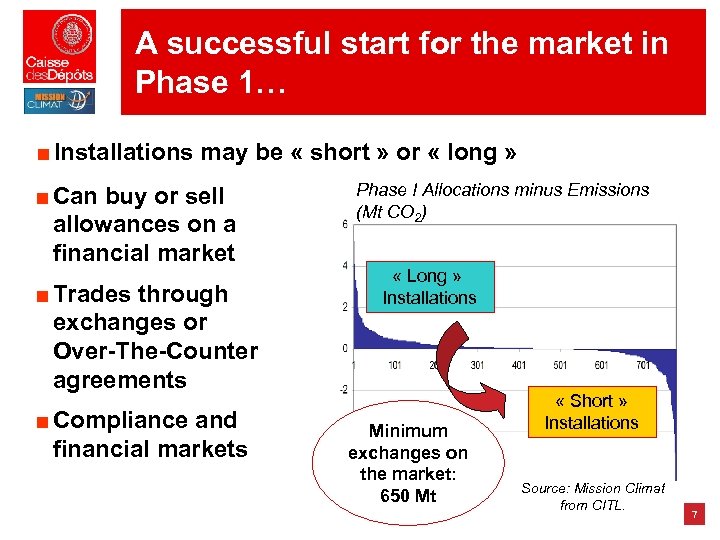 A successful start for the market in Phase 1… ■ Installations may be « short » or « long » ■ Can buy or sell allowances on a financial market ■ Trades through exchanges or Over-The-Counter agreements ■ Compliance and financial markets Phase I Allocations minus Emissions (Mt CO 2) « Long » Installations Minimum exchanges on the market: 650 Mt « Short » Installations Source: Mission Climat from CITL. 7
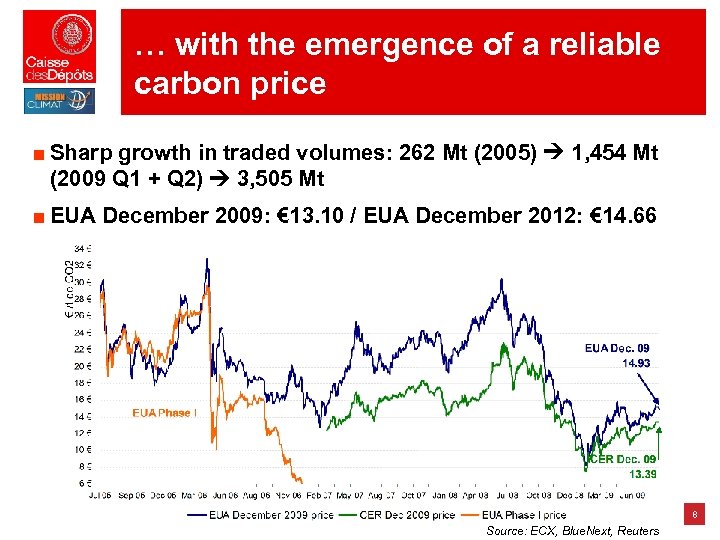 … with the emergence of a reliable carbon price ■ Sharp growth in traded volumes: 262 Mt (2005) 1, 454 Mt (2009 Q 1 + Q 2) 3, 505 Mt ■ EUA December 2009: € 13. 10 / EUA December 2012: € 14. 66 8 Source: ECX, Blue. Next, Reuters
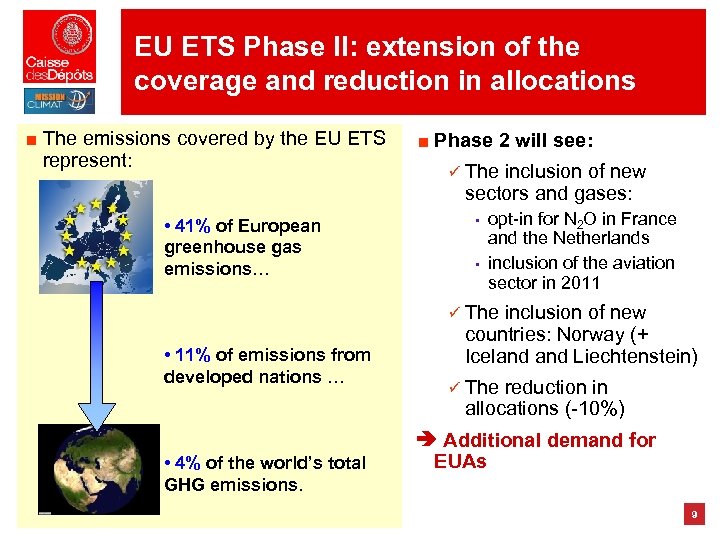 EU ETS Phase II: extension of the coverage and reduction in allocations ■ The emissions covered by the EU ETS represent: ■ Phase 2 will see: ü The inclusion of new sectors and gases: • 41% of European greenhouse gas emissions… • • opt-in for N 2 O in France and the Netherlands inclusion of the aviation sector in 2011 ü The inclusion of new • 11% of emissions from developed nations … countries: Norway (+ Iceland Liechtenstein) ü The reduction in allocations (-10%) • 4% of the world’s total GHG emissions. Additional demand for EUAs 9
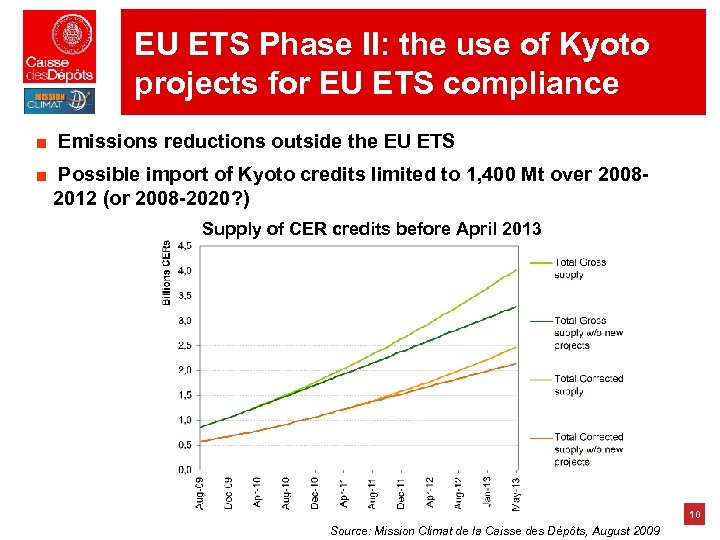 EU ETS Phase II: the use of Kyoto projects for EU ETS compliance ■ Emissions reductions outside the EU ETS ■ Possible import of Kyoto credits limited to 1, 400 Mt over 20082012 (or 2008 -2020? ) Supply of CER credits before April 2013 10 Source: Mission Climat de la Caisse des Dépôts, August 2009
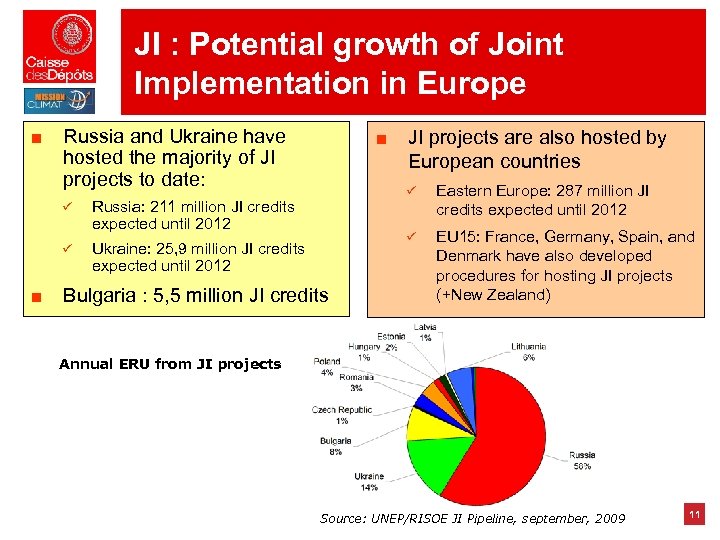 JI : Potential growth of Joint Implementation in Europe ■ ü JI projects are also hosted by European countries ü Ukraine: 25, 9 million JI credits expected until 2012 Bulgaria : 5, 5 million JI credits Eastern Europe: 287 million JI credits expected until 2012 ü Russia: 211 million JI credits expected until 2012 ü ■ ■ Russia and Ukraine have hosted the majority of JI projects to date: EU 15: France, Germany, Spain, and Denmark have also developed procedures for hosting JI projects (+New Zealand) Annual ERU from JI projects Source: UNEP/RISOE JI Pipeline, september, 2009 11
 Agenda 1. Entering into Phase 2 of the EU ETS: what is new ? 2. Main compliance results from 2008 3. The European Commission’s proposal for Phase 3: changing the rules 12
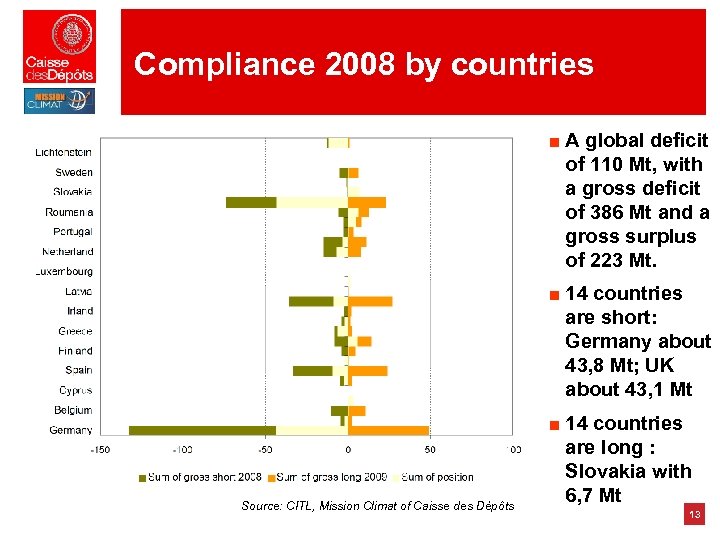 Compliance 2008 by countries ■ A global deficit of 110 Mt, with a gross deficit of 386 Mt and a gross surplus of 223 Mt. ■ 14 countries are short: Germany about 43, 8 Mt; UK about 43, 1 Mt Source: CITL, Mission Climat of Caisse des Dépôts ■ 14 countries are long : Slovakia with 6, 7 Mt 13
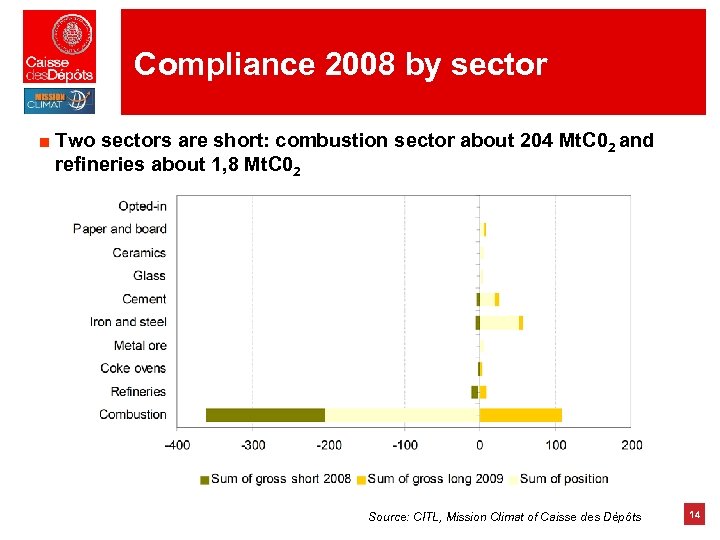 Compliance 2008 by sector ■ Two sectors are short: combustion sector about 204 Mt. C 02 and refineries about 1, 8 Mt. C 02 Source: CITL, Mission Climat of Caisse des Dépôts 14
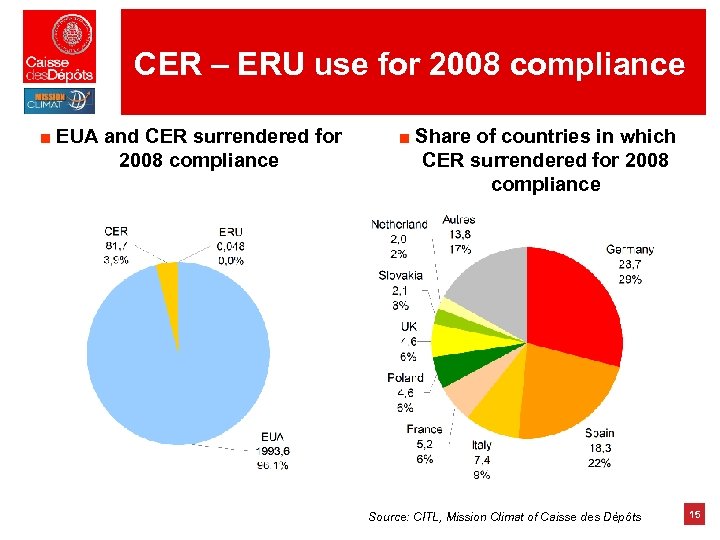 CER – ERU use for 2008 compliance ■ EUA and CER surrendered for 2008 compliance ■ Share of countries in which CER surrendered for 2008 compliance Source: CITL, Mission Climat of Caisse des Dépôts 15
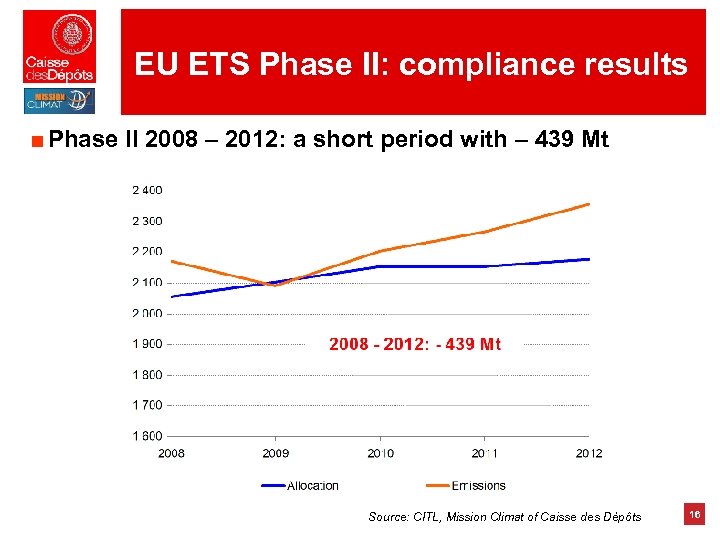 EU ETS Phase II: compliance results ■ Phase II 2008 – 2012: a short period with – 439 Mt Source: CITL, Mission Climat of Caisse des Dépôts 16
 Agenda 1. Entering into Phase 2 of the EU ETS: what is new ? 2. Main compliance results from 2008 3. The European Commission’s proposal for Phase 3: changing the rules 17
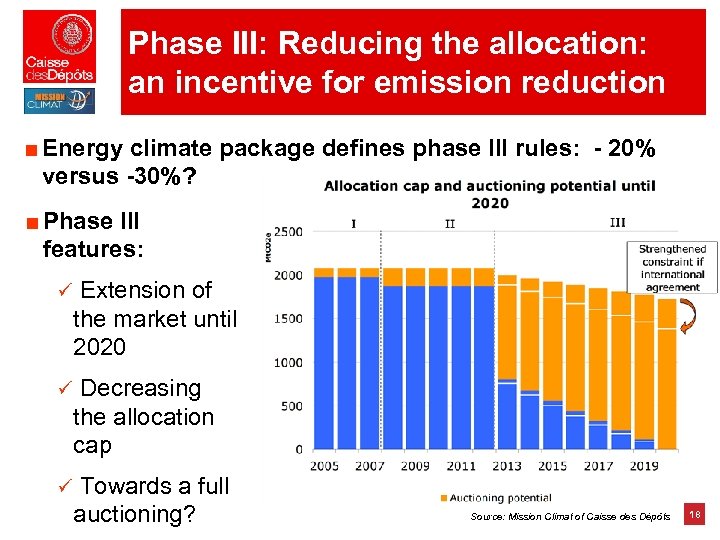 Phase III: Reducing the allocation: an incentive for emission reduction ■ Energy climate package defines phase III rules: - 20% versus -30%? ■ Phase III features: ü Extension of the market until 2020 ü Decreasing the allocation cap ü Towards a full auctioning? Source: Mission Climat of Caisse des Dépôts 18
 Which impact on the industry competitiveness? ■ No observed impact on market shares during Phase I… ■ But potential impact on the long term for energy intensive industries ü All industries but power production at different levels ü Indirect impact for electricity-intensive industries ■ Impacts of new features of the EU ETS to be assessed by the EC before December 2010 ■ Solutions? Free allocation, border tax adjustments, sectoral agreements… 19
 Phase III: the use of carbon credits ■ A limited amount of CER/ERU usable for compliance ü Without an international agreement : no additional Kyoto credits if -20% target. Kyoto credits no used in 2008 -2012 allowed or maximum of 11% of 2008 -2012 allocation (115 Mt); ü With an international agreement: additional cap = 50% of the additional effort if -30% target. ■ New project mechanisms ü In least developed countries ü On the European territory through a harmonized framework for Domestic Offset Projects 20
 The EU ETS in the world ■Possible links with other cap-and-trade programs: ü Complete fungibility between ETS seems difficult, but the common use of projects mechanisms could be a first step. ü First linking opportunities: RGGI, Australia, New Zealand ü Looking toward the future: a US federal trading program? ■ How to get ready: ü Voluntary agreements ü Sectoral agreements ■ The next steps: ü Copenhagen COP/MOPs 21
 Contact Emilie Alberola, Mission Climat of Caisse des Dépôts Emilie. alberola@caissedesdepots. fr § Publications of Mission Climat of Caisse des Dépôts www. caissedesdepots. fr/missionclimat § Club Tendances Carbone www. clubtendancescarbone. com § Association for the Promotion of Research in Carbon Economics (APREC) www. aprec. net 22