


 Скачать презентацию The European Union 500 million people 27
eu_in_slides_en.ppt
- Количество слайдов: 47
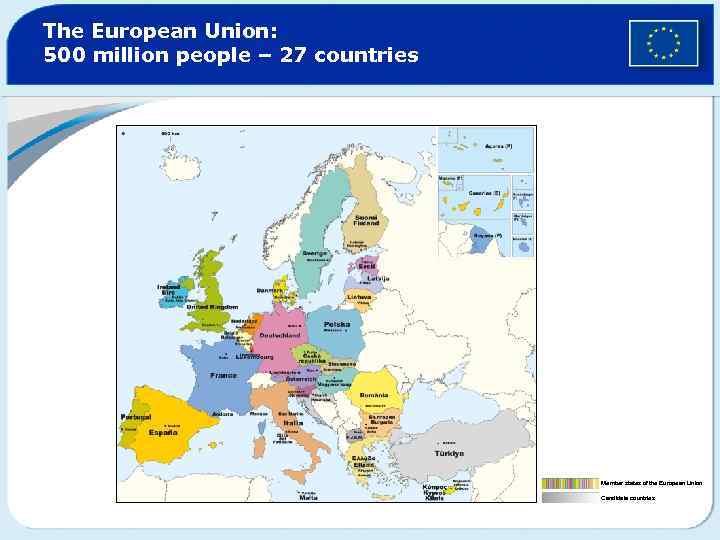 The European Union: 500 million people – 27 countries Member states of the European Union Candidate countries
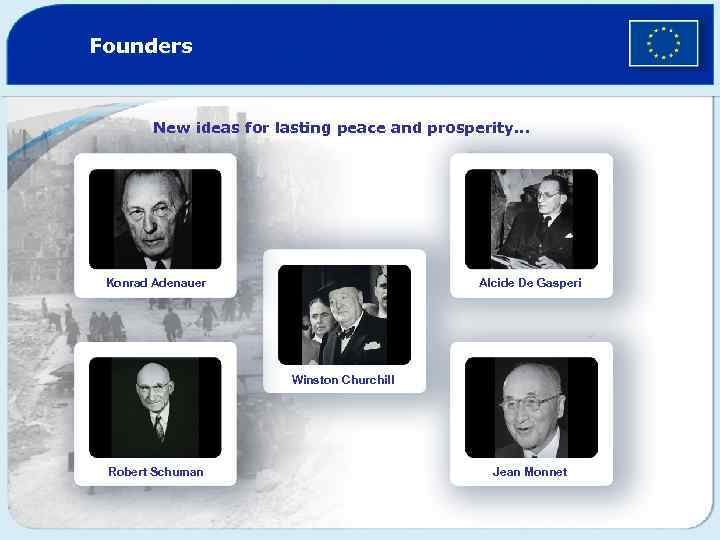 Founders New ideas for lasting peace and prosperity… Konrad Adenauer Alcide De Gasperi Winston Churchill Robert Schuman Jean Monnet
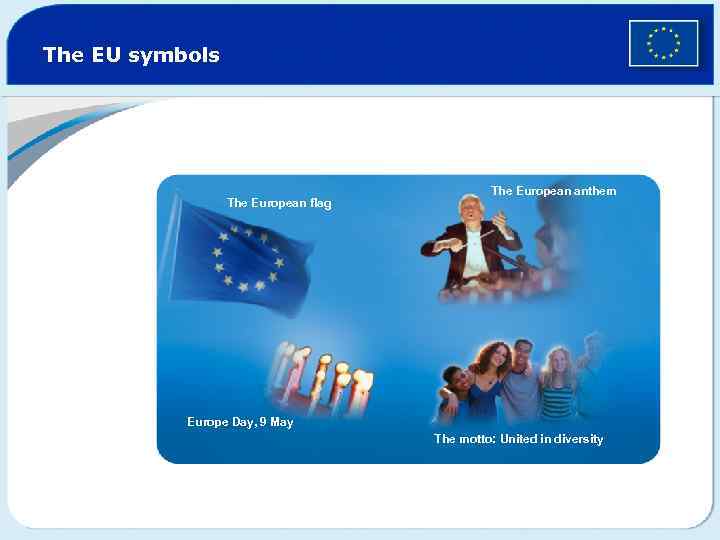 The EU symbols The European flag The European anthem Europe Day, 9 May The motto: United in diversity
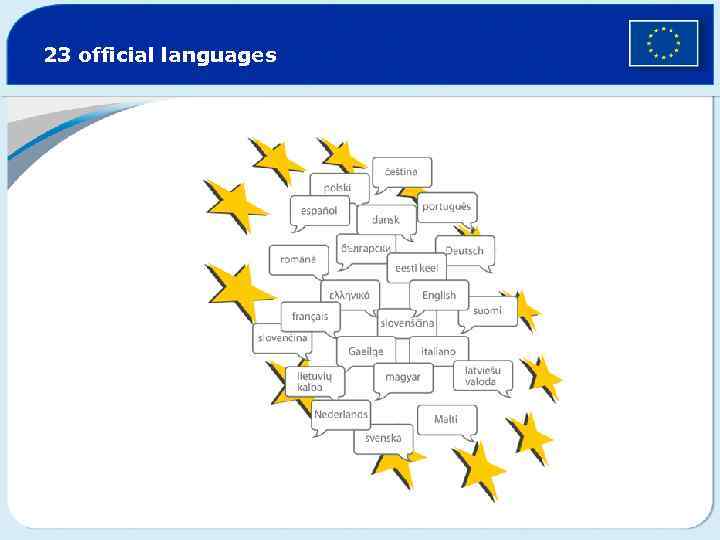 23 official languages
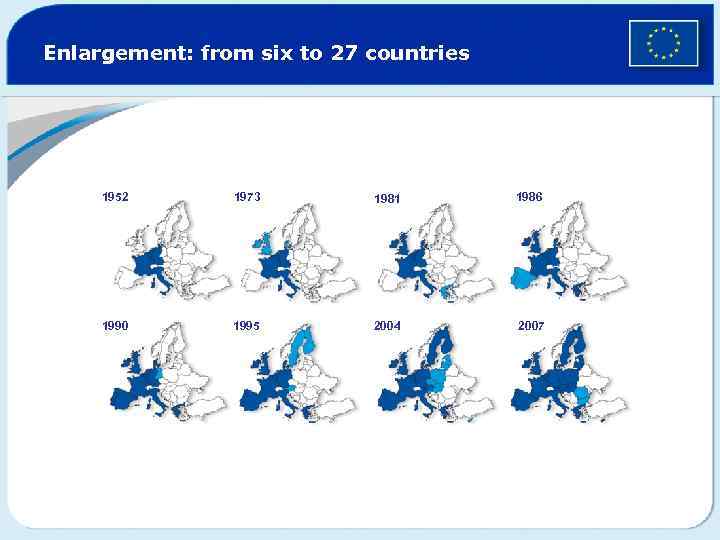 Enlargement: from six to 27 countries 1952 1973 1981 1986 1990 1995 2004 2007
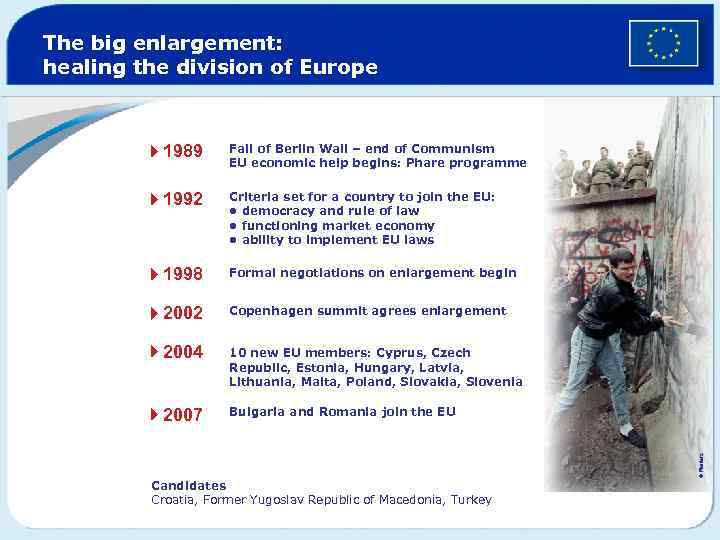 The big enlargement: healing the division of Europe Fall of Berlin Wall – end of Communism EU economic help begins: Phare programme 41992 Criteria set for a country to join the EU: • democracy and rule of law • functioning market economy • ability to implement EU laws 41998 Formal negotiations on enlargement begin 42002 Copenhagen summit agrees enlargement 42004 10 new EU members: Cyprus, Czech Republic, Estonia, Hungary, Latvia, Lithuania, Malta, Poland, Slovakia, Slovenia 42007 Bulgaria and Romania join the EU Candidates Croatia, Former Yugoslav Republic of Macedonia, Turkey © Reuders 41989
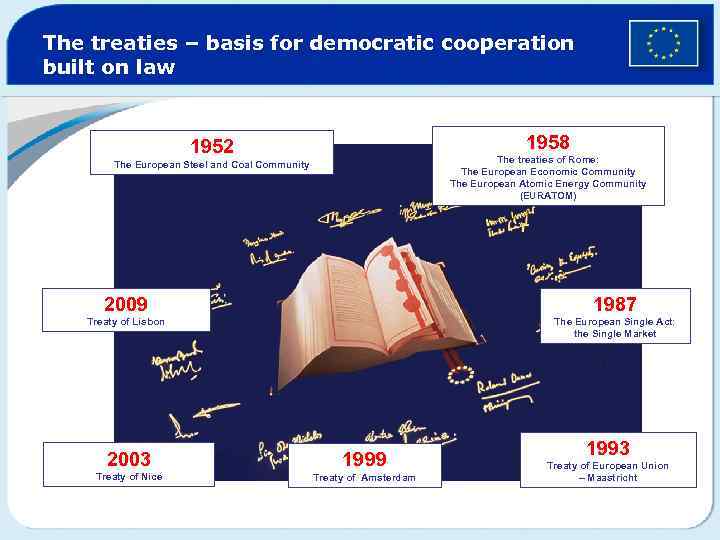 The treaties – basis for democratic cooperation built on law 1958 1952 The treaties of Rome: The European Economic Community The European Atomic Energy Community (EURATOM) The European Steel and Coal Community 2009 1987 Treaty of Lisbon The European Single Act: the Single Market 2003 1999 Treaty of Nice Treaty of Amsterdam 1993 Treaty of European Union – Maastricht
 The Lisbon treaty - taking Europe into the 21 st century The Treaty will make the European Union: More efficient Simpler processes, full-time president for the Council, etc. More democratic Stronger role for the European Parliament and national parliaments, "Citizens Initiative", Charter of Fundamental Rights, etc. More transparent Clarifies who does what, greater public access to documents and meetings, etc. More united on High Representative for Foreign Policy, etc. the world stage More secure New possibilities to fight climate change and terrorism, secure energy supplies, etc.
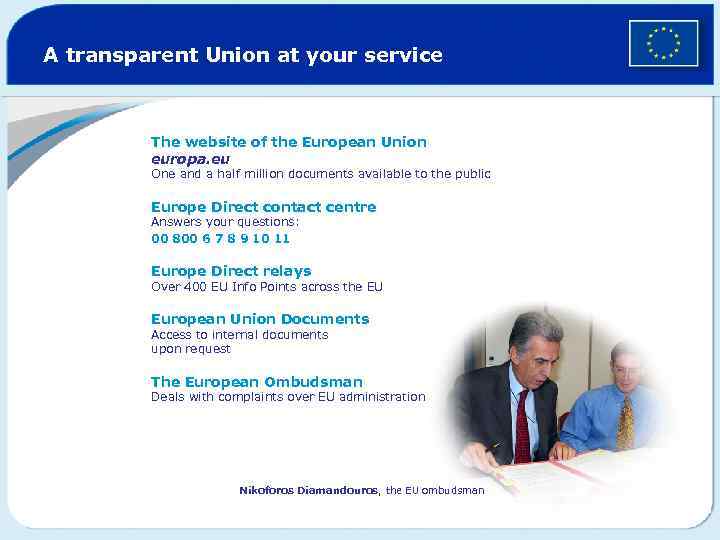 A transparent Union at your service The website of the European Union europa. eu One and a half million documents available to the public Europe Direct contact centre Answers your questions: 00 800 6 7 8 9 10 11 Europe Direct relays Over 400 EU Info Points across the EU European Union Documents Access to internal documents upon request The European Ombudsman Deals with complaints over EU administration Nikoforos Diamandouros, the EU ombudsman
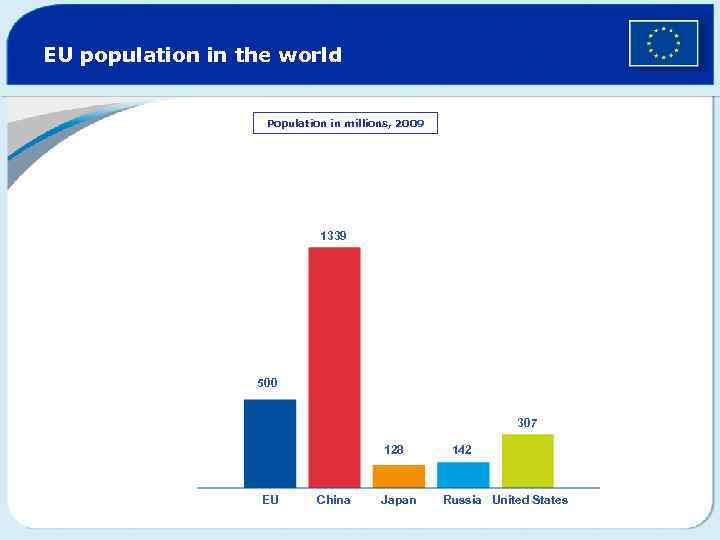 EU population in the world Population in millions, 2009 1339 500 307 128 EU China Japan 142 Russia United States
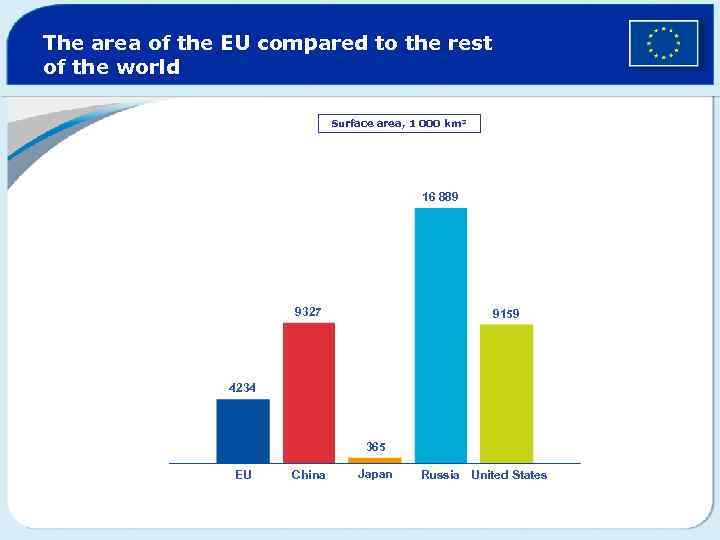 The area of the EU compared to the rest of the world Surface area, 1 000 km² 16 889 9327 9159 4234 365 EU China Japan Russia United States
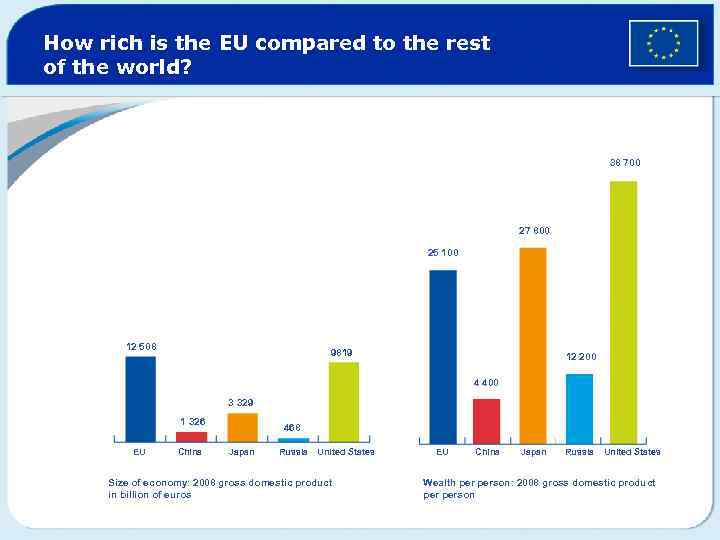 How rich is the EU compared to the rest of the world? 38 700 27 800 25 100 12 508 9819 12 200 4 400 3 329 1 326 EU China 468 Japan Russia United States Size of economy: 2008 gross domestic product in billion of euros EU China Japan Russia United States Wealth person: 2008 gross domestic product person
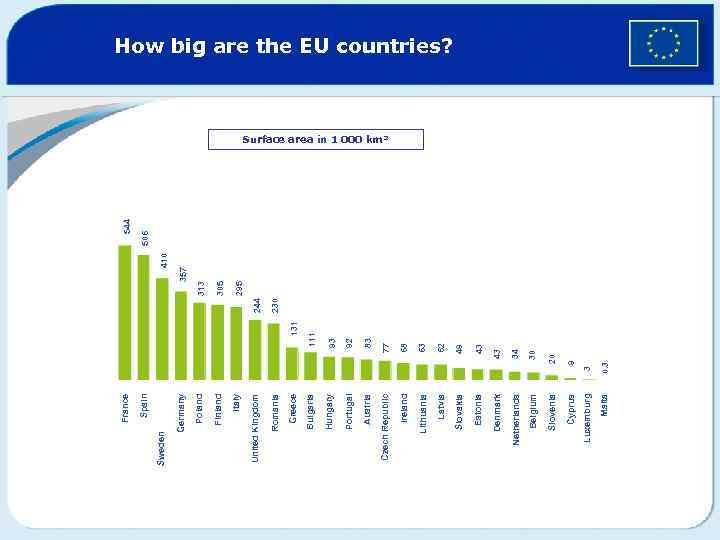 3 49 43 43 34 30 20 9 Slovakia Estonia Denmark Netherlands Belgium Slovenia Cyprus 0. 3 62 Latvia Malta 63 Lithuania Luxemburg 68 83 Austria Ireland 92 Portugal 77 93 Hungary Czech Republic 111 Bulgaria Greece 230 Romania 131 244 United Kingdom Italy Finland Poland Germany Sweden Spain France 295 305 313 357 410 506 544 How big are the EU countries? Surface area in 1 000 km²
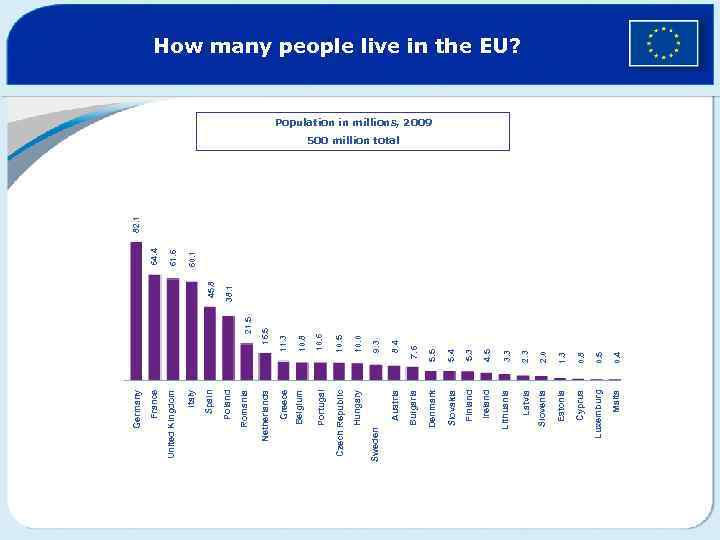 21. 5 7. 6 5. 5 5. 4 5. 3 4. 5 3. 3 2. 0 1. 3 0. 8 0. 5 0. 4 Denmark Slovakia Finland Ireland Lithuania Latvia Slovenia Estonia Cyprus Luxemburg Malta 8. 4 Bulgaria Austria 10. 0 Hungary 9. 3 10. 5 Czech Republic Sweden 10. 6 10. 8 11. 3 Portugal Belgium Greece Netherlands 16. 5 38. 1 Romania Poland 60. 1 Italy Spain 61. 6 United Kingdom 45. 8 64. 4 France Germany 82. 1 How many people live in the EU? Population in millions, 2009 500 million total
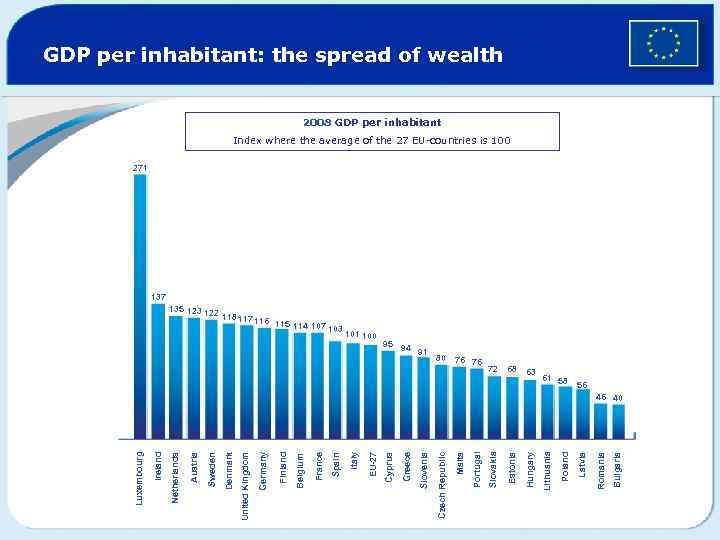 Bulgaria Romania Latvia Poland 72 68 63 Lithuania Hungary Estonia 76 76 Slovakia Portugal 80 Malta 95 94 91 Czech Republic Slovenia Greece 101 100 Cyprus EU-27 115 114 107 103 Italy Spain France Belgium 118 117 116 Finland Germany United Kingdom 135 123 122 Denmark Sweden Austria Netherlands Ireland Luxembourg GDP per inhabitant: the spread of wealth 2008 GDP per inhabitant Index where the average of the 27 EU-countries is 100 271 137 61 58 56 46 40
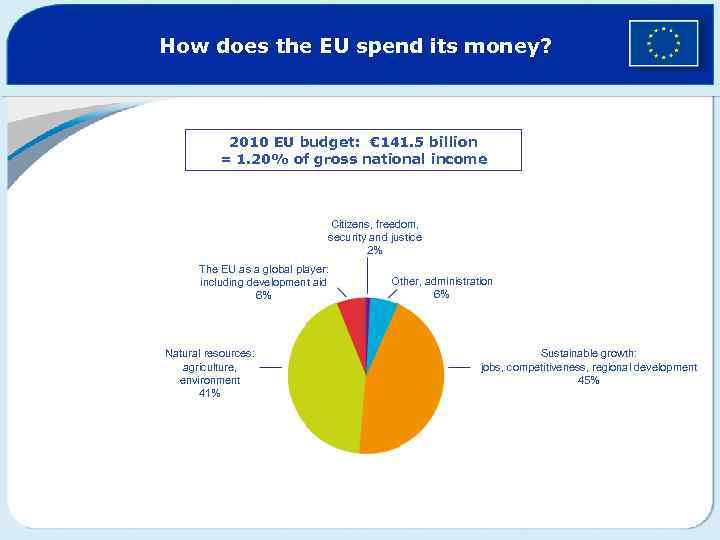 How does the EU spend its money? 2010 EU budget: € 141. 5 billion = 1. 20% of gross national income Citizens, freedom, security and justice 2% The EU as a global player: including development aid 6% Natural resources: agriculture, environment 41% Other, administration 6% Sustainable growth: jobs, competitiveness, regional development 45%
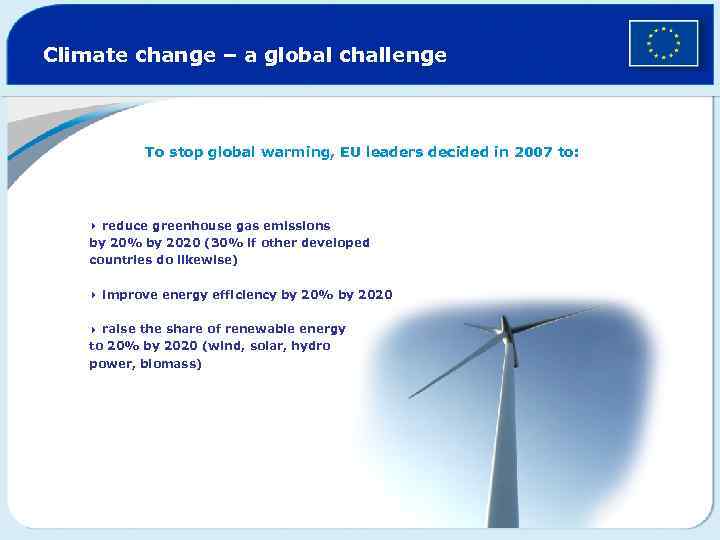 Climate change – a global challenge To stop global warming, EU leaders decided in 2007 to: 4 reduce greenhouse gas emissions by 20% by 2020 (30% if other developed countries do likewise) 4 improve energy efficiency by 20% by 2020 4 raise the share of renewable energy to 20% by 2020 (wind, solar, hydro power, biomass)
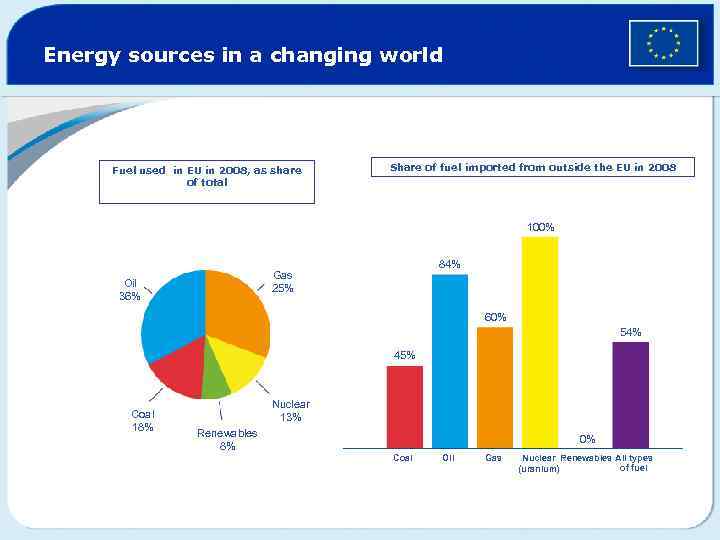 Energy sources in a changing world Fuel used in EU in 2008, as share of total Share of fuel imported from outside the EU in 2008 100% 84% Gas 25% Oil 36% 60% 54% 45% Coal 18% Nuclear 13% Renewables 8% 0% Coal Oil Gas Nuclear Renewables All types of fuel (uranium)
 Jobs and growth Challenges: 4 Demography: Europeans live longer, have fewer children 4 Globalisation: European economy faces competition from other parts of the world 4 Climate change: Emission of greenhouse gases must come down Solutions: European leaders have therefore agreed on a joint strategy for: 4 More research and innovation 4 A more dynamic business environment 4 Investing in people 4 A greener economy
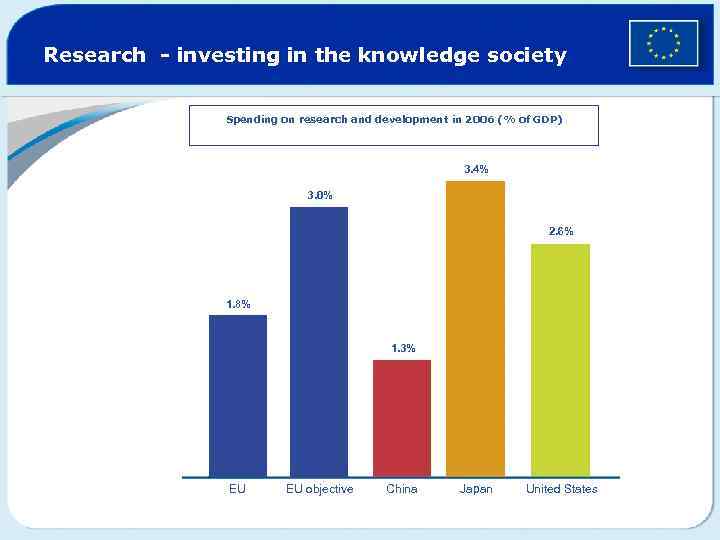 Research - investing in the knowledge society Spending on research and development in 2006 (% of GDP) 3. 4% 3. 0% 2. 6% 1. 8% 1. 3% EU EU objective China Japan United States
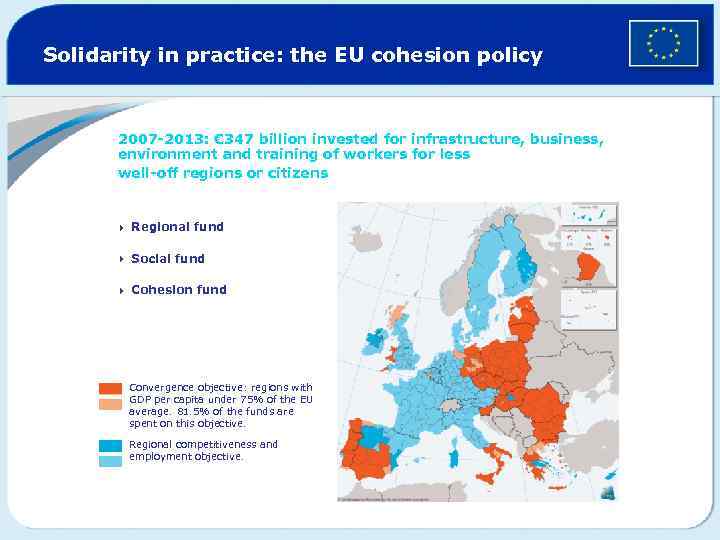 Solidarity in practice: the EU cohesion policy 2007 -2013: € 347 billion invested for infrastructure, business, environment and training of workers for less well-off regions or citizens 4 Regional fund 4 Social fund 4 Cohesion fund Convergence objective: regions with GDP per capita under 75% of the EU average. 81. 5% of the funds are spent on this objective. Regional competitiveness and employment objective.
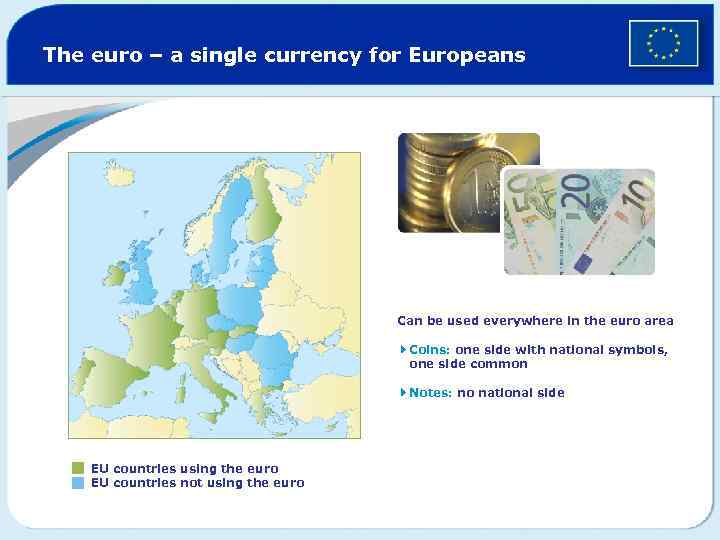 The euro – a single currency for Europeans Can be used everywhere in the euro area 4 Coins: one side with national symbols, one side common 4 Notes: no national side EU countries using the euro EU countries not using the euro
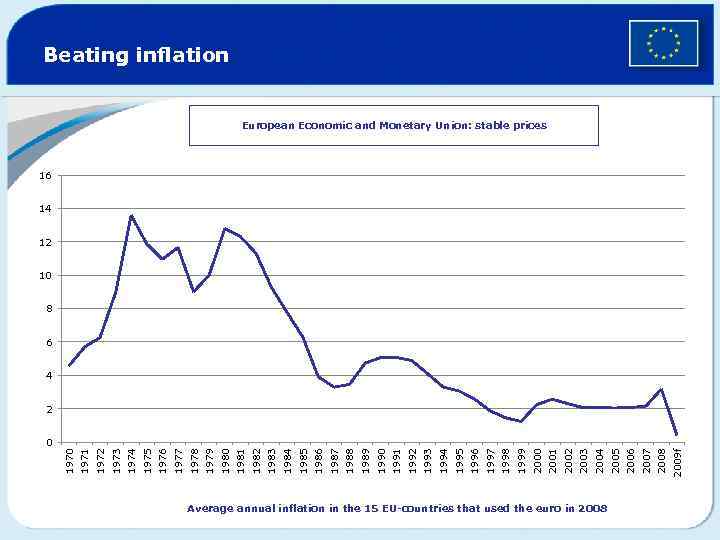 Average annual inflation in the 15 EU-countries that used the euro in 2008 2009 f 2008 2007 2006 2005 2004 2003 2002 2001 2000 1999 1998 1997 1996 1995 1994 1993 1992 1991 1990 1989 1988 1987 1986 1985 1984 1983 1982 1981 1980 1979 1978 1977 1976 1975 1974 1973 1972 1971 1970 Beating inflation European Economic and Monetary Union: stable prices 16 14 12 10 8 6 4 2 0
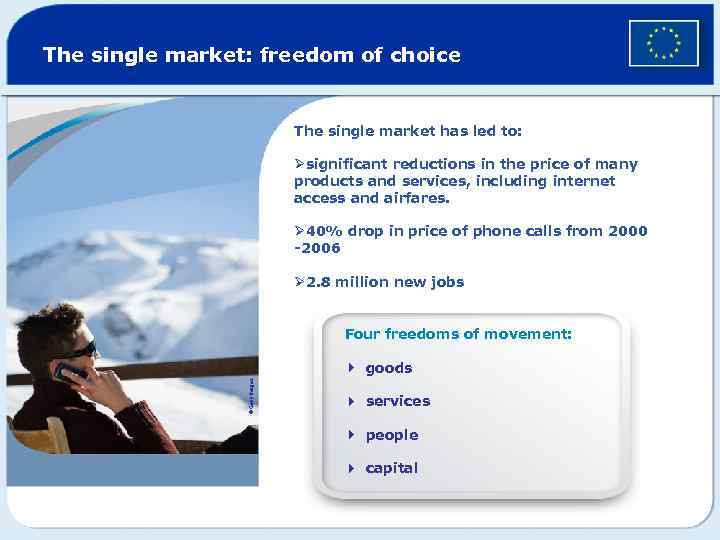 The single market: freedom of choice The single market has led to: Øsignificant reductions in the price of many products and services, including internet access and airfares. Ø 40% drop in price of phone calls from 2000 -2006 Ø 2. 8 million new jobs Four freedoms of movement: © Getty Images 4 goods 4 services 4 people 4 capital
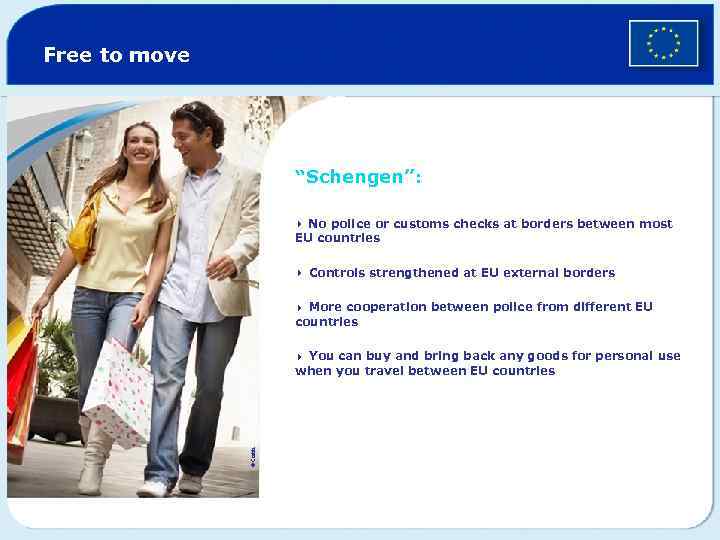 Free to move “Schengen”: 4 No police or customs checks at borders between most EU countries 4 Controls strengthened at EU external borders More cooperation between police from different EU countries 4 You can buy and bring back any goods for personal use when you travel between EU countries © Corbis 4
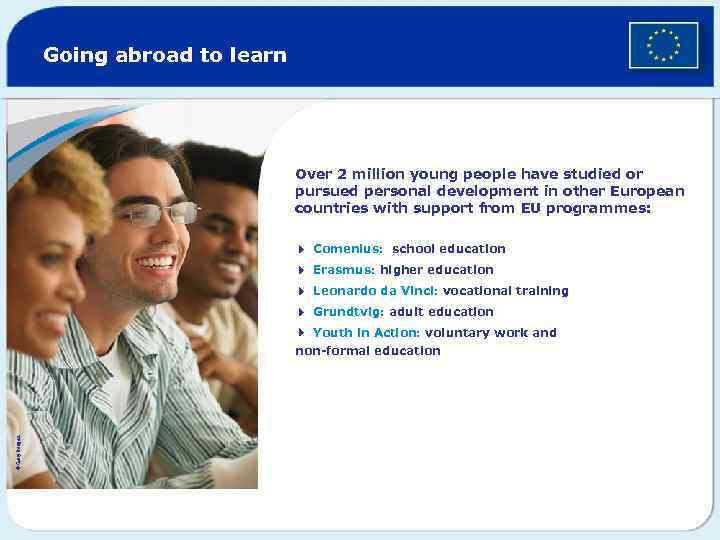 Going abroad to learn Over 2 million young people have studied or pursued personal development in other European countries with support from EU programmes: 4 Comenius: school education 4 Erasmus: higher education 4 Leonardo da Vinci: vocational training 4 Grundtvig: adult education 4 Youth in Action: voluntary work and © Getty Images non-formal education
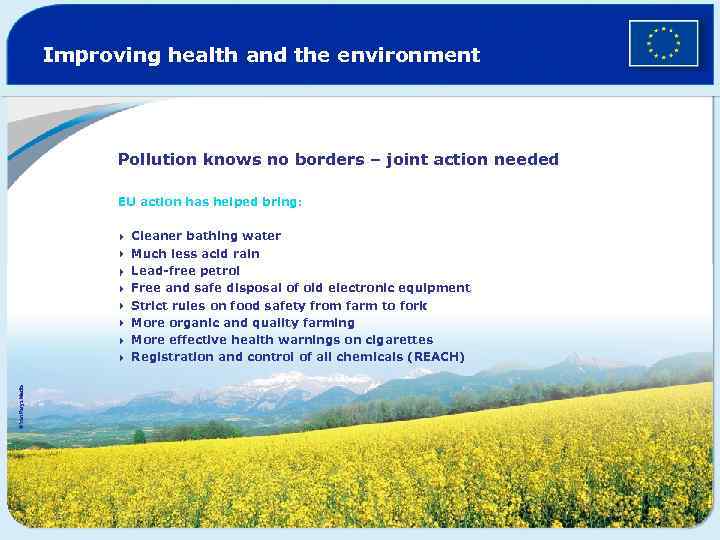 Improving health and the environment Pollution knows no borders – joint action needed EU action has helped bring: 4 4 4 4 © Van Parys Media 4 Cleaner bathing water Much less acid rain Lead-free petrol Free and safe disposal of old electronic equipment Strict rules on food safety from farm to fork More organic and quality farming More effective health warnings on cigarettes Registration and control of all chemicals (REACH)
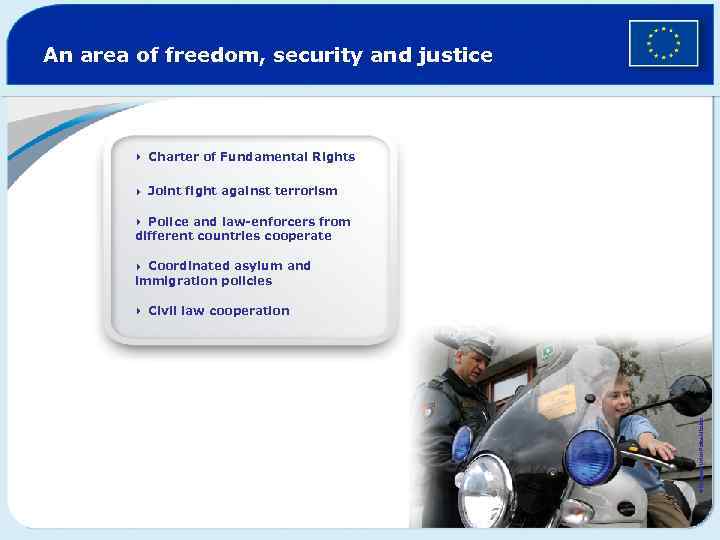 An area of freedom, security and justice 4 Charter of Fundamental Rights 4 Joint fight against terrorism Police and law-enforcers from different countries cooperate 4 Coordinated asylum and immigration policies 4 Civil law cooperation © European Union Police Mission 4
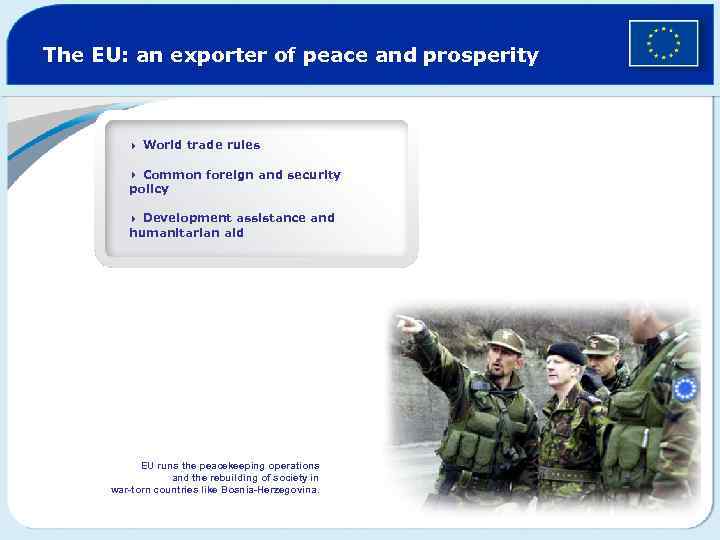 The EU: an exporter of peace and prosperity 4 World trade rules Common foreign and security policy 4 Development assistance and humanitarian aid 4 EU runs the peacekeeping operations and the rebuilding of society in war-torn countries like Bosnia-Herzegovina.
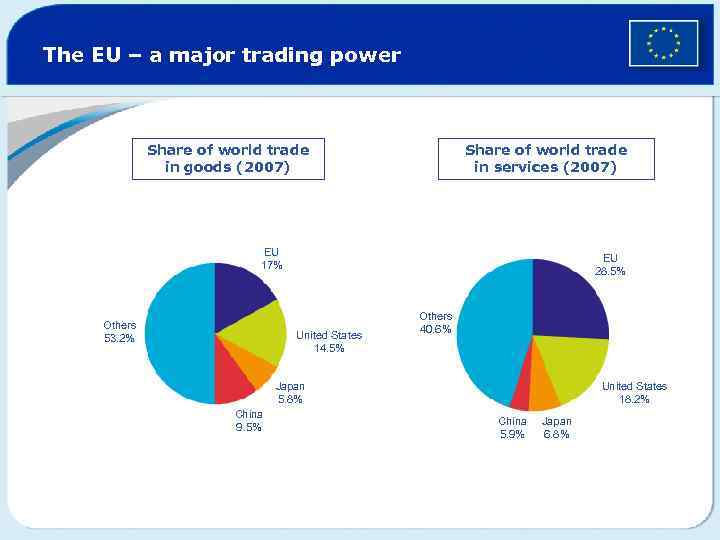 The EU – a major trading power Share of world trade in goods (2007) Share of world trade in services (2007) EU 17% Others 53. 2% EU 28. 5% United States 14. 5% Others 40. 6% Japan 5. 8% China 9. 5% United States 18. 2% China 5. 9% Japan 6. 8%
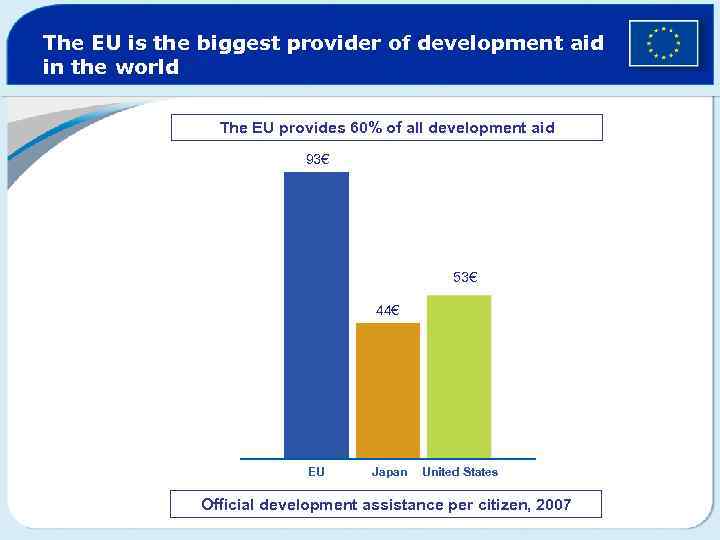 The EU is the biggest provider of development aid in the world The EU provides 60% of all development aid 93€ 53€ 44€ EU Japan United States Official development assistance per citizen, 2007
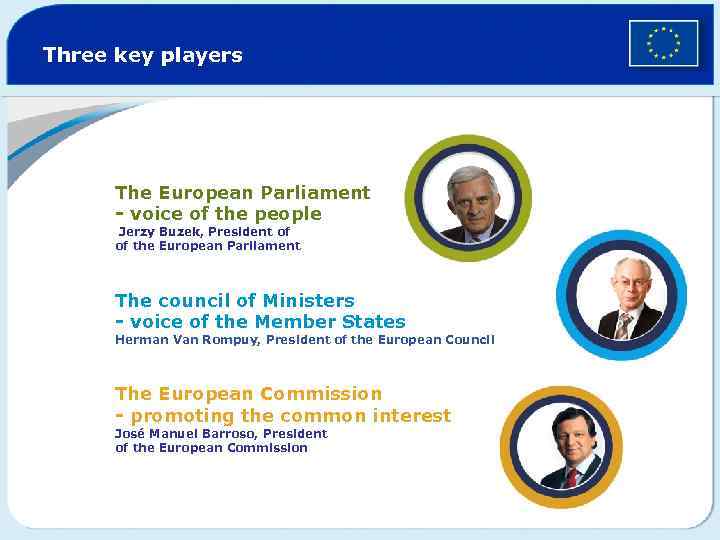 Three key players The European Parliament - voice of the people Jerzy Buzek, President of of the European Parliament The council of Ministers - voice of the Member States Herman Van Rompuy, President of the European Council The European Commission - promoting the common interest José Manuel Barroso, President of the European Commission
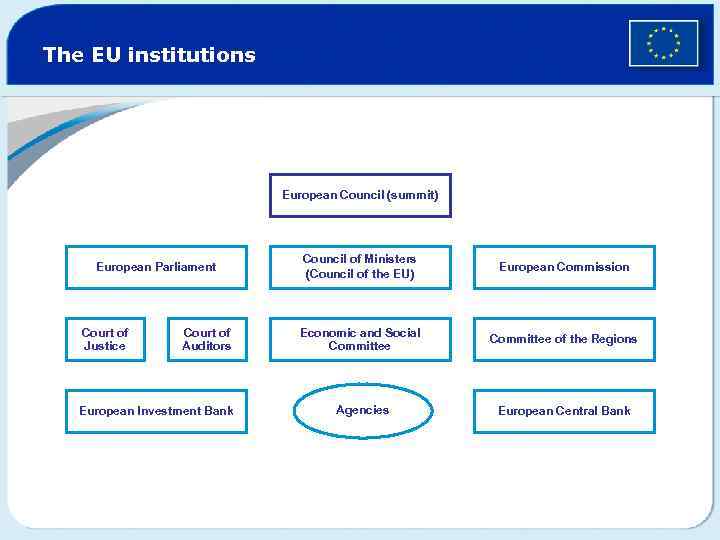 The EU institutions European Council (summit) European Parliament Court of Justice Court of Auditors European Investment Bank Council of Ministers (Council of the EU) European Commission Economic and Social Committee of the Regions Agencies European Central Bank
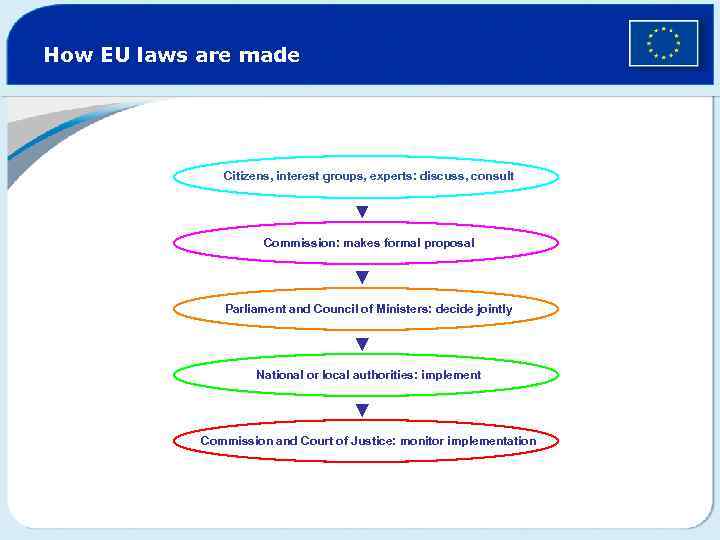 How EU laws are made Citizens, interest groups, experts: discuss, consult Commission: makes formal proposal Parliament and Council of Ministers: decide jointly National or local authorities: implement Commission and Court of Justice: monitor implementation
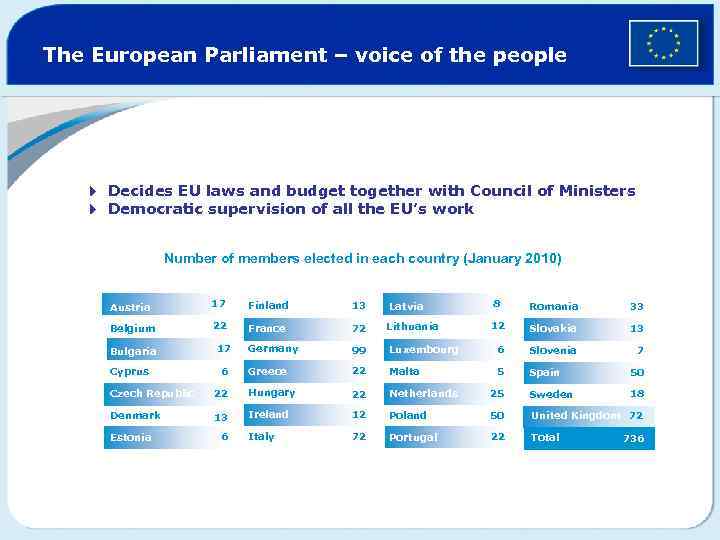 The European Parliament – voice of the people 4 Decides EU laws and budget together with Council of Ministers 4 Democratic supervision of all the EU’s work Number of members elected in each country (January 2010) Austria 17 Finland 13 Latvia 8 Romania 33 Belgium 22 France 72 Lithuania 12 Slovakia 13 Germany 99 Luxembourg 6 Slovenia 7 Greece 22 Malta 5 Spain 50 18 Bulgaria Cyprus 17 6 Czech Republic 22 Hungary 22 Netherlands 25 Sweden Denmark 13 Ireland 12 Poland 50 United Kingdom 72 Italy 72 Portugal 22 Total Estonia 6 736
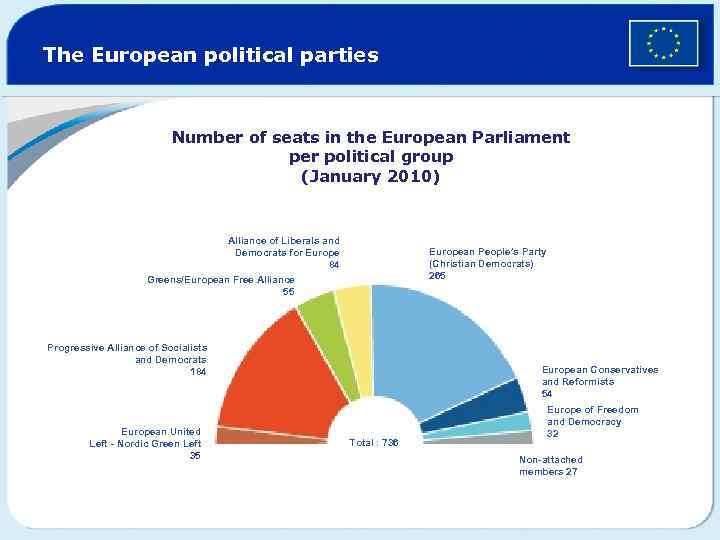 The European political parties Number of seats in the European Parliament per political group (January 2010) Alliance of Liberals and Democrats for Europe 84 European People’s Party (Christian Democrats) 265 Greens/European Free Alliance 55 Progressive Alliance of Socialists and Democrats 184 European United Left - Nordic Green Left 35 European Conservatives and Reformists 54 Total : 736 Europe of Freedom and Democracy 32 Non-attached members 27
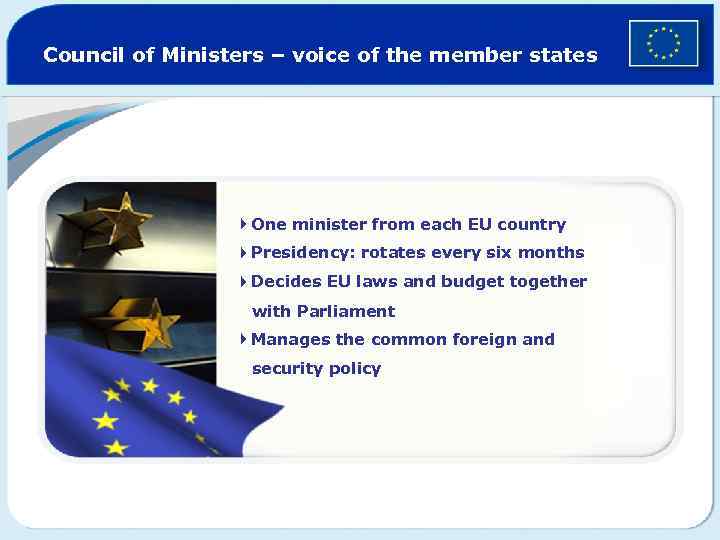 Council of Ministers – voice of the member states 4 One minister from each EU country 4 Presidency: rotates every six months 4 Decides EU laws and budget together with Parliament 4 Manages the common foreign and security policy
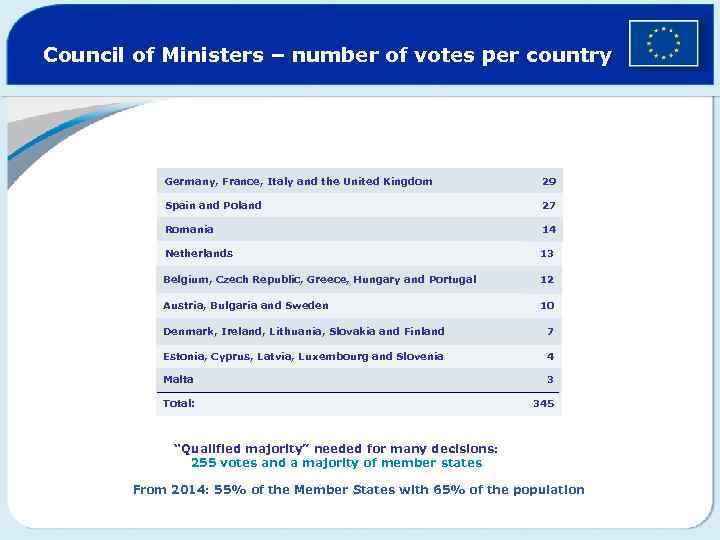 Council of Ministers – number of votes per country Germany, France, Italy and the United Kingdom 29 Spain and Poland 27 Romania 14 Netherlands 13 Belgium, Czech Republic, Greece, Hungary and Portugal 12 Austria, Bulgaria and Sweden 10 Denmark, Ireland, Lithuania, Slovakia and Finland 7 Estonia, Cyprus, Latvia, Luxembourg and Slovenia 4 Malta 3 Total: 345 “Qualified majority” needed for many decisions: 255 votes and a majority of member states From 2014: 55% of the Member States with 65% of the population
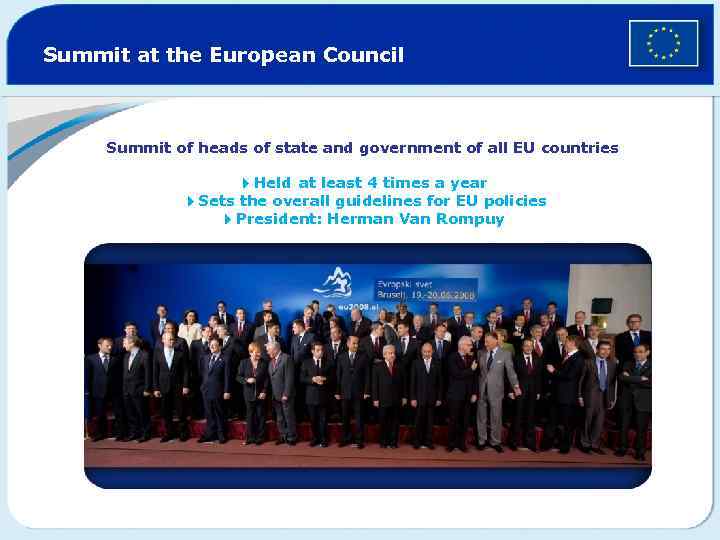 Summit at the European Council Summit of heads of state and government of all EU countries 4 Held at least 4 times a year 4 Sets the overall guidelines for EU policies 4 President: Herman Van Rompuy
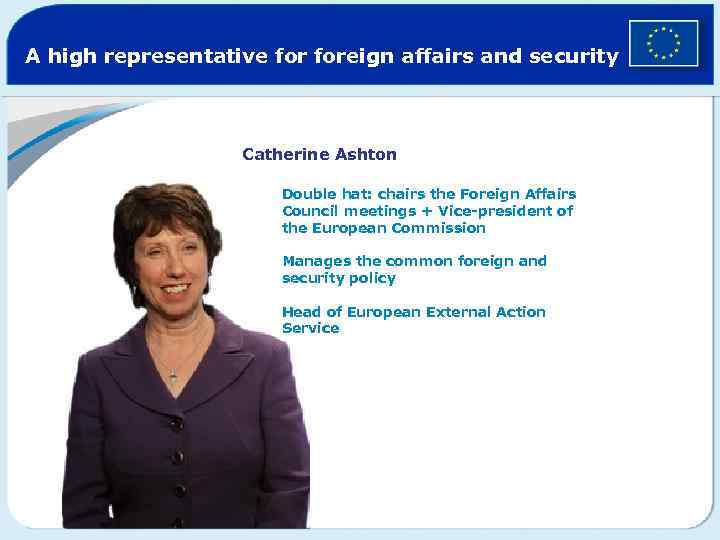 A high representative foreign affairs and security Catherine Ashton Double hat: chairs the Foreign Affairs Council meetings + Vice-president of the European Commission Manages the common foreign and security policy Head of European External Action Service
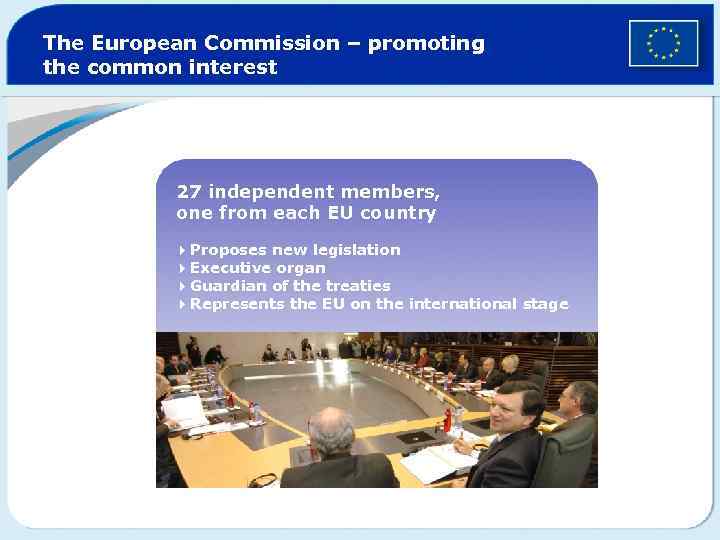 The European Commission – promoting the common interest 27 independent members, one from each EU country 4 Proposes new legislation 4 Executive organ 4 Guardian of the treaties 4 Represents the EU on the international stage
 The Court of Justice – upholding the law 27 independent judges, one from each EU country 4 Rules on how to interpret EU law 4 Ensures EU countries apply EU laws in the same way
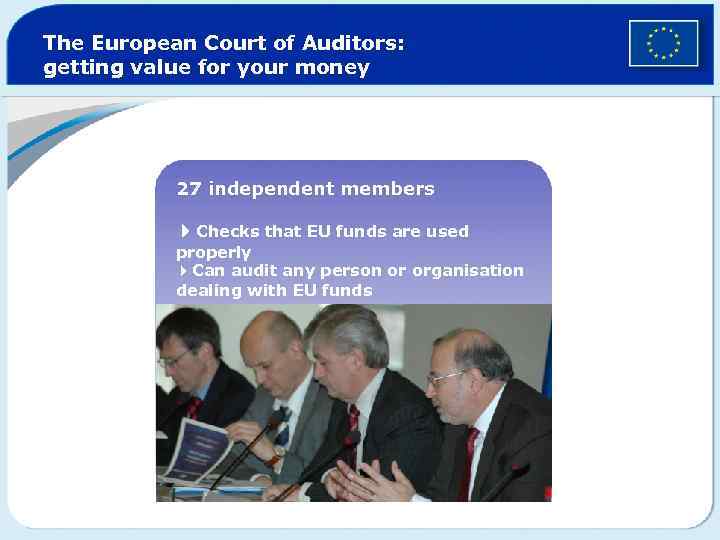 The European Court of Auditors: getting value for your money 27 independent members 4 Checks that EU funds are used properly 4 Can audit any person or organisation dealing with EU funds
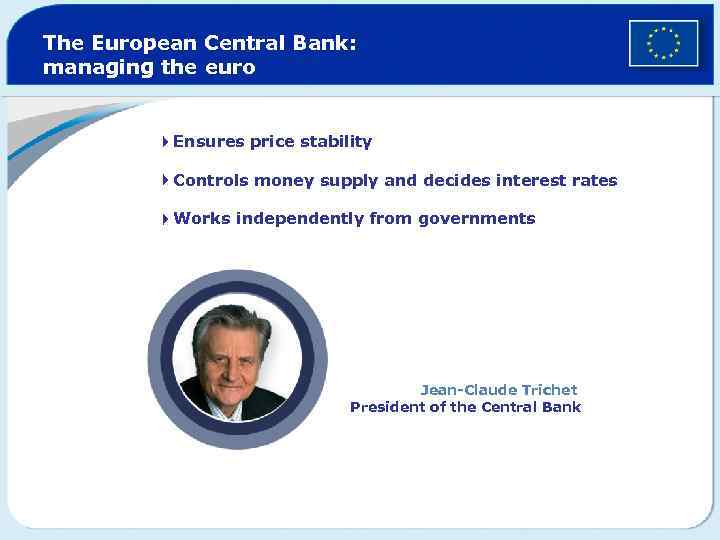 The European Central Bank: managing the euro 4 Ensures price stability 4 Controls money supply and decides interest rates 4 Works independently from governments Jean-Claude Trichet President of the Central Bank
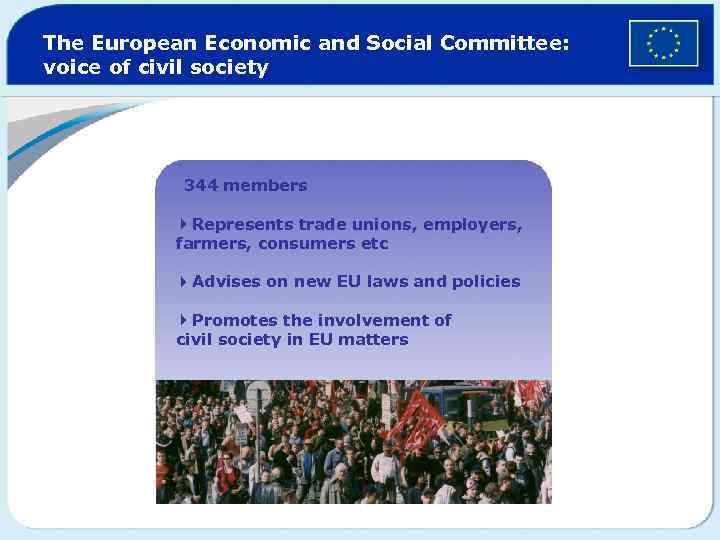 The European Economic and Social Committee: voice of civil society 344 members 4 Represents trade unions, employers, farmers, consumers etc 4 Advises on new EU laws and policies 4 Promotes the involvement of civil society in EU matters
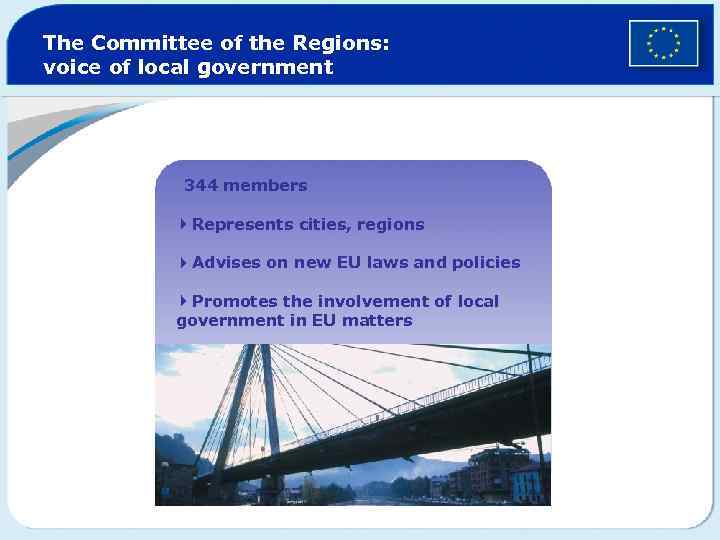 The Committee of the Regions: voice of local government 344 members 4 Represents cities, regions 4 Advises on new EU laws and policies 4 Promotes the involvement of local government in EU matters
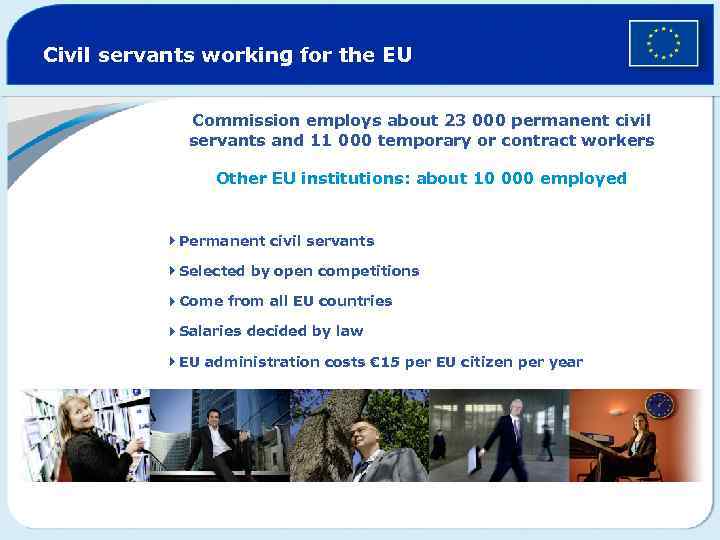 Civil servants working for the EU Commission employs about 23 000 permanent civil servants and 11 000 temporary or contract workers Other EU institutions: about 10 000 employed 4 Permanent civil servants 4 Selected by open competitions 4 Come from all EU countries 4 Salaries decided by law 4 EU administration costs € 15 per EU citizen per year