


 Скачать презентацию The European Spallation Source Steve Peggs for ESS AD
5e7d4eb56e7b1072380cc02d9c9b439d.ppt
- Количество слайдов: 32
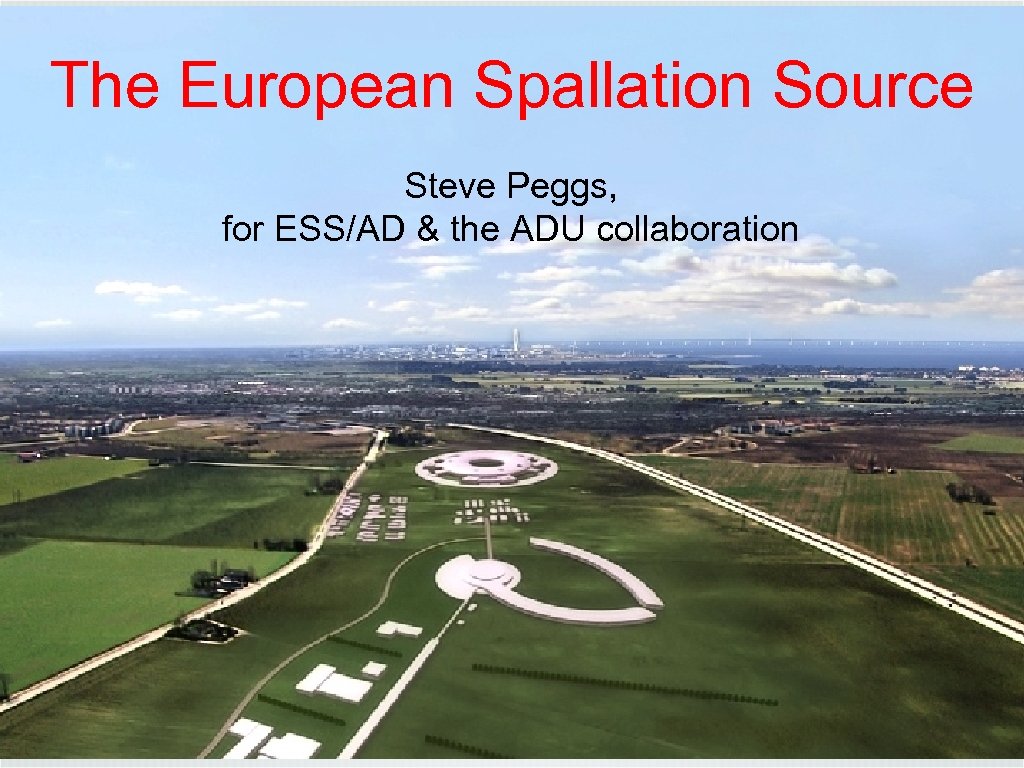 The European Spallation Source Steve Peggs, for ESS/AD & the ADU collaboration
 23 ESS papers at IPAC 11 MOODB 02 MOPC 049 MOPC 050 MOPC 136 MOPC 161 MOPS 039 MOPS 082 TUPC 131 TUPS 096 TUZB 01 WEIB 05 WEPC 166 WEPS 059 WEPS 060 WEPS 061 WEPS 062 WEPS 063 WEPS 064 THEA 01 THPS 031 THPS 050 THXA 01 IPAC 11, 110909 Stephen Molloy Robert Ainsworth Stephen Molloy Karin Rathsman Anders J Johansson Aurélien Ponton Carsten Welsch Lali Tchelidze Karin Rathsman Guillaume Devanz Cristina Oyon Thomas Hansson Håkan Danared Mohammad Eshraqi Mats Lindroos Colin Carlile Heine Thomsen Anne Holm Igor Verstovsek RF Modeling Plans for the ESS Bead-pull Test Bench for Studying Accelerating Structures at RHUL Multipacting Analysis for the SRF Cavity HOM Couplers in ESS The RF Power Source for the High Beta Elliptical Cavities of the ESS Challenges for the Low Level RF Design for ESS High Power Proton Linac Front-End: Beam Dynamics. . . for the ESS. . . Choice of Frequency & Geometrical Beta in. . . Proton Linacs … Overview of ESS Beam Loss Monitoring System ESS Parameter List Database and Web Interface Tools Superconducting RF Technology for Proton and Ion Accelerators Collaborative R&D in the Industry of Science Licensing and Safety Issues of the ESS Accelerator Layout of the ESS Proton Linac Design and Optimization of the ESS LINAC, Design and Beam Dynamics Study of Hybrid ESS LINAC Compensation of. . . Malfunctioning Spoke Resonators [in] ESS Upgrade Strategies for High Power Proton Linacs Is it Possible to Operate a Large Research Facility with Wind Power? The Beam Expander System for the ESS The High Energy Beam Transport System for the ESS Recent Trends in Accelerator Control Systems Steve Peggs 2
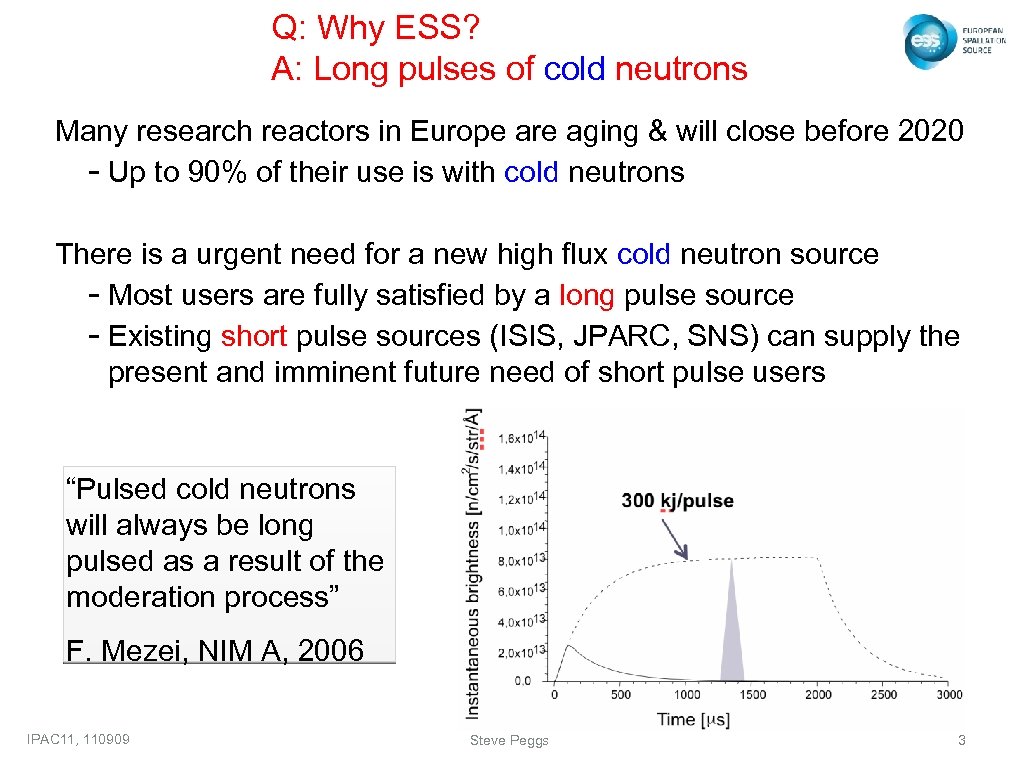 Q: Why ESS? A: Long pulses of cold neutrons Many research reactors in Europe are aging & will close before 2020 - Up to 90% of their use is with cold neutrons There is a urgent need for a new high flux cold neutron source - Most users are fully satisfied by a long pulse source - Existing short pulse sources (ISIS, JPARC, SNS) can supply the present and imminent future need of short pulse users “Pulsed cold neutrons will always be long pulsed as a result of the moderation process” F. Mezei, NIM A, 2006 IPAC 11, 110909 Steve Peggs 3
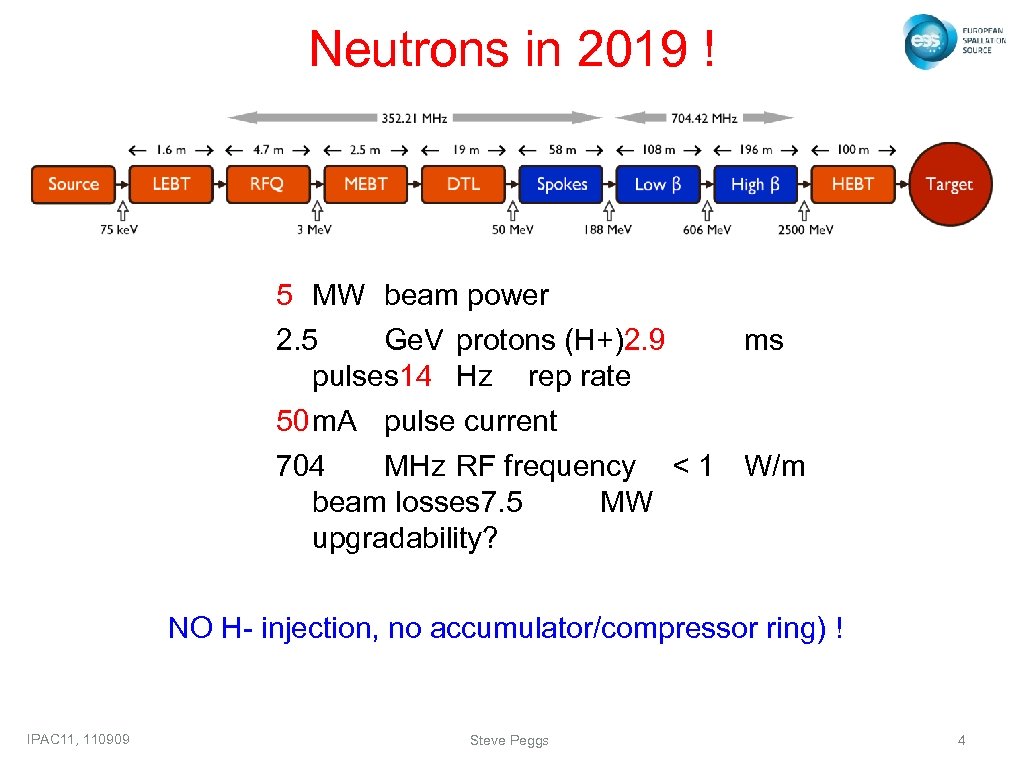 Neutrons in 2019 ! 5 MW beam power 2. 5 Ge. V protons (H+)2. 9 ms pulses 14 Hz rep rate 50 m. A pulse current 704 MHz RF frequency < 1 W/m beam losses 7. 5 MW upgradability? NO H- injection, no accumulator/compressor ring) ! IPAC 11, 110909 Steve Peggs 4
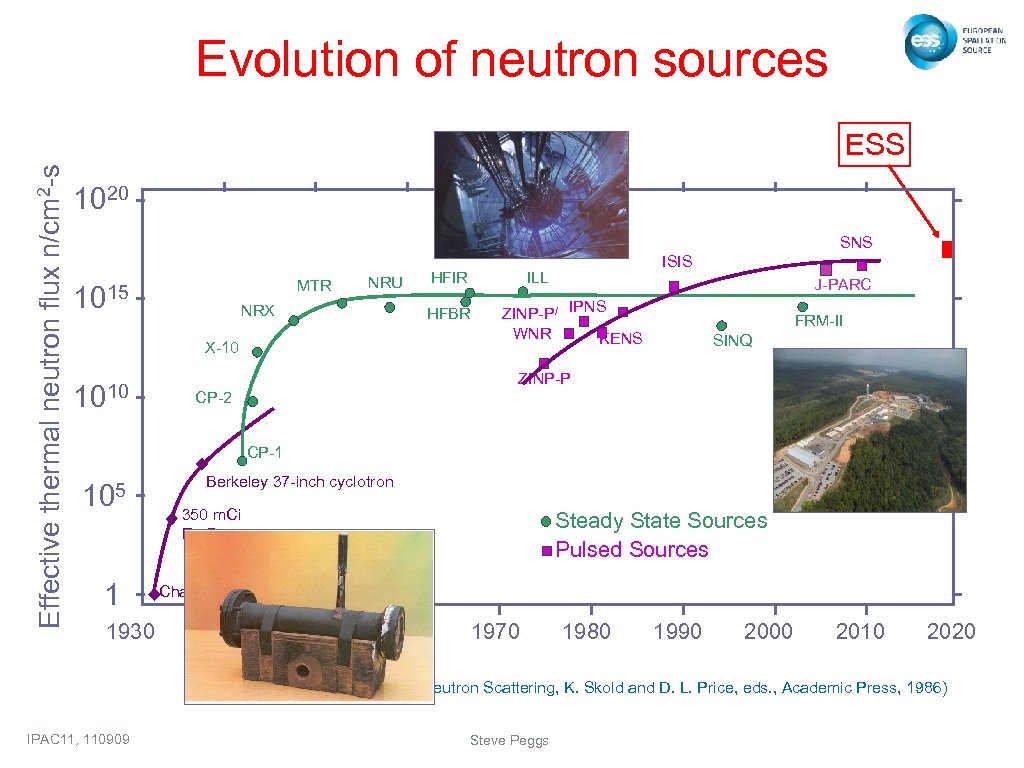 Evolution of neutron sources Effective thermal neutron flux n/cm 2 -s ESS 1020 SNS MTR 1015 NRX HFBR X-10 1010 ILL HFIR NRU ISIS J-PARC ZINP-P/ IPNS WNR KENS FRM-II SINQ ZINP-P CP-2 CP-1 105 1 1930 Berkeley 37 -inch cyclotron 350 m. Ci Ra-Be source Steady State Sources Pulsed Sources Chadwick 1940 1950 1960 1970 1980 1990 2000 2010 2020 (Updated from Neutron Scattering, K. Skold and D. L. Price, eds. , Academic Press, 1986) IPAC 11, 110909 Steve Peggs
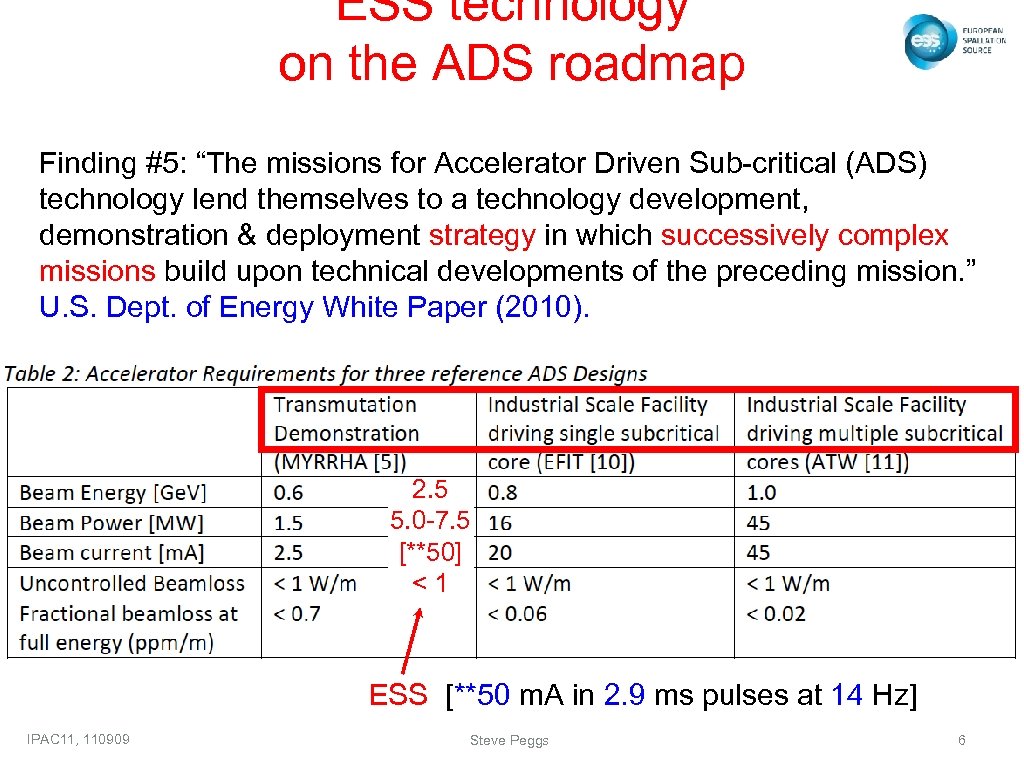 ESS technology on the ADS roadmap Finding #5: “The missions for Accelerator Driven Sub-critical (ADS) technology lend themselves to a technology development, demonstration & deployment strategy in which successively complex missions build upon technical developments of the preceding mission. ” U. S. Dept. of Energy White Paper (2010). 2. 5 5. 0 -7. 5 [**50] <1 ESS [**50 m. A in 2. 9 ms pulses at 14 Hz] IPAC 11, 110909 Steve Peggs 6
 Green (field) site IPAC 11, 110909 Steve Peggs 7
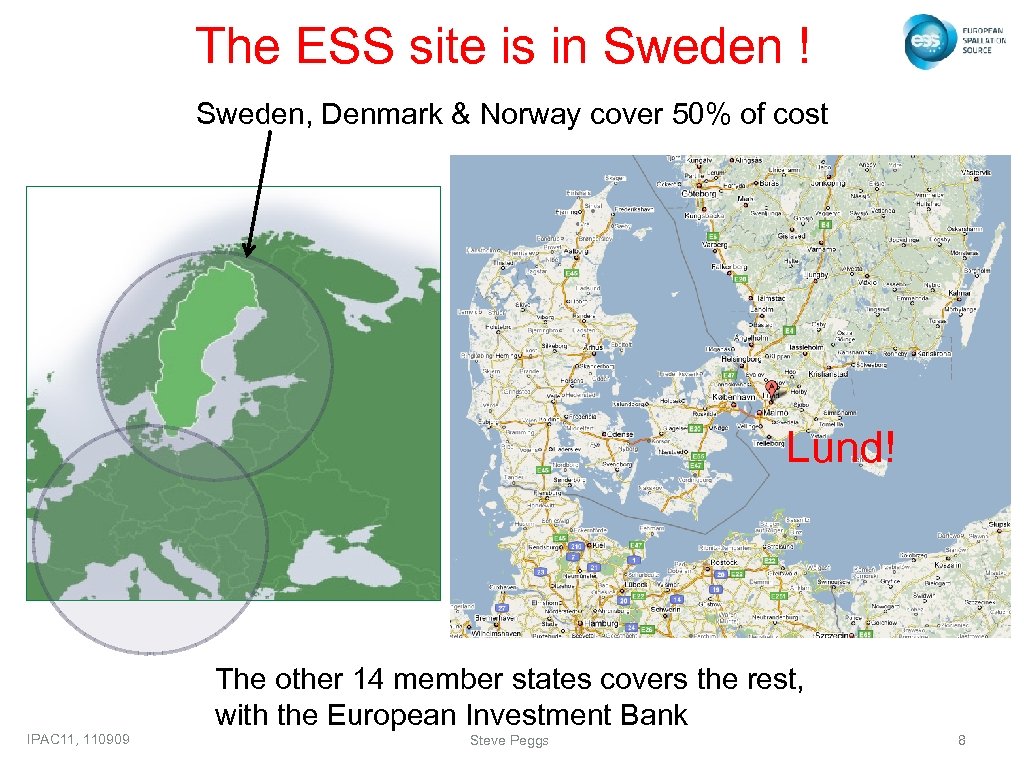 The ESS site is in Sweden ! Sweden, Denmark & Norway cover 50% of cost Lund! IPAC 11, 110909 The other 14 member states covers the rest, with the European Investment Bank Steve Peggs 8
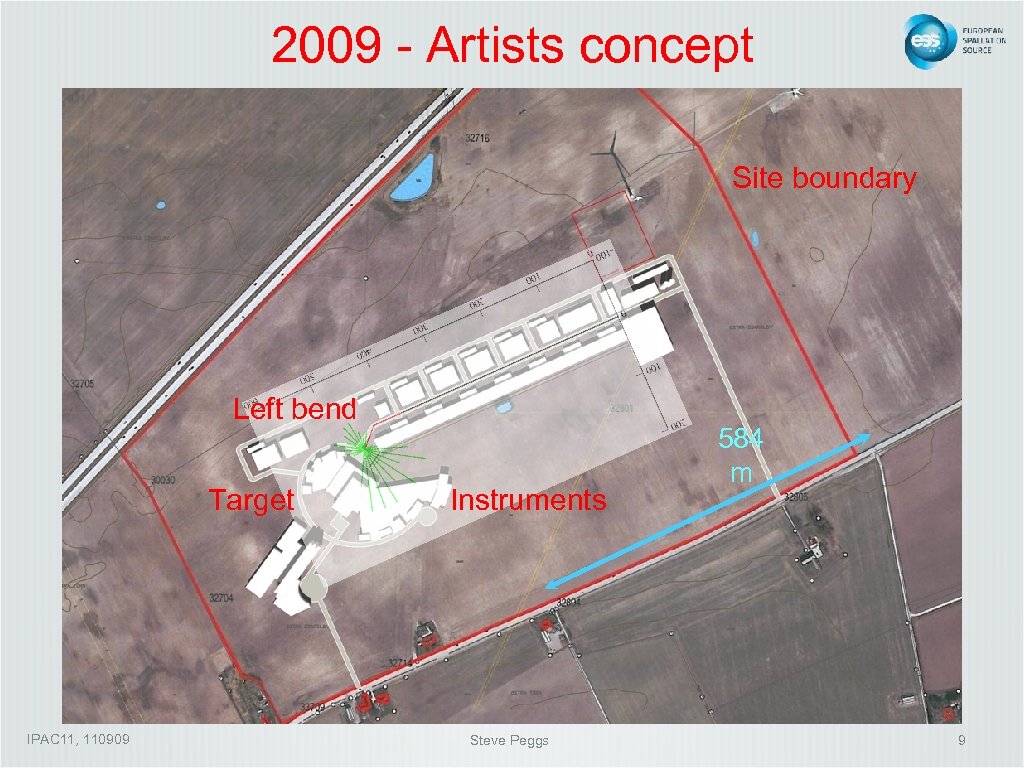 2009 - Artists concept Site boundary Left bend Target IPAC 11, 110909 Instruments Steve Peggs 584 m 9
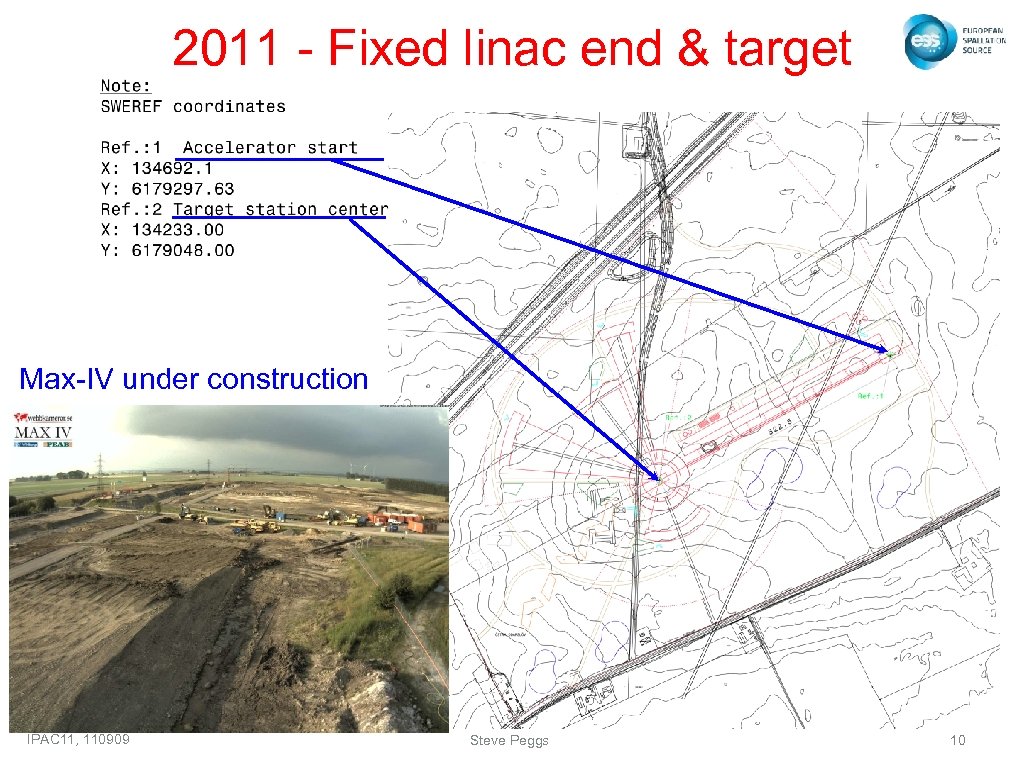 2011 - Fixed linac end & target Max-IV under construction IPAC 11, 110909 Steve Peggs 10
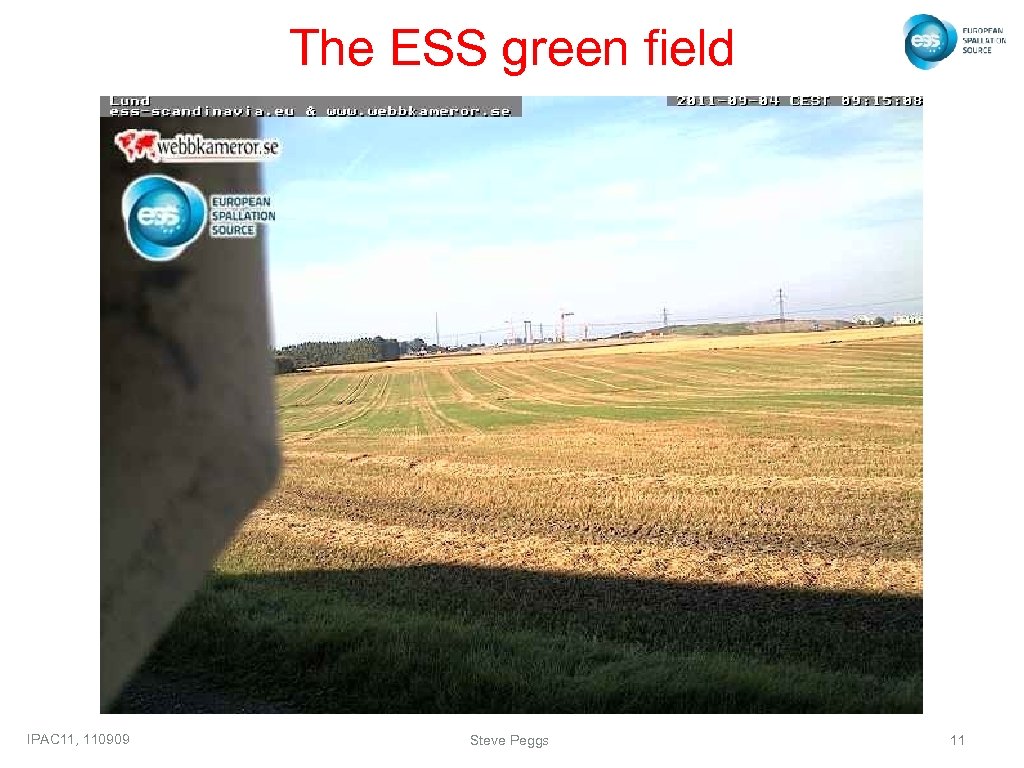 The ESS green field IPAC 11, 110909 Steve Peggs 11
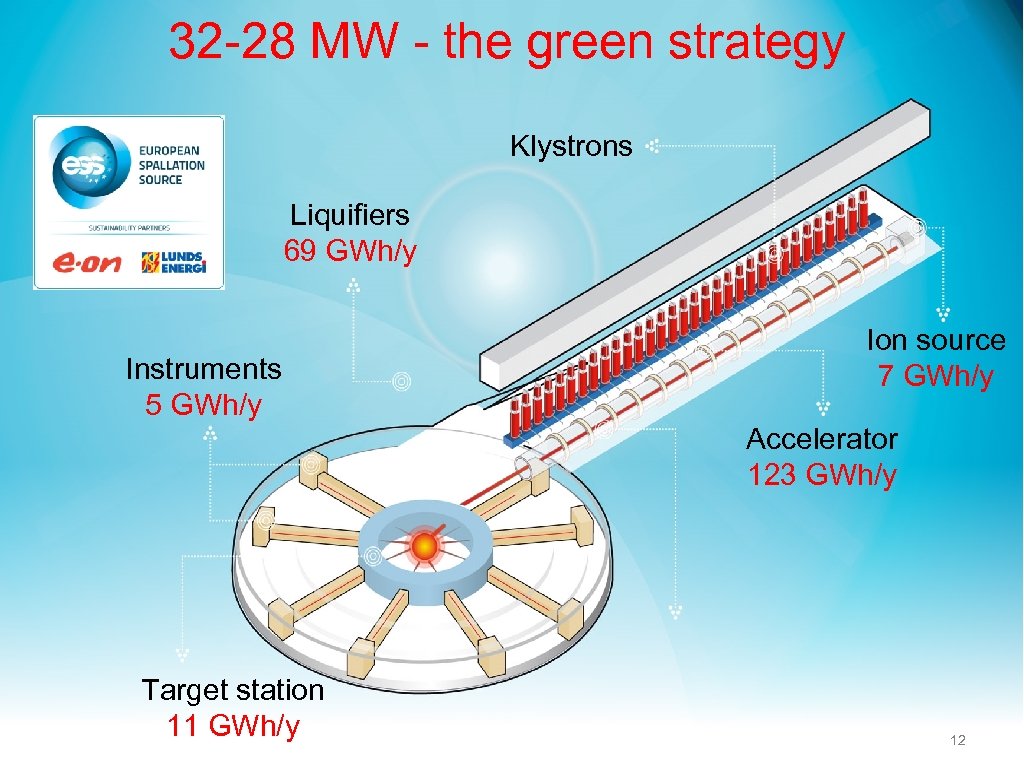 32 -28 MW - the green strategy Klystrons Liquifiers 69 GWh/y Ion source 7 GWh/y Instruments 5 GWh/y Accelerator 123 GWh/y IPAC 11, 110909 Target station 11 GWh/y Steve Peggs 12
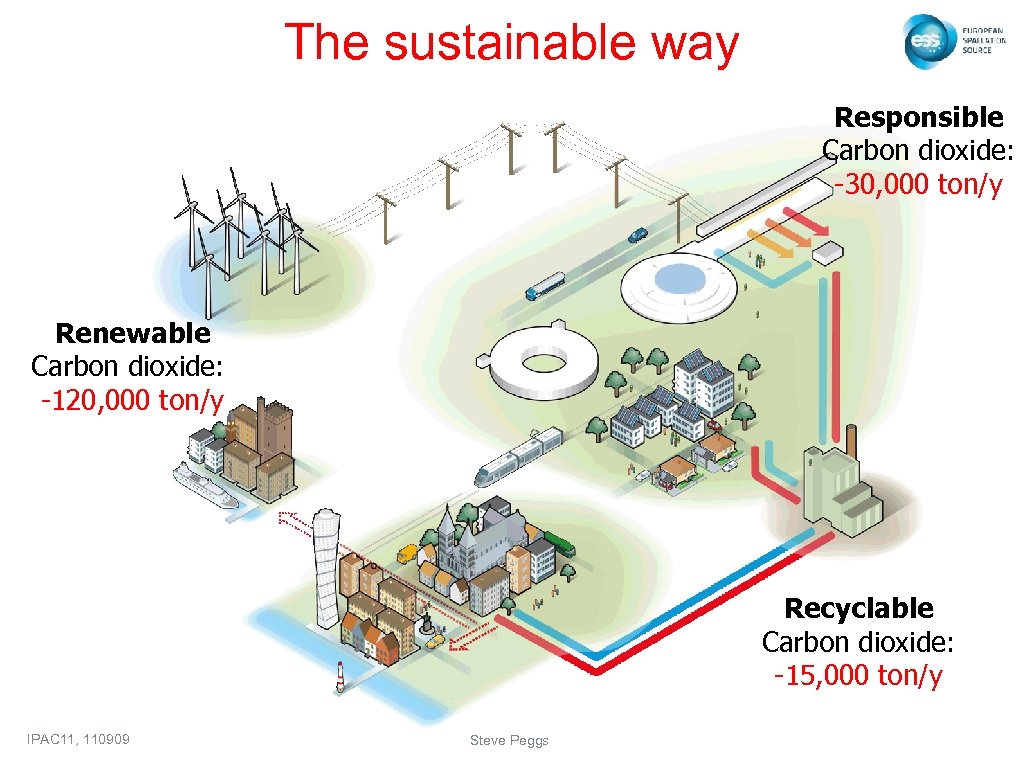 The sustainable way Responsible Carbon dioxide: -30, 000 ton/y Renewable Carbon dioxide: -120, 000 ton/y Recyclable Carbon dioxide: -15, 000 ton/y IPAC 11, 110909 Steve Peggs
 Technical issues IPAC 11, 110909 Steve Peggs 14
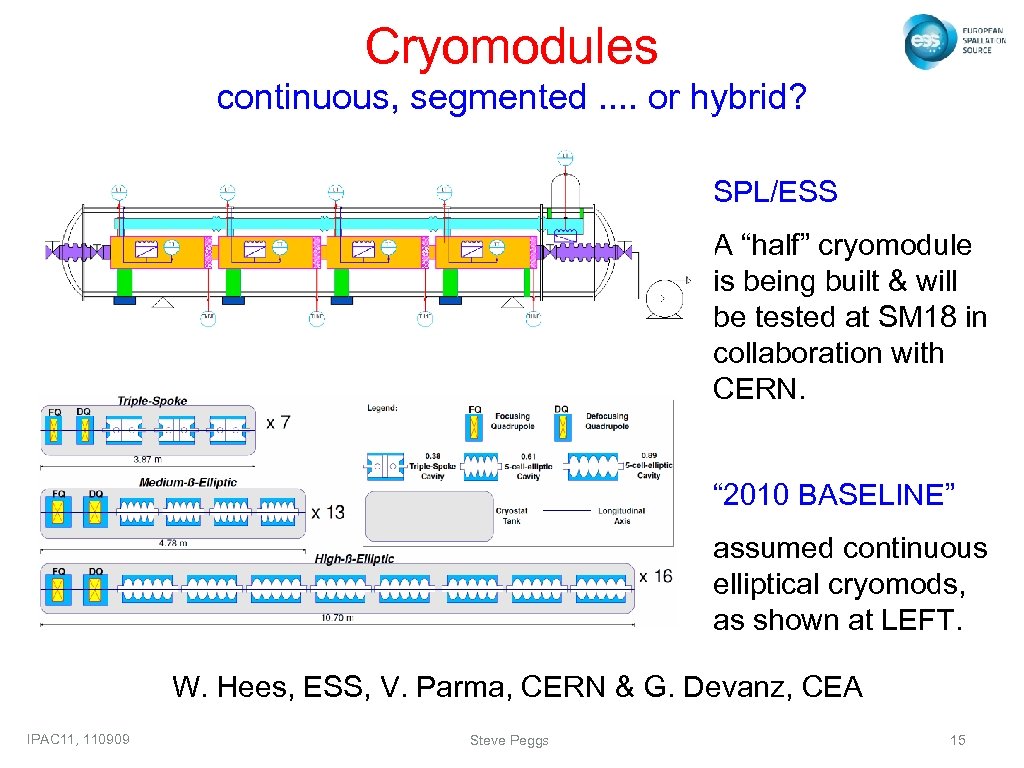 Cryomodules continuous, segmented. . or hybrid? SPL/ESS A “half” cryomodule is being built & will be tested at SM 18 in collaboration with CERN. “ 2010 BASELINE” assumed continuous elliptical cryomods, as shown at LEFT. W. Hees, ESS, V. Parma, CERN & G. Devanz, CEA IPAC 11, 110909 Steve Peggs 15
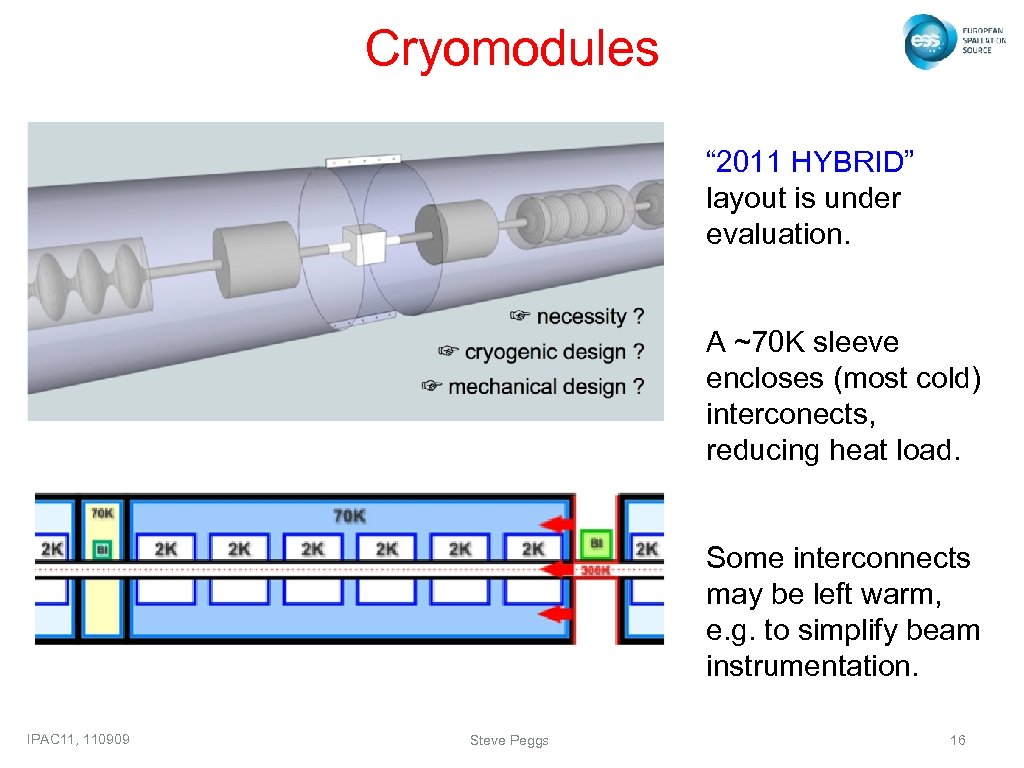 Cryomodules “ 2011 HYBRID” layout is under evaluation. A ~70 K sleeve encloses (most cold) interconects, reducing heat load. Some interconnects may be left warm, e. g. to simplify beam instrumentation. IPAC 11, 110909 Steve Peggs 16
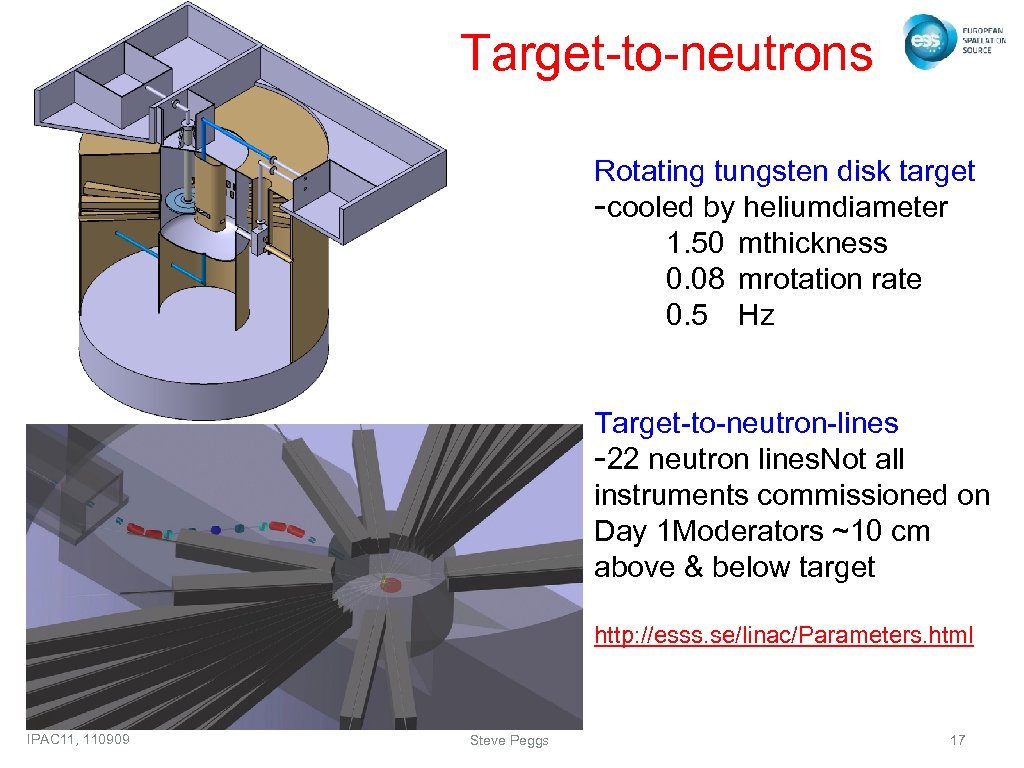 Target-to-neutrons Rotating tungsten disk target -cooled by heliumdiameter 1. 50 mthickness 0. 08 mrotation rate 0. 5 Hz Target-to-neutron-lines -22 neutron lines. Not all instruments commissioned on Day 1 Moderators ~10 cm above & below target http: //esss. se/linac/Parameters. html IPAC 11, 110909 Steve Peggs 17
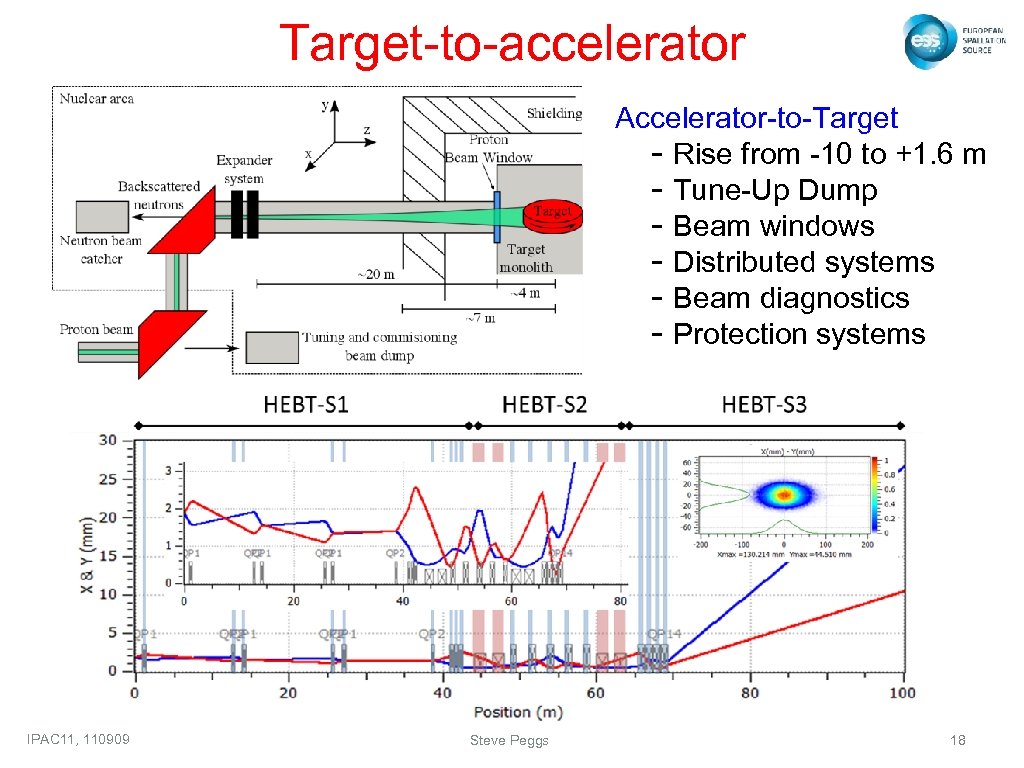 Target-to-accelerator Accelerator-to-Target - Rise from -10 to +1. 6 m - Tune-Up Dump - Beam windows - Distributed systems - Beam diagnostics - Protection systems IPAC 11, 110909 Steve Peggs 18
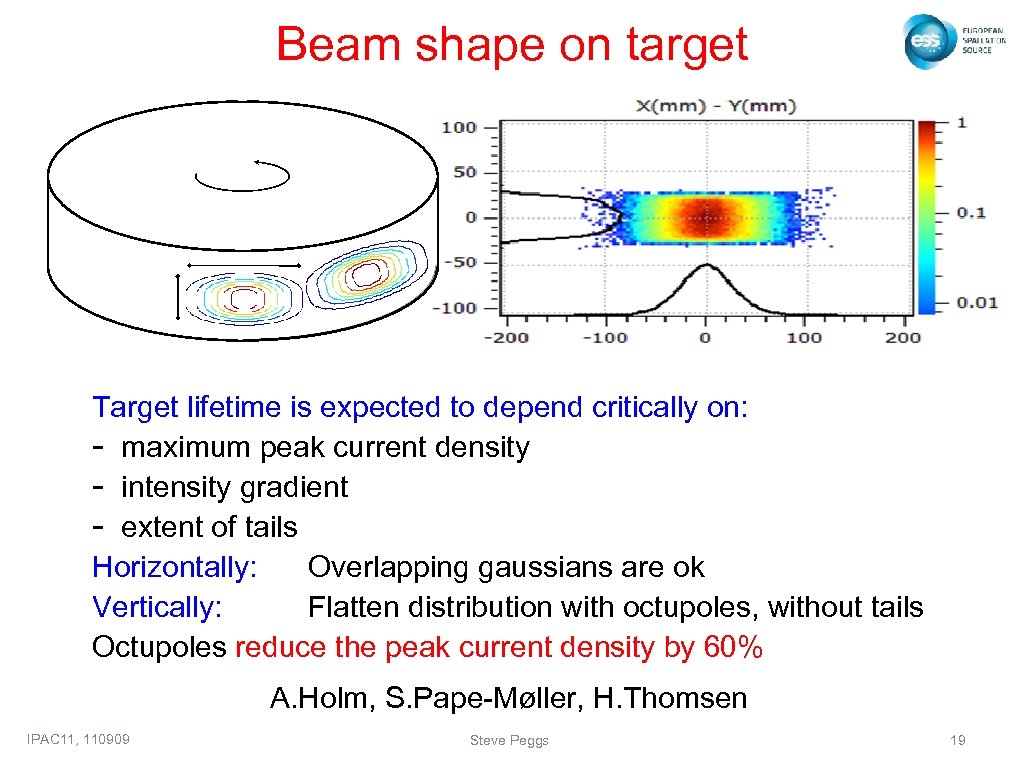 Beam shape on target Target lifetime is expected to depend critically on: - maximum peak current density - intensity gradient - extent of tails Horizontally: Overlapping gaussians are ok Vertically: Flatten distribution with octupoles, without tails Octupoles reduce the peak current density by 60% A. Holm, S. Pape-Møller, H. Thomsen IPAC 11, 110909 Steve Peggs 19
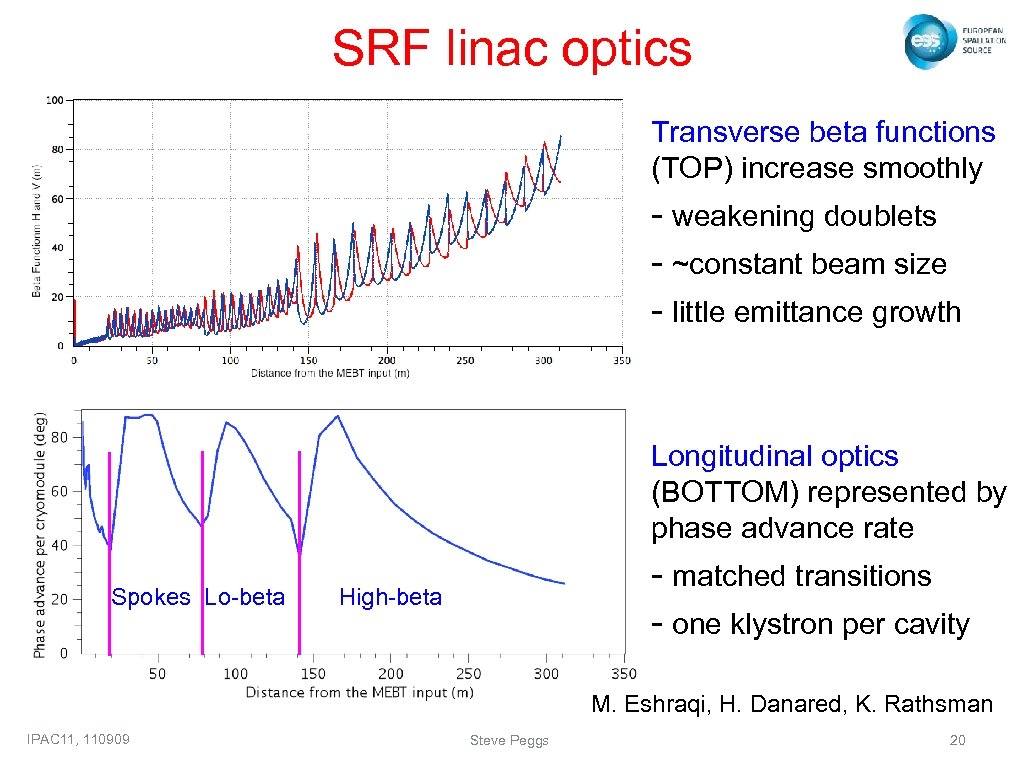 SRF linac optics Transverse beta functions (TOP) increase smoothly - weakening doublets - ~constant beam size - little emittance growth Longitudinal optics (BOTTOM) represented by phase advance rate Spokes Lo-beta - matched transitions - one klystron per cavity High-beta M. Eshraqi, H. Danared, K. Rathsman IPAC 11, 110909 Steve Peggs 20
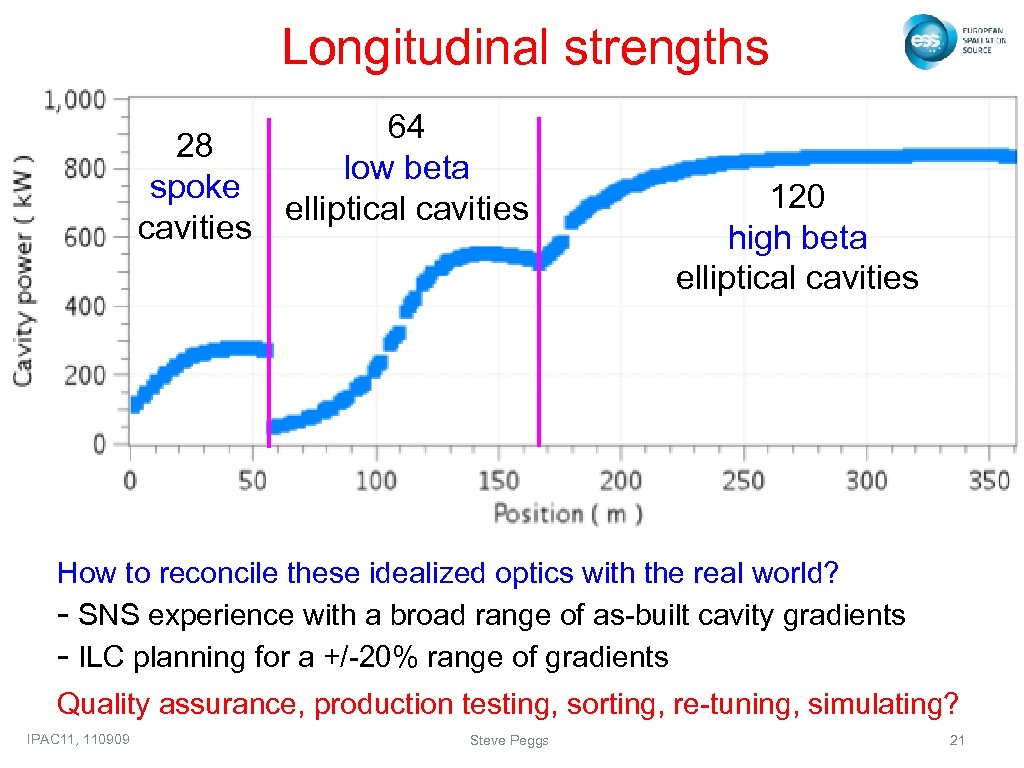 Longitudinal strengths 28 spoke cavities 64 low beta elliptical cavities 120 high beta elliptical cavities How to reconcile these idealized optics with the real world? - SNS experience with a broad range of as-built cavity gradients - ILC planning for a +/-20% range of gradients Quality assurance, production testing, sorting, re-tuning, simulating? IPAC 11, 110909 Steve Peggs 21
 Beam losses Radio-activation is unacceptable from losses larger than about 1 W/m. Intra-beam stripping is plausibly an important source of beam losses in H- linacs like the SNS (0. 2 W/m) - but not in the H+ ESS ! Other potential beam loss sources: 1. Space charge resonances 2. Transverse overfocusing 3. Uncollimated low energy beam halo Attaining the ability to confidently predict the relative importance of loss mechanisms is a fundamental challenge to our ability to design multi-MW proton linacs. Resolve by 1) simulation & theory, 2) experiment (eg, SNS). . . IPAC 11, 110909 Steve Peggs 22
 End-to-end simulations of course, but what is the question? 1) Optics design & tuning strategies: integration by beam - lengths & strengths, optics matching - diagnostics & correctors, algorithms - on-line & off-line from one single model 2) Multi-particle pushing: - does the emittance blow up, do tails grow? 1)collimation 2)Beam losses: fundamental challenge - power limit? Contingency: real-time production line response - move risk from manufacturer to ESS (cf XFEL) Upgradability: the cost of preservation - Power, non-neutron scattering uses, parasitic extraction 1) Reliability: longer term contingency response 1)Synergy with ADSR? IPAC 11, 110909 Steve Peggs 23
 RF issues Higher Order Modes - There is risk in NOT damping, & also IN damping HOMs - HOM couplers will be installed if ongoing studies indicate the need - Could be instrumented to measure transverse displacements Field Emission & Multipacting - SNS experience indicates that FE & MP may limit cavity performance - Excessive power into HOM electronics, via thermal detuning? - A simulation campaign has been launched Low Level RF - Protons: semi-relativistic speeds cause phase & amplitude errors to accumulate along the linac - Investigations (eg of modulator ripple & droop) are in progress IPAC 11, 110909 Steve Peggs 24
 Potential upgrades The mandate is to build a 5 MW accelerator! The most likely scenario is a power upgrade to higher power, with maintaining bunch time structure - towards 7. 5 MW via current &/or energy, from 50 m. A & 2. 5 Ge. V How this can be prepared within the present 5 MW baseline? - the additional cost will be estimated & made apparent in the costing of the 5 MW baseline NO second “full power” Target Station ! - but secondary proton extraction lines may be possible? NO H- injection or short pulses, or accumulator ring ! IPAC 11, 110909 Steve Peggs 25
 Organization & planning IPAC 11, 110909 Steve Peggs 26
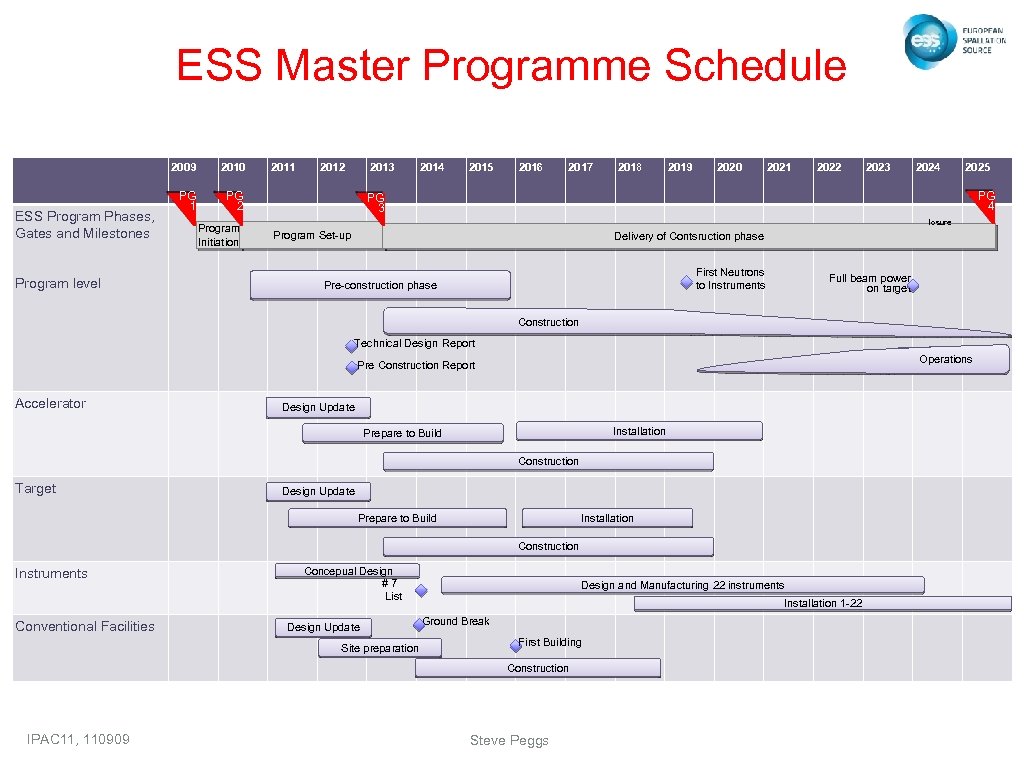 ESS Master Programme Schedule 2009 ESS Program Phases, Gates and Milestones Program level 2010 PG 1 PG 2 Program Initiation 2011 2012 2013 2014 2015 2016 2017 2018 2019 2020 2021 2022 2023 2024 2025 PG 4 PG 3 losure Program Set-up Delivery of Contsruction phase First Neutrons to Instruments Pre-construction phase Full beam power on target Construction Technical Design Report Operations Pre Construction Report Accelerator Design Update Installation Prepare to Build Construction Target Design Update Prepare to Build Installation Construction Instruments Conventional Facilities Concepual Design #7 List Design Update Site preparation Design and Manufacturing 22 instruments Installation 1 -22 Ground Break First Building Construction IPAC 11, 110909 Steve Peggs
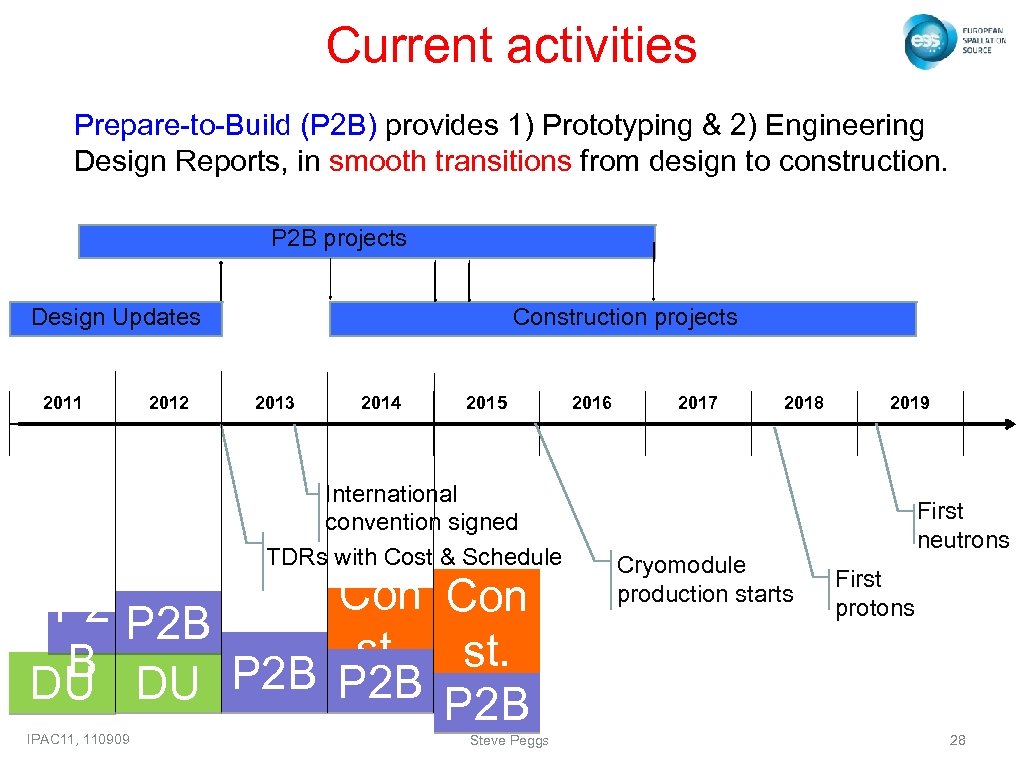 Current activities Prepare-to-Build (P 2 B) provides 1) Prototyping & 2) Engineering Design Reports, in smooth transitions from design to construction. P 2 B projects Design Updates 2011 2012 Construction projects 2013 2014 2015 International convention signed TDRs with Cost & Schedule Con P 2 B st. B DU P 2 B IPAC 11, 110909 Steve Peggs 2016 2017 2018 Cryomodule production starts 2019 First neutrons First protons 28
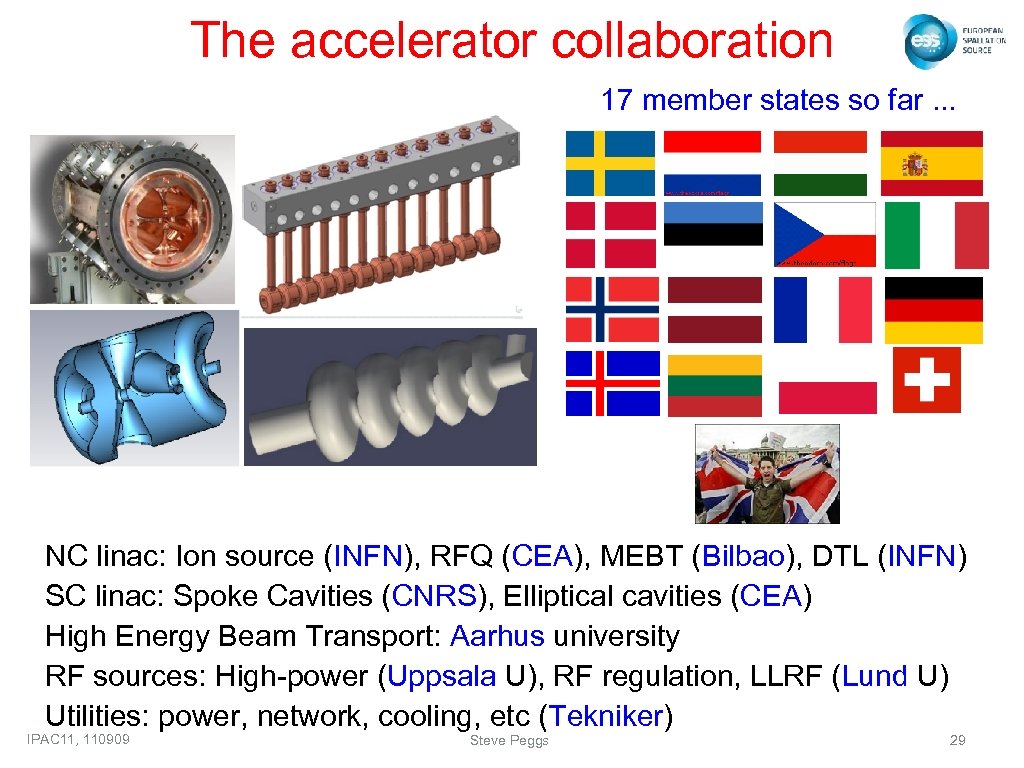 The accelerator collaboration 17 member states so far. . . NC linac: Ion source (INFN), RFQ (CEA), MEBT (Bilbao), DTL (INFN) SC linac: Spoke Cavities (CNRS), Elliptical cavities (CEA) High Energy Beam Transport: Aarhus university RF sources: High-power (Uppsala U), RF regulation, LLRF (Lund U) Utilities: power, network, cooling, etc (Tekniker) IPAC 11, 110909 Steve Peggs 29 6
 Test stand strategy 704 MHz test stand for SC elliptical cavities and a cryomodule Upgrades of CERN, CEA and Uppsala test stands - Uppsala: RF source, control & distribution (energy aspects) - ESS is contributing with a modulator to the CERN test-stand - IFMIF test stand extended at CEA Possible use of XFEL infrastructure & test stands at DESY & CEA during ESS construction 352 MHz test stand for SC spoke cavities and cryomodules One test stand at CEA One test stand under construction at IPNO in Paris Test area for Ion Source development exists in Catania IPAC 11, 110909 Steve Peggs 30
 Accelerator Division expansion Sept 2011 ➞ Dec 2012 Technical staff RF systems & power supplies Beam physics & magnets Beam instrumentation Cryogenics & vacuum Controls & scientific computing Administration & project support 22 ➞ 38 4➞ 9 5➞ 6 3➞ 7 3➞ 5 3➞ 6 4➞ 5 Recruitment is very much in progress! IPAC 11, 110909 Steve Peggs 31
 Summary 1. The European Spallation Source will be built in Lund. 2. The design will ensure a long life with many upgrades. 3. The accelerator design, prototyping & construction is being performed in a collaboration. 4. The energy aspects of the accelerator complex are very important. 5. We look forward to welcoming more collaborators to ESS ! Many thanks to all members of the emerging ESS accelerator collaboration, and to SNS ! IPAC 11, 110909 Steve Peggs 32