


 Скачать презентацию The European Patent Office How to file European
bfc8ff3e02ecced2640f29bfa52242b6.ppt
- Количество слайдов: 66
 The European Patent Office How to file European Applications The European Patent Grant Procedure Presentation held at ITI-CERTH on 10. 11. 2010 Presenter: Dr. Benno Penzkofer; Cluster Audio/Video/Media 3/19/2018
 Contents 1. The European Patent Office – – – About us What we do Quality Facts and figures Milestones 2. How to file European Applications – Formal requirements – EPO fees 3. The European Grant Procedure 4. The seven deadly sins of the inventor
 Contents § § § About us What we do Quality Facts and figures Milestones
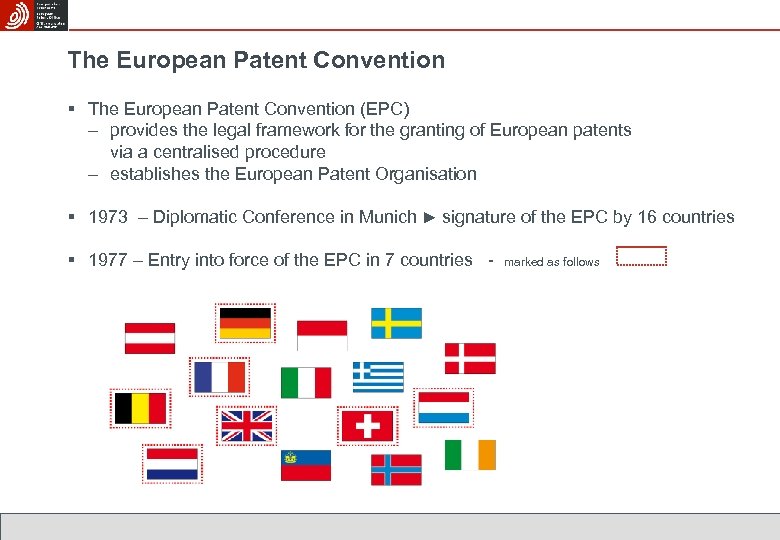 The European Patent Convention § The European Patent Convention (EPC) – provides the legal framework for the granting of European patents via a centralised procedure – establishes the European Patent Organisation § 1973 – Diplomatic Conference in Munich ► signature of the EPC by 16 countries § 1977 – Entry into force of the EPC in 7 countries - marked as follows
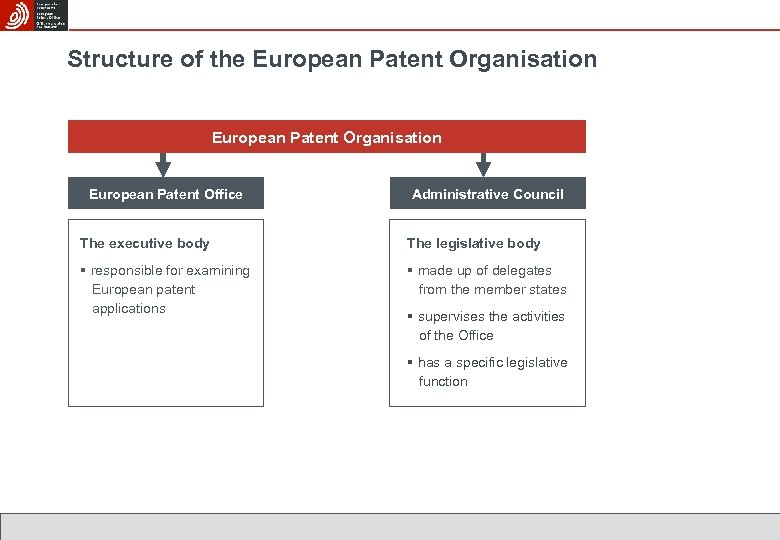 Structure of the European Patent Organisation European Patent Office Administrative Council The executive body The legislative body § responsible for examining European patent applications § made up of delegates from the member states § supervises the activities of the Office § has a specific legislative function
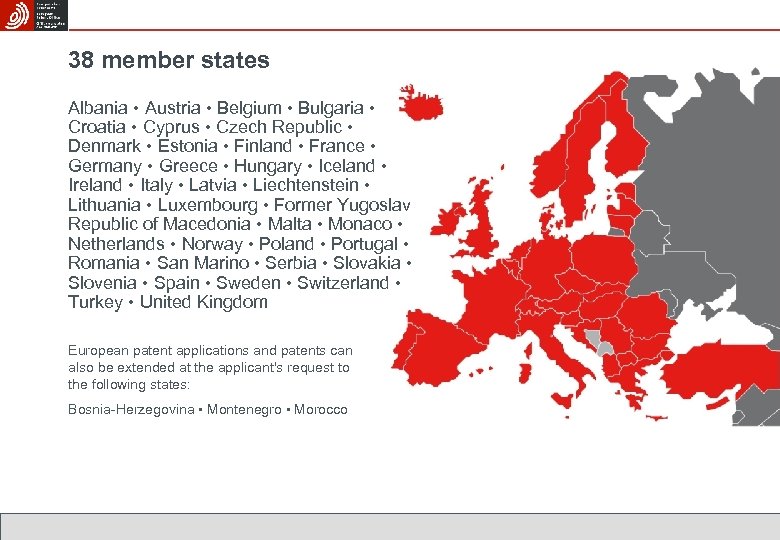 38 member states Albania • Austria • Belgium • Bulgaria • Croatia • Cyprus • Czech Republic • Denmark • Estonia • Finland • France • Germany • Greece • Hungary • Iceland • Ireland • Italy • Latvia • Liechtenstein • Lithuania • Luxembourg • Former Yugoslav Republic of Macedonia • Malta • Monaco • Netherlands • Norway • Poland • Portugal • Romania • San Marino • Serbia • Slovakia • Slovenia • Spain • Sweden • Switzerland • Turkey • United Kingdom European patent applications and patents can also be extended at the applicant's request to the following states: Bosnia-Herzegovina • Montenegro • Morocco
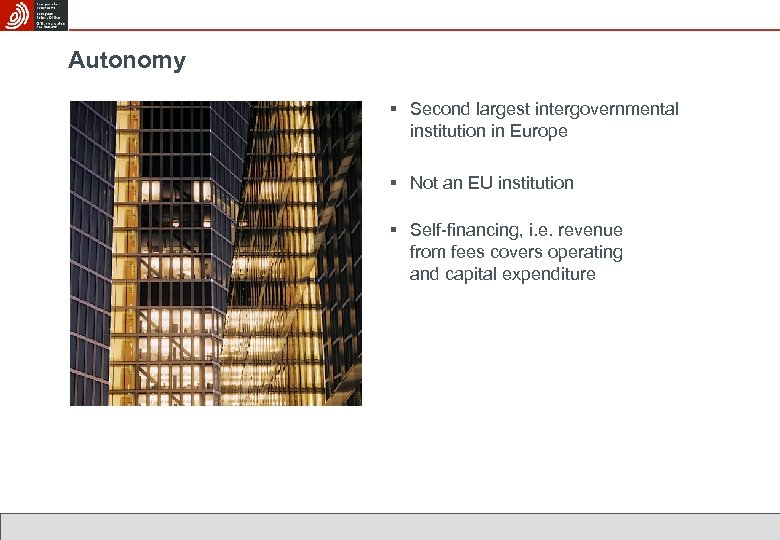 Autonomy § Second largest intergovernmental institution in Europe § Not an EU institution § Self-financing, i. e. revenue from fees covers operating and capital expenditure
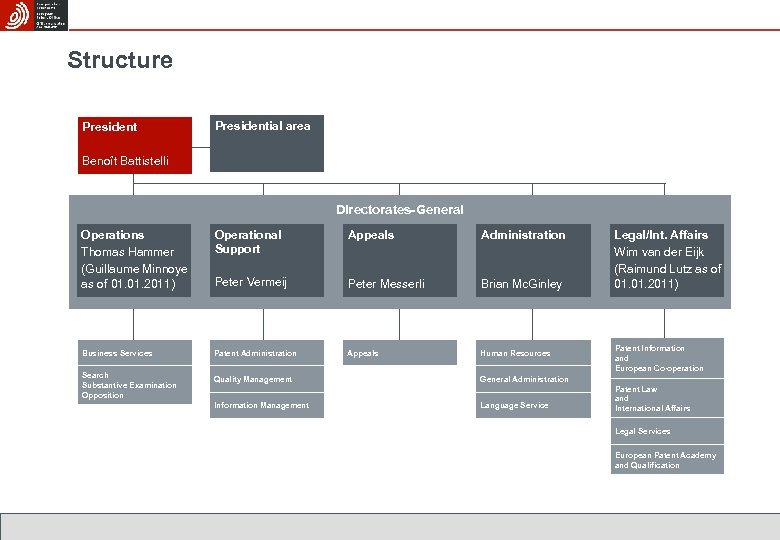 Structure Presidential area Benoît Battistelli Directorates-General Operations Thomas Hammer (Guillaume Minnoye as of 01. 2011) Operational Support Appeals Administration Peter Vermeij Peter Messerli Brian Mc. Ginley Business Services Patent Administration Appeals Human Resources Search Substantive Examination Opposition Quality Management Information Management Legal/Int. Affairs Wim van der Eijk (Raimund Lutz as of 01. 2011) Patent Information and European Co-operation General Administration Language Service Patent Law and International Affairs Legal Services European Patent Academy and Qualification
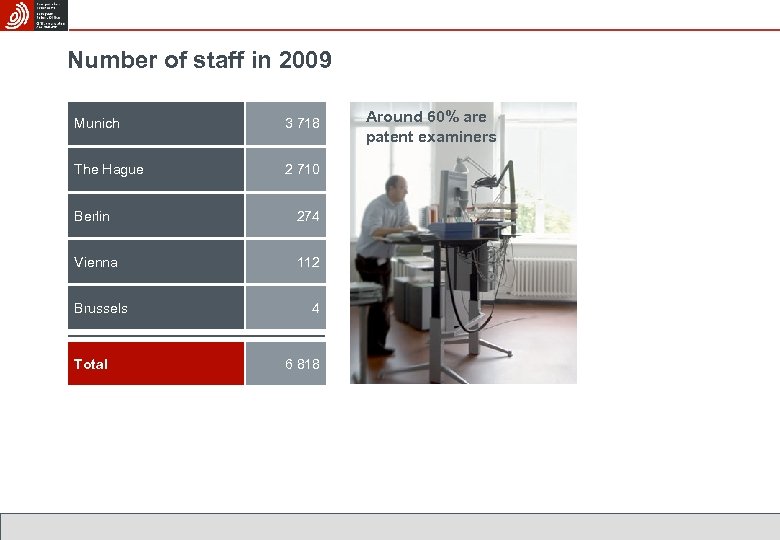 Number of staff in 2009 Munich 3 718 The Hague 2 710 Berlin 274 Vienna 112 Brussels Total 4 6 818 Around 60% are patent examiners
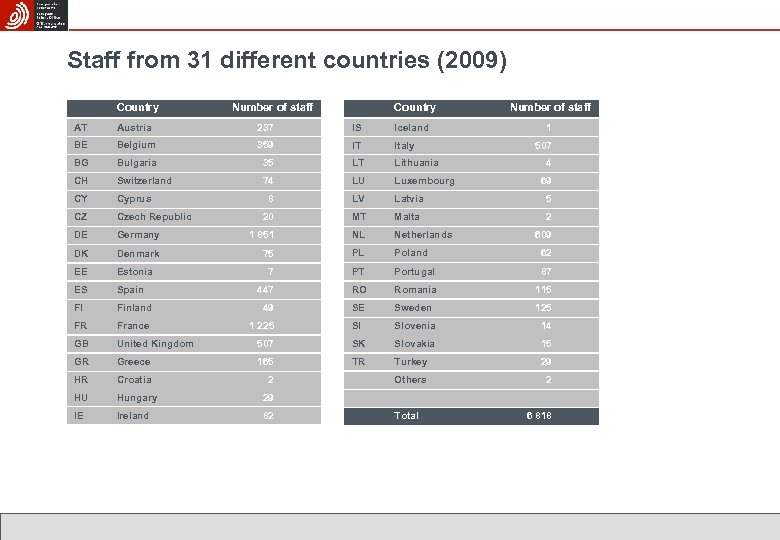 Staff from 31 different countries (2009) Country Number of staff AT Austria 237 IS Iceland BE Belgium 359 IT Italy BG Bulgaria 35 LT Lithuania CH Switzerland 74 LU Luxembourg CY Cyprus 8 LV Latvia 5 CZ Czech Republic 20 MT Malta 2 DE Germany 1 851 NL Netherlands DK Denmark 75 PL Poland 62 EE Estonia 7 PT Portugal 87 ES Spain 447 RO Romania 115 FI Finland 49 SE Sweden 125 FR France 1 225 SI Slovenia 14 GB United Kingdom 507 SK Slovakia 15 GR Greece 165 TR Turkey 29 HR Croatia 2 Others 2 HU Hungary 29 IE Ireland 82 Total 1 507 4 69 609 6 818
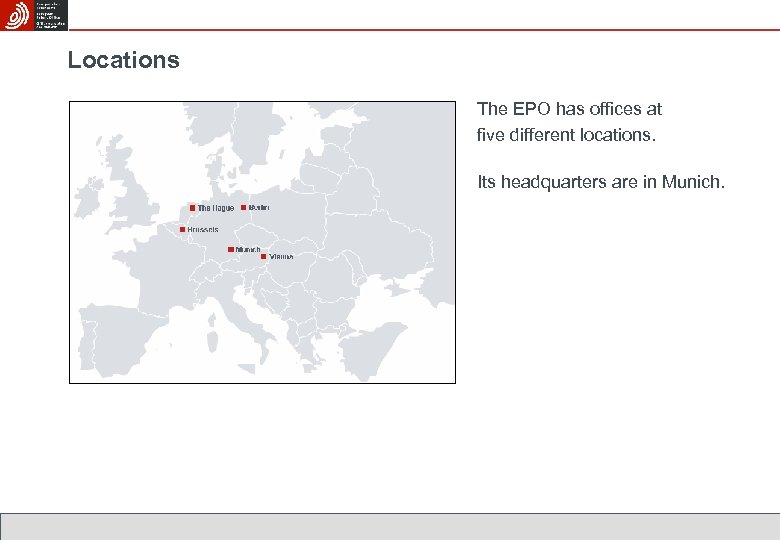 Locations The EPO has offices at five different locations. Its headquarters are in Munich.
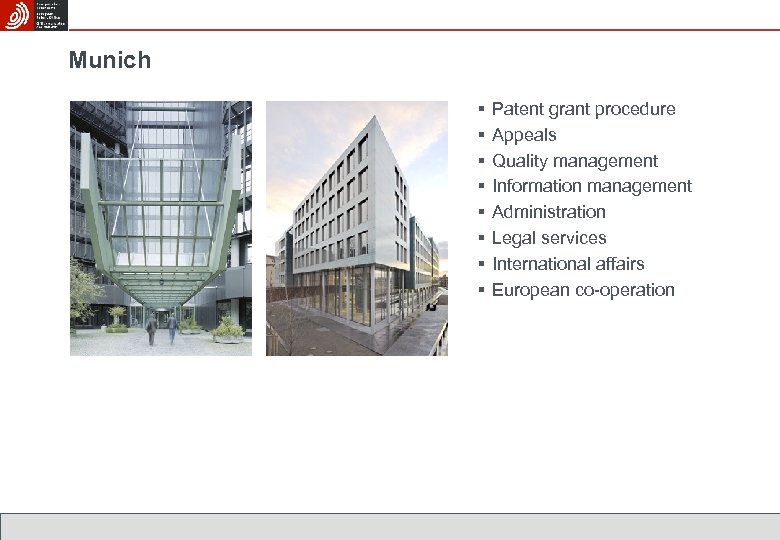 Munich § § § § Patent grant procedure Appeals Quality management Information management Administration Legal services International affairs European co-operation
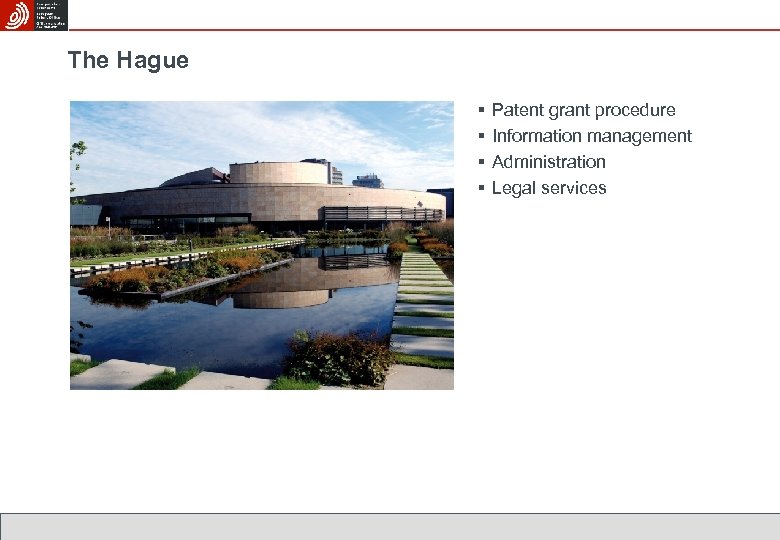 The Hague § § Patent grant procedure Information management Administration Legal services
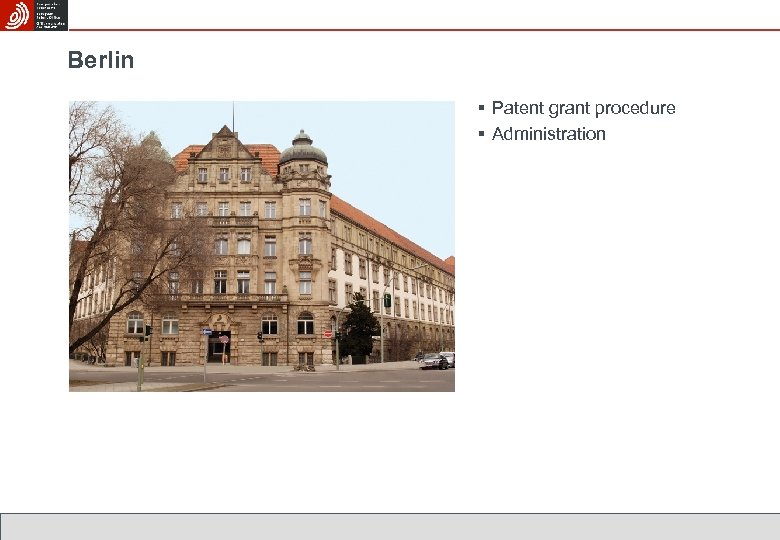 Berlin § Patent grant procedure § Administration
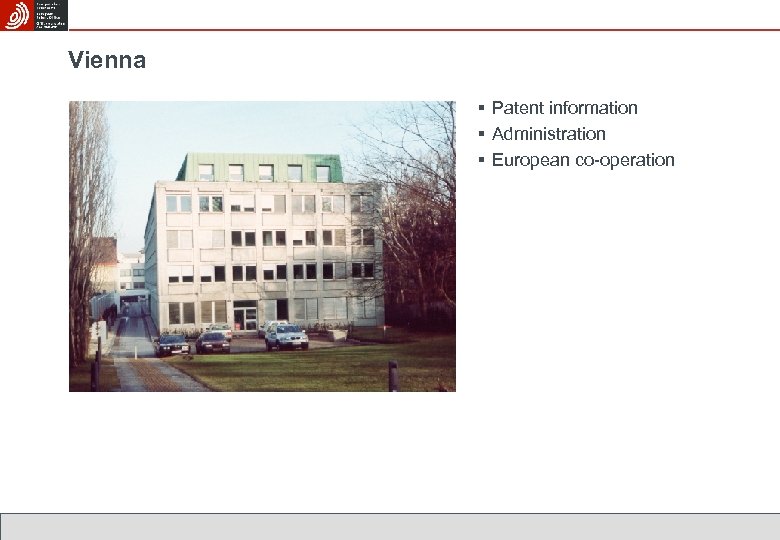 Vienna § Patent information § Administration § European co-operation
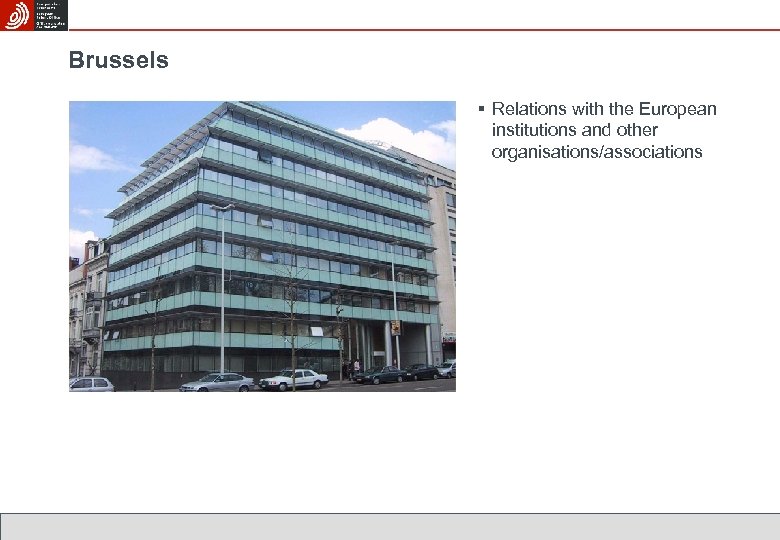 Brussels § Relations with the European institutions and other organisations/associations
 Contents § § § About us What we do Quality Facts and figures Milestones
 Our role in the European patent system § We provide patent protection in up to 40 European countries based on a single application in one of the three official languages (German, English, French) European patent applications can be filed: – direct with the EPO – via the national patent offices of the contracting states – based on an international (PCT) application § We are also responsible for – limitation and revocation proceedings by patentees – opposition proceedings by third parties – appeal proceedings before the Boards of Appeal
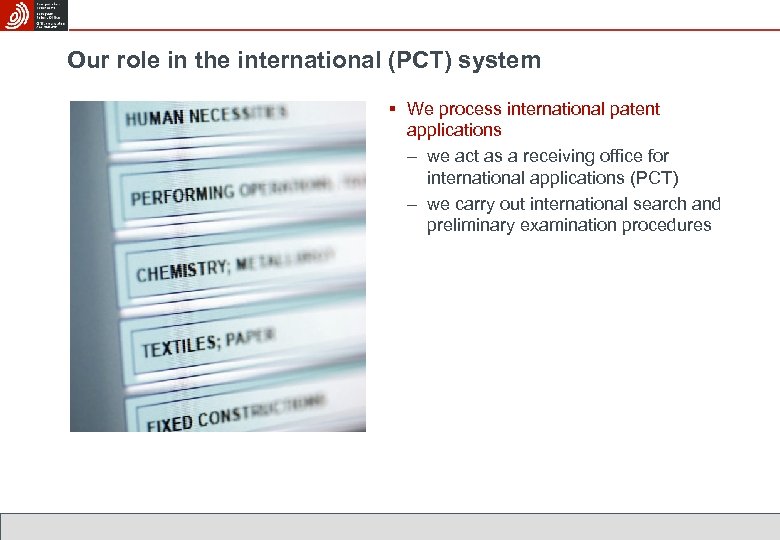 Our role in the international (PCT) system § We process international patent applications – we act as a receiving office for international applications (PCT) – we carry out international search and preliminary examination procedures
 Other services § Free online services – file inspection – tracking of legal status of applications § Free patent information services – online access to all European patent documents (updated weekly) – simple online searches in our database of over 70 million patent applications – helpdesk staffed by experts on the Japanese, Chinese and Korean patent systems § Training – conferences – workshops and seminars – e-learning
 Contents § § § About us What we do Quality Facts and figures Milestones
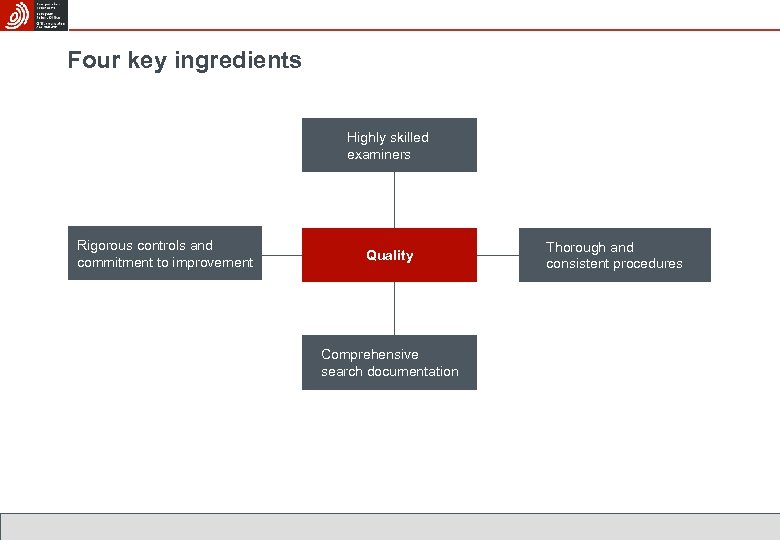 Four key ingredients Highly skilled examiners Rigorous controls and commitment to improvement Quality Comprehensive search documentation Thorough and consistent procedures
 Highly skilled examiners § Top-level engineers and scientists – high degree of technical expertise – knowledge of the EPO's three official languages § Training during first two years – extensive legal and procedural training – individual coaching by experienced examiners § Continuing professional development throughout career
 Thorough and consistent procedures § Single procedure – the European Patent Convention provides the legal framework for the granting of European patents § Systematic approach – each application is examined by a division of three technically qualified examiners § Review processes – each opposition is examined by three technically qualified examiners, at least two of whom will not have been involved in the grant proceedings for the patent – appeals heard by independent second-instance judiciary (Boards of Appeal)
 Comprehensive search documentation § World's largest collection of patent and non-patent literature documents, containing more than 540 million records in over 120 databases and updated daily § Online access to more than 6 000 journals via the EPO Virtual Library § New tools and services such as machine translation to extend the range of easily accessible information § Ongoing efforts to improve the scope and quality of our documentation
 Rigorous controls and commitment to improvement § Up-to-date guidelines and instructions for examiners § Spot-checks on search reports and patent quality § Internal quality audits
 Contents § § § About us What we do Quality Facts and figures Milestones
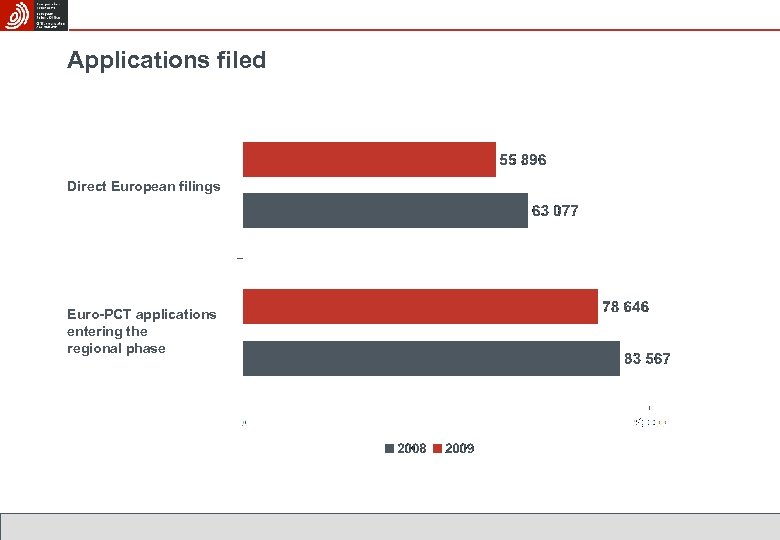 Applications filed Direct European filings Euro-PCT applications entering the regional phase
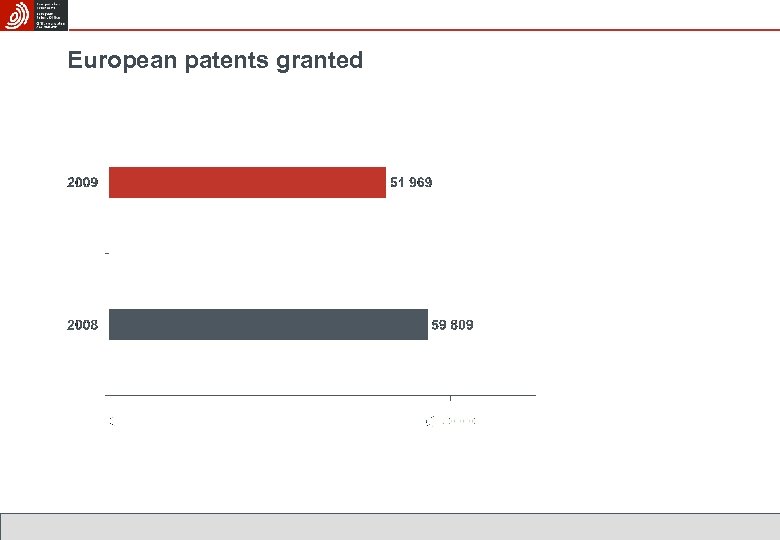 European patents granted
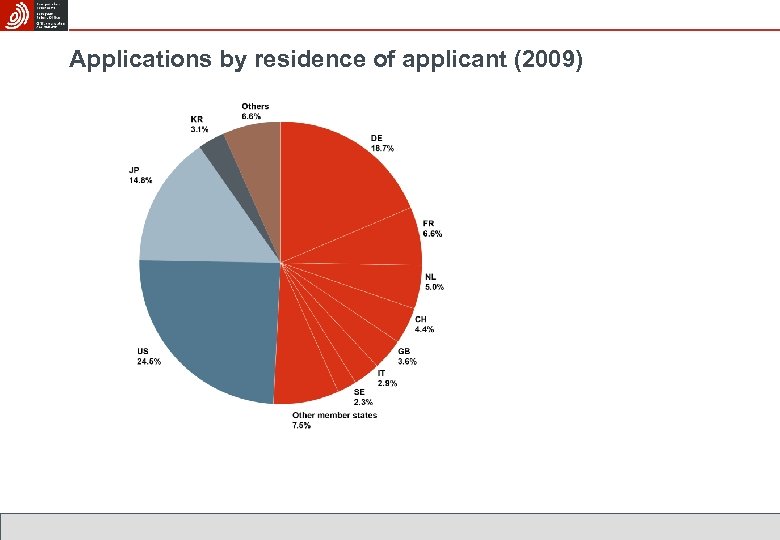 Applications by residence of applicant (2009)
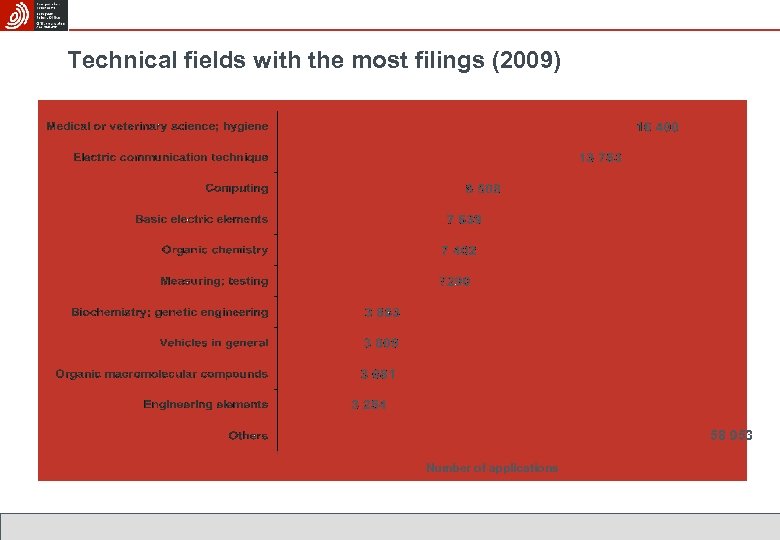 Technical fields with the most filings (2009) 58 953 Number of applications
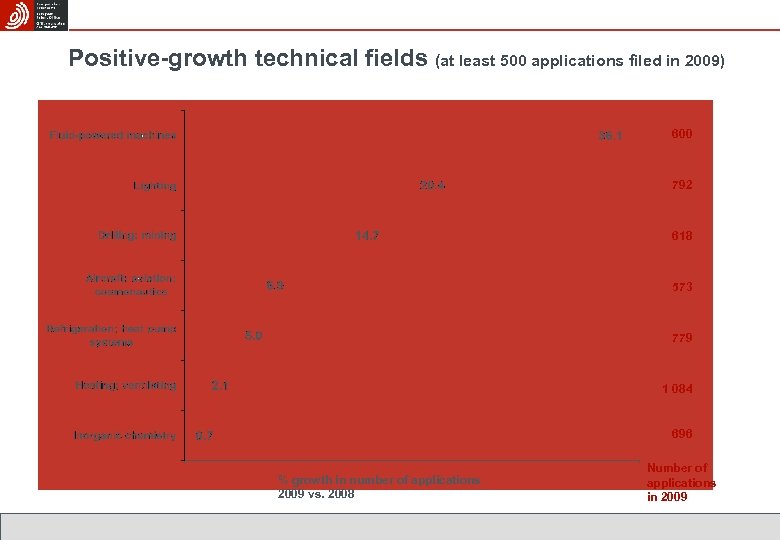 Positive-growth technical fields (at least 500 applications filed in 2009) 600 792 618 573 779 1 084 696 % growth in number of applications 2009 vs. 2008 Number of applications in 2009
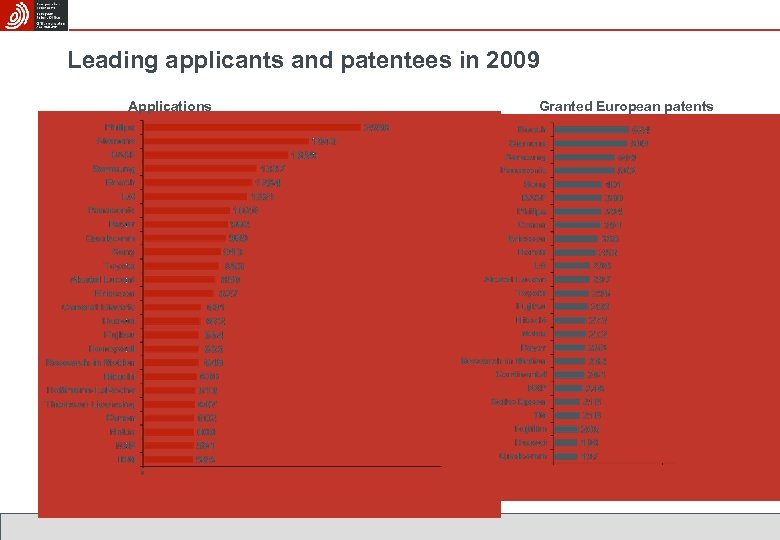 Leading applicants and patentees in 2009 Applications Granted European patents
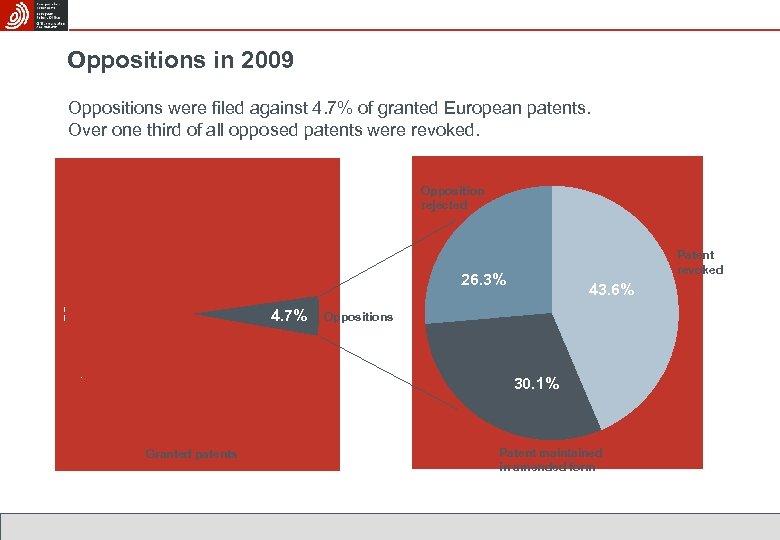 Oppositions in 2009 Oppositions were filed against 4. 7% of granted European patents. Over one third of all opposed patents were revoked. Opposition rejected Patent revoked 26. 3% 4. 7% 43. 6% Oppositions 30. 1% Granted patents Patent maintained in amended form
 Contents § § § About us What we do Quality Facts and figures Milestones
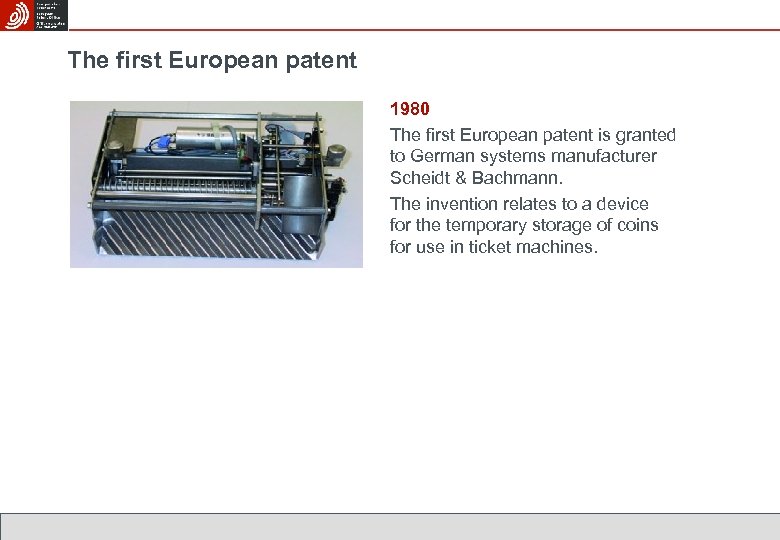 The first European patent 1980 The first European patent is granted to German systems manufacturer Scheidt & Bachmann. The invention relates to a device for the temporary storage of coins for use in ticket machines.
 Trilateral co-operation 1983 The EPO and the Japanese and US patent offices set up a programme of trilateral co-operation which so far has included technical standards, new databases, document exchange and electronic filing. Today, these three offices receive 85% of all applications filed worldwide.
 Co-operation with the Chinese Patent Office 1985 This year sees the start of the EPO's co-operation with the Chinese Patent Office. The EPO helps China to establish a modern and effective patent system. This includes the provision of a search system, the training of examiners and the exchange of databases. Today the Chinese office is the third largest in the world.
 Patent law versus bioethics 1992 The conflict between patent law and bioethics hits the headlines with the grant by the EPO of the first ever patent on a mammal (EP 169672). Implanted with a human cancer gene, the so-called oncomouse has an increased disposition for developing tumours.
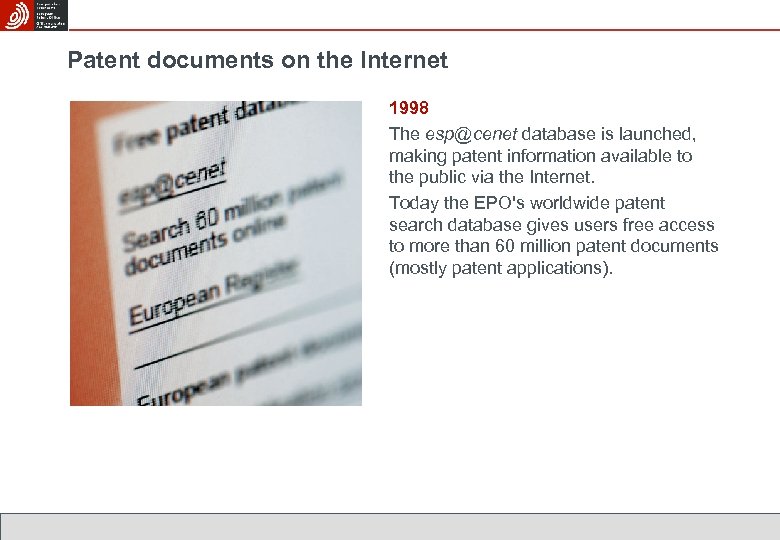 Patent documents on the Internet 1998 The esp@cenet database is launched, making patent information available to the public via the Internet. Today the EPO's worldwide patent search database gives users free access to more than 60 million patent documents (mostly patent applications).
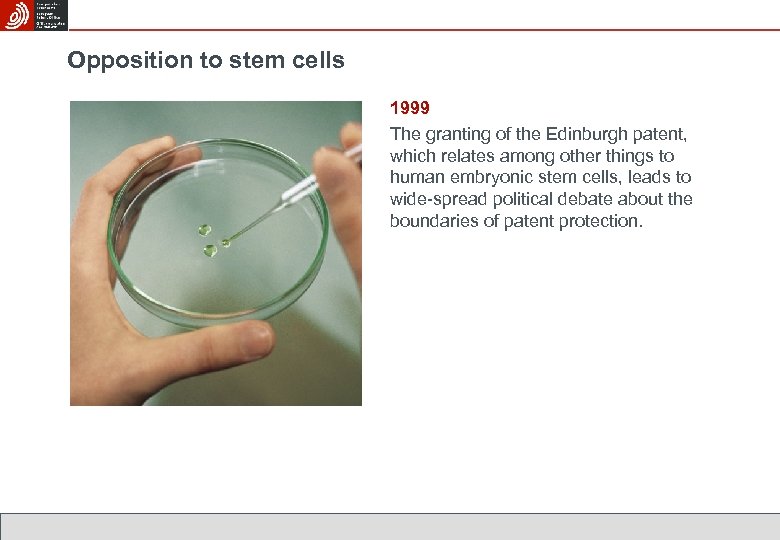 Opposition to stem cells 1999 The granting of the Edinburgh patent, which relates among other things to human embryonic stem cells, leads to wide-spread political debate about the boundaries of patent protection.
 Online filing 2000 Thanks to the EPO's electronic epoline service, applicants are able for the first time to file patent applications via the Internet. Online fee payment and file inspection follow.
 Contents 2. How to file European Applications
 Introduction Formal requirements for European patent applications I. Entitlement to file a European patent application II. States for which a European patent application may be filed III. Languages of European patent applications IV. Language arrangements to assist applicants from certain states V. Items making up a European patent application VI. Request for grant VII. Designation of inventor VIII. Claiming priority IX. Representation
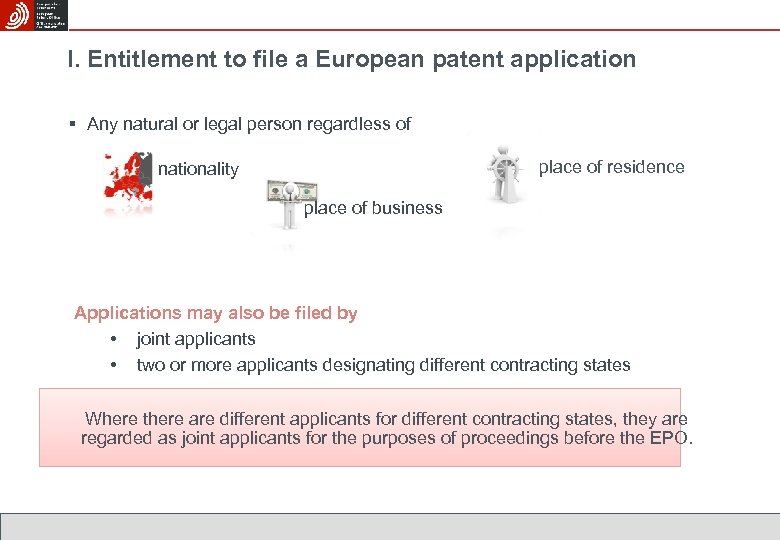 I. Entitlement to file a European patent application § Any natural or legal person regardless of place of residence nationality place of business Applications may also be filed by • joint applicants • two or more applicants designating different contracting states Where there are different applicants for different contracting states, they are regarded as joint applicants for the purposes of proceedings before the EPO.
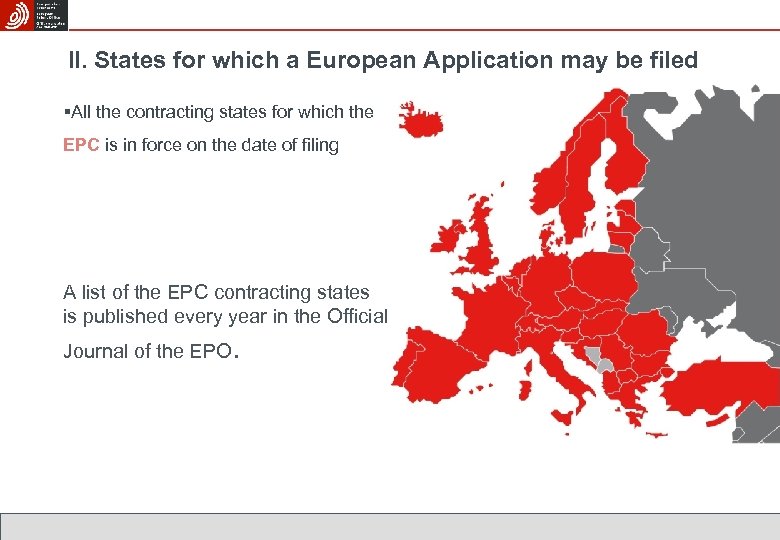 II. States for which a European Application may be filed §All the contracting states for which the EPC is in force on the date of filing A list of the EPC contracting states is published every year in the Official Journal of the EPO .
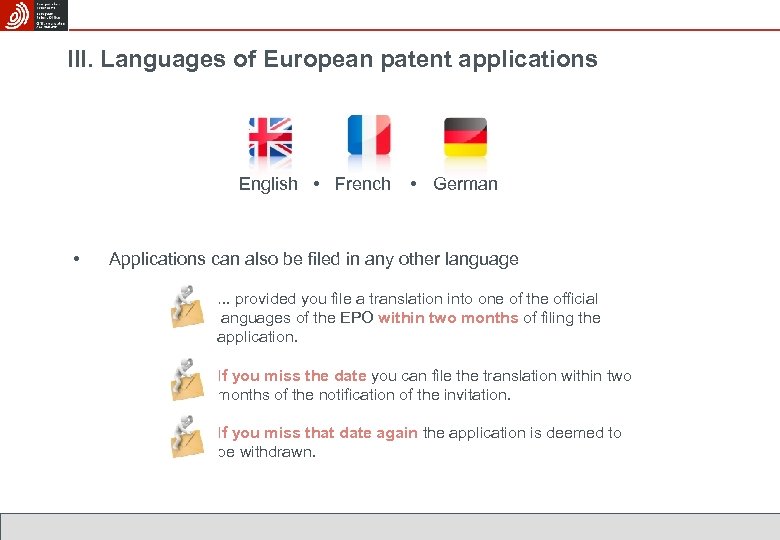 III. Languages of European patent applications English French • German Applications can also be filed in any other language • . . . provided you file a translation into one of the official languages of the EPO within two months of filing the application. If you miss the date you can file the translation within two months of the notification of the invitation. If you miss that date again the application is deemed to be withdrawn.
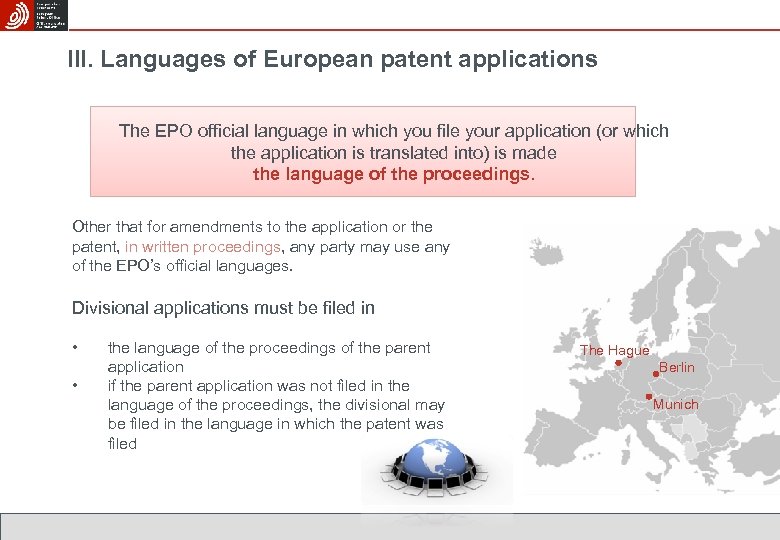 III. Languages of European patent applications The EPO official language in which you file your application (or which the application is translated into) is made the language of the proceedings. Other that for amendments to the application or the patent, in written proceedings, any party may use any of the EPO’s official languages. Divisional applications must be filed in • • the language of the proceedings of the parent application if the parent application was not filed in the language of the proceedings, the divisional may be filed in the language in which the patent was filed The Hague Berlin Munich
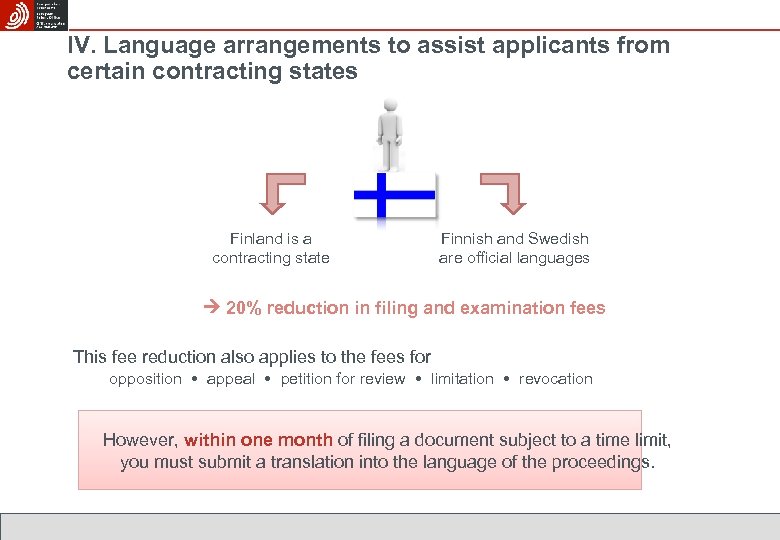 IV. Language arrangements to assist applicants from certain contracting states Finland is a contracting state Finnish and Swedish are official languages 20% reduction in filing and examination fees This fee reduction also applies to the fees for opposition appeal petition for review limitation revocation However, within one month of filing a document subject to a time limit, you must submit a translation into the language of the proceedings.
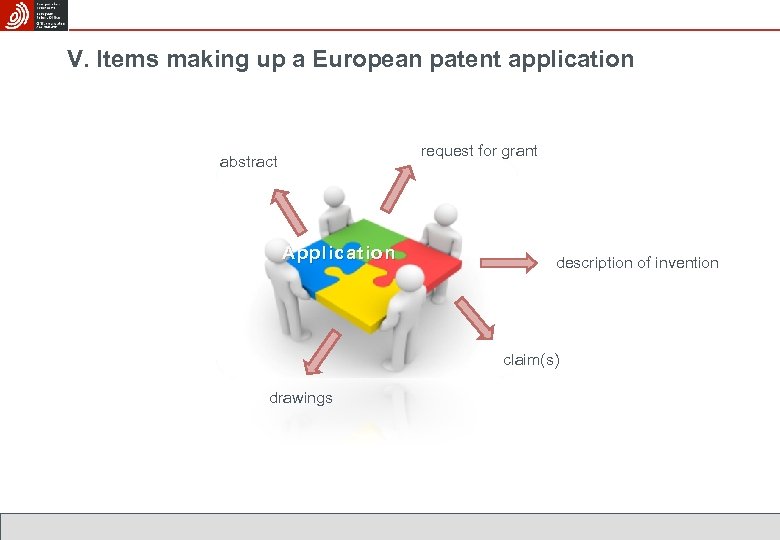 V. Items making up a European patent application request for grant abstract Application description of invention claim(s) drawings
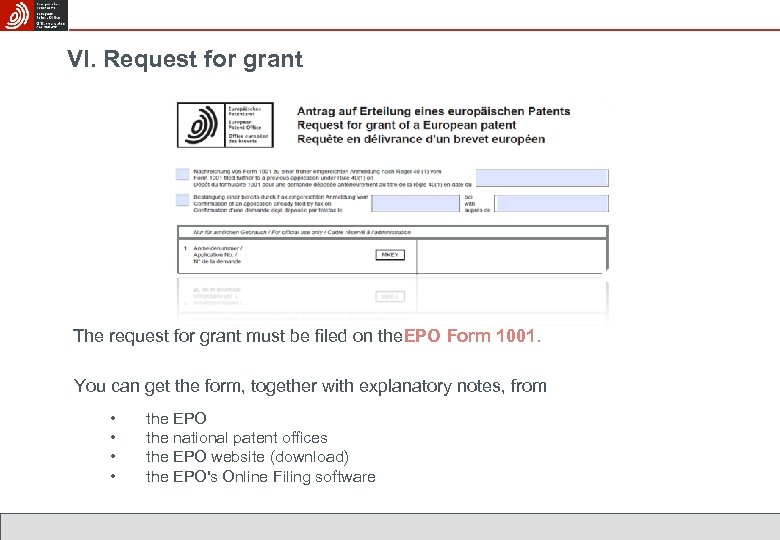 VI. Request for grant The request for grant must be filed on the. EPO Form 1001. You can get the form, together with explanatory notes, from • • the EPO the national patent offices the EPO website (download) the EPO's Online Filing software
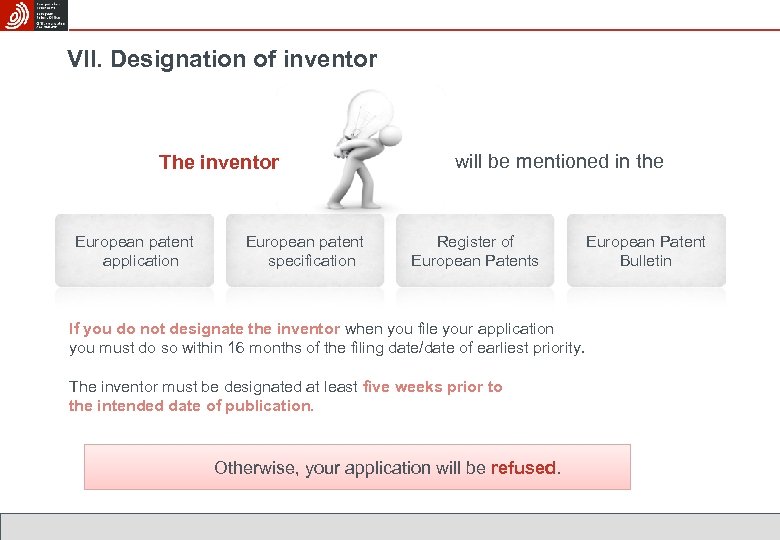 VII. Designation of inventor The inventor European patent application European patent specification will be mentioned in the Register of European Patents If you do not designate the inventor when you file your application you must do so within 16 months of the filing date/date of earliest priority. The inventor must be designated at least five weeks prior to the intended date of publication. Otherwise, your application will be refused. European Patent Bulletin
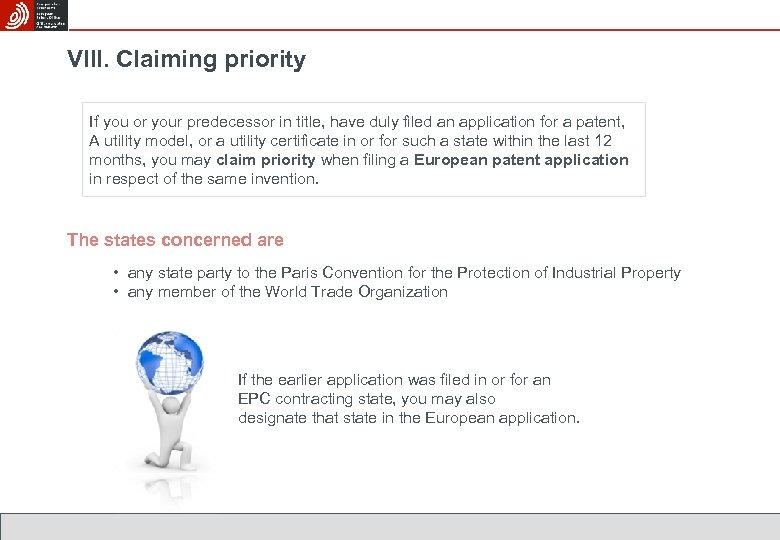 VIII. Claiming priority If you or your predecessor in title, have duly filed an application for a patent, A utility model, or a utility certificate in or for such a state within the last 12 months, you may claim priority when filing a European patent application in respect of the same invention. The states concerned are • any state party to the Paris Convention for the Protection of Industrial Property • any member of the World Trade Organization If the earlier application was filed in or for an EPC contracting state, you may also designate that state in the European application.
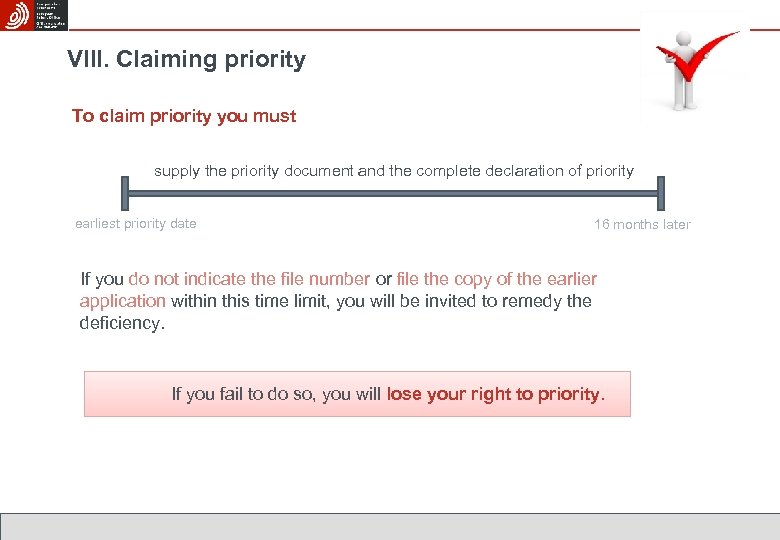 VIII. Claiming priority To claim priority you must supply the priority document and the complete declaration of priority earliest priority date 16 months later If you do not indicate the file number or file the copy of the earlier application within this time limit, you will be invited to remedy the deficiency. If you fail to do so, you will lose your right to priority.
 IX. Representation There are no geographical restrictions to prevent you filing a European patent application You need a representative and must act through him if you have neither • a residence nor • your principal place of business in one of the contracting states.
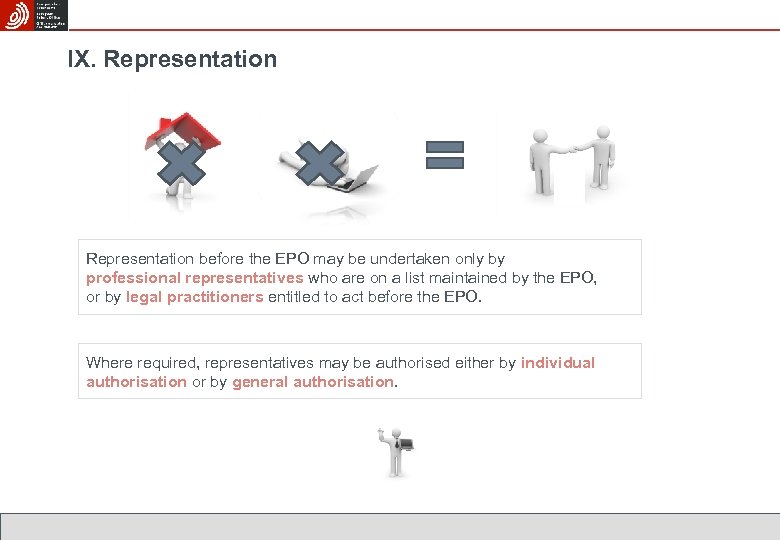 IX. Representation before the EPO may be undertaken only by professional representatives who are on a list maintained by the EPO, or by legal practitioners entitled to act before the EPO. Where required, representatives may be authorised either by individual authorisation or by general authorisation.
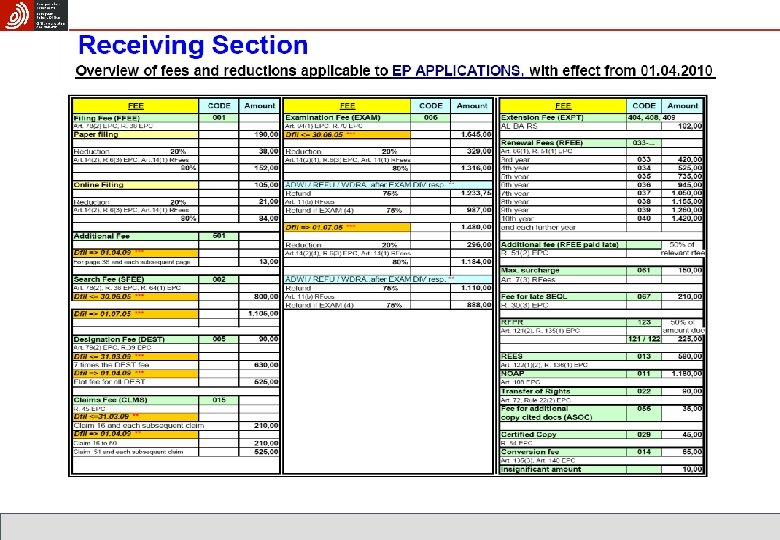
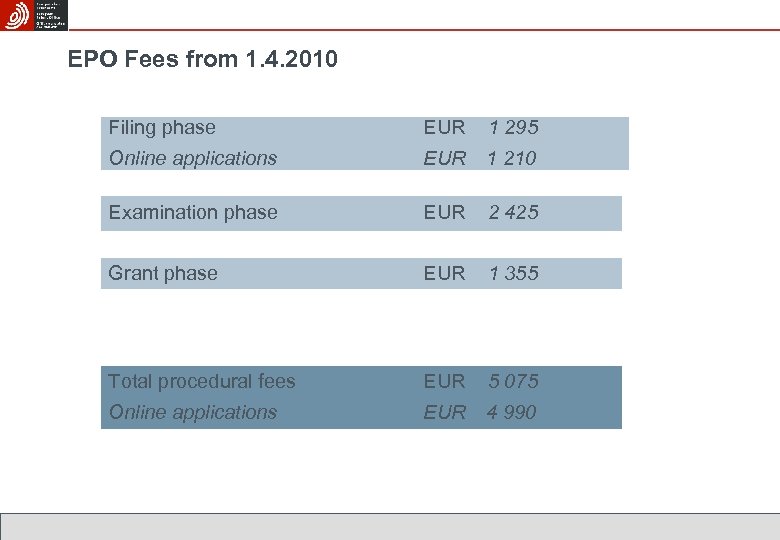 EPO Fees from 1. 4. 2010 Filing phase EUR 1 295 Online applications EUR 1 210 Examination phase EUR 2 425 Grant phase EUR 1 355 Total procedural fees EUR 5 075 Online applications EUR 4 990
 Contents 3. The European Grant Procedure
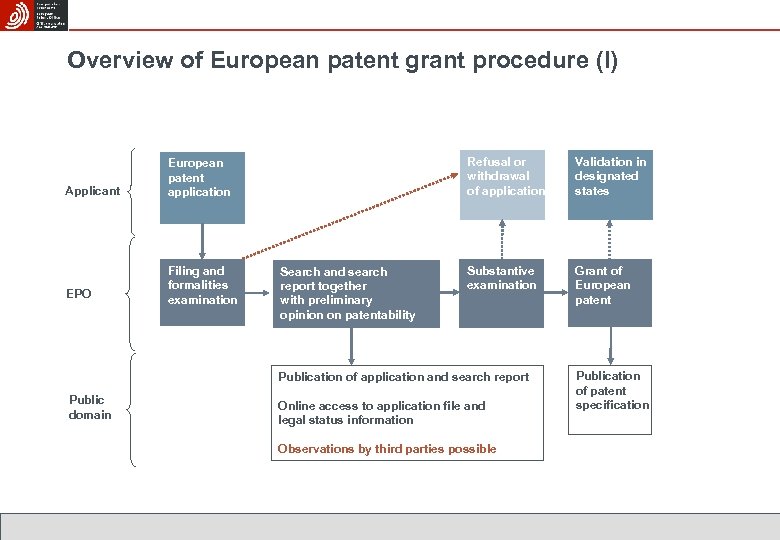 Overview of European patent grant procedure (I) Applicant EPO Refusal or withdrawal of application European patent application Filing and formalities examination Search and search report together with preliminary opinion on patentability Validation in designated states Substantive examination Grant of European patent Publication of application and search report Public domain Online access to application file and legal status information Observations by third parties possible Publication of patent specification
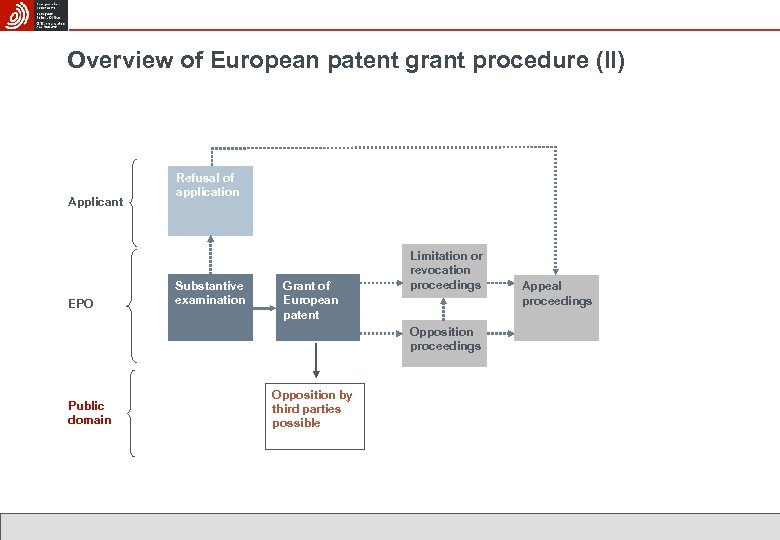 Overview of European patent grant procedure (II) Applicant EPO Refusal of application Substantive examination Grant of European patent Limitation or revocation proceedings Opposition proceedings Public domain Opposition by third parties possible Appeal proceedings
 Contents 4. The seven deadly sins
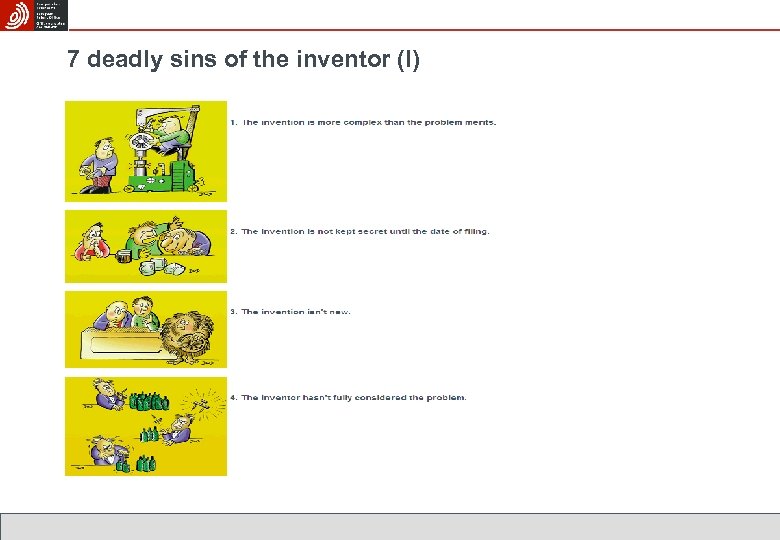 7 deadly sins of the inventor (I)
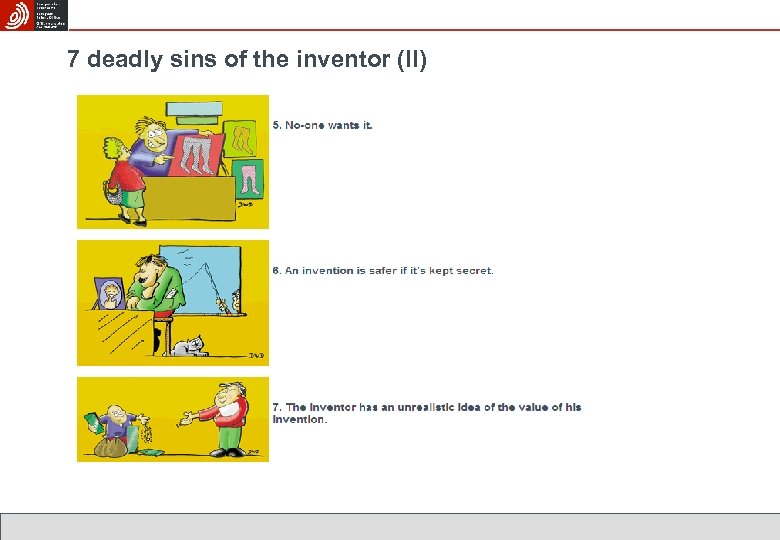 7 deadly sins of the inventor (II)
 Need more information? www. epo. org info@epo. org Tel. + 49 (0)89 2399 - 4636
 Thank you for your attention !