 Скачать презентацию The European Neighbourhood Policy ENP and the ENPI
20ad1874fb9dfeaa32090266a38f5994.ppt
- Количество слайдов: 26



The European Neighbourhood Policy (ENP) and the ENPI financial instrument Jakub Urbanik DG External Relations European Commission
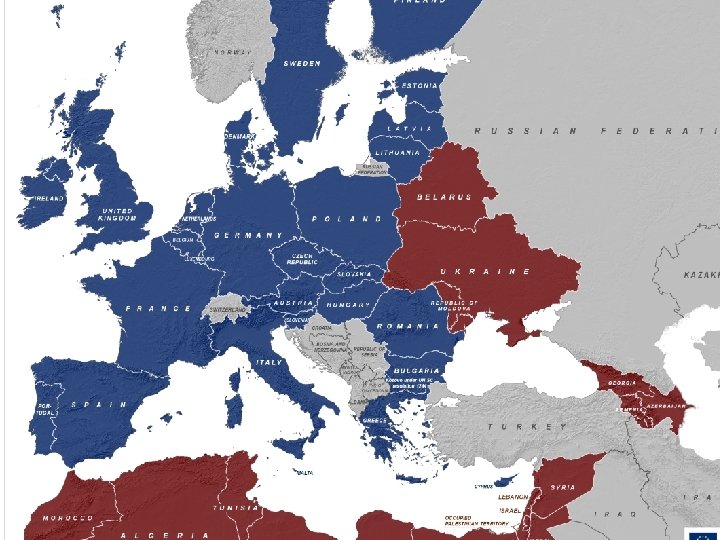
Different neighbours of the EU, different relations § EFTA/EEA: Liechtenstein, Norway, Switzerland – multi- and bilateral accords § Candidate Countries: Croatia, Turkey, former Yugoslav Republic of Macedonia + “Potential candidates”: Iceland, Albania, Bosnia and Herzegovina, Montenegro, Serbia and Kosovo § Russian Federation - Strategic Partnership Ø European Neighbourhood Policy (ENP): an EU offer of privileged partnership to 16 partners
What is the ENP? § Key EU “foreign” policy priority § Privileged relationship, building upon a mutual commitment to common values § … supporting partners’ own reform processes (political, economic, social, etc. ) by working together (joint ownership) § Based on EU model/some similarities to the ELARG approach, but the reforms are not imposed nor obligatory Ø Strategic goal: mutual prosperity, stability and security around EU
Our ENP partners The category of immediate neighbours of the EU to the South and to the East… § Armenia, Azerbaijan, Egypt, Georgia, Israel, Jordan, Lebanon, Moldova, Morocco, the Palestinian Authority, Tunisia and Ukraine with a legal base (PCA/AA) and an ENP Action Plan agreed § Algeria (Association Agreement in force since 2005) § Libya (negotiations started on a basic agreement in November 2008) § Belarus, Syria (no agreements in force yet)
How does it work? § Building upon and strengthening existing relations § Principle of differentiation: progress is rewarded § Using relevant EU experience in how to support transition and reforms § Gradual approximation with the acquis communautaire in selected relevant areas § ENP Action Plans: Country-specific, tailor-made political documents § Jointly defined reform agenda § Short & medium-term priorities (3 -5 years horizon)
ENP Action Plans with the 12 partners Ø Similar chapters in all Action Plans but content specific to each partner: § Political dialogue and reform § Sound macro-economic management, economic and social cooperation and development § Trade related issues, market and regulatory reform § Co-operation on Justice, Freedom and Security § Sector policies: Transport, energy, information society, environment, research and development § Human dimension: People-to-people contacts, civil society, education, public health Ø Future model under review
Progress Reports Yearly exercise assessing progress in key reform areas per country Despite difficult context ENP is working: § Political cooperation was strengthened § Economic integration and trade exchanges § § boosted Visa facilitation and fight against illegal migration Cooperation on justice and fight against corruption has increased Transport links and energy cooperation are strengthened Internal reforms strengthened Deficiencies however exist in e. g. good governance, democratisation, human rights issues work in progress
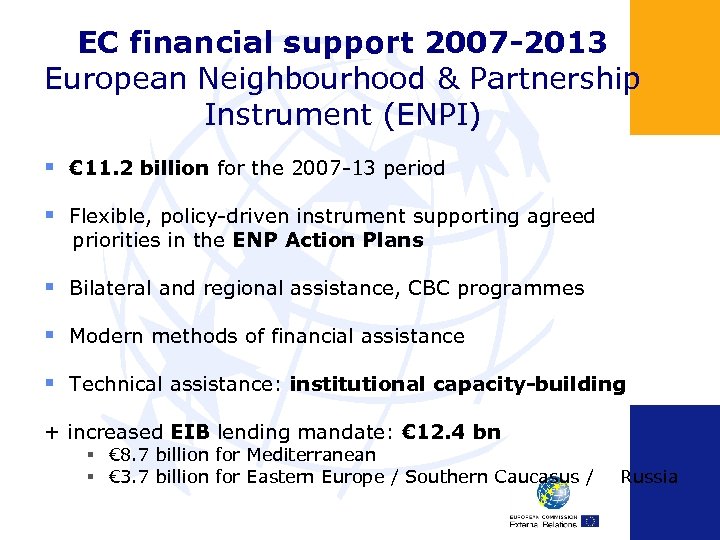
EC financial support 2007 -2013 European Neighbourhood & Partnership Instrument (ENPI) § € 11. 2 billion for the 2007 -13 period § Flexible, policy-driven instrument supporting agreed priorities in the ENP Action Plans § Bilateral and regional assistance, CBC programmes § Modern methods of financial assistance § Technical assistance: institutional capacity-building + increased EIB lending mandate: € 12. 4 bn § € 8. 7 billion for Mediterranean § € 3. 7 billion for Eastern Europe / Southern Caucasus / Russia
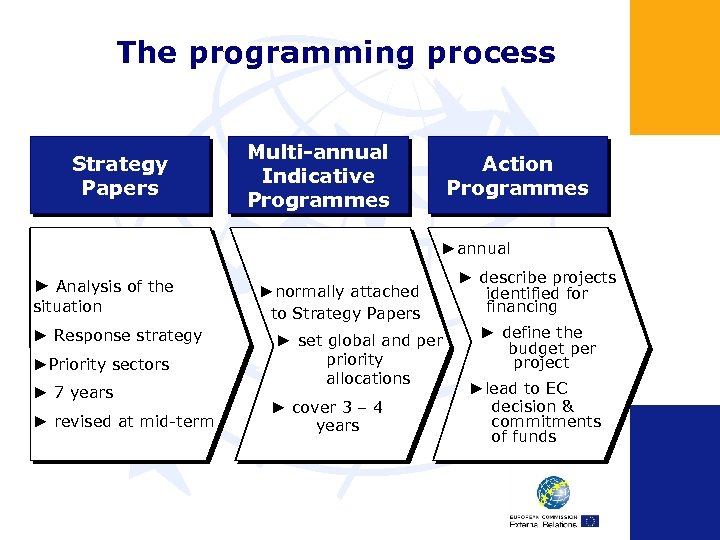
The programming process Strategy Papers Multi-annual Indicative Programmes Action Programmes ►annual ► Analysis of the situation ► Response strategy ►Priority sectors ► 7 years ► revised at mid-term ►normally attached to Strategy Papers ► set global and per priority allocations ► cover 3 – 4 years ► describe projects identified for financing ► define the budget per project ►lead to EC decision & commitments of funds
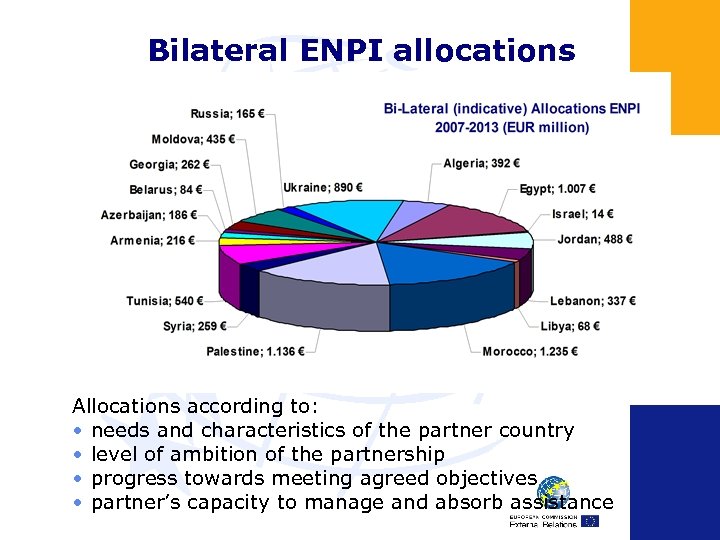
Bilateral ENPI allocations Allocations according to: • needs and characteristics of the partner country • level of ambition of the partnership • progress towards meeting agreed objectives • partner’s capacity to manage and absorb assistance
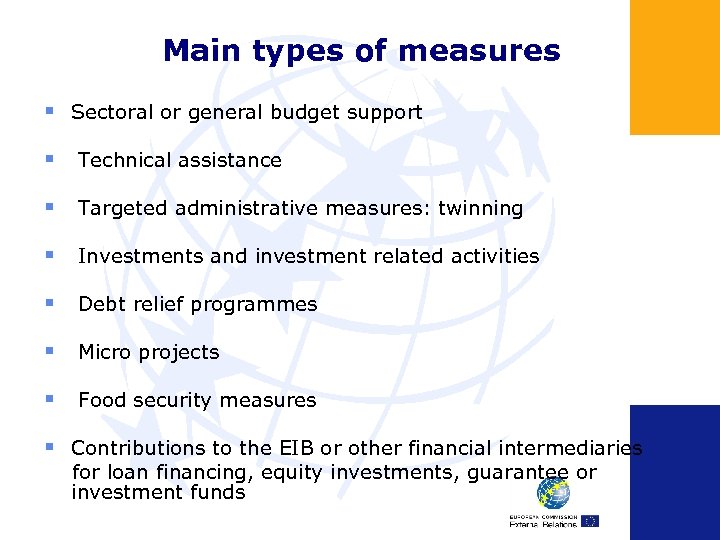
Main types of measures § Sectoral or general budget support § Technical assistance § Targeted administrative measures: twinning § Investments and investment related activities § Debt relief programmes § Micro projects § Food security measures § Contributions to the EIB or other financial intermediaries for loan financing, equity investments, guarantee or investment funds
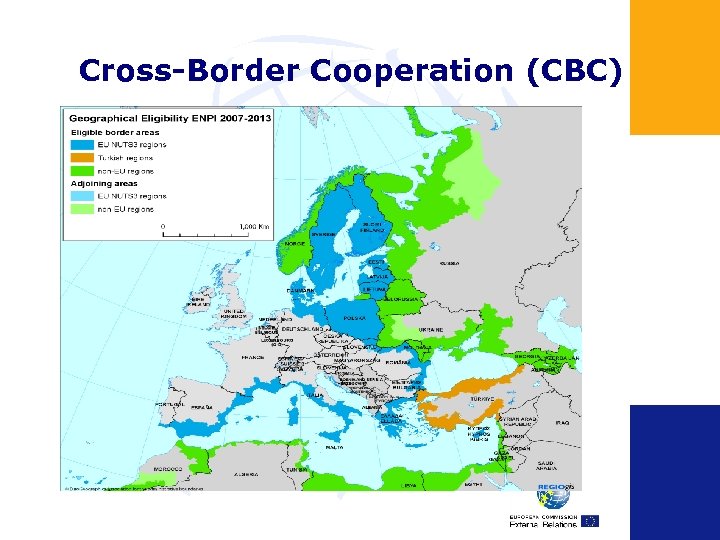
Cross-Border Cooperation (CBC)
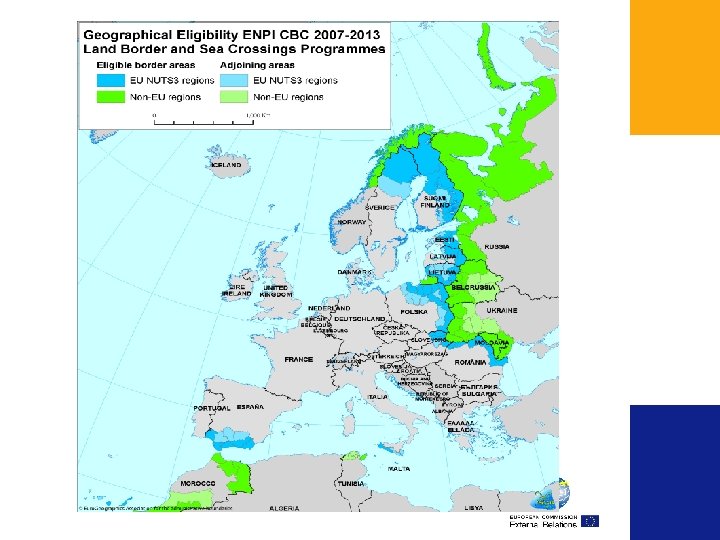
The evolution of ENPI CBC at the external borders of the EU § CBC is a priority of the new Instrument for § § the Neighbourhood countries (ENPI) It is based on previous experiences under INTERREG, Tacis, Meda, Phare and the Neighbourhood Programmes 2004 -2006 Innovations of ENPI CBC from 2007: sevenyear programming period, single budget, common legal framework and implementation rules on both sides of the border (Member State/ partner country)
What is ENPI Cross Border Cooperation? § The aim of the ENPI CBC programmes is to § § support cross border co-operation projects between the Member States and the partner countries along the external borders of the European Union. 15 ENPI CBC programmes listed in the ENPI CBC Strategy Paper Over 1. 1 billion € financial allocation for the period 2007 – 2013, coming from the ENPI and the ERDF
CBC overall objectives set out in the Strategy Paper § Promoting economic and social development of the § § § border regions Addressing their common challenges (environment, heath, crime) Ensuring efficient and secure borders Promoting direct people to people co-operation These objectives should be addressed in each programme as prepared by its stakeholders
Who are the beneficiaries? Governmental bodies Ø Partner countries, their regions and their institutions Ø Decentralized bodies in the partner countries ØLocal authorities and administrations ØJoint bodies of partner countries and the Community ØPublic or semipublic bodies Non-state actors ØNGOs ØTrade associations ØWomen and youth organizations ØCross-border associations ØCultural, research and scientific organizations ØOrganizations representing economic and social interests
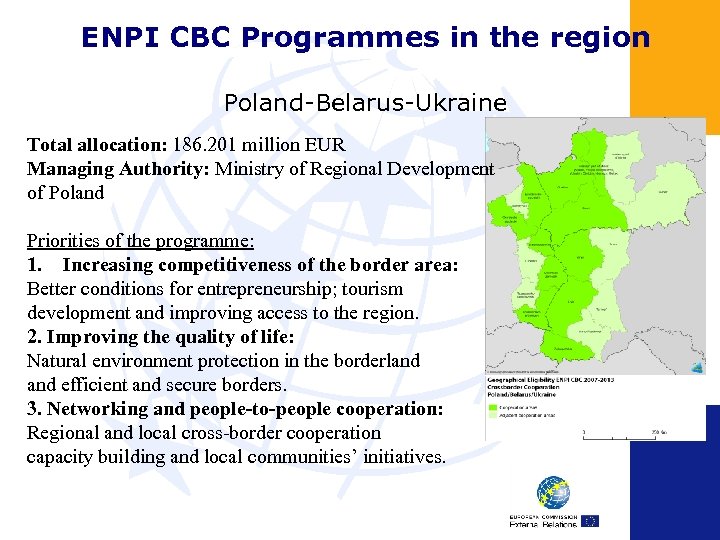
ENPI CBC Programmes in the region Poland-Belarus-Ukraine Total allocation: 186. 201 million EUR Managing Authority: Ministry of Regional Development of Poland Priorities of the programme: 1. Increasing competitiveness of the border area: Better conditions for entrepreneurship; tourism development and improving access to the region. 2. Improving the quality of life: Natural environment protection in the borderland efficient and secure borders. 3. Networking and people-to-people cooperation: Regional and local cross-border cooperation capacity building and local communities’ initiatives.
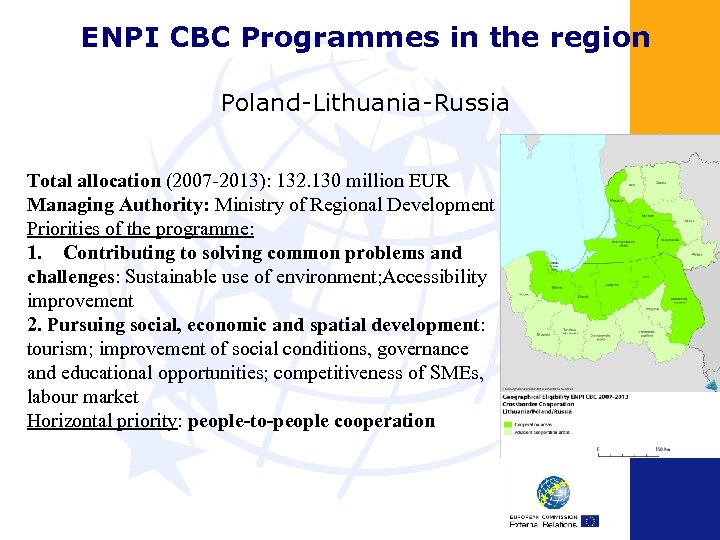
ENPI CBC Programmes in the region Poland-Lithuania-Russia Total allocation (2007 -2013): 132. 130 million EUR Managing Authority: Ministry of Regional Development Priorities of the programme: 1. Contributing to solving common problems and challenges: Sustainable use of environment; Accessibility improvement 2. Pursuing social, economic and spatial development: tourism; improvement of social conditions, governance and educational opportunities; competitiveness of SMEs, labour market Horizontal priority: people-to-people cooperation
Leveraging more funding § Neighbourhood Investment Facility (NIF): € 700 million from ENPI + MS contributions § Leveraging loan resources from European Development Banks § NIF has provided € 170 million so far for 25 projects in the East and the South § Priority sectors include energy, transport and environment sectors, as well as SME development and financial/social sector
DCI Thematic Programmes § Nearly EUR 500 Million included in the global DCI Thematic Programmes, with ENPI “ringfenced” allocations Ø Non-State Actors and Local Authorities in Development Ø Environment and Sustainable Management of Natural Resources, including Energy (ENRTP) Ø Migration and Asylum Ø Food Security Ø Investing in People § European Instrument for Democacy and Human Rights (EIDHR)
ENP and regional initiatives § Northern Dimension Ø External dimension of the EU Strategy for the Baltic Sea § Black Sea Synergy (2007) Ø Coordinated action in the key sectors: transport, environment, energy – through Partnerships Ø Union for the Mediterranean (2008) § July 2008 -all Member States of the EU and the non-EU Mediterranean coastal states; Upgrading the Barcelona process § Eastern Partnership (2009) Ø launched in May 2009 in Prague; EU and Armenia, Ø Azerbaijan, Belarus, Georgia, Republic of Moldova, Ukraine Responds to the aspirations of partners to come closer to the EU; Additional funding of EUR 350 million
Possible local/regional cooperation in the Ea. P § Strengthening of the Partner countries participation in the INTERREG territorial cooperation programmes (Central Europe and South- East Europe programmes), incl. developing direct contacts between the EU and Partner countries’s regions § Widening of the current CBC programmes to the borders between the Partner countries (bilateral/regional) § Regional development of the Partners: - pilot projects inspired by EU regional development programmes - mini programmes involving several regional administrations § Cooperation through the Committee of the Regions, which is invited to establish an Eastern Europe and South Caucasus Local and Regional Assembly and participates in the work of thematic platforms
Outlook/Challenges Can the EU muster enough coherence and engagement to effectively help Partners address: § § § Economic and financial crisis Conflicts and instability Immigration pressures Radicalisation and authoritarianism Expectations and hopes/fears (of both sides) Proper development of the local dimension (AS ALWAYS) MORE NEEDS TO BE DONE…
THANK YOU Contact us: enp-info@ec. europa. eu http: //ec. europa. eu/comm/world/enp
Скачать презентацию The European Neighbourhood Policy ENP and the ENPI
20ad1874fb9dfeaa32090266a38f5994.ppt