


 Скачать презентацию The European Master in Law and Economics EMLE
bc30b6b4c4c73783078542a119397483.ppt
- Количество слайдов: 18
 The European Master in Law and Economics (EMLE) Filomena Chirico* Skopje, 31 March 2009 * European Commission. The opinions expressed represent personal views and do not bind the institution
 Outline l l 2 The EMLE programme Historical overview Examples of challenges and good practices Erasmus Mundus
 The EMLE Programme l l Interdisciplinary Law and Economics Applying the economic method to analyse the law – – l l Expression of the European Association of Law and Economics (academic network) Lecturers – l 3 Positive and normative Which law? Law and borders Lawyers or economists (or both) Strong connection to research activities
 EMLE Organisational structure l l 8 partner universities in 8 countries + US EMLE Board – Includes l l l – Meets twice a year l l 4 Programme Director Erasmus Mundus Coordinators of each institution Participation of student representatives Ombudsman and Quality Assurance Officer
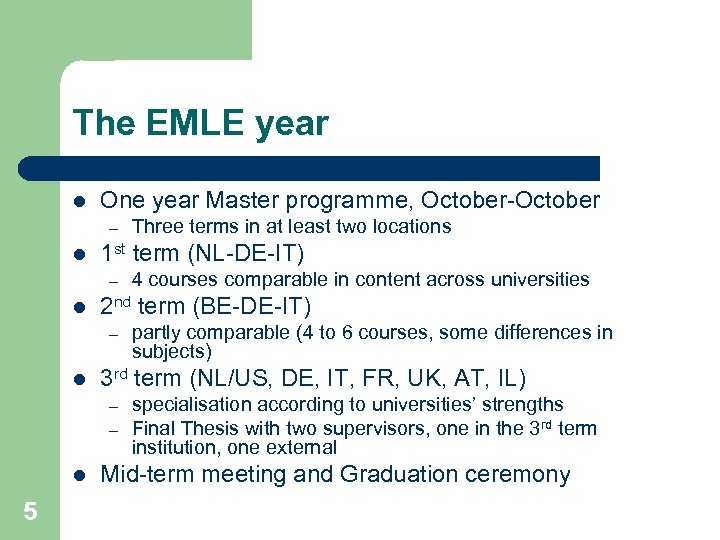 The EMLE year l One year Master programme, October-October – l 1 st Three terms in at least two locations term (NL-DE-IT) – 4 courses comparable l 2 nd term (BE-DE-IT) – l – 5 partly comparable (4 to 6 courses, some differences in subjects) 3 rd term (NL/US, DE, IT, FR, UK, AT, IL) – l in content across universities specialisation according to universities’ strengths Final Thesis with two supervisors, one in the 3 rd term institution, one external Mid-term meeting and Graduation ceremony
 EMLE at the origins l l Created in 1990, 4 participating institutions Pre-existing academic network – l Common research interests – l l l 6 European L & E Association Several annual meetings/conferences Advocacy role Little structure and a lot of enthusiasm Need for pragmatic solutions
 The EMLE at the EUA JM Project 2003 l l l About 100 Students per year Over 20 nationalities, mostly European 20 Partner Universities – l l l 7 Not all teaching centres Increasing need of coordination Sustainability issues Need for pragmatic solutions
 EMLE as Erasmus Mundus 2009 l l Eight Partner Institutions 100 Students – l l l 8 About 30% non European Higher level of harmonisation and centralisation of procedures More stable financial situation Still, need for pragmatic solutions
 The EMLE degree l Who issues the degree? – – l What degree? – – – 9 Initial solution: 3 rd term institution + “certificate” of “jointness”: 1 degree Post-EM: each institution where a student is enrolled multiple degrees Depending on national regulations (MA, EMLE, LLM) Student complaints: unfairness (NB: regulated profession) Repeated calls for a “European” label
 What Master? l l 10 “The EMLE is a postgraduate course. Preference will be given to applicants who already have a first master degree. ” Pre-requisite 4 years Possible admission of students with completed 1 st cycle of 3 years What kind of Master degree?
 Quality Assurance (I) l Internal Procedures – Curriculum integration l l – Common standards for evaluation l – l 11 Communication and statistical comparison Admission requirements l – Horizontal and vertical consistency Multiple meetings every year Flexible initially, but streamlined and centralised after EM Only one online application form Trust among partners (mutual recognition)
 Quality Assurance (II) l Substance – Content at the “right” level l “Jointness” – 12 Outcome of partners’ agreement Common definition of learning outcomes Added value: different cultural experiences, teaching methods, going beyond national laws, optimising resources
 External Evaluation and Accreditation l Coping with multiple national legal and institutional contexts – l 13 NL/BE and DE cases Mutual recognition
 Funding l l Fundamental for sustainability of the programme Depends on national context – l National legislation or institutional regulations may be unsuited for JMs EMLE Fees – – – Originally decentralised, depending on national regulation/institutional strategy Divergence caused arbitrage/unfairness on students’ side Unified after EM l l Lessons: – 14 4. 500 Euros for EU students/8. 500 Euros for non-EU Sustainability achieved when institutions “own” ad support the programme
 Logistics l l Standard administrative support may be unsuited Specific organisational support within each institution – – l Key problem: short-time accommodation – – l 15 Student ID cards Library/IT access Local specificities Best practices Flexibility is fundamental
 Other organisational issues l Language – – l Monitoring of graduates – – 16 English is official language of the programme (easier communication, common reading material etc. ) Courses to learn local language are much appreciated Not structured so far Recent initiatives (alumni association, journal, conference)
 What did Erasmus Mundus do for EMLE? l l l A quality label Attracted overseas students (beyond individual professors’ contact) Changes in the structure to fulfil requirements – – l l 17 Unified fees Centralised admission More comparable degrees Multiple degrees But some partners had to drop out (ES and SE cases) Better institutional support Better funding Overall higher sustainability
 Thanks for your attention! 18