 Скачать презентацию The European High Performance Computing Strategy Augusto BURGUEÑO
33fc19a80995391ba6e81e68976b64e2.ppt
- Количество слайдов: 26



The European High Performance Computing Strategy Augusto BURGUEÑO ARJONA Head of Unit e. Infrastructure DG CONNECT European Commission
Agenda for today § Context: HPC and the Digital Single Market (DSM) strategy § Implementing the HPC strategy in Horizon 2020 § Status of the main objectives towards European Leadership in HPC § Next steps 2 2
Context: HPC and the Digital Single Market (DSM) strategy
DSM in a nutshell • Better online access to digital goods and services, • Helping to make the EU's digital world a seamless and level marketplace to buy and sell • An environment where digital networks and services can prosper, • Designing rules which match the pace of technology and support infrastructure development • Digital as a driver for growth, • Ensuring that Europe's economy, industry and employment take full advantage of what digitalisation offers
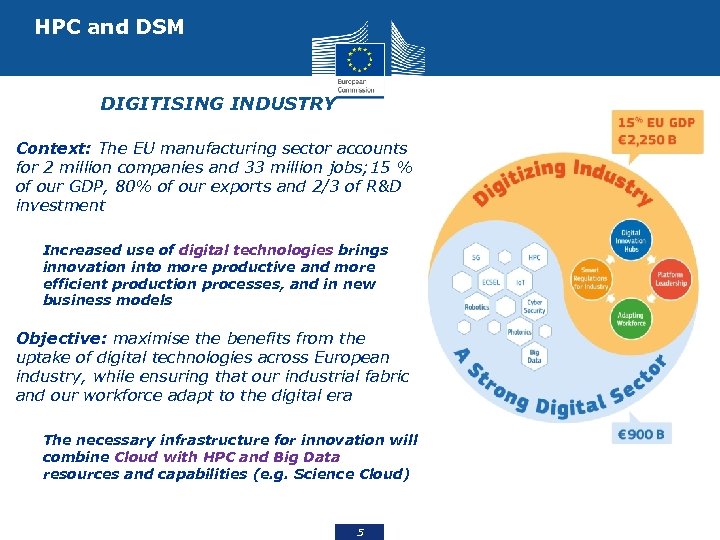
HPC and DSM DIGITISING INDUSTRY Context: The EU manufacturing sector accounts for 2 million companies and 33 million jobs; 15 % of our GDP, 80% of our exports and 2/3 of R&D investment § Increased use of digital technologies brings innovation into more productive and more efficient production processes, and in new business models Objective: maximise the benefits from the uptake of digital technologies across European industry, while ensuring that our industrial fabric and our workforce adapt to the digital era • The necessary infrastructure for innovation will combine Cloud with HPC and Big Data resources and capabilities (e. g. Science Cloud) 5
Computing trends in the context of the DSM • The exponential growth of data, networking and computing and the convergence of HPC, Big Data and Cloud will drive societal changes, scientific advances and productivity gains across the economy • HPC is the engine to power the new global digital economy • HPC intertwines with a growing number of industrial applications and scientific domains • The nature of computing is changing with an increasing number of data-intensive critical applications
Implementing the HPC strategy in Horizon 2020
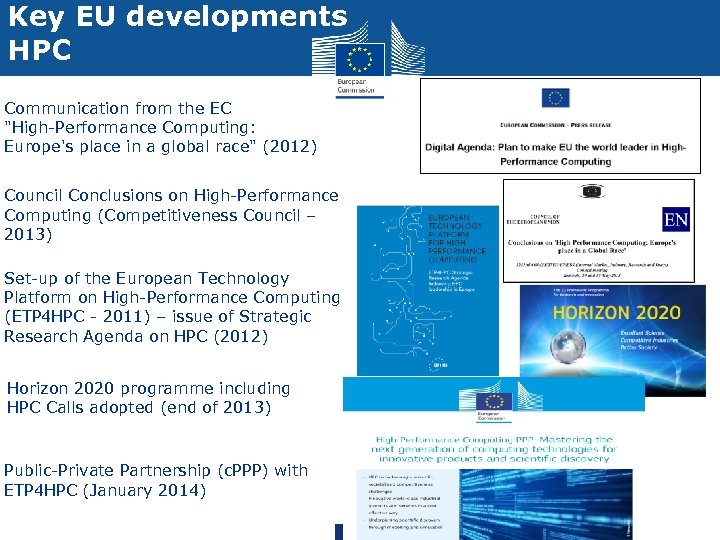
Key EU developments HPC Communication from the EC "High-Performance Computing: Europe's place in a global race" (2012) Council Conclusions on High-Performance Computing (Competitiveness Council – 2013) Set-up of the European Technology Platform on High-Performance Computing (ETP 4 HPC - 2011) – issue of Strategic Research Agenda on HPC (2012) Horizon 2020 programme including HPC Calls adopted (end of 2013) Public-Private Partnership (c. PPP) with ETP 4 HPC (January 2014)
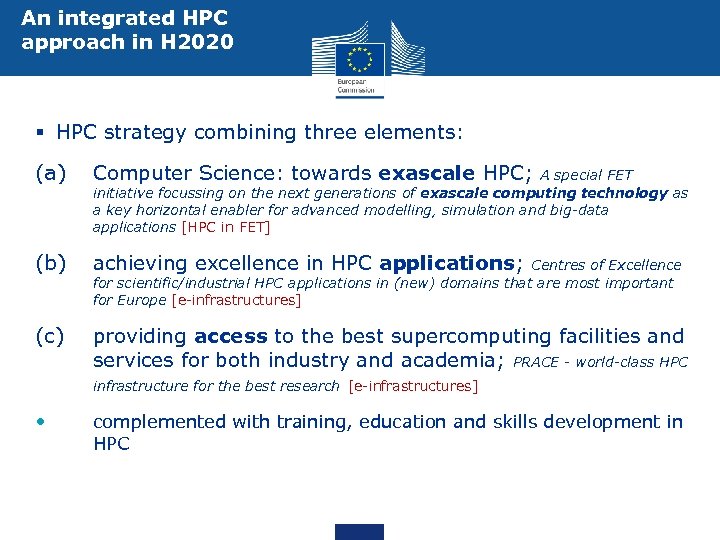
An integrated HPC approach in H 2020 § HPC strategy combining three elements: (a) Computer Science: towards exascale HPC; A special FET (b) achieving excellence in HPC applications; Centres of Excellence (c) providing access to the best supercomputing facilities and services for both industry and academia; PRACE - world-class HPC infrastructure for the best research [e-infrastructures] • complemented with training, education and skills development in HPC initiative focussing on the next generations of exascale computing technology as a key horizontal enabler for advanced modelling, simulation and big-data applications [HPC in FET] for scientific/industrial HPC applications in (new) domains that are most important for Europe [e-infrastructures]
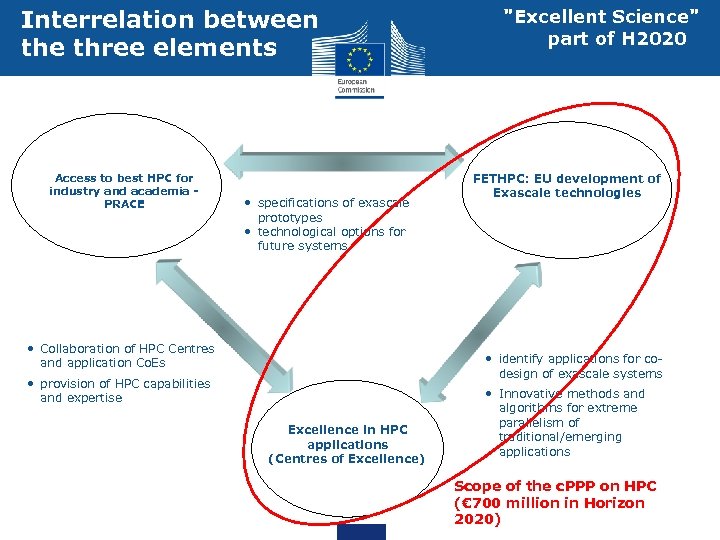
Interrelation between the three elements Access to best HPC for industry and academia PRACE • specifications of exascale prototypes • technological options for future systems • Collaboration of HPC Centres and application Co. Es "Excellent Science" part of H 2020 FETHPC: EU development of Exascale technologies • identify applications for codesign of exascale systems • provision of HPC capabilities and expertise Excellence in HPC applications (Centres of Excellence) • Innovative methods and algorithms for extreme parallelism of traditional/emerging applications Scope of the c. PPP on HPC (€ 700 million in Horizon 2020)
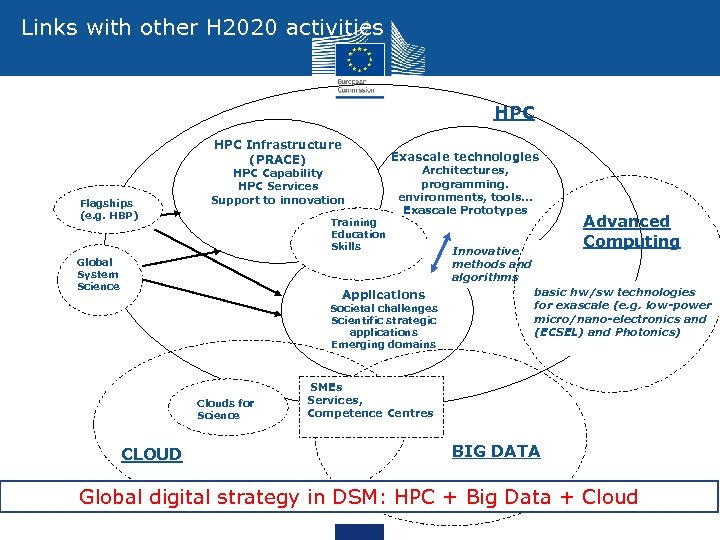
Links with other H 2020 activities HPC Infrastructure (PRACE) Flagships (e. g. HBP) Exascale technologies HPC Capability HPC Services Support to innovation Training Education Skills Global System Science Architectures, programming. environments, tools… Exascale Prototypes Applications Societal challenges Scientific strategic applications Emerging domains Clouds for Science CLOUD Advanced Computing Innovative methods and algorithms basic hw/sw technologies for exascale (e. g. low-power micro/nano-electronics and (ECSEL) and Photonics) SMEs Services, Competence Centres BIG DATA Global digital strategy in DSM: HPC + Big Data + Cloud
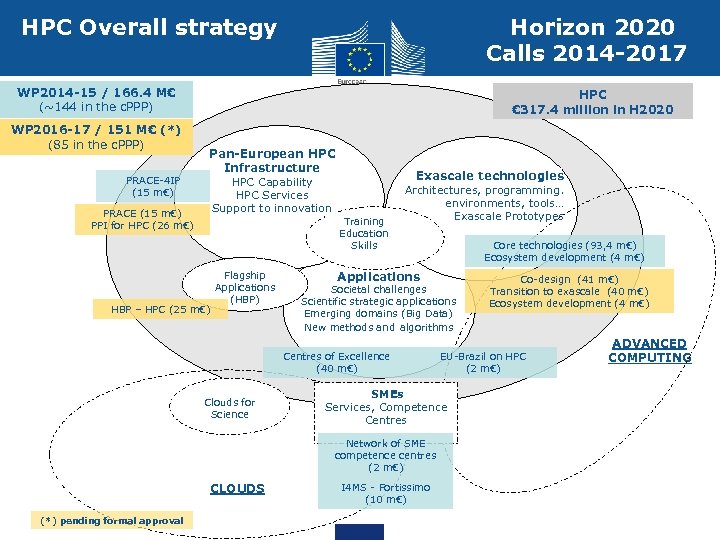
HPC Overall strategy Horizon 2020 Calls 2014 -2017 WP 2014 -15 / 166. 4 M€ (~144 in the c. PPP) WP 2016 -17 / 151 M€ (*) (85 in the c. PPP) PRACE-4 IP (15 m€) HPC € 317. 4 million in H 2020 Pan-European HPC Infrastructure Exascale technologies HPC Capability HPC Services Support to innovation PRACE (15 m€) PPI for HPC (26 m€) Training Education Skills HBP – HPC (25 m€) Flagship Applications (HBP) Architectures, programming. environments, tools… Exascale Prototypes Applications Societal challenges Scientific strategic applications Emerging domains (Big Data) New methods and algorithms Centres of Excellence (40 m€) Clouds for Science (*) pending formal approval I 4 MS - Fortissimo (10 m€) Co-design (41 m€) Transition to exascale (40 m€) Ecosystem development (4 m€) EU-Brazil on HPC (2 m€) SMEs Services, Competence Centres Network of SME competence centres (2 m€) CLOUDS Core technologies (93, 4 m€) Ecosystem development (4 m€) ADVANCED COMPUTING
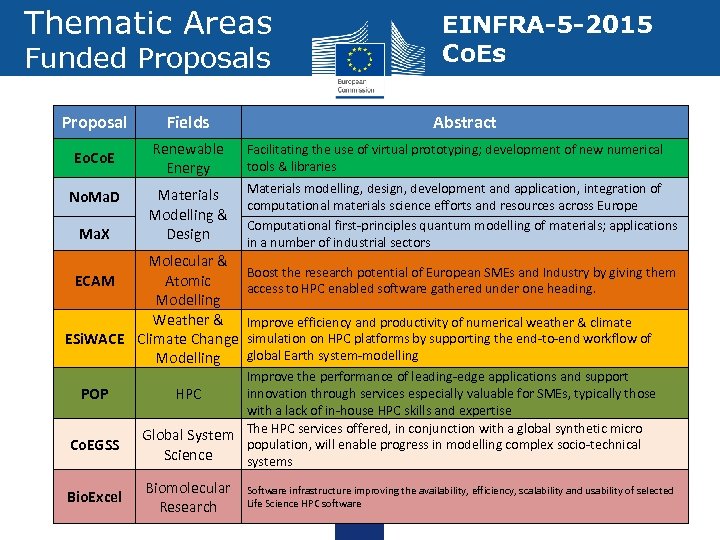
Thematic Areas Funded Proposals EINFRA-5 -2015 Co. Es Proposal Fields Eo. Co. E Renewable Energy Facilitating the use of virtual prototyping; development of new numerical tools & libraries Materials Modelling & Design Materials modelling, design, development and application, integration of computational materials science efforts and resources across Europe Computational first-principles quantum modelling of materials; applications in a number of industrial sectors No. Ma. D Ma. X Molecular & ECAM Atomic Modelling Weather & ESi. WACE Climate Change Modelling POP Co. EGSS Bio. Excel Abstract Boost the research potential of European SMEs and Industry by giving them access to HPC enabled software gathered under one heading. Improve efficiency and productivity of numerical weather & climate simulation on HPC platforms by supporting the end-to-end workflow of global Earth system-modelling Improve the performance of leading-edge applications and support innovation through services especially valuable for SMEs, typically those HPC with a lack of in-house HPC skills and expertise Global System The HPC services offered, in conjunction with a global synthetic micro population, will enable progress in modelling complex socio-technical Science systems Biomolecular Research Software infrastructure improving the availability, efficiency, scalability and usability of selected Life Science HPC software
• Status of the main objectives towards European Leadership in HPC
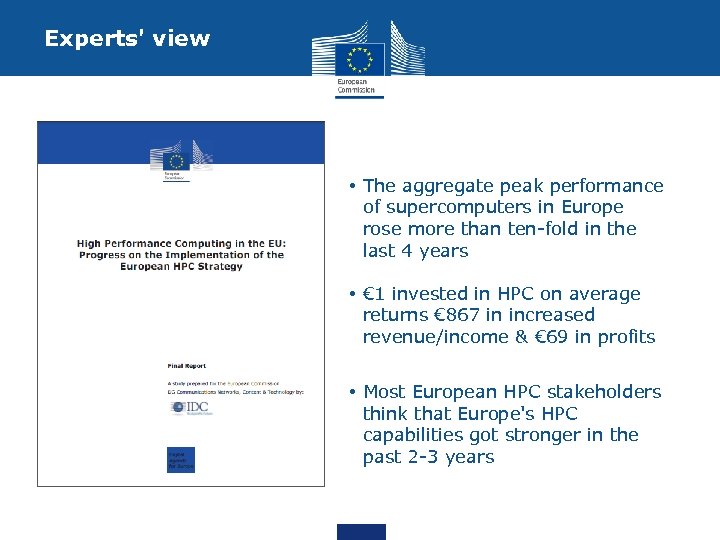
Experts' view • The aggregate peak performance of supercomputers in Europe rose more than ten-fold in the last 4 years • € 1 invested in HPC on average returns € 867 in increased revenue/income & € 69 in profits • Most European HPC stakeholders think that Europe's HPC capabilities got stronger in the past 2 -3 years
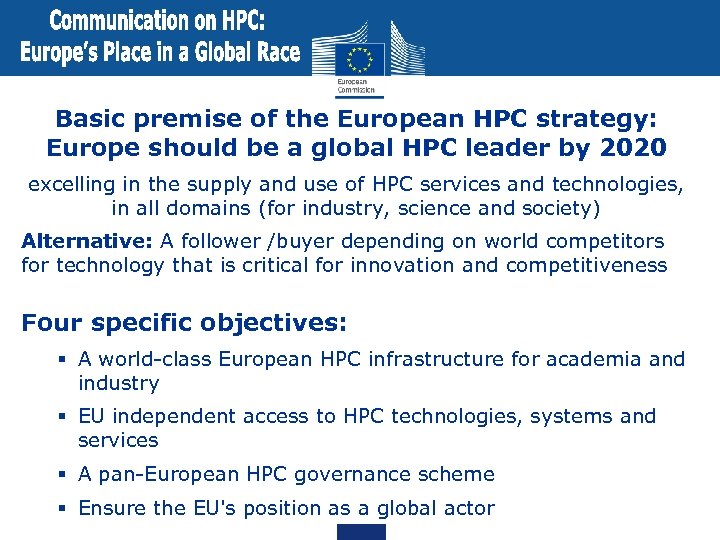
Basic premise of the European HPC strategy: Europe should be a global HPC leader by 2020 excelling in the supply and use of HPC services and technologies, in all domains (for industry, science and society) Alternative: A follower /buyer depending on world competitors for technology that is critical for innovation and competitiveness Four specific objectives: § A world-class European HPC infrastructure for academia and industry § EU independent access to HPC technologies, systems and services § A pan-European HPC governance scheme § Ensure the EU's position as a global actor
Summary assessment of progress towards the objectives (1/2) § Growing awareness at EU and national level of the importance of HPC for the competitiveness of European science and industry § Advances in Europe's position as a provider of high-end supercomputing resources. . . but still not matching the EU's economic importance: e. g. only 1 system in the top 10 and 3 in the top 20, dropping from a peak 4 and 7 systems in 2012 § Significant additional investments will be needed for Europe to stay in the HPC race (IDC study): additional € 3 billion in 5 years or € 5 billion in 7 years to match the developments of Europe's main competitors § The governance of HPC has evolved in the last few years, but there is a need to efficiently coordinate the different national HPC policies and the European strategy to reach the huge investments required, and to pool and rationalise available HPC resources at EUlevel– in particular in view of the upcoming European Science Cloud
Summary assessment of progress towards the objectives (2/2) § The EU is well positioned to manage a strong programme for independent access to technology and assemble exascale HPC capability that could achieve world-class, if not global leadership, status § Industrial access to HPC has improved…. however, greater outreach is needed to make HPC resources and software available to a broader base of industry/SMEs and easing the access to innovative European HPC applications that are currently in limited use § There is still a shortage of qualified HPC job applicants § Protective barriers of the main HPC world-competitors (U. S. A. , Japan and China) are still in place –by contrast, the EU is the most open market both for commercial and government procurements.

Next steps 19
Strengthening the European governance in HPC § To support the evolution of the HPC infrastructure (including PRACE) as a key component of the European Science Cloud, through the coordination capacity deployment at national and European level to match the needs of the researchers and research infrastructures Support to the "democratisation" of HPC - taking advantage of the convergence of HPC, Big Data and Cloud § support the easier access to HPC resources (to industry/SMEs and researchers in particular for the European Science Cloud) § "cloudification of HPC applications" to facilitate industrial use § promote HPC in curricula/skill development in a multidisciplinary way, and exploiting the combination of Web-programming skills with cloud-based access to HPC resources
Development of the European HPC eco-system § EXDCI support action (launched in Sept. 2015) to coordinate the strategy of the European HPC ecosystem (PRACE, ETP 4 HPC, EESI, Centres of Excellence) § Continuing the support to the HPC strategy in three axis: European HPC infrastructure around PRACE, autonomous technology and strengthening Europe's HPC supply chain, and Centres of Excellence in HPC applications for key scientific and industrial domains § Ensuring the coordination of technology developers and suppliers, users and procurers in Europe § Integration of the technology building blocks developed in the R&I programmes into large-scale platforms with a co-design approach § complement the effort of large-scale integration with coordinated acquisition strategy at EU level of world-class systems to transition the European leading machines to the new computing generation
Digital 4 Science platform • Register at http: //ec. europa. eu/d 4 science to join the conversation • How to foster the HPC ecosystem? • User-driven, with the application users and owners playing a decisive role in governance: Who are the users, which application, what is the role of the users? • Integrated: encompassing not only HPC software but also relevant aspects of hardware, data management/storage, connectivity, security, etc. ; What type of integration and how it will be implemented? • multidisciplinary: with domain expertise co-located alongside HPC system, software and algorithm expertise; Which expertise is available? • …
Next steps in Horizon 2020 • Launch of WP 2014 -2015 projects and establishment of first 8 Centres of Excellence (ongoing) • Report to Parliament and Council on European HPC strategy (end 2015) • WP 2016 -2017 § Support to the Pan-European HPC infrastructure (e. Infrastructure) • Implementation of PRACE (PRACE-4 IP) – 15 m€ • Procurement of innovative solutions in HPC (PPI) – 26 m€ • HPC e-infrastructure for the Human Brain Project – 25 m€ § Support to exascale technologies development (FET) • Co-design of HPC systems and applications – 41 m€ • Transition to exascale computing – 40 m€ • Exascale Ecosystem Development – 4 m€
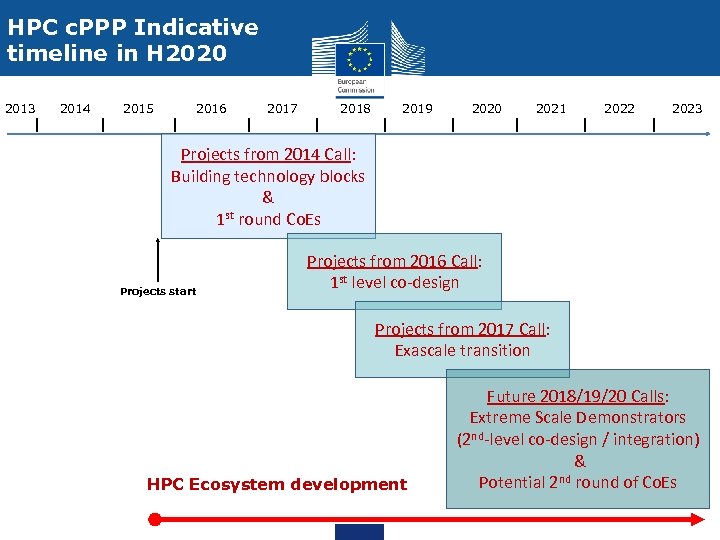
HPC c. PPP Indicative timeline in H 2020 2013 l 2014 l 2015 l 2016 l 2017 l 2018 l 2019 l 2020 l 2021 l 2022 l 2023 Projects from 2014 Call: Building technology blocks & 1 st round Co. Es Projects start Projects from 2016 Call: 1 st level co-design Projects from 2017 Call: Exascale transition HPC Ecosystem development Future 2018/19/20 Calls: Extreme Scale Demonstrators (2 nd-level co-design / integration) & Potential 2 nd round of Co. Es
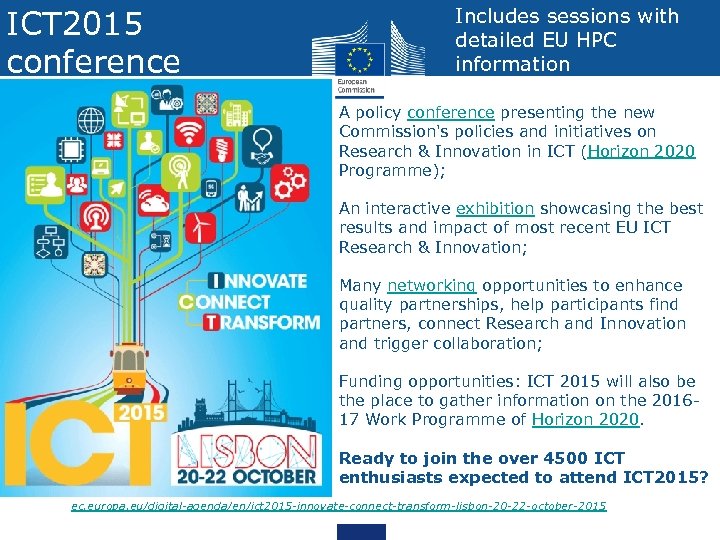
ICT 2015 conference Includes sessions with detailed EU HPC information A policy conference presenting the new Commission's policies and initiatives on Research & Innovation in ICT (Horizon 2020 Programme); An interactive exhibition showcasing the best results and impact of most recent EU ICT Research & Innovation; Many networking opportunities to enhance quality partnerships, help participants find partners, connect Research and Innovation and trigger collaboration; Funding opportunities: ICT 2015 will also be the place to gather information on the 201617 Work Programme of Horizon 2020. Ready to join the over 4500 ICT enthusiasts expected to attend ICT 2015? • ec. europa. eu/digital-agenda/en/ict 2015 -innovate-connect-transform-lisbon-20 -22 -october-2015
Thank you for your attention! Single point access to all information about the EC HPC strategy, work programmes and HPC related news: ec. europa. eu/horizon 2020 -hpc
Скачать презентацию The European High Performance Computing Strategy Augusto BURGUEÑO
33fc19a80995391ba6e81e68976b64e2.ppt