


 Скачать презентацию The ESDI past present and future Claude Luzet
7dce887a81aa206f00dc4713767d98c2.ppt
- Количество слайдов: 37
 The ESDI, past, present and future Claude Luzet, Euro. Geographics Programme Manager ESDI presentation at SEESDI conference, Sofia, 23 rd October 2003
 Yesterday in Europe ……. . 2
 Three European steps 1. GI 2000 and the EGII (European Geographic Information Infrastructure) 1995 -1999 2. ETe. MII and the European Territorial Management Information Infrastructure) 2000 -2001 3. GSDI → ESDI (European spatial Data Infrastructure) → INSPIRE (Infrastructure for Spatial Information in Europe) 2002 -2003 → ? ? ? 3
 GI 2000 : a discussion paper • An initiative born in 1995, buried in 1999 • Geographic Information in Europe: a Discussion Document, DG XIII/E - August 1998 • Identified main barriers to development • National orientation • No mandate to provide for the cost of collecting and maintaining EUwide data sets • Different rules exist within the Member States • Disparities between these local markets 4
 GI 2000 : barriers to development (cont’d) • Lack of base data • Lack of consistency between national data sets results in lack of exploitation for other applications, leading to duplication of effort • Unexploited potential of GI in Europe • Lack of awareness of the potential benefits of using digital geographic information may be the greatest barrier to future market development • Technical problems • Action is needed to ensure that the necessary training is available in Europe. 5
 GI 2000 : suggested areas for EU action • Providing leadership for European co-operation and co-ordination • Continued support to European associations such as EUROGI, CERCO, MEGRIN • Stimulating the development of a European GI infrastructure • Encourage public bodies to co-operate and form partnerships with the private sector • Create seamless geographic base data across Europe • Stimulate the creation of EU-wide directory services • Ensure that GI specific standards are developed as needed • Realising the potential of GI at European level • Contributing to the definition of global rules and standards 6
 A spatial data infrastructure means: • “The availability and the unimpeded sharing and use of the required data, according to agreed mechanisms and specifications. ” 7
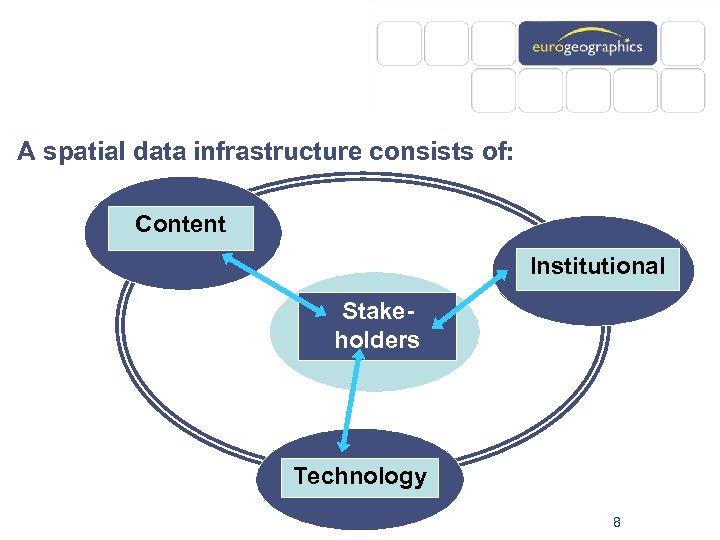 A spatial data infrastructure consists of: Content Institutional Stakeholders Technology 8
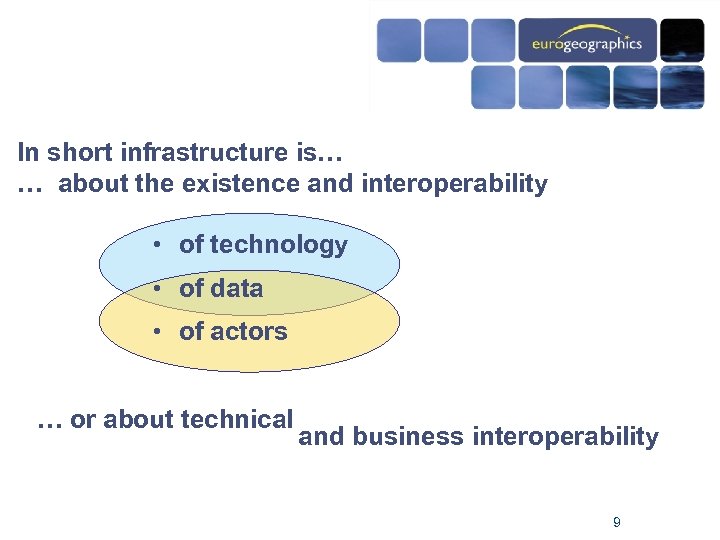 In short infrastructure is… … about the existence and interoperability • of technology • of data • of actors … or about technical and business interoperability 9
 ……. . Today in Europe ……. . 10
 State of the art in Europe (business models) From a 2003 Euro. Geographics study on 19 European countries (L. Aslesen and Expert-Group on Legal & Commercial Issues ) • Different categories of business models at NMAs • with a fixed budget and tasks, all income back to government • with a fixed budget and tasks, allowed to keep (part of) income • with a “state contract”, often combined with an expected return on investments for the government 11
 State of the art (licensing and services) • Most cases indicate a defined policy for usage (usage rights, business license, internal/private use), and a form of license for value-added products • However : Analysis difficult because of unclear answers → Language and terminology problems • Pricing policies for on-line services fall in three main categories • Charging per volume, i. e. per hits or transaction • Charging a fixed fee, usually per year • Combination of these two 12
 Towards business ‘interoperability’ • Obvious need to increase harmonisation of (national) pricing and licensing policies – Doesn’t mean the same terms and prices for data anywhere – It does mean greater agreement on pricing models, licensing arrangements and service delivery – And common terminology : ‘speaking the same language’ 13
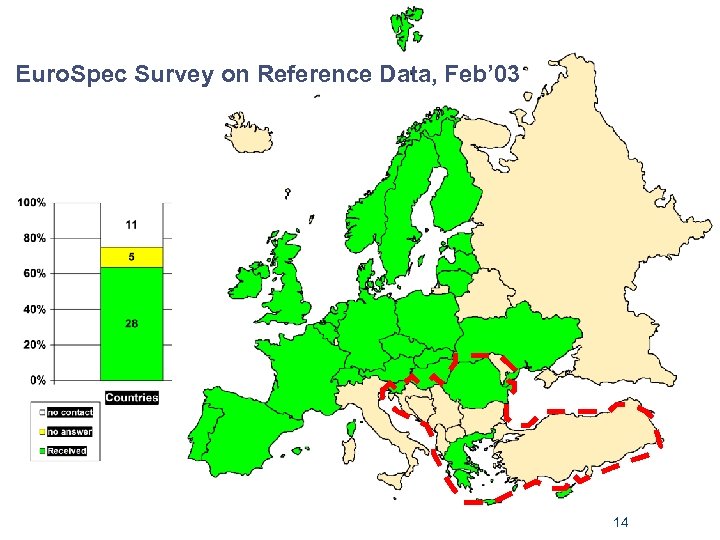 Euro. Spec Survey on Reference Data, Feb’ 03 14
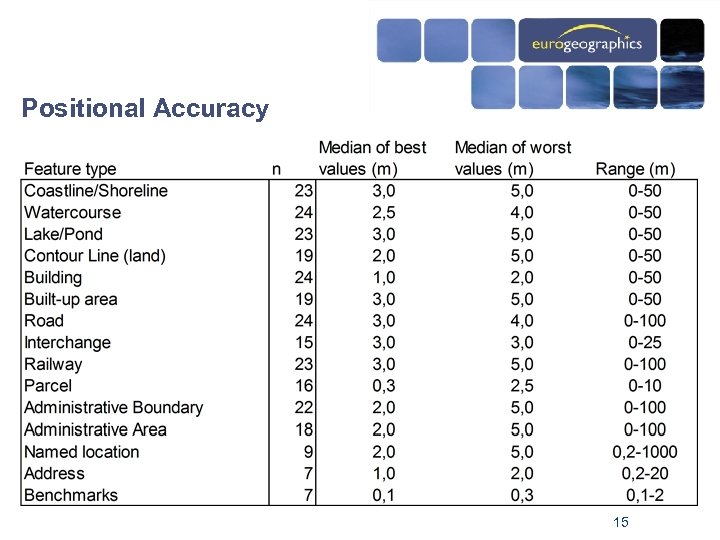 Positional Accuracy 15
 State of the art (technical) • Results of survey (A. Jakobsson and Euro. Geographics Ex. G-Quality) • Common Reference Data mostly available at 100% (minimum 70% for parcels, buildings, addresses) • At medium-high resolution (~1: 10. 000 scale) • Very few implementations of international standards • High trend in changes in DB structure: object based (9/11), moving towards (6/5) • Final report to be published end 2003 16
 ……. and tomorrow. 17
 The INSPIRE RDM position paper : • Identified the Common Reference Data as a key component of the ESDI, • And recommended • To define a conceptual model for the reference data components • To agree of common definitions for objects and their attributes belonging to the components of the reference data • That reference data specifications are created and described in a way that is commonly understood and which takes into account cultural differences. 18
 The 12 INSPIRE policy principles of the DPLI position paper 1 - The European Spatial Data Infrastructure shall be built upon a network of National Spatial Data Infrastructures; 6 - Reference data will provide the underpinning framework to which all other INSPIRE data will be referenced. 3 - Datasets made available to harmonised data specifications and to common standards; 10 - Harmonised licensing framework will optimise sharing and trading of georeferenced thematic information; 19
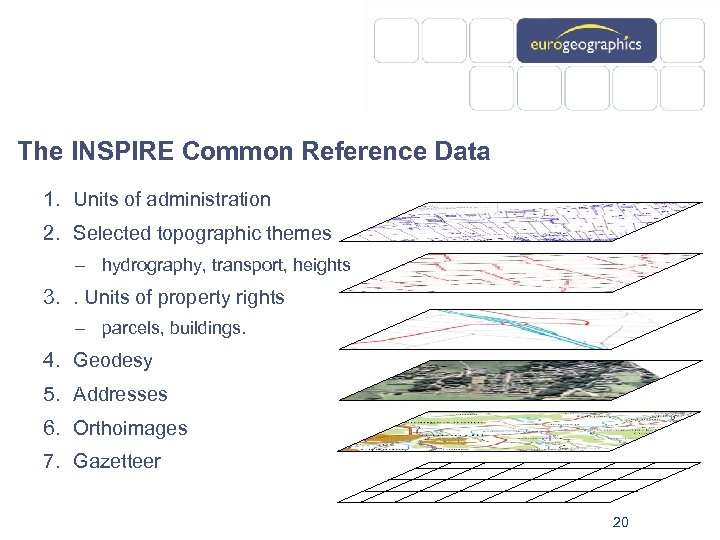 The INSPIRE Common Reference Data 1. Units of administration 2. Selected topographic themes – hydrography, transport, heights 3. . Units of property rights – parcels, buildings. 4. Geodesy 5. Addresses 6. Orthoimages 7. Gazetteer 20
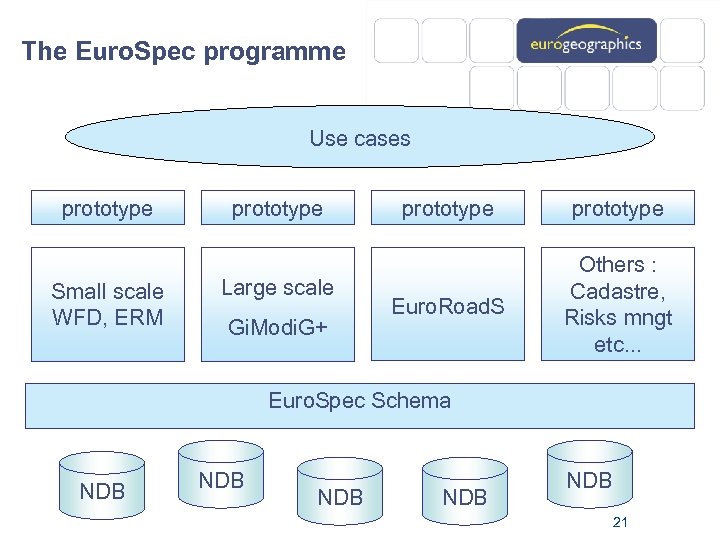 The Euro. Spec programme Use cases prototype Small scale WFD, ERM prototype Large scale Gi. Modi. G+ prototype Euro. Road. S Others : Cadastre, Risks mngt etc. . . Euro. Spec Schema NDB NDB NDB 21
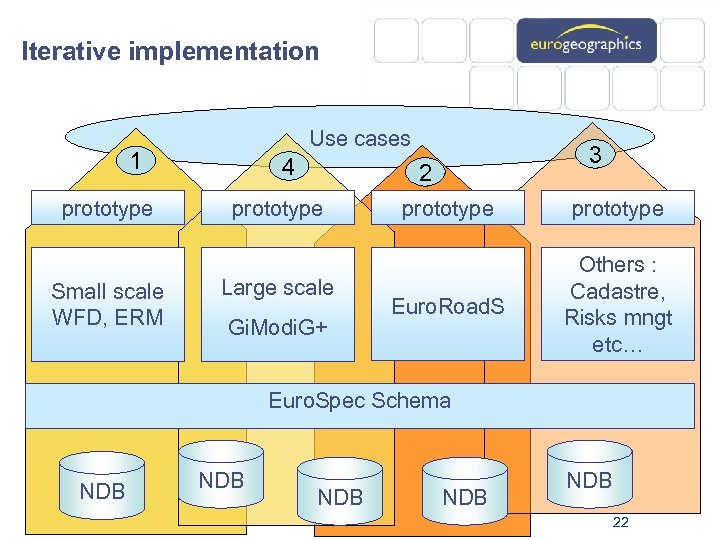 Iterative implementation Use cases 1 prototype Small scale WFD, ERM 4 3 2 prototype Large scale Gi. Modi. G+ prototype Euro. Road. S Others : Cadastre, Risks mngt etc… Euro. Spec Schema NDB NDB NDB 22
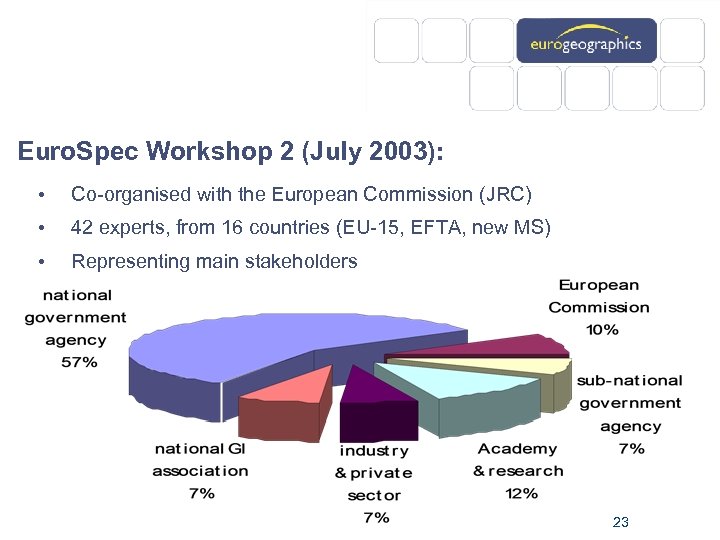 Euro. Spec Workshop 2 (July 2003): • Co-organised with the European Commission (JRC) • 42 experts, from 16 countries (EU-15, EFTA, new MS) • Representing main stakeholders 23
 WS-2 conclusions • Euro. Spec an indispensable and timely initiative • A process, with short- and long-term objectives • Necessity to relate to and link with real life use-cases and existing relevant initiatives and projects • Build on existing legacy from major actors Euro. Geographics as the ‘natural’ leader Minutes and presentations available at www. eurogeographics. org 24
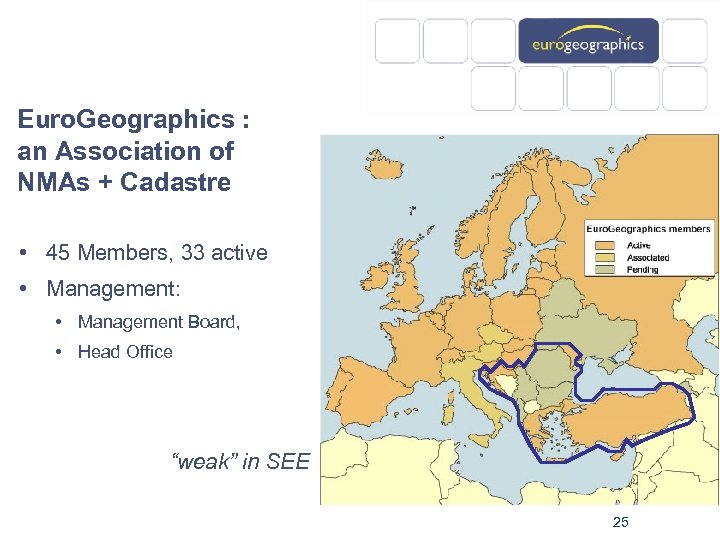 Euro. Geographics : an Association of NMAs + Cadastre • 45 Members, 33 active • Management: • Management Board, • Head Office “weak” in SEE 25
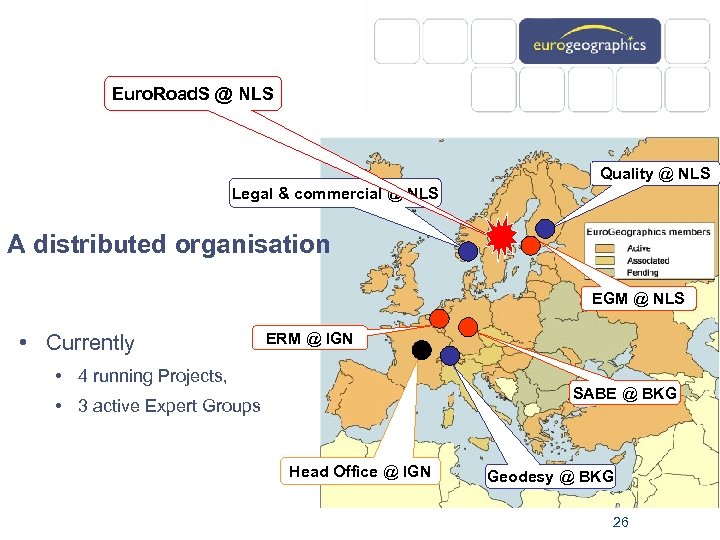 Euro. Road. S @ NLS Quality @ NLS Legal & commercial @ NLS A distributed organisation EGM @ NLS • Currently ERM @ IGN • 4 running Projects, SABE @ BKG • 3 active Expert Groups Head Office @ IGN Geodesy @ BKG 26
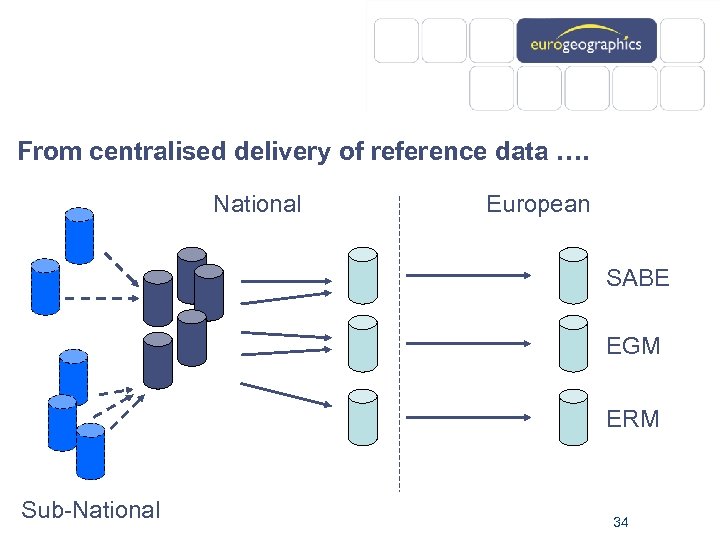
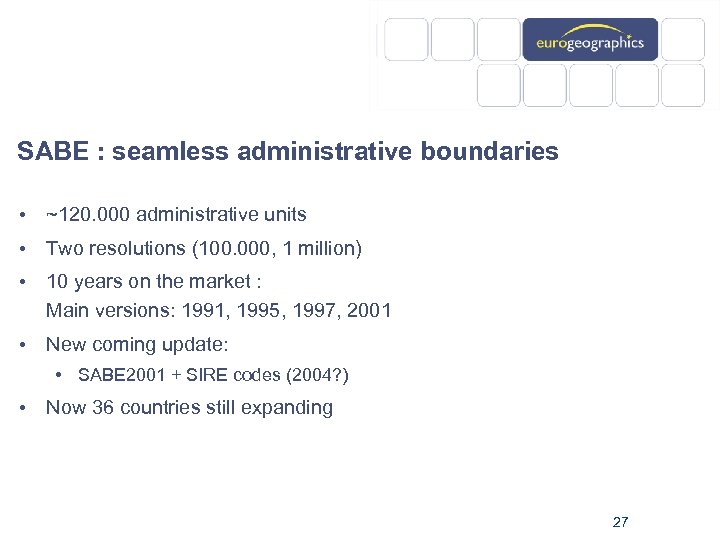 SABE : seamless administrative boundaries • ~120. 000 administrative units • Two resolutions (100. 000, 1 million) • 10 years on the market : Main versions: 1991, 1995, 1997, 2001 • New coming update: • SABE 2001 + SIRE codes (2004? ) • Now 36 countries still expanding 27
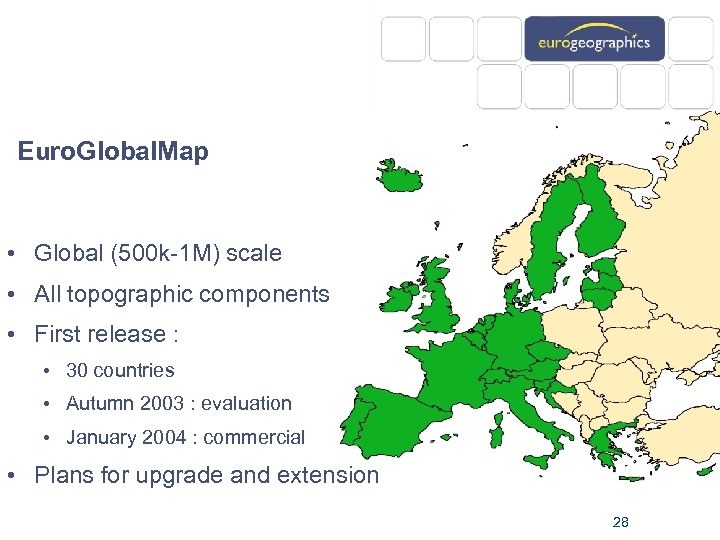 Euro. Global. Map • Global (500 k-1 M) scale • All topographic components • First release : • 30 countries • Autumn 2003 : evaluation • January 2004 : commercial • Plans for upgrade and extension 28
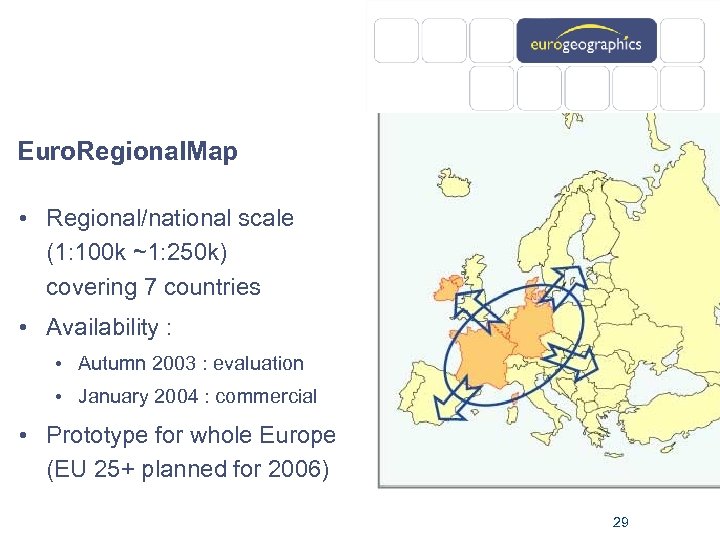 Euro. Regional. Map • Regional/national scale (1: 100 k ~1: 250 k) covering 7 countries • Availability : • Autumn 2003 : evaluation • January 2004 : commercial • Prototype for whole Europe (EU 25+ planned for 2006) 29
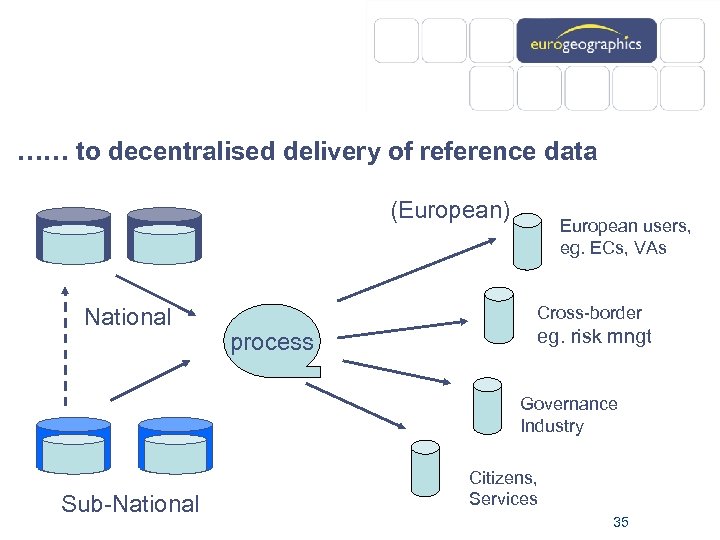
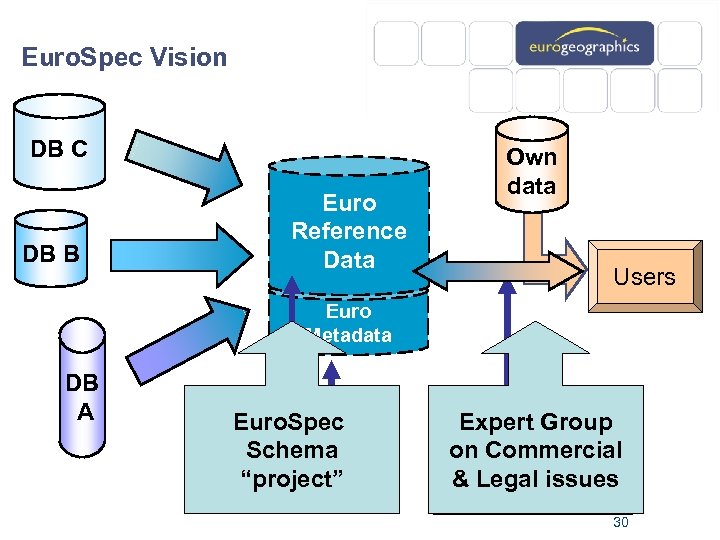 Euro. Spec Vision DB C DB B Euro Reference Data Own data Users Euro Metadata DB A Euro. Spec Schema “project” ISO Expert Group Pricing & Licensing policy on Commercial & Legal issues Legal Framework 30
 Next steps for the ESDI? • GI 2000, more than 5 years ago • Had already identified the issues and proposed the appropriate actions • INSPIRE • Had raised awareness of and promoted the ESDI vision and concepts • Had created an stronger community of GI stakeholders • … but no INSPIRE legal framework before 2006, 2007, ? • Urgent needs now • From the market, the Industry • For supporting the development of the national strategies on SDIs 31
 Starting now, how? 1. Use and support today existing operational structures, eg. Euro. Geographics • Representing major stakeholders • • Mapping and Cadastre of 40 European countries A network of various expertise Permanent operational body of 5 persons (and 500. 000 € core budget) Working in close partnership with • • • EUROSTAT/GISCO : the EC GI data manager JRC/INSPIRE project : the EC GI technical support CEN/TC 287 liaison member EUROGI : the community of the European stakeholders Euro. SDR & Agile : the European GI research community EUREF (geodesy), Euro. Geo. Surveys (geology), etc 2. In parallel consider what other organisational structure should best manage the future development of the ESDI. 32
 Euro. Spec : Benefits • For reference data custodians • Shares best practice re-engineering databases & developing new products/services • Provides common specifications for those not yet on the move, • Input national/organisations culture and language specifics. • Interoperability – business • Increasing public-private partnership (and outsourcing), • Review business policies & processes. • Interoperability – data • A major step towards the NSDIs and the ESDI 33
 From centralised delivery of reference data …. National European SABE EGM ERM Sub-National 34
 …… to decentralised delivery of reference data (European) National European users, eg. ECs, VAs Cross-border process eg. risk mngt Governance Industry Sub-National Citizens, Services 35
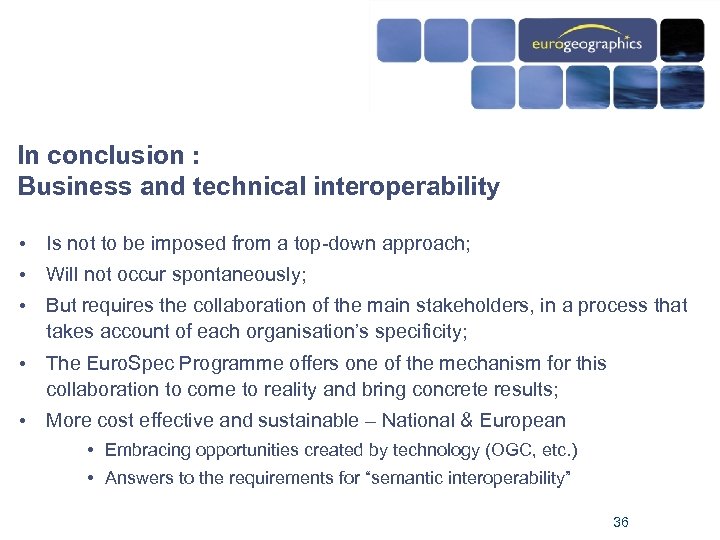 In conclusion : Business and technical interoperability • Is not to be imposed from a top-down approach; • Will not occur spontaneously; • But requires the collaboration of the main stakeholders, in a process that takes account of each organisation’s specificity; • The Euro. Spec Programme offers one of the mechanism for this collaboration to come to reality and bring concrete results; • More cost effective and sustainable – National & European • Embracing opportunities created by technology (OGC, etc. ) • Answers to the requirements for “semantic interoperability” 36
 Thank you ! 37