 Скачать презентацию The Entrepreneurial Spirit Creativity and Innovation The Ability
456984241bdf0dc8e27d018e8c29bd76.ppt
- Количество слайдов: 15



The Entrepreneurial Spirit Creativity and Innovation The Ability to Organize Resources The Willingness to Accept Risks and Failures
Entrepreneur – Advantages • Be Your Own Boss – You Make the Rules • Unlimited Income Potential • If Successful, Access to Unique People and Places • Satisfaction of Creating and Building Something Unique • Life Long Learning – Always Learning Something New and Interesting
More characteristics … Achievement motivation Opportunistic Alert to business opportunities Innovative and creative, ideas person Utilize a variety of sources of finance High profile image-maker Restless, adventurous Intuitive Agent of change, proactive Self-reliant Strong sense of self-belief Analytical, assesses risks realistically Good communicator
Creativity Blockers The Right Answer That’s Not Logical Follow the Rules Be Practical Avoid Ambiguity • • • To Err Is Wrong Play is Frivolous That’s Not My Area Don’t Be Foolish I’m Not Creative.
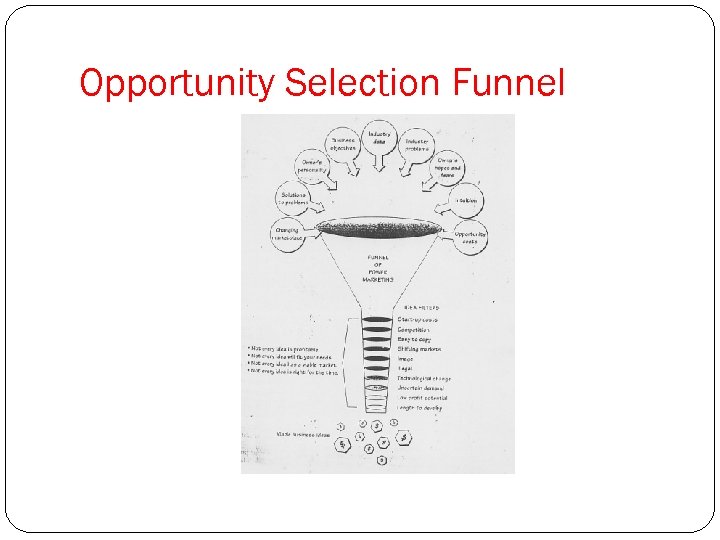
Opportunity Selection Funnel
Entrepreneurial Misconceptions Most Businesses Do Not Succeed You Need a Lot of Money to Start a Business Webvan – Started With $375 Million and Is Now Out of Business John Mc. Connell Started Worthington Industries With $500 and Built a Successful Fortune 500 Company
What Does It Take to Succeed? q Extreme Determination Never Give Up! q Good Sales Skills • • • Recruiting Employees Gaining New Customers Persuading Partners and Suppliers to Do What You Want q New Businesses That Fail Usually Fail Because of Lack of Revenue q Good Financial Controls q Ability to Build and Motivate a Team
How to Get Started q Pick a Business • • Should Be in a Growing Industry It Helps If You Already Know Something About It – but This Is Not Critical q Go to Work for a Similar Business q Learn Everything You Can About the Business and the Industry q Consider a Franchise for First Business or Pick a Partner That Has Some Business Experience q Go Ahead and Do It – Worst That Can Happen – You Can Fail but Learn a Lot – Then Start Another One
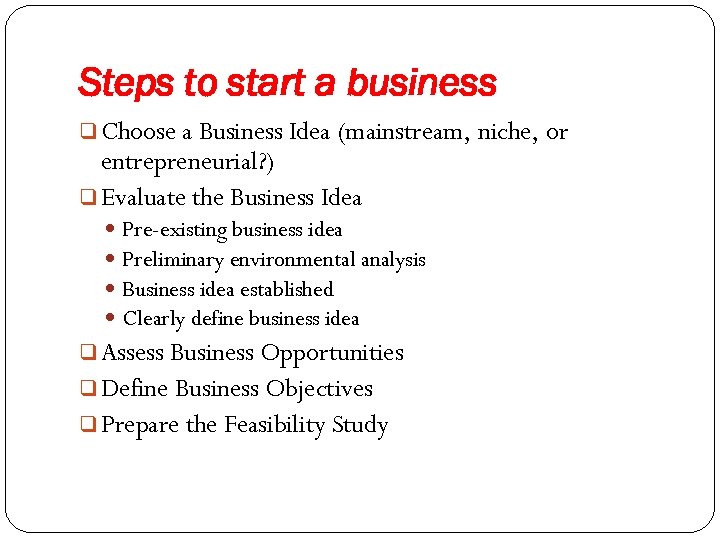
Steps to start a business q Choose a Business Idea (mainstream, niche, or entrepreneurial? ) q Evaluate the Business Idea Pre-existing business idea Preliminary environmental analysis Business idea established Clearly define business idea q Assess Business Opportunities q Define Business Objectives q Prepare the Feasibility Study
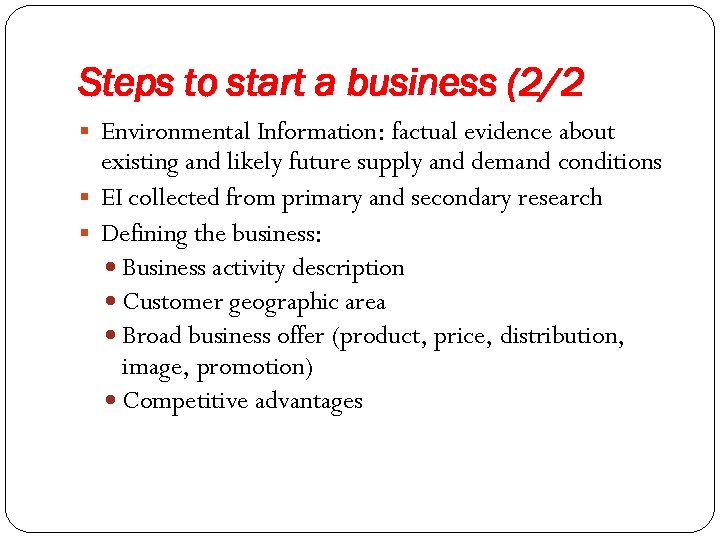
Steps to start a business (2/2 § Environmental Information: factual evidence about existing and likely future supply and demand conditions § EI collected from primary and secondary research § Defining the business: Business activity description Customer geographic area Broad business offer (product, price, distribution, image, promotion) Competitive advantages
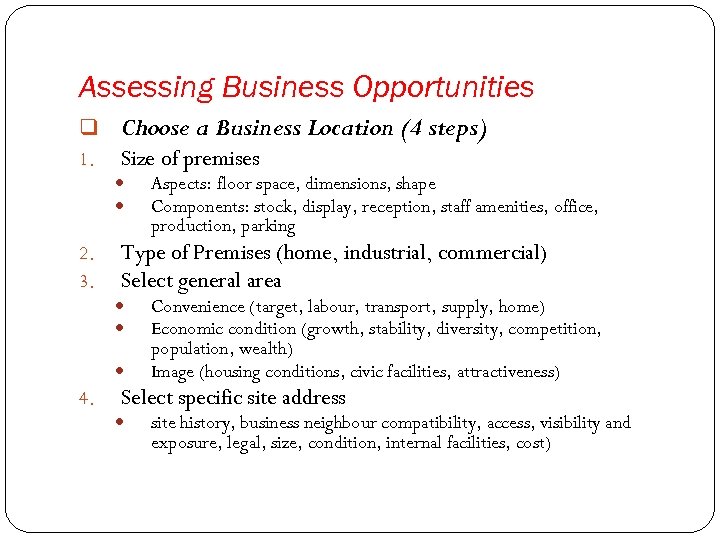
Assessing Business Opportunities q Choose a Business Location (4 steps) 1. Size of premises 2. 3. Type of Premises (home, industrial, commercial) Select general area 4. Aspects: floor space, dimensions, shape Components: stock, display, reception, staff amenities, office, production, parking Convenience (target, labour, transport, supply, home) Economic condition (growth, stability, diversity, competition, population, wealth) Image (housing conditions, civic facilities, attractiveness) Select specific site address site history, business neighbour compatibility, access, visibility and exposure, legal, size, condition, internal facilities, cost)
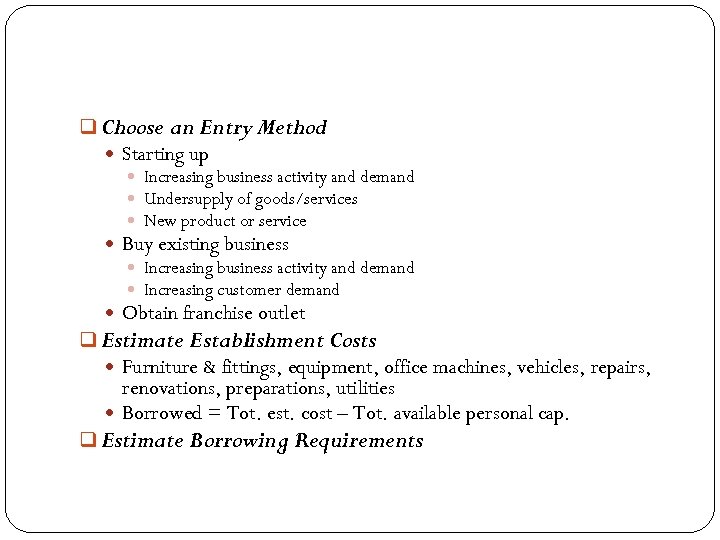
q Choose an Entry Method Starting up Increasing business activity and demand Undersupply of goods/services New product or service Buy existing business Increasing business activity and demand Increasing customer demand Obtain franchise outlet q Estimate Establishment Costs Furniture & fittings, equipment, office machines, vehicles, repairs, renovations, preparations, utilities Borrowed = Tot. est. cost – Tot. available personal cap. q Estimate Borrowing Requirements
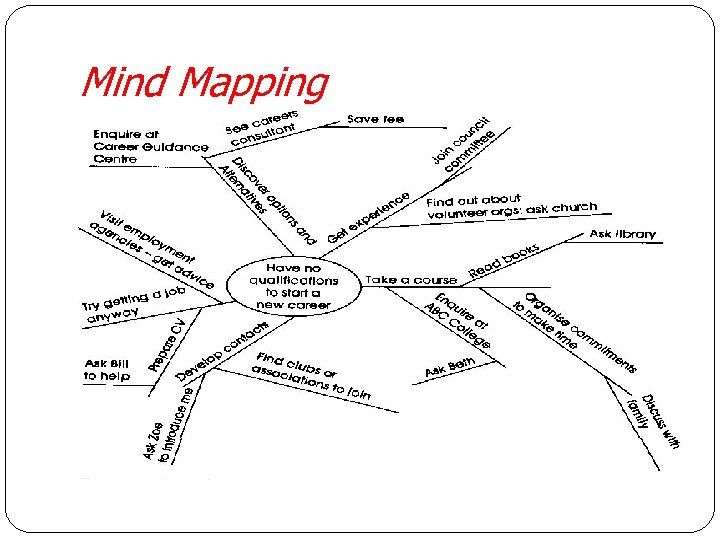
Mind Mapping
References Dollinger, M. J. , Entrepreneurship: Strategies and Resources, 2 nd Ed. , Prentice-Hall, NJ, 1998. Ebert, R. J. , Business Essentials, Prentice-Hall, New Jersey, 2000. Kuratko, D. F. , Entrepreneurship: A Contemporary Approach, 4 th Ed. , Dryden Press, Or, 1998. Peters, R. D. , Entrepreneurship, 4 th Ed. , Mc. Graw-Hill, USA, 1998. Thomas, R. J. , New Product Success Stories: Lessons from Leading Innovators, JWS, NY, 1995. Timmons, J. E. , New Venture Creation : A Guide to Entrepreneurship, 2 nd Ed. , Irwin, Ill, 1985
Terima Kasih Salam sukses untuk kita semua. Dodi Setiawan Riatmaja. , S. Psi. , MBA. @dodi_setiawanr
Скачать презентацию The Entrepreneurial Spirit Creativity and Innovation The Ability
456984241bdf0dc8e27d018e8c29bd76.ppt