 Скачать презентацию The Entity-Relationship Model Chapter 2 Database Management Systems
085e9e6b1614260115831e7ee254b31f.ppt
- Количество слайдов: 26



The Entity-Relationship Model Chapter 2 Database Management Systems 3 ed, R. Ramakrishnan and J. Gehrke 1
Data Model Move from informal description of what user wants to v Precise description of what can be implemented in a DBMS v Database Management Systems 3 ed, R. Ramakrishnan and J. Gehrke 2
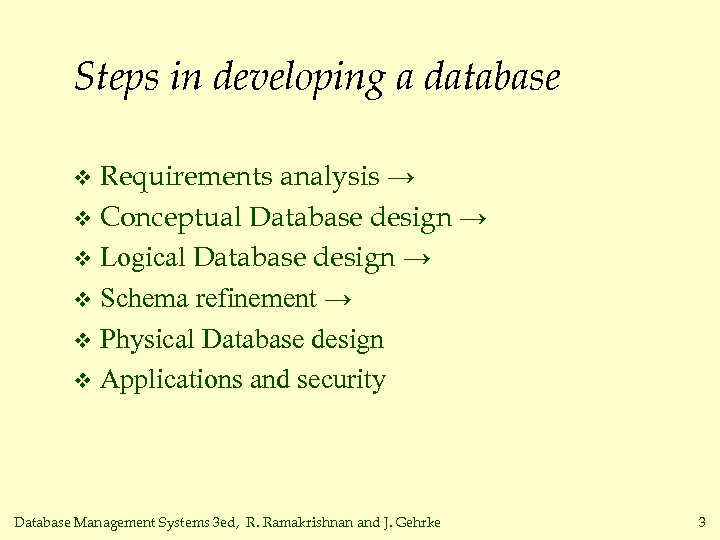
Steps in developing a database Requirements analysis → v Conceptual Database design → v Logical Database design → v Schema refinement → v Physical Database design v Applications and security v Database Management Systems 3 ed, R. Ramakrishnan and J. Gehrke 3
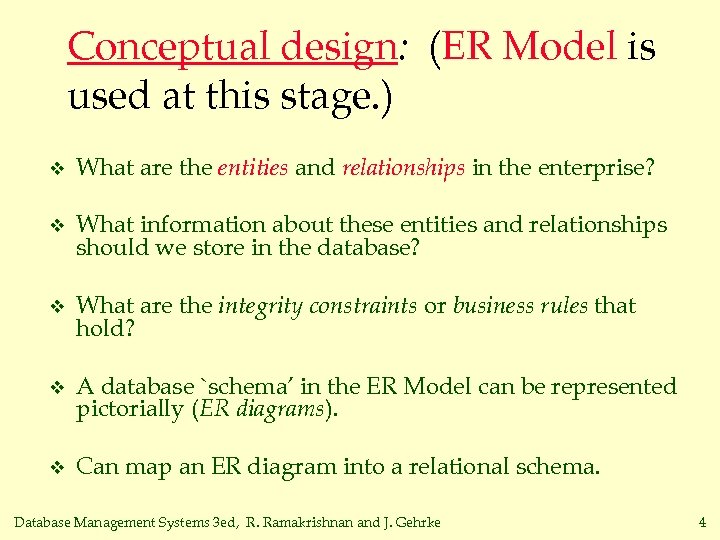
Conceptual design: (ER Model is used at this stage. ) v What are the entities and relationships in the enterprise? v What information about these entities and relationships should we store in the database? v What are the integrity constraints or business rules that hold? v A database `schema’ in the ER Model can be represented pictorially (ER diagrams). v Can map an ER diagram into a relational schema. Database Management Systems 3 ed, R. Ramakrishnan and J. Gehrke 4
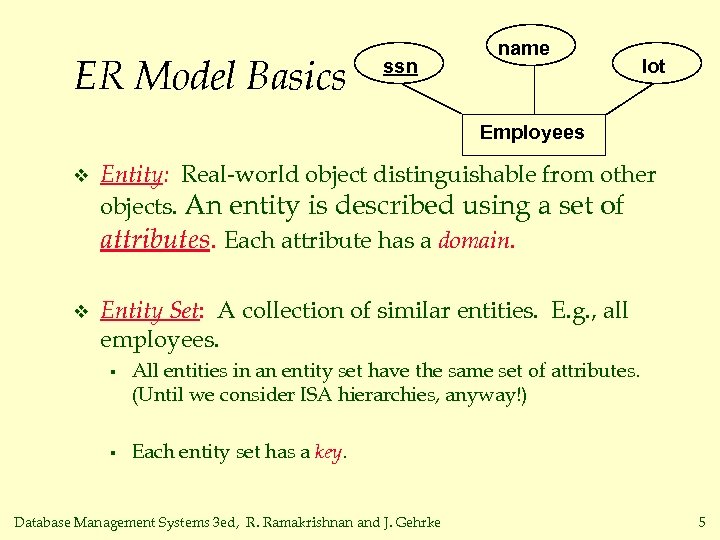
ER Model Basics ssn name lot Employees v Entity: Real-world object distinguishable from other objects. An entity is described using a set of attributes. Each attribute has a domain. v Entity Set: A collection of similar entities. E. g. , all employees. § All entities in an entity set have the same set of attributes. (Until we consider ISA hierarchies, anyway!) § Each entity set has a key. Database Management Systems 3 ed, R. Ramakrishnan and J. Gehrke 5
Keys v Minimal set of attributes which uniquely identify an instance of a entity v Many candidate keys choose one to be a primary keys v SSN vs Name … key must be unique Database Management Systems 3 ed, R. Ramakrishnan and J. Gehrke 6
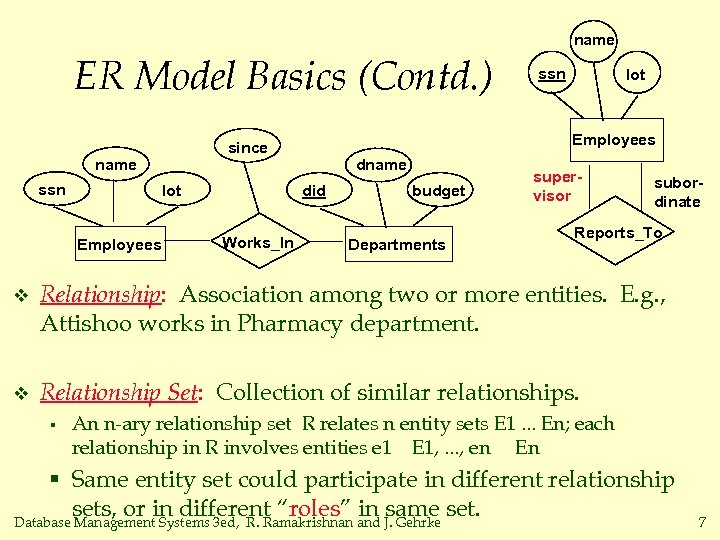
name ER Model Basics (Contd. ) ssn lot Employees dname did Works_In lot Employees since name ssn budget Departments supervisor subordinate Reports_To v Relationship: Association among two or more entities. E. g. , Attishoo works in Pharmacy department. v Relationship Set: Collection of similar relationships. § An n-ary relationship set R relates n entity sets E 1. . . En; each relationship in R involves entities e 1 E 1, . . . , en En § Same entity set could participate in different relationship sets, or in different “roles” in same set. Database Management Systems 3 ed, R. Ramakrishnan and J. Gehrke 7
Key Constraints v Consider Works_In: An employee can work in many departments; a dept can have many employees. So many to many Database Management Systems 3 ed, R. Ramakrishnan and J. Gehrke 8
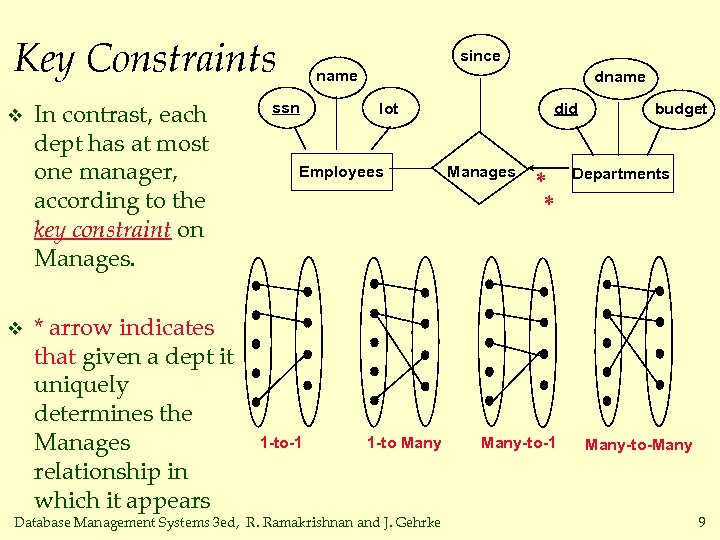
Key Constraints v v In contrast, each dept has at most one manager, according to the key constraint on Manages. * arrow indicates that given a dept it uniquely determines the Manages relationship in which it appears since name ssn dname lot Employees 1 -to-1 1 -to Many Database Management Systems 3 ed, R. Ramakrishnan and J. Gehrke did Manages * * Many-to-1 budget Departments Many-to-Many 9
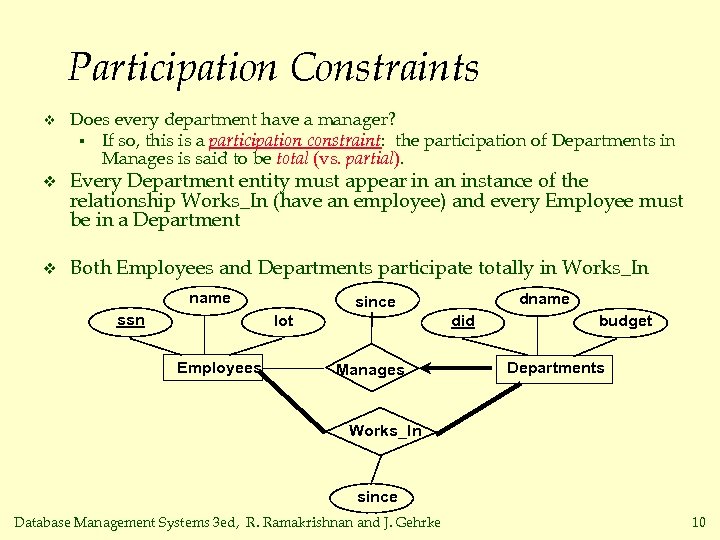
Participation Constraints v Does every department have a manager? § If so, this is a participation constraint: the participation of Departments in Manages is said to be total (vs. partial). v Every Department entity must appear in an instance of the relationship Works_In (have an employee) and every Employee must be in a Department v Both Employees and Departments participate totally in Works_In name ssn did lot Employees dname since Manages budget Departments Works_In since Database Management Systems 3 ed, R. Ramakrishnan and J. Gehrke 10
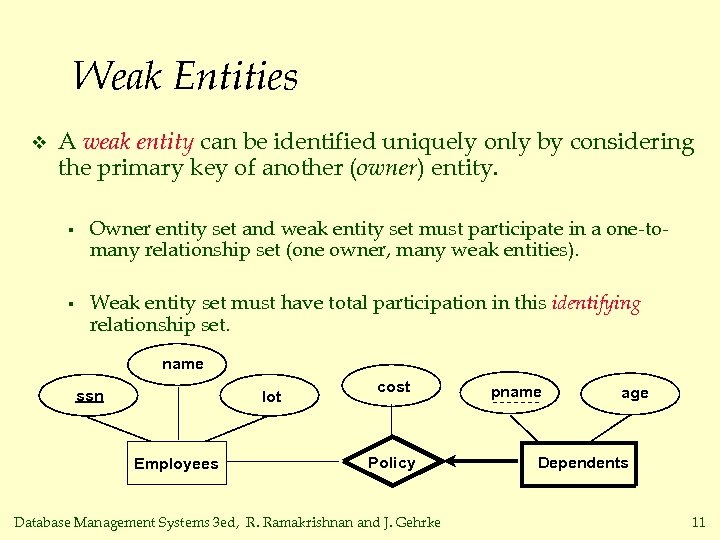
Weak Entities v A weak entity can be identified uniquely only by considering the primary key of another (owner) entity. § Owner entity set and weak entity set must participate in a one-tomany relationship set (one owner, many weak entities). § Weak entity set must have total participation in this identifying relationship set. name ssn lot Employees cost Policy Database Management Systems 3 ed, R. Ramakrishnan and J. Gehrke pname age Dependents 11
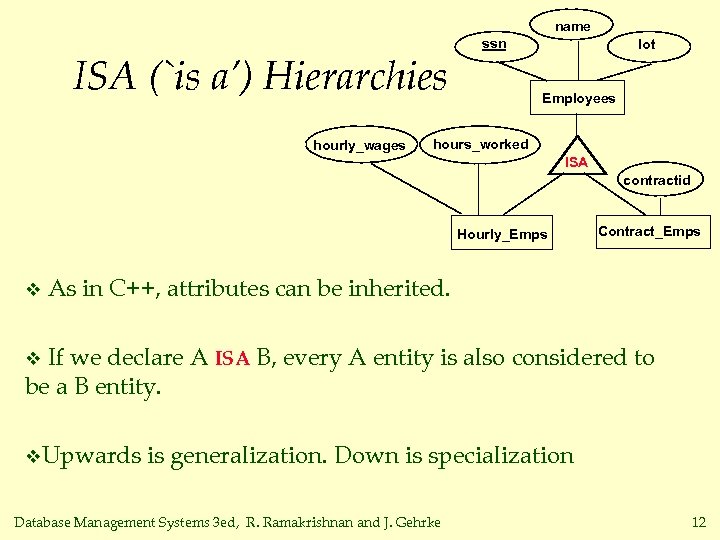
name ssn ISA (`is a’) Hierarchies hourly_wages lot Employees hours_worked ISA contractid Hourly_Emps v Contract_Emps As in C++, attributes can be inherited. If we declare A ISA B, every A entity is also considered to be a B entity. v v. Upwards is generalization. Down is specialization Database Management Systems 3 ed, R. Ramakrishnan and J. Gehrke 12
Constraints in ISA relation v Overlap constraints: Can Joe be an Hourly_Emps as well as a Contract_Emps entity? (Allowed/disallowed) v Covering constraints: Does every Employees entity also have to be an Hourly_Emps or a Contract_Emps entity? (Yes/no) v Reasons for using ISA: § To add descriptive attributes specific to a subclass. § To identify entitities that participate in a relationship. Database Management Systems 3 ed, R. Ramakrishnan and J. Gehrke 13
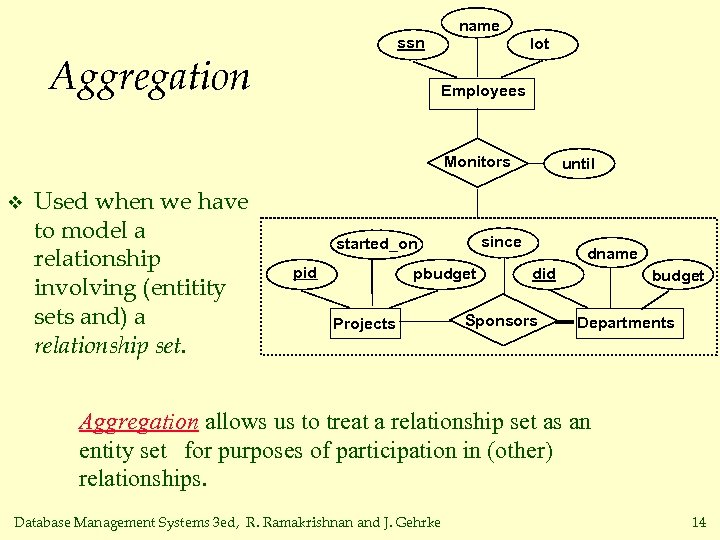
name ssn Aggregation lot Employees Monitors v Used when we have to model a relationship involving (entitity sets and) a relationship set. since started_on pid pbudget Projects until dname did Sponsors budget Departments Aggregation allows us to treat a relationship set as an entity set for purposes of participation in (other) relationships. Database Management Systems 3 ed, R. Ramakrishnan and J. Gehrke 14
Aggregation vs. ternary relationship: v Monitors in last example is a distinct relationship, with a descriptive attribute. v Also, can say that each sponsorship is monitored by at most one employee. Database Management Systems 3 ed, R. Ramakrishnan and J. Gehrke 15
Conceptual Design Using the ER Model v Design choices: § § § v Should a concept be modeled as an entity or an attribute? Should a concept be modeled as an entity or a relationship? Identifying relationships: Binary or ternary? Aggregation? Constraints in the ER Model: § § A lot of data semantics can (and should) be captured. But some constraints cannot be captured in ER diagrams. Database Management Systems 3 ed, R. Ramakrishnan and J. Gehrke 16
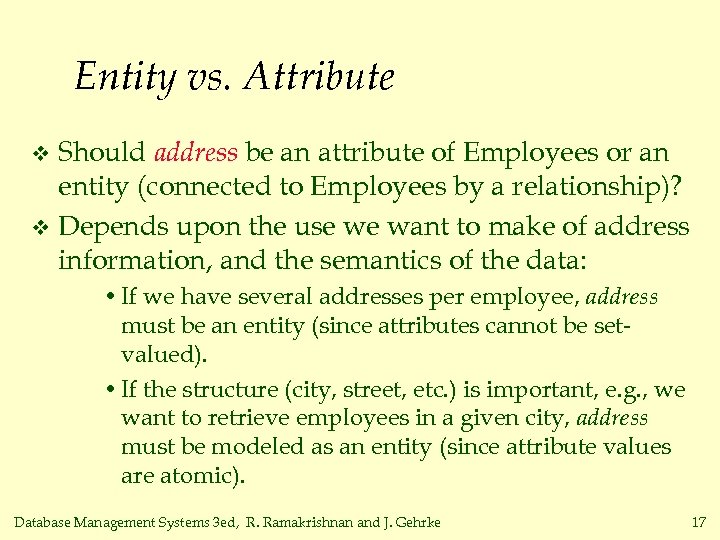
Entity vs. Attribute Should address be an attribute of Employees or an entity (connected to Employees by a relationship)? v Depends upon the use we want to make of address information, and the semantics of the data: v • If we have several addresses per employee, address must be an entity (since attributes cannot be setvalued). • If the structure (city, street, etc. ) is important, e. g. , we want to retrieve employees in a given city, address must be modeled as an entity (since attribute values are atomic). Database Management Systems 3 ed, R. Ramakrishnan and J. Gehrke 17
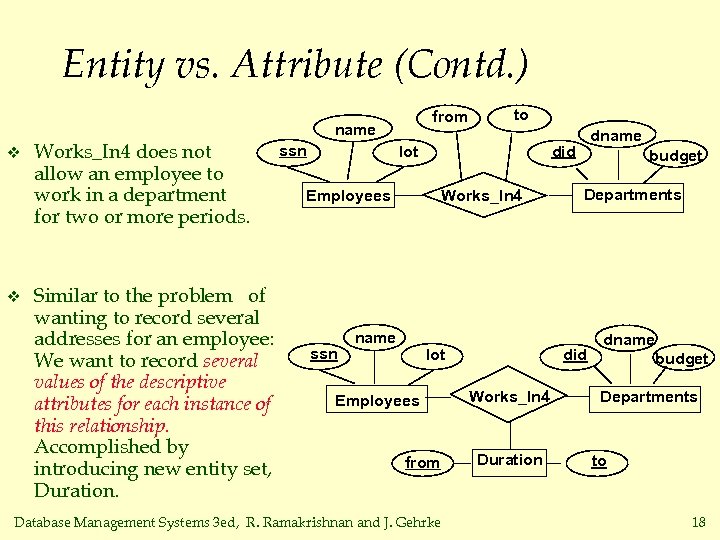
Entity vs. Attribute (Contd. ) from name v v Works_In 4 does not allow an employee to work in a department for two or more periods. Similar to the problem of wanting to record several addresses for an employee: We want to record several values of the descriptive attributes for each instance of this relationship. Accomplished by introducing new entity set, Duration. ssn to lot did Works_In 4 Employees ssn name dname lot Employees from Database Management Systems 3 ed, R. Ramakrishnan and J. Gehrke budget Departments did Works_In 4 Duration dname budget Departments to 18
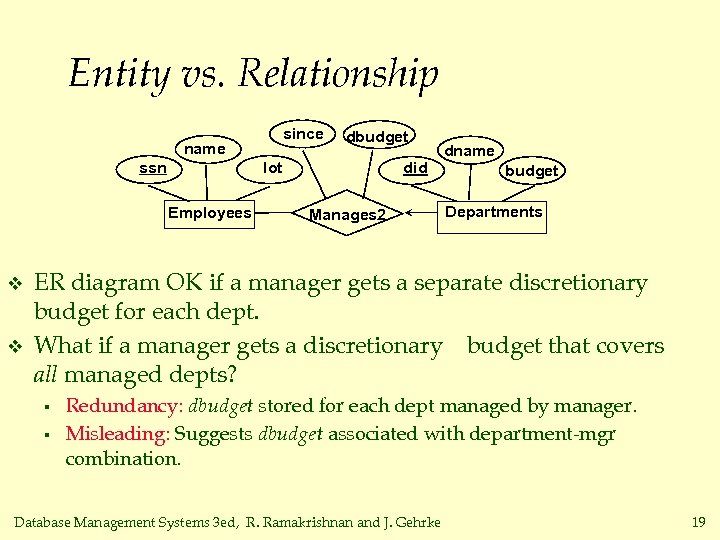
Entity vs. Relationship since name ssn lot Employees v v dbudget did Manages 2 dname budget Departments ER diagram OK if a manager gets a separate discretionary budget for each dept. What if a manager gets a discretionary budget that covers all managed depts? § § Redundancy: dbudget stored for each dept managed by manager. Misleading: Suggests dbudget associated with department-mgr combination. Database Management Systems 3 ed, R. Ramakrishnan and J. Gehrke 19
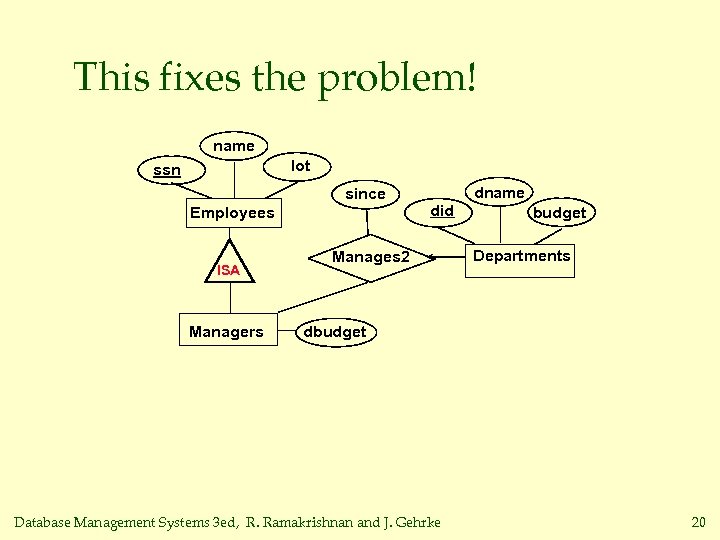
This fixes the problem! name lot ssn since Employees ISA Managers dname did Manages 2 budget Departments dbudget Database Management Systems 3 ed, R. Ramakrishnan and J. Gehrke 20
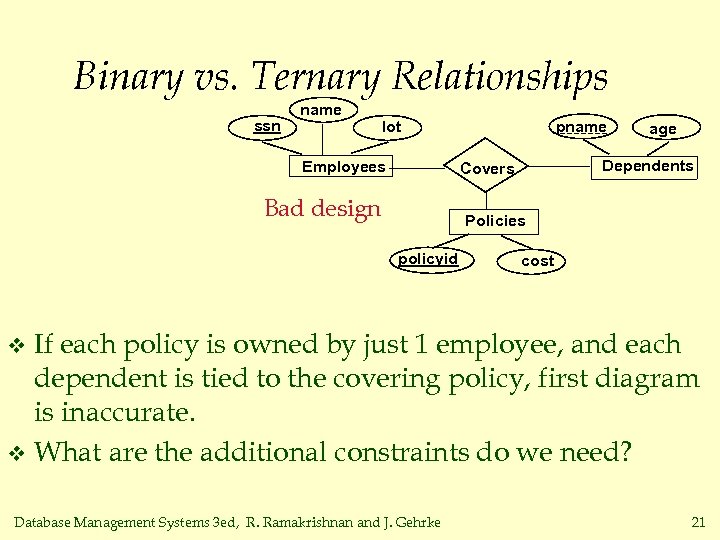
Binary vs. Ternary Relationships ssn name pname lot Employees Dependents Covers Bad design age Policies policyid cost If each policy is owned by just 1 employee, and each dependent is tied to the covering policy, first diagram is inaccurate. v What are the additional constraints do we need? v Database Management Systems 3 ed, R. Ramakrishnan and J. Gehrke 21
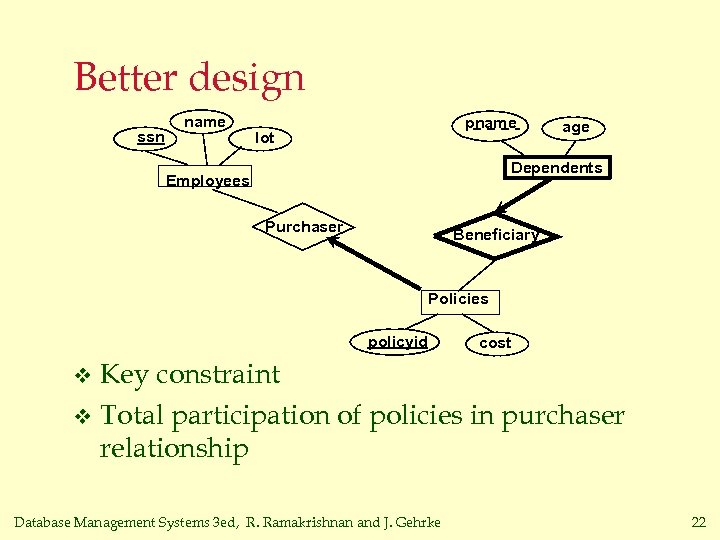
Better design ssn name pname lot age Dependents Employees Purchaser Beneficiary Policies policyid cost Key constraint v Total participation of policies in purchaser relationship v Database Management Systems 3 ed, R. Ramakrishnan and J. Gehrke 22
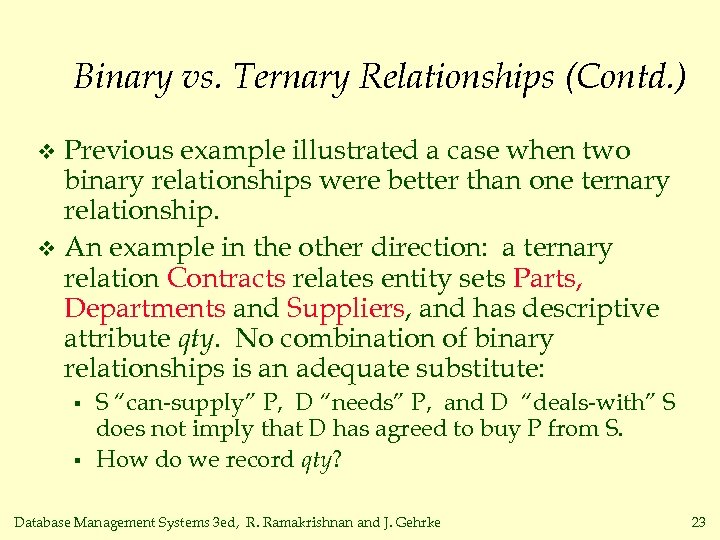
Binary vs. Ternary Relationships (Contd. ) Previous example illustrated a case when two binary relationships were better than one ternary relationship. v An example in the other direction: a ternary relation Contracts relates entity sets Parts, Departments and Suppliers, and has descriptive attribute qty. No combination of binary relationships is an adequate substitute: v § § S “can-supply” P, D “needs” P, and D “deals-with” S does not imply that D has agreed to buy P from S. How do we record qty? Database Management Systems 3 ed, R. Ramakrishnan and J. Gehrke 23
Summary of Conceptual Design v Conceptual design follows requirements analysis, § v Yields a high-level description of data to be stored ER model popular for conceptual design § Constructs are expressive, close to the way people think about their applications. Basic constructs: entities, relationships, and attributes (of entities and relationships). v Some additional constructs: weak entities, ISA hierarchies, and aggregation. v Note: There are many variations on ER model. v Database Management Systems 3 ed, R. Ramakrishnan and J. Gehrke 24
Summary of ER (Contd. ) v Several kinds of integrity constraints can be expressed in the ER model: key constraints, participation constraints, and overlap/covering constraints for ISA hierarchies. Some foreign key constraints are also implicit in the definition of a relationship set. § § Some constraints (notably, functional dependencies) cannot be expressed in the ER model. Constraints play an important role in determining the best database design for an enterprise. Database Management Systems 3 ed, R. Ramakrishnan and J. Gehrke 25
Summary of ER (Contd. ) v ER design is subjective. There are often many ways to model a given scenario! Analyzing alternatives can be tricky, especially for a large enterprise. Common choices include: § v Entity vs. attribute, entity vs. relationship, binary or nary relationship, whether or not to use ISA hierarchies, and whether or not to use aggregation. Ensuring good database design: resulting relational schema should be analyzed and refined further. FD information and normalization techniques are especially useful. Database Management Systems 3 ed, R. Ramakrishnan and J. Gehrke 26
Скачать презентацию The Entity-Relationship Model Chapter 2 Database Management Systems
085e9e6b1614260115831e7ee254b31f.ppt